The second relative kept staring at the water beneath the kitchen table.
For several seconds, nobody moved.
My husband stood between us and the doorway. My daughter had her jacket pressed against her chest.
The first relative who had finally challenged him remained beside her instead of returning to the group.
And my mother looked terrified of whatever sentence was about to come next.
“I heard her crying before,” the second relative finally said.
My husband immediately cut in.
“You don’t know what you heard.”
The relative looked up.
“I heard you yelling at her in the hallway the last time everyone was here.”
My daughter went completely still beside me.
That reaction mattered more than my husband’s denial.
I kept the phone raised.
“When?” I asked.
Nobody answered me at first.
Then my daughter did.
“Before dinner.”
Her voice was so quiet I almost missed it.
I looked at her.
“What happened before dinner?”
My husband took one step toward us.
The relative holding the jacket stepped between him and my daughter.
That was the moment the balance finally shifted.
Until then, everybody in that kitchen had been organized around him.
His anger.
His embarrassment.
His demand for privacy.
Now there was one adult physically standing on my daughter’s side.
Then two.
My husband realized it too.
“Everybody needs to stop talking,” he said.
I almost laughed.
Minutes earlier, six adults had watched him pin our daughter to the kitchen floor over spilled water.
Now he suddenly cared about order.
My daughter leaned into my side.
“Can we go?”
“Yes.”
My answer came instantly.
My mother reached for my arm.
“Don’t do anything permanent while you’re angry.”
I pulled away.
“My daughter just told me this wasn’t the first time.”
“She is emotional.”
“So am I.”
My husband pointed toward my phone.
“You have no idea what you’re starting.”
That sentence settled something inside me.
Because he was still talking as if the danger was what I might do next.
Not what he had already done.
I looked at the phone screen.
The recording was still running.
The kitchen was bright enough to show everything clearly.
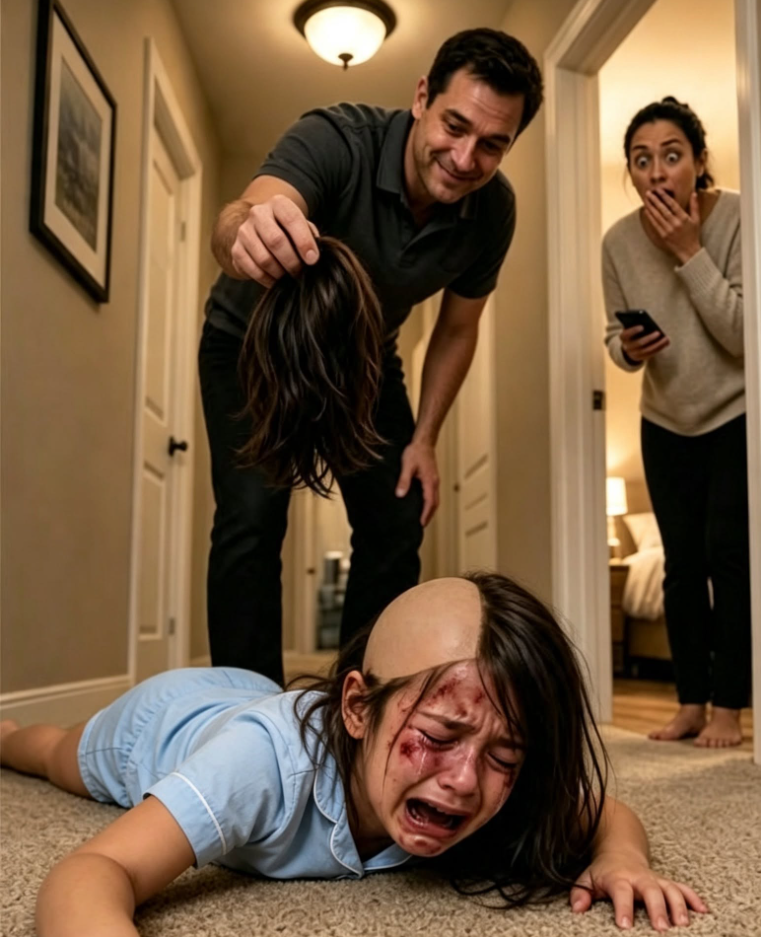
My daughter’s disheveled hair.
The patch on the side of her head where strands had been torn loose.
The spilled water.
The adults.
My husband’s voice.
My mother’s attempts to stop me from recording.
The relative telling him to move.
My daughter saying this was not the first time she had been told to stay quiet.
I had spent years believing memory was enough.
That if something terrible happened in front of enough relatives, somebody would eventually admit the truth.
That night taught me otherwise.
A room full of witnesses can still become a wall.
I put my free arm around my daughter.
“We’re leaving.”
My husband blocked the doorway again.
The relative beside my daughter moved first.
“Move.”
My husband stared at them.
“You’re really doing this?”
“Yes.”
The answer was calm.
No speech.
No grand confrontation.
Just one person finally refusing to help him trap us inside the family version of events.
He stepped aside.
My daughter and I walked out.
The cold air hit her first.
She flinched and pulled the jacket tighter around herself.
Behind us, voices erupted almost immediately.
My mother was crying.
Someone accused the relative who helped us of betraying the family.
My husband shouted my name from the doorway.
I kept walking.
At the car, my daughter froze before getting in.
I thought she was afraid he would follow.
Instead, she looked at me and asked, “Are you mad that I didn’t tell you?”
That question nearly broke me.
I crouched beside her.
“No.”
“But I should’ve told you.”
“No. You should never have been put in a position where you thought you had to hide something from me.”
She looked toward the house.
The kitchen lights were visible through the window.
Six adults had been inside.
Six adults had watched.
And somehow my daughter had still believed the burden of disclosure belonged to her.
I asked if she was hurt anywhere else.
She touched the side of her head.
“My scalp hurts.”
“Anywhere else?”
She hesitated.
That hesitation frightened me more than an immediate answer.
“He grabbed me before.”
My chest tightened.
“When?”
She looked down at the driveway.
“Other times.”
I did not interrogate her beside the car.
I did not make her reconstruct every event while she was shaking.
I told her we were going somewhere safe first.
Once we were in the car with the doors locked, I saved the recording in more than one place.
Then I called for help.
I described what had happened plainly.
My husband had pinned our daughter down.
He had struck her.
He had pulled out part of her hair.
Several relatives witnessed it.
I had video.
My daughter was now telling me there had been previous incidents.
For the first time all night, I stopped trying to soften the language.
That mattered.
For years, my family had survived by sanding the sharp edges off ugly things.
Anger became stress.
Cruelty became discipline.
Silence became peace.
And fear became respect.
I was done translating.
When we spoke with authorities that night, my daughter and I were separated from the family members who had been in the kitchen.
I gave them the recording.
I explained who was visible.
I identified each voice I could recognize.
I told them my mother had tried to make me put the phone away.
I told them one relative had eventually stepped in.
And I repeated my daughter’s exact sentence.
“This wasn’t the first time everybody told me to keep quiet.”
That sentence became the center of everything that followed.
Not because it proved every earlier incident by itself.
It didn’t.
But it told the adults responsible for her safety that the kitchen was not an isolated problem.
Someone needed to ask what she meant.
Carefully.
Without my husband standing behind her.
Without my mother correcting her.
Without six relatives deciding which version would be easiest for everyone to live with.
My daughter was checked for injuries.
The damage to her scalp was documented.
So were the marks from what had just happened.
I stayed close when I was allowed to and stepped away when professionals needed to speak with her separately.
That was difficult.
Every instinct in me wanted to sit beside her and protect her from every question.
But I also understood why she needed space to speak without watching my face.
When we were together again, she looked exhausted.
I asked only one thing.
“Do you want to go home with Dad there?”
“No.”
That was enough for me.
We did not return to life as normal.
My husband did not come home with us that night.
I made sure he could not simply walk back into the same arrangement and pretend the kitchen scene had been a bad family argument.
The next morning, my mother called.
I let it ring.
She called again.
Then she sent a message.
Please don’t let one terrible night destroy everything.
I stared at those words.
One terrible night.
Even after hearing her granddaughter say it was not the first time, my mother was still trying to shrink the story back down to one evening.
One spilled glass.
One angry father.
One emotional mother holding a phone.
I did not answer.
The relative who had handed my daughter the jacket contacted me later.
Their message was different.
I should have moved sooner.
I read that sentence several times.
Then another arrived.
I saw what he was doing and I froze. I’m sorry.
That apology did not erase what happened.
But it was the first message from anyone in that kitchen that centered my daughter instead of the family’s reputation.
I asked them what they knew.
They told me they had seen my husband become increasingly harsh with our daughter over small mistakes.
They had heard him humiliate her in front of people.
Once, they had heard crying from another room and accepted my mother’s explanation that my daughter was being “dramatic.”
The second relative admitted hearing my husband shouting during a previous gathering.
They had not seen what happened.
They had not asked.
My daughter later filled in part of the gap.
On that earlier night, her father had grabbed her arm hard enough to frighten her after she talked back.
Afterward, relatives told her not to “make a scene.”
She remembered that phrase.
Not make a scene.
She had interpreted it the way children often interpret adult silence.
If everyone wanted her quiet, then maybe speaking was the wrong thing.
That realization changed me.
I had been watching for obvious danger.
I had not understood that my daughter had already learned an entire system for surviving smaller moments.
Watch his mood.
Don’t argue.
Don’t cry too loudly.
Don’t tell Grandma, because Grandma will say Dad is stressed.
Don’t tell relatives, because they will ask everyone to calm down.
Don’t tell Mom while everyone is together, because it might become a fight.
A child should not need a strategy for navigating her own father.
The recording from the kitchen destroyed one advantage my husband had always depended on.
Doubt.
He could no longer tell me I had misunderstood his tone.
He could not claim our daughter had exaggerated.
He could not insist the family had seen something different.
The video showed what happened.
Just as importantly, it showed what the adults around him did.
Or did not do.
Some relatives became defensive when they realized their silence was also visible.
One said freezing was not the same as approving.
That was true.
People freeze.
Fear can paralyze adults too.
But freezing in one shocking second was different from what happened afterward.
They had time to speak.
They had time to help my daughter stand.
They had time to tell my husband to move.
Instead, most of them used their voices to tell me to stop recording.
That was a choice.
Over the following days, I made choices too.
I stopped letting my mother spend unsupervised time with my daughter.
I told relatives who had minimized what happened that access to her was no longer automatic.
I began the process of ending my marriage.
There was no discussion about counseling together first.
No family meeting.
No promise from my husband that he would “work on his temper.”
He had crossed a line in front of witnesses and then tried to protect himself by controlling the record.
After I learned there had been earlier incidents, the decision became irreversible.
My job was no longer preserving the marriage.
My job was making sure my daughter never had to calculate whether telling the truth would cost her an entire family.
My husband blamed me.
At first, he claimed the recording lacked context.
Then he claimed he had lost control for only a few seconds.
Then he said I had humiliated him by involving outsiders.
His explanations changed.
The video did not.
The consequences were concrete.
He was separated from our daughter while the incident and the earlier disclosures were addressed.
He lost the ordinary access to us that he had assumed would continue regardless of what happened inside our home.
Our separation moved forward.
The relatives who had protected him were no longer trusted caregivers.
And the family gatherings that once depended on everybody pretending nothing serious was wrong stopped happening around my daughter.
Those changes hurt.
There was no triumphant feeling.
My daughter lost routines.
I lost a marriage.
My mother lost the version of our relationship where she could call silence “peace” and expect me to accept it.
The relatives who finally spoke had to live with the fact that they had waited.
And my husband had to face a reality he had apparently never considered while demanding privacy:
Once someone documents what happened, the family story is no longer the only story.
Months later, my daughter and I were eating dinner together when she knocked over a glass.
Water ran across the table and dripped onto the floor.
Her face changed instantly.
Her shoulders rose.
Her hands stopped moving.
I saw her waiting.
That spilled water carried me straight back to the kitchen.
The overturned glass.
The wet dish towel.
Her hand against her head.
Six adults watching.
I stood up, grabbed another towel, and laid it over the spill.
“It’s water,” I said.
She looked at me.
“That’s it?”
“That’s it.”
We cleaned it together.
No shouting.
No punishment.
No adults surrounding her.
No one told her to keep quiet.
Later that night, I found the original recording saved on my phone.
For a moment, my thumb hovered over it.
Then I closed the screen.
I did not need to replay it to remember why I left.
My daughter had asked her grandmother one question that night.
Why didn’t you stop him?
I could not change the answer she received from the six adults who stood there.
But I could change what happened after.
One relative eventually handed her a jacket.
Another finally admitted hearing something before.
And I stopped treating family loyalty as a reason to doubt my own child.
The spilled water dried.
Her scalp healed.
The missing patch of HAIR eventually grew back.
What did not return was the old arrangement where everyone else’s comfort came before her safety.
That was the part I chose never to repair.
And for the first time in a long time, my daughter no longer had to whisper to be believed.