I let a ruthless sheriff arrest me without saying a word, wanting to see how far his cruelty would go. But when his young deputy opened my wallet and saw my federal judge badge, the entire precinct turned into pure, chaotic panic.
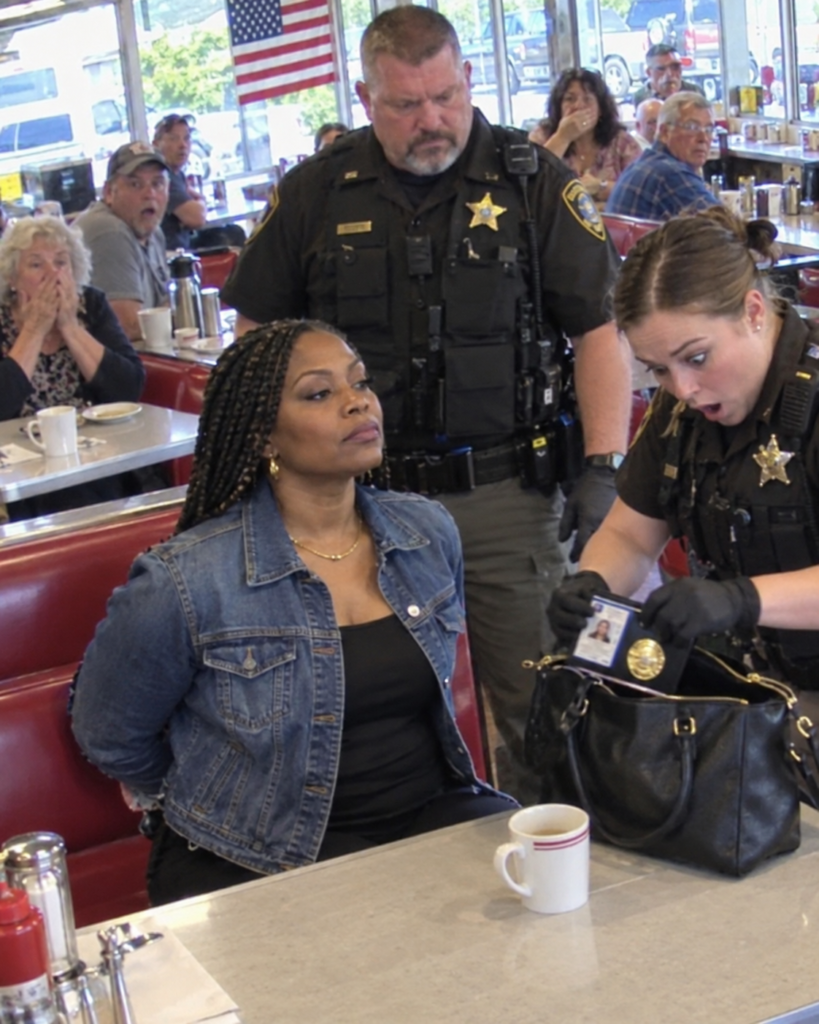
The heavy metal cuffs slammed onto my left wrist before I even had time to lower my fork.
“Hands behind your back, right now!” Sheriff Dalton Voss growled, his deep voice booming across the small-town diner like sudden thunder.
The entire restaurant went dead silent. Utensils clattered onto ceramic plates. Local diners froze in mid-bite, staring in utter shock as this burly, thick-necked lawman roughly pinned my shoulder against the vinyl booth.
I didn’t flinch. I didn’t scream. I sat perfectly still, feeling the ice-cold steel bite into my skin as I calmly finished chewing my lunch.
My name is Amara Whitlock. I am forty-four years old, born and raised in Georgia, and for the past six years, I have served as an appointed United States District Judge for the Federal Court.
But looking at me today in my casual denim jacket and braided hair, Sheriff Voss saw only a Black woman who he believed was powerless, isolated, and completely at his mercy.
He didn’t know I had deliberately left my judicial badge concealed deep inside my purse, choosing to enter his county incognito after receiving dozens of anonymous corruption complaints against his department.
I wanted to witness firsthand how Sheriff Voss treated ordinary citizens when he thought nobody was watching.
“You’re making a grave mistake, Sheriff,” I said softly, keeping my voice steady, unbothered, and completely measured.
“I don’t make mistakes in my county, lady,” Voss sneered, leaning down so close I could smell the stale coffee and cigar smoke on his breath.
He twisted my right arm behind my back and slapped the second cuff shut with a vicious, metallic click.
“You match the description of a suspect in an armed theft, and right now, you’re actively resisting arrest.”
I hadn’t moved an inch. I hadn’t raised my voice. Yet he yanked me out of the booth so violently that my table shook and my water glass spilled over.
The crowd gasped, but nobody dared to speak up against the man who had ruled this town through raw fear for over a decade.
Voss leaned down to my ear, his tone dripping with cruel satisfaction.
“You think you’re clever? In my town, nobody hears you scream, and nobody is coming to save you.”
As he violently shoved me through the glass front doors toward his idling police cruiser, my purse hung from his deputy’s shoulder—and inside it, my encrypted phone suddenly began to vibrate frantically with an urgent, high-priority alert directly from the Chief Judge of the Federal District Court.
Sheriff Voss thought he had just humiliated another powerless outsider in his small county.
He had no idea he was locking up the very federal judge who held his entire future in her hands—and the nightmare at the precinct was only just beginning.
Sheriff Dalton Voss shoved me into the back of his cruiser as if I were nothing more than a criminal he had caught in the act.
The handcuffs dug into my wrists, but I kept my eyes forward and my mouth shut.
Across from me, Deputy Caleb Miller nervously held my purse, glancing at his superior as though he already regretted being part of this arrest.
“Run her name through the system,” Voss ordered when we reached the precinct. “And find out what she was doing in my county.”
I watched him swagger toward his office, completely convinced that he controlled every person in the building.
Two deputies avoided my eyes as they led me past the booking desk. One of them whispered that Sheriff Voss had arrested people for far less than what he claimed I had done.
Then my encrypted phone vibrated again inside the purse.
Deputy Miller reached inside to retrieve it, expecting to find identification.
Instead, he pulled out my federal credentials and a black leather wallet containing my official judicial badge.
His fingers suddenly stopped moving. The color drained from his face as he stared at the gold emblem and read my name aloud.
“Judge Amara Whitlock?” he whispered. “United States District Court?”
The room fell silent.
A clerk slowly rose from her chair, while another deputy stepped away from the booking computer as if the screen had suddenly become dangerous.
Miller turned toward the sheriff’s office, his voice trembling.
“Sir, you need to come here. Right now.”
Voss emerged wearing an irritated scowl, ready to demand an explanation.
Then he saw the badge in Miller’s shaking hand.
His expression changed so quickly that even the officers standing beside him noticed.
“That’s impossible,” he muttered, snatching the credentials and examining them himself.
Before he could speak again, my phone lit up with a secure message from the Chief Judge.
Miller read the notification displayed on the screen and went completely pale.
It ordered immediate contact with federal authorities regarding an urgent investigation into alleged misconduct within the sheriff’s department.
I finally raised my eyes to Voss.
“Sheriff, you told me nobody was coming to save me.”
I paused as the first distant sirens began approaching the precinct.
“You were right about one thing. Someone is coming. But they aren’t coming for me.”
Sheriff Dalton Voss stood frozen behind the booking desk, clutching Judge Amara Whitlock’s federal credentials as though staring at them long enough might somehow make them disappear.
Around him, deputies exchanged frightened glances, and the usual confidence in their faces had been replaced by unmistakable panic.
I remained seated with my hands cuffed, watching the man who had threatened me only minutes earlier struggle to find something to say.
“This has to be a mistake,” Voss finally muttered. “Nobody told me a federal judge was in my county.”
Deputy Caleb Miller swallowed hard and glanced toward the front entrance.
“Sir, those credentials are official, and the message on her phone came directly from the Chief Judge’s office.”
Voss snapped at him to be quiet, but his voice lacked the authority it had carried in the diner.
He turned toward me, attempting to force a smile that looked more like a grimace.
“Judge Whitlock, if that is who you really are, perhaps we can resolve this unfortunate misunderstanding privately.”
I tilted my head slightly.
“You arrested me without presenting evidence, accused me of resisting when I never resisted, and told me nobody would hear me scream.”
My voice remained calm, but every officer in the room could hear each word.
“Now that you know my position, you suddenly want to resolve things privately?”
Voss opened his mouth, then closed it again when he realized several deputies were listening.
I asked Miller to remove my handcuffs immediately.
He looked toward his sheriff for permission, but Voss could no longer bring himself to issue another order.
With trembling hands, the young deputy unlocked the cuffs and stepped away.
Red marks circled my wrists, and the clerk behind the desk quietly documented what she had witnessed.
I thanked Miller without hostility, because I wanted to know whether he would tell the truth when it mattered.
Then the precinct’s front doors swung open.
Three federal agents entered alongside a senior investigator carrying a thick folder marked with the county’s name.
Behind them came a representative from the United States Attorney’s Office, whose expression made it clear that this was no routine visit.
Voss straightened his uniform and attempted to greet them as though he were hosting an official ceremony.
The lead agent ignored his outstretched hand and walked directly toward me.
“Judge Whitlock, are you injured?” she asked, examining the marks around my wrists.
I assured her that I was able to continue, then requested that every detail of my arrest be preserved in the official record.
Her colleague immediately instructed the desk clerk to secure the booking logs, surveillance footage, and communications relating to my detention.
For the first time since I entered the county, nobody was asking Sheriff Voss what he wanted done.
The senior investigator opened his folder and placed several documents on the desk.
They contained complaints from residents who claimed they had been threatened, wrongfully detained, or pressured to withdraw allegations against the sheriff’s department.
Some complaints had disappeared after being submitted, while others had been marked resolved without any documented investigation.
Voss stared at the papers, his jaw tightening as he recognized several names.
I watched him carefully, wondering how many people had suffered because they believed nobody powerful enough would ever listen.
“Those are unverified accusations,” Voss protested, attempting to recover his composure.
The investigator calmly replied that the complaints were the beginning of an inquiry, not its conclusion, and that the department’s records would now be examined independently.
I reminded everyone that no allegation should be treated as proven until the evidence had been reviewed.
But I also made it clear that nobody would be allowed to destroy records or intimidate witnesses while that review continued.
Then Deputy Miller stepped forward, holding a small notebook against his chest.
“There’s something else you need to know,” he said, looking directly at the federal investigator. “I’ve seen Sheriff Voss order arrests without proper justification before, and I wrote down the dates.”
Voss spun toward him, his face burning with anger, but the federal agents immediately moved between them.
Miller’s hands shook as he opened the notebook to the first page.
The room became so quiet that the ticking clock behind the booking desk sounded deafening.
Miller placed the notebook on the table, revealing names, dates, and brief descriptions of incidents that had never appeared in the official reports.
The investigator began reading, and his expression grew more serious with every page.
I realized that my arrest might have uncovered something far larger than one sheriff’s abuse of authority.
Then Miller pointed to the final entry and whispered:
“This is the incident they told me never to mention.”
The squad room remained frozen under the relentless hum of the overhead fluorescent lights. Deputy Caleb Miller’s hand lingered over the dog-eared pocket notebook resting on the booking desk. Federal agents instantly flanked the trembling young officer.
Sheriff Dalton Voss stepped forward aggressively, his heavy jaw clenched until the tendons bulged against his neck. “Miller, you keep your traitorous mouth shut,” Voss snarled, his voice cracking with panic. Lead Special Agent Evelyn Carter stepped directly into his path.
“Step back immediately, Sheriff,” Carter warned coldly, flashing her credentials while resting her palm deliberately against her sidearm. “You are obstructing a federal investigation. Another word from you constitutes witness tampering under federal criminal statutes.”
Voss froze, chest heaving beneath his gold-trimmed badge. He slowly raised both hands, though malice still burned brightly in his squinted eyes. The precinct remained silent, every deputy watching their once-untouchable leader shrink before federal authority.
I pulled back the cuffs of my denim jacket, gently rubbing the stinging red ridges cut into my dark wrists. “Proceed, Deputy Miller,” I said softly. My voice was calm, yet it carried the undeniable weight of the federal bench.
Deputy Miller swallowed hard, his Adam’s apple bobbing erratically. He traced his trembling finger across the scrawled handwriting on the bottom line. “Three months ago, a truck driver named Marcus Cole refused to pay the sheriff’s cash toll.”
“What toll?” Assistant United States Attorney Gregory Vance demanded, leaning over the counter with pen poised over his legal pad. The room felt suffocatingly warm as everyone leaned closer to hear the rookie deputy’s quiet confession.
“Voss set up illegal checkpoints on County Road Nine,” Miller confessed, keeping his eyes glued to the scuffed linoleum. “He forced commercial truckers hauling lumber to pay five hundred dollars in cash or face fabricated felony drug charges.”
A sharp gasp escaped from the middle-aged booking clerk sitting near the computer terminals. Voss shot her a venomous glare, but the woman met his gaze with sudden defiance. The suffocating wall of precinct silence was beginning to crack.
“Mr. Cole refused,” Miller continued, his voice steadying with sudden moral resolve. “He pulled out his smartphone to record the encounter. Sheriff Voss smashed his phone against the asphalt, beat him with a heavy flashlight, and hauled him in.”
I felt a surge of cold fury rise within my chest, yet I maintained my composure. “Where is Mr. Cole now, Deputy Miller?” I asked, leaning against the wooden counter. The question hung over the room like heavy smoke.
“Cole was charged with felony assault on an officer,” Miller whispered, glancing nervously at Voss. “He is currently sitting in cell four downstairs. He’s been denied bail and medical attention for twelve straight weeks.”
Agent Carter turned swiftly toward two armed tactical agents standing by the entrance. “Agents Rodriguez and Barnes, secure the lower holding cells immediately. Summon emergency medical services for prisoner Cole without delay.”
“Wait, you can’t just raid my private jail without a local warrant!” Voss bellowed, lunging toward the hallway. Rodriguez stepped into his path, chest to chest, immovable and unflinching. Voss bounced backward off the agent’s armored tactical vest.
“This facility is now an active federal crime scene, Sheriff,” Vance stated, holding up an emergency preservation order. “Signed two hours ago by the Chief Judge of the Eleventh Circuit. You no longer control anything here.”
Heavy tactical boots echoed down the concrete stairwell leading into the basement cells. Within seconds, a sickening metallic clanking resonated through the ventilation shafts as rusted cell doors were unbolted by federal agents. The entire precinct held its breath.
Agent Rodriguez returned upstairs minutes later, his face pale and grim. “We need paramedics immediately. Mr. Cole has an untreated compound fracture on his collarbone and severe dehydration. He was lying in complete darkness.”
The heavy silence was shattered by the high-pitched wail of approaching county ambulances. Civilians gathered on the sidewalk outside, pressing their faces against the precinct’s reinforced glass windows to witness the unimaginable spectacle unfolding within.
I walked slowly toward Sheriff Voss, stopping merely inches from his towering frame. Despite his size, he seemed diminished, his eyes darting wildly toward the exits. “You told me no one was coming to save me, Sheriff.”
Voss swallowed hard, sweat beading heavily along his receding hairline. “This is a political hit job, Judge Whitlock. You came here specifically to entrap me because I run a tough law-and-order county.”
“You do not run a law-and-order county, Dalton Voss,” I replied, my voice echoing off the concrete walls. “You operate a private criminal syndicate wrapped inside a badge you swore an oath to honor.”
A federal forensic technician entered carrying black Pelican cases, immediately beginning to mirror the hard drives of every departmental computer. The senior records clerk voluntarily pointed out hidden filing cabinets Voss kept locked in his private bathroom.
“There are offshore accounts and secondary ledgers in there,” the clerk declared boldly, stepping away from her desk. “He kept duplicate logbooks documenting the cash taken from seized vehicles during unlawful interstate traffic stops.”
Voss lunged toward her with a roar, but Agent Carter swiftly hooked his arm and shoved him backward against the wall. “Dalton Voss, you are officially under arrest for deprivation of civil rights under color of law.”
The metallic click of federal handcuffs echoed across the room with poetic justice. The sound was clean, crisp, and permanent. Voss flinched violently as his thick wrists were wrenched behind his back and bound tightly together.
Deputy Miller let out a long, ragged exhale, collapsing into a plastic chair with tears streaming down his cheeks. He had carried the weight of Voss’s corruption alone, terrified of ending up like the prisoners downstairs.
“You did the right thing today, son,” Vance said, placing a firm, reassuring hand on Miller’s shoulder. “Your cooperation will be formally noted and protected under federal whistleblower statutes. You saved lives today.”
Paramedics wheeled a gurney through the double doors, carrying Marcus Cole out into the sunlight. Though bruised, gaunt, and battered, the injured trucker raised his uninjured hand toward the crowd, realizing his nightmare had finally ended.
The crowd outside erupted into spontaneous cheers as Cole was loaded into the ambulance. Word had spread like wildfire across the county; the tyrannical sheriff had finally been brought down by an unassuming federal judge.
Federal agents led a handcuffed Dalton Voss through the front doors, parading him past the citizens he had terrorized for a decade. Cameras flashed continuously as local news vans screeched to a halt along the curb.
Voss hung his head in profound disgrace, unable to meet the fiery gazes of shopkeepers, farmers, and mothers whose sons he had unjustly incarcerated. His reign of intimidation had collapsed entirely in less than an hour.
I stepped outside into the warm afternoon air, feeling the cool breeze against my face. Agent Carter handed me my purse and my black leather credential case, offering a crisp, respectful salute.
“What are your next orders, Your Honor?” Carter asked respectfully, glancing at the convoy of federal vehicles lining the street. A dozen additional agents were now sealing off the county courthouse across the square.
“Secure every file dating back ten years,” I instructed, looking out across the bustling town square. “Every fraudulent charge must be vacated, every stolen dollar returned, and every corrupted officer held accountable.”
Over the next forty-eight hours, the Department of Justice set up a temporary operations center inside the federal courthouse fifty miles north. A team of dedicated prosecutors began sifting through thousands of corrupted county files.
The findings were staggering and horrific. Dozens of commercial drivers and minority travelers had been targeted, robbed, and framed with planted contraband to fund Voss’s lavish personal lifestyle and illegal offshore accounts.
Two corrupt senior deputies who actively assisted Voss were arrested the following morning at their homes. Seeing their sheriff in chains had shattered their loyalty, and they quickly turned state’s evidence to save themselves.
The county prosecutor, who had turned a blind eye to Voss’s abuses for years, resigned immediately in disgrace. An interim state attorney general was appointed to immediately dismiss hundreds of bogus pending misdemeanor and felony cases.
Marcus Cole received top-tier medical surgery at the university hospital, his broken bones finally set correctly. The civil rights division filed an expedited civil claim ensuring he received substantial federal restitution for his unjust suffering.
Deputy Caleb Miller was placed under federal protection while he provided hours of sworn depositions. His detailed notebooks proved invaluable, serving as the definitive roadmap to unmasking the entire county syndicate from top to bottom.
I returned to my federal chambers in Atlanta, hanging my denim jacket behind the mahogany door. My regular black judicial robes hung waiting, a profound reminder of the solemn duty entrusted to me by the Constitution.
Though the arrest had bruised my wrists, it had rejuvenated my soul. I was reminded why I fought so hard to become a judge: to ensure the vulnerable were never left completely defenseless against tyranny.
One week later, the federal grand jury returned an eighty-count indictment against Dalton Voss. The charges included racketeering, extortion, civil rights violations, kidnapping under color of law, and multiple counts of witness tampering.
Because of the overwhelming forensic evidence and witness testimony, Voss’s attorneys knew a jury trial would result in life imprisonment. The disgraced former lawman had no leverage left to negotiate any meaningful leniency.
Three months later, Voss stood before the United States District Court for formal sentencing. Stripped of his uniform, gun, and arrogant demeanor, he wore an orange jumpsuit and heavy leg irons that rattled across the carpet.
Presiding Judge Wallace, a senior colleague of mine, looked down from the bench with stern disapproval. He adjusted his glasses and reviewed the mountain of victim impact statements piled before him on the bench.
“Dalton Voss, you wielded public authority like a private weapon,” Judge Wallace declared, his deep voice filling the packed courtroom. “You betrayed the public trust, terrorized the innocent, and shamed the entire law enforcement profession.”
Voss kept his eyes cast downward, tears of self-pity rolling down his flushed cheeks. None of his old political friends or sycophantic deputies were present in the gallery to offer him comfort or support.
“I sentence you to thirty-five years in federal custody without the possibility of parole,” Judge Wallace announced firmly, striking his wooden gavel with an echoing thud. Voss visibly sagged, his broken knees nearly giving out.
Federal marshals swiftly marched Voss out through the secure side door, sending him to a high-security penitentiary far away. The man who once bragged that nobody could save his victims would now spend his remaining years behind bars.
Back in Dalton County, a remarkable transformation began to unfold. A special election was organized to select a new sheriff who would serve with integrity, transparency, and genuine respect for basic human dignity.
The community rallied behind Caleb Miller, who had demonstrated extraordinary courage by risking his career and freedom to expose the truth. With overwhelming civilian support, the modest young deputy was elected the new county sheriff.
Sheriff Miller’s first official act was dismantling the illegal highway checkpoints and publicly apologizing to the community. He established a citizen oversight committee to ensure transparency and prevent corruption from ever taking root again.
Marcus Cole was awarded a multi-million-dollar civil settlement, allowing him to launch his own independent logistics company. He named his very first long-haul commercial truck The Scales of Justice in honor of his survival.
Six months after that fateful afternoon in the diner, I decided to drive back through the quiet Southern town. The summer sun bathed the oak trees and quaint storefronts in a warm, gentle golden light.
The oppressive atmosphere of fear and silence that had previously hung over the county had completely vanished. Children played freely in the public park, and local shopkeepers greeted pedestrians with genuine, relaxed smiles.
I pulled my car to the curb and walked back inside the diner where my unlawful arrest had taken place. The room was bustling with lively conversation, the comforting scent of fried chicken and warm peach cobbler filling the air.
The waitress who had gasped when Voss slammed my wrists onto the table immediately recognized me. A radiant, tearful smile crossed her face as she hurried over to wipe down an empty booth.
“Judge Whitlock,” she whispered, her voice trembling with profound emotion. “You came back to our town.” Several patrons looked up from their plates, their eyes widening in sudden, heartfelt recognition of their savior.
“I came to finish my lunch,” I replied warmly, taking a seat beside the bright window. A soft ripple of warm laughter spread across the diner, washing away the lingering ghosts of that terrifying afternoon.
Sheriff Caleb Miller entered the diner moments later wearing his freshly pressed uniform, his silver badge gleaming under the midday light. He removed his hat respectfully and approached my booth with deep humility.
“Good afternoon, Judge Whitlock,” Sheriff Miller said, extending a steady, confident hand. “The entire county owes you a debt we can never truly repay. You gave us our town and our freedom back.”
I shook his hand firmly, proud of the honorable man he had chosen to become. “The law is only as noble as the people who enforce it, Sheriff Miller. Never forget whose servant you truly are.”
“I never will, Your Honor,” Miller promised, placing a hand over his heart. He walked toward the counter, greeting his constituents not with intimidation, but with genuine kindness, warmth, and quiet protective strength.
As I enjoyed my meal in peaceful silence, looking out at the thriving town square, I felt a deep sense of fulfilled purpose. Justice had arrived not like sudden thunder, but like the dawn—unyielding, brilliant, and absolutely unstoppable.