The House He Thought He Could Take
Eight days after I signed the papers for my first home, I was finally allowing myself to feel proud.
Not because the house was huge. It wasn’t.
It was a small two-bedroom house at the edge of Cedar Falls, surrounded by old oak trees and a quiet neighborhood where people actually waved when they walked past.
But to me, it was everything.
Because for the first time in my life, something belonged only to me.
No shared mortgage.
No arguments over whose name was on the paperwork.
No one telling me what I could or couldn’t do.
My name was on the deed.
My name was on the loan.
My future was inside those walls.
After twelve years of marriage, I had finally built something for myself.
My divorce from Andrew had been finalized seven months earlier.
Seven months of learning how to sleep alone.
Seven months of rebuilding my finances.
Seven months of reminding myself that losing a marriage did not mean losing my life.
I never told many people about the house.
Only a few trusted friends knew.
Even my former husband didn’t know the exact address.
At least, that was what I believed.
That Saturday morning, I was four hours away, visiting my younger sister Claire in Lexington.
We were sitting at her kitchen table, drinking coffee, when my phone suddenly vibrated.
A security alert.
Motion detected near your front entrance.
At first, I smiled.
I assumed it was the delivery company.
Maybe the furniture I ordered had arrived earlier than expected.
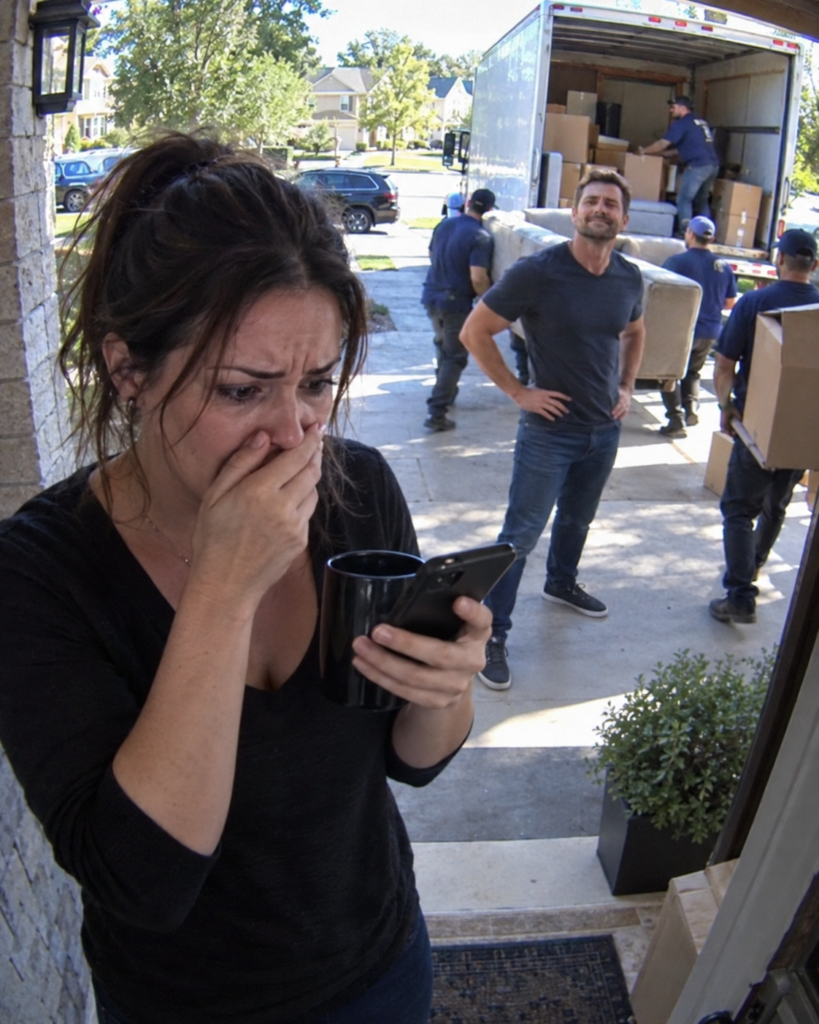
I opened the security app.
And froze.
A large moving truck was parked in my driveway.
Not near my driveway.
Inside it.
A huge white truck was blocking the entrance to my home.
For several seconds, I stared at the screen, trying to understand what I was seeing.
Then the driver’s door opened.
And Andrew stepped out.
My ex-husband.
The man who had not spoken to me except through lawyers during the final months of our divorce.
The man who had moved out and started a new life.
The man who had absolutely no reason to be standing in front of my house.
Then another person stepped out.
His new wife, Melissa.
She looked around happily, holding a set of keys.
My stomach tightened.
Because she wasn’t confused.
She wasn’t asking where she was.
She looked like someone arriving home.
Then they opened the back of the truck.
And started carrying furniture inside.
My furniture.
My house.
My driveway.
My life.
Being taken over by two people who had no right to be there.
I immediately called Andrew.
He didn’t answer.
I called again.
Nothing.
Melissa’s phone went straight to voicemail.
That was when I realized something.
They weren’t making a mistake.
They expected this.
I didn’t waste another second.
I called the police.
Twenty minutes later, I was still staring at the security footage when Claire walked into the kitchen.
“What happened?”
I handed her the phone.
She watched silently.
Then looked at me.
“Is that Andrew?”
I nodded.
“And he’s moving into your house?”
“Yes.”
Her expression changed from confusion to anger.
“He cannot do that.”
“I know.”
“Does he have a key?”
I looked back at the screen.
Melissa had opened the front door without hesitation.
That was the part I couldn’t understand.
“How did they get inside?”
I didn’t know.
But I knew one thing.
I was going to find out.
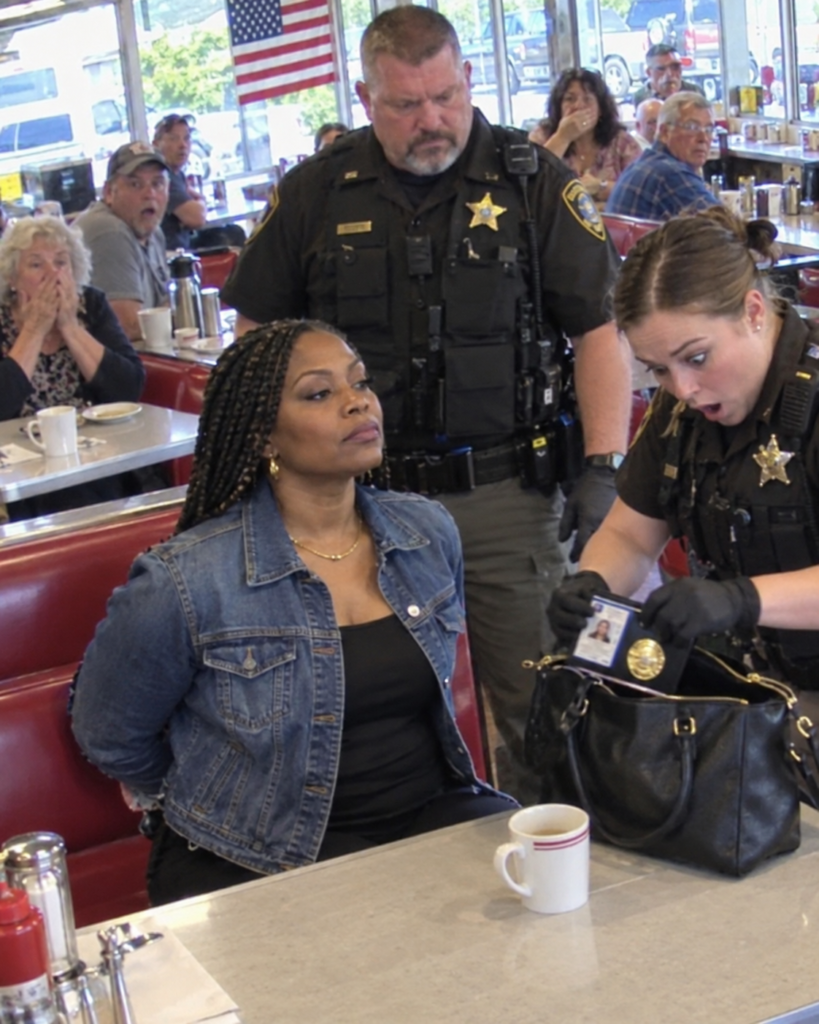
When the officers arrived at my house, Andrew was still inside.
The security camera showed him walking through my living room, pointing at different areas as if he was giving instructions.
Melissa was arranging furniture.
They looked comfortable.
Like they had been planning this for weeks.
The officer knocked.
Andrew opened the door.
The confidence disappeared from his face when he saw the police.
“What’s going on?”
The officer looked at him.
“We received a report of unauthorized entry into this property.”
Andrew immediately changed his expression.
“This is my house.”
The officer looked at the paperwork.
“Your name?”
“Andrew Collins.”
“Are you the owner?”
“Yes.”
The officer turned toward the camera.
Then back at him.
“Can you provide proof?”
Andrew hesitated.
Just for a second.
But I noticed.
The officer asked:
“Do you have documentation showing ownership?”
Andrew became defensive.
“You need to talk to my ex-wife.”
The officer looked at him.
“Your ex-wife?”
“Yes.”
At that moment, my phone rang.
The officer had called me.
I explained everything.
The deed.
The purchase date.
The legal documents.
Everything.
Then he asked:
“Are you currently the registered owner?”
“Yes.”
“Did you give Mr. Collins permission to enter?”
“No.”
“Did you give him permission to move belongings into the property?”
“No.”
The officer was silent for a moment.
Then said:
“Understood.”
An hour later, I arrived at my house.
The first thing I noticed was how different it felt.
Not because anything had changed physically.
But because someone had crossed a line.
Andrew was standing outside.
His face was angry.
“You called the police?”
I looked at him.
“Yes.”
He laughed.
“You seriously think this is necessary?”
I stared at him.
“You broke into my house.”
His expression hardened.
“Your house?”
“Yes.”
He shook his head.
“You need to calm down.”
That sentence.
That one sentence.
It was the same thing he had always said whenever I stood up for myself.
Calm down.
Don’t overreact.
You’re being emotional.
But this time, I wasn’t.
I was completely clear.
“How did you get the keys?”
Andrew looked away.
Melissa suddenly became quiet.
That told me everything.
I looked at her.
“You knew.”
She crossed her arms.
“We thought you would understand.”
Understand?
I almost laughed.
“You moved into a house you don’t own, and you think I should understand?”
Andrew stepped forward.
“You bought this house after we separated. It doesn’t change the fact that we were married for twelve years.”
I looked at him.
“That’s exactly why this is unbelievable.”
“What?”
“You spent twelve years knowing me, and you still thought you could take something from me.”
The truth came out later.
Andrew had somehow found the property information through old financial records.
He assumed because we had once shared a life, he still had access to mine.
He believed he could pressure me into letting him stay.
He believed I would avoid conflict.
Because that was who I used to be.
The woman who apologized first.
The woman who gave in.
The woman who always tried to keep peace.
But that woman was gone.
The following week, the legal process began.
Everything was documented.
The ownership records.
The security footage.
The messages.
The evidence.
Andrew eventually admitted he had no legal claim to the house.
But the damage was already done.
Not to my property.
To my trust.
A month later, I sat on my porch, watching the sunset.
The same porch I had imagined when I bought the house.
The same place where I had once wondered if starting over was possible.
My divorce had taken away twelve years of my life.
But buying that house gave me something back.
A reminder.
That I was capable.
That I could stand alone.
That I didn’t need anyone’s permission to build a future.
Andrew thought he was taking something from me.
He thought he was walking into a house.
But he was really walking into the life I had rebuilt without him.
And this time…
I was the one holding the keys.
PART 2
Three weeks after Andrew was forced out of my house, I thought the nightmare was finally over.
The locks had been changed.
The security system had been upgraded.
Every piece of furniture Melissa and Andrew had brought into my home had been removed.
I was finally beginning to feel safe again.
Then, on a Tuesday afternoon, my attorney called.
“There’s something you need to know about Andrew.”
I sat down immediately.
“What happened?”
“He filed a legal claim against your property.”
I stared at the phone.
“What?”
“He’s arguing that the house should be considered marital property because you purchased it shortly after your separation.”
I almost laughed.
Our divorce had been finalized seven months before I purchased that house.
Andrew had signed every document acknowledging that our financial affairs were separate.
“He can’t seriously believe he has a claim,” I said.
“He may not have a strong case,” my attorney replied. “But there’s something else. He submitted documents claiming that you agreed to let him temporarily occupy the property.”
My stomach tightened.
“I never agreed to that.”
“I know. That’s why I need you to look at something.”
An email arrived a few minutes later.
Attached was a document with my name at the bottom.
My signature.
Or at least, something that looked like it.
It supposedly gave Andrew permission to move into my house for six months.
I stared at it, feeling cold all over.
Someone had forged my signature.
And suddenly, I understood why Melissa had been carrying those keys so confidently.
This hadn’t been a spontaneous decision.
They had planned everything.
My attorney asked me to come to his office the following morning.
When I arrived, he had already reviewed the documents.
“There are several problems with Andrew’s claim,” he explained. “First, the property deed is entirely in your name. Second, the purchase occurred after your divorce was finalized. And third, this authorization document has inconsistencies.”
“What inconsistencies?”
He pointed to the signature.
“The date on this document is supposedly from six months ago. But the electronic file metadata indicates it was created much more recently.”
I felt my hands tighten.
“So he fabricated it?”
“We need to establish that through the proper investigation. But it certainly raises serious questions.”
Then my attorney opened another folder.
“There is one more thing.”
Inside was a copy of an email exchange between Andrew and Melissa.
The messages had been submitted accidentally as part of the evidence attached to his filing.
I read the first message.
Melissa: What if she refuses to let us stay?
Andrew: She won’t. She never stands up to me.
Melissa: And if she calls the police?
Andrew: By the time she gets there, our furniture will already be inside. She’ll be too embarrassed to make a scene.
I stopped reading.
Then I saw another message.
Andrew: Once we’re inside, she’ll eventually agree to let us stay. She doesn’t have the money or patience to fight me in court.
For several seconds, I couldn’t speak.
Twelve years.
Twelve years of marriage, and he still believed my greatest weakness was that I didn’t want to fight.
My attorney closed the folder.
“I think we now understand what this was really about.”
But I wasn’t finished.
Because there was something else I remembered.
When Andrew and I were married, he had access to some of my old financial records.
Including a folder containing documents from the house I had inherited from my grandmother.
I had sold that property years earlier.
But the records contained my previous signature, identification information, and other personal documents.
I immediately told my attorney.
He looked concerned.
“We need to determine whether those documents were used to create the authorization.”
The investigation began.
And what we discovered was worse than I expected.
Andrew hadn’t simply found my new address.
He had been monitoring my financial activity through an old account that should have been closed after our divorce.
He had also contacted a former real estate acquaintance, asking questions about my recent purchase.
The acquaintance eventually provided a statement confirming that Andrew had asked whether my new home could be occupied by someone claiming a previous marital interest.
Andrew had been looking for a way in long before that moving truck appeared in my driveway.
Then came the court hearing.
Andrew arrived wearing an expensive navy suit.
Melissa sat beside him, looking confident.
When he saw me, he gave a small smile.
The same smile he used whenever he thought he had already won.
His attorney argued that Andrew had reasonably believed he had permission to occupy the property.
My attorney stood.
“Your Honor, this is not a misunderstanding between former spouses. This is an attempt to establish a legal right to property through a document whose authenticity is seriously disputed.”
He presented the original deed.
The divorce judgment.
The purchase records.
The security footage.
And finally, the messages between Andrew and Melissa.
The courtroom became silent as the messages were read aloud.
When the judge reached the sentence about me being too embarrassed to make a scene, she stopped.
Then she looked directly at Andrew.
“Mr. Collins, did you write this message?”
Andrew shifted in his seat.
“It was taken out of context.”
“Did you write it?”
He hesitated.
“Yes.”
“And did you have permission from the registered owner to occupy this property?”
Andrew looked toward his attorney.
His lawyer leaned over and whispered something.
Finally, Andrew answered.
“No.”
The judge continued reviewing the evidence.
Then she turned to the disputed authorization document.
“Mr. Collins, you have submitted a document bearing your former wife’s signature. She denies signing it. The electronic records raise serious questions about when and how it was created.”
Andrew’s face had turned pale.
The judge ordered the disputed document referred for further investigation and rejected his request for any immediate right to occupy or control the property.
She also warned him that any further attempt to enter the house could result in additional legal consequences.
It wasn’t the end of the legal process.
But it was the first time Andrew had been forced to hear the truth in a room where he couldn’t silence me.
Outside the courthouse, Melissa approached me.
“Can we talk?”
I stopped.
Andrew stood several feet behind her.
Melissa looked exhausted.
“I didn’t know he was going to use your signature like that.”
I studied her face.
“You knew he was moving into my house.”
She looked down.
“He told me you had agreed.”
“And when the police arrived?”
She didn’t answer.
I continued.
“You had the keys. You carried furniture into my home. You stood in my living room arranging things as if you owned the place.”
Her eyes filled with tears.
“I thought we were doing the right thing.”
“No,” I said quietly. “You thought I wouldn’t do anything about it.”
She began crying.
Andrew suddenly stepped forward.
“Enough. You’re making this bigger than it needs to be.”
I turned toward him.
For the first time in twelve years, I didn’t feel intimidated by his voice.
“You know what your biggest mistake was, Andrew?”
He frowned.
“You thought I was still the woman you married.”
He shook his head.
“You’re being ridiculous.”
“No. I’m finally being careful.”
I handed my attorney the remaining documents and walked away.
Several weeks later, the investigation confirmed that the authorization document had been created using information from my old financial records.
Andrew eventually withdrew his property claim.
The matter involving the disputed signature was handled separately, and he faced additional legal consequences.
He also had to cover the costs associated with removing his belongings and addressing the damage caused during the unauthorized occupation.
Melissa moved out of their apartment shortly afterward.
I never asked what happened between them.
I no longer needed to know.
One Saturday morning, I stood in the doorway of my house, holding a new set of keys.
The old ones had been discarded.
The locks were new.
The walls had been repainted.
And the living room was finally filled with furniture I had chosen myself.
I placed a small framed photograph on the mantel.
It was a picture of me standing in front of the house on the day I bought it.
I looked nervous in that photograph.
But I was smiling.
I remembered how frightened I had been when I first saw Andrew’s moving truck in my driveway.
I remembered thinking that perhaps I would never feel safe in my own home again.
But I was wrong.
He had taken advantage of the life we once shared.
He had used my old documents, my old signature, and my old habit of avoiding conflict.
He thought our twelve years together gave him a permanent right to control me.
It didn’t.
That evening, Claire came over for dinner.
She looked around the living room and smiled.
“So, how does it feel?”
I looked at the walls, the furniture, and the little kitchen where I now drank coffee every morning.
Then I looked at the keys resting on the table.
“Honestly?”
She nodded.
“I’ve never felt more at home.”
And I meant it.
Because a home isn’t just a building.
It’s a place where nobody gets to decide whether you belong.
Andrew once believed he could walk into my life, take what he wanted, and force me to accept it.
But he forgot one important thing.
I had already survived losing him.
I wasn’t afraid of losing anything else to him.
And the next time someone tried to take my home, they would find something very different waiting behind that front door.
Not the frightened woman who used to apologize.
Not the wife who always gave in.
Just a woman who knew exactly what belonged to her.
And who would never hand over the keys again.