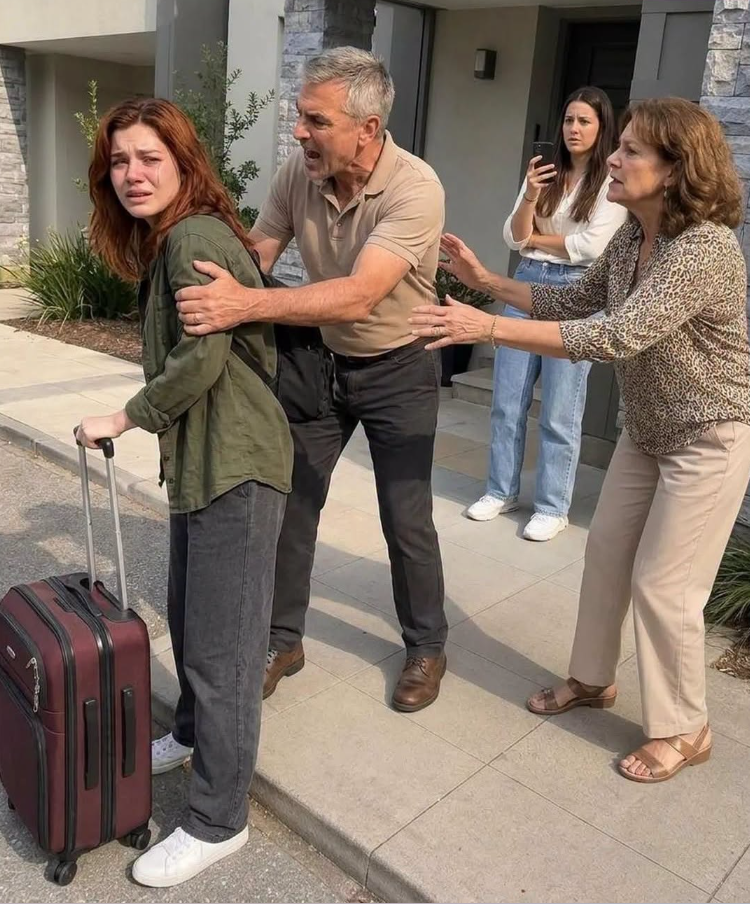
My parents handed me one hundred dollars and a garbage bag for my clothes.
That was my goodbye.
There was no hug.
No apology.
No offer to drive me to the bus station.
My mother stood in the doorway with her arms crossed while my father looked at me without a trace of emotion.
“You wanted to be independent, Emma,” he said. “Go be independent.”
I was twenty-two years old.
And I was standing outside the only home I had ever known with a backpack over one shoulder, a garbage bag filled with clothes in my hand, and a folded hundred-dollar bill pressed into my palm.
I remember staring at that money and thinking that it wasn’t enough to buy a week of groceries.
It wasn’t enough to pay a month’s rent.
It wasn’t even enough to make me feel like my parents were helping me.
It felt like payment for getting rid of me.
The reason they had thrown me out was simple.
I had refused to give my college refund check to my sister, Madison.
The check was for $3,800.
It wasn’t spending money.
It was supposed to cover my final semester, my books, and the certification exam I needed to finish school and finally build a life outside that house.
Madison wanted the money because she had quit yet another job and claimed she needed a fresh start.
It wasn’t the first fresh start.
It was her third job in six months.
She cried when I said no.
Mom called me selfish.
Dad said college had changed me.
Then he looked at me and said I had always thought I was better than the rest of the family.
I tried explaining that I wasn’t refusing to help Madison because I didn’t love her.
I was refusing because that money had a purpose.
It was the money I needed to finish my education.
It was my way out.
Nobody cared.
By midnight, I was outside.
One backpack.
One garbage bag.
One hundred dollars.
And no family waiting for me to come back.
I didn’t know it then, but that night would become the dividing line between the life I had been given and the life I would build myself.
The first winter was brutal.
I didn’t have a place of my own.
My friend Riley let me sleep on an old couch in her apartment. It wasn’t comfortable, and there were nights when I woke up because my back hurt so badly I couldn’t find a position that didn’t ache.
But I was inside.
And I was safe.
I also still had school to finish.
So I worked two jobs.
At night, I cleaned offices.
In the morning, I answered customer-support emails and tickets.
Whenever I had time between shifts, I studied.
Sometimes I studied at Riley’s apartment.
Sometimes I studied at the library.
And sometimes I went to a laundromat because it was warm, open late, and nobody cared how long I stayed as long as I wasn’t bothering anyone.
I remember sitting between washing machines with my laptop balanced on my knees, trying to understand course material while dryers rumbled behind me.
There were moments when I was exhausted enough to cry.
But I didn’t call my parents.
Not because I didn’t want to.
Because I knew they wouldn’t answer.
And they didn’t.
For five years, they never called.
Not once.
Not on my birthday.
Not on Christmas.
Not on Thanksgiving.
Not when I graduated.
Not even when I changed my phone number and they never bothered to ask what the new one was.
They simply disappeared from my life.
And eventually, I stopped expecting them to return.
I had no choice.
I had to keep moving.
I didn’t become successful overnight.
I became tired first.
Then I became skilled.
Then I became determined.
And eventually, I became someone people could no longer ignore.
The turning point came from one of the most ordinary jobs I had ever taken.
I was cleaning a small medical clinic.
One evening, while I was working, I noticed several boxes of medical supplies being thrown away.
At first, I assumed they were damaged.
They weren’t.
Some had expired.
Others had been ordered unnecessarily.
The clinic simply didn’t have a good system for tracking inventory, expiration dates, or supply usage.
I started noticing how often it happened.
Box after box.
Hundreds of dollars in supplies.
Sometimes more.
It seemed ridiculous.
Hospitals and clinics were spending enormous amounts of money on supplies, yet nobody had a simple way to see what they already had before ordering more.
I mentioned it to Riley.
Instead of dismissing the idea, she asked me a question.
“What if you built something?”
I laughed at first.
Neither of us had a company.
Neither of us had investors.
We certainly didn’t have much money.
But we had an idea.
So we started with a basic software prototype.
It was nothing impressive at first.
Just a simple tool designed to help clinics track supplies, monitor expiration dates, and reduce unnecessary waste.
Then a retired doctor saw what we were building.
He understood the problem immediately.
More importantly, he believed in us.
He invested.
That changed everything.
One clinic became three.
Three became thirty.
Then hospitals started paying attention.
Eventually, hospital networks became interested.
The small tool I had built because I was tired of watching perfectly usable medical supplies get thrown away had become a real company.
I became its founder.
And for the first time in my life, I wasn’t simply trying to survive.
I was building something.
Something that belonged entirely to me.
Five years after my parents had thrown me out, a national business publication wrote about the company.
The article described me as a founder helping fix a quiet but expensive problem in American healthcare.
My name was everywhere.
My story was attached to the company.
The article talked about the growth, the hospitals, the technology, and the future.
I never sent it to my family.
I didn’t even think about them when I read it.
I had learned long ago that success meant very little if you spent it trying to impress people who had already decided you weren’t worth supporting.
I thought that chapter was over.
Then Madison found the article.
I don’t know what she was searching for that morning.
Maybe she was simply scrolling online.
Maybe she recognized my name by accident.
Whatever happened, at 7:16 a.m., she called our parents.
She was crying.
By 8:02, my old social-media account received a message.
It was from my mother.
Emma? Is this really you? Please call me. We are family.
I stared at the word family for a long time.
Family.
The same people who had handed me $100 and a garbage bag.
The same people who hadn’t called when I graduated.
The same people who had allowed five birthdays to pass without a single phone call.
Now, suddenly, we were family.
By lunchtime, I had forty-one missed calls.
By dinner, there were eighty-eight.
Madison sent me a message.
I can’t believe you hid this from us.
I read it twice.
Hid this from us.
As if I had somehow been obligated to report my life to the people who had deliberately removed themselves from it.
Then my father wrote.
We need to talk like adults.
My mother sent twelve crying emojis.
Then she sent a photograph of my childhood bedroom.
It was still painted yellow.
She seemed to believe that a photograph of my old bedroom could somehow unlock the door to a relationship they had spent five years destroying.
Then my phone buzzed again.
Madison.
Mom and Dad are driving to your office right now.
I looked across the glass conference room at my assistant.
“Cancel my next meeting,” I said.
Then I added:
“And call security.”
Because my parents hadn’t found me.
They had found my money.
They arrived that afternoon.
All three of them walked into the lobby of my office as if five years had never happened.
Security stopped them before they could come upstairs.
My mother insisted she had to see me.
“She has to talk to me,” she said. “I’m her mother.”
When I finally came downstairs, she immediately reached toward my face.
I stepped back.
Her hand stopped in midair.
For a second, neither of us said anything.
Then she started crying.
My father was less emotional.
He looked at me as though he were evaluating the person standing in front of him.
“You’ve done well,” he said.
There was something strange about hearing that from him.
Not pride.
Not warmth.
Just surprise.
Then he said something that made my stomach tighten.
“We knew you could succeed.”
I almost laughed.
They hadn’t known.
They had expected me to fail.
They had sent me away with one hundred dollars because they believed I needed to learn a lesson about independence.
Now my father was acting as though my success had been part of some plan they had always supported.
Then Madison spoke.
“You should have told us,” she said.
“Told you what?”
“That you were doing this well.”
I stared at her.
“You didn’t ask.”
She looked away.
My father cleared his throat.
Then he opened a folder.
That was when the real reason for their visit became clear.
They were behind on their mortgage.
The family home was in trouble.
My mother explained that there were other expenses.
Madison mentioned additional financial problems.
They needed help.
A lot of help.
And suddenly, all those missed birthdays and unanswered years made sense.
They weren’t there because they missed me.
They were there because they needed something from me.
Still, I asked the question.
“How much?”
Madison answered quietly.
“Two hundred and forty thousand dollars.”
$240,000.
Nearly a quarter of a million dollars.
For a moment, I simply looked at the three people standing in front of me.
My mother.
My father.
My sister.
The same family who had once watched their twenty-two-year-old daughter stand outside with a garbage bag and one hundred dollars.
Now they were standing in the lobby of the company I had built from nothing, asking that same daughter to rescue them financially.
And suddenly, everything was clear.
They hadn’t come looking for Emma.
They had come looking for the founder whose name appeared beside a successful company.
I didn’t scream.
I didn’t insult them.
I didn’t ask them why they hadn’t called me during the first winter.
I didn’t ask why they hadn’t attended my graduation.
I didn’t ask why they hadn’t wondered whether I was eating, whether I had somewhere warm to sleep, or whether I was okay.
Instead, I did something much quieter.
I made a list.
Every birthday they had ignored.
Every holiday.
My graduation.
The years of silence.
Every moment when they could have called and chose not to.
Then, at the bottom, I wrote:
Balance due: accountability.
I handed them the list.
Nobody spoke.
My mother began crying again.
My father looked angry.
Madison looked confused.
Then I told them that from that point forward, any communication would have to go through my attorney.
My father stared at me.
“You’re going to regret being alone,” he said.
That sentence stayed with me.
Not because it hurt.
Because it was so completely wrong.
I wasn’t alone.
Riley was upstairs.
The people who had helped me build the company were upstairs.
My colleagues were upstairs.
The life I had fought for was upstairs.
The people who had believed in me when I had nothing were still standing beside me.
I had spent five years learning something my parents had never understood.
Being abandoned is not the same thing as being alone.
My parents had sent me away with one hundred dollars and a garbage bag.
They had believed they were teaching me independence.
They thought I would come crawling back.
Instead, I built a life without them.
I worked through exhaustion.
I studied wherever I could find warmth.
I built a company from an idea I discovered while cleaning a medical clinic.
I turned a problem nobody seemed to care about into a business hospitals needed.
I built a future with no inheritance, no family money, and no safety net.
And five years later, the people who had refused to give me even a second chance were asking me for $240,000.
I didn’t give it to them.
Not because I wanted revenge.
Because I finally understood the difference between forgiveness and permission.
I could forgive them for what they had done.
But forgiveness did not mean I had to reopen the door they had deliberately slammed in my face.
That night, after they left, I went back upstairs.
Riley was waiting for me.
She didn’t ask whether I had given them the money.
She already knew the answer.
She simply asked, “Are you okay?”
I looked around the office.
At the people working.
At the company I had built.
At the life I had once been told I was incapable of creating.
And for the first time, I understood just how far I had come.
My parents had once looked at me and seen a selfish daughter who needed to be taught a lesson.
They had sent her away with $100.
Five years later, they returned expecting nearly a quarter of a million dollars.
But the woman standing in front of them wasn’t the twenty-two-year-old they had thrown out.
She didn’t need their approval.
She didn’t need their money.
And, most importantly, she didn’t need them to tell her that she belonged.
Because I had already built a life where I did.
The daughter they abandoned had become someone they could no longer ignore.
But by the time they finally noticed me, I had already learned how to live without them.