Gloria handed Trevor a copy of the wire-transfer request.
It instructed my company to send $820,000 to Falcon Ridge Ventures and carried a digital signature made to resemble mine.
My CFO had stopped the transfer less than an hour before approval.
Trevor stared at the document.
“I did not submit this.”
“The request came from an account connected to your home laptop,” the financial investigator said. “The authentication code was forwarded to your phone.”
Diane stepped between them.
“This is a misunderstanding. My son manages family finances.”
“He does not manage Vanessa’s company,” Gloria replied.
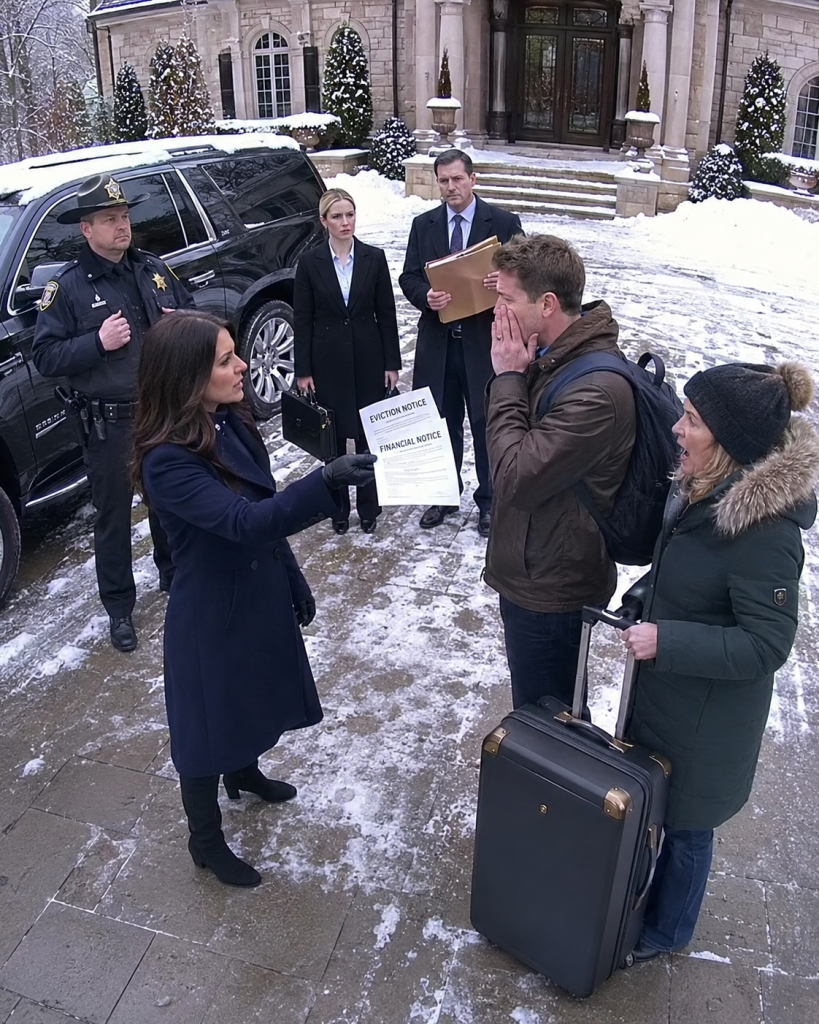
The deputy informed Trevor that the emergency occupancy order required him to leave the property while the court reviewed the financial allegations.
He could collect clothing and essential medication under supervision.
“You cannot remove me from my marriage,” Trevor said.
“No,” I answered. “I am removing your access to my home.”
Chloe began filming until Gloria warned that confidential financial records were being discussed.
Diane accused me of destroying the family, while Trevor demanded a private conversation.
I refused.
As he packed, the investigator showed Gloria photographs recovered from Falcon Ridge’s cloud account: forged invoices, copies of my identification, internal company authorization charts, and notes describing how to keep each payment beneath audit thresholds.
One spreadsheet divided stolen funds into columns labeled T, D, and C.
Trevor.
Diane.
Chloe.
Chloe saw her initials and stopped shouting.
“What is that?”
Trevor ordered her to remain silent.
Her expression changed.
“You said the money came from consulting.”
Diane looked at her son.
“Trevor?”
He ignored them both.
Before leaving, he turned toward me.
“You are doing this over a vacation.”
“No. The vacation is simply where you finally stopped hiding.”
That evening, Gloria received confirmation that Falcon Ridge had attempted to close two bank accounts and transfer the remaining balance overseas.
Emergency orders froze the funds.
Trevor called from his parents’ condominium.
“You made your point,” he said.
“The courts will decide that.”
“We can settle this privately.”
“You already used private arrangements to steal publicly accountable money.”
His voice softened.
“Vanessa, I love you.”
“You loved access.”
He began crying.
Months earlier, that might have changed me.
Now I heard only another strategy.
Then Gloria called on the second line.
Investigators had located the original Falcon Ridge incorporation documents.
The company’s real organizer was not Trevor’s friend.
Part 3
The company’s real organizer was not Trevor’s friend.
Gloria slid another document across the table.
“He was only the registered front man.”
Trevor stared at the page.
His name appeared beneath a section titled Beneficial Control.
Below it was another name.
Diane Calloway.
Trevor’s mother.
For several seconds, no one spoke.
The snow continued falling beyond the windows.
Soft.
Quiet.
Almost peaceful.
It was the strangest thing about that afternoon.
My life was collapsing and rebuilding itself at the same time, yet the world outside continued as if nothing had happened.
Diane snatched the document from Gloria.
“This is fabricated.”
“It came directly from the corporate registry,” Gloria said.
“You don’t understand.”
“I understand very well.”
Diane’s eyes moved rapidly across the page.
Then she looked at Trevor.
“You told me this was handled.”
Trevor’s head snapped toward her.
“You told me you had handled it.”
Chloe stepped backward.
“What are you two talking about?”
Neither answered.
I looked at Gloria.
“What does the document prove?”
She opened another folder.
“That Falcon Ridge wasn’t simply receiving money. It was created as a conduit. The company received funds from Vanessa’s businesses, moved portions through three intermediary accounts, and then distributed them to personal accounts.”
Trevor swallowed.
“That’s not proof I knew.”
Gloria placed another sheet on the table.
“Your email is attached.”
Trevor looked at it.
His face changed.
It was an email he had sent six months earlier.
The subject line read:
Keep Vanessa Out of the Numbers.
The message contained instructions about payment limits, vendor names, and which transfers should be separated into different weeks.
At the bottom was Trevor’s signature.
He didn’t speak.
Diane grabbed the page.
“Where did you get this?”
“The forensic accountant recovered it from the Falcon Ridge cloud account.”
“That doesn’t mean he wrote it.”
The investigator finally spoke.
“We have the metadata.”
Diane looked at him.
“The login originated from Mr. Calloway’s laptop. The authentication token came from his personal device. We also recovered deleted versions from the same machine.”
Trevor closed his eyes.
I watched him.
For years, I had wondered what it would look like when Trevor finally ran out of explanations.
Now I knew.
It looked small.
Not powerful.
Not dangerous.
Just frightened.
Gloria turned toward me.
“Vanessa, there’s one more thing.”
I nodded.
She handed me a photograph.
It showed a desk.
Trevor’s desk.
On it was my company’s internal authorization chart.
Beside it was a handwritten note.
Next transfer: $820K.
Underneath that:
Make it look like Vanessa approved.
I stared at the photograph.
The room seemed to tilt.
Not because I was surprised.
Because somewhere inside me, I had still been hoping I was wrong.
I had spent months telling myself that perhaps Trevor had simply been irresponsible.
Perhaps he was drowning in debt.
Perhaps he was embarrassed.
Perhaps he had made a series of stupid choices and was too ashamed to tell me.
But this wasn’t shame.
This was planning.
This was deliberate.
This was betrayal with spreadsheets.
Trevor saw my face.
“Vanessa—”
“Don’t.”
He stopped.
“I never wanted to hurt you.”
I looked at him.
“You forged my signature.”
“I was trying to fix something.”
“You stole from my company.”
“I was going to put it back.”
“You used my card.”
“I knew you’d pay it.”
“You took my money to finance your entire family.”
His eyes dropped.
I took a slow breath.
“And you were going to take another eight hundred twenty thousand dollars.”
He said nothing.
Diane suddenly started crying.
It was the first time I had ever seen her cry.
But even then, I couldn’t tell whether she was grieving what she had done or what she was about to lose.
She looked at me.
“Vanessa, please.”
I almost laughed.
For years, she had never said please to me.
She had said:
You should.
You owe.
Our family expects.
A wife should.
A daughter-in-law must.
Now, suddenly, she knew the word please.
“I gave you everything,” she whispered.
“No,” I said. “You took everything.”
Her face crumpled.
“We treated you like family.”
“You treated me like a bank.”
Trevor stepped forward.
“Can we talk privately?”
“No.”
“Please.”
“No.”
His voice broke.
“Vanessa, I am your husband.”
I looked at the deputy.
Then at Gloria.
Then back at Trevor.
“That is exactly why this hurts.”
He looked down.
I continued.
“I didn’t marry a stranger. I married the man I thought would stand beside me when things became difficult.”
His eyes filled with tears.
“And when I gave you trust, you turned it into access.”
He wiped his face.
“I loved you.”
“Maybe you did.”
He looked up.
“But somewhere along the way, you decided loving me also meant owning what I had.”
He couldn’t answer.
Gloria stepped forward.
“Trevor, you need to understand that this is no longer a marital disagreement.”
The investigator nodded.
“There are potential criminal implications.”
Diane’s face went white.
“Criminal?”
Gloria didn’t soften her voice.
“Unauthorized financial access. Fraud. Forgery. Potential conspiracy. Misappropriation of corporate funds.”
Chloe suddenly spoke.
“I didn’t know.”
Everyone looked at her.
“I swear,” she said. “I thought the money Trevor gave me was from his consulting work.”
The investigator looked at his tablet.
“Some of it may have been.”
Chloe’s eyes filled with tears.
“What does that mean?”
“It means we need to determine what you knew and when you knew it.”
She looked at Trevor.
“You told me it was legitimate.”
“I thought it would be.”
“That isn’t an answer.”
Trevor said nothing.
Chloe’s expression hardened.
“You let me spend stolen money?”
“Chloe—”
“You told me I deserved it.”
“I was trying to help you.”
“You were trying to impress me.”
Diane snapped.
“Stop fighting in front of everyone.”
Chloe turned toward her.
“You knew.”
Diane froze.
“You knew about Falcon Ridge.”
“Watch your mouth.”
“You knew!”
The deputy stepped closer.
“Everyone needs to calm down.”
Chloe began crying.
“I trusted you.”
Trevor stared at the floor.
For the first time, the family that had spent years making me feel like an outsider was turning against itself.
I felt no satisfaction.
Only exhaustion.
Gloria closed the folder.
“We are done here for today.”
Trevor looked at me.
“Where am I supposed to go?”
“Your attorney can advise you.”
“I don’t have anywhere.”
I looked at him.
“You had somewhere.”
He blinked.
“You had a wife who trusted you.”
His face tightened.
“You had a home.”
I paused.
“You had a future.”
Then I stepped aside.
“But you kept choosing money over all three.”
The deputy escorted Trevor to the driveway.
Diane followed.
Before getting into the vehicle, she turned around.
“Vanessa.”
I said nothing.
“You’re destroying my family.”
I looked at her.
“No, Diane.”
I shook my head.
“I’m stopping my money from destroying me.”
She stared at me.
Then the vehicle door closed.
And they were gone.
That night, I couldn’t sleep.
The house felt enormous.
For years, I had thought its size represented comfort.
That night, it represented silence.
I walked through the rooms slowly.
The living room.
The dining room.
The kitchen.
The hallway where Trevor used to leave his shoes.
The office where I had worked late while he watched television downstairs.
There were photographs everywhere.
Our wedding.
Our vacations.
Christmas mornings.
Birthday dinners.
A life that suddenly looked like evidence.
I stopped beside one photograph.
Trevor was standing behind me with his arms around my waist.
We were laughing.
I remembered the moment.
He had whispered that he couldn’t believe he was lucky enough to have me.
I had believed him.
I touched the frame.
Then I put it face down.
Not because the memory had become meaningless.
Because it had become painful.
My phone rang.
Gloria.
“You should get some rest.”
“I can’t.”
“I know.”
“What happens now?”
“The emergency orders are temporary. The court hearing is tomorrow morning.”
“And the criminal investigation?”
“That will continue separately.”
I sat on the edge of the bed.
“Will I have to see him?”
“Probably.”
I closed my eyes.
“I’m afraid I’ll feel sorry for him.”
“That doesn’t make you weak.”
“I don’t want to.”
“You don’t have to hate him either.”
I opened my eyes.
“What do I have to do?”
“Tell the truth.”
I looked toward the window.
Snow covered the garden.
“That’s all?”
“That is usually enough.”
The next morning, the courthouse was crowded.
Trevor arrived with an attorney I had never seen before.
Diane sat behind him.
Chloe wasn’t there.
The judge reviewed the emergency filings.
Gloria presented the trust documents.
The property records.
The financial statements.
The credit-card charges.
The forensic report.
The wire-transfer request.
The evidence connecting Trevor to Falcon Ridge.
Trevor’s attorney objected repeatedly.
But each objection met another document.
Another timestamp.
Another account.
Another piece of evidence.
At one point, Trevor’s attorney asked:
“Your Honor, isn’t it possible that Mr. Calloway believed he had permission to use marital assets?”
Gloria stood.
“The card was solely in my client’s name.”
She placed the agreement on the evidence table.
“The property was acquired with funds from the Halbrook Residential Trust before the marriage.”
Another document.
“The business accounts were corporate assets.”
Another.
“And the alleged $820,000 transfer required forged authorization.”
Another.
The judge looked at Trevor.
“Mr. Calloway, did you authorize this wire request?”
Trevor hesitated.
His attorney touched his arm.
“I’ll answer, Your Honor.”
The judge waited.
Trevor finally spoke.
“No.”
The judge looked at the investigator.
“Is there evidence connecting the defendant to the submission?”
“Yes.”
The investigator provided the authentication logs.
The judge studied them.
“Mr. Calloway, do you dispute these records?”
Trevor’s mouth opened.
Then closed.
“No.”
The courtroom became silent.
The judge granted me exclusive occupancy of the house.
The financial restraining order remained in effect.
Trevor was prohibited from accessing my business accounts.
His access to certain marital assets was restricted pending further proceedings.
Then the judge turned to the evidence involving Falcon Ridge.
“I am referring these allegations for appropriate investigation.”
Trevor lowered his head.
I looked straight ahead.
I did not smile.
I did not celebrate.
I simply breathed.
For the first time in months, I wasn’t fighting to prove that something was wrong.
Someone else had finally seen it.
Three weeks later, the truth became bigger than our marriage.
The financial investigation uncovered additional transfers.
The total exceeded $1.3 million.
Some money had gone to Diane.
Some had gone to Chloe.
Some had been used to pay Trevor’s personal debts.
Some had funded vacations.
Some had been moved through accounts belonging to shell companies.
And some had disappeared.
The $820,000 transfer had been intended to replenish an account Trevor had already drained.
He hadn’t been trying to steal eight hundred twenty thousand dollars for the first time.
He had been trying to cover what he had already stolen.
That discovery changed everything.
The prosecutor’s office requested a formal interview with Trevor.
Diane hired separate counsel.
Chloe cooperated with investigators.
That cooperation eventually became the thing that finally broke the family’s story apart.
She provided text messages.
Bank records.
Emails.
Photographs.
And one voice recording.
In it, Diane could be heard saying:
“Vanessa will never check the small transfers.”
Another voice asked:
“What if she does?”
Diane laughed.
“She won’t. Trevor knows how to keep her calm.”
I listened to the recording once.
Only once.
Then I turned it off.
There was something deeply painful about hearing your name discussed by people who had smiled at you across a dinner table.
Gloria sat across from me.
“You don’t have to listen to any more.”
“I know.”
I looked at her.
“I just don’t understand how someone can sit across from you and plan your destruction.”
“Some people separate the person from what they want from the person.”
“What did Trevor want?”
Gloria didn’t hesitate.
“Everything.”
I looked down.
“And he got it for a while.”
“No,” she said.
“He got access.”
She leaned back.
“You gave him love.”
I looked at her.
“He never had ownership of you.”
That sentence stayed with me.
The divorce proceedings lasted months.
Trevor initially demanded half the house.
His attorney argued that he had contributed to the household.
Gloria responded with records.
My trust documents.
My payments.
My tax records.
My renovation invoices.
The court rejected his claim to ownership.
Then he requested spousal support.
That request became difficult to defend after the financial investigation revealed his income and assets.
Eventually, his attorney stopped asking for the house.
Then the vehicles.
Then the investment accounts.
Then the business interests.
His demands became smaller.
Smaller.
Smaller.
Until all he wanted was a settlement large enough to start over.
Gloria asked me what I wanted.
I sat across from her in her office.
“What would be fair?”
“That’s not the question.”
“What is?”
“What do you want?”
I thought for a long time.
“I don’t want revenge.”
She nodded.
“I want my life back.”
“That can be arranged.”
“And I want him to understand that I didn’t leave because he lost money.”
Gloria smiled slightly.
“You left because he lost your trust.”
“Yes.”
“Then say that.”
So I did.
At the final mediation, Trevor sat across from me.
He looked different.
Thinner.
Older.
No expensive watch.
No tailored jacket.
No confident smile.
For a moment, I remembered the man I married.
Then I remembered the spreadsheet.
The forged signature.
The stolen card.
The note.
I felt the sadness.
But not the temptation.
Trevor looked at me.
“Are you really going through with this?”
“Yes.”
“After everything?”
I almost smiled.
“Because of everything.”
He looked down.
“I made mistakes.”
“You made decisions.”
“I was desperate.”
“You were entitled.”
“I thought you would help me.”
“I did.”
He looked at me.
“I mean more.”
I shook my head.
“You never wanted more help.”
“What did I want?”
I looked directly into his eyes.
“You wanted access without accountability.”
He flinched.
I continued.
“You wanted to spend without explaining.”
“You wanted your family to admire you.”
“You wanted to look wealthy without becoming responsible.”
“You wanted me to absorb every consequence.”
His eyes filled.
“And I did.”
He whispered:
“Why didn’t you leave sooner?”
That question hurt more than anything else.
I answered honestly.
“Because I loved you.”
He closed his eyes.
“And because I kept hoping you would become the man you promised me you were.”
He looked at me.
“I am sorry.”
“I believe you.”
His face changed.
“You do?”
“Yes.”
Hope flickered in his eyes.
Then I finished.
“But being sorry doesn’t rebuild trust.”
He looked away.
“Can you ever forgive me?”
I thought about it.
“Yes.”
He looked surprised.
“Really?”
“Yes.”
“Then maybe—”
“Forgiveness doesn’t mean reconciliation.”
His face fell.
“It means I don’t want to carry you around in my heart anymore.”
He nodded slowly.
For once, he didn’t argue.
The divorce was finalized several weeks later.
Trevor received a limited settlement from legitimate marital assets.
Nothing from the trust.
Nothing from my separate businesses.
Nothing connected to the stolen funds.
The fraudulent transactions remained subject to recovery proceedings.
Diane’s case continued separately.
Chloe entered into a cooperation agreement after proving she had not known the full extent of the scheme.
Trevor eventually accepted responsibility for the financial crimes.
His attorney negotiated a plea agreement.
The sentence was not what the newspapers predicted.
But it was enough to change his life.
For the first time, he had to live within limits.
No assistants.
No luxury hotels.
No family members waiting for him to solve their problems.
No wife absorbing the consequences.
Just himself.
And the truth.
Six months after the divorce, I returned to the house after spending several weeks away.
I had considered selling it.
Then I changed my mind.
The house had never betrayed me.
Trevor had.
Diane had.
The lies had.
Not the walls.
Not the windows.
Not the lake.
So I stayed.
But I changed everything else.
I replaced the locks.
Redesigned the office.
Removed the old security system.
Changed the furniture.
Painted the bedroom.
Packed away the wedding photographs.
Not destroyed.
Just stored.
I wanted the memories to exist without controlling the room.
One afternoon, I stood by the kitchen window with a cup of coffee.
The same breakfast nook.
The same view.
But I was different.
My phone rang.
It was Gloria.
“I have an update.”
“Good or bad?”
“Depends on how you define good.”
I laughed.
“Tell me.”
“The court approved the first recovery payment from the frozen Falcon Ridge funds.”
“How much?”
“Enough to cover a substantial portion of the documented corporate losses.”
I closed my eyes.
For months, I had imagined justice as something dramatic.
A courtroom.
Handcuffs.
Newspaper headlines.
But the reality was quieter.
Numbers being returned.
Documents being corrected.
Accounts being closed.
Names being removed.
Lives being rebuilt.
Justice was paperwork.
And sometimes, paperwork was exactly what a liar feared most.
A year after the Aspen trip, I received a letter.
There was no return address.
I recognized Trevor’s handwriting.
I almost threw it away.
Instead, I opened it.
He wrote about prison.
About having too much time to think.
About how angry he had been at first.
Then ashamed.
He wrote that he had blamed me.
Then blamed Diane.
Then Chloe.
Then the bank.
Then the circumstances.
Eventually, he wrote:
“I ran out of people to blame.”
I stopped reading.
I looked outside.
Snow was beginning to fall again.
The same season.
A completely different woman.
I finished the letter.
At the end, he wrote:
“I don’t expect you to answer. I only wanted to say that I finally understand what I destroyed.”
I folded the letter.
I didn’t respond.
Not because I hated him.
Because I didn’t owe him closure.
He had already taken enough of my life.
I wasn’t going to give him the final word too.
Two years later, I sold the Falcon Ridge assets that had been recovered through the legal process.
The money went back into the company.
The company grew.
I promoted my CFO, who had stopped the fraudulent transfer.
I hired an internal compliance team.
Every financial authorization changed.
No single person could approve a major transfer anymore.
Every sensitive transaction required independent verification.
The experience had changed how I ran my businesses.
Trust remained important.
But trust without boundaries was no longer something I confused with love.
One evening, I hosted a small dinner for my employees.
My CFO raised a glass.
“To surviving expensive lessons.”
Everyone laughed.
I smiled.
“Some lessons are worth more than others.”
He looked at me.
“What did you learn?”
I thought about it.
Then I answered.
“That people who truly love you don’t need access to everything you own.”
The room became quiet.
I continued.
“They don’t measure your love by what you let them spend.”
“They don’t threaten you when you say no.”
“And they don’t call something theirs just because they married you.”
My CFO lifted his glass.
“To boundaries.”
Everyone raised theirs.
I laughed.
“To boundaries.”
One Saturday morning, someone knocked on my door.
It was Chloe.
I hadn’t seen her since the final hearing.
She stood on the porch holding a small box.
“I wasn’t sure you’d let me in.”
“I almost didn’t.”
She nodded.
“I understand.”
I opened the door.
She stepped inside.
For a moment, neither of us spoke.
Then she handed me the box.
“What is it?”
“Things I found in Trevor’s old office.”
I opened it.
Inside were documents.
Old photographs.
A few letters.
And one small velvet box.
I opened it.
Inside was a necklace I had given Trevor’s mother years earlier.
Diane had claimed it had been lost.
I looked at Chloe.
“She took this?”
“Yes.”
“Why?”
Chloe looked ashamed.
“To pay a debt.”
I closed the box.
“Why bring it back?”
“Because I’m tired of pretending.”
She sat down.
“I owe you an apology.”
I sat across from her.
“You do.”
She nodded.
“I thought you were arrogant.”
I almost smiled.
“I know.”
“I thought you were controlling.”
“I know.”
“I thought you were lucky to be accepted into our family.”
I looked at her.
“And now?”
She swallowed.
“Now I think we were lucky you ever accepted us.”
I didn’t answer.
She looked down.
“I spent years believing my mother was strong because she always got what she wanted.”
“And now?”
“Now I realize she was just loud.”
I smiled faintly.
“That can be mistaken for strength.”
Chloe wiped her eyes.
“I don’t expect us to be friends.”
“We won’t be.”
She nodded.
“But I hope one day you don’t hate me.”
“I don’t.”
She looked surprised.
“I don’t hate you.”
“Why?”
“Because hate is another form of attachment.”
She stared at me.
“I’ve spent enough time attached to the Calloways.”
She laughed through her tears.
“That sounds like something Gloria would say.”
“Maybe she taught me well.”
We sat in silence.
Then Chloe stood.
“I should go.”
I walked her to the door.
Before leaving, she turned.
“Vanessa?”
“Yes?”
“You really did own the house the whole time?”
I laughed.
“Yes.”
She shook her head.
“My mother is never going to get over that.”
“I don’t think that’s my responsibility.”
“No.”
She smiled sadly.
“It isn’t.”
Then she walked away.
I watched her car disappear down the road.
And for the first time, I felt no anger toward anyone in that family.
Only distance.
Beautiful, clean distance.
Three years after the Aspen trip, I attended another charity dinner.
The same type of event where I had once sat beside Trevor and pretended everything was fine.
This time, I went alone.
I wore a simple black dress.
No wedding ring.
No explanation.
A woman I barely knew approached me during dinner.
“I heard what happened.”
I smiled politely.
“That’s unfortunate.”
She laughed.
“I mean, everyone heard.”
“I know.”
“How did you survive it?”
I thought for a moment.
“I stopped trying to save people who were determined to sink me.”
She nodded.
“Was it difficult?”
“Yes.”
“Worth it?”
I looked across the ballroom.
At the people laughing.
At the chandeliers.
At the glass walls reflecting the city lights.
“Yes.”
Then she asked the question people always asked.
“Do you ever miss him?”
I didn’t answer immediately.
Because the honest answer was complicated.
I missed who I thought he was.
I missed the early years.
I missed the man who held my hand when my father died.
I missed the person I believed would grow old with me.
But I didn’t miss the man who stole my card.
I didn’t miss the man who forged my signature.
I didn’t miss the man who threatened divorce because I said no.
So I said:
“Sometimes I miss the marriage I thought I had.”
She nodded.
“But not the marriage I actually had.”
That was the truth.
And truth had become my favorite kind of freedom.
That night, when I returned home, the lake was covered in moonlight.
I walked into the kitchen.
The limestone counters were still there.
The windows still overlooked the water.
The house was quiet.
But the silence no longer felt empty.
It felt mine.
I made coffee.
Then I sat in the breakfast nook.
The exact place where Trevor had once called me from the airport and screamed:
Reactivate it now or I’ll divorce you.
I smiled.
How strange.
He had thought those words were a weapon.
He had believed the possibility of divorce frightened me.
He had been right.
It had frightened me.
But not because I couldn’t live without him.
I was afraid of discovering that the man I loved didn’t exist.
That fear had been worse than divorce.
And yet, once I discovered the truth, something unexpected happened.
I became free.
My phone buzzed.
A message from Gloria.
Proud of you.
I typed back:
Thank you.
Then I put the phone down.
Outside, snow began falling again.
Softly.
Silently.
Exactly as it had the morning Trevor called from the airport.
But this time, no one was shouting.
No one was threatening me.
No one was demanding access to what belonged to me.
I looked around the kitchen.
This house was mine.
My businesses were mine.
My future was mine.
But more importantly, my decisions were mine.
For years, Trevor had convinced me that marriage meant merging everything.
Money.
Property.
Choices.
Boundaries.
Identity.
He had used the word family whenever he wanted something.
He had used the word love whenever he wanted forgiveness.
He had used the word husband whenever he wanted access.
I finally understood the difference.
Love doesn’t demand access.
Marriage doesn’t erase ownership.
Family doesn’t excuse theft.
And forgiveness doesn’t require reopening the door.
I stood and walked to the window.
The snow covered every footprint outside.
Soon, there would be no evidence that anyone had ever stood there.
I thought about the day Trevor and his family had returned from Aspen.
They had stepped out of that vehicle expecting to find a frightened wife.
Instead, they found my lawyer.
A financial investigator.
A sheriff’s deputy.
And documents.
They thought the house was theirs.
They thought my money was theirs.
They thought my silence was permission.
They were wrong about all three.
But the greatest mistake they made was believing that I would remain the same woman forever.
I wasn’t.
The woman who once explained herself at every dinner table was gone.
The woman who apologized for saying no was gone.
The woman who confused generosity with obligation was gone.
The woman who believed keeping peace was more important than protecting herself was gone.
In her place stood someone quieter.
Stronger.
Not cruel.
Not bitter.
Just awake.
I turned off the kitchen light.
Then I walked upstairs.
At the bedroom door, I paused.
For years, I had thought losing Trevor meant losing my future.
Now I understood something better.
Sometimes losing someone is simply the price of getting your future back.
I closed the door.
And for the first time in years, I slept peacefully in a house that had never belonged to the Calloways.
It had always belonged to me.
So did the life waiting beyond it.
And this time, I wasn’t waiting for anyone’s permission to live it.