My thumb hovered above the final confirmation button.
Then Andrea touched my wrist.
“Before you do that, is there anyone else?”
I almost said no.
Pride makes emergencies expensive.
Then I remembered Marcus.
Marcus Reed had worked beside me for four years.
He was forty-one, married, father of a twelve-year-old daughter, and the kind of man who complained every time you borrowed his torque wrench but somehow always remembered your birthday.
I called.
He answered immediately.
“What happened?”
That alone almost broke me.
Not hello.
Not why are you calling.
What happened.
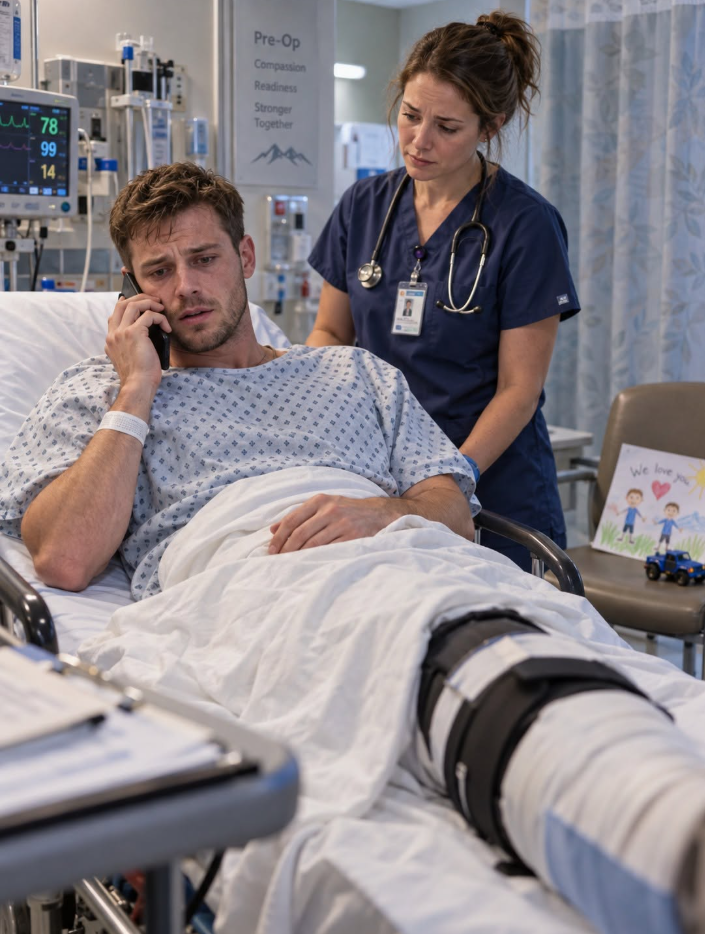
“I’m at Madigan.”
“Okay.”
“I got hurt.”
“How bad?”
“Surgery.”
“Okay.”
I heard movement.
A door closing.
Then his voice became quieter.
“What do you need?”
I stared at the ceiling.
“My boys.”
He didn’t hesitate.
“Where are they?”
The contrast was so sharp I couldn’t speak.
“Ben?”
“My neighbor has them.”
“Text me the address.”
“You don’t have to—”
“Text me the address.”
“Tasha might not—”
“Tasha is standing beside me putting shoes on.”
I covered my eyes.
Marcus stopped speaking.
He knew.
After a few seconds he said:
“We’ve got them.”
Three words.
No discussion of refunds.
No calculations.
No speech about what I should have planned better.
We’ve got them.
The surgery lasted a little over three hours.
When I woke, Andrea told me Marcus had called twice for updates.
My mother had texted:
Hope everything went smoothly. We board early so service may be spotty. Love you.
There was a photograph attached.
Two suitcases beside their front door.
I turned the phone face down.
Marcus and Tasha kept Ethan and Sam for nine days.
Not because I asked for nine.
Because nine was what I needed.
Tasha handled school drop-off.
Marcus brought the boys to the hospital on day two.
Ethan walked in trying not to cry.
Sam did not try.
He climbed onto the edge of my bed and wrapped both arms around my chest until my ribs reminded us both that I was injured.
Marcus immediately lifted him away.
“Easy, linebacker.”
Sam wiped his face.
“Grandma’s on a boat.”
Children say complicated things like weather reports.
I looked at Marcus.
He looked away.
“Yeah,” I said.
“She is.”
My parents called from Juneau on the third day.
Mom wanted to FaceTime.
I answered because I did not want the boys learning that adult disappointment required disappearing.
She appeared wearing a new blue rain jacket.
Dad was behind her near a window overlooking gray water.
“How are you feeling?”
Mom asked.
“Like I got crushed by a rack.”
She frowned.
“Ben.”
“What?”
“The boys look good.”
“They are.”
“Tasha seems lovely.”
“She is.”
Mom smiled.
“See? It worked out.”
That sentence changed something.
Not because she was malicious.
She truly believed it.
In her mind, the emergency had passed.
I found childcare.
I had surgery.
The boys were safe.
Therefore their decision had caused no real damage.
I looked at the screen.
“Yeah.”
I nodded.
“I figured it out.”
Mom missed the difference in my voice.
Dad did not.
His expression changed.
But neither of them said anything.
When my parents returned eleven days later, they brought the boys stuffed bears wearing Alaska sweaters.
Sam loved his.
Ethan left his in the gift bag for almost a month.
Mom came to my apartment carrying chowder mix and souvenir coffee.
She hugged me carefully.
“You scared us.”
I looked at her.
“I scared you?”
“Yes.”
“We kept checking with Jenna.”
I frowned.
“You checked with Jenna?”
“We didn’t want to wake you.”
“You had my number.”
Mom sighed.
“Can we not do this now?”
That was the second moment something became permanent.
Not the cruise.
The avoidance afterward.
I had not needed them to cancel Alaska forever.
I needed them to understand what their decision meant.
Instead, they wanted the outcome without the discomfort.
“You said four thousand dollars was too much to lose.”
Mom’s face tightened.
“Ben.”
“I just want to know where the line is.”
“What line?”
“The amount.”
She stared at me.
“At three thousand, do you come?”
“That is not fair.”
“At two thousand?”
“Stop.”
“What if one of the boys had been the one in surgery?”
Her expression changed immediately.
“Of course we would have stayed.”
And there it was.
I nodded.
“Okay.”
“What does that mean?”
“It means you understood the choice.”
Mom’s eyes filled.
“That’s cruel.”
“No.”
I shook my head.
“It’s actually clearer.”
She left angry.
Dad stayed five minutes longer.
He stood near the door with both hands in his coat pockets.
“I wanted to stay.”
I looked at him.
“But you didn’t.”
“No.”
“Why?”
He looked ashamed.
“Your mother would’ve gone alone.”
I waited.
“That was unacceptable?”
He didn’t answer.
“So you chose her not being disappointed over me not having anyone for my kids.”
He flinched.
I immediately regretted the wording.
Not the truth.
The sharpness.
Dad nodded slowly.
“Yeah.”
That answer mattered more than Mom’s excuses.
He did not ask me to make it sound better.
My recovery took four months.
For the first six weeks, I could not drive.
Marcus took me to physical therapy twice.
Tasha picked Sam up when after-school care closed unexpectedly.
Jenna flew up from Portland for one weekend and slept on my couch.
My parents came by.
They brought groceries.
Dad fixed a cabinet hinge.
Mom did laundry without asking.
Things looked normal.
They were not.
The practical help came after the emergency—the part of the story where helping was convenient again.
I appreciated it.
I also stopped confusing it with reliability.
One night, after the boys were asleep, I pulled out the folder I had not looked at since their mother and I separated.
My will.
Guardianship documents.
Emergency authorizations.
If something happened to me, the boys’ temporary caregivers were listed in order:
- Linda and Phil Carter.
My parents.
- Jenna Carter.
My sister.
At the time, the choice had seemed obvious.
Grandparents.
Family.
People who loved the boys.
I stared at their names for a long time.
Then I called a family attorney.
The appointment cost $350.
The paperwork cost more.
That was the easy part.
The hard part was calling Marcus and Tasha.
We sat in their kitchen while their daughter did homework upstairs.
Marcus read the draft twice.
“You’re serious?”
“Yes.”
“You want us as temporary guardians?”
“If something happens before Jenna can get here.”
Tasha looked at me.
“And long-term?”
“Jenna first.”
That had been my decision after talking to her.
My sister had already said yes.
“But if she couldn’t?”
I swallowed.
“You two.”
Marcus leaned back.
“That’s a big ask.”
“I know.”
“What about your parents?”
There it was.
I looked at him.
“They showed me what they do when family and plans collide.”
Tasha’s expression softened.
“Ben, one terrible decision doesn’t mean they don’t love the boys.”
“I know.”
That mattered.
I wasn’t removing my parents because I thought they didn’t love Ethan and Sam.
I was removing them because emergency guardianship was not a prize for loving someone.
It was a job.
When things went wrong, somebody had to show up before the problem was solved.
Marcus tapped the papers.
“If we say yes, you need to understand something.”
“What?”
“We don’t want to be used to punish them.”
“I don’t either.”
“You tell them.”
I hated that part.
But he was right.
A boundary you keep secret until someone crashes into it becomes a trap.
Two weeks later, I invited my parents to dinner.
I waited until the boys were at Tasha’s house.
Dad knew immediately something was wrong.
Mom talked about school fundraising for almost ten minutes before I interrupted.
“I changed my emergency documents.”
She stopped.
“What documents?”
“For the boys.”
Her face went blank.
I explained.
Jenna primary.
Marcus and Tasha backup.
My parents no longer designated emergency caregivers.
Mom stared at me.
“You removed us?”
“Yes.”
Her voice rose.
“We are their grandparents.”
“I know.”
“You think those people are more family than we are?”
“No.”
“Then what is this?”
I took a breath.
“This is not a family ranking.”
“It certainly feels like one.”
“It’s a job description.”
Dad looked down.
Mom stared at me.
“What is that supposed to mean?”
“If I’m unconscious somewhere and my boys need someone at two in the morning, I need the first names on that list to be people who come.”
Mom stood.
“I knew this was about Alaska.”
“Of course it’s about Alaska.”
“One trip.”
“One emergency.”
“We had spent four thousand dollars.”
“Yes.”
I nodded.
“You made that the number.”
She looked stunned.
“I never said money mattered more than your children.”
“You didn’t have to.”
Her face crumpled.
Dad whispered, “Linda.”
She ignored him.
“You are taking my grandsons away because I took one vacation?”
“No.”
I kept my voice calm.
“I am making sure nobody has to open a babysitting app from a surgical bed because their emergency contact has nonrefundable plans.”
That ended the argument.
Not emotionally.
Practically.
Mom sat back down.
She cried.
I hated watching it.
I wanted to undo the sentence.
Undo the paperwork.
Undo the entire night at Madigan.
But if I changed the decision because she cried, I would be teaching myself that her pain mattered more than my sons’ safety.
I couldn’t do that.
Dad eventually asked:
“Can we earn our way back onto the list?”
I looked at him.
That question was harder.
Because I had not thought of the paperwork as temporary.
Maybe some part of me wanted a permanent consequence.
That realization embarrassed me.
“I don’t know.”
He nodded.
Fair answer.
Mom didn’t speak to me for almost three weeks.
She still picked the boys up for Sunday breakfast because I refused to involve them in the dispute.
Adults could be angry without making children pay admission.
The boys noticed tension anyway.
Of course they did.
Ethan asked:
“Is Grandma mad because we stayed with Mr. Marcus?”
“No.”
“Then why?”
“Because adults sometimes disagree about responsibilities.”
He stared at me.
“That sounds boring.”
“I’m trying very hard to keep it boring.”
He accepted that.
Months passed.
My leg improved.
I returned to work on light duty.
Then full duty.
I moved the boys into the rental with the yard six months later, but the emergency childcare bill, legal fees, and unpaid leave had eaten almost the entire amount I had saved.
That was the financial cost.
The larger cost was family.
My mother and I became careful around each other.
She stopped dropping by without calling.
I stopped telling her everything.
Dad called separately more often.
Nobody liked the new shape.
Then, eight months after the accident, Dad needed cataract surgery.
Nothing life-threatening.
Outpatient.
But he couldn’t drive afterward, and someone had to stay with him overnight because of another medical issue.
Mom called.
“Can you take Friday off?”
I looked at the calendar.
Friday was Ethan’s first overnight school camping trip.
Parents were invited to the evening campfire.
He had been talking about it for two months.
“I can’t.”
Silence.
“Ben, your father is having surgery.”
“I know.”
“You have paid leave again.”
“I do.”
That was true.
Mom waited.
The old version of me would already have been calculating how to do both.
Instead I said:
“I can arrange a medical ride, and Jenna can fly in Friday night if you need another person.”
Mom’s voice changed.
“You won’t come?”
“I’ll come Saturday morning.”
She became quiet.
For one uncomfortable second, I heard the parallel too clearly.
Trip.
Medical procedure.
Family obligation.
I did not want revenge disguised as principle.
So I asked:
“Is Dad unsafe without me?”
Mom paused.
“No.”
“Do you have another safe option?”
“Yes.”
“Then I’m keeping my promise to Ethan.”
She did not like that answer.
But this time I did not have to abandon anyone for it.
That distinction mattered.
Dad called later.
“Go camping.”
“You sure?”
“Yes.”
“Mom sounds upset.”
“Your mother will survive being upset.”
I laughed.
Then Dad said:
“I think I’m starting to understand the difference.”
“What difference?”
“Between somebody being able to figure it out and somebody not needing you.”
I didn’t answer for a moment.
That was the sentence I had needed months earlier.
Dad’s surgery went fine.
Jenna stayed overnight.
I arrived Saturday with breakfast.
Mom was civil.
Not warm.
Civil.
That was enough.
The real payoff came the following winter.
Sam fell from playground equipment at school and needed stitches.
Nothing catastrophic.
The school called me.
I was forty minutes away at work.
Their next call went to Marcus.
He was there in twelve minutes.
By the time I arrived at urgent care, Sam was sitting beside him holding an ice pack and explaining in great detail why the playground design was “probably illegal.”
Marcus looked at me.
“Your kid has opinions.”
“He gets that from somebody.”
Then I saw my parents in the doorway.
Mom had heard from the school secretary, who knew her from volunteering.
She had driven straight there.
No bags packed.
No questions about whether somebody else could go.
She just came.
Sam saw her.
“Grandma!”
Mom hurried over.
He hugged her.
I watched.
Something inside me loosened.
Later, while Sam was being discharged, Mom stood beside me.
“I know I’m not on the form.”
I looked at her.
“No.”
“I came anyway.”
“Yes.”
She looked toward Sam.
“I should have done that the first time.”
There was no defense attached.
No mention of the cruise.
No reminder that he had been safe.
Just the truth.
“I know.”
She wiped one eye.
“I’m sorry.”
This time, the apology did not ask me to erase what happened.
That was why I could finally receive it.
A month later, I updated the emergency plan again.
Jenna stayed first.
Marcus and Tasha stayed second.
My parents became third.
Mom cried when I told her.
Dad smiled.
I made one thing very clear.
“This isn’t forgiveness points.”
Mom nodded.
“I know.”
“It isn’t a reward.”
“I know.”
“It means if everybody above you can’t get there—”
“We go.”
She finished the sentence.
No discussion.
No calculation.
“We go.”
The Alaska cruise stayed framed in their hallway.
Glacier behind them.
Dad smiling.
Mom in that blue raincoat.
For a long time, I hated the picture.
Eventually I didn’t.
The trip was never the real problem.
Four thousand dollars wasn’t either.
The problem was the sentence underneath it:
You will figure it out.
People had said that about me for years like it meant I was strong.
Maybe I was.
But strength should never become the excuse people use not to show up.
The night of my accident, I opened an app because my parents chose a reservation over an emergency.
What I lost that night wasn’t my family.
Not completely.
I lost the belief that family automatically meant dependable.
They had to build that meaning back.