My father’s message appeared beneath General Pierce’s final sentence, and for several seconds, I could not bring myself to open it.Có thể là hình ảnh về văn bản
I already knew the tone before reading it, because my father had perfected the art of making disappointment sound like inconvenience.
His message contained only nine words: “We saw the speech online, and you embarrassed us.”
I stared at the screen until the letters blurred, then slowly locked my phone again without replying.
General Pierce remained at the podium while applause continued rolling through the stadium like distant thunder.
She waited patiently until every graduate had returned to their seats, then lifted the leather folder she had deliberately closed.
“There is something else I need to say,” she told the crowd, her voice suddenly quieter than before.
The stadium gradually fell silent, and thousands of people leaned forward as though sensing that something unexpected was coming.
“Leadership is not measured by the number of people celebrating when you succeed,” General Pierce continued, looking directly toward my row.
“It is measured by what you do when the people you expected beside you decide they would rather be somewhere else.”
Something tightened inside my chest when she said those words, because suddenly the empty chairs no longer felt like an accusation.
They felt like evidence that I had survived something much larger than one disappointing graduation ceremony.
General Pierce opened the folder again, but instead of reading the prepared speech, she removed a single sealed envelope.
“This envelope contains an assignment recommendation I was instructed to keep confidential until today,” she announced.
A ripple of confusion moved through the audience, and several academy officials exchanged surprised glances near the stage.
I looked at General Pierce, unable to understand why she was holding something apparently connected to me.
Then she said my name again.
“Clara Evans, your service record has been reviewed by a selection board for an exceptional leadership assignment.”
My heart began pounding harder.
I had expected my commission.
I had expected my graduation.
I had expected the ordinary beginning of an officer’s career after years of exhausting preparation.
I had never expected this.
General Pierce walked away from the podium and approached me while the entire stadium watched.
She stopped directly in front of my chair and handed me the sealed envelope.
“Open it,” she said.
My fingers trembled slightly as I broke the seal.
Inside was a formal appointment recommendation bearing several signatures from senior officers.
The document recommended me for a specialized leadership position involving strategic planning and operational coordination.
My eyes moved down the page until I reached the final paragraph.
Then I stopped breathing for a moment.
The assignment was not merely prestigious.
It placed me on a leadership track that could eventually lead toward senior command responsibilities.
I looked up at General Pierce, convinced I had misunderstood something.
“This is real?” I whispered.
She smiled.
“It is real, Clara.”
The stadium erupted again.
This time, I could hear my classmates shouting my name.
I could hear people clapping behind me.
And somewhere in the crowd, someone began chanting my name loudly enough for everyone to hear.
But I barely noticed any of it.
My attention remained fixed on the document.
Because beneath the recommendation was something I had never expected to see.
General Pierce had personally endorsed me.
Not simply as a promising graduate.
Not simply as a capable officer.
She had described me as someone with the judgment required for exceptional responsibility.
I swallowed hard.
For twenty-eight years, my family had treated my achievements as background noise.
Now the person who had taught me what leadership actually meant was telling thousands of people that I belonged in the room.
General Pierce leaned closer.
“Your parents may not understand what they missed today,” she whispered.
“But one day, they may realize they were sitting at home while history was being written in front of them.”
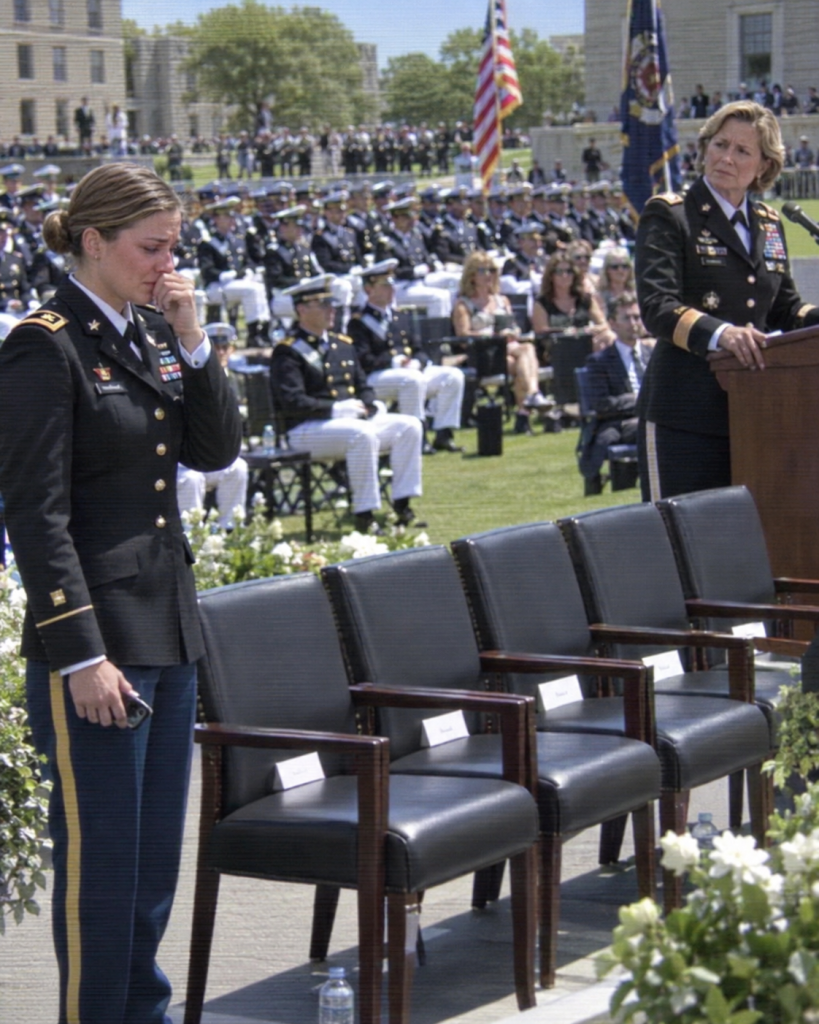
I looked toward the empty VIP chairs.
For the first time that morning, I did not feel abandoned.
I felt strangely free.
Then another phone notification appeared.
This time, it was from Tiffany.
Her message contained only one sentence.
“Mom says General Pierce is exaggerating because she feels sorry for you.”
I almost laughed.
Not because the message was funny.
Because it was so perfectly familiar.
Even after everything, my family still believed someone else had to be responsible for my accomplishments.
If I succeeded, someone had helped me.
If I received recognition, someone had exaggerated it.
If people respected me, they must have misunderstood me.
I had spent years trying to prove them wrong.
Suddenly, I realized I no longer needed to.
I placed the phone inside my jacket pocket and turned toward the stage.
The ceremony continued.
Names were called.
Graduates crossed the platform.
Parents cried.
Photographs were taken.
Families embraced their sons and daughters beneath banners representing years of sacrifice.
And I stood among them knowing that my own family had chosen a cruise instead.
But something unexpected happened after the ceremony.
General Pierce asked me to remain behind.
The stadium slowly emptied while officers, graduates, and families disappeared through the surrounding gates.
Eventually, only a small group remained near the stage.
General Pierce approached me carrying the same leather folder.
“There is something I didn’t tell you,” she said.
My stomach tightened.
“What is it?”
She looked around before answering.
“Your selection was not unanimous.”
I frowned.
“Someone opposed it?”
“One person strongly opposed it.”
I immediately assumed she meant someone on the selection board.
Instead, she reached into the folder and removed another document.
I recognized the letterhead immediately.
It belonged to my father’s former professional organization.
I stared at her in confusion.
“Why would my father be involved in my assignment?”
General Pierce did not answer immediately.
She handed me the document.
I read the first paragraph.
Then I read it again.
My father had apparently contacted someone connected to the selection process weeks earlier.
He had argued that I lacked the emotional stability required for senior leadership.
My hands became cold.
“What?”
General Pierce nodded slowly.
“He requested that your recommendation be reconsidered.”
The words seemed impossible.
My father had not merely skipped my graduation.
He had apparently tried to interfere with my career.
I continued reading.
His letter described me as stubborn, overly ambitious, and difficult to manage.
He claimed that my obsession with military achievement had created unnecessary tension within our family.
He even suggested that I might eventually regret choosing service over family.
I felt something inside me crack.
Not because the accusations were unfamiliar.
But because I had spent years believing my father simply did not understand me.
Now I realized he had understood perfectly.
He simply did not want me to become something he could no longer dismiss.
General Pierce watched silently as I finished reading.
“Why didn’t you tell me this before?”
“Because you deserved to graduate without carrying his resentment onto that field.”
I looked at the document again.
“Did this affect the decision?”
“No.”
Her answer came immediately.
“The board reviewed your record independently.”
She paused before continuing.
“Your performance was stronger than his accusations.”
I closed my eyes.
For the first time, I understood something painful.
My family had not simply failed to support me.
They had actively underestimated me.
And perhaps that was why my achievements had always made them uncomfortable.
Tiffany could gain followers.
She could receive attention.
She could be celebrated at restaurants and photographed beside swimming pools.
But my accomplishments represented something my family could not control.
They represented independence.
General Pierce placed a hand on my shoulder.
“Clara, people sometimes become threatened when someone they dismissed begins succeeding without their permission.”
I looked at her.
“What should I do?”
“Nothing.”
I blinked.
“Nothing?”
“Do not fight them.”
She folded the document and returned it to the folder.
“Do not spend your career trying to convince people who have already decided not to believe you.”
Her words struck harder than anything my parents had ever said.
Because I suddenly remembered every childhood achievement I had minimized.
Every award I had hidden because Tiffany was having a difficult week.
Every accomplishment I had described as luck because my mother looked uncomfortable.
Every time I had apologized for being proud.
I had spent years making myself smaller so my family could remain comfortable.
General Pierce seemed to read the realization on my face.
“Your first responsibility is not proving your worth to your family,” she said.
“It is becoming worthy of the responsibility your country is about to place in your hands.”
I nodded.
For the first time that day, I smiled without forcing it.
Then General Pierce gave me another envelope.
“This one is personal.”
I opened it carefully.
Inside was a handwritten note.
The handwriting was unmistakably hers.
“You are going to encounter people who measure success through attention, money, popularity, and appearances.”
The note continued.
“Do not let their definition become yours.”
I felt tears gathering in my eyes.
The final line was short.
“Serve well, lead honestly, and let time explain everything else.”
I folded the note and placed it inside my uniform.
That should have been the end of the story.
It wasn’t.
Two days later, I received an unexpected call from my mother.
I almost ignored it.
Instead, curiosity made me answer.
“Clara,” she said, sounding strangely nervous.
“Yes?”
“We need to talk.”
I sat down.
“About what?”
There was a long silence.
Then she asked whether General Pierce had really recommended me for the assignment.
I immediately understood.
The news had reached them.
“Yes.”
“And your father says the assignment is temporary.”
I smiled faintly.
“Maybe.”
My mother hesitated.
Then her voice changed.
“Could you send us some pictures from graduation?”
I stared at the wall.
“You missed graduation.”
“I know.”
“You chose a cruise.”
“It was Tiffany’s milestone.”
“So was mine.”
Silence.
For once, my mother did not have an immediate response.
Then she said something I never expected.
“We didn’t realize how important it was.”
I looked down at the uniform hanging beside me.
“You knew.”
She began crying.
I did not feel victorious.
I did not feel angry.
I simply felt tired.
“You knew for twenty-eight years,” I said quietly.
“You just didn’t think my achievements mattered unless they made you look good.”
She stopped crying.
Neither of us spoke for several seconds.
Then she whispered, “Can we fix this?”
That question stayed with me.
Part of me wanted to say yes immediately.
Another part remembered the empty chairs.
The pool photograph.
The message telling me not to be dramatic.
And the letter my father had written attempting to undermine my career.
“I don’t know,” I finally answered.
It was the most honest answer I could give.
My mother asked whether I hated them.
“No.”
“Then what do you feel?”
I looked through the window at the early morning sky.
“I feel like I’m finally learning that forgiveness doesn’t require me to forget.”
She said nothing.
I continued.
“If you want to be part of my life, you have to respect the person I’ve become.”
Another silence followed.
Then she whispered, “Your father won’t like that.”
I smiled sadly.
“He doesn’t have to.”
The call ended shortly afterward.
For the first time, I did not feel guilty for setting a boundary.
A week later, I reported for my new assignment.
The office was smaller than I expected.
There were no cameras.
No stadium.
No cheering crowd.
Only maps, reports, computers, and people carrying responsibilities that could affect thousands of lives.
I remembered General Pierce’s advice.
Leadership was not applause.
It was responsibility.
My first week was brutal.
There were long nights.
There were disagreements.
There were decisions that made everyone uncomfortable.
But I approached every problem the same way I had approached that failed operational plan years earlier.
I studied it.
I admitted what I did not know.
And I refused to repeat the same mistake twice.
Months passed.
My parents occasionally sent messages.
Some were awkward.
Some were defensive.
Some were surprisingly sincere.
Tiffany eventually sent me a message too.
It contained no apology.
Instead, she wrote, “I didn’t know you were doing all that.”
I stared at the sentence for several seconds.
Then I replied with something simple.
“You never asked.”
She never answered.
That was okay.
I had stopped waiting.
One year after my graduation, I returned to the academy for a leadership conference.
General Pierce was there.
She recognized me immediately.
“How is the assignment?”
“Difficult.”
She smiled.
“Good.”
I laughed.
“You still say that?”
“Only when someone is doing well.”
We walked across the same grounds where I had once stared at four empty chairs.
The stadium looked smaller now.
The memories did not.
General Pierce stopped beside the entrance.
“Do you ever think about that day?”
“Sometimes.”
“Does it still hurt?”
I considered the question.
“Yes.”
Then I smiled.
“But it doesn’t control me anymore.”
She nodded.
“That is the difference between surviving something and learning from it.”
I looked toward the stadium.
Thousands of graduates would eventually stand there again.
Thousands of families would fill the seats.
Some would bring flowers.
Some would cry.
Some would take hundreds of photographs.
And some seats would inevitably remain empty.
But I had learned something that day.
An empty chair does not determine your value.
A parent’s disappointment does not determine your future.
A sibling’s popularity does not diminish your achievement.
And being overlooked by the people closest to you does not mean the world cannot see you.
Sometimes the person who recognizes your potential is someone who has no obligation to love you.
Sometimes a mentor sees your future more clearly than your family sees your present.
And sometimes the greatest revenge is not proving someone wrong.
It is becoming so secure in who you are that their approval stops being necessary.
Years later, my mother attended another ceremony.
This time, she arrived early.
She sat in the front row.
My father came too.
Tiffany arrived separately and quietly.
There were no empty chairs.
But I did not need them anymore.
When my name was announced, I looked toward the audience.
My mother was crying.
My father stood beside her.
Tiffany was holding a small bouquet.
For one brief second, I felt the old ache return.
Then I remembered the Caribbean photograph.
The empty VIP seats.
General Pierce closing her speech.
And the envelope that changed everything.
I smiled.
Not because my family had finally validated me.
But because I had finally stopped needing them to.
General Pierce stood near the stage.
Our eyes met.
She gave me the smallest nod.
I understood exactly what it meant.
Keep going.
So I did.
Because the greatest achievement was never making my parents regret missing my graduation.
It was becoming the woman they could no longer reduce to someone else’s shadow.