The sealed envelope settled into my palm, and the sight of Dad’s handwriting across the front made my stomach tighten.
Grant.
Just my name, written by Raymond Mercer himself before doctors took him into emergency surgery.
I stood in that hospital corridor staring at it, afraid of what might be inside and even more afraid of why my father had made one thing so clear before he was sedated: Natalie was not supposed to see it.
Three days earlier, none of this had made sense.
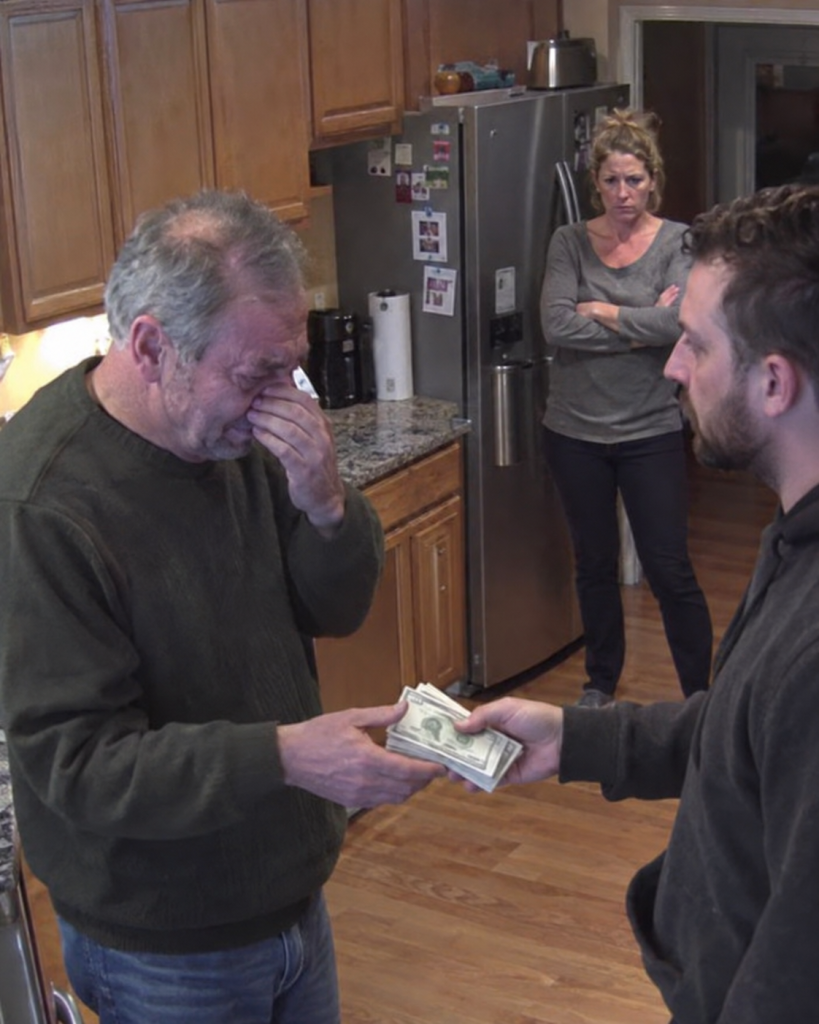
Dad had been standing in the middle of my kitchen asking me for $1,000.
That alone was enough to tell me something was wrong.
My father was the kind of man who would spend an hour repairing something most people would replace before he would admit he needed help.
For more than thirty years, he had worked construction.
He carried lumber, poured concrete before sunrise on freezing mornings, climbed roofs under brutal summer heat, and came home with hands that always seemed to have another scrape or callus on them.
He never talked much about sacrifice.
He just made sacrifices.
When I went to college, he sold his motorcycle to help cover my tuition.
I learned about that later.
When I was nine and needed decent shoes for school, he sold the only good suit he owned.
He never told me that either.
Other people did.
That was Dad.
He would quietly give away something he cared about and then act like it had never mattered.
So when he showed up at my house with his weathered hands clasped together and his eyes fixed on my kitchen floor, I knew this was not some casual request for spending money.
He looked embarrassed before he had even finished asking.
“I need to borrow a thousand dollars,” he said.
Before I could ask what had happened, Natalie looked across the room at him.
“Tell him to get another job,” she said. “We’re not some kind of bank.”
The words landed harder because Dad did not fight back.
He did not snap at her.
He did not remind her of everything he had done for us.
He just stood there.
His hands trembled slightly.
“That’s enough,” I told Natalie.
Then I took Dad outside before the argument could get worse.
The afternoon was warm, but he kept rubbing his palms together as though he were trying to warm them.
“I didn’t come here to cause trouble between you two,” he said. “If you can’t help, I’ll understand.”
That almost made me angrier than Natalie’s comment.
Dad was apologizing for asking his own son for help when I could count on one hand the number of times he had ever asked me for anything significant.
“What is the money for?” I asked.
He looked toward the house before answering.
“The money isn’t exactly for me, Grant. I need certified copies of some documents. I need legal help. And there’s a test I have to take.”
None of those things belonged together in my mind.
Documents.
Legal help.
A test.
“What documents?”
He hesitated.
“Old adoption files.”
For a moment I thought I had misunderstood him.
“Whose adoption?”
His eyes moved toward the house again.
That second glance bothered me more than the first.
Dad was not simply uncomfortable discussing the subject.
He was checking where Natalie was.
“I need proof before I tell you everything,” he said.
“Proof of what?”
“Because otherwise, someone might say I’m getting confused.”
He stopped and swallowed.
“Or accuse me of trying to interfere with your marriage.”
There are sentences you hear and immediately understand.
Then there are sentences that keep expanding after they are spoken.
That was one of them.
Dad had not said Natalie’s name.
He did not need to.
“Who would accuse you of that?” I asked.
He would not answer.
Instead, he put one rough hand on my shoulder.
“I’m trying to give you something I should have given you a long time ago.”
I knew my father well enough to hear what was underneath those words.
Urgency.
Maybe fear.
But I also knew something else.
This was the man who had spent most of my life helping me without making me prove that I deserved it.
I was not going to make him stand in my backyard and justify every dollar.
“I’ll get it,” I said.
His face changed immediately.
Relief moved through it, but embarrassment stayed.
“I’ll pay you back.”
“You don’t have to.”
I went inside and opened the small safe beneath my office desk.
We kept emergency cash there.
I pulled out the money, put it together for Dad, and was about to return when Natalie appeared in the doorway behind me.
“You’re really giving him the money?”
“Yes.”
“We agreed we’d discuss major expenses.”
“He has never asked me for money before.”
“That doesn’t mean it won’t become a habit.”
I looked at her.
“He’s my father.”
“And this is our house.”
That stopped me.
Not because she was right.
Because the house was one more thing Dad had helped make possible.
Years earlier, after selling the last parcel of land he had inherited from his mother, he had paid most of the down payment.
Natalie knew that.
I did not argue about it then.
I carried the money back to Dad.
When I handed him the envelope, his fingers trembled around it.
“I’m sorry, son.”
“You have nothing to be sorry for.”
Usually, Dad hugged me before he left.
That afternoon, he didn’t.
It was such a small difference that I almost dismissed it.
But later, I would keep thinking about it.
About the adoption files.
About the way he looked toward the house before answering me.
About his fear that someone would accuse him of being confused.
And about the fact that he was trying to give me something he believed he should have given me years earlier.
The front door had barely closed behind him when Natalie turned on me.
“You made me look like an idiot.”
I could not believe that was what she had taken from the entire conversation.
“You embarrassed him first.”
“You always choose him over me.”
That accusation had probably been waiting longer than the argument itself.
I looked straight at her.
“He spent my entire childhood choosing me.”
Neither of us had much to say after that.
But Dad’s request stayed with me.
There was nothing ordinary about it.
If he had needed help with a bill, he would have said so.
If his truck needed repairs or something in his house had broken, he would probably have tried fixing it himself before calling me.
Instead, he needed certified documents, legal help, some kind of test, and old adoption records.
Most troubling of all, he seemed convinced he needed proof before he could tell me the truth.
For three days, I had no idea what he was doing with the money.
Then my phone rang from a number I did not recognize.
“Is this Grant Mercer?” a woman asked.
“Yes.”
“I’m calling from the hospital. Raymond Mercer listed you as his emergency contact.”
My chair shot backward when I stood.
“What happened?”
“He collapsed this morning. The doctors found an aortic aneurysm and took him straight into emergency surgery.”
For several seconds, all I could hear was the blood beating in my ears.
Dad had been in my kitchen three days earlier.
He had walked into my backyard.
He had put his hand on my shoulder.
Now someone was telling me surgeons were trying to save his life.
“Is he alive?” I asked.
“He was stable when they brought him into the operating room.”
Stable.
I grabbed onto that word because there was nothing else to hold.
Then the woman said something I did not expect.
“Before your father was sedated, he asked us to give you a sealed envelope.”
I stopped moving.
“There is also an attorney here waiting to speak with you.”
“An attorney?”
“Yes. Her name is Priya Desai.”
Legal help.
Dad’s words from the backyard came back immediately.
Certified copies.
Adoption files.
Proof.
An attorney was now waiting at the hospital while my father was undergoing emergency surgery.
Whatever Dad had been doing, it had not been a vague idea.
He had already put something in motion.
I grabbed my keys from the counter.
I was heading for the door when the woman stopped me.
“Mr. Mercer, there’s one more thing.”
My hand stayed around the keys.
“What?”
“Your father left very specific instructions. He said you must not discuss the contents of the envelope with your wife until after you’ve spoken privately with Ms. Desai.”
I remember standing completely still after that.
Not because I understood what was happening.
Because suddenly every strange detail from Tuesday connected to Natalie.
Dad looking toward the house.
Dad refusing to explain whose adoption he was talking about.
Dad saying someone might claim he was confused.
Dad worrying that someone would accuse him of interfering with my marriage.
And now this.
Do not discuss the envelope with your wife.
“What does Natalie have to do with this?” I asked.
“I’m sorry. Your father didn’t explain.”
That answer gave me nothing, but it also told me something important.
The hospital staff were not interpreting Dad’s wishes.
They were following them.
He had been clear enough, before being sedated for emergency surgery, to create a boundary around that envelope.
My wife was outside it.
I drove to the hospital with one thought repeating in my head.
Dad had been preparing this before he ever walked into my kitchen asking for $1,000.
The request had not started the problem.
It had been part of something already underway.
That realization changed how I remembered his embarrassment.
Maybe he had not been ashamed only because he needed money.
Maybe he had been carrying the weight of whatever he was finally trying to tell me.
I kept replaying our conversation.
“I’m trying to give you something I should have given you a long time ago.”
At the time, I had heard that as an explanation for the money.
Now it sounded different.
He had not said he was buying something for me.
He had said he was trying to give me something.
Information, maybe.
Proof, certainly.
Something connected to old adoption records.
Something he believed could affect my marriage enough that he expected accusations before he even revealed it.
I did not know whether those fears were justified.
I did not know what the documents said.
I did not know what kind of test he had needed or why an attorney was involved.
And I refused to invent answers simply because the questions frightened me.
Dad had asked me to trust him long enough to get proof.
So that was what I had to do.
At the hospital, the corridor felt like the last place in the world where I wanted to solve a family mystery.
My father was somewhere beyond those doors in surgery.
Every other question should have felt secondary.
But the envelope made that impossible.
This was something he had chosen to arrange while facing an emergency serious enough that he might not be able to explain it himself afterward.
He had made sure the hospital knew I was his emergency contact.
He had made sure the envelope reached me.
He had made sure an attorney was there.
And he had made sure I understood one restriction before I opened anything.
Natalie was not to be involved yet.
That instruction hurt in a way I was not prepared for.
Until then, the conflict between my father and my wife could still be explained as personality, money, pride, or old resentment.
Natalie thought Dad depended on me too much.
I thought she judged him without recognizing what he had sacrificed for us.
Those were painful differences, but they were ordinary enough to understand.
A secret envelope tied to adoption files was different.
Dad was not merely frustrated with her.
He believed secrecy was necessary.
And he believed it strongly enough to say so before surgery.
I thought again about the kitchen.
Natalie’s arms crossing when Dad tried to explain himself.
Her saying people who could not manage their finances always seemed to have some strange emergency.
Dad’s face tightening without arguing.
His refusal to hug me when he left.
None of those moments proved anything about the envelope.
But they made the hospital instruction impossible to dismiss.
The worst part was that Dad could not answer my questions.
He had spent his life being the person I called when something went wrong.
Now something had gone wrong with him, and I was standing there holding the question he had prepared for me.
A sealed envelope can weigh almost nothing.
That one felt heavy.
I could see the front of it clearly.
My name was there in Dad’s handwriting.
Not Natalie’s.
Not both of ours.
Mine.
Grant.
I thought about the thousand dollars still more than I wanted to.
Three days earlier, Natalie had treated the request as though Dad were starting a bad habit.
Dad had treated the money like a necessary step.
Whatever those certified copies, legal help, adoption files, and the test were connected to, he had been determined enough to swallow his pride and ask me for cash.
That told me the answer mattered to him.
The attorney waiting nearby told me he had gotten farther than I realized.
The sealed envelope told me he had expected a moment when the truth might have to speak for him.
And the instruction about my wife told me he feared what might happen if the information reached the wrong person too soon.
I still did not know what any of it meant.
That was the line I kept forcing myself not to cross.
Suspicion was not proof.
Dad himself had understood that.
It was exactly why he said he needed records before telling me everything.
He had not wanted to make an accusation he could not support.
He had not wanted me to believe him simply because he was my father.
He wanted something verifiable in his hands first.
That realization made me respect his silence differently.
Three days earlier, I had been frustrated that he would not answer my questions.
Now I understood at least the principle behind it.
He was trying to protect the truth from becoming another family argument.
Whatever he knew, he wanted evidence attached to it.
Maybe that was why he feared being called confused.
Maybe that was why he worried about being accused of interfering in my marriage.
Those were possibilities, not answers, and Dad had been careful enough to know the difference.
So I needed to be careful too.
I looked down at the envelope again.
Dad’s handwriting was familiar in a way that suddenly made my chest ache.
Those were the same rough hands that had worked construction for decades.
The same hands that had sold things he owned so I could have opportunities he never talked about giving me.
The same hands that had trembled when I placed $1,000 into them three days earlier.
And sometime before doctors sedated him, those hands had written my name on the thing I was now holding.
Behind the envelope was an attorney named Priya Desai, waiting to speak with me privately.
Behind the attorney were the questions Dad had refused to answer without proof.
And behind all of it was my father, undergoing emergency surgery while I stood in a hospital corridor trying not to let fear turn uncertainty into conclusions.
For most of my life, Raymond Mercer had protected me by doing things instead of explaining them.
He paid what he could.
He fixed what broke.
He sacrificed quietly.
He showed up.
This time, he had done something different.
He had left words behind.
I had not opened the envelope yet.
I did not know whose adoption file had sent him looking for certified records.
I did not know what the test was meant to establish.
I did not know why he believed Natalie needed to be kept away from the information until I spoke with the attorney.
But for the first time since the hospital called, I knew exactly what I had to do next.
I tightened my fingers around the envelope and kept it with me.
Dad had asked me to trust the process he had started.
Until I knew what was inside, that was the one promise I could still keep.