PART 1 — The Letters I Sent Instead
On December twentieth, my daughter sent me a message that read, “Mom, we decided that Christmas will be for immediate family only this year, and I really hope you understand.” I answered with just one word: “Understood,” and afterward, I settled at my kitchen table. Rather than buying Christmas presents for my three grandchildren, I decided to write each of them a personal letter. On Christmas morning, at nine o’clock, two of those children would arrive on my front porch with their bicycles in the snow. Their mother’s car would turn into my driveway only four minutes behind them.
Brenda is forty-six now and works locally as a pharmacist. Her husband, Greg, is forty-eight, a regional sales manager. Their children are Owen, fourteen; Tessa, twelve; and Max, nine. All three are wonderful children. The previous Christmas, Greg’s parents, Frank and Phyllis, had joined us for dinner at my house. Much of their evening had been devoted to finding fault with the baked ham I had prepared.
I went over her message four times. I did not reach for the telephone, and I did not ask her to explain what I might have done wrong. Forty-six years of being a mother had taught me that such questions could become invitations for somebody to invent a reason. A telephone conversation would also give her an opportunity to explain away something she and Greg had already decided. Instead, I took out my good cream-colored stationery, the paper with my initials printed at the top.
In Owen’s letter, I explained that his grandfather was the person who had taught me to make cinnamon rolls. I told him I would put them into the oven at eight o’clock on Christmas morning, so the kitchen would have the familiar smell it had always had. For Tessa, I wrote about the little wooden angel that went on top of my tree. I had bought it on the day she was born, and it belonged to her. Its box would be waiting on the mantel.
Tessa had been placing that angel on the highest branch every Christmas since she was three. I reminded her of that without asking anything of her. To Max, I wrote that I would be at home throughout Christmas Day, with my front door unlocked, and that he could come by whenever he wished. On the envelopes, I wrote the children’s own names, not Brenda’s. Then I attached snowflake stamps and walked to the mailbox on the corner through a freezing wind that brought water to my eyes.
Christmas morning found me awake at six. I made the cinnamon rolls, brewed a fresh pot of coffee, and switched on the lights of my fir tree. The carved birch angel remained inside its box on the fireplace mantel. I kept reminding myself that its presence there did not mean anybody would come to put it on the tree. I could prepare the things I always prepared without expecting the house to fill as it had in other years.
At two minutes after nine, footsteps sounded on the wooden boards of my porch. When I opened the door, Tessa and Max stood outside in the snow. Their bicycles lay where they had dropped them on my lawn. Neither child had gloves, and the bitter air had turned both their cheeks bright red. Beneath his heavy winter coat, Max was still wearing his flannel pajama pants. Tessa held her letter in one hand, its paper deeply creased from being opened and folded over and over again.
She looked up at me and asked quietly, “Grandma, is the angel still waiting in the box?” For a moment, I could not make my voice work well enough to answer. I simply moved aside and opened the door farther, giving them room to come in from the cold. There was nothing I could have said immediately that would have explained what it meant to see the two of them standing there, with their red cheeks and the letter I had written at my kitchen table.
Max went directly to the kitchen, drew in a deep breath, and announced, “It smells completely right in here.” I stepped into the pantry and stayed there for an entire minute with my hand over my mouth. While I stood out of sight, Tessa crossed the living room to the mantel and opened the wooden box. The angel I had told myself not to expect her to place was no longer merely waiting in its usual spot.
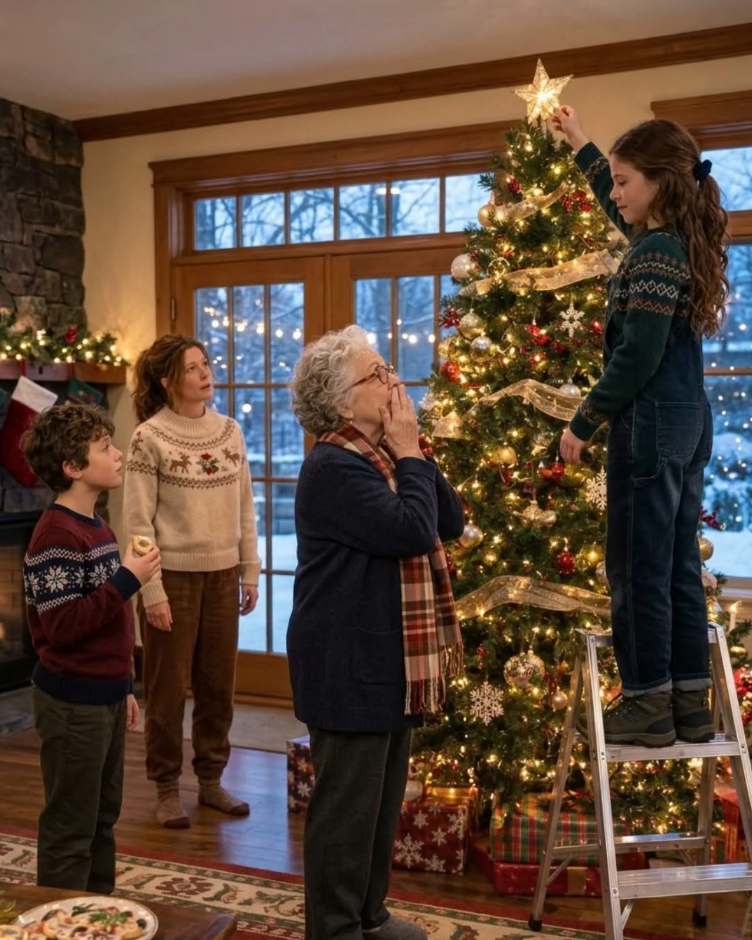
By the time I came back, Tessa had climbed onto my wooden step stool. She was reaching toward the top of the fir tree when a car rushed into the driveway and slid to a stop. Brenda came through my front door without knocking. A heavy winter coat had been pulled over her bathrobe, one slipper was on the wrong foot, and melting snow clung to her untidy hair. She was breathless, and there was no mistaking the urgency with which she had followed the children.
“Mom, they just left without telling us, and Owen is still sitting in the car because he wanted to come too, so what on earth did you send them in the mail?” Brenda demanded breathlessly. The question brought the letters into the room between us, although the letters themselves contained no accusation. Owen, too, had wanted to come. He was sitting outside while his younger brother and sister were already inside the house that had supposedly been left out of their Christmas.
Tessa did not scramble down from the stool when her mother entered. Before turning around, she carefully set the wooden angel onto the top branch. Only then did she look down at Brenda. My twelve-year-old granddaughter stood beside the tree with the ornament she had placed there every year since she was small, while her mother remained in the living room in a bathrobe and slippers. What Tessa said next would make Greg get out of the car and walk toward my front door.
PART 2 — What Understood Really Meant
“Mom, you told us last night that Grandma Dorothy did not want us to come over here, and you claimed she had made her feelings very clear,” Tessa said firmly while keeping one hand on the wooden angel. Brenda stopped in the middle of the living room. Behind her, the front door remained open. Through it, I could see Greg leaving the car in his wool coat and coming up the path toward the house.
“Tessa, you need to get down from that step stool right this second,” Brenda ordered in a tight voice. But Tessa did not lower her voice or turn away from what she had begun. “She never said she did not want us, Mom, because she only replied with the word understood, and I read the text on your phone while it was sitting on the kitchen counter,” Tessa replied without lowering her voice. After thirty-three years in a school office, I knew the posture of a child determined to tell the whole truth: that brief pause, followed by a spine held very straight.
“Tessa, that is not what I meant at all when I was talking,” Brenda protested quickly. Tessa answered her without letting go of the tree’s upper branch. “It is completely what you meant because I was sitting on the stairs when you told Dad in the kitchen that Grandma had made her feelings clear,” Tessa answered as she gripped the top branch of the tree. “The word understood is not a feeling, Mom, because it is just what you say when someone else has already made the decision for you.”
I put a hand against the back of my wooden chair and allowed the silence to remain. An honest moment needed its first few seconds without somebody hurrying to interrupt it; I reminded myself of that while we stood there. Then heavy footsteps crossed the porch. Greg appeared in the doorway, snow scattered over his shoulders, his face pale with shock. “Tessa, please come down from there right now,” Greg said quietly.
“No, Dad, I would like to finish putting the angel on straight first,” Tessa replied calmly. Turning toward the tree again, she used both hands to straighten the little birch figure. She adjusted it until the gold paper halo was level. One wing still bore the tiny chip Max had made when he accidentally dropped it in 2019. Only after the angel would stay where she wanted it did Tessa step down. In her wet sneakers, she took her place in the center of my living room and faced both parents.
“I want to say something important, and I would like to finish without being interrupted,” Tessa stated as Greg slowly removed his winter hat. “You told us Christmas was for immediate family only, which meant just us and Grandpa Frank and Grandma Phyllis, and I counted seven people on that list while leaving out Grandma Dorothy, who is actually your own mother.” Brenda gave a small, strangled gasp. Tessa swallowed hard, but she was not finished.
“On Christmas Eve, Grandpa Frank told Owen that he would hate to have a repeat of last year’s ham, and both he and Dad laughed about it, even though I thought last year’s ham was wonderful,” Tessa finished with a crack in her voice. I had known Greg for twenty-two years. He had carried my groceries and eaten three helpings of the food I served at holidays. Seeing deep shame come over his face was startling. “Tessa, was it wrong of me to laugh at that joke?” Greg asked softly. “I think you should ask Grandma Dorothy that question instead of me,” Tessa answered evenly.
In the quiet, Greg finally looked directly into my eyes, something he had not truly done for years. He held his hat tightly in both hands. “Dorothy, I am truly sorry,” Greg said with his hat held tightly in both hands. “What are you apologizing for, Greg?” I asked gently. “I am sorry for laughing at my father’s comment,” he replied, and when I asked which occasion he meant, his jaw stiffened. Then he acknowledged, “I am sorry for all of them.”
All morning, I had been practicing a speech in my head, something cool enough and devastating enough to deliver when the moment came. Yet the sight of that rumpled man in my doorway took the anger out of me entirely. “Come inside and shut the front door before you let all the heat out of the house,” I told him simply. We settled in the living room. Greg took Walter’s old armchair, Tessa sat on the floor near the tree, and Brenda sat on the sofa. Max had left the kitchen to press himself against her side.
A minute later, Brenda went back outside to talk to Owen. Soon he came in wearing his gray sweatshirt and paused in the doorway to smell the air. “It smells like the cinnamon rolls, Grandma, so are you making the real ones from Grandpa’s recipe?” Owen asked hesitantly from the doorway. “They are baking in the oven right now, and yes, they are your grandfather’s recipe,” I assured him warmly. He looked at his mother for permission, then sat beside his sister on the floor.
Owen muttered an apology for not coming on his bicycle, explaining that he had been unable to find his gloves. I teased him that he had never managed to locate his gloves in all his fourteen years. A surprised laugh escaped him, and he lowered his forehead to his knees. Outside, Frank and Phyllis stayed in their running car by the curb. I watched them through the living room window as twenty minutes passed.
Brenda followed my gaze. “They are upset because I told them we would bring them inside, and Frank said that if Dorothy wanted them there, she would have invited them herself.” Her explanation was quiet. “I never invited them because I did not know they were coming, though I would have set two extra places in a minute if someone had asked,” I replied calmly. Brenda lifted a hand over her eyes. Max looked up at her and informed the room that his mother was crying because of the letter.
“It is only partly because of the letter, sweetie, because mostly it is my own fault,” Brenda admitted in a thick voice. Looking down at the floor, she began to explain while the children listened. During the first six years of her marriage, she had tried to win Frank and Phyllis’s approval. Neither of them had ever told her she had done anything right. “Last year, they came here and criticized your ham, and I realized I would never get to be the woman who hosts Christmas because your holidays are always so effortless and perfect,” Brenda confessed through her tears.
“I just wanted one year at my own house where I could cook the meal and fail without anyone comparing me to you, and then Phyllis said she hated to impose on you, so suddenly you were left out,” Brenda continued. I told her that she could have called and that I would gladly have agreed. She shook her head. “That is exactly why I did not call, Mom, because you are always so gracious that I would have felt like a helpless child again.”
The pale winter sun came through the window as I sat listening. In my mind, forty years of our family’s history shifted into a different arrangement. I had devoted myself to making holidays seem smooth and easy for Brenda, and in doing so, I had never left her room to host one herself. “Brenda, back in 1985, I baked a ham for Walter’s family that turned out terribly dry, and his mother looked at it and called it very ambitious,” I told her gently.
She raised her face in surprise. I smiled at the memory before continuing. “I cried in the pantry until Walter came in, stood beside me silently for ten minutes, and then reminded me that his mother had never once praised anything she did not cook herself,” I said, making Greg let out a helpless laugh from his armchair. “I did not quit hosting, Brenda, I simply practiced until I got better, and I would much rather eat your dry ham than a perfect meal at somebody else’s table.”
Brenda began to cry openly. Max put his arms around her shoulders, and from her place on the floor, Tessa reached up to take her mother’s hand. At twenty minutes to eleven, I noticed movement outside. Frank had finally left the car. Wearing his camel-colored wool coat and gray scarf, he came slowly up the steps to my porch. Then, for the first time in nineteen years, he rang my doorbell. When I opened the door, he stood on the welcome mat, pinched and uncomfortable in the cold.
“Dorothy, I would like to apologize to you, though I would prefer to say it out here on the porch if you do not mind,” Frank said in a dry, careful voice. I stepped outside in my slippers and drew the door halfway closed behind me. In the crisp winter air, I waited to hear what he had come to say.
PART 3 — A Place at the Table
Frank looked down at the hat he was holding. “The ham you made last year was actually very good, and I said it was not because I thought it was a joke, mostly because my own father used to make remarks like that for seventy years,” Frank admitted while staring down at his hat. Then he continued more quietly. “I heard my father’s voice come out of my mouth on Christmas Eve in front of Owen, and then I saw the look on the boy’s face,” Frank added quietly.
Ordinarily, I would have softened such an apology with polite conversation and allowed the discomfort to pass. This time, looking at the proud, miserable man on my porch, I asked for something different. “I would like you to come inside for a cinnamon roll and repeat what you just told me to Owen, because he is fourteen and thinks your joke was aimed at him,” I told him firmly. Frank blinked, surprised, and then gave a hoarse nod.
He followed me indoors after carefully wiping his boots on the mat twice. In the living room, he made his way to Owen and lowered himself stiffly onto the carpet beside him, his knees bent. For a long moment, he said nothing. “Owen, I told you that your grandmother’s ham was bad, when in truth it was the best ham I have ever eaten,” Frank said clearly. Owen turned a sideways look toward his grandfather. “Then why did you say it was bad in the first place?”
Frank did not retreat into another joke. “I said it because I am an old man and I was being a coward,” Frank answered honestly. At eleven o’clock, Phyllis finally got out of the car as well. In her navy coat and feathered hat, she came along my snowy path with her chin raised. When I opened the door, she stood very straight on the mat. “Dorothy, I came to tell you I was wrong, though I would prefer to be invited properly for Christmas in your own words before I step inside.”
For nineteen years, that silver-haired woman had offered sharp little suggestions across my dining table. Standing before her now, I understood the courage it had taken for her to come to my door. “Phyllis, would you like to come inside and celebrate Christmas with us?” I asked warmly. Her chin trembled as she answered. “I would be honored, Dorothy, and since I can already smell the cinnamon rolls, I would love to help you bake the next batch because I never learned how to make them properly,” Phyllis replied with a trembling chin.
Before long, we were standing together at my kitchen counter in aprons, flour dusting both our forearms. Phyllis frowned over the sticky dough. When she complained about how badly it was turning out, I laughed. I told her that Walter’s mother had stood at precisely that counter in 1975 and criticized everything I did. For all that, I had loved the woman dearly. Now Phyllis was standing in the same place, trying something she had admitted she did not know how to do.
She put her floury hand over her mouth. “I think I have been acting just like her for years, Dorothy, and I would really like to stop,” Phyllis whispered with her flour-covered hand pressed over her mouth. I did not tell her that old habits vanished merely because someone finally recognized them. “It takes a few years to break old habits, Phyllis, and I will gladly help you practice,” I promised her. We remained side by side at the counter, working on the next batch.
By three that afternoon, all nine of us were seated at my dining room table. Brenda had gone upstairs and returned in a dark-green wool dress, her hair combed neatly. She admitted she had made mashed potatoes and baked a pie at home that morning. Both had been packed into the trunk of her car, just in case they ended up coming to my house. Even before she had stepped through my door in her bathrobe, part of the meal had already been waiting outside.
“I was hoping we would come here, Mom, because I think I was just waiting for someone to tell me I was allowed to try,” Brenda said as I wrapped my arms around her shoulders. I held her and answered softly. “You were always allowed to try, sweetheart, and I am sorry I never told you that out loud,” I replied softly. Her mashed potatoes were deliciously buttery, with just a hint of nutmeg. My ham, on the other hand, had become slightly dry while the morning kept drawing my attention elsewhere.
When Frank put down his fork and observed that the ham was a little dry, silence fell across the entire dining room. His cheeks immediately went pink. “That is not a criticism, everyone, it is simply an observation, and I would like it noted that I am genuinely trying to do better,” Frank explained quickly, making Greg hide a laugh behind his napkin. Across the table, Phyllis offered her assessment. “I would like it noted that he has done very well so far,” Phyllis added dryly from across the table.
Max, still in his pajama pants but now wearing a clip-on tie, looked from one grandparent to the other. Then he gave his own verdict. “It is still good ham, Grandpa, it is just a little bit ambitious.” Hearing that enormous word delivered by a nine-year-old undid me. I lowered my head onto the dining table and laughed until tears streamed down my cheeks. After everything that had happened that morning, it was Max and that one word that left me unable to stop laughing.
Two days later, on December twenty-seventh, Brenda appeared alone on my porch. She was carrying a brown paper bag. Inside it was a small, dark ham, its sugar glaze scorched. With tears bright in her eyes, she told me why she had brought it. “I baked this at home for you and burned the glaze completely, because I wanted to fail somewhere that you could see me,” Brenda said with tears shining in her eyes.
I told her it looked like a very ambitious ham. Then I pulled her into the house so we could have it together for lunch. The next day, she gave me a handmade card suggesting a new arrangement for Christmas. We would take turns hosting: my house in odd-numbered years and hers in even-numbered years. The card also expressly gave me permission to decline any request to bring the ham.
Last Christmas, I sat at Brenda’s long dining table and ate the turkey she had roasted herself. It was lopsided and slightly dry. Frank automatically pointed out the dryness, but this time Greg quietly told his father that the remark was rude. Frank apologized to Brenda immediately, his napkin still in his hand. The familiar comment had not been allowed to pass unnoticed, and the apology had not required a child to stand beside a Christmas tree and demand it.
At the head of the table, Brenda laughed so hard that she had to lay down her fork. She explained that she was delighted the turkey was bad because it belonged entirely to her. It was the meal she had made, at the table where she was hosting. I ate it there with her, just as I had told her I would rather do than sit somewhere else over a perfect dinner.
These days, Tessa rides her bicycle to my house every Saturday morning. We make cinnamon rolls together in the warm kitchen. Last week, while she was kneading the dough, she stopped to ask me something. “Grandma, was it wrong of me to speak up to Mom in front of everyone like that, or should I have waited for a private moment?” The question brought us back to Christmas morning, to the words she had spoken while the angel waited above her.
I dried my hands on a dish towel and looked through the window. A red cardinal was perched in the bare maple tree outside. Then I shook my head. “It was not wrong at all, Tessa, because I have lived seventy-two years and learned that if you wait for a private moment to speak the truth, that moment usually never arrives,” I told her gently.
Tessa gave a shy smile. Then she drove both fists into the dough and pointed toward the living room. It was late January, but our tilted fir tree was still standing there. On its highest branch, the chipped wooden angel remained where she had placed it—leaning just a little to the left…