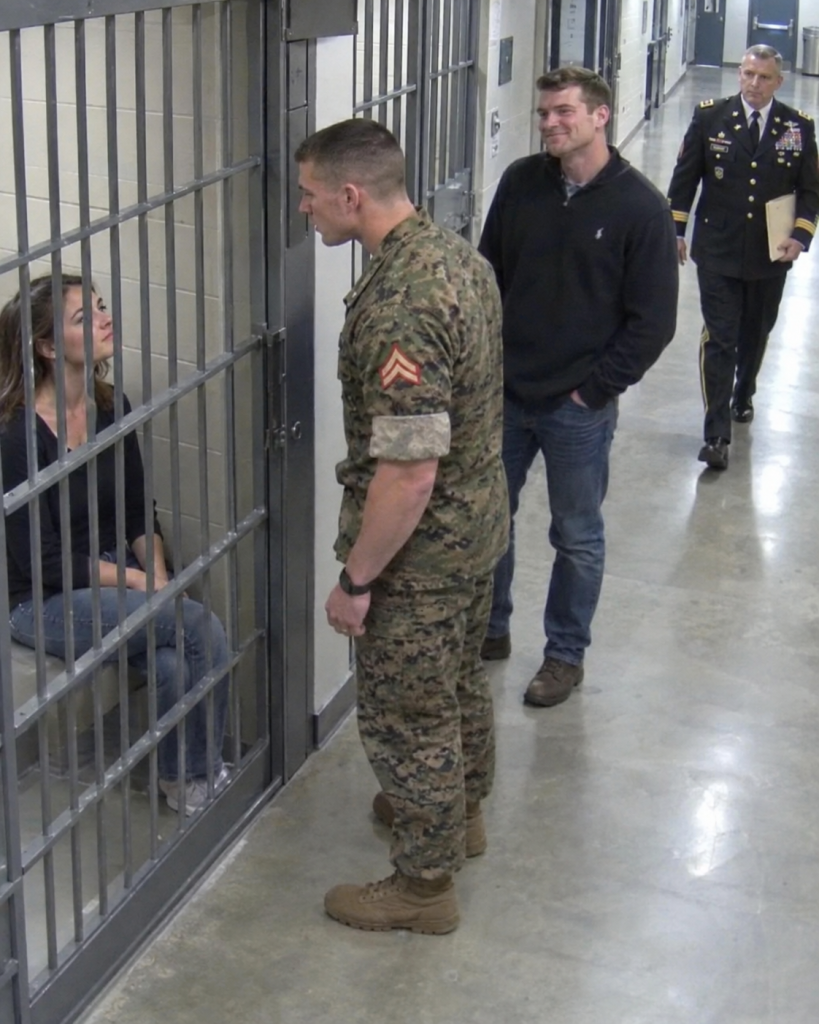
The corporal locked me inside a holding cell on the Marine base I was about to command, and my brother Glenn smiled at me through the bars.
“I told you they’d figure you out,” he said.
I did not answer him.
A few minutes later, the officer of the day walked into the hallway carrying paperwork, looked through the bars, and stopped so suddenly that even Glenn noticed.
That moment had begun hours earlier with a decision that seemed simple at the time.
I had arrived at the installation in civilian clothes because I wanted to see the place before anyone had time to polish it for me.
No escort waited beside my car.
There was no convoy, no formal reception, and no carefully arranged line of people ready to tell an incoming commander exactly what they thought she wanted to hear.
I wanted the ordinary version of the base.
I wanted to see the gate as it operated on a regular day, watch how Marines spoke to one another when they thought no senior leader was listening, and get a feel for the place before ceremony changed the atmosphere.
So I drove my old sedan.
My official orders were with me, along with the newly reissued credential I expected to use at the gate.
Glenn sat in the passenger seat.
Bringing him had been my second decision, and it was the one I would think about much longer.
He had been making jokes about my career since I was eighteen years old.
When I first told my family that I wanted to earn a Marine Corps commission, my father laughed at the dinner table.
Glenn laughed with him.
He called it “playing dress-up for the government,” a phrase that somehow survived every year that followed.
I remembered how quickly everyone at that table had joined in, as if my plan were not something I had thought carefully about but a joke I had accidentally told.
At eighteen, I believed achievement would eventually settle the argument.
I believed that if I worked hard enough, stayed long enough, carried enough responsibility, and earned enough trust, the people closest to me would eventually have to reconsider the version of me they had built when I was young.
That belief followed me longer than I like to admit.
When I became a captain, Glenn said I pushed paperwork while real Marines did the work.
When I reached lieutenant colonel, he said I had simply become better at wearing the costume.
Every promotion gave him another opportunity to turn something difficult into something small.
He could reduce years of work to a punch line in half a sentence.
I learned not to argue with him in public, but privately I kept expecting some future accomplishment to be the one he could no longer dismiss.
Then I was selected for a star.
Even after that, some stubborn piece of me wanted my younger brother there when I arrived at the installation I was about to command.
I wanted him to see where thirty years of service had led.
More than that, I wanted one moment in which he looked around, understood what had happened, and had absolutely nothing clever to say.
That was why he was in the passenger seat when we reached the gate.
I handed over my credential expecting nothing more dramatic than the routine inconvenience of entering a new installation with recently updated paperwork.
The scanner rejected it.
Corporal Jared Brandt looked at the card, tried again, and frowned.
He was twenty-two years old and had been standing watch alone for only two weeks.
I did not know those details when I first rolled down the window, but I would learn enough during the encounter to understand that he was inexperienced, cautious, and suddenly confronted with something that did not fit the simple categories he had expected that day.
“Ma’am, this card is invalid,” he said.
I asked him to check the orders I had brought with me.
Then I asked him to make a call.
The command group or the protocol office could clear up the problem quickly.
Nothing about the situation required a confrontation.
A credential had failed.
There was a straightforward way to confirm my identity and authority without anyone losing face.
Brandt did not take it.
He looked at me, then at the documents, and his expression hardened with the confidence of someone who believed he had already solved the problem in front of him.
“You are not entering my base with a fake story,” he said.
The words were almost more surprising than the scanner failure.
I kept my voice level and again told him that one phone call would settle the matter.
He refused.
“Until someone tells me different, you’re going to wait.”
Behind me, Glenn was smiling.
I could see it before I turned completely toward him.
It was the same half-smile he had used for decades whenever something happened that he believed confirmed his opinion of my career.
That expression hurt more than Brandt’s suspicion.
The corporal did not know me.
He saw a civilian woman with a credential that would not scan, an unusual claim, and paperwork he did not yet trust.
Glenn knew thirty years of the story and still preferred the joke.
The situation moved from the gate to a holding area.
Then the door closed behind me.
The cell was cold, brightly lit, and almost offensively ordinary.
Fluorescent lights buzzed overhead.
A steel bench ran along one wall.
There was no dramatic sense of danger in the room, which somehow made the humiliation sharper.
It was simply a place designed to keep someone contained until the people outside decided what should happen next.
I sat on the bench and listened to the lock settle.
Thirty years of service had given me harder days than that one.
I had dealt with longer nights, heavier responsibilities, and decisions involving people who needed me to remain steady whether I felt steady or not.
I had learned to control my expression when anger would only make a situation worse.
I had learned that leadership often meant carrying the emotion of a room without allowing your own emotion to control the next decision.
Yet sitting in that holding cell felt personal in a way those harder days had not.
The reason was standing on the other side of the bars.
Glenn walked closer.
He did not look worried for me.
He did not look confused about how a simple credential problem had turned into confinement.
He looked satisfied.
“Thirty years of dress-up,” he whispered. “And this is where it ends.”
For most of my life, a remark like that would have triggered an immediate defense in my head.
I could have listed deployments.
I could have listed commands.
I could have talked about nights away from home, responsibilities Glenn had never seen, and people who had trusted me when the consequences were real.
I could have told him about decisions that never made it into family conversations because the work was not something I needed to turn into a performance.
I could have reminded him that a career does not last thirty years because everyone involved is pretending.
There had always been another fact available.
There had always been another accomplishment I could hold up and say, See? Does this count yet?
Sitting on that steel bench, I realized how exhausted I was by the question.
My hands rested together in my lap.
For the first time, I felt no urgent need to convince him.
That surprised me more than the locked door.
I had spent years imagining that respect would arrive after the next milestone.
The next promotion would settle it.
The next command would settle it.
The next visible proof would force the people who had mocked me at eighteen to admit that they had been wrong.
But Glenn had never lacked information.
He had watched enough of my life to know that the joke no longer matched reality.
What he lacked was the willingness to give up the joke.
That was different.
A person can correct a misunderstanding when new information arrives.
It is much harder to correct a story someone has chosen because the story gives them something they do not want to lose.
For Glenn, dismissing my career had become part of the way he understood both of us.
If I was merely playing dress-up, then he never had to reconsider the years he had laughed.
He never had to ask whether the older judgments at our family table had been unfair.
He never had to admit that the sister he had reduced to a punch line had built a life of responsibility he had refused to see clearly.
That was his burden, not mine.
The realization did not arrive as a speech.
I did not stand up and tell him what I had learned.
I simply stopped preparing a defense.
Glenn waited for one anyway.
He had spent thirty years learning exactly which comments could pull me into explaining myself.
This time, I gave him nothing.
The silence changed his expression slightly.
Not dramatically.
He was still amused, still confident that the scene at the gate had proven something important, but now he had to stand there without the familiar argument that normally followed his insult.
I looked past him toward the hallway.
There was still an administrative problem to solve.
My credential had failed, the corporal had refused to verify my documents through the obvious channels, and I was now sitting behind a locked door on an installation preparing for my arrival.
Those facts would eventually have to meet one another.
I did not know exactly how long it would take.
I only knew I no longer needed Glenn to understand them first.
Then I heard footsteps approaching.
They were not hurried.
Someone was walking down the hallway with the purposeful pace of a person carrying out an ordinary task.
Corporal Brandt shifted his attention toward the sound.
Glenn glanced over his shoulder.
I remained seated.
The officer of the day entered carrying paperwork.
At first, nothing about his movement suggested that he expected trouble.
He looked down at the page in his hand and then toward the holding area.
His eyes found my face.
Then they returned to the paperwork.
He checked the name.
He looked at me again.
His posture changed immediately.
It was a small physical reaction, but everyone in that narrow hallway could see it.
He did not need a speech from me.
He did not need Glenn’s opinion.
He did not need to debate whether I looked like the person he had expected to arrive.
The paperwork in his hand and the woman sitting behind the locked door belonged to the same story.
The installation had been preparing for the arrival of its incoming commander.
That commander was now sitting in a holding cell because the newly reissued credential she presented at the gate had failed to scan.
For the first time since we arrived, the situation was being seen by someone who already understood the larger context.
The officer’s attention moved from me to Corporal Brandt.
Brandt stood a little straighter.
I could almost see the moment when the young corporal began reconsidering the certainty that had brought us there.
The problem was no longer a stranger telling an improbable story at the gate.
Now the officer of the day was looking at the same stranger and reacting as though he recognized exactly what had gone wrong.
Glenn noticed it too.
His half-smile did not vanish all at once.
First, he looked at the officer.
Then at me.
Then at the paperwork.
He had spent the last several minutes treating the holding cell as the final proof that his thirty-year joke had been right.
But the meaning of the room was changing in front of him.
I still said nothing.
That was the part I would remember most clearly.
Not the scanner.
Not the fluorescent lights.
Not even Glenn’s whispered line through the bars.
I remembered sitting still while the truth finally entered the room without needing me to drag it in behind an argument.
For years, I had believed that defending myself was part of earning respect.
If someone diminished the work, I explained the work.
If someone mocked the rank, I explained the responsibility behind it.
If someone suggested that thirty years had been a costume, I mentally assembled thirty years of evidence.
In that hallway, the evidence was not mine to present.
It was already there.
The officer of the day knew whose arrival the installation had been preparing for.
He knew the name printed on the paperwork.
He knew the person he was looking at should not have been sitting behind those bars.
That recognition carried more weight than any defensive speech I could have given Glenn.
And because I had stopped trying to control what my brother believed, I could finally see the moment for what it actually was.
Corporal Brandt had made a serious judgment based on incomplete verification.
Glenn had taken that mistake and turned it into emotional entertainment because it supported a story he had been repeating since we were teenagers.
The two things were not the same.
One was an error that could be confronted with facts and responsibility.
The other was a relationship pattern I had spent too many years trying to repair by becoming more impressive.
My new command would require me to deal with the first problem carefully.
My life outside that command would require me to think differently about the second.
The officer looked at Brandt again.
No one laughed now.
The hallway seemed suddenly smaller, not because anything physical had changed, but because everyone understood that the next sentence mattered.
Brandt’s earlier certainty was now exposed to a person who knew the context he had refused to verify.
Glenn’s certainty was exposed too.
He had wanted the locked door to mean that thirty years of service had finally been revealed as pretend.
Instead, he was watching someone with direct knowledge recognize me before I said another word.
For once, there was nothing I needed to list.
No deployments.
No commands.
No promotions.
No explanation of what the star meant or what responsibilities would come with the position I was about to assume.
The truth had become visible without my help.
I looked at Glenn through the bars.
His eyes were no longer fixed on me with that easy amusement.
He was watching the officer.
Maybe he was trying to decide what the reaction meant.
Maybe he already understood.
Either way, I did not rescue him from the uncertainty.
The officer stepped closer.
He looked once more at the name on the paperwork, as though confirming what he already knew.
Then he faced Corporal Brandt fully.
That was the instant everything Glenn had been enjoying about the situation finally turned against the assumption behind his smile.
Not because I had demanded recognition.
Not because I had raised my voice.
Not because my brother had suddenly decided to defend me.
The shift came because reality had reached the room, and reality did not require Glenn’s permission.
I had spent decades hoping one final accomplishment might make my family see me differently.
Sitting behind those bars, I understood that I had been asking the wrong question.
The real question was not how much I had to accomplish before Glenn respected my life.
It was how long I was willing to keep treating his refusal as a problem I was responsible for solving.
The officer of the day drew a breath.
His eyes stayed on Corporal Brandt.
Glenn stood beside the bars, suddenly quiet.
And then the officer began to speak.