Our newly adopted daughter barely reacted to her bedroom, her books, or the rest of the house.
She didn’t ask where the snacks were. She didn’t want to know where the television was. She didn’t even seem particularly interested in the room we’d spent weeks preparing for her.
There was only one thing she wanted to see.
The basement.
At first, I thought it was simply an odd childhood curiosity.
Then, the next morning, I found her sitting there alone in her wheelchair, staring at a sealed section of the wall.
And when she finally spoke, I realized this child knew something about our home that my husband and I had never known.
My husband, Daniel, and I had spent nearly three years trying to adopt a child.
Three years of paperwork.
Three years of interviews, home visits, classes, background checks, false starts, and cases that looked promising until they suddenly weren’t.
It had been an emotional rollercoaster that taught me one painful lesson: never let one good meeting become an entire imagined future.
So when we first met Ava, I tried to keep my expectations under control.
Then she rolled into the room.
She looked straight at me with those serious gray eyes, and something inside my heart shifted.
She was nine years old.
Small for her age.
Thin.
Careful.
And remarkably self-contained.
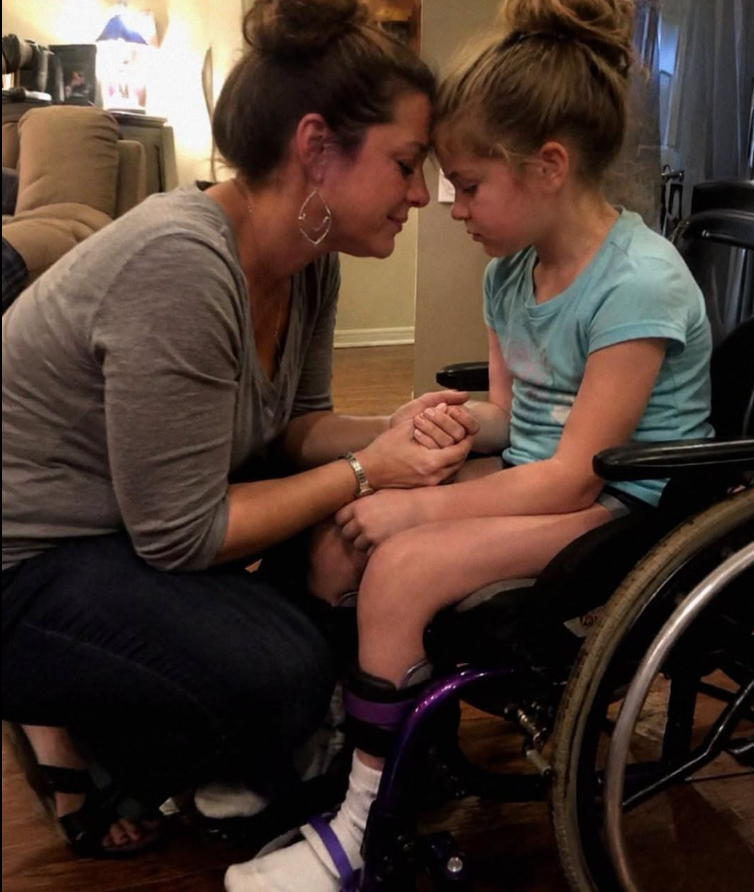
Ava used a wheelchair because of a spinal injury she had suffered as a toddler. The social worker assigned to her case, Beth, described her as bright, observant, and slow to trust new people.
She also warned us that Ava had already experienced enough placements that she rarely reacted strongly at first, even when she was interested in something.
“She watches before she decides,” Beth told us.
She was right.
When Daniel and I first met Ava, she barely spoke.
She answered our questions politely and without much emotion.
She told us she liked drawing, lemon ice pops, and books about animals.
She didn’t smile often.
But then Daniel accidentally knocked over a cup of coffee.
He immediately apologized to the table as if the table itself had feelings.
Ava looked down quickly.
I caught the smallest hint of a smile.
That tiny moment was enough for me.
Six months later, after more home visits, more classes, more forms, more waiting, and one stretch when I thought I might lose my mind from trying so hard not to hope too much, we finally brought her home.
I expected nerves.
Maybe tears.
Maybe silence.
Instead, Ava spent almost the entire drive staring out the window as if she were searching for something she couldn’t quite name.
I tried to talk to her without overwhelming her.
“Your room is painted light green,” I said. “We thought you might want to choose another color later, but we didn’t want it to feel too empty.”
She nodded.
From the driver’s seat, Daniel added, “And if you hate green, we can paint it any color you want.”
Ava didn’t answer.
I twisted around in my seat and gave him a look.
“No need to push.”
“Yeah,” he said quickly. “No pressure.”
Ava continued watching the road.
I told myself not to read too much into her silence.
The first days were strange.
First days were filled with shock, politeness, nerves and adrenaline.
Still, when we pulled into the driveway of the old brick house Daniel and I had purchased the year before, I felt that nervous flutter in my stomach all over again.
This was the deeper fear.
What if we loved her with our whole hearts, but she never felt safe enough to believe us?
The house had belonged to an older man named Walter.
He had died several years earlier, and the property had gone through an estate sale before eventually being auctioned.
We had gotten it for less than expected because it needed considerable work.
But the structure itself was solid.
It had wide hallways, a first-floor bedroom, and a basement we’d converted for accessibility.
Daniel and his brother had built ramps off the back deck, and the dry, unfinished basement was mostly used for storage.
When we got inside, I showed Ava around slowly.
The kitchen.
The living room.
The downstairs bathroom with its widened doorway.
Then her bedroom.
There was a reading lamp beside the bed and empty shelves waiting for books she didn’t own yet.
Ava barely reacted.
Then, as we stood in the hallway, she looked up at me.
“Can I see the basement?”
I actually laughed a little because I was so surprised.
“The basement?”
She nodded.
“Sure,” I said. “Later, though. It’s mostly boxes and old tools.”
To my surprise, she looked disappointed.
It wasn’t dramatic.
She didn’t pout or complain.
It was simply a brief, visible drop in her expression, as if something important had just been postponed.
For the rest of the evening, she barely spoke.
Daniel made spaghetti because it was one of the few meals every child we’d hosted before had tolerated.
Ava ate quietly and thanked him after nearly every little thing.
Twice, I caught her looking toward the hallway where the basement door was.
Later that night, after we’d settled her into bed with a pile of library books she didn’t touch, I went downstairs.
Daniel was in the kitchen rinsing dishes.
“So,” I said, “that was weird, right?”
He looked over his shoulder.
“The basement thing?”
“Yes. What nine-year-old asks to see a basement before asking where the snacks are?”
He shrugged.
“Maybe she’s curious.”
“Mmmh. Maybe.”
He dried his hands and leaned against the counter.
“Claire, today was huge for her. If she fixated on one odd detail, it doesn’t automatically mean something’s wrong.”
“I know.”
And I did know.
But something still felt off.
That night, I slept lightly.
I imagine that’s what all new mothers do, even adoptive mothers who aren’t ready to say the word “mother” out loud yet because it feels too sacred to claim too soon.
When I woke the next morning, it was barely after six.
Daniel was still asleep beside me.
The house was silent.
Then I glanced at the baby-monitor-style camera feed we’d set up in Ava’s room for the first week.
We had asked for permission first and explained to Ava that she could unplug it whenever she felt comfortable.
Her bed was empty.
The camera was still on.
My entire body snapped awake.
I got out of bed so quickly that I nearly tripped over the rug.
At first, I thought she’d gone to the bathroom.
Maybe she’d gone downstairs looking for a snack.
Then my mind, cruel and efficient, jumped immediately to the worst possibility.
She had left.
She had panicked during the night and tried to get outside alone.
I checked the hallway.
The bathroom.
The kitchen.
She wasn’t there.
Then I heard it.
A faint metallic sound.
Coming from the basement.
I don’t think I’ve ever moved that fast in my life.
I rushed to the basement door, already calling her name, and pulled it open.
At the bottom of the ramp, sitting in the middle of the basement, was Ava.
She was in her wheelchair.
The overhead light was on.
And she wasn’t looking at me.
She was staring at the far wall.
More specifically, at a section of old brick that was partially hidden behind a metal shelving unit we’d pushed there months earlier.
When she heard me, she raised one hand.
Then she pointed toward the wall.
Her voice was calm.
Almost puzzled.
“That’s not where you hid it last time.”
I stopped so abruptly that I had to grab the banister.
“What?”
Ava slowly turned toward me.
For the first time since we’d met her, she looked openly confused.
Almost frightened.
“The box,” she said.
“That’s not where you hid it last time.”
My heart began pounding so hard I could feel it in my throat.
“When, Ava?”
I stared at her.
“We’ve never been in this basement together.”
She looked at me.
Then, right before my eyes, the color drained from her face.
She looked from me to the wall.
Then back to me.
Her voice became small and shaky.
“I know this house.”
Fear and understanding hit me at exactly the same time.
How could she possibly know this house?
I slowly made my way down the ramp and knelt in front of her.
“What do you mean?”
Ava’s eyes filled with sudden tears.
She seemed embarrassed by them.
“I didn’t know,” she whispered. “I thought maybe I was wrong.”
She looked back at the wall.
“But there was no ramp here. Not here or outside. There were just stairs. The kitchen wasn’t painted, and my room is different.”
She swallowed.
“But the hallway is the same.”
Her eyes moved toward the basement door.
“And the basement door sounds the same.”
The only explanation that made any sense was that she’d been here before.
Just not with us.
“Sweetheart,” I said carefully, “did you live here before?”
Ava pressed her lips together.
“I think so.”
She paused.
“Probably with my mom.”
Behind me, I heard Daniel coming down the stairs.
“Claire?” he called.
Then he saw Ava.
He stopped.
“What happened?”
I looked up at him.
“I think she used to live here.”
He stared at me.
Then he looked at Ava.
“What?”
Ava was becoming increasingly frantic, as though she were trying to pull a stubborn memory out of the back of her mind.
“My mom and I used to keep a box here,” she said.
“She told me more than once to remember the wall in case she wasn’t there one day.”
Her voice trembled.
“She said it was important.”
Daniel came the rest of the way down and crouched beside me.
“Ava,” he said gently, “what was your mom’s name?”
“Marie.”
I looked at Daniel.
We knew no Marie.
Everything we’d been told was that Ava’s mother had died in the car accident that left Ava using a wheelchair.
And the previous owner of our house wasn’t listed as Marie.
It was listed as Walter.
Then I remembered something.
Before the house was cleared, I’d taken photographs.
I pulled out my phone and searched through them until I found one that showed a portrait of Walter.
I zoomed in.
“Do you remember him?” I asked.
Ava stared at the picture.
Her eyes widened.
“That’s…”
She hesitated.
“That’s Granddad.”
The basement suddenly seemed much quieter.
None of us moved.
Then Ava turned back toward the wall.
“There should be a box here,” she said.
There was no uncertainty in her voice this time.
She was certain.
Daniel and I moved the heavy shelving unit together.
Ava watched us closely, breathing faster with every second.
Behind the shelving, one section of brick looked slightly different.
It wasn’t obvious at first glance.
But once you knew what to look for, you could see it.
One line of mortar was newer than the rest.
Daniel went to the workbench and returned with a hammer and flathead screwdriver.
My hands were shaking too badly to do much more than hold the flashlight.
When the first brick finally came loose, we saw a hollow space behind the wall.
And inside that space sat a metal lockbox.
It was dull with dust.
I looked at Ava.
“Is this it?”
She nodded.
Her eyes were enormous.
The box wasn’t locked.
Daniel placed it on the floor and opened it carefully.
Inside were two thick bundles of letters tied with ribbon.
A packet of savings bonds sealed inside a plastic sleeve.
Several photographs.
And a small stuffed rabbit with one missing button eye.
Ava made a strangled sound.
She reached into the box and pulled the rabbit against her chest.
“My bunny.”
That was when I started crying.
I didn’t understand everything yet.
But suddenly, the strange basement fixation made perfect sense.
This child hadn’t been obsessed with a random room.
She had been carrying one broken piece of memory for years.
And somehow, that memory had led her home.
The first letter sat on top.
It was written in neat handwriting.
The envelope read:
“For Ava, when she’s old enough.”
I looked at Ava.
“Do you want me to read it?”
She nodded without speaking.
So I did.
“My dearest girl, if you are reading this, then something happened before I could put these things directly in your hands. I hope that isn’t true.”
“I hope I am sitting beside you one day, laughing that I was ever dramatic enough to hide letters in a basement wall.”
“But your grandfather is drinking and gambling again, and I do not trust him with money or with promises when he is like this.”
“So I am making sure you will be sorted if anything ever happens to me. I am all you have, and even when I am not here, I will hold your hand.”
My voice broke on the final line.
Marie had written letter after letter over several years.
Some were practical.
Others were deeply personal.
The savings bonds had been purchased from a lawsuit settlement after Marie had been wrongfully fired because of gender discrimination.
She had written that the money was for Ava’s future.
For school.
For training.
And, if there was anything left after that, to help Ava start a life of her own.
Maybe renting an apartment.
Maybe starting a business.
Whatever she wanted.
Marie wanted the money to belong to Ava.
She didn’t want her daughter dependent on Walter’s gambling and alcoholism, which often left him drowning in debt.
Suddenly, so much of the mystery surrounding the house began to make sense.
The previous owner, Walter, had died after his life had spiraled downward.
He had left behind enormous debts.
It had taken time for the estate to be settled and for much of the property to be auctioned.
Eventually, the house was sold to us.
And we had walked into it without ever knowing whose grief had once lived behind those walls.
Marie’s letters were candid, tender and beautiful.
They read like a journal documenting Ava’s childhood.
She wrote about Ava’s first day of preschool.
She wrote about Ava insisting on wearing red rain boots in the middle of summer.
She wrote about a camping trip in the backyard when they ate marshmallows that tasted mostly like smoke and sugar.
She wrote about how Ava stayed awake trying to identify stars, most of which she had completely invented.
Marie wrote because she loved the little details.
She wanted her daughter to one day be able to look back and see her childhood through those words.
She wrote that it was unfair that we barely remembered so much of our childhood, even though those years contained some of our happiest moments.
Then I came across one line that stopped me.
“Your existence brings me so much joy.”
By the time I finished reading that letter, Daniel was openly wiping tears from his face.
Ava sat completely still in her wheelchair.
She clutched the rabbit to her chest.
She listened as if every word were a hand reaching through the years to find her.
Over the next several hours, more pieces of the story began falling into place.
We called Beth, the social worker.
She pulled Ava’s records and confirmed what none of us had known.
Ava’s full legal records had been sealed because of the accident, the death of her mother and the later death of Walter.
Beth knew Ava had entered state care after her grandfather died.
But she had never connected Walter’s old address to the house we now owned.
The adoption system, like most complicated systems, wasn’t designed for poetic coincidences.
Walter had apparently fallen apart after Marie died.
His drinking and gambling worsened.
He neglected Ava.
By the time he suffered a stroke several months later, the house was already facing foreclosure and was buried under liens.
Ava entered state care.
The estate was liquidated.
The house was eventually auctioned.
Three years later, Daniel and I bought it.
We had absolutely no idea whose history was still hidden inside its walls.
After we found the box, I worried constantly that Ava would spiral.
I worried that recovering so much of her past at once would be too painful.
But something unexpected happened.
The opposite.
She softened.
She was still Ava.
Still observant.
Still careful.
But a tension I hadn’t even realized she’d been carrying began to disappear.
I think those letters gave her something that no social worker’s report and no official case file ever could.
They gave her proof that she had been deeply loved before everything fell apart.
And knowing that you were loved matters more than people realize.
At night, I began reading one or two letters aloud whenever Ava asked.
Sometimes she wanted the funny ones.
Sometimes she wanted the practical ones.
Once, after I finished reading a letter in which Marie described teaching Ava to paint with her fingers because “brushes do not bring our originality,” Ava spoke quietly.
“In state care, it is easy to forget your life before.”
She looked down.
“The love and care it had. So everything doesn’t hurt so much.”
I sat on the edge of her bed.
“You don’t have to forget anything here.”
I paused.
“We promise to care for you and love you just as much as your mother did.”
Ava nodded.
Her face seemed to brighten a little more every day.
Children don’t only grieve what they lose.
Sometimes they grieve the stories they have to invent in order to survive the loss.
A week after we discovered the box, Daniel took the savings bonds to the bank with an attorney Beth had recommended.
They were real.
They were valid.
It wasn’t a fortune, but it was enough to matter.
Once properly managed and matured, the money would help cover college or vocational training and give Ava a financial start when she was older.
When Daniel told her, Ava stared at him.
“She did that for me?”
“She did.”
Ava looked down at her hands.
“She loved me.”
Daniel sat down on the floor beside her wheelchair.
“She did.”
Then he smiled.
“And now we will too.”
That was the first time Ava reached for him without being asked.
She hugged him tightly.
It nearly broke him.
A month later, I asked Ava whether she wanted to see more of the old house with us.
The attic.
The back garden.
The closet beneath the stairs.
She said yes.
We moved slowly.
As we walked through the house, she began telling us what she remembered in fragments.
She remembered her mother singing in the kitchen.
She remembered that, before her grandfather became seriously ill, he carved pumpkins and told ridiculous stories about ghosts.
She remembered her mother covering the living room windows with blankets when thunderstorms rolled in.
And she remembered the basement.
Marie must have taken her down there at least once.
That was probably when she showed Ava the hiding place and told her:
“Remember this.”
I asked Ava if she remembered the accident.
She shook her head.
“Only after.”
She paused.
“The hospital. People talking around me. And bits about my mother’s funeral.”
That seemed to be enough.
The truth was, I had spent years imagining adoption as a single moment.
A child enters your home.
You love them.
They become yours.
Everything somehow becomes clean and simple.
That isn’t how it works.
At least it wasn’t for us.
Ava came to us carrying an entire life that had existed before we knew her.
She had a house she already remembered.
A mother she still loved.
A history that didn’t disappear simply because Daniel and I wanted to build a new future with her.
What changed wasn’t that her past vanished.
It was that her past finally had a place in her present.
By Christmas, Ava had opinions about everything.
She had opinions about which mug was hers.
Which blanket belonged in the living room.
Which cereal Daniel always forgot to buy.
She had also started drawing again.
Most of her drawings were pictures of rooms, doorways, walls and windows filled with light.
One afternoon, I found her sketching the basement.
But she wasn’t drawing the hidden compartment.
She wasn’t drawing the wall.
She was drawing the three of us standing around the open box.
She had drawn Daniel much taller than he actually was.
She had given me ridiculous hair.
And she had drawn herself holding the stuffed rabbit like a queen holding court.
At the top of the page, she’d written in careful block letters:
“My Family.”
I looked at her.
“Can I keep it?”
She shrugged in that deliberately casual way children use when something matters far more than they want you to know.
“Yes.”
A few months later, Ava said something I’ll never forget.
We were sitting together in bed reading another one of Marie’s letters.
This particular letter was about Ava’s second birthday and how she’d demanded cake for breakfast.
Ava was smiling when she suddenly looked up at me.
“I think my mom would like you.”
For a second, I couldn’t speak.
“You think so?”
“She would,” Ava said matter-of-factly.
Then she added:
“You read her letters to me.”
I had to look away.
That was somehow the highest praise anyone had ever given me.
It has been two years now.
Ava is 11.
She still uses her wheelchair, although she is stronger than anyone expects.
She is also absolutely ruthless at board games, which I secretly respect.
Daniel is still trying to learn how to braid hair.
He is also still failing spectacularly at keeping his pancake-flipping ambitions within safe limits.
I still keep Marie’s letters in a fireproof box.
Except for the rabbit.
That lives on Ava’s bed now, with all the dignity of a survivor.
The savings are in a protected account for her future.
And the basement wall?
We repaired it.
But we deliberately left one brick loose.
Not to hide secrets anymore.
To remember that sometimes, things buried inside a family are meant to be found.
Ava came into our lives carrying one broken piece of memory and a fear she couldn’t explain.
She asked to see the basement because some part of her still remembered it, despite everything that had happened during her childhood.
She was right to follow that instinct.
In the end, what Marie left behind wasn’t just money.
It wasn’t just legal documents.
It wasn’t even proof of what had happened.
She left her daughter a trail back to something more important.
A way to remember that she had been loved.
A way to reconnect with the little girl she had once been.
And, somehow, that trail led Ava back to the house where her mother had tried to protect her.
We were simply lucky enough to be waiting at the end of it.