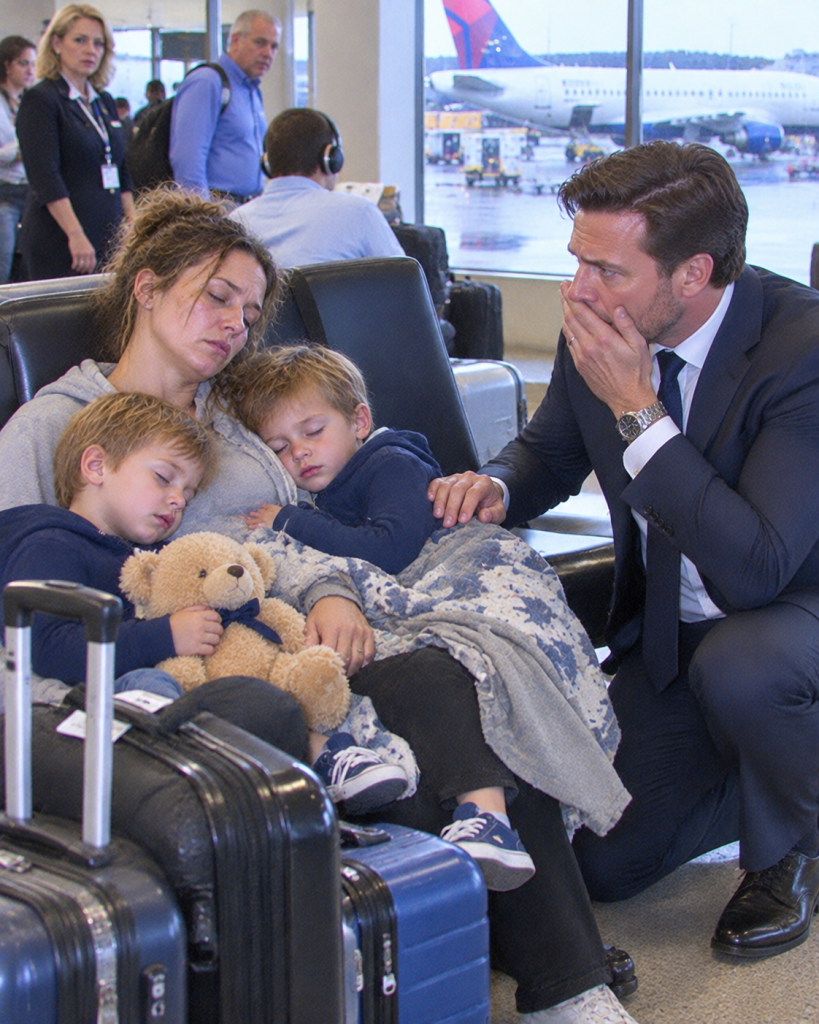
My punctuality as a forty-four-year-old resort owner was tested when a thirty-five-minute mechanical delay struck Terminal 2 at Minneapolis-Saint Paul International Airport. I was scheduled to fly to Baltimore to finalize the largest waterfront estate acquisition of my career to expand my portfolio across Miami, Key West, Nashville, and Salt Lake City. Seeking a quiet place to review financials, I noticed a woman sleeping near a scuffed blue suitcase with two young boys. It was Rosalind, the woman who had mysteriously vanished from my life six years earlier while organizing charity galas for my family foundation. My mother, Genevieve, had always insisted that Rosalind left because she felt out of place in our wealthy world.
As I approached, one of the five-year-old boys woke up, revealing my dark wavy hair, my late father’s square jawline, and a distinct notch in his left eyebrow that perfectly matched my own. When Rosalind finally opened her eyes and saw me, she looked completely terrified and pulled her sons close to her chest.
After a tense moment of disbelief, Rosalind revealed that the boys were named Mason and Lucas and confirmed that they were my children. She pulled a thick stack of papers from her bag, which contained returned letters, ignored emails, and a cashier check for sixty thousand dollars signed by my mother.
Rosalind explained that Genevieve had offered her the money to disappear and falsely claimed that I knew about the pregnancy but wanted absolutely nothing to do with them. She added that her landlord had abruptly canceled her lease and my family attorneys had threatened her with harassment charges if she ever reached out.
Just as I was processing this profound betrayal, I received a phone call from my mother ordering me to ignore Rosalind. Turning around in the crowded terminal, I spotted Genevieve standing fifty yards away alongside our senior corporate counsel, Oliver Vance, who was clutching a gray legal folder filled with private investigator surveillance photos of my children.
I immediately confronted my mother and demanded the legal folder from Oliver, threatening to terminate his employment on the spot if he refused to hand it over. Inside the folder, I found intrusive photographs of Rosalind walking the boys to preschool and a drafted legal settlement offering two hundred thousand dollars for her absolute silence.
Rosalind then produced a folded document on my company letterhead from six years ago, which bore my forged signature and stated that I was rejecting her and our unborn children. My mother showed no remorse, claiming she had engineered the separation to protect my future and our family legacy from an outsider.
I immediately contacted my executive team to cancel the massive Baltimore acquisition and instructed my corporate departments to lock down all server backups and mail logs related to my mother and attorney. Oliver finally admitted that Genevieve had instructed his firm to sever all contact and escalate legal threats, assuming she had my full authorization to do so.
Following our airport encounter, Rosalind and I arranged for a court-admissible DNA test that confirmed my paternity at a probability of ninety-nine point ninety-nine percent. I spent hours in my office mourning the five years of birthdays, holidays, and milestones I had missed due to my family’s cruel manipulation.
Our corporate audit quickly uncovered the full extent of the deception, revealing emails where my mother instructed a retired secretary to forge my signature on official documents. Phone records also showed that my mother had intercepted and blocked seventeen incoming calls from Rosalind right after she discovered she was pregnant.
Armed with this undeniable evidence, Rosalind filed criminal complaints for harassment and forgery, which ultimately led to Oliver surrendering his legal license. I systematically stripped my mother of all her corporate power and administrative access, informing her that she would never see her grandsons unless she completed extensive family counseling and earned approval from child psychologists.
Rebuilding a relationship with my sons required immense patience and consistency, as Rosalind had spent six years raising them with the help of her sister, Charlotte. I slowly integrated myself into their daily routines by walking them to preschool, attending Little League games, and learning their unique habits, like Mason’s love for state capitals and Lucas’s fascination with dismantling plastic toys.
Within six months, Rosalind leased a spacious condo just ten minutes from my home, paying her own way while I fulfilled my official child support obligations. While unpacking in their new living room, Mason discovered the old blue suitcase filled with the returned letters that had been intercepted six years earlier.
I assured my son that despite the massive obstacles placed in our path, I was finally exactly where I belonged. A simple thirty-five-minute flight delay completely changed the trajectory of my life, and I now keep one of those returned letters on my desk as a constant reminder of our new beginning.
PART 2
Genevieve’s isolation was absolute, yet her bitterness only festered behind the heavy, wrought-iron gates of her estate. Stripped of her title, her board seat, and her influence, she refused counseling, convinced to her core that time would eventually force me to bend. But time only deepened the roots of my new life. Every milestone—from teaching Lucas how to ride a bike without training wheels to listening to Mason proudly recite the capitals of all fifty states—reminded me of what was stolen, and what I was finally building.
The true breaking point arrived two years later on a crisp autumn evening. A courier delivered a thick, cream-colored envelope bearing the crest of a private hospice facility downtown. Inside was a brief, sterile note from a palliative care physician: Genevieve had been diagnosed with an aggressive, late-stage illness, and her doctors gave her only weeks to live. Enclosed was a single, handwritten line scrawled in my mother’s unmistakable, sharp cursive: Bring my grandsons to see me before it’s too late.
When I showed the letter to Rosalind, her expression was a quiet storm of old trauma and lingering pain. She didn’t demand revenge or forbid me from going; she simply held my hand and said, “Whatever you decide, remember who we had to become to survive her.”
That night, I drove to the decaying estate alone. The grand foyer smelled of dust and unyielding stubbornness. I found Genevieve propped up in a makeshift medical bed in the parlor, looking impossibly small against the velvet cushions. The iron will that had once broken families and forged corporate signatures was now trapped inside a failing, skeletal frame.
She didn’t apologize. Instead, her dull eyes flared with a familiar, desperate pride as she looked at me. “You… you managed to keep the resorts,” she whispered, her voice rattling in her chest. “But you gave everything else to a stranger.”
“She was never a stranger, Mother,” I replied, my voice steady, stripped of the anger I thought I’d always carry. “She was the only real thing in a world you built out of glass and lies. The boys aren’t coming. They will never know the woman who tried to erase them.”
Genevieve closed her eyes, a single tear cutting a path through her wrinkled skin—not of remorse, but of profound defeat. She passed away three days later, entirely alone, wrapped in the cold architecture of her own design.
At the reading of her final will, it was revealed that she had left her personal fortune to a litigious charity foundation, cutting me out completely. But I felt no anger. I walked out of the attorney’s office into the afternoon sunlight, got into my car, and drove straight to Rosalind and the boys.
Mason and Lucas were in the front yard, tossing a baseball back and forth under the golden light of October. When they saw me, they dropped the ball and raced across the grass, their small arms wrapping around my waist. Rosalind stood on the porch, leaning against the railing with a quiet, knowing smile, the old blue suitcase sitting safely in the closet inside—no longer a symbol of lost history, but a reminder of how far we had traveled to find each other.
Epilogue: The Architecture of Us
Ten years have slipped by like the changing tides along the Miami and Key West coastlines where my resort portfolio finally flourished. Time has a gentle way of smoothing jagged edges, turning deep scars into quiet reminders of resilience.
Our lives settled into a steady, beautiful rhythm. Rosalind and I never rushed into marriage, choosing instead to let our bond grow organically, anchored by mutual respect and the shared joy of watching our sons thrive. Last year, in a quiet, sunlit ceremony overlooking the ocean with only Charlotte and the boys in attendance, we finally exchanged vows. Rosalind wore a simple ivory dress, and when I looked at her, I didn’t see the terrified woman holding a scuffed blue suitcase in a crowded airport terminal; I saw my partner, my anchor, and the heart of everything I hold dear.
Mason is now fifteen, a towering, thoughtful young man with his grandfather’s square jawline and a sharp mind for business. He still loves geography, occasionally pulling out maps to pitch eco-friendly resort expansion ideas during our Sunday family dinners. Lucas, at fifteen as well—the two brothers sharing an unbreakable twin-like bond—has channeled his boundless energy into competitive robotics and sketching architectural designs, often building miniature models of the very hotels I manage.
Genevieve’s old estate was eventually sold, the proceeds quietly redirected by court settlement to support single-parent education grants—a poetic twist of fate that turned her accumulated wealth into a lifeline for others. The dark chapter she authored is now just a distant shadow, fading completely beneath the bright, chaotic warmth of our household.
On my office desk, right beside my computer monitor, sits that single yellowed letter from six years ago, preserved beneath a clean glass frame. It no longer carries the weight of betrayal or sorrow. Instead, it stands as a testament to the fact that the most valuable things in life cannot be forged, bought, or erased. A thirty-five-minute flight delay didn’t just alter my schedule that day; it gave me back my family, my future, and the true meaning of home.