Mark’s fingers were inches from the folder when my hand came down over it.
I didn’t slap his wrist away.
I didn’t raise my voice.
Image
I simply placed my palm on the cover before he could take it from Table 31.
Mark looked at my hand, then at me.
For the first time that night, he seemed unsure what version of his sister he was dealing with.
“Don’t,” I said.
One word.
That was enough.
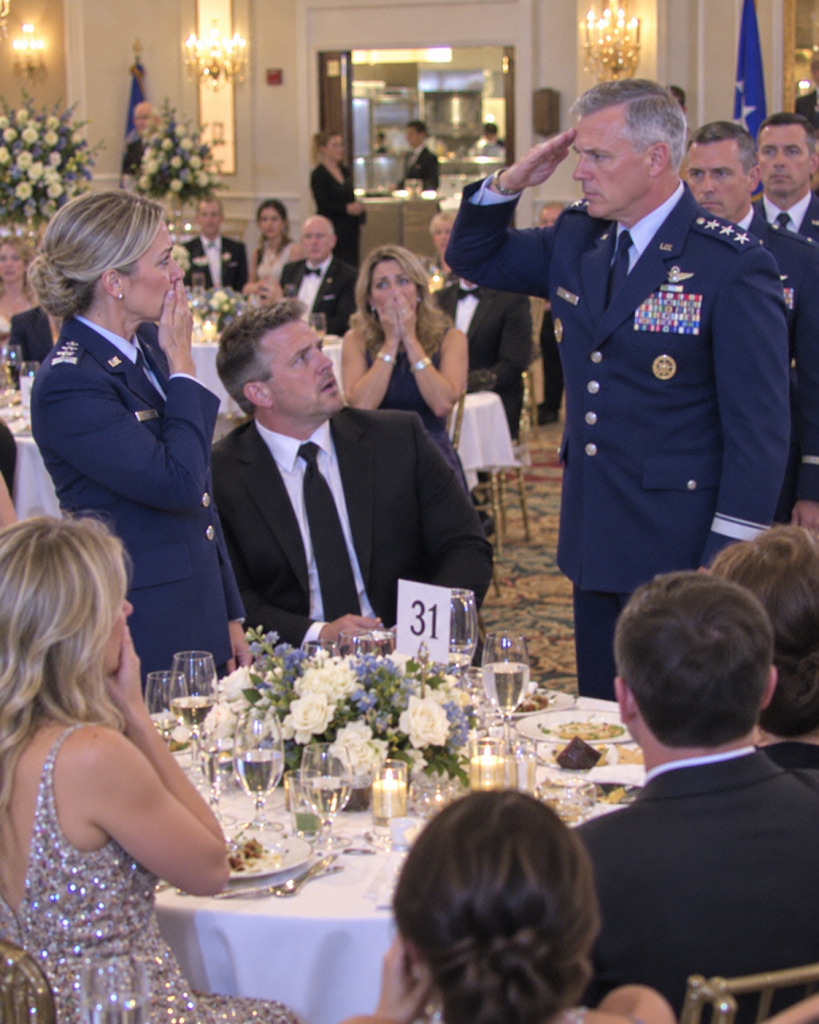
Lieutenant General Nathaniel Vance remained beside me, his posture straight, his expression unreadable in the way senior officers learn to make unreadable look effortless.
The two officers behind him stayed several steps back.
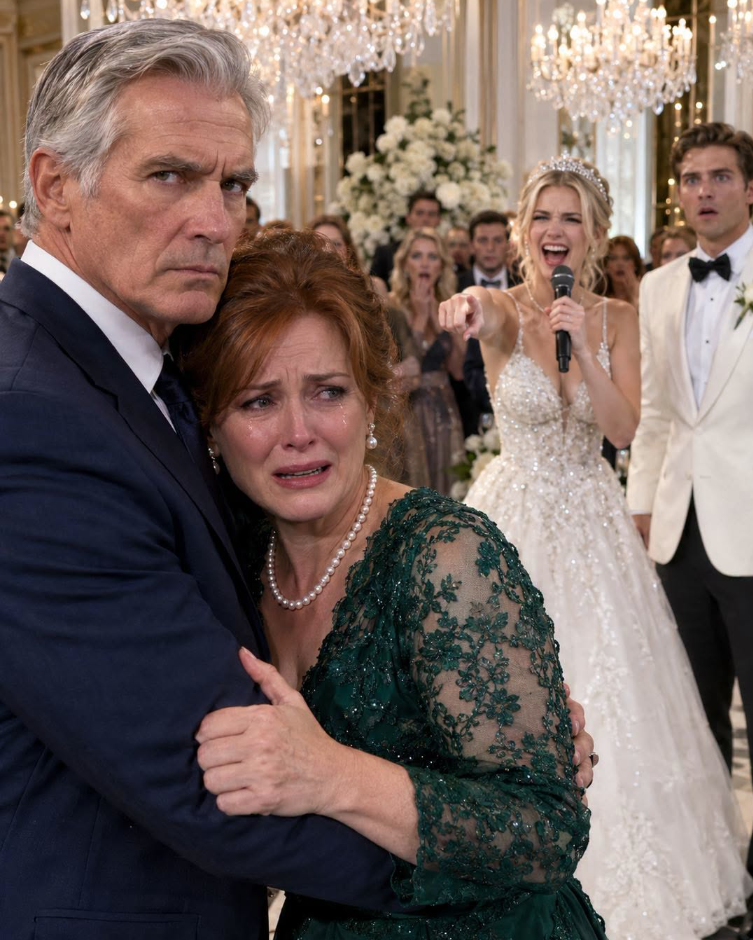
Mark still held the microphone in his other hand.
Four hundred people had laughed when he called me a desk warrior.
Now every sound in the ballroom seemed too loud: a chair shifting, a server setting down a tray, the kitchen door swinging behind me.
My mother stared at the folder under my hand.
My father stared at the three silver stars on General Vance’s shoulders.
Mark stared at me.
“Colonel?” he finally said.
He said it like the word had been put in the wrong sentence.
General Vance turned his eyes toward him.
“Yes.”
Mark gave a short laugh, but there was nothing amused in it.
“That doesn’t make sense.”
My mother found her voice next.
“Maggie, what is he talking about?”
I looked at her.
Twenty years.
Twenty years of questions I had answered vaguely because that was what the job required.
Twenty years of letting my family build explanations around the blank spaces.
At first, their assumptions had almost been convenient.
If Dad believed I answered phones, there were fewer follow-up questions.
If Mom believed I handled paperwork, she didn’t ask why I disappeared for stretches of time or why I sometimes came home looking ten years older than when I left.
If Mark believed I had never really done anything, I didn’t have to decide how much truth I could safely give him.
So I smiled.
I shrugged.
I said, “Something like that.”
And over the years, their misunderstanding hardened into a family fact.
Mark was the pilot.
Mark was the success.
Mark was the one Dad drove eleven hours to watch finish flight training.
I was Maggie.
The quiet one.
The woman who supposedly spent twenty years protecting America from paper cuts.
I had told myself their opinions didn’t matter.
That was only partly true.
You can survive being underestimated.
That doesn’t mean you stop noticing who keeps doing it.
General Vance glanced toward the microphone in Mark’s hand.
“I believe your sister has been very patient tonight.”
Mark’s jaw tightened.
“I was joking.”
“I heard you.”
That landed harder than any insult I could have returned.
Mark looked around the room as if expecting someone to rescue him with laughter.
Nobody did.
A few minutes earlier, he had controlled every face in the ballroom.
He could lift the microphone and make four hundred people follow him wherever he wanted.
Now the microphone looked awkward in his hand.
My father pushed his chair back.
“Maggie,” he said, “why didn’t you tell us?”
There it was.
Not what happened?
Not what did you do?
Why didn’t you tell us?
I almost answered too quickly.
Then I remembered my phone vibrating during dinner.
DECLASSIFICATION COMPLETE. REMAIN AVAILABLE.
I had spent years training myself not to fill silence just because someone else was uncomfortable.
So I let the question sit for a moment.
“There were things I wasn’t allowed to discuss,” I said.
Dad frowned.
“For twenty years?”
“For as long as necessary.”
Mark lowered the microphone slightly.
“So what, you were some kind of secret colonel?”
I looked at him.
“I was a colonel whether you knew it or not.”
A few people near his table shifted in their seats.
He heard them.
Of course he did.
Mark had always been good at reading a room.
The problem was that he had never learned the difference between reading a room and owning one.
He pointed toward General Vance.
“And ‘Halo Six’?”
General Vance didn’t answer for me.
That mattered.
He could have taken over the moment.
He had the rank, the uniform, and the kind of presence that could have turned the entire evening into a speech about my career.
Instead, he left the choice with me.
I looked down at the folder.
“There are parts of my service I can talk about now,” I said. “There are parts I still won’t.”
Mark stared at me as if refusing details somehow proved I was bluffing.
“You expect everyone to just accept this?”
General Vance’s voice remained calm.
“I do.”
Mark looked at him.
The general continued.
“Colonel Sutton served twenty years. She earned her rank. She earned the respect of people who worked beside her. None of that depends on whether her family understood her assignment.”
My mother sat down slowly.
Her face had changed.
Not into admiration.
Not yet.
It was something less flattering and more useful.
Confusion.
She was beginning to understand that the family story she had repeated for years might have been built almost entirely from assumptions.
“But she told us she answered phones,” she said.
I shook my head.
“No. Dad asked if I was still answering phones for Uncle Sam. I said, ‘Something like that.’”
My father looked down.
He remembered.
I could see it.
Mark did too.
“That’s basically the same thing,” he said.
“No,” I said. “It was the answer I could give.”
The kitchen door opened behind me.
A server stepped through carrying a tray, saw the cluster of officers around Table 31, and stopped just long enough to realize she needed another path.
The ordinary movement grounded me.
Steak sauce.
Dinner rolls.
Dishwater.
The same little corner where I had spent the evening being treated as an inconvenience now held the attention of the entire ballroom.
I almost laughed at the absurdity of it.
Mark noticed the change in my face.
“What?”
I looked toward the head table, then back at the number standing upright beside my water glass.
“Table 31.”
He followed my eyes.
His expression hardened.
“That was the seating chart.”
“I heard you at coat check.”
His face stopped moving.
My mother looked at him.
“What does she mean?”
I didn’t answer for him.
Mark rubbed his thumb against the microphone.
“It was crowded.”
General Vance said nothing.
He didn’t need to.
I remembered the coordinator saying, “She’s immediate family.”
And Mark answering, “Technically.”
So I repeated the word.
“Technically.”
Mom’s eyes moved from me to Mark.
“What did you say?”
He exhaled through his nose.
“Can we not turn a seating issue into some huge betrayal?”
I felt something settle inside me.
For years, I had believed the hardest part was keeping secrets.
It wasn’t.
The hardest part was watching people use the silence those secrets required as evidence that there was nothing worth respecting.
“I’m not turning it into anything,” I said. “You already decided what it meant.”
Mark stepped closer.
“Maggie, come on. You never told anybody this stuff. You let us think—”
“I let you not know.”
He stopped.
“That’s different from giving you permission to humiliate me.”
The words were quiet.
They carried anyway.
My father sat down again.
He suddenly looked tired.
“I should have asked more,” he said.
I turned toward him.
It would have been easy to punish him right then.
I had twenty years of material.
The missed ceremonies.
The eleven-hour drive for Mark.
The jokes.
The way he had introduced me to people as his daughter who “worked some office job for the Air Force.”
But revenge would have made the moment simpler than it really was.
Dad had been careless with me.
That didn’t mean he had known what he was dismissing.
“You could have,” I said.
He nodded once.
No defense.
That meant more than a speech would have.
My mother’s eyes filled, but she didn’t make the evening about her feelings.
That surprised me.
She looked at the floor where the champagne glass had shattered.
Then at me.
“I told you to be a good sport.”
“Yes.”
Her mouth tightened.
“I’m sorry.”
I accepted the sentence without rushing to comfort her.
Mark watched that exchange and seemed to realize the room was moving away from him.
He brought the microphone back toward his mouth.
I saw the instinct before he spoke.
Control the room.
Explain it.
Make it funny.
Turn the whole disaster into one more performance.
General Vance saw it too.
But I moved first.
I held out my hand.
“Give me the microphone.”
Mark blinked.
“What?”
“You wanted me to stand up.”
A murmur moved through the nearest tables.
Mark looked at the microphone.
Then at me.
For a second, I thought he might refuse simply because everyone was watching.
Instead, he handed it over.
The weight of it surprised me.
Not because it was heavy.
Because twenty minutes earlier, it had been his weapon of choice.
Now it was just an object in my hand.
I turned toward the room.
Four hundred faces looked back.
I had spoken in rooms where mistakes mattered far more than embarrassment.
I had made decisions while exhausted, frightened, and responsible for people whose families would never know my name.
Still, this room felt different.
These people had just laughed at a version of me my own family had created.
I could have corrected every lie.
I could have listed titles.
I could have made Mark feel as small as he had tried to make me feel.
I didn’t.
“My brother is right about one thing,” I said.
Mark’s head lifted.
“I did spend twenty years in the Air Force.”
A few nervous smiles appeared and disappeared around the room.
“And for most of those twenty years, my family did not know exactly what I did.”
I looked toward my parents.
“That was not because I was ashamed of my work.”
Then I looked at Mark.
“And it was not because there was no work worth talking about.”
The ballroom stayed quiet.
“I kept things private because I was required to keep them private. I got good at it. Maybe too good.”
I paused.
“But privacy is not the same as insignificance.”
I stopped there.
One sentence was enough.
I did not give them a war story.
I did not offer details from desert nights or broken radio calls.
I did not turn people I had served beside into supporting characters in a family argument.
Those memories belonged to more than me.
I handed the microphone back to Mark.
He took it automatically.
His eyes stayed on mine.
“You really flew?” he asked quietly.
The question was so small compared with everything he had said that I almost smiled.
I remembered my aircraft shaking through desert storms.
I remembered voices fighting through broken transmissions.
I remembered fear that had nowhere useful to go.
“Yes,” I said.
He swallowed.
“How many times?”
“That’s not the part you need to understand tonight.”
His shoulders lowered.
It was the first moment all evening when he looked less like a performer and more like my younger brother.
General Vance glanced toward the folder beneath my hand.
“I brought that because some people believed retirement should not pass without acknowledgment.”
I looked at him.
Ten years since I had last heard him call me Halo Six.
Ten years since that particular part of my life had been spoken aloud in my presence.
The name carried more weight than I expected.
Not glory.
Weight.
People.
Responsibility.
Things done right.
Things that could never be done again.
Things I still woke up remembering.
“Thank you, sir,” I said.
He gave a small nod.
“No ceremony unless you want one.”
That was exactly why I trusted him.
I looked around the ballroom.
At the giant banner celebrating Mark’s promotion.
At the head table where my parents had been seated.
At Table 31 beside the kitchen doors.
“No ceremony,” I said.
General Vance nodded again.
“Understood.”
Mark looked at the folder.
“What’s in it?”
I almost told him to mind his own business.
Instead, I slid the folder off the table and tucked it under my arm.
“Something that was brought to me.”
He understood the distinction.
Not to him.
Not to the family.
To me.
My father rose again, slower this time.
“Can we talk after this?”
I looked at him.
“About what?”
He hesitated.
“You.”
For years, my family had wanted stories they could summarize.
Mark the pilot.
Dad the proud father.
Mom the woman who could tell everyone at church where each child had succeeded and where each had supposedly fallen short.
Now Dad was asking for something less convenient.
Not a title.
Not a headline.
Me.
“We can talk,” I said. “But there are things I still won’t answer.”
“That’s fair.”
Mark looked down at the microphone.
Then he did something I had not expected.
He switched it off.
No joke.
No announcement.
No attempt to repair himself in front of four hundred witnesses.
He simply set it on the head table.
When he came back, he stopped a few feet from me.
“I thought you didn’t care,” he said.
“About what?”
“What we said.”
I studied him.
There are apologies that begin with regret.
There are others that begin with surprise that the injured person was actually injured.
Mark wasn’t all the way there yet.
But for once, he wasn’t performing.
“I cared,” I said. “I just didn’t argue.”
He nodded slowly.
“I guess I confused those things.”
“You did.”
He glanced toward Table 31.
“And the seating thing…”
I waited.
He rubbed the back of his neck.
“That was deliberate.”
My mother shut her eyes.
Mark kept going.
“I thought you’d make the night weird if people asked about what you did and you gave those vague answers.”
I almost laughed.
“So you put me by the kitchen.”
“Yes.”
At least he had stopped lying.
“Thank you for finally saying it.”
His brow pulled together.
“That’s it?”
“What do you want?”
“I don’t know.”
“That’s probably a good place to start.”
General Vance stepped back, giving the conversation space without pretending he wasn’t there.
My mother reached for my father’s hand.
I noticed Mark notice it too.
For years, family gatherings had revolved around smoothing things over before anyone had to sit with discomfort.
Someone made a joke.
Someone changed the subject.
Someone told the person who had been hurt to be a good sport.
This time, nobody rescued Mark from what he had done.
And I didn’t punish him for it either.
He had to stand there with it.
So did my parents.
So did I.
Eventually, the ballroom began moving again.
Servers resumed clearing plates.
Guests turned back toward one another in low conversations.
Someone carefully swept the broken champagne glass into a dustpan.
The celebration had not ended.
It had simply become impossible to pretend nothing had happened.
General Vance asked whether I wanted to leave.
I looked toward the doors.
Then toward Mark’s promotion banner.
“No,” I said. “It’s still his night.”
Mark’s eyes flicked toward me.
I raised one hand before he could misunderstand.
“That does not erase what happened.”
“I know.”
“But I’m not taking your promotion away from you because you tried to take my service away from me.”
He absorbed that in silence.
Then he nodded.
For the rest of the evening, I stayed at Table 31.
Not because I had been put there.
Because I chose not to move.
That difference mattered.
My father eventually carried his chair over and sat beside me.
My mother followed a few minutes later.
They did not ask me for classified stories.
Dad asked whether I wanted coffee.
Mom asked whether my feet hurt in the black heels I had been wearing for hours.
Ordinary questions.
Strangely, they felt more respectful than the questions they had asked in years.
Mark remained near the head table for a while.
He spoke to guests without the microphone.
Near the end of the night, he walked back to me.
He looked at the folder under my arm but did not reach for it this time.
“I’m sorry, Maggie,” he said.
No explanation followed.
No “but.”
No joke.
I nodded.
“I heard you.”
I wasn’t ready to tell him everything was fine.
It wasn’t.
Twenty years of being diminished does not disappear because a three-star general walks into a ballroom.
A salute can correct a room.
It cannot repair a family by itself.
That part takes longer.
General Vance and the other officers left before I did.
At the ballroom doors, he turned back toward me.
“Good to see you again, Halo Six.”
This time the nickname did not shatter a glass.
It simply hung between us, carrying a history I no longer had to pretend was empty.
“Good to see you too, sir.”
Then he left.
A little later, I picked up my purse and the folder.
My water glass had stopped sweating hours ago.
The giant banner was still hanging over the head table.
The kitchen doors were still swinging open and shut behind Table 31.
Nothing physical about the room had changed very much.
But my family had.
Or at least the story they had been telling themselves had finally cracked.
As I walked toward the exit, Mark came beside me.
He did not take the folder.
He did not ask what was inside.
He simply held the ballroom door open.
For once, he let me decide what came next.