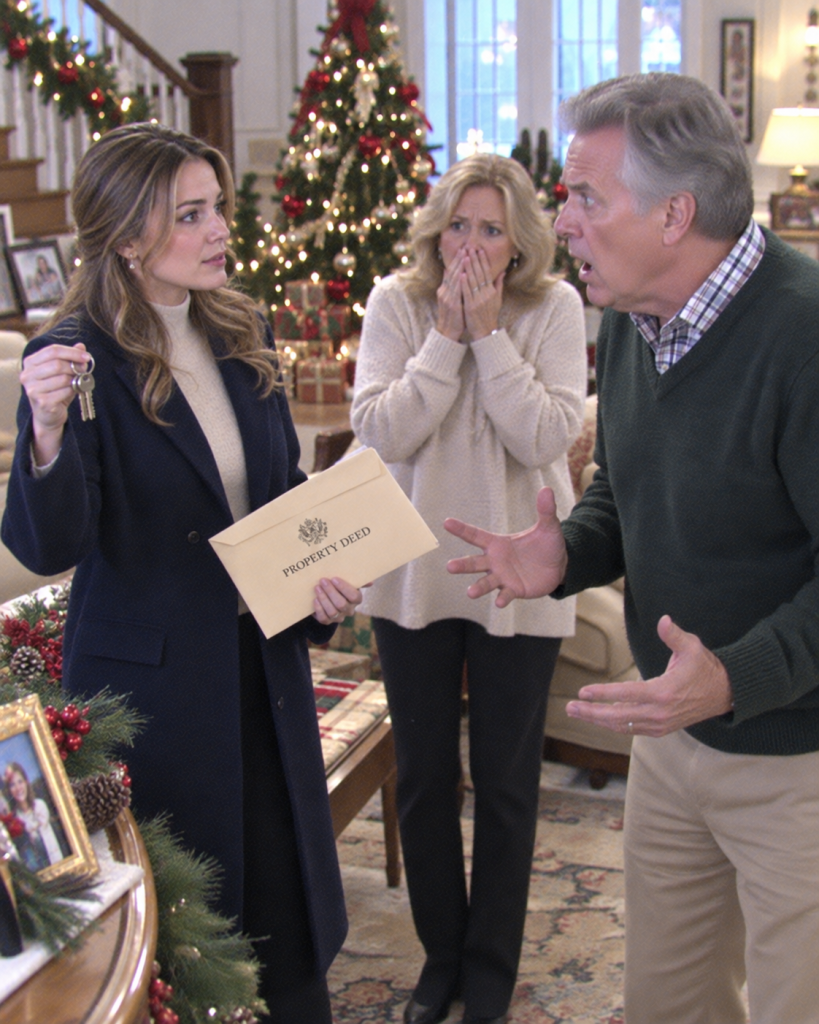
I was standing in the bakery aisle with a chocolate cake in one hand and an apple pie in the other when my mother told me Christmas had already happened.
For several seconds, I thought she was joking.
The grocery store was bright in that flat, fluorescent way stores always are on holidays, when half the shelves are empty and the employees look as if they have already answered the same question a hundred times. Somewhere behind me, a child was asking for frosted cookies. A cart squeaked past with wrapping paper sticking out of it. Christmas music played softly through ceiling speakers.
I shifted the cake against my hip and smiled into the phone.
“Very funny, Mom. Which one do you want?”
She did not answer immediately.
That was when I stopped smiling.
“We did Christmas yesterday,” she said.
I looked at the apple pie in my other hand.
“What do you mean, you did Christmas yesterday?”
“Everyone was already available last night, so we decided to do dinner and presents then.”
Her voice had that careful softness she used whenever she wanted something uncomfortable to sound ordinary.
I glanced at the clock above the bakery counter.
11:18 a.m.
Christmas Day.
I had spent the morning wrapping the last two gifts, buying her favorite coffee, and planning to get to my parents’ house early enough to help set the table before everyone arrived.
“You changed Christmas?”
Another pause.
“Yes.”
“And nobody told me?”
I heard movement on the other end of the line.
Then Dad’s voice replaced hers.
“Everything was easier without you there.”
The cake box pressed sharply into my thumb.
I do not remember moving, but somehow I ended up standing beside a display of dinner rolls while my father explained why my family had held Christmas without me.
According to him, I had become “too difficult” at gatherings.
I corrected people.
I questioned jokes.
I made everyone think too hard about what they said.
Two weeks earlier, he had made a remark at my younger sister Leah’s expense during dinner. Leah had gone silent and stared at her plate. I had simply said, “Dad, she clearly doesn’t find that funny. Let it go.”
That was it.
No shouting.
No slammed doors.
Three seconds of uncomfortable silence.
Apparently those three seconds had stayed with him.
“We wanted one peaceful holiday,” Dad said. “One night where people could relax.”
I stood surrounded by Christmas cakes and pies and tried to understand how a family could call itself more relaxed after deciding one of its members should not be there.
I did not argue.
That surprised me later.
Usually, I was the person who repaired conversations before they had even finished breaking.
I explained.
Softened.
Translated.
Found a compromise everyone could live with.
That morning, I did none of those things.
I listened until there was nothing left to misunderstand.
Then I said, “Okay.”
Dad seemed almost disappointed.
“That’s all?”
“I heard you.”
I ended the call.
For a long moment, I remained in the bakery aisle holding both desserts.
Then I carefully returned the apple pie to the refrigerated shelf.
Mom’s favorite.
The chocolate cake stayed in my cart.
Dad’s favorite.
I had no idea why.
Maybe my body was still following a plan my mind no longer believed in.
I finished shopping.
Coffee.
Dinner rolls.
A small package of batteries because Dad had mentioned he needed them for the new thermostat.
At checkout, the cashier smiled.
“Merry Christmas.”
“Merry Christmas.”
My voice sounded normal.
Outside, the Ohio sky was the pale gray of cold metal. Frost still clung to the shaded edges of parked cars. I loaded the bags into the trunk, placed the untouched cake on the passenger seat, and sat behind the wheel without starting the engine.
My parents’ wrapped gifts were in the trunk.
Mom’s coffee was beside me.
And inside my purse was a cream-colored envelope that contained the largest Christmas gift I had ever planned to give anyone.
The bungalow.
Two months earlier, I had bought my parents a house.
Not an enormous house.
A one-story brick bungalow on a quiet street about twenty minutes from where they already lived outside Columbus.
Two bedrooms.
Two bathrooms.
A small backyard.
Bay window in the living room.
Wide enough hallways that Mom would not have trouble navigating them later in life.
No stairs she and Dad would eventually have to climb every night.
The grocery store was five minutes away.
Their doctor was nearby.
A park with level walking paths sat at the end of the neighborhood.
The house had cost me around $285,000.
I paid cash.
That number represented more than money to me.
For over a decade, I had lived below what I earned.
I saved bonuses.
Left profit-sharing distributions invested.
Kept the same practical car long after friends began trading theirs every few years.
I had a good career, a comfortable apartment, and enough savings to feel secure.
My company had experienced an unusually strong year, and for the first time, the idea I had quietly carried for years became possible.
Make Mom and Dad’s retirement easier.
I bought the bungalow in my own name.
My attorney prepared the documents for a future transfer, but we had not completed anything.
There was no signed deed conveying the property to them.
No closing.
No ownership interest.
Legally, the house remained entirely mine.
Emotionally, however, my parents had already moved in.
I had taken them through it twice.
On the first visit, Mom stood in the living room with a tape measure stretched across the bay window.
“These would need lighter curtains.”
Dad laughed.
“We haven’t even been given the house yet.”
“I’m planning.”
“You’re invading.”
“You already picked your chair.”
Dad had, in fact, claimed the corner of the second bedroom for a reading chair.
He stood there looking toward the window.
“I could put a lamp right here.”
“You don’t read enough to need a dedicated reading corner,” I told him.
“I’ll start.”
Mom rolled her eyes.
That afternoon had been one of my happiest days of the year.
Not because I owned another house.
Because I watched the two people who raised me imagine growing older with less worry.
Mom planning her kitchen.
Dad pretending he needed a study.
The little yard where they could drink coffee.
Future Christmases around the dining table Mom already knew she wanted near the bay window.
I had thought making the transfer official on Christmas would be the final part of the gift.
Now I sat in a grocery store parking lot with the envelope in my purse and heard my father’s sentence again.
Everything was easier without you there.
For years, I had been the person who made family events easier.
Nobody had appointed me.
The role accumulated slowly.
One task at a time.
I remembered which aunt hated pecans.
I knew Leah’s work schedule.
I made reservations.
Reminded Dad to buy cards.
Checked whether Mom had enough ice.
If two relatives were not speaking, I quietly adjusted the seating.
If somebody forgot a gift, I usually had something extra in my car.
I arrived early.
I stayed late.
I loaded dishwashers while everyone else sat in the living room.
And because I had always done those things voluntarily, nobody noticed when help gradually became expectation.
For a long time, I did not notice either.
Being useful felt like belonging.
That was the trap.
I started the car.
I did not drive toward my parents’ house.
I did not drive home either.
I simply drove.
The streets were almost empty. Storefronts were dark. Traffic lights changed for intersections with no cars waiting.
About fifteen minutes later, I passed a community center my employer had supported during a winter supply drive.
A banner hung outside.
CHRISTMAS MEAL — FAMILY PROGRAM.
I knew there was temporary family housing connected to the center.
I had never been inside.
I looked at the chocolate cake on the passenger seat.
Then made a U-turn.
My plan was to leave the cake at the front desk and go home.
That was all.
Inside, the building was warm and smelled faintly of roasted meat, coffee, and industrial cleaner.
Paper snowflakes made by children had been taped unevenly along the walls.
Long folding tables filled the main room.
Disposable plates.
Foil-covered trays.
Mismatched serving utensils.
A volunteer checked the seal on the cake box.
“Perfect. Thank you.”
“No problem.”
She carried it toward the dessert table.
That was when I noticed the little girl.
She stood beside a woman holding a bag of donated clothes.
Maybe nine years old.
Dark hair in a loose ponytail.
Sweater sleeves a little too long.
She was staring at the cake.
Not in the hungry, dramatic way people write into stories afterward.
She simply looked surprised.
As if something ordinary had arrived from somewhere unexpected.
She caught me looking and immediately looked away.
Then back toward the cake.
“Is the whole thing really for us?”
The question was so simple it hurt.
“Yes.”
Her expression brightened.
“The whole cake?”
“The whole cake.”
She looked at the woman beside her.
The woman smiled.
“Laya, let them set up.”
“But it’s chocolate.”
“I can see that.”
Laya looked at me again.
“Chocolate is the best.”
“I agree.”
That was our first conversation.
Her mother introduced herself as Monica Alvarez.
She thanked me without making a performance out of gratitude.
She looked tired, but not defeated.
Neatly dressed.
Winter coat that had seen a few seasons.
One hand still holding the donated clothing bag.
I had intended to leave.
Instead, I found myself standing beside a table while volunteers moved around us.
Monica and I started talking because we happened to be in the same place, not because I asked her to explain herself.
The facts emerged naturally.
She had worked in payroll for several years.
Her employer closed suddenly that fall.
At first, she had savings.
Unemployment benefits.
Good references.
She expected to find another job quickly.
Then her apartment building sold.
The new ownership did not renew several leases during renovations.
At exactly the moment Monica needed a new apartment, she also needed to prove current income.
First month.
Deposit.
Moving costs.
All while unemployed.
One problem had collided with another until the numbers stopped working.
By December, she and Laya were staying in temporary family housing while Monica applied for jobs and tried to keep her daughter at the same elementary school.
She did not tell the story as if she wanted sympathy.
She sounded like someone explaining a difficult project.
“This happened, so I did this. Then that happened, so now I’m trying this.”
Two interviews were scheduled after Christmas.
The shelter staff had helped her with transportation and applications.
“What do you need most?” I asked.
She hesitated.
“Time.”
Not money.
Not a house.
Time.
“A stable address long enough to rebuild savings and qualify for an apartment again.”
Laya wandered closer while we talked.
She found a paper snowflake coming loose from the wall and pressed the tape back down with both hands.
“Mom says we just need one good break.”
Monica looked embarrassed.
“Laya.”
“What?”
“Homework has made her philosophical.”
“I hate math,” Laya announced.
“That is not philosophy.”
“It is to me.”
I laughed.
For the first time that day, the tightness in my chest loosened.
One good break.
I had spent the morning carrying a gift worth hundreds of thousands of dollars toward people who had decided Christmas would be easier if I stayed away.
And here was a woman who was uncomfortable even discussing help she genuinely needed.
I knew enough about community organizations to understand that assistance did not need to mean handing someone keys based on one emotional meeting.
There were established programs.
Screening.
Case management.
Employment support.
Transitional housing.
I said carefully, “I may know some people who understand housing programs better than I do.”
Monica’s expression changed.
“I’m already working with the shelter.”
“I know. I’m not offering you a house.”
She relaxed slightly.
“I just mean I might be able to find out whether there are other programs connected to this one.”
She asked practical questions.
Would it affect existing support?
Were the programs reputable?
Were there requirements?
I did not know.
So I said, “I don’t know.”
That answer made her trust me more than pretending confidence would have.
“I can ask.”
“Information would help.”
“Then I’ll get information.”
When I finally returned to my car, the passenger seat was empty.
The chocolate cake was inside becoming someone else’s Christmas dessert.
I sat behind the wheel.
The bungalow came back into my mind.
Mom measuring the windows.
Dad standing in the second bedroom.
I did not immediately think, I’ll give the house to someone else.
That would have been too easy.
Too dramatic.
Too much like revenge wearing the costume of generosity.
The thought that came instead was quieter.
Why was I still completing a gift that no longer felt freely given?
I had bought the bungalow because I wanted to.
Not because my parents lacked shelter.
They already owned a perfectly safe home.
I wanted to make life easier as they aged.
A gift.
Not repayment.
Not obligation.
Yet somewhere between my intention and their excitement, the language had changed.
The house I was giving them.
Then their retirement house.
Then our place next year.
Their plans had become so detailed that I had stopped noticing when gratitude turned into assumption.
I opened my email.
My attorney’s office was closed for Christmas.
Of course it was.
There would be no dramatic legal meeting.
No instant paperwork.
But there was one thing I could do.
I wrote:
Please do not proceed with any deed preparation, transfer, delivery, or closing steps regarding the bungalow. I am withdrawing my authorization to complete the proposed gift. Please confirm when the office reopens that title remains unchanged and no transfer has occurred.
I sent it.
Then I left a voicemail with the same instruction.
That was enough for Christmas Day.
My parents, however, needed to know.
I called Mom.
She answered quickly.
“Are you okay?”
“I’m fine.”
Her relief irritated me.
I kept my voice calm.
“I need to tell you something so you and Dad don’t make further plans.”
Silence.
“I’m not transferring the bungalow.”
“What?”
“I withdrew the gift.”
Another silence.
Longer.
“You can’t just do that.”
“The house is still legally mine.”
“That’s not what I mean.”
“I know.”
“Because of Christmas?”
“I’m not discussing the entire reason right now.”
Her voice rose.
“We planned around that house.”
“I understand.”
“No, you don’t. We have talked about selling this place. Your father has already been planning furniture.”
“Mom.”
“What?”
“Please stop making plans around owning the bungalow.”
“What are you going to do with it?”
“I don’t know yet.”
That was true.
“I stopped at a family shelter today. I may look into whether the property could be used through a legitimate transitional housing organization.”
The sentence barely finished before Mom said:
“You’re giving our house to strangers?”
I went completely still.
Our house.
Mom heard it too.
She tried to correct herself.
“The house you promised us.”
“It was never your house.”
“You know what I meant.”
“Yes.”
I did.
That was the problem.
She began talking about promises.
Retirement.
Furniture.
The plans they had made.
Then she said Christmas had been “just one dinner.”
One dinner.
One house.
As if the size of the gift determined the size of the hurt.
I ended the conversation before we reached the familiar point where I would begin solving everyone’s discomfort.
“I’m not changing my mind today.”
“Please don’t do something permanent because you’re emotional.”
“I’m not doing anything permanent today.”
“You already are.”
“No. I’m stopping something before it becomes permanent.”
Then I hung up.
For the next several hours, my phone rang.
Mom.
Dad.
Leah.
Mom again.
I put away groceries I no longer needed for dinner.
The wrapped presents went into the hall closet.
I made coffee and forgot to drink it.
I could imagine the family phone tree without hearing any of it.
She’s upset.
She’ll calm down.
Give her time.
She always comes around.
Around three hours after Laya had asked whether the whole cake was really for them, Mom called again.
This time I answered.
She was angry now.
“How could you do this to us?”
“Do what?”
“Pull the house away.”
“It was never transferred.”
“You know we built our retirement around it.”
“That was your decision.”
“You promised.”
“I intended to give it to you.”
“That’s the same thing.”
“No.”
Mom began explaining how much they had already planned.
The current house.
Furniture.
Moving schedules.
Then she returned to Christmas.
“We weren’t trying to hurt you.”
“You held Christmas without telling me.”
“We thought it would be easier this year.”
“Who decided?”
Silence.
I waited.
Mom sighed.
“We had talked about it the previous weekend.”
That sentence stopped me more effectively than Dad’s cruelty in the grocery store.
“The previous weekend?”
“Yes.”
“You planned it?”
“It wasn’t some secret plot.”
“You decided days ahead of time.”
“We thought you’d get over it.”
There it was.
Not forgetfulness.
Not spontaneous convenience.
They knew I would be hurt.
They had included my eventual forgiveness in the plan.
“You thought I would get over it.”
“You always do.”
I closed my eyes.
Mom kept speaking, but I barely heard the next few sentences.
I ended the call.
That night, I did not sleep much.
The bungalow was not the reason.
The legal part was simple.
The house was in my name.
The transfer had not happened.
What kept me awake was the fact that Christmas had been planned without me days in advance.
Dad knew.
Mom knew.
Leah had been there.
Aunt Marissa.
Other relatives.
Someone had chosen my absence.
Everyone else had stepped around it.
Monday morning at 9:17, my attorney emailed confirmation.
No deed had been delivered.
No ownership transfer had occurred.
The bungalow remained entirely mine.
One paragraph settled what my family had spent Christmas treating like catastrophe.
I saved the email.
Closed my laptop.
Then stared at the wrapped gifts in my hall closet.
The family questions remained.
Dad left a voicemail saying I was using money to punish people.
Mom texted that “nobody meant to exclude me permanently,” which was such a strange sentence I read it three times.
Leah wrote:
I thought you knew we moved Christmas. Mom said you had other plans.
That stopped me.
Other plans.
I called Aunt Marissa.
She answered awkwardly.
“Merry Christmas.”
“Two days late.”
“I know.”
“I need to ask you something.”
She went quiet.
“What did Mom tell you about Christmas?”
Marissa hesitated.
“That you were doing your own thing this year.”
“Exactly.”
“She said you had plans.”
“With who?”
“She didn’t say.”
“Did anyone ask?”
“I did.”
My grip tightened around the phone.
“What did she say?”
“That you were busy and we should just take advantage of everyone else being available Christmas Eve.”
I sat down.
“So you thought I chose not to come.”
“Yes.”
Marissa’s voice changed.
“Oh.”
“What?”
“I’m realizing something.”
“What?”
“You always organize everything.”
“Yes.”
“I remember thinking it was strange that nobody had heard from you.”
“Did you text me?”
Silence.
“No.”
“Did anyone?”
“I don’t know.”
“I didn’t get anything.”
Marissa sounded embarrassed.
“I’m sorry.”
“I’m not calling for an apology.”
“What are you calling for?”
“The truth.”
So she gave it to me.
The date had been circulated since the weekend before Christmas.
Mom had told relatives I already had plans.
Everyone assumed my absence was voluntary.
At dinner, nobody questioned it enough to call me.
I thanked Marissa.
Then ended the conversation.
That evening, I thought about the word Dad had used.
Tension.
For years, my family acted as though tension appeared whenever I opened my mouth.
But when I looked backward, I noticed when they used that word.
Mom’s birthday the year before.
Everyone volunteered to help.
Then the details quietly moved toward me.
Reservation.
Menu.
Flowers.
Transportation.
Money collection.
I said I would handle the reservation but not everything else.
Dad called that “turning a birthday into a negotiation.”
Later, a relative made a cutting joke.
I asked for an apology instead of changing the subject.
Tension.
Then the dinner two weeks before Christmas.
Dad made Leah uncomfortable.
I said so.
Tension.
Nothing had become louder.
I had simply stopped absorbing discomfort before anyone else had to feel it.
That was the change.
Tension was the name my family gave to consequences they were no longer allowed to hand to me.
Leah came to my apartment Tuesday evening.
She kept smoothing the sleeve of her coat even after she sat down.
I made coffee.
She barely touched hers.
“Mom told me you had plans.”
“I know.”
“I believed her.”
“I know.”
“I didn’t know you were excluded.”
“I believe you.”
She looked relieved.
Then I said:
“But you noticed I wasn’t there.”
Her face changed.
I let the silence stay.
“Of course I noticed.”
“Did you wonder where I was?”
“Yes.”
“Did you text me?”
Her eyes dropped.
“No.”
“Why?”
“I don’t know.”
That hurt more than a deliberate explanation might have.
Not because Leah was cruel.
Because she wasn’t.
My absence had been visible.
She simply accepted the version of events that required the least effort.
I glanced toward the hall closet.
One of the wrapped gifts visible through the open door was hers.
“If everyone thought I was spending Christmas somewhere else, why didn’t anyone send me Merry Christmas?”
Leah closed her eyes.
“I should have.”
“That isn’t the question.”
“I know.”
She sat there for a long time.
Then said:
“I think we all assumed you’d be fine.”
I nodded.
That sentence sounded familiar.
Everyone always thought I would be fine.
Because I usually was.
Or because I made sure everyone else believed I was.
“I’m not asking you to pick sides.”
“I know.”
“I’m asking you not to pretend something didn’t happen because admitting it makes the room uncomfortable.”
Leah nodded.
Then her gaze shifted toward the closet.
“What?”
She frowned.
“Dad talked about the bungalow at Christmas.”
My stomach tightened.
“What did he say?”
“I don’t remember exactly.”
“Don’t guess.”
She rubbed her forehead.
“I remember a toast.”
“To what?”
“I need to think.”
“Then think.”
I had spent enough time dealing with people’s reconstructed versions of events.
I wanted facts.
“Call me when you’re sure.”
She left an hour later.
The next morning, I drove to the bungalow.
I had not been there since before Christmas.
Frost edged the lawn.
The brick path looked too clean because no one lived there.
I stayed in the car for several minutes.
Then unlocked the door.
The house smelled faintly of fresh paint and empty rooms.
Mom’s plans were everywhere even though none of her belongings were.
Bay window.
Curtains.
Dining table.
Dad’s reading corner.
In the kitchen, a pencil mark remained where Dad had measured the wall for a coffee station.
I rubbed it with my thumb.
On their first visit, Mom had said:
“This house you’re giving us.”
Second visit:
“Our retirement place.”
By the third:
“Next year, we’ll put the Christmas tree over there.”
I had smiled every time.
I thought their excitement meant the gift was working.
Now I saw something else.
Possession had replaced gratitude gradually enough that none of us noticed.
My phone rang.
Dad.
I answered.
“We need to talk.”
“We’re talking.”
“Face to face.”
I looked around the empty bungalow.
“I’m here.”
“Where?”
I told him.
He arrived twenty minutes later.
The moment he walked inside, his eyes moved around the living room.
Not curiosity.
Recognition.
He looked toward the corner where he planned to put his chair.
Then removed his gloves.
That tiny movement told me everything.
He still felt at home there.
Dad began immediately.
“You are using money to control this family.”
I said nothing.
“A gift is a gift.”
“It was never completed.”
“That is paperwork.”
“Yes.”
He paced.
“You gave us your word.”
“I told you I intended to give you the house.”
“And now because your feelings got hurt, you change your mind.”
I watched him walk through a living room he did not own while accusing me of making ownership conditional.
A year earlier, I would have rushed to prove I was generous.
Now I waited.
When he finally stopped, I said:
“There was never a condition attached to the bungalow.”
He frowned.
“I never told you that you had to thank me in a certain way. I never asked for control over your furniture. I never said you owed me anything.”
“Exactly.”
“I did assume my parents wanted me at Christmas.”
Dad’s jaw tightened.
“That has nothing to do with the house.”
And there it was.
In his mind, my place at the family table could be removed without affecting the gift I brought to it.
Christmas was emotional.
The house was practical.
He saw no contradiction.
“Why should they be separate?”
“Because gifts aren’t payment for invitations.”
“I agree.”
“Then what are we arguing about?”
“That you no longer get the gift.”
“That is punishment.”
“No.”
I looked toward the bay window.
“I don’t want to give it anymore.”
Dad stared.
“That is worse.”
“Why?”
“Because a daughter in your position should want to make her parents’ lives easier.”
The sentence settled into the room.
I had wanted exactly that.
That was why it hurt.
Somewhere between my desire to give and his expectation of receiving, the bungalow had turned into duty.
“You think I owe you this house.”
“I think family takes care of family.”
“Does family invite family to Christmas?”
He looked away.
“You always turn everything into a debate.”
“No.”
“You do. Every sentence becomes about respect. Boundaries. Wording.”
He threw up his hands.
“You make everyone think before they speak.”
He meant it as criticism.
I heard something else.
“Yes.”
Dad stared.
“Yes what?”
“I expect people to think about what they say.”
“Family should be able to relax.”
“Relax how?”
He looked irritated.
“Without worrying that every joke becomes an issue.”
I thought about Leah staring at her broccoli while Dad made her the center of a joke she clearly hated.
“You wanted a Christmas where nobody had to care whether someone else was uncomfortable.”
“That is not what I said.”
“It’s what happened.”
He stepped toward the window.
“We wanted one easy night.”
I let the words settle.
Then asked:
“Did you talk about the bungalow at Christmas?”
His expression changed.
Barely.
But I saw it.
“What does that have to do with anything?”
“Did you?”
He started talking about retirement instead.
Their plans.
Their current house.
Moving.
Furniture.
One-story living.
He never answered the question.
I picked up my keys.
“We’re done for today.”
Dad looked surprised.
“You’re leaving?”
“Yes.”
“We haven’t resolved anything.”
“We don’t have to.”
That was new.
For most of my life, I stayed until everybody reached an ending they could tolerate.
That morning, I no longer needed his agreement before I could leave.
We stepped outside.
I locked the bungalow.
For one second, I saw guilt on his face.
Or maybe I imagined it.
Then I remembered his voice in the grocery store.
Everything was easier without you there.
I drove away.
Leah called that afternoon.
“I remembered.”
I pulled into a parking lot before answering.
“Tell me only what you’re sure of.”
“Dad made a toast.”
My hand tightened around the steering wheel.
“He said something like, ‘Next Christmas, we’ll all be at our new place.’ I don’t remember the exact first sentence.”
“Then don’t use it.”
“But I’m sure about ‘our new place.’”
“Okay.”
“Everyone raised glasses.”
I closed my eyes.
“Mom too?”
“Yes.”
“And people congratulated them?”
“Yes.”
I thanked Leah.
Then ended the call.
The bungalow was only ten minutes away.
I drove back.
Inside, I sat on the living room floor beneath the bay window.
No furniture.
No decorations.
Just winter light crossing hardwood.
I pictured only what I knew.
My family gathered.
Christmas dinner.
My absence explained as my choice.
Dad raising a glass.
Everyone celebrating a future inside the house I was giving my parents.
They did not merely have Christmas without me.
They toasted my gift while I was still planning to show up the next day carrying dessert.
That was the moment my uncertainty ended.
I did not need to turn the bungalow into revenge.
I did not need to prove anything.
The gesture itself had changed.
I could grieve the future I had imagined for my parents without forcing myself to complete it.
For the first time since Christmas, the decision felt quiet.
Final.
The next step took longer.
That mattered.
I returned to the family shelter the following week.
Not with cake.
With questions.
I asked staff about established transitional-housing organizations.
How placements worked.
Whether homeowners could retain title.
Screening.
Insurance.
Case management.
Employment requirements.
Typical length of stay.
I explained that I owned a vacant bungalow and was considering making it available through a structured program.
I also made one thing clear.
“I met a mother and daughter here on Christmas. I don’t want them selected because I met them.”
The coordinator nodded.
“That’s good.”
“If I do this, the program chooses.”
“Yes.”
“I don’t want applicant files.”
“Also good.”
Helping did not have to mean controlling.
That was another lesson I was only beginning to learn.
Monica was not at the shelter that afternoon.
She had a job interview.
Laya sat at a table doing homework.
She looked up.
“Cake lady.”
I laughed.
“I have a name.”
“I know.”
“Do you?”
She grinned.
Then returned to a math worksheet.
I watched her press her pencil hard enough to leave grooves.
“Bad?”
“Terrible.”
“What is it?”
“Fractions.”
“That is serious.”
“Mom says they’re important.”
“Your mom is right.”
Laya looked deeply disappointed in me.
The ordinariness mattered.
She was not a symbol.
Not “the shelter girl.”
She was Laya.
Nine years old.
Hated fractions.
Loved chocolate frosting.
Her mother was looking for work.
They were living through a difficult chapter.
That was all.
I took program materials home.
Reviewed financial statements.
Charity registrations.
Insurance structures.
Talked with my attorney.
One organization stood out.
They operated single-family transitional homes for periods generally lasting nine to twelve months.
Families worked with case managers.
Employment or active job-search requirements.
Savings goals.
Rental preparation.
School stability.
The nonprofit handled placements and daily administration.
Homeowners retained title through written use agreements.
It was not rescue.
It was a bridge.
I liked that.
My attorney liked the organization’s documentation.
Over several weeks, we worked through inspection requirements, insurance changes, maintenance responsibilities, and termination terms.
Nothing happened overnight.
That reassured me.
The Christmas decision had been immediate because I needed to stop a transfer before it occurred.
Everything afterward deserved patience.
During those weeks, my family discovered something unexpected.
I stopped managing them.
Mom called about a January family lunch.
“What weekend works for everyone?”
“I don’t know.”
“You have Leah’s schedule.”
“She has Leah’s schedule.”
Mom paused.
“Can you just coordinate it?”
“No.”
Silence.
“I’m not asking for much.”
“I know.”
“You always do this.”
“I used to.”
Her voice tightened.
“So now you’re punishing all of us.”
“No.”
“What do you call it?”
“Letting you plan your lunch.”
She hung up irritated.
The lunch still happened.
Mom chose the restaurant.
Leah responded for herself.
Aunt Marissa arrived late because she had been given the wrong start time.
Dad thought Mom had made the reservation.
Mom thought Dad had.
Nobody remembered Leah’s dietary preference.
For the first twenty minutes, Mom kept looking at me as if I should step in.
I did not.
Everyone ate anyway.
Marissa laughed about the confusion.
Dad stopped checking his watch.
Nothing collapsed.
That was important.
They had always been capable.
My efficiency had simply allowed them not to practice.
Dad called one Thursday about a warranty problem with his dishwasher.
Usually, he would give me the serial number and I would handle everything.
My fingers actually moved toward my laptop.
Then stopped.
I gave him the manufacturer’s customer service number.
“You know how to do this faster,” he said.
“Yes.”
“So why won’t you?”
“Because you can.”
“This is still about Christmas.”
“No.”
“It feels like punishment.”
That sentence stayed with me.
For years, my help had been called generosity.
The first time I withdrew it, the absence became punishment.
I closed my laptop.
Mom’s birthday arrived in early spring.
For years, her birthday functioned like a private project on my calendar.
Restaurant.
Flowers.
Cake.
Guest reminders.
Dad’s card.
Leah’s schedule.
This year, I bought Mom a thoughtful gift and called in the morning.
“I love you.”
“I love you too.”
“Have fun tonight.”
“You’re not coming?”
“I wasn’t invited to dinner.”
“I assumed you knew.”
There it was again.
Assumption.
“I didn’t.”
“Well, come.”
“I already have plans.”
That was true.
I met a friend for dinner.
Mom’s birthday celebration still happened.
Dad made the reservation.
Too late for her preferred time.
The flowers were remembered after dinner.
The cake came from a grocery store and was chocolate instead of lemon.
Nothing terrible happened.
Three days later, Mom called.
“It felt different.”
“I’m sure.”
“You used to care more.”
I was washing a coffee mug.
My hands stopped.
“What does that mean?”
“You always made birthdays special.”
“I called.”
“I know.”
“I bought you a gift.”
“I know.”
“I told you I loved you.”
“I know.”
“Then what was missing?”
She sighed.
“You know.”
Yes.
The labor.
She had received that labor for so long that its absence looked like less love.
“I’m not withholding affection, Mom.”
“That’s how it feels.”
“I’m sorry it feels that way.”
I did not volunteer to make next year smoother.
That was harder than it sounds.
My entire nervous system expected to repair the disappointment.
I let it remain hers.
Meanwhile, the bungalow passed inspection.
Minor repairs.
Smoke detectors.
Bathroom fixture.
A window seal.
I approved the work.
By early spring, the long-term use agreement was ready.
I signed it at my kitchen table.
No ceremony.
No dramatic handoff.
The title remained mine.
The purpose changed.
A few days later, I met program staff at the property while they prepared for the first placement.
A secondhand bookshelf went against the living room wall.
Simple dining table.
Beds.
Basic lamps.
Storage bins.
For a moment, the grief returned so sharply I stepped onto the porch.
I could see Mom standing at the bay window again.
Dad laughing about his reading chair.
I still loved them.
That was the hard part.
Changing the gift did not erase the future I once wanted for them.
It simply meant I was no longer required to build that future after they had treated my place in their own as optional.
The program coordinator told me they had begun evaluating applicants.
She did not name anyone.
I did not ask.
Exactly as agreed.
At the shelter, I heard only that Monica was working closely with her case manager.
I did not know whether she applied for my property.
That was how I wanted it.
I opened a door.
I did not choose who deserved to walk through it.
Spring created new spaces in my life.
Saturday mornings with nothing scheduled.
Friends I had postponed.
A pottery class I signed up for because I had always wanted to try it and had no intention of becoming good.
I volunteered occasionally with the housing organization, but I chose ordinary tasks.
Sorting donations.
Setting up tables.
Checking supply lists.
I refused leadership roles.
That was almost funny.
For years, I believed my value came from becoming indispensable.
Now I was learning the relief of being useful without becoming responsible for everything.
Leah and I rebuilt our relationship first.
She called more often.
Not to ask what the family was doing.
To ask what I was doing.
That difference was small.
I noticed every time.
One evening, she stopped by with takeout.
No crisis.
No agenda.
We ate on my sofa.
Halfway through dinner, she said:
“I think I understand Christmas now.”
I looked at her.
“What part?”
“I kept thinking the bungalow was separate.”
“Like Dad.”
“Yes.”
She set down her fork.
“I thought you took away something practical because something emotional happened.”
“And now?”
“I think I had it backward.”
I waited.
“The house was emotional because you bought it out of love. We treated the love like it was permanent no matter what we did with the relationship.”
I looked at her.
“That’s closer.”
She nodded.
“I’m sorry I didn’t text.”
“I know.”
“No.”
She shook her head.
“I’m sorry I noticed you were missing and decided it was easier not to ask why.”
That apology mattered.
It named an action.
Not my reaction.
Not the house.
Not the months afterward.
The thing she had actually done.
“Thank you.”
We went back to eating.
That was our reconciliation.
No speeches.
No promise that nothing bad would happen again.
Just truth.
A few weeks later, I saw Monica at the shelter.
She looked different.
Not transformed.
Just steadier.
She had found a payroll job with hours that worked around Laya’s school schedule.
“I start Monday.”
“That’s great.”
“I’m terrified.”
“Also normal.”
“I haven’t worked in months.”
“You did the work before.”
“I know.”
She smiled.
“I keep reminding myself.”
Laya appeared carrying a school folder.
She looked at me.
“Still hate fractions?”
“Now we have decimals.”
“Worse?”
“Much.”
Monica rolled her eyes.
“Everything is a crisis when you’re nine.”
“Correct,” Laya said.
I laughed all the way to my car.
Three weeks later, Monica called while I was leaving work.
Her name appeared on my screen.
I almost did not answer because I was carrying a laptop, coffee cup, and folder all at once.
I balanced everything on the roof of my car.
“Hi.”
For a second, she said nothing.
Then:
“We got a house.”
My chest tightened.
“The program?”
“Yes.”
She was laughing and crying.
“Laya and I got the first placement.”
I leaned against the car.
“Which house?”
Silence.
Then:
“Yours.”
For a few seconds, I could not speak.
The bungalow.
Mom’s bay window.
Dad’s pencil mark.
A little girl who hated fractions putting her backpack somewhere it would still be the next morning.
“I didn’t know.”
“I know.”
“You were selected normally?”
“Yes. My case manager told me you weren’t involved.”
“Good.”
Monica became quiet.
“I want you to know something.”
“What?”
“I’m not asking you to carry us.”
I closed my eyes.
“I know.”
“The house is a bridge.”
“I know.”
“I have a savings target. I have a timeline. I have a case plan.”
“You don’t have to prove anything to me.”
“I know.”
She laughed softly.
“That’s why I wanted to.”
After we hung up, I stayed beside the car for several minutes.
The decision hurt.
And felt right.
Both could exist.
That evening, Mom called.
Her voice was quieter than it had been for months.
“Can we meet?”
“About what?”
“Us.”
Not the house.
Us.
I agreed.
She chose a coffee shop halfway between our homes.
Neutral territory.
That mattered.
At my parents’ kitchen table, I automatically knew where the tea was.
Which cups she preferred.
What needed clearing.
In a coffee shop, we were just two women sitting across from each other.
Mom was already there.
Her coat folded over the neighboring chair.
Cup untouched.
For several seconds after I sat, neither of us spoke.
Months earlier, silence would have frightened me into filling it.
Now I waited.
Mom finally said:
“I miss you.”
My throat tightened.
Those three words were exactly what I had wanted to hear in the grocery store.
Not an explanation.
Not a defense.
Not a discussion about the bungalow.
I miss you.
“I miss you too.”
Her eyes filled.
Then she said:
“I don’t know how we got here.”
I almost answered.
Instead, I let her continue.
She talked about the months after Christmas.
The family feeling different.
Dad being angry.
Leah no longer automatically agreeing.
Birthdays feeling harder.
Plans requiring more effort.
Then the bungalow.
She and Dad had built real retirement expectations around it.
She still grieved the house.
I listened.
“I know you understand legally it wasn’t yours.”
“I do.”
“But emotionally…”
“It felt like yours.”
“Yes.”
I nodded.
“I understand.”
She looked surprised.
“You do?”
“Yes.”
Understanding did not mean reversing the decision.
That was something I had finally learned.
Mom twisted her wedding ring.
“We never thought you’d change your mind.”
“I know.”
“Because you promised.”
“I intended to give it.”
“That feels like the same thing.”
“It did to you.”
She looked down.
I reminded her of the sequence.

The Christmas decision had been planned.
She told relatives I had other plans.
Dad toasted the bungalow.
They all celebrated.
I was still in a grocery store the next morning choosing dessert for a dinner that had already happened.
Mom closed her eyes.
“I know.”
“Whose idea was it?”
She stared through the coffee shop window.
Cars moved through wet spring pavement.
Finally:
“Your father suggested it.”
I waited.
“But I agreed.”
That mattered more.
“He said everyone had been walking on eggshells around you.”
“Because I asked him not to embarrass Leah.”
“I know.”
“He said Christmas would be easier if you weren’t there.”
“Yes.”
“And you agreed.”
Mom’s eyes filled.
“Yes.”
“Then you told everyone I had other plans.”
“Yes.”
“Why?”
She looked at me.
“Because it was easier than saying we had decided not to invite you.”
The coffee shop seemed louder after that.
Cups.
Chairs.
Steam from the espresso machine.
My mother had not been powerless.
She had made a choice.
“I thought it was one night,” she said. “I thought we could have one easy Christmas and then everything would go back to normal.”
“You thought I’d get over it.”
“Yes.”
“Why were you so sure?”
She looked down.
“Because you always did.”
There it was again.
The same assumption.
My forgiveness had become part of the family infrastructure.
She had learned to treat it like electricity.
Always available.
Only noticed when it stopped.
“I’m sorry.”
Her voice shook.
“For what?”
Mom looked at me.
“For lying to the family about why you weren’t there.”
I waited.
“For deciding you were the problem because you made us uncomfortable.”
I waited again.
“For expecting the bungalow to stay ours in our minds after we treated you like you didn’t belong at Christmas.”
Something in my chest loosened.
Not everything.
Enough.
“I’m not erasing you from my life.”
Mom cried quietly.
“I know.”
“I want a relationship.”
“So do I.”
“But I’m not going back to the old job.”
“What job?”
“The one where loving all of you meant doing whatever made everything easier.”
She looked down at her coffee.
“It did make things easier.”
“I know.”
“For us.”
“Yes.”
She almost smiled through her tears.
“I’m starting to understand.”
Then she asked about the bungalow.
Not angrily.
“What happened with it?”
“The transitional housing program accepted it.”
She nodded slowly.
“They’ve selected their first family.”
“Do you know who?”
“Monica and her daughter.”
“The woman from Christmas?”
“Yes.”
Mom’s lips pressed together.
For months, some part of her had apparently believed the decision might reverse.
Now she understood the house had another life.
She reached for her coffee.
It had gone cold.
I saw grief in the small motion.
For the first time, I felt sympathy without converting sympathy into obligation.
I could be sorry she was hurting.
And leave the decision intact.
When we stood, Mom hugged me.
Hesitant at first.
As if she had learned not to assume.
I hugged her back.
For one second, her floral perfume carried me back to childhood.
Then we stepped apart.
Nothing was fixed.
Something was named.
Dad took longer.
He remained convinced the real issue was the bungalow.
Months passed before we had a real conversation.
An anniversary dinner for relatives brought everyone together.
I arrived on time.
Brought a card.
Nothing else.
Someone else made the reservation.
Someone else coordinated the guest list.
Dinner was fine.
Afterward, Dad asked me to stay.
Leah caught my eye.
She did not say:
Hear him out.
He’s still Dad.
Be nice.
She simply nodded.
The choice was mine.
Dad and I moved toward the quiet end of the restaurant near the windows.
He started with:
“This family needs to move on.”
I listened.
Mom had apologized.
Leah had apologized.
Everyone had adjusted.
He said Christmas had turned into months of punishment.
Then, unbelievably, he said:
“I’m willing to let the house issue go.”
I stared at him.
“You’re willing to let it go.”
“Yes.”
“The house you never owned.”
His jaw tightened.
“This is what I mean.”
“What?”
“Every sentence.”
I almost laughed.
Instead, I asked:
“What exactly are you apologizing for?”
He looked annoyed.
“I already admitted we should have handled Christmas differently.”
“How?”
“We should have told you.”
“That’s what you regret?”
“That you found out the way you did.”
I waited.
Dad continued.
He regretted the distance.
Mom being upset.
Leah changing.
The family becoming harder to organize.
The bungalow.
Everything except the decision.
So I asked again.
“What did you do to me?”
He looked out the window.
For the first time, he stopped trying to redirect the conversation toward what I had done afterward.
Then he told the truth.
“I didn’t want you there.”
The words were quieter than the ones in the grocery store.
“I was tired.”
“Of what?”
“Feeling challenged.”
I stayed silent.
“You had changed.”
“How?”
“Everything became a discussion.”
“Examples?”
“Jokes. Comments. Plans.”
He rubbed one hand across his forehead.
“I felt like I had to think about every sentence.”
“You mean you couldn’t say whatever you wanted without someone responding.”
“That isn’t fair.”
“Maybe not.”
He sighed.
“I wanted one evening where everybody could relax.”
“So you removed the person who stopped pretending.”
He looked at me.
“I knew you’d be hurt.”
That mattered.
“But I thought it would pass.”
“Why?”
Dad answered immediately.
“Because you always come back.”
The sentence landed softly.
That was what made it devastating.
He had not believed I would be unharmed.
He believed the harm would have no lasting cost because I would return anyway.
Birthdays.
Holidays.
Sunday dinners.
Calls.
Problems.
I always came back.
I had called that forgiveness.
Dad had learned to read it as permission.
For several seconds, I said nothing.
Then:
“I’m still your daughter.”
He looked at me.
“That never changed.”
“Then why does it feel like you left?”
“Because I stopped returning in the same way.”
Dad looked down.
“I don’t know how to do this differently.”
“That’s honest.”
“What do you want from me?”
“I don’t need you to agree with every boundary.”
“Then what?”
“I need you to understand that my presence is not something you can turn off when it becomes inconvenient and turn back on when you need help.”
He did not answer.
“I’m not refusing family.”
I picked up my coat.
“I’m refusing a job description.”
Dad looked older than he had at Christmas.
Not defeated.
Not broken.
Simply like a man facing a consequence he had assumed would eventually disappear.
“Do you forgive me?”
I thought about the question.
“Yes.”
His shoulders loosened.
Then I added:
“That doesn’t mean everything goes back.”
The relief faded.
“Then what does forgiveness mean?”
“It means I don’t need to spend my life angry.”
I put on my coat.
“It doesn’t mean automatic access.”
Leah waited near the entrance.
She did not ask what happened.
She held the door.
Cold air touched my face.
I walked outside.
For most of my life, returning had been proof that I loved my family.
Maybe sometimes it was.
But love had never required me to return to the same role every time.
That night, I drove home without turning around.
For the first time, I did not feel like I was abandoning my family.
I felt like I had stopped abandoning myself to remain useful to them.
By the following Christmas, the bungalow no longer felt trapped between two versions of my life.
Monica kept her payroll job.
She rebuilt savings.
Laya remained in the same school.
The transitional program helped Monica create a move-out plan for the following year.
Over time, my conversations with her became ordinary.
Work.
Groceries.
Weather.
Laya’s school complaints.
The housing situation stopped being the only thing I knew about them.
My family changed too.
Mom and I spoke regularly.
She began asking instead of assuming.
“Are you free Sunday?”
“Would you like to come?”
“Can you help with this?”
Not:
We’re doing dinner Sunday.
Handle the reservation.
Dad and I remained more distant.
He did not become crueler.
He simply lost the certainty that I would always be available on command.
Leah and I became closer than we had been in years.
She stopped using me as the person who knew everyone’s plans.
We started being sisters instead.
One December afternoon, the housing organization held a volunteer event at the bungalow.
Wreath on the front door.
Outdoor lights.
Donated winter supplies.
Monica had agreed to appear in a few ordinary photographs for the organization.
Nothing about her past.
No inspirational story attached to her name.
Just residents and volunteers preparing for the season.
In one photo, Laya held one end of a string of lights that she had clearly tangled.
Monica stood near the porch.
I was caught laughing at something outside the frame.
The organization posted the photo.
I barely thought about it.
Until Mom called Christmas Eve.
“Merry Christmas.”
“Merry Christmas.”
“What are you doing tomorrow?”
“Dinner with friends.”
“Leah coming?”
“Later.”
Mom paused.
“I saw the picture.”
“What picture?”
“The bungalow.”
I waited.
“It looks…”
Another pause.
“Full of life.”
I looked toward my apartment window.
Snow had begun falling lightly.
“Yeah.”
Mom did not ask whether I regretted anything.
Did not call it their house.
Did not ask whether the agreement could someday change.
She simply said:
“I hope you’re somewhere you feel wanted.”
My throat tightened.
One year earlier, she would have asked when I was coming home.
The difference was only a few words.
It felt enormous.
“I am.”
“I’m glad.”
We said goodbye.
Christmas dinner the next day was small.
Monica and Laya.
A couple of close friends.
Leah joined later after spending part of the day with Mom and Dad.
Someone else had organized dinner.
Someone else bought ice.
I had one assignment.
Dessert.
That made me smile.
I went to the same grocery store.
Same bakery section.
For a moment, I stood between chocolate cake and apple pie.
The memory returned with embarrassing clarity.
Fluorescent lights.
Cake box cutting into my thumb.
Mom’s silence.
Dad’s voice.
Everything was easier without you there.
I chose the chocolate cake.
When I carried it toward the bungalow that evening, I did not need to call anyone to ask whether they wanted it.
I had been invited.
The front door opened.
Warm air rolled out.
Dinner.
Cinnamon.
Music playing quietly.
Coats stacked near the entrance.
Laya appeared almost immediately.
She stared at the cake.
“Chocolate?”
“Yes.”
“I want a corner piece.”
Monica called from the kitchen.
“You’re getting whatever piece lands on your plate.”
“That is unfair.”
“It is Christmas.”
“Exactly.”
I laughed.
Then carried the cake into the dining room.
That was when I saw my chair.
Nothing special.
No decoration.
No name card.
A plate.
Folded napkin.
Glass.
One chair between two others.
Someone had counted me before I arrived.
I stopped.
Laya almost walked into me.
“What?”
“Nothing.”
I looked at the table.
A year earlier, I had been carrying enough love toward a table that had already decided it was easier without me.
Now the simplest object in the room said more than every apology I had heard since.
A place had been made for me before I arrived.
Not because I had organized dinner.
Not because I owned the house.
Not because I had solved anyone’s problem.
Not because the cake cost anything.
I had not earned the chair.
That was the point.
Leah arrived later carrying sparkling cider.
She hugged me.
Did not ask whether anything still needed doing.
Someone else cut the cake.
Laya got her corner piece anyway.
The dining room became noisy.
Imperfect.
Ordinary.
Nobody thanked me for saving Christmas because nothing needed saving.
I sat down.
For years, I had confused being needed with being loved.
I thought belonging meant people depended on me.
I thought returning no matter what happened proved I was loyal.
I thought giving more made my place safer.
That Christmas, I learned something quieter.
Being wanted feels different.
There is no invoice attached.
No task waiting beside the plate.
No crisis you have to solve before you are allowed to sit.
You walk through the door.
And your chair is already there.