The homeless man I married always drank his coffee black outside the subway station I used every day. After his funeral, his final letter began with an apology I couldn’t understand and sent me straight back to the courthouse. There, a clerk opened an old record book, found his name written across hundreds of pages, and asked which Larry I had married.
“Sarah, I need to apologize before I thank you.”
Then I reached the next sentence.
“Nobody was going to bury me as a John Doe.”
All the color left my face. I lowered myself into a chair.
“No.”
The blood drained from my face.
Less than a month before that, Larry had been sitting outside my subway station with a cardboard sign resting across his knees.
MARRY ME. I HAVE ONE MONTH LEFT TO LIVE.
I had known him for two years.
I HAVE ONE MONTH LEFT TO LIVE.
Every weekday morning, I stopped at the kiosk beside the station and bought two coffees. Mine came with cream. Larry took his black.
Larry never asked me for anything.
Some mornings, we talked about the weather. On others, he complained about the pigeons or informed me that my office shoes looked like they had been designed by “somebody who hated feet.”
Larry never begged me for anything.
Most days, I stayed for about five minutes before hurrying off to work.
But on that bitterly cold Tuesday, Larry looked awful.
His skin carried a yellow tint, and his hands shook when I passed him his coffee.
“What is this?” I asked, pointing at the sign.
“What is this?”
“The clinic gave me about a month.”
For a moment, the sound of the traffic seemed to vanish.
“What?”
“Liver failure.”
I lowered myself onto the freezing concrete beside him.
“Larry, I’m so sorry.”
“The clinic gave me about a month.”
“Don’t make that face.”
“What face?”
“The one people make when they’re already at your funeral.”
Even then, he somehow managed to make me laugh.
But there was nothing funny about the sign.
“Why marriage?”
But the sign wasn’t funny.
Larry lowered his gaze toward the coffee in his hands.
“I don’t want to die belonging to nobody.”
“You don’t.”
“That’s nice to say, Sarah. It’s different on a form.”
He told me that without any legal relatives, strangers would eventually be responsible for dealing with his remains.
“It’s different on a form.”
“I just want somebody who can say, ‘He’s mine. I’ll take him.’”
I wasn’t married.
Larry was dying.
And throughout my life, I had always been much better at solving a problem than turning away from one.
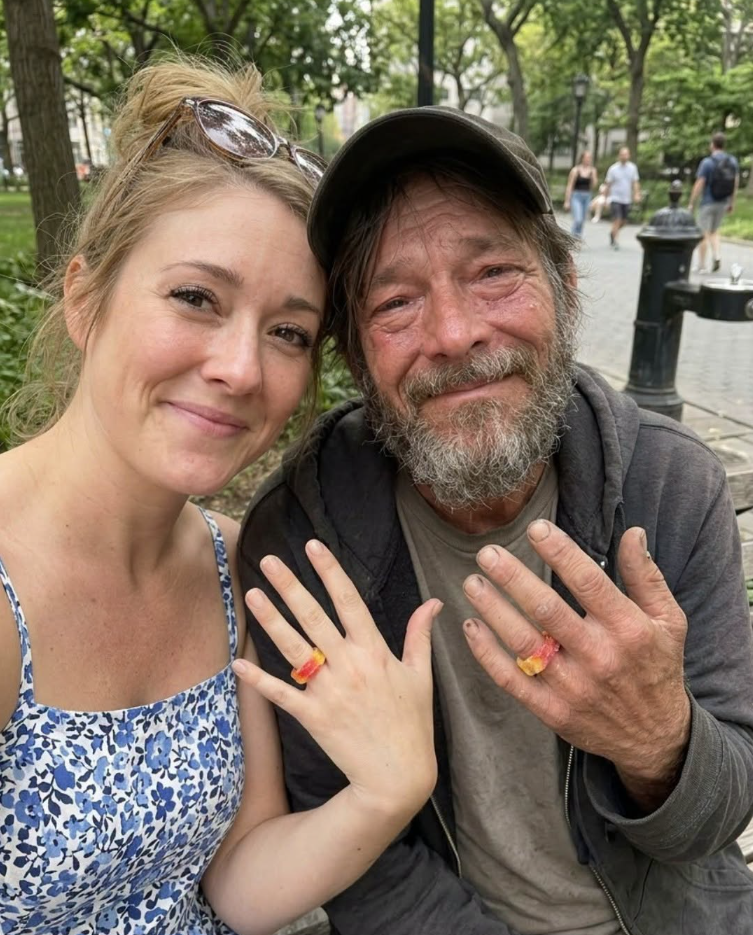
Two days later, we walked into the courthouse together.
He was dying.
Larry wore a clean blue shirt someone from the shelter had given him. I had on my navy work dress.
When the clerk mentioned rings, Larry searched his pockets.
“Knew I forgot something.”
I laughed.
Eleven minutes later, legally, I became his wife.
I wore my navy work dress.
Exactly three weeks later, I sat beside his bed in the state hospice facility and watched as his breathing gradually faded away.
Now, according to his letter, the reason I had married him hadn’t been true.
I’d married him.
I forced myself to keep reading.
“The liver failure was real. The month was real. The lie was why I asked you to marry me.”
For a moment, I lowered the letter.
Then I immediately picked it back up.
“The lie was why I asked you to marry me.”
“My arrangements were already handled. I knew somebody from hospice or the county would deal with the paperwork. I wasn’t going to disappear without a name.”
I shot to my feet so quickly that the chair scraped against the floor behind me.
“What did you do, Larry?”
“I wasn’t going to disappear without a name.”
My anger had nowhere to land.
Larry was already dead.
I couldn’t phone him.
I couldn’t demand that he explain himself.
I couldn’t even force him to sit there and look at the expression on my face.
I couldn’t call him.
Still, I continued reading.
“If I gave you a problem you could solve, I knew you’d solve it.”
That sentence hurt more than anything else.
Because Larry was right.
For two years, I had constantly offered him things.
Coffee.
Food.
Socks.
Numbers for local shelters.
That was the line that hurt.
Once, during a week when temperatures fell below freezing, I spent nearly half my lunch break calling shelters until I located an available bed.
Larry thanked me every single time.
But it had never occurred to me that he might have spent those years learning exactly what kind of request would make me say yes.
Larry had thanked me every time.
At the bottom of the page, he had added:
“Before you decide what kind of jerk I was, go back to the courthouse where we got married. Ask for Margaret. Tell her you’re my wife.”
I almost threw the letter into the trash.
“Tell her you’re my wife.”
Instead, one hour later, I found myself standing inside the courthouse lobby.
Couples occupied the rows of plastic chairs.
A woman wearing a white jumpsuit adjusted her lipstick while her fiancé held onto her bouquet. Nearby, a toddler crawled underneath two chairs as his father tried to catch him.
I was standing in the courthouse.
Three weeks before, Larry and I had waited in that exact same row.
He had repeatedly rubbed his palms against his trousers.
“You’re shaking,” I’d told him.
“I’m dying. I’m allowed to shake.”
“You’re shaking.”
At the time, I accepted that explanation without question.
Now I wondered how many other things I had accepted because asking another question would have been harder.
At the records counter, one of the clerks directed me toward an older woman wearing red glasses.
“Margaret?”
She raised her head.
“Yes?”
I’d accepted that explanation.
“I’m Sarah. Larry’s wife.”
Her hands immediately froze above the keyboard.
“Larry?”
I nodded.
She pushed her chair backward.
“Oh, honey.”
She walked around the counter and wrapped her arms around me.
I remained stiff inside her embrace.
“I’m Sarah. Larry’s wife.”
When she stepped back, her eyes were already wet.
“When did he pass away?”
“A week ago.”
She turned her face away.
“I knew he was sick. I didn’t realize it was that close.”
“You knew Larry?”
“I knew he was sick.”
Margaret frowned. “Of course.”
“How?”
Her eyes moved around the courthouse.
“He worked here.”
I stared at her.
“Here?”
“For 28 years.”
“Then how did he end up outside?” I asked.
“He worked here.”
“His health failed after he retired. Medical bills took his savings, and when he lost his apartment, he was too proud to call any of us.”
“What did he do?”
“Marriage licenses, mostly.”
Margaret took off her glasses.
“He never told you?”
“No.”
“What did he do?”
“That sounds like Larry.”
“What does that mean?”
She paused. “Come with me.”
Margaret guided me down a hallway and into a small room used for civil ceremonies.
Against the wall stood a wooden arch I immediately recognized.
“This is where we got married.”
“Come with me.”
“I know.”
“You were here?”
“No. But Larry was, the afternoon before.”
I turned toward her.
“Why?”
Margaret walked over to a cabinet and unlocked its bottom drawer.
“I asked him the same thing.”
“You were here?”
She removed a thick binder and laid it across a nearby table.
“He sat right there for almost an hour.”
She gestured toward a chair positioned beside the wooden arch.
“What did he want?” I asked.
“Nothing.” Margaret smiled faintly. “He said he was nervous.”
“What did he want?”
I almost laughed.
“A man who worked around weddings for 28 years?”
“That’s what I told him.” She rested one hand on the binder. “He looked at that arch and said, ‘Tomorrow I’m standing on the other side of the desk.’”
“Tomorrow I’m standing on the other side of the desk.”
I suddenly remembered Larry’s trembling hands.
I had assumed they were shaking because he was sick.
Maybe I had actually been witnessing something entirely different.
Margaret opened the binder.
“Look.”
An old marriage record sat beneath a protective plastic sheet.
I had blamed the illness.
Two names I didn’t recognize were printed at the top.
Near the bottom was a signature that I recognized immediately.
Larry.
Beside his signature appeared a single word.
Witness.
Margaret flipped through several more pages.
Another couple.
Larry.
Witness.
Then another one.
Beside it was one word.
The dates moved forward through the years.
Different names.
Different couples.
But always the same handwriting.
“What is this?”
“People sometimes came in without anyone else,” Margaret said. “Larry would step out from behind the counter and witness for them.”
The same handwriting.
She turned to another record.
“He hated the thought of somebody getting married with nobody standing there.”
I placed my finger against one of his signatures.
Seeing Larry’s handwriting from decades before I ever knew him felt strangely intimate.
The same narrow L.
The same uneven y.
“How many?”
I touched one of his signatures.
Margaret lifted her shoulders.
“Hundreds, probably.” She smiled. “He used to joke that he’d attended more weddings than anyone in the building and never had to remember an anniversary.”
A small laugh escaped me.
Then it disappeared when the obvious question entered my mind.
I touched one of his signatures.
“Was he ever married?”
Margaret closed the binder.
She said nothing.
“Margaret?”
“Once.”
I searched her expression.
“To who?”
She held my gaze.
“You.”
I lowered myself into the nearest chair.
For twenty-eight years, Larry had watched strangers walk into that courthouse carrying two separate names and leave legally joined together.
“Was he ever married?”
Whenever someone arrived with nobody beside them, Larry stepped forward and became their witness. His name appeared on page after page, but never beside the word spouse.
Not until me.
Margaret opened a different drawer.
Never beside the word spouse.
“There’s something else. Larry asked me to pull this after the marriage was recorded, in case you ever came looking for me.”
She removed a transparent plastic sleeve and set it in front of me.
Inside was a copy of our marriage certificate.
My name.
Larry’s.
And beside his:
SPOUSE.
“There’s something else.”
I remembered the care with which Larry had folded his own copy after the ceremony.
I remembered him asking the clerk twice where his signature belonged.
And I remembered teasing him.
“You’re acting like this is a real wedding.”
I’d teased him.
Larry had become quiet for a moment.
Then he smiled.
“First marriage. Let me have my nerves.”
I had laughed.
Now I couldn’t.
Margaret lowered herself into the chair beside me.
“Did Larry tell you why he wanted to marry you?”
I’d laughed. Now I couldn’t.
“He told me a reason.”
I explained what the letter had said.
The story about his burial.
His confession that he had exaggerated the situation because he knew it would make me help.
When I finished speaking, Margaret didn’t try to excuse him.
“That wasn’t fair to you, dear.”
“He told me a reason.”
I turned toward her.
“He knew you’d say yes to a problem,” she said. “Larry was always better at asking for practical help than asking anybody to choose him.”
Margaret closed the binder, but my eyes remained fixed on Larry’s signature.
“What was I really saying yes to?”
I kept looking at Larry’s signature.
Margaret looked down at our certificate.
“That isn’t my story to tell.”
Part of me wanted to demand that she answer.
Then I remembered the rest of Larry’s letter waiting inside my purse.
He had specifically told me to come to the courthouse first.
He wanted me to see all of this.
I wanted to demand an answer.
The witness signatures.
The certificate.
The word spouse.
I left the courthouse and boarded the subway toward my apartment.
But when the train reached the station where Larry used to sit, I stepped off.
The woman working at the coffee kiosk recognized me.
“Two?”
The woman behind the counter recognized me.
I nearly answered yes without thinking.
Then I glanced toward the empty space beside the station entrance.
“Yeah.”
She handed over my coffee with cream and Larry’s usual black coffee.
I carried both cups outside and sat where he always used to sit.
For two years, I had never stayed there long enough to finish an entire cup.
I almost said yes.
I placed his black coffee beside me.
Then I unfolded the next page of his letter.
At the top, Larry had written only one sentence.
“I didn’t need a wife to make my life matter, Sarah.”
Below it was another.
I unfolded the next page.
“But I did want to know what it felt like once to have somebody choose that word with me.”
I stopped reading.
Steam rose from the black coffee beside me into the freezing air.
Then I moved to the next line.
“I knew if I’d told you the truth, you might still have said yes.”
I read the next line.
My eyes filled with tears.
“So why didn’t you?”
Larry’s answer sat immediately beneath the question.
“Because then I’d have to hear you decide whether being lonely was a good enough reason.”
Suddenly, the two years of mornings I had spent with Larry seemed different.
“So why didn’t you?”
His next line said:
“I made it easier for you to say yes by turning loneliness into paperwork. You had the right to know. I’m sorry.”
I stared down at the page.
“You should’ve told me.”
A subway train thundered somewhere beneath the sidewalk.
“You should’ve told me.”
The letter went on.
“You always wanted to fix things for me. I liked that about you, even when you drove me crazy.”
I almost smiled.
During our brief three weeks as husband and wife, I had bought Larry warmer socks, a phone charger, a fresh blanket, and enough toiletries to last half a year.
I almost smiled.
Every time I visited him at hospice, the routine was identical.
I entered carrying something.
Larry would say, “Sit down, Sarah.”
I would respond, “In a minute.”
There was always another nurse I needed to speak with. Another piece of paperwork to finish. Another problem waiting for me to fix.
“Sit down, Sarah.”
His letter continued: “I didn’t need better socks as much as you thought I did.”
I laughed while tears ran down my face.
“You’re welcome, Larry.”
Then I reached the next sentence.
“I needed you to sit down.”
I stared toward the empty space beside me.
“I needed you to sit down.”
On our final Tuesday together, I had brought him the black coffee he always drank.
“You staying?” he’d asked.
“Five minutes.”
“Big spender.”
I had stayed twelve.
Maybe those twelve minutes had been the real gift.
The final paragraph started with:
“Don’t turn me into one more person you failed to save.”
Maybe 12 minutes had been the gift.
My fingers became still.
Ever since his funeral, that was exactly what I had been doing.
If only I had noticed sooner.
Found better doctors.
Found him somewhere to live.
Done more.
Larry had written beneath it: “You were not my failed rescue. You were my wife for three weeks. I liked it.”
If I’d noticed sooner.
A laugh burst from me.
“Idiot.”
I folded the letter together with the copy of our marriage certificate.
For decades, Larry’s name had appeared beside one particular word.
Witness.
For three weeks, it had appeared beside another.
Spouse.
A shadow moved across the pavement.
“Excuse me. Is this seat taken?”
For decades, Larry’s name had appeared beside one word.
A man carrying a worn backpack gestured toward the empty space beside me.
My hand instinctively moved toward my purse.
Then I stopped myself.
“No.”
He sat down.
My first impulse was to ask if he wanted coffee.
He sat.
Instead, Larry’s final instruction came back to me.
“Next time you start fixing somebody’s life, ask them what they actually want first.”
For several moments, the two of us simply watched commuters rushing toward the subway entrance.
Then I extended my hand.
“I’m Sarah.”
The man looked slightly surprised.
“Jeremy.”
“Nice to meet you.”
I remembered Larry’s final instruction.
I lifted the second cup and took a sip.
Black.
My face twisted immediately.
Jeremy glanced toward me.
“Bad?”
“No.”
I looked toward Larry’s empty place.
“Just not mine.”
I returned to the coffee kiosk.
The woman working behind the counter noticed me approaching.
“Just not mine.”
“Another black?”
I shook my head.
“Actually, could I get some cream?”
When I returned to the bench, Larry’s letter and our marriage certificate rested beside me.
For once, there was nowhere I needed to hurry.
And the coffee I held finally tasted like it belonged to me.
For once, I wasn’t rushing anywhere.