My eight-year-old son, Tyler, had always been exceptionally close to my mother. When I was raising him on my own and working long hours, Grandma was the person who packed his lunches, helped him with homework, and never missed one of his school concerts.
So when Mom’s heart condition suddenly deteriorated and she required major surgery, I brought her home with us so she could recover under our care. Tyler barely left her side. He brought her water, reminded her when it was time for her medicine, and sat beside her bed reading comic books whenever she was too tired to talk.
My brother, Jason, had also started coming by almost every day. He brought groceries, fixed little things around the house, and constantly offered to stay with Mom whenever I needed to run errands.
“You’ve got enough on your plate,” he’d tell me. “Let me help.”
But gradually, I began noticing something that didn’t sit right with me.
Whenever Jason went upstairs, Tyler followed him. If Jason volunteered to stay alone with Grandma, Tyler would suddenly come up with a reason to remain in her room. Once, Jason laughed and gently ruffled his hair.
“What’s with you, little bodyguard?”
Tyler didn’t laugh.
I actually reprimanded him afterward.
“Uncle Jason is trying to help Grandma. You don’t have to follow him everywhere.”
Tyler stared down at the floor.
“Okay, Mom.”
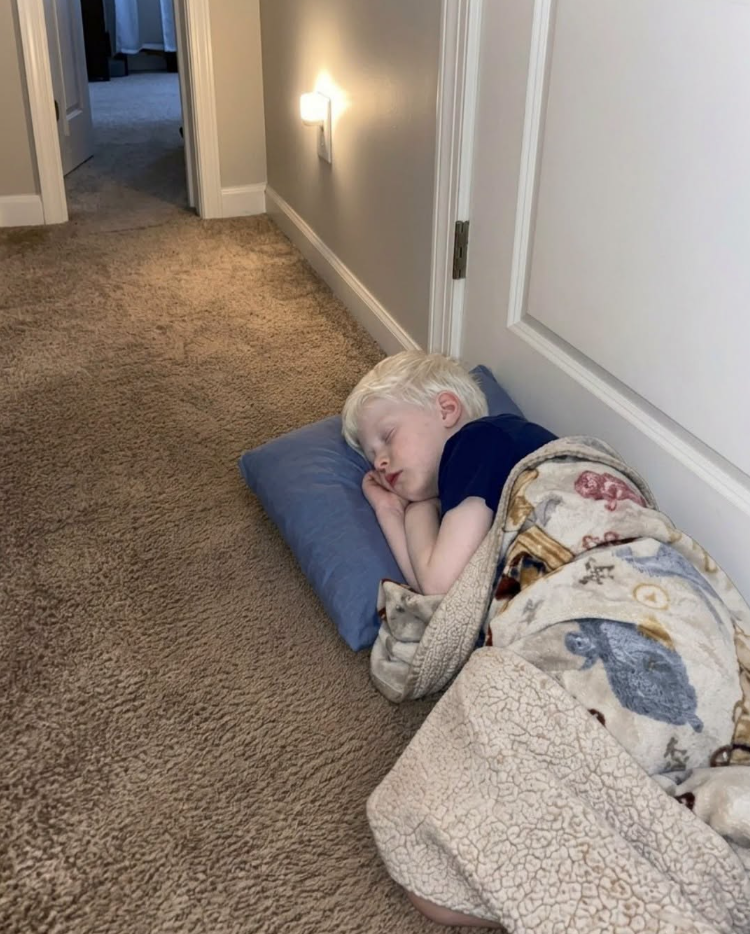
Still, that night, he slept outside Grandma’s bedroom again.
Then, shortly after 4 a.m. last Thursday, a soft whisper woke me.
I stepped into the hallway and stopped cold.
Tyler was lying beneath his blanket outside Grandma’s door, but he wasn’t asleep. His eyes were fixed on the doorknob, and one small hand was tightly wrapped around his pillow.
“I won’t fall asleep tonight,” he whispered to himself.
Then, after a moment, he whispered again.
“I won’t let Uncle Jason do it to Grandma again.”
My blood ran cold.
“Tyler?”
He startled and immediately sat upright.
I hurried toward him.
“What won’t you let Uncle Jason do again?”
His eyes filled with tears almost instantly. He looked toward Grandma’s closed bedroom door before lowering his voice.
“Mom, promise you won’t tell anyone.”
I could barely breathe.
“What did he do?”
Tyler covered his face with both hands.
Then he leaned toward me and whispered one sentence into my ear.
By the time he finished, my hands were shaking so badly that I had to grab the wall.
Tyler’s words echoed in my head.
“Mom… Uncle Jason makes Grandma take extra pills when you’re gone, and he tells her not to tell you.”
For several seconds, I couldn’t move.
I looked at my son’s frightened face, then at the closed bedroom door.
“Are you sure?”
Tyler nodded.
“I saw him.”
“When?”
“Before.”
His voice cracked.
“Sometimes when you go to the store. Sometimes when you’re downstairs.”
I crouched in front of him.
“Tyler, I need you to tell me exactly what you saw. You won’t be in trouble.”
He wiped his cheeks with his sleeve.
“Uncle Jason takes the medicine bottle. He gives Grandma more than you give her.”
My stomach twisted.
“What does Grandma say?”
“She tells him she doesn’t want it.”
Tyler’s voice became even quieter.
“And he says she needs it because she’s sick.”
I stared at him.
“Why didn’t you tell me?”
He looked ashamed.
“Because Uncle Jason said Grandma would get worse if you got upset. And he said you’d think I was lying.”
I pulled him into my arms.
“Oh, sweetheart. You should never have had to keep something like this to yourself.”
Tyler started crying against my shoulder.
“I tried to tell you.”
“I know.”
“I slept outside her door because I didn’t want him to go in there.”
I held him tighter.
“You did the right thing by telling me.”
But inside, panic was taking over.
I knew Mom had been prescribed several medications after her surgery, and I knew they had to be taken carefully. I also knew I couldn’t simply confront Jason in the middle of the night without first making sure Mom was safe.
I quietly checked on her.
She was awake.
Her face looked pale in the dim light.
“Mom?”
She turned toward me.
“What’s wrong?”
I sat beside her.
“Have you been feeling okay?”
She hesitated.
Then she looked toward the hallway.
“Why?”
I took her hand.
“Has Jason been giving you your medication when I’m not here?”
Her expression changed.
For a moment, she said nothing.
Then her eyes filled with tears.
“Sometimes.”
My heart sank.
“Mom, what does he give you?”
She shook her head.
“I don’t know.”
“What do you mean you don’t know?”
“He says it’s what the doctor ordered.”
I felt a wave of anger, but I forced myself to stay calm.
“Has he ever given you more than what I prepared?”
She looked down.
“Yes.”
I closed my eyes.
Tyler had been telling the truth.
“Why didn’t you tell me?”
Mom’s voice trembled.
“Because he’s your brother.”
I stared at her.
“That doesn’t matter.”
“He kept telling me I was confused because of the surgery. He said if I made trouble between you two, you’d be overwhelmed.”
She squeezed my hand.
“And I didn’t want you to have to choose between caring for me and dealing with him.”
I could hardly believe what I was hearing.
“Mom, you never have to protect me from something like this.”
“I know that now.”
I stayed beside her until morning.
The next thing I did was gather every medication bottle and compare the labels with the schedule I had been given after her surgery. I didn’t make any assumptions about what the extra doses meant or why Jason had given them. I knew only that something was wrong and that a medical professional needed to know immediately.
I contacted Mom’s medical team and explained what she had told me.
They instructed us on what to do next and made it clear that we needed to keep careful records of every medication she received.
Mom was evaluated.
The doctors reviewed her medications and her recent symptoms.
That was when we discovered that the medication schedule had not been followed consistently.
I felt sick.
Not because I had failed to notice something obvious.
Because Tyler had noticed.
My eight-year-old had seen the fear on his grandmother’s face and understood that something wasn’t right long before I did.
Later that morning, Jason arrived at the house carrying a grocery bag.
He walked through the door as casually as he always had.
“Morning. How’s Mom?”
I stepped between him and the hallway.
“Don’t go upstairs.”
He stopped.
“What?”
“You heard me.”
His expression changed.
“Is something wrong?”
“Yes.”
I held up the medication bottles.
“Mom told me you’ve been giving her medication when I’m not here.”
Jason stared at me.
Then he shook his head.
“You’re misunderstanding.”
“Then explain it.”
“I was helping.”
“Helping doesn’t mean changing someone’s medication schedule.”
“I never changed anything.”
Mom’s voice came from the hallway.
“You did.”
Jason turned.
She was standing there with one hand resting against the wall.
He immediately looked alarmed.
“Mom, you’re confused.”
“No.”
Her voice was weak, but steady.
“I’m not confused.”
Jason took a step toward her.
I moved between them.
“Don’t.”
He stopped.
For the first time since he had started coming over, he looked genuinely uncertain.
“You don’t understand what happened,” he said.
“Then tell me.”
He didn’t answer.
Mom looked at him.
“Why did you keep telling me not to tell my daughter?”
Jason’s face tightened.
“I was trying to keep her from worrying.”
“You were telling me not to tell my own daughter what you were giving me.”
“I thought I was helping.”
Mom shook her head.
“You frightened me.”
The room went silent.
Then Tyler appeared at the top of the stairs.
Jason saw him.
His face changed.
“You’ve been listening to this kid?”
I immediately turned toward Tyler.
“Go to your room, sweetheart.”
Tyler didn’t move.
He looked terrified.
I walked over and took his hand.
“You’re safe.”
Jason looked at him.
“So that’s what this is about.”
I stepped between them again.
“You will not question him.”
Jason opened his mouth.
Then closed it.
Whatever explanation he had prepared seemed to disappear.
We handled the situation through Mom’s doctors and the appropriate authorities. We documented what had happened, kept the medication under controlled supervision, and made sure Jason could no longer be alone with Mom.
There was no dramatic confrontation.
No shouting match.
No moment where everything suddenly became simple.
There were questions that needed answers, records that needed to be checked, and professionals who needed to determine exactly what had happened.
For me, the hardest part came afterward.
That evening, I found Tyler sitting on the edge of his bed.
His blanket was folded beside him.
His pillow was tucked under one arm.
“Are you going to sleep in the hallway again?” I asked.
He looked embarrassed.
“I don’t know.”
I sat beside him.
“You don’t have to guard Grandma anymore.”
He looked at me.
“Are you sure?”
“Yes.”
“What if Uncle Jason comes back?”
“He won’t be alone with Grandma.”
Tyler looked down.
“I was scared.”
“I know.”
“I thought if I went to sleep, something bad would happen.”
I wrapped my arms around him.
“You should never have had to feel responsible for protecting an adult.”
He started crying quietly.
“I just didn’t want Grandma to get hurt.”
“I know.”
I kissed the top of his head.
“And you did something very important. You told me.”
He leaned against me.
“Are you mad at me for following Uncle Jason?”
“No.”
“For not telling you sooner?”
“No.”
“For sleeping outside Grandma’s door?”
I smiled through my tears.
“No.”
He finally smiled too.
“Can I still sleep there tonight?”
I laughed softly.
“You can sleep wherever you feel comfortable.”
That night, Tyler carried his pillow into the hallway again.
But this time, Grandma’s door was open.
Mom was sitting comfortably in bed, reading.
Tyler curled up on the floor.
I sat beside him.
After a few minutes, Mom called softly from her room.
“Tyler?”
“Yeah, Grandma?”
“Thank you for watching over me.”
He smiled.
“You’re welcome.”
Then he looked at me.
“Mom?”
“Yes?”
“Does this mean I can stop being the bodyguard now?”
I laughed.
“Yes, sweetheart.”
He pulled the blanket over himself.
“Good.”
A few minutes later, he was asleep.
I stayed there for a while, listening to his quiet breathing and watching my mother rest safely in her bed.
I kept thinking about all the mornings I’d found him sleeping outside that door.
I had assumed he was frightened because Grandma was sick.
I had assumed he simply needed reassurance.
I had assumed he was too young to understand what was happening.
But children notice things adults overlook.
They notice changes in voices.
They notice hesitation.
They notice when someone is afraid.
And sometimes, when they don’t have the words to explain what they’re seeing, they simply stay close to the person they love.
Tyler had done exactly that.
He hadn’t known how to explain everything.
He only knew that something was wrong.
So every night, he placed his little body between the hallway and Grandma’s bedroom, convinced that staying awake could keep her safe.
The next morning, when he woke up, I found him still holding his pillow.
He looked at Grandma’s open door.
Then he looked at me.
“Mom?”
“Yeah?”
“Grandma’s okay now?”
I smiled.
“Yes.”
He nodded.
“Then I’m going back to my bed.”
And for the first time in weeks, he picked up his pillow and walked down the hallway without looking back.
I watched him go.
Then I turned toward my mother.
She smiled at me.
Neither of us said anything.
We didn’t need to.
Because that little hallway, that blanket, and that frightened eight-year-old boy had changed everything.
And I knew I would never again dismiss the quiet warning signs simply because they came from someone too young to explain them perfectly.
Sometimes the smallest voice in the house is the one telling you that something is wrong.
You just have to stop long enough to listen.