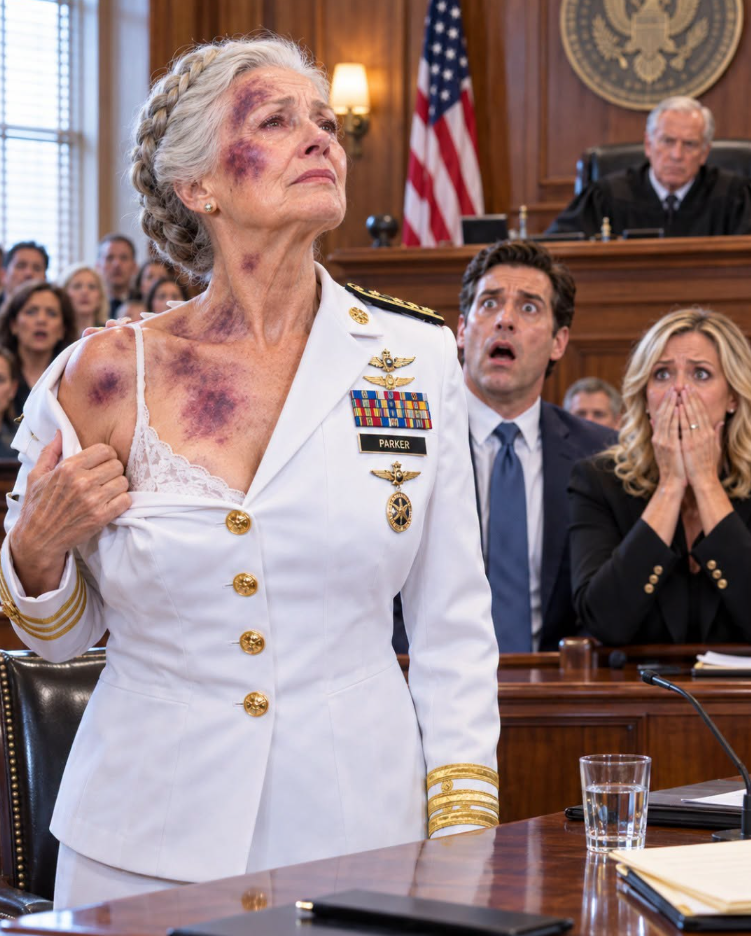
From inside my coat I took a small black voice recorder.
Michael’s face shifted.
“Your Honor, if Mrs. Parker intends to introduce an audio recording, we would first need to establish its admissibility and—”
Judge Bennett raised one hand.
“You’ll have your opportunity, Mr. Walsh.”
Then he looked at me.
“Mrs. Parker?”
I set the recorder down with care.
“These are conversations recorded inside my own home.”
Michael bent toward Gregory and murmured something.
Gregory shook his head.
“I also have bank statements, property records, medical reports, original photographs with metadata, text messages, and a written timeline documenting the past eleven weeks.”
The courtroom went quiet.
Michael looked at me as if I were a stranger.
That almost made me smile.
My son had apparently concluded that age meant a duller mind.
Gray hair meant frailty.
Grief meant confusion.
He had forgotten who taught him to balance his first checking account.
Who caught him taking twenty dollars from my purse at fourteen because he had put the remaining bills back facing the wrong direction.
Who had once uncovered a multimillion-dollar pension fraud because three numbers on a quarterly report did not reconcile.
Patterns had been my work.
And Michael had left patterns everywhere.
Judge Bennett looked at the empty chair beside me.
“Mrs. Parker, you are representing yourself today?”
“For this hearing, yes.”
Gregory allowed the faintest relieved smile.
I saw it.
So did the judge.
“But I didn’t come unprepared.”
I slid a folder toward the clerk.
The first page was an evaluation completed by Dr. Rebecca Collins, a board-certified neurologist specializing in geriatric cognitive health.
Three hours of testing.
Memory.
Judgment.
Language.
Spatial reasoning.
Executive function.
Decision-making capacity.
I had scored in the ninety-fourth percentile for my age.
More importantly, Dr. Collins had written one conclusion in bold:
There is no clinical evidence that Margaret Parker lacks the capacity to manage her personal, medical, legal, or financial affairs.
Judge Bennett read it twice.
Michael shifted.
Rachel muttered, “That doesn’t prove she isn’t hurting herself.”
I looked at her.
She dropped her gaze at once.
The judge had heard her.
“Then let’s discuss Mrs. Parker’s injuries.”
I opened another folder.
“The photograph Michael submitted showing my swollen wrist was taken on April twenty-second.”
Gregory checked his papers.
“Yes.”
“At 6:42 p.m.”
“I don’t know the precise time.”
“I do.”
I passed another page to the clerk.
“The original file was preserved through a family cloud account Michael voluntarily synchronized with an account he authorized me to administer years ago.”
Michael sat up.
“What?”
Gregory turned on him.
“You accessed his private account?”
“No. Michael never removed his files from the shared family storage account.”
Then Michael remembered.
Family photographs.
Tax records.
Videos.
Documents.
A cloud plan I had paid for every month.
People seldom notice the doors they leave open when they decide the person on the other side is harmless.
“The photograph of my bruised wrist was taken at 6:42,” I continued. “But another photograph was taken forty-seven seconds earlier.”
The clerk handed the print to Judge Bennett.
Michael went pale.
The image showed Rachel gripping my wrist.
Her fingers were visibly pressing into my skin while I tried to pull away.
The photograph Michael had submitted showed only the bruise afterward.
Gregory stood.
“My client’s wife may simply have been trying to stabilize Mrs. Parker.”
“Then the video should clarify that.”
Rachel’s head snapped toward me.
For the first time, I saw genuine fear.
I produced a flash drive.
Michael whispered, “No.”
My house had six security cameras.
Michael knew about them.
What he did not know was that after my husband, Henry, became sick, I replaced two cameras with newer models that automatically backed up to an encrypted server.
Michael disconnected the obvious hallway camera.
He never discovered the smaller camera hidden inside the smoke detector.
The courtroom watched the footage.
Rachel stood in my hallway holding several papers.
“Sign it.”
“No.”
“It only gives us temporary access.”
“No.”
“Michael is trying to help you.”
“He can help me by leaving my house.”
Rachel seized my wrist.
Hard.
Her knuckles turned white.
“Stop fighting us.”
Then Michael appeared.
He did not stop his wife.
Instead, he looked at me.
“Mom, you’re making this worse.”
The recording ended.
Nobody spoke.
Judge Bennett folded his hands.
“Mrs. Parker, did that incident cause the wrist injury?”
“Yes.”
“And your shoulder?”
“That happened another day.”
I played the second clip.
Michael was blocking the hallway while I tried to reach Henry’s study.
“Where is the original trust?” he demanded.
“That is none of your business.”
“I’m your son.”
“You’re also forty-four years old. Stop acting like an heir waiting for a funeral.”
He pushed me.
It was not a theatrical shove.
It did not send me flying.
It was simply hard enough for my shoulder to strike the wall.
Then Michael immediately said:
“Mom, why did you step backward like that?”
That sentence mattered.
Before I had even regained my balance, he had started building his defense.
Gregory understood it.
So did the judge.
“Your Honor,” Gregory said, “I need a recess to speak privately with my client.”
“Not yet.”
Judge Bennett looked at the bruise above my eyebrow.
“What caused that injury?”
I swallowed.
That one was harder.
Henry’s study had remained almost untouched since his death.
His reading glasses still rested beside the lamp.
An unfinished crossword puzzle remained inside his desk.
Michael knew how much that room meant to me.
He went through it anyway.
I played the final video.
Michael was opening drawers while Rachel carried folders.
I entered.
“What are you doing?”
“Looking for insurance documents.”
“Those aren’t insurance documents.”
He pulled out a red folder.
Henry’s estate documents.
Trust amendments.
Account information.
A private letter.
I reached for it.
Michael pulled it away.
Rachel stepped between us.
When I tried to move around her, Michael pushed me backward with his forearm.
My heel caught the rug.
My forehead struck the corner of the bookcase.
I fell.
Rachel screamed when she saw the blood.
Michael stared down at me.
Then he said the words that changed everything.
“Take a picture before she cleans herself up.”
Rachel pulled out her phone.
She photographed me lying there bleeding.
Michael crouched beside me.
For one foolish second, I thought my son was finally going to help me.
Instead, he whispered:
“You really need help, Mom.”
Then he looked at Rachel.
“Write down that she fell again.”
Judge Bennett stopped the video.
Gregory slowly removed his glasses.
Michael looked sick.
Rachel was crying now.
But those tears were not for me.
The judge called a ten-minute recess and ordered Michael and Rachel to remain inside the courthouse.
Michael leaned across the aisle.
“Mom.”
I ignored him.
“Mom, listen. This has gotten completely out of control.”
As if bruises had simply appeared.
As if financial documents had walked out of locked drawers by themselves.
As if guardianship petitions filed themselves.
“You can stop this,” he whispered. “You’ve made your point.”
“My point?”
His fear turned back into anger.
“You want revenge because Dad left everything complicated. You never trusted me.”
“No.”
He stared at me.
“I stopped trusting you when you gave me reasons not to.”
Judge Bennett returned.
After everyone sat, he turned to Gregory.
“Mr. Walsh, were you aware of these recordings?”
“No, Your Honor.”
“Were you aware that injuries represented to this court as accidental falls allegedly resulted from physical confrontations involving your client and his wife?”
Gregory looked directly at Michael.
“No.”
Michael protested.
“He knew there were family disagreements.”
“Michael.”
Gregory said his name sharply.
Michael stopped.
I opened my final folder.
“This is where the guardianship petition stops being the worst part.”
Rachel closed her eyes.
Michael did not.
Apparently, she knew something he didn’t.
I handed the clerk a transaction report.
“For forty years, Henry and I kept our primary accounts at Atlantic Commonwealth Bank. After Henry died, Michael offered to help organize my paperwork.”
“I was helping you,” Michael snapped.
Judge Bennett silenced him with a look.
“Six weeks after Henry’s funeral, someone attempted to add Michael as joint owner of my savings account.”
Michael stared at me.
“You signed that.”
“No.”
“Yes, you did.”
“The authorization contains something resembling my signature.”
I paused.
“But it is not mine.”
I had spent decades examining fraudulent financial documents.
A convincing forgery is not merely about copying letters.
It is about pressure.
Rhythm.
Stroke sequence.
Hesitation.
The signature looked good.
But there was one mistake.
It read “Margaret L. Parker.”
I had stopped using my middle initial on banking documents in 1998.
Henry knew.
My accountant knew.
My bank knew.
Michael did not.
“The bank rejected the ownership change because the signature failed its verification process.”
Michael looked confused.
I faced him.
“You didn’t know it had been rejected, did you?”
His expression answered me.
I handed the judge another document.
“Two weeks later, a durable financial power of attorney appeared naming Michael as my agent.”
Gregory’s face changed.
Michael said, “Dad wanted me handling things.”
“Your father had been dead for nearly two months when this document was supposedly executed.”
The listed notary was Patricia Dawson.
There was one problem.
Patricia had lost her notary commission eighteen months earlier.
“And yesterday,” I continued, “Ms. Dawson provided a sworn statement confirming that she never notarized this document.”
Michael shot to his feet.
“This is insane!”
The deputy immediately moved closer.
“Sit down,” Judge Bennett ordered.
Michael pointed toward me.
“She manipulates everything! She takes numbers and makes innocent people look guilty!”
I had heard variations of that accusation throughout my career.
Numbers do not manipulate people.
People manipulate numbers.
“The forged power of attorney was used three times,” I continued.
Rachel turned toward Michael.
“What?”
He whispered, “Not now.”
“The first attempt involved my investment account. It failed. The second requested information about my life insurance policies. That succeeded.”
I paused.
“The third went to a real estate broker.”
Judge Bennett frowned.
“For what?”
“To prepare my house for sale.”
Rachel shook her head.
“No. Michael told me Margaret agreed to move.”
“Shut up,” Michael whispered.
Rachel stared at him.
“You said she agreed to the condo.”
“I never agreed to sell my home,” I told the judge.
Michael suddenly shouted, “You can’t live there forever!”
There it was.
Ownership.
He had already started treating my property as his.
“My home is worth approximately $1.8 million,” I said. “The savings and investment accounts they attempted to access total approximately $2.4 million.”
Rachel’s mouth fell open.
Even that surprised her.
Michael had apparently given different people different versions of my finances.
Judge Bennett asked why I had not reported everything immediately.
“Because I wanted to know how far it went.”
Michael laughed bitterly.
“She set us up.”
“Yes,” I said. “I did.”
Once I discovered the suspicious power of attorney, I stopped confronting them.
I pretended to be more tired than I was.
I occasionally repeated questions.
I deliberately left an outdated account statement inside an unlocked drawer.
Its balance was wrong by exactly eighty thousand dollars.
Three days later, Michael mentioned that exact number while privately speaking to Rachel.
So I created another test.
A fake letter from my investment adviser referenced a nonexistent $600,000 certificate of deposit.
I placed it inside Henry’s study.
Two nights later, Michael entered the room and found it.
He searched online for the account.
The account did not exist.
But the inquiry did.
11:48 p.m.
Michael’s home IP address.
Using a scanned copy of my driver’s license that had been stored inside my locked desk.
That was when I contacted Olivia Ramirez, a forensic investigator specializing in elder financial exploitation.
I had trained Olivia years earlier.
For three weeks, she followed every trail.
The forged power of attorney.
The broker inquiry.
The banking attempts.
The medical evidence attached to Michael’s guardianship petition.
That last item caught the judge’s attention.
“Medical evidence?”
I handed him two documents.
“The first is the medical summary Michael submitted.”
It contained a sentence stating that I had demonstrated increasing confusion and an inability to remember recent injuries.
“The second is the certified record directly from my physician.”
That sentence was absent.
Gregory stood so quickly his chair scraped against the floor.
“Your Honor, my office received the medical record from Mr. Parker already assembled as an exhibit.”
Judge Bennett stared at Michael.
Michael looked at Rachel.
Rachel shook her head.
“No.”
“You prepared the packet,” Michael said.
“I scanned what you gave me.”
“You edited it.”
“You told me those were corrections!”
Gregory physically stepped away from his clients.
That was when Michael panicked.
“She’s lying!”
Rachel stared at him.
“You told me your mother’s doctor forgot to include the diagnosis!”
“There was no diagnosis,” I said.
Rachel looked at Michael.
“You said she had dementia.”
“I said she was declining.”
“You said a neurologist told you!”
Judge Bennett struck the bench.
“That is enough.”
Then he looked at me.
“Do you have evidence concerning who created the altered document?”
“Yes.”
A week before the hearing, Rachel’s printer had stopped working.
She emailed the modified PDF to a copy center.
Her message said:
“Michael says use this version because Mom’s doctor left out the mental part.”
The email eventually appeared in materials forwarded to Gregory’s office.
The paper trail existed.
Judge Bennett ordered another recess.
This time two additional officers entered.
Michael noticed.
“So this is it?” he asked me. “You’re going to get your own son arrested?”
“You still think this is about what I’m doing to you.”
He stared at me.
“You entered my locked office. You forged my signature. You tried to access my money. You prepared to sell my home. You photographed injuries you helped cause and then presented them as proof that I couldn’t care for myself.”
My voice remained calm.
“You did those things, Michael.”
His expression twisted.
“You’re my mother.”
“Yes.”
My voice finally trembled.
“And you were my son before you decided to become my predator.”
For a moment, something broke across his face.
Then anger returned.
“You always loved Dad more.”
That surprised me.
“He respected you,” Michael continued. “Everything was always Henry and Margaret. Perfect marriage. Perfect team. Perfect financial minds.”
“Your father loved you.”
“He judged me.”
“He rescued you.”
Michael stopped.
I had not planned to say what came next.
“When your construction company failed six years ago, your father covered payroll so twelve employees could receive their wages before Christmas.”
Rachel stared at Michael.
“What?”
“When you had tax problems, Henry paid the attorney. When you lost forty-three thousand dollars trading options, he covered your mortgage because Rachel was pregnant.”
Rachel whispered, “You told me your company gave you a bonus.”
Michael grabbed her arm.
“Sit down.”
She pulled free.
“You told me you paid that mortgage yourself.”
A deputy moved between them.
In that moment, I realized their marriage had been constructed from the same material as their case against me.
Edited truths.
Selective memories.
Invented explanations.
Michael convinced Rachel I was selfishly hoarding money.
Rachel convinced herself that forcing an elderly widow out of her house was practical.
Each lie made the next easier.
When court resumed, Judge Bennett needed less than three minutes to rule.
The guardianship petition was denied.
Completely.
He found no evidence that I lacked capacity and substantial reason to believe the petition might have been filed for improper financial purposes.
He referred the forged power of attorney, altered medical records, and evidence of physical abuse to prosecutors and protective-services investigators.
Then he issued a temporary protective order preventing Michael and Rachel from entering my home, accessing my accounts, contacting my financial institutions, or disposing of anything taken from my property.
Michael had lost.
But there was one thing left.
“Your Honor?”
Judge Bennett looked at me.
“There is another matter.”
Michael gave a broken laugh.
“Of course there is.”
I lifted a thin brown envelope.
Henry’s handwriting covered the front.
For Margaret, if Michael ever tries to take control.
Michael recognized it immediately.
His face went blank.
I had discovered the envelope hidden behind a panel inside Henry’s desk three nights before the hearing.
Inside was a letter.
And an amendment to our family trust.
Henry had signed it eleven months before his death.
Long before the bruises.
Long before the petition.
Long before Michael began telling people I was confused.
Apparently my husband had seen something I had refused to see.
I unfolded his letter.
Michael whispered, “Mom, don’t.”
I read the relevant portion.
“Margaret, If you are reading this because Michael has attempted to pressure you for control of our assets, then I was right to be concerned. I love our son. But love does not require blindness. Michael has repeatedly asked about the trust, the house, and whether your signature alone would be sufficient after my death. I have amended the trust so that any beneficiary who attempts through fraud, coercion, abuse, or a bad-faith guardianship proceeding to gain control over you or the trust will forfeit his inheritance.”
Michael whispered, “No.”
I continued.
“His share will pass to his lawful descendants in protected trust, or, if none survive, to the Henry and Margaret Parker Foundation for Elder Financial Protection.”
Henry had known.
Even while dying, my husband had tried to protect me.
From our own child.
Michael shook his head.
“That isn’t valid.”
“Henry signed it.”
“You manipulated him.”
“He recorded the signing.”
Michael froze.
Of course Henry recorded it.
He had spent forty-six years married to a forensic accountant.
The video showed him sitting in his study beside his attorney and two witnesses.
Thin.
Weak.
But completely lucid.
“If Michael never crosses that line,” Henry said into the camera, “then none of this matters. I hope he never does.”
He coughed.
“But if he tries to use Margaret’s age, grief, or health to steal control from her, he receives nothing from me.”
Michael sank into his chair.
Rachel whispered, “How much?”
He did not answer.
She looked at me.
“How much was Michael supposed to inherit?”
“Approximately $3.2 million.”
Rachel stared at her husband.
Gone.
Not because I took it.
Not because the judge did.
Because Henry had established one simple condition.
Do not prey upon your mother.
Michael failed.
Rachel suddenly laughed.
“You told me we had to do this before she changed the trust.”
Michael went still.
“You said if the guardianship went through, the inheritance would be protected.”
“Rachel.”
“You knew about the clause?”
“Stop talking.”
“You knew!”
Michael grabbed her again.
The deputy immediately restrained him.
And there was the final piece.
Michael had known enough about the amendment to understand that openly coercing me could destroy his inheritance.
So he needed a judge to declare me incompetent.
Then he could claim he acted lawfully.
Out of concern.
The bruises would show that I could not care for myself.
The altered medical records would show cognitive decline.
The forged power of attorney was insurance.
Every path led to my house, my accounts, and the inheritance.
But Henry had built a wall at the end of every one.
Michael was not marched directly to prison that afternoon.
Real life moves slower than television.
There were investigations.
Motions.
Interviews.
More lies.
Michael blamed Rachel.
Rachel blamed Michael.
Gregory withdrew and surrendered his files under court order.
Eventually Michael pleaded guilty to several financial offenses and an offense connected to the forged document.
Rachel accepted a separate plea involving evidence falsification and unlawful restraint.
They lost their reputation.
Their marriage eventually collapsed.
Their house was sold.
And Michael lost the inheritance he had tried so desperately to preserve.
I never claimed that money.
Henry’s amendment determined where it went.
Michael’s share was placed in protected trusts for his two children.
My grandchildren could use it for education, medical needs, housing, and later adulthood.
Michael could not touch a dollar.
My attorney asked whether I wanted to challenge that arrangement.
“No.”
“After everything?”
“Especially after everything.”
Children should not inherit their parents’ punishment.
A year later, I sold my house.
Not because Michael wanted me gone.
Because I decided I was ready.
That difference mattered.
I walked through every room one final time.
The kitchen where Henry made terrible pancakes on Sunday mornings.
The dining room where Michael opened birthday presents as a child.
The hallway where Rachel bruised my wrist.
The study where my son pushed me.
I stayed there longest.
Henry’s chair remained behind the desk.
I placed my hand on it.
“You knew.”
For a moment, I was angry that he had never told me.
Then I understood.
Henry had hoped he was wrong.
So had I.
That may be the cruelest part of loving someone.
Sometimes the evidence arrives long before you are emotionally willing to accept the conclusion.
I moved into a smaller home twelve miles away.
One floor.
Large windows.
A manageable garden.
Then I did something Michael never expected.
I returned to work.
Only three days a week.
I opened a small consulting practice devoted to fraudulent guardianships and elder financial exploitation.
My first client was seventy-eight.
Her niece had convinced relatives that she was confused.
Ninety thousand dollars had disappeared from her account in eight months.
She sat across from me apologizing.
For getting old.
For trusting family.
For not noticing sooner.
I reached across my desk.
“Stop apologizing.”
She looked up.
“Now show me the statements.”
Six months later, we recovered most of her money.
Then another case arrived.
And another.
Eventually Judge Bennett invited me to speak at a judicial conference about abusive guardianship petitions.
A young attorney asked me:
“How do families know when help becomes control?”
I thought for a moment.
“Help gives someone more choices.”
The room became quiet.
“Control takes those choices away.”
Three years have passed.
Michael still writes occasionally.
His early letters blamed Rachel.
Then his lawyer.
Then Henry.
Then me.
His most recent letter was different.
“Mom, I understand now that I kept calling it concern because admitting what I really wanted would have made me hate myself. I believed I deserved what you and Dad built. I understand why you don’t answer. I’m sorry.”
I read it twice.
Then put it away.
Forgiveness is not the same thing as access.
Perhaps someday I will completely forgive my son.
Maybe part of me already has.
But Michael will never again possess a key to my home.
Or access to my accounts.
Or authority over my decisions.
Last month, my granddaughter turned eighteen.
Henry’s trust paid her first college tuition bill.
She came over afterward carrying a little bakery cake.
We sat in my garden.
She asked about her grandfather.
Not his money.
Henry himself.
“What was Grandpa really like?”
I laughed.
“He cheated at Scrabble.”
She looked horrified.
“No!”
“Constantly.”
We talked until sunset.
Before leaving, she hugged me.
Then she asked:
“Grandma, were you scared that day in court?”
I remembered my coat.
My cane.
Michael laughing.
Rachel smiling.
Photographs of my bruises being displayed as evidence against me.
Judge Bennett opening the file.
And the little black recorder hidden inside my coat.
“Yes,” I said. “I was terrified.”
She looked surprised.
“But you seemed so strong.”
I smiled and took her hand.
“That’s what people misunderstand about strength.”
The porch light came on behind us.
“Being strong doesn’t mean you aren’t afraid. It means fear doesn’t get to make the decision.”
After she left, I stayed outside.
For most of my career, I believed numbers always told a story.
I eventually realized I was wrong.
People tell stories.
Numbers reveal which stories are lies.
Michael created a story in which I was elderly, confused, unstable, and incapable of protecting myself.
He gathered photographs.
Created records.
Filed a petition.
Changed documents.
He expected everyone in that courtroom to see exactly what he wanted them to see.
A frail seventy-one-year-old widow.
He was right about some things.
I was seventy-one.
I was grieving.
Some mornings I needed a cane.
But age had not erased forty years of experience.
Grief had not erased my judgment.
And love had not erased the evidence.
Michael believed the bruises would make me powerless.
Instead, every bruise became a timestamp.
Every lie produced another document.
Every forged signature created another trail.
Every photograph became evidence.
The courtroom where my son expected to take away my independence became the place where I reclaimed it.
I did not watch when officers eventually led Michael through the courthouse doors.
By then, I had already turned away.
Because I finally understood that winning had never meant watching my son lose everything.
Winning was walking outside into the sunlight, reaching into my own pocket for my own house key, and knowing that nobody would ever again make decisions about my life without my permission.