When I first met my fiancé’s parents, I told them I was a nurse.
That was true.
It just wasn’t the whole truth.
I had started my career in nursing, and I was proud of every year I had spent learning the profession from the ground up. But by the time I met Daniel’s family, I had gone much further.
I was Dr. Emily Carter, Chief of Cardiothoracic Surgery at St. Victoria Medical Center, one of the most prestigious private hospitals in Chicago.
Daniel knew.
His parents didn’t.
And for six weeks, I watched them decide exactly how much respect I deserved based on a job title they had never bothered to understand.
I never expected that one hospital chart would eventually force them to see me differently.
It happened at the Reynolds Country Club on a bright late-morning Sunday.
Nearly forty relatives were gathered beneath polished chandeliers, champagne glasses catching the sunlight as conversations bounced from one end of the room to the other.
I was standing beside Daniel when his mother, Barbara, placed a hand on my shoulder.
She smiled proudly.
“And this is Emily. She’s a nurse.”
There was a pause.
Not a cruel pause.
That somehow made it worse.
It was the subtle change in a room when people think they have already figured you out.
An elderly aunt gave me a polite smile.
Someone else asked which hospital I worked at.
“St. Victoria Medical Center.”
A man across the table immediately looked interested.
“I’ve heard they have some incredible surgeons there.”
Barbara laughed softly.
“Oh, they do. I’m sure Emily keeps them organized.”
A few people chuckled.
Daniel went completely still beside me.
I didn’t.
I simply smiled, lifted my coffee cup, and said:
“They certainly keep me busy.”
Barbara looked satisfied.
She thought she understood me.
She thought she had placed me neatly into a category.
What she didn’t know was that I had spent nearly two years building a life with her son without ever needing the Reynolds family’s approval.
And what she definitely didn’t know was that Daniel had wanted to tell them everything from the beginning.
I was the one who asked him not to.
One evening, sitting together in our Chicago condo, he had looked at me across the kitchen island.
“You know they’re going to keep assuming you’re just a nurse, right?”
“I know.”
“You want me to tell them?”
I shook my head.
“If they only respect me after they hear my title, then they never respected me in the first place.”
Daniel understood.
So we kept the truth between us.
When Barbara asked what I did at St. Victoria, I told her I worked in surgery.
Before I could explain any further, she interrupted.
“Oh, she’s one of the nurses.”
I didn’t correct her.
The truth was, I had been a nurse.
And I was proud of it.
Nursing had taught me things no textbook could.
It had taught me how to recognize fear in a patient’s eyes. How to stay calm when everyone else was panicking. How to speak gently to families who had just received devastating news.
It had been part of the journey that eventually led me to becoming a surgeon.
But Barbara didn’t know any of that.
And rather than asking, she simply filled in the blanks herself.
From that day forward, she found a hundred polished little ways to remind me that I wasn’t the woman she had imagined for her son.
At Sunday dinner, she casually mentioned that becoming a physician “isn’t for everyone.”
At breakfast one morning, she handed me an apron.
“Nurses are practical people,” she said.
I smiled.
“That’s one way to put it.”
At a charity gala, the Reynolds family made their priorities even clearer.
Daniel was seated at the head table alongside physicians, executives, investors, and major donors.
I was placed near the back with volunteers and event staff.
Barbara noticed me looking at the seating arrangement.
“The head table is reserved for senior leadership,” she explained gently.
I nodded.
“Of course.”
I didn’t argue.
I didn’t embarrass Daniel.
I didn’t tell her that the hospital executives sitting at that table had attended meetings I had chaired.
I simply took my seat.
Then came our engagement brunch.
Barbara handed me a beautifully wrapped cookbook.
I opened it.
Easy Family Meals for Busy Beginners.
For a moment, I thought maybe I was being too sensitive.
Then I saw the handwritten note inside.
So Daniel won’t have to live on hospital cafeteria food forever.
Love, Barbara.
Several relatives laughed.
I closed the cookbook.
“Thank you.”
Barbara leaned closer.
“A good meal keeps a marriage healthy.”
I looked directly into her eyes.
“So does kindness.”
For the first time, her smile slipped.
Only for a second.
Then my phone vibrated.
It was the hospital.
My phone was normally on silent, but St. Victoria was one of the few contacts allowed to break through.
I stepped into the hallway and answered.
A major multi-vehicle collision had occurred on the freeway.
Twelve patients were being transported to St. Victoria.
Trauma was already overwhelmed.
They needed me immediately.
I returned to the room and reached for my purse.
Daniel looked at my face and understood before I said anything.
“I have to go.”
Barbara frowned.
“Now?”
“There’s been a serious accident.”
She gave a small, almost amused sigh.
“Well, I suppose hospitals are busy on weekends.”
I turned toward the door.
Then she laughed lightly and said, loud enough for several relatives to hear:
“I guess somebody has to change all those bedpans.”
Daniel’s chair scraped sharply against the floor.
“Mom.”
The room went silent.
“That’s enough.”
Barbara blinked.
“I was joking.”
“No,” Daniel said. “You’ve been insulting Emily since the day you met her.”
I touched his arm before his anger could turn the brunch into something neither of us could take back.
“It’s okay.”
He looked at me.
“No, Emily. It isn’t.”
I picked up my purse.
“It will be.”
Twenty-eight minutes later, I walked through the staff entrance at St. Victoria.
The moment the automatic doors opened, the Reynolds family disappeared from my thoughts.
A resident rushed toward me with an update.
Another handed me a tablet filled with trauma scans.
A nurse passed me surgical gloves without even slowing down.
The emergency department was chaos.
Twelve patients.
Multiple injuries.
Families crying.
Physicians shouting orders.
Nurses moving from bed to bed.
There was no room for wounded pride.
No room for family drama.
There were patients who needed us.
And there were lives to save.
I worked most of the night.
By the following morning, three trauma patients were stable.
One remained critical.
I had barely finished my coffee when my pager vibrated again.
Emergency consult.
Possible Type A aortic dissection.
I walked toward the imaging station and began reviewing the CT scans.
The tear was extensive.
Time mattered.
Every minute mattered.
An emergency physician handed me the patient’s chart.
I looked down.
And froze.
The name on the chart was:
Richard Reynolds.
Daniel’s father.
For one second, every sound around me seemed to disappear.
Then my training took over.
“Prep Operating Room Three.”
I tucked the chart beneath my arm and headed toward the trauma bay.
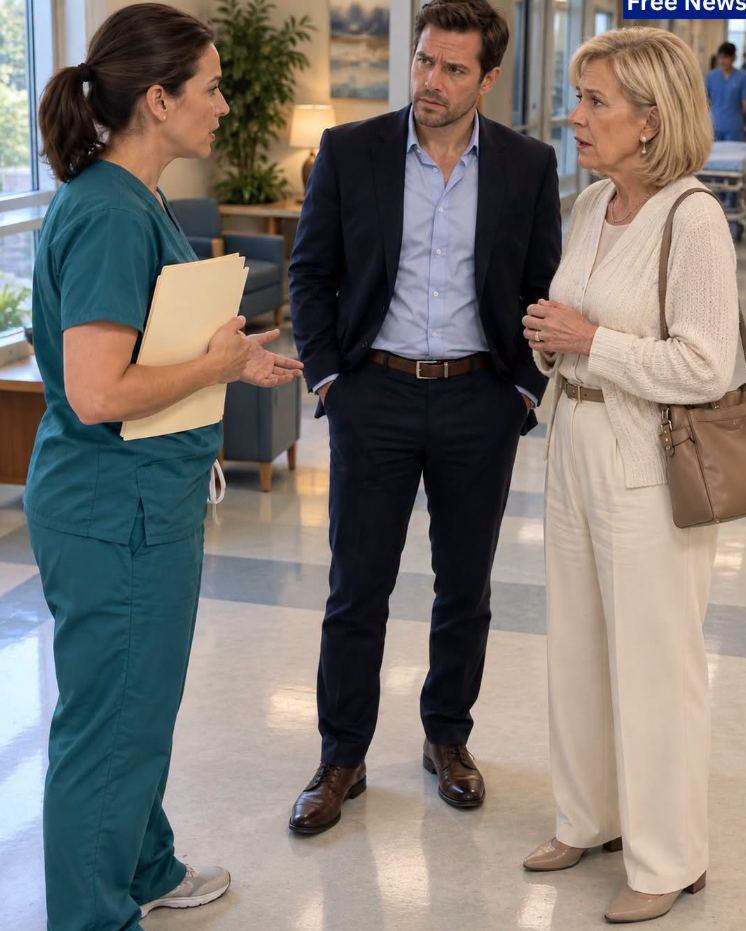
That was when I saw Daniel.
He stood in the corridor beside his mother.
His face was pale.
He looked terrified.
The moment his eyes found mine, he stepped forward.
“Emily…”
Barbara turned.
Her expression changed instantly when she saw me.
I was wearing surgical scrubs.
My hospital badge was clipped to my chest.
A surgical team was already gathering behind me.
Barbara looked from me to the medical staff.
“What is she doing here?”
Before Daniel could answer, the charge nurse hurried toward me.
“We’re ready, Doctor.”
Barbara stepped forward.
Still confused.
Still trying to understand what was happening.
“I’m sorry,” she said. “We’re waiting for the chief surgeon.”
The charge nurse stopped.
She looked at Barbara.
Then at me.
Then back at Barbara.
“Mrs. Reynolds,” she said calmly, “Dr. Emily Carter is the chief surgeon.”
Barbara’s face went completely blank.
Her eyes dropped to my badge.
Then back to my face.
For the first time since I had met her, Barbara Reynolds had absolutely nothing to say.
And unfortunately for her, the woman she had spent six weeks mocking was now the surgeon her husband’s life depended on.
There was no time for embarrassment.
No time to discuss who had misunderstood whom.
No time for explanations.
Richard Reynolds was lying behind those doors with a life-threatening tear in his aorta.
He needed an operating room.
Not a family argument.
Barbara stared at the consent form.
Her hands trembled slightly.
Then she signed.
I looked at Daniel.
“I’m going to take care of him.”
Daniel nodded, his eyes filling with tears.
“I know.”
Then I turned and walked into the operating room.
The surgery lasted nearly six hours.
Six hours of concentration.
Six hours of monitoring every movement.
Six hours of knowing that the man on the table wasn’t simply another patient.
He was my future father-in-law.
The same man whose family had spent weeks deciding I wasn’t important enough to ask questions about.
But inside that operating room, none of that mattered.
I wasn’t Barbara’s future daughter-in-law.
I wasn’t Daniel’s fiancée.
I wasn’t the woman who had been humiliated at a country club.
I was his surgeon.
And he was my patient.
When I finally stepped out of the operating room, exhaustion hit me all at once.
Daniel and Barbara were waiting.
Daniel stood immediately.
I pulled down my mask.
“Your father is stable.”
Daniel closed his eyes.
A breath escaped him that sounded as though he had been holding it for six hours.
“He’s going to recover,” I continued. “The repair went well. The next few days will be important, but he made it through.”
Daniel hugged me.
Hard.
For several seconds, neither of us spoke.
Then I looked toward Barbara.
She was standing a few feet away.
Her eyes were red.
She looked smaller somehow.
Not because anything about her had changed physically, but because the certainty she had carried for six weeks was gone.
“Emily,” she said quietly.
I waited.
“I owe you an apology.”
I didn’t interrupt.
“I judged you before I ever bothered to know you.”
She swallowed.
“I thought I knew what kind of person you were because of what I thought your job was.”
I looked at her.
“That wasn’t the only problem.”
Barbara nodded slowly.
“I know.”
“You didn’t just insult me.”
She looked down.
“You made nurses sound like they were less important.”
She raised her eyes again.
“I know.”
I took a breath.
“There are nurses at that hospital who have saved lives before a surgeon ever entered the room. There are people working in emergency departments, cleaning rooms, transporting patients, answering phones, changing dressings, comforting families. None of them deserve to be treated as though their work makes them less valuable.”
Barbara’s eyes filled with tears.
“I understand now.”
I believed that she meant it.
But understanding doesn’t erase what happened.
And an apology doesn’t automatically rebuild trust.
It simply creates the possibility of rebuilding it.
Months later, Daniel and I were married in a small botanical garden.
There were about eighty guests.
No ballroom.
No extravagant seating chart.
No head table designed to separate the important people from everyone else.
Just flowers, trees, family, friends, and the people who genuinely mattered to us.
When Barbara stood to give her toast, the room became quiet.
She looked at me.
Then at Daniel.
Then at the guests.
“I spent a long time believing that a person’s title told me their value,” she said.
Her voice shook slightly.
“I was wrong.”
She paused.
“Emily taught me something I should have known long before I met her. Integrity matters more than appearances. Kindness matters more than status. And the way someone treats people who cannot offer them anything in return tells you far more about their character than a job title ever will.”
I looked across the room.
Richard was sitting at a nearby table.
He looked healthier.
Stronger.
More attentive to life than he had before the surgery.
He raised his glass.
Daniel smiled.
I lifted mine.
I never needed Barbara to admire me because I was a chief surgeon.
I never needed the Reynolds family to be impressed by my credentials.
What I needed was much simpler.
I needed them to understand that dignity should never depend on a title.
A nurse is not less valuable because she isn’t a surgeon.
A hospital worker is not less worthy because she doesn’t sit at a head table.
And a person doesn’t become more important because a room suddenly discovers what they have accomplished.
Barbara took the long way to learn that lesson.
But eventually, she did.
And what waited at the end wasn’t humiliation.
It was something far more meaningful.
It was the beginning of an honest relationship.
One neither of us could have built while pretending those six painful weeks had never happened.
Because the truth was, Barbara had never really been embarrassed by my job.
She had been embarrassed by her own assumptions.
And when the surgical chart landed in my hands, it didn’t make me more worthy of respect.
It simply gave her no choice but to finally see the woman who had been standing in front of her all along.