When I refused to let her move in, my father canceled my 30th birthday party and announced, “The lawyer is coming.”
They thought I would panic.
Instead, I opened the security log and saw the secret they had been hiding for three days.
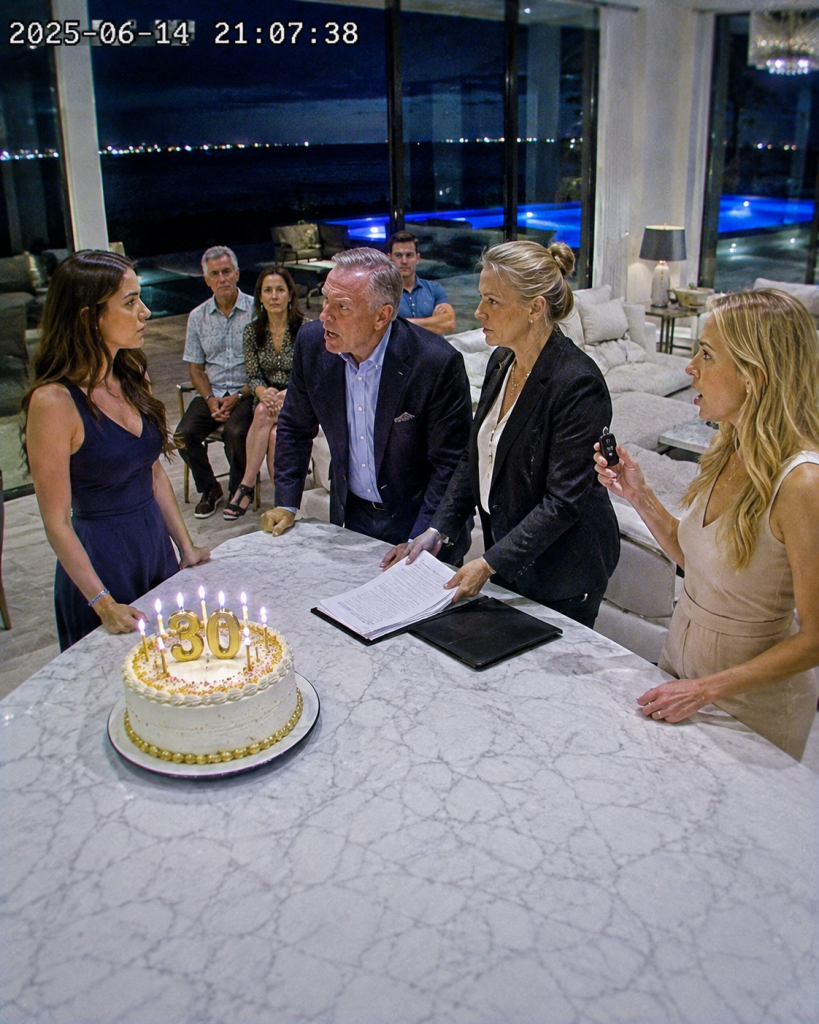
The cake was still untouched on the kitchen island. Thirty gold candles leaned slightly in the frosting, and champagne flutes crowded the sink beneath windows overlooking the dark water.
My aunt had cut herself one careful slice, but she had stopped eating when Kristen began touring the house.
Not admiring it.
Measuring it.
She studied the staircase, the glass doors, the blue-lit pool, and the hallway leading to the guest suite. My mother followed behind her with the soft, patient expression she used whenever she wanted me to look selfish in front of other people.
Kristen ran one finger across the marble counter.
“You don’t need all this space, Denise.”
Nobody laughed.
My cousins looked at their plates. My uncle suddenly became fascinated by the label on his champagne bottle.
They had heard this conversation before.
I was the only person who had not been invited to it.
My father cleared his throat. That sound had controlled every dinner table of my childhood.
“Your sister is going through a transition,” he said. “Family helps family.”
Kristen nodded as though he had just confirmed a decision.
“I’ll take the guest suite,” she said. “Just until my brand gets established. Six months, maybe a year.”
My mother touched my arm.
“You work constantly. You’re barely here. Would it really hurt you?”
That was when Kristen made her mistake.
She pointed down the hallway.
“The guest suite has its own bathroom anyway.”
I looked at her hand.
She had never been inside this house before.
At least, that was what she had told me.
The room went quiet enough for me to hear the refrigerator humming behind us.
I asked, “How do you know where the guest suite is?”
Kristen’s smile paused.
Only for a second.
Then she shrugged. “It’s obvious.”
It wasn’t.
The door looked like a linen closet unless someone had walked through it.
I turned to my parents. My mother looked down. My father straightened his shoulders.
I said, “No one is moving into my house.”
One sentence.
No apology. No explanation.
My father’s face hardened so quickly it looked rehearsed.
“Then the party is canceled,” he announced. “Everyone can go. The lawyer is coming.”
My aunt slowly lowered her fork.
One cousin whispered, “A lawyer?”
Kristen looked at her phone and smiled.
That was when I saw the black key fob resting in her palm.
It was not a copy from a hardware store. It was a custom smart key made for my security system. I had received one when I closed on the house.
There was never supposed to be a second.
My father noticed me staring.
“Don’t make this ugly,” he said.
I looked at Kristen. “Give me the key.”
She curled her fingers around it.
“Dad said I could have it.”
“Dad doesn’t own this house.”
My mother’s voice dropped to a warning whisper. “Denise. Not in front of everyone.”
I almost laughed.
They had announced their plan in front of everyone. Humiliation only became inappropriate when I stopped cooperating.
I walked past Kristen toward the staircase.
Her perfume was stronger in the hallway.
Then stronger again near the stairs.
She had been upstairs.
At the bottom step, I opened the home-security app on my phone. Birthday messages covered the screen, but beneath them was the access history.
My profile appeared first.
Below it was another entry.
FAMILY GUEST.
Created three days ago.
The profile had entered the house six times.
The first entry lasted forty-seven minutes.
The second lasted nearly three hours.
The most recent had happened that morning, four hours before my party.
I kept scrolling.
The guest key had opened the front door, the upstairs hall, and my private office.
My father stepped closer. “Put the phone away.”
I looked up at him. “Who created this profile?”
“We were trying to avoid a scene.”
“By entering my house without permission?”
Kristen rolled her eyes. “We didn’t steal anything.”
I had not accused her of stealing.
Not yet.
My office contained the closing folder, insurance records, passport copies, and the original deed packet from the title company.
I opened the camera archive.
Three recordings had been flagged because someone had covered the office camera with a silk scarf.
My mother’s scarf.
The system had still captured twelve seconds before the lens went dark.
In the frozen preview, Kristen stood beside my desk while my father pulled open the locked document drawer.
My hands went cold.
My face did not change.
Kristen saw the image and stepped toward me. “You shouldn’t have cameras inside. That’s creepy.”
“You shouldn’t be inside.”
My father pointed toward the kitchen. “Sit down. We can settle this like adults when Martin arrives.”
Martin Hale had been my father’s attorney for twenty years. He handled business contracts, property disputes, and every threat my father wanted to make sound official.
My mother began collecting purses and coats, quietly telling relatives the party was over.
Nobody defended me.
They filed toward the door with lowered eyes, leaving half-full glasses and untouched cake behind them.
My aunt squeezed my hand as she passed, but even she said nothing.
Kristen stayed.
She placed the smart key on the counter, but kept two fingers over it.
“This doesn’t have to become a family war,” she said. “Sign an occupancy agreement, let me use the suite, and everyone walks away happy.”
“What occupancy agreement?”
She glanced at my father.
There it was.
Another secret.
My father pulled a folded document from inside his jacket and laid it beside my birthday cake.
My name was printed at the bottom.
A signature that looked almost like mine appeared above it.
The document claimed my parents had contributed to the purchase of the house and therefore controlled a forty-percent family interest. It also granted Kristen twelve months of rent-free occupancy.
Dated three weeks earlier.
I had never seen it.
My mother whispered, “Your father was trying to protect everyone.”
I took one photograph of the document.
Then I sent one message.
Maya. Bring the title packet. Now.
My father mistook my silence for surrender.
“Martin has already submitted the necessary paperwork,” he said. “You can fight us and waste a fortune, or you can act like a daughter.”
Kristen slid the key toward herself again.
“By tomorrow, my things will be here.”
I reached across the island and removed one candle from my cake.
Then I pressed the security app’s emergency-lock button.
Every door in the house sealed with a heavy metallic click.
Kristen’s smile vanished.
“What did you do?”
“Revoked every guest credential.”
My father laughed once. “A lock won’t stop a legal claim.”
“No,” I said. “But an audit trail might.”
The doorbell rang.
My father smiled toward the entryway. “That’s Martin.”
But when I opened the door, my attorney, Maya Chen, stood beside Martin Hale. She carried a laptop under one arm and a sealed county title report in the other.
Martin would not meet my father’s eyes.
Maya walked to the kitchen island, placed the report beside the forged agreement, and opened the folder.
Then she looked directly at my father.
“Your filing didn’t go through,” she said.
For the first time that night, he went pale.
Maya removed a rejected quitclaim deed from the folder and placed it over my father’s fake occupancy agreement.
“The county flagged the signature,” she said. “Then Denise’s title-monitoring service traced the submission to your office.”
My father recovered quickly. “It was an administrative misunderstanding.”
Martin stepped away from him. “You told me Denise had signed voluntarily.”
Kristen snatched the smart key from the counter. “Stop acting innocent, Denise. Sign tonight, or everyone here learns where your down payment really came from.”
Maya did not argue. She connected her laptop to the television above the fireplace.
The screen turned black, then displayed a timestamp from three days earlier.
Kristen appeared inside my private office. My father stood behind her, holding my deed packet while she traced my signature onto a sheet of paper.
Then the recording’s audio began.
My father said, “Once the title is clouded, she’ll have no choice but to negotiate.”
Maya froze the video and reached for a second file.
“That isn’t the worst part,” she said.
PART 2
Maya did not argue.
She connected her laptop to the television above the fireplace.
The screen turned black, then displayed a timestamp from three days earlier.
Kristen appeared inside my private office. My father stood behind her, holding my deed packet while she traced my signature onto a sheet of paper.
Then the recording’s audio began.
My father said, “Once the title is clouded, she’ll have no choice but to negotiate.”
Maya froze the video and reached for a second file.
“That isn’t the worst part,” she said.
Nobody moved.
Even the pool lights outside seemed to have stopped shimmering.
My father stared at the television.
“What are you doing?”
Maya looked at him.
“Showing Denise what happened in her own house.”
Kristen’s face had gone completely white.
She turned toward my father.
“You said there weren’t cameras in the office.”
He didn’t answer.
That was the first crack.
Not the video.
Not the forged signature.
Not even the fraudulent filing.
The fact that Kristen had just admitted she knew there were cameras.
My father slowly looked at her.
“Kristen.”
But Maya was already playing the second recording.
This one was from the night before.
The angle was different.
A small camera hidden above the bookshelf showed my mother entering the office alone.
She closed the door.
She opened the document drawer.
Then she removed a blue envelope.
My mother stopped breathing.
I stared at the screen.
I knew that envelope.
It had been in my office for almost a year.
I had never opened it.
It was the envelope containing the original letter from my grandmother.
The grandmother my parents had always told me “didn’t have much.”
The grandmother who had supposedly left me nothing but a collection of old photographs and a silver watch.
My mother’s hand trembled on the screen.
She took the envelope.
Then she made a phone call.
Maya increased the volume.
My mother’s recorded voice filled the room.
“I found it.”
A man’s voice answered.
“Are you sure?”
“Yes.”
“And the amount?”
My mother looked toward the office door.
“Enough.”
The recording ended.
I slowly turned toward her.
“Who were you talking to?”
My mother opened her mouth.
Nothing came out.
My father stepped between us.
“Denise, this is being taken completely out of context.”
Maya smiled without humor.
“Then perhaps we should watch the next recording.”
She clicked.
Another timestamp.
Two months earlier.
My father was sitting at my office desk.
Across from him sat Martin Hale.
Martin looked exhausted.
My father pushed a folder across the desk.
“You said she couldn’t sell it without our consent.”
Martin opened the folder.
“I said if we had a legitimate ownership interest.”
“We do.”
“No.”
My father leaned forward.
“You’ve handled this family for twenty years.”
“And I’ve told you for twenty years that Denise owns that property.”
Silence.
Martin continued.
“Her grandmother left it to her.”
My father’s jaw tightened.
“She didn’t leave her a house.”
“No.”
Martin looked down at the paperwork.
“She left her the money that bought it.”
My stomach dropped.
Maya paused the recording.
Nobody spoke.
I looked at my mother.
She was crying now.
Not loudly.
Just silently.
Tears sliding down her cheeks as though they had been waiting years for permission.
I turned toward Maya.
“What did my grandmother leave me?”
Maya opened the blue envelope.
Inside was a copy of a trust agreement.
My name was printed across the first page.
The trust had been established when I was nineteen.
My grandmother had deposited a substantial investment portfolio into it.
The funds had remained untouched until I turned twenty-five.
At twenty-five, the trust transferred into my sole control.
I had forgotten about the paperwork because my father had handled everything after my grandmother’s death.
He had told me the estate was complicated.
He had told me the lawyers were dealing with taxes.
He had told me there wasn’t much.
Apparently, “not much” meant enough to buy a $1.5 million vacation home.
Maya placed another document beside it.
“This is the bank transfer.”
I stared at the number.
My father’s name appeared as the trustee.
But beneath it was something else.
A second transfer.
Then a third.
Money had moved from my grandmother’s trust into an account controlled by my father.
From there, it had been transferred into my property purchase.
For years, I had believed my father helped me buy the house because he wanted me to have a place to escape to.
He had told everyone he contributed to the down payment.
He had never told me that the money was mine.
He had simply moved it through his own accounts and allowed himself to become the hero.
My father’s voice was barely audible.
“That money was family money.”
I looked at him.
“No.”
His eyes hardened.
“Your grandmother intended it for the family.”
“Then why was my name on the trust?”
He had no answer.
Maya did.
“Because your grandmother specifically anticipated this.”
She pulled out another page.
There was a handwritten note.
The handwriting was unmistakable.
My grandmother’s.
I had seen it on birthday cards when I was a child.
Maya read it aloud.
“If my son ever tells Denise that this money belongs to the family, he is lying.”
My father closed his eyes.
My mother’s shoulders shook.
I could barely breathe.
Maya continued.
“Denise has spent her entire childhood being told she is difficult whenever she asks for fairness. I am leaving this to her because I know exactly why.”
I stared at the television.
My grandmother had known.
Somehow, years before any of this happened, she had known.
She had seen what I couldn’t see.
The favoritism.
The manipulation.
The way every family demand was dressed up as love.
The way my parents used guilt whenever I said no.
The way Kristen learned to expect things from me because everyone around her taught her that I owed them.
My father finally spoke.
“Your grandmother was bitter.”
I turned toward him.
“She was right.”
He flinched.
Maya closed the trust folder.
“There’s more.”
Of course there was.
At that point, I almost laughed.
The night had become a room full of hidden doors.
Every time one opened, there was another one behind it.
Maya brought up a spreadsheet.
“This is a reconstruction of every transaction involving Denise’s trust from the date it was established until today.”
I looked at the screen.
There were dozens.
Small transfers.
Large transfers.
Credit card payments.
Mortgage payments.
Business expenses.
Medical bills.
Car payments.
Private school tuition.
Travel expenses.
Even a wedding venue deposit.
My family had been using my grandmother’s money for years.
I pointed at one transaction.
“What’s that?”
Maya zoomed in.
“Kristen’s business.”
Kristen shook her head.
“No.”
“Two hundred and eighty thousand dollars.”
“No.”
“The transfer was made from an account funded entirely by Denise’s trust.”
Kristen looked at my father.
“Dad.”
He said nothing.
She stepped backward.
“You told me that was your money.”
My father looked at her.
“It was.”
Maya corrected him.
“No. It wasn’t.”
Kristen’s face collapsed.
“Then why did you give it to me?”
My father didn’t answer.
Kristen turned on him.
“You told me Denise didn’t care about money.”
Still nothing.
“You told me the house was basically yours.”
Silence.
“You told me once the lawyer filed the deed, she would have to share it.”
My father’s expression hardened.
“Stop talking.”
Kristen stared at him.
For the first time that night, I saw something I had never seen before.
My sister was afraid of my father.
Not annoyed.
Not irritated.
Afraid.
Maya closed the laptop.
“The fraudulent deed has been referred to the county recorder’s fraud division.”
My father immediately straightened.
“That is unnecessary.”
“The forged signature was submitted using your attorney’s office credentials.”
Martin looked sick.
“I didn’t submit it.”
Maya nodded.
“We know.”
Martin stared at her.
“How?”
“Because the submission came from a computer connected to your office network.”
My father said, “Someone must have used my credentials.”
Maya looked at Kristen.
Kristen’s eyes widened.
“No.”
Maya continued.
“The security footage shows Kristen entering the office at 10:14 that morning.”
Kristen shook her head.
“I was looking for the bathroom.”
“The bathroom is downstairs.”
“I didn’t know.”
“You had already entered the house five times before that.”
Kristen stopped.
Maya looked at me.
“The access logs show something else.”
She opened another screen.
The guest profile.
Six entries.
Then seven.
Then eight.
I frowned.
“I only saw six.”
“There were eight.”
Maya pointed at the final two.
“They were made after your family arrived tonight.”
I looked toward the front door.
“Who entered?”
Maya enlarged the screen.
The profile name appeared.
FAMILY GUEST.
The camera footage loaded.
A man entered the house.
Not my father.
Not Kristen.
Not my mother.
Martin stared at the screen.
“That’s…”
He stopped.
I looked at him.
“Who?”
Martin swallowed.
“My assistant.”
My father turned sharply.
“What was he doing here?”
Martin didn’t answer.
Maya did.
“He was carrying a document case.”
The footage showed him walking directly toward my office.
He stayed inside for nineteen minutes.
Then he left.
I looked at Martin.
“Did you send him?”
Martin slowly shook his head.
“No.”
“Then who did?”
Nobody answered.
Maya paused the video.
She turned toward me.
“Denise, there’s something you need to know before we continue.”
I nodded.
“The title-monitoring system sent me an alert three weeks ago.”
My heart sank.
“Three weeks?”
“Yes.”
“Why didn’t you tell me?”
“Because I wanted to verify it before frightening you.”
“What alert?”
“A preliminary attempt to add a lien against the property.”
I looked at my father.
He looked away.
Maya continued.
“It wasn’t the first.”
My mouth went dry.
“How many?”
“Four.”
Four.
Four attempts to take control of my house.
Four times someone had tried to create a legal claim against property they didn’t own.
And all four times, my father had known.
Maybe even ordered them.
I looked at the forged occupancy agreement on the counter.
“Why tonight?”
Maya took a breath.
“Because tonight was the deadline.”
“For what?”
She opened the last document.
A contract.
Private.
Between my father and an investment company.
My name was not on it.
My house was.
My father had agreed to use the property as collateral for a business loan.
The amount was enormous.
More than the house was worth.
The lender had given him seventy-two hours to provide proof that he controlled the property.
He couldn’t.
Because he didn’t.
So he had created a plan.
He would convince me to sign an occupancy agreement.
That agreement would falsely establish my parents’ ownership interest.
Then he would use that document to claim the property was family-owned.
Then the house would secure his debt.
And when the loan defaulted, the lender would seize it.
I stared at my father.
“You were going to lose my house.”
He finally looked at me.
“I was going to save the family.”
“No.”
My voice was strangely calm.
“You were going to save yourself.”
He slammed his palm against the counter.
“You have no idea what I’ve done for this family!”
I didn’t move.
“You stole from me.”
“I provided for you!”
“You lied to me.”
“I raised you!”
“You used my grandmother’s money.”
“I protected your future!”
“You tried to mortgage my house.”
His voice broke.
“Because I needed time.”
There it was.
The truth.
Not an apology.
Not remorse.
Just desperation.
I looked at my mother.
“And you?”
She wiped her face.
“I knew about the loan.”
I closed my eyes.
That hurt more than my father’s confession.
Because my father had always been predictable.
My mother had been the person I still wanted to believe loved me.
“You knew?”
She nodded.
“How long?”
“Six months.”
I looked down at the birthday cake.
Thirty candles.
Thirty years.
My entire life suddenly felt like a collection of transactions.
What I gave.
What they took.
What they expected.
What they called love.
Kristen suddenly spoke.
“I didn’t know about the loan.”
My father glared at her.
She stepped forward.
“I knew they wanted the house, but I didn’t know why.”
I looked at her.
“Then why did you come here three days ago?”
She hesitated.
“Because Dad told me you were going to sign.”
“I never agreed.”
“He said you would.”
“Why?”
“Because he said you always did.”
The words landed harder than anything else.
Because they were true.
I had always done it.
I had paid.
I had forgiven.
I had attended.
I had rescued.
I had stayed quiet.
I had been the easy daughter.
The reasonable daughter.
The one who understood.
The one who was supposed to sacrifice because she was single and therefore apparently had no real life of her own.
Kristen looked at the floor.
“I thought you would give me the room.”
“Of course you did.”
She began crying.
“I thought you didn’t need it.”
I almost asked her why.
Then I realized I already knew.
Because every time I had needed something, they had told me someone else needed it more.
My scholarship money was needed for Kristen’s tuition.
My car was needed because Dad’s truck broke down.
My savings were needed because Mom had medical bills.
My weekends were needed because Kristen was moving.
My apartment was needed when Kristen’s marriage failed.
My house was needed because Kristen’s business was struggling.
There was always someone who needed something.
And somehow, it was always me who was supposed to provide it.
Maya walked toward the door.
“Denise, we need to make some decisions tonight.”
My father laughed bitterly.
“You think this ends here?”
Maya turned.
“No.”
She placed another folder on the counter.
“It gets much worse for you.”
My father stared at her.
Maya opened the folder.
“This contains the forensic report on the forged signature.”
She slid a page across the marble.
“The ink analysis shows the signature was created after the document’s stated date.”
My father said nothing.
“The printer used to produce the document was registered to your office.”
Still nothing.
“The paper came from your office.”
Nothing.
“The electronic metadata identifies the original file as having been created on your computer.”
My father looked at Martin.
Martin took a step away.
“You used my office.”
My father finally shouted.
“I didn’t forge anything!”
Maya didn’t flinch.
“You don’t have to.”
She turned toward Kristen.
“Your sister did.”
Kristen’s face went blank.
“What?”
Maya pulled up the recording.
Kristen was sitting at my desk.
My father’s voice came through the speaker.
“Make it look close enough.”
Kristen’s recorded voice answered.
“What if she notices?”
“She won’t.”
“And if she does?”
“Then we’ll tell her the lawyer prepared it.”
Kristen covered her mouth.
The room went silent.
She looked at me.
“I…”
I waited.
She couldn’t finish.
My father whispered, “Kristen.”
She turned toward him.
“You said you would protect me.”
“I will.”
“You said the house would be mine someday.”
“I said we’d figure something out.”
“You promised.”
He snapped.
“I was trying to save you!”
She stared at him.
Then something inside her broke.
She started laughing.
It wasn’t happy laughter.
It was the kind that comes when someone realizes the lie they built their entire life around has finally collapsed.
“Save me?”
She wiped her face.
“You ruined me.”
My father stepped toward her.
“Enough.”
“No.”
Kristen backed away.
“You told me Denise was selfish.”
He stopped.
“You told me she was lucky.”
Another step.
“You told me Grandma left everything to the family.”
Nothing.
“You told me the house should belong to me because I’m the one with children.”
My mother whispered, “Kristen…”
“No.”
Kristen looked at both of them.
“You made me hate her.”
I didn’t speak.
She looked at me.
“I thought you were the problem.”
Her voice cracked.
“I thought you were the reason Dad was always angry.”
She covered her face.
“But you weren’t.”
For a moment, nobody moved.
Then the doorbell rang again.
Maya looked at her watch.
“That will be the county investigator.”
My father went rigid.
“The what?”
Maya walked toward the front door.
“I notified them.”
My father grabbed her arm.
She immediately pulled away.
“Don’t touch me.”
His hand dropped.
The front door opened.
Two investigators entered.
Behind them was a uniformed deputy.
My father suddenly looked much older.
The deputy handed him a document.
“You need to come with us to answer some questions regarding suspected property fraud and forgery.”
My mother gasped.
“Arrest him?”
“At this stage, he’s being detained for questioning.”
My father looked at me.
His eyes were different now.
Not angry.
Not commanding.
Desperate.
“Denise.”
I said nothing.
“Tell them this was a family matter.”
I looked at him.
“You made it a legal matter.”
His face crumpled.
“Please.”
It was the first time in my life my father had ever said that word to me.
Please.
The same man who had spent thirty years teaching me never to say no.
The same man who had canceled my birthday because I refused to give away my home.
Now he was asking me for mercy.
I thought about the little girl I had been.
The girl who waited by the window for her father to come home.
The girl who believed every promise.
The girl who thought being a good daughter meant never disappointing anyone.
I looked at the man standing in front of me.
Then I said quietly,
“I’ve spent my whole life trying to be good enough for you.”
He looked at me.
“I don’t have to anymore.”
The deputy escorted him outside.
My mother followed.
She stopped at the door.
“Denise.”
I looked at her.
She was crying.
“I am sorry.”
I believed she meant it.
That was the hardest part.
Because an apology could be sincere and still arrive too late.
I nodded once.
Then she left.
Kristen remained.
She looked at the empty kitchen.
At the cake.
At the champagne.
At the smart key.
Then she placed the key on the counter.
“I don’t deserve your forgiveness.”
I didn’t answer.
“I don’t expect it.”
Still nothing.
She walked toward the door.
Before she left, she turned.
“Happy birthday.”
Then she walked away.
The house became silent.
Not the uncomfortable silence from earlier.
A different kind.
A clean silence.
Maya stood beside me.
“You okay?”
I looked at the cake.
“I don’t know.”
She nodded.
“You don’t have to know tonight.”
I pulled out one of the candles.
Thirty.
I turned it between my fingers.
Then I lit it.
The flame reflected in the glass doors.
Outside, the ocean moved beneath the moonlight.
Maya smiled.
“You should make a wish.”
I almost laughed.
“I already got what I wanted.”
“What?”
“To know the truth.”
But the truth wasn’t the ending.
It was only the beginning.
—
The next morning, the story was everywhere.
Not because I wanted it to be.
Because my father’s company had been connected to the fraudulent property filing, and the investment company had filed its own legal complaint when they discovered the collateral documents were invalid.
The house itself became evidence.
The security footage was subpoenaed.
The financial records were frozen.
The county opened an investigation into the fraudulent filings.
Martin Hale voluntarily cooperated.
He turned over emails.
Contracts.
Messages.
Call logs.
Every piece of evidence made the same thing clearer.
My father had not made one mistake.
He had built an entire system.
For years.
My grandmother’s trust had been drained.
My family had treated the money as an endless account.
My father’s business had been kept alive by funds that were never his.
Kristen’s company had been funded by money she believed came from him.
Even my mother’s car had been purchased through my trust.
The house was simply the final thing they thought they could take.
And they had underestimated one thing.
I had stopped being afraid.
Two weeks later, the first hearing took place.
My father was released under strict conditions.
He could not contact me.
He could not enter the property.
He could not access any accounts connected to my trust.
The court froze the disputed assets.
Kristen’s business collapsed.
Not because I destroyed it.
Because it had never been profitable.
It had survived on my grandmother’s money.
When that money disappeared, so did the illusion.
My mother moved into a small apartment.
For the first time in thirty years, she had a bank account with her own name on it.
She sent me one letter.
I didn’t open it immediately.
I left it on the kitchen counter for three days.
Then one morning, I finally did.
It was four pages long.
She didn’t ask for money.
She didn’t ask to move in.
She didn’t defend my father.
She wrote about fear.
She admitted she had spent years being afraid of him.
Afraid of losing the house.
Afraid of losing the family.
Afraid of what would happen if she stood up to him.
She said she had mistaken silence for peace.
At the end she wrote:
“I taught you that keeping the family together mattered more than protecting yourself. I was wrong.”
I read that sentence twice.
Then I folded the letter.
I didn’t forgive her.
Not yet.
But I didn’t tear it up either.
Some wounds need time before they can become scars.
—
Three months later, the case reached a settlement conference.
My father’s attorneys tried everything.
They claimed the property had been a family investment.
They claimed my grandmother intended the money to benefit everyone.
They claimed I had verbally promised Kristen the guest suite.
They claimed I had allowed my parents to use the property for years.
They even claimed the smart key proved I had voluntarily granted access.
Maya destroyed every argument.
The security logs showed exactly who entered.
The trust documents showed exactly where the money came from.
The bank records showed exactly where it went.
The cameras showed exactly what happened.
And the forged signature was undeniable.
The judge ordered my father to repay the trust.
Every dollar.
Including interest.
He had to liquidate several assets.
His company went into bankruptcy protection.
The family business disappeared within months.
The house remained mine.
Entirely mine.
No family percentage.
No shared ownership.
No occupancy rights.
No secret agreement.
Mine.
The first night after the judgment, I stood barefoot beside the pool.
The water was still.
The ocean beyond it was almost black.
I thought about how much energy I had spent believing I needed to defend my right to exist.
I didn’t.
I had simply needed to stop surrendering.
—
Six months after my birthday, I received a phone call from Kristen.
I almost didn’t answer.
But I did.
“Hello?”
She was silent.
Then she said, “I wanted to tell you something.”
“What?”
“I’m selling everything.”
I frowned.
“What do you mean?”
“My company. My car. The apartment.”
“Why?”
“I owe the trust.”
I sat down.
“Kristen, you don’t have to—”
“I do.”
Her voice was calm.
“For once, I’m paying for something that was actually mine.”
I didn’t know what to say.
She continued.
“I got a job.”
I almost smiled.
“Really?”
“Yes.”
“What kind?”
“Marketing.”
“Do you like it?”
She laughed softly.
“I don’t know yet.”
There was a long silence.
Then she said,
“I used to think you had everything.”
I didn’t respond.
“You had the house. The money. The freedom.”
She paused.
“But now I understand.”
“Understand what?”
“You weren’t free.”
I looked out toward the ocean.
“No.”
“I think I was the one who was free.”
I frowned.
“How?”
“I never had to say no.”
The words stayed with me.
Kristen had been given everything.
And because she had been given everything, she never learned how to stand on her own.
I had spent years being punished for saying no.
Maybe that was why I finally learned how.
“I hope you’re okay,” I said.
She breathed out.
“I think I will be.”
Then she hung up.
It wasn’t reconciliation.
But it was something.
Something honest.
For our family, that was new.
—
A year after the birthday party, I renovated the house.
Not because it needed renovation.
Because I wanted the place to stop feeling like a crime scene.
I replaced the office door.
Changed the security system.
Repainted the kitchen.
Removed the guest-room furniture.
I turned the guest suite into a library.
The room Kristen had claimed became my favorite room in the house.
It had floor-to-ceiling windows overlooking the water.
I filled it with books.
Plants.
Photographs.
And one small framed note from my grandmother.
I placed it above the desk.
The note said:
“Your life belongs to you.”
Nothing more.
Nothing less.
Sometimes I sat there and wondered what she would have thought of everything.
I imagined her shaking her head.
Then I imagined her smiling.
She had known me better than anyone.
—
My thirty-first birthday arrived quietly.
No restaurant.
No relatives.
No elaborate dinner.
Just the ocean.
A small cake.
And two friends.
Maya came.
She brought champagne.
“Thirty-one,” she said.
“Don’t remind me.”
She laughed.
“How does it feel?”
I looked around the house.
“Peaceful.”
She raised her glass.
“To peaceful.”
We clinked glasses.
Then the doorbell rang.
I froze.
For half a second, an old instinct returned.
The instinct to check who was there.
To wonder what they wanted.
To prepare myself to give something away.
Then I realized something.
I didn’t have to open the door.
Not because I was afraid.
Because I was allowed to choose.
I looked at the security monitor.
It was my mother.
She stood outside holding a small package.
Maya looked at me.
“You want me to get rid of her?”
I smiled.
“No.”
I walked to the door.
I opened it.
My mother looked older.
Softer.
She held out the package.
“I brought you something.”
I accepted it.
Inside was the silver watch my grandmother had left me.
The one I thought had been the only thing in the estate.
I looked at my mother.
“I thought Dad sold this.”
“He tried.”
“What stopped him?”
She smiled sadly.
“Your grandmother.”
I looked down at the watch.
There was a tiny engraving on the back.
I had never noticed it.
Three words.
“Never surrender yourself.”
My eyes filled with tears.
My mother said,
“She knew.”
I nodded.
“She did.”
My mother looked toward the house.
“Can I come in?”
I hesitated.
Not because I hated her.
Because the old version of me would have opened the door immediately.
The new version of me took a moment.
Then I stepped aside.
“Yes.”
She entered.
She didn’t look around as though she owned the place.
She didn’t comment on the guest suite.
She didn’t ask about money.
She simply walked into the kitchen.
She saw the birthday cake.
Then she smiled.
“Thirty-one candles?”
“Thirty-one.”
“You’re getting old.”
I laughed.
It was the first time we had laughed together in years.
—
My father was sentenced eight months later.
The judge described his actions as a deliberate attempt to manipulate ownership records, misuse trust assets, and defraud both his daughter and a lending institution.
He received a prison sentence.
Not a dramatic one.
Not the kind of sentence movies build around.
Just enough time to force him to sit with the consequences of his choices.
He lost the company.
Lost most of his assets.
Lost his reputation.
But I never celebrated his downfall.
I celebrated my freedom.
There was a difference.
Kristen paid back what she could.
She worked.
She rented a small apartment.
She learned to live without my father’s money.
My mother visited her.
Sometimes she visited me.
Slowly, carefully, without expectations.
We rebuilt nothing.
We built something new.
It was smaller.
Quieter.
More honest.
Maybe that was enough.
—
Two years after the night of my thirtieth birthday, I stood on the same balcony where I had once watched my family arrive with suitcases they believed they had the right to bring inside.
The ocean was bright under the afternoon sun.
The house was worth more now.
Much more.
But I no longer cared about its value.
Because I finally understood what the house had really given me.
Not luxury.
Not status.
Not financial security.
A boundary.
A physical reminder that I could own something without apologizing for it.
That I could say no.
That I could close a door.
That I could choose who entered.
I looked at the smart key in my hand.
There was only one now.
Mine.
I had considered giving copies to my mother and Kristen.
I didn’t.
Not yet.
Maybe someday.
But only if I wanted to.
Only if trust existed.
Not because someone called themselves family.
The sunset painted the water gold.
My phone buzzed.
A message from Maya.
“Happy birthday, Denise.”
Then another.
“Your grandmother would be proud.”
I smiled.
I typed back.
“I think she already knew.”
I put the phone away.
Then I walked into the kitchen.
There was a cake waiting.
No untouched champagne.
No angry relatives.
No threats.
No lawyer.
Just one candle.
I lit it.
For a moment, I stood there alone.
And I thought about the night when my father had looked me in the eyes and said,
“Since you’re single, the family should share this place.”
Back then, I had thought he was asking for a house.
He wasn’t.
He was asking whether I still belonged to them.
And for the first time in my life, I understood the real question.
Did I belong to myself?
The answer was yes.
It had always been yes.
I just hadn’t known it.
I blew out the candle.
And this time, I made a wish.
Not for revenge.
Not for money.
Not for my family to change.
I wished for something much simpler.
A life where love didn’t come with a bill.
A family where “help” didn’t mean surrender.
A home where the person holding the key was the person who actually owned the door.
My door.
My life.
My choice.
And for the first time, when I looked around the house, I didn’t see the place my family had tried to take from me.
I saw the place I had finally taken back.
My grandmother’s voice seemed to echo in the quiet.
Your life belongs to you.
I smiled.
Then I locked the door.
Not because I was afraid of who might come in.
Because now I finally understood the difference between a locked door and a closed heart.
A locked door protects what matters.
A closed heart lets fear decide who gets in.
I had spent thirty years with the wrong one.
I wasn’t going to spend the next thirty that way.
Outside, the ocean kept moving.
The house stood quietly above it.
And for once, nobody was asking me for anything.
Nobody was measuring the rooms.
Nobody was calculating what they could take.
Nobody was telling me what family meant.
I stood by the window and watched the sun disappear.
Then I whispered the only words I needed.
“I’m home.”
And this time,
I meant it.