The glass door shattered before I fully understood that my own son had pushed me through it.
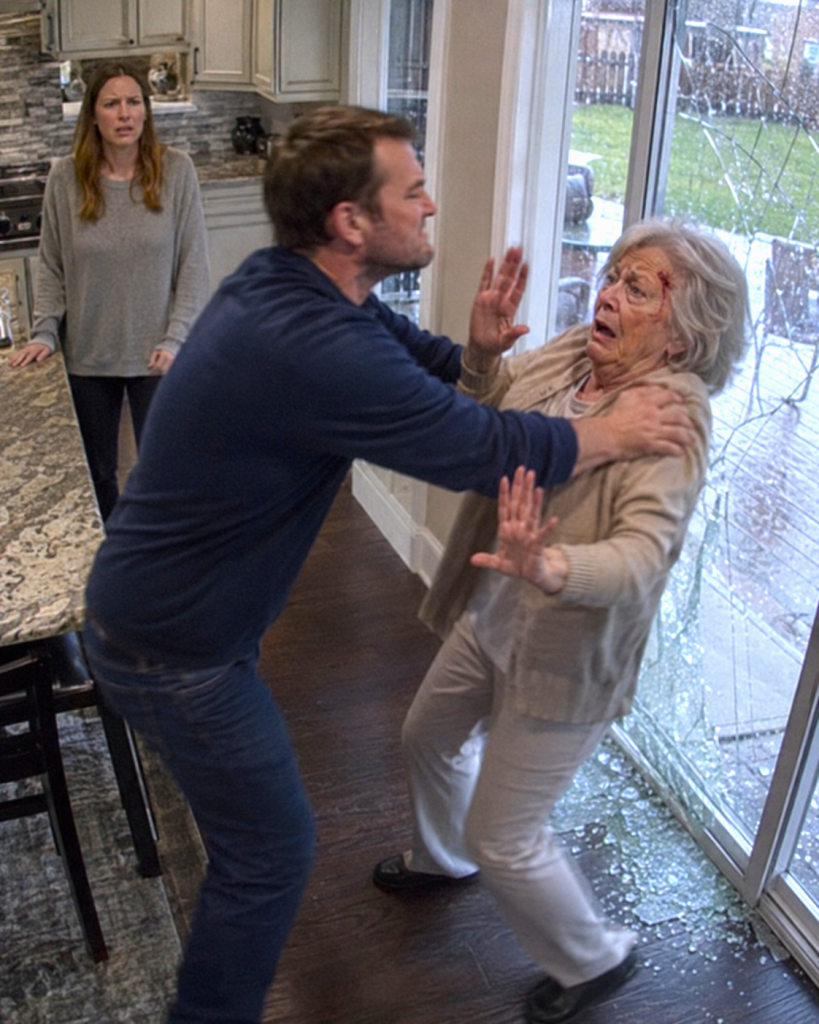
One second I was standing inside Ethan’s Connecticut home with transfer papers on the table behind me, and the next my shoulder struck the cold stone terrace while broken glass scattered around my hands like pieces of ice.
Music was still playing inside.
That was the part I remembered most clearly later.
Not Vanessa screaming.
Not Ethan rushing to help me.
Not even one frightened guest asking whether I was all right.
Just music continuing through the open room while blood slid from my temple and soaked into the collar of my blouse.
Ethan stood over me.
“Now maybe you’ll finally learn where you belong.”
For several seconds, I could not speak.
My cheek burned.
My left hand trembled when I tried to push myself upright.
There were tiny pieces of glass caught in the sleeve of my cardigan, and another shard lay beside my palm close enough that I could see my own face reflected in it.
Vanessa appeared in the broken doorway.
She looked down at me with the same expression she used whenever she talked about me to her friends.
Pity arranged to look like kindness.
“You’re broke, useless, and ungrateful,” she said.
I pressed a linen napkin against my forehead.
Then I stood.
I did not yell.
I did not remind them that I was Ethan’s mother.
I did not tell them what was really inside the Mercer Trust.
And I did not tell my son that the woman he had spent three years presenting as a burden still controlled more of his life than he had ever bothered to understand.
My silence made him comfortable.
That was useful.
For three years, I had lived in the guest cottage behind Ethan’s sprawling Connecticut property.
He told people he was supporting me.
At dinners, Vanessa would sometimes smile sadly and explain that I had “fallen on hard times” after my husband died.
She said Ethan had been generous enough to let me live on the property because I had nowhere else to go.
People believed her.
Why wouldn’t they?
I wore simple clothes.
I drove an old sedan.
I never corrected anyone when Ethan joked that retirement had not worked out for me.
I let them think the money was gone.
The truth began years earlier, before Ethan ever imagined he would become the center of my financial decisions.
My late husband, Charles, had watched his own brother lose nearly everything he had built because he trusted a reckless child with unrestricted access to family assets.
Charles never forgot it.
When we began putting our estate in order, he insisted that wealth should never become a reward for cruelty, irresponsibility, or entitlement.
So we created the Mercer Trust.
Its rules were precise.
Assets could be used for family benefit, but ownership and control were not the same thing.
Residences could be assigned.
Management authority could be granted.
Access could be revoked.
And no child, simply because of blood, had an automatic right to seize the future of everyone else connected to the trust.
After Charles died, I became the person responsible for carrying out those protections.
Ethan knew a trust existed.
What he did not know was how much it still controlled.
He assumed most of the estate had disappeared in bad investments.
I allowed him to believe that.
It was not a trick at first.
It was grief.
I had lost my husband, and I no longer wanted to live surrounded by rooms that reminded me of him.
Ethan invited me to the cottage behind his house.
At first, I thought the offer came from love.
I moved in.
I brought only what I needed.
A few boxes.
My clothes.
Photographs.
Charles’s old watch.
A worn recipe book.
And the documents Ethan never knew I kept beneath the floorboards.
For the first few months, he was kind.
He brought groceries.
He checked whether the furnace worked.
He asked if I needed anything from town.
Then slowly, once he became convinced there was nothing left for me to give him, something changed.
The visits became shorter.
The jokes became sharper.
Vanessa started referring to the cottage as “our guesthouse,” even when I was sitting right there.
At one dinner, she told a couple across the table that they had sacrificed “an entire rental property” because Ethan refused to abandon his mother.
I looked at my plate and said nothing.
Ethan smiled.
That smile stayed with me.
It told me he liked the story.
A successful son caring for his helpless mother made him look generous.
The fact that it was false did not seem to bother him.
So I watched.
I wanted to know who my son was when he believed there was nothing to gain from treating me well.
I wish I could say he passed that test.
He did not.
Three years passed.
Then came the papers.
It was early evening, and Ethan had invited me into the main house.
Vanessa was pouring drinks.
Music played from hidden speakers throughout the living room.
A stack of documents sat on the dining table.
Ethan tapped them with one finger.
“We need you to sign something.”
I sat down.
“What is it?”
“Just cleanup.”
That word made me careful.
I picked up the first page.
The documents concerned the land surrounding the guest cottage.
They were written to make a transfer into Vanessa’s name look routine.
I read farther.
Then I placed the pages back on the table.
“No.”
Vanessa stopped pouring.
Ethan stared at me.
“No?”
“The cottage land is part of the trust.”
He gave a short laugh.
“Your imaginary trust?”
“It isn’t imaginary.”
“Mom, we’ve been through this.”
“No, you’ve talked about it. I’ve listened.”
Vanessa folded her arms.
“You don’t own anything.”
I looked at her.
“You’re living here because we allow it,” she continued. “Do you know how much people would pay to rent that cottage?”
Ethan nodded toward the paperwork.
“Just sign.”
I pushed it toward him.
“No.”
His face changed.
Not dramatically.
That almost made it worse.
It was the small tightening around his mouth that told me he had expected obedience.
“Why are you making this difficult?”
“Because I’m not transferring trust property to Vanessa.”
Vanessa laughed.
“Trust property? Eleanor, stop.”
I stood.
The conversation was over as far as I was concerned.
Ethan grabbed my arm.
His hand closed hard above my elbow.
“Sit down.”
I pulled away.
That was when Vanessa moved behind me near the patio door.
I remember seeing the reflection of the room in the glass.
The lights.
The dining table.
The papers.
Ethan’s face.
Then his anger hardened.
He shoved me.
The glass exploded.
After I stood on the terrace and pressed the napkin against my forehead, Ethan looked almost pleased with himself.
“Good,” he said. “Pack tonight. You’re done here.”
I looked at my son.
There had been a time when I knew every expression that crossed his face.
As a boy, Ethan used to run into my room during thunderstorms because he was afraid of lightning.
At twelve, he broke his wrist falling from a bicycle and refused to cry until I arrived at the emergency room.
At twenty-one, he called me before proposing to Vanessa because he wanted to know whether I thought he was ready.
I had spent most of my life believing that somewhere inside every grown child lived the person you remembered raising.
Standing on that terrace, I stopped relying on that belief.
I walked back to the cottage.
No one followed.
Behind me, the music grew louder again.
By the time I locked the cottage door, blood had dried along the side of my face.
I went into the bedroom.
Moved the narrow rug.
Lifted the loose floorboard.
The safe beneath it had been there since the week I moved in.
Ethan had never found it.
Inside were my passport, medical directives, original trust documents, account instructions, and a black phone I kept charged but almost never used.
I sat on the edge of the bed for several minutes before turning it on.
My hands were steadier now.
At 11:47 p.m., I called Martin Hale.
Martin had been our family attorney for twenty-six years.
He had sat beside Charles and me when we signed the original trust documents.
He had attended my husband’s funeral.
And he was one of the few people who knew exactly how much control I had deliberately left dormant.
He answered on the second ring.
“Eleanor?”
“Activate the Mercer Trust protections.”
Silence.
Then:
“All of them?”
I looked at the blood on my sleeve.
“Yes.”
His voice changed immediately.
“Tell me what happened.”
“First, freeze the residence.”
Another pause.
“Ethan’s house?”
“The trust residence assigned for his use.”
“All right.”
“Revoke his management authority.”
“Done as soon as the notices go out.”
“And move the liquid assets beyond his reach.”
Martin became completely quiet.
The liquid holdings under my control were worth approximately twenty-one million dollars.
Ethan had spent years assuming they no longer existed.
I had never needed to tell him otherwise.
“Eleanor,” Martin said, “are you safe?”
That question almost broke me.
Not because it was complicated.
Because my own son had not asked it.
“I’m in the cottage.”
“Were you injured?”
“Yes.”
“What happened?”
I looked through the bedroom window.
Across the lawn, lights from Ethan’s pool reflected against the trees.
I could hear distant laughter.
“My son made a mistake.”
Martin did not ask me to soften it.
He did not tell me Ethan was family.
He did not suggest sleeping on it.
“Photograph everything,” he said. “And get medical attention.”
“I will.”
“I’ll start the trust actions tonight.”
When the call ended, I sat in the dark.
For years, I had wondered whether keeping the truth from Ethan was unfair.
That night, I finally understood why Charles had insisted on the structure we created.
The trust had never been designed to punish our son.
It had been designed to prevent one person’s entitlement from destroying everything around him.
I photographed the cut on my temple.
The bruising beginning along my shoulder.
The torn sleeve.
Then I photographed the papers Ethan had tried to make me sign because I had taken copies with me when I left the main house.
After that, I called for medical care.
By morning, everything looked different.
Ethan discovered it first when he attempted to access one of the accounts he used for property expenses.
The authorization failed.
Then another.
And another.
At 7:18 a.m., Martin sent formal notice that Ethan’s management privileges connected to Mercer Trust assets had been suspended.
At 7:26, the residence entered administrative freeze under the trust provisions.
The house had not vanished.
No one was dragging furniture onto the lawn.
But Ethan could no longer treat the property like something he personally controlled.
He could not transfer it.
He could not borrow against it through the trust.
He could not use his previous management authority to move related assets.
The twenty-one million dollars in liquid holdings were placed beyond his access under the protections Charles and I had written years earlier.
At 7:41, my phone began ringing.
Ethan.
I watched it.
I did not answer.
He called again.
Then Vanessa.
Then Ethan.
A text appeared.
WHAT DID YOU DO?
I read it twice.
Not:
Are you hurt?
Not:
I’m sorry.
Not:
I lost control.
What did you do?
I put the phone down.
At 8:03, someone knocked on the cottage door.
I knew who it was before I opened it.
Ethan stood there wearing yesterday’s shirt.
He looked exhausted.
Vanessa waited behind him several yards away.
“What did you do to the house?”
I studied his face.
“My house is frozen.”
“It isn’t your house.”
He stared at me.
“Don’t start with that trust nonsense again.”
“It appears the trust isn’t imaginary after all.”
His expression shifted.
“Martin called me.”
“I know.”
“He says my authority is suspended.”
“Yes.”
“Why?”
I looked at the cut reflected faintly in the window beside him.
“You pushed me through a glass door.”
His eyes flicked toward my forehead.
For one second, I thought he might apologize.
Instead he said:
“You were refusing to cooperate.”
That answer hurt.
But it also clarified everything.
I opened the door a little wider.
“You demanded that I transfer trust land to your wife.”
“It’s a technicality.”
“No.”
“It’s property sitting there doing nothing.”
“I live there.”
He exhaled sharply.
“Mom, stop acting like a victim.”
I almost laughed.
Not because anything was funny.
Because there are moments when a person tells you exactly who they are, and the only mistake left is refusing to believe them.
Vanessa finally came closer.
“This is insane. You’re destroying your own son over an argument.”
I looked at her.
“An argument?”
She glanced at my injury.
Her eyes moved away quickly.
Ethan lowered his voice.
“Undo it.”
“No.”
“Call Martin.”
“No.”
“You can’t freeze my life because you’re angry.”
“I didn’t freeze your life.”
I spoke quietly.
“I protected mine.”
He stared at me.
Then he finally asked the question I had been waiting three years to hear.
“How much money is there?”
I said nothing.
His face changed.
Vanessa looked between us.
“How much?”
Again, I said nothing.
Because that was the moment I understood something I should have understood much earlier.
They were not afraid I was hurt.
They were afraid I had resources.
Ethan stepped closer.
“Mom.”
I closed the door.
My hand remained on the lock for several seconds after they walked away.
I cried then.
Not loudly.
Not dramatically.
I sat on the edge of the small cottage bed and cried for the boy who had once been frightened of thunderstorms.
I cried for Charles, who had seen enough of human nature to build protections I once thought were too severe.
And I cried because twenty-one million dollars could be protected with paperwork, but there was no document in the world that could restore the relationship I thought I had with my son.
Later that morning, Martin arrived.
He brought copies of every trust action taken overnight.
Nothing had been improvised.
Nothing depended on threats.
Everything rested on authority that had existed for years.
The house was protected.
The management rights were suspended.
The liquid assets were secure.
And the cottage Ethan had ordered me to leave was not his to give or take away.
Martin placed the papers on my little kitchen table.
“You understand that you don’t have to decide everything today.”
“I know.”
“Do you want to remain here?”
I looked around the cottage.
Three years earlier, I had considered it a temporary refuge.
That morning, for the first time, it felt like mine.
“For now.”
He nodded.
Then he asked:
“What do you want to happen with Ethan?”
I looked through the window toward the main residence.
Vanessa was pacing near the pool.
Ethan was on his phone.
The same son who had told everyone his broke mother depended entirely on him was now discovering how much of his comfort had depended on structures he never respected enough to understand.
“I don’t know yet.”
Martin waited.
“But I know what I’m not going to do.”
“What?”
“I’m not going to rescue him from the consequences before he even admits what he did.”
Martin closed the folder.
“That seems reasonable.”
For years, my silence had protected Ethan’s image.
It allowed him to call himself generous.
It allowed Vanessa to treat me like a guest who should be grateful for scraps.
It allowed everyone around them to believe that I lived behind their house because I had nowhere else to go.
The glass door changed that.
Not because it revealed that I had twenty-one million dollars.
Money was the least important thing it revealed.
It showed me what my son was willing to do when he believed I had no power.
And once you learn that about someone, even someone you raised, you cannot unknow it.
By the end of that morning, the house Ethan thought he owned was frozen under trust protections.
His authority was gone.
The money he assumed had disappeared was secure beyond his reach.
And I was still sitting in the same small cottage he had mocked me for needing.
Only now the story was different.
I was not the broke mother living on her son’s charity.
I was the woman who had spent three years watching what he did when he thought kindness no longer benefited him.
Charles had once told me that inheritance was not only about what we left behind.
It was about what we refused to let destroy the people who came after us.
I had never understood that sentence as clearly as I did that morning.
Ethan had believed my silence meant helplessness.
Vanessa had believed simplicity meant poverty.
Both of them had mistaken restraint for weakness.
I did not need to prove them wrong by shouting.
I did not need to stand in their foyer waving account statements.
I had already made the only call that mattered.
And by sunrise, the truth was sitting quietly in every frozen account, every suspended authorization, and every page of the trust my son had laughed at the night before.
Twenty-one million dollars remained untouchable.
The house remained protected.
And for the first time in years, so did I.