He answered so quickly that I never had a chance.
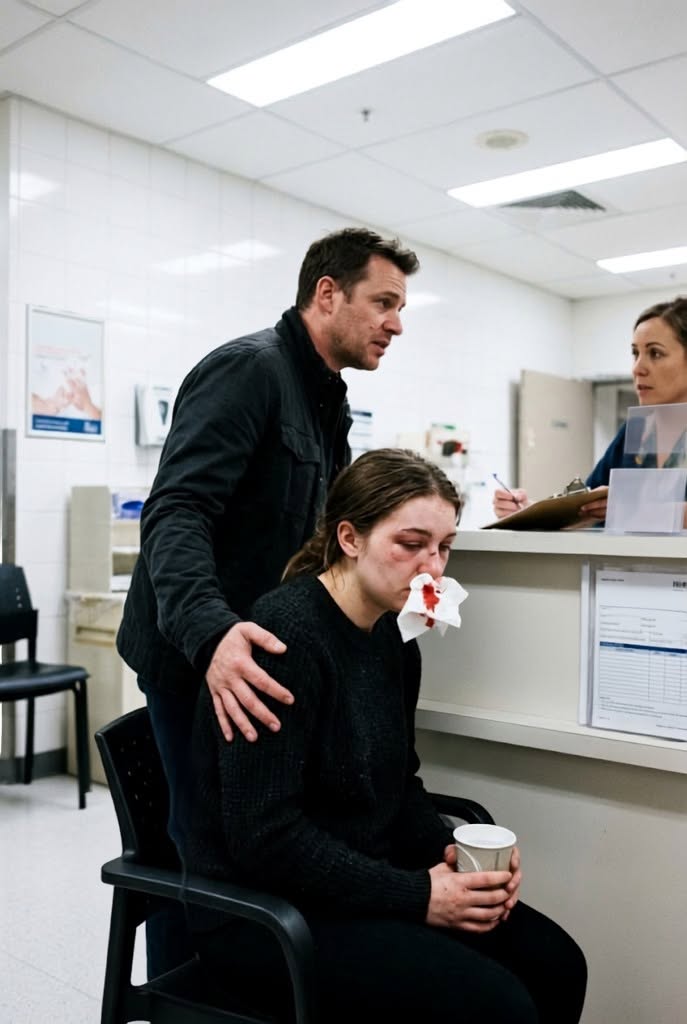
I kept my eyes on the counter because lifting my head made the room tilt.
The nurse looked at me instead of him.
“Were you wearing your seat belt?”
“Yes,” he said.
Her hands stopped over the keyboard.
It was a small movement.
There was no dramatic reaction and no accusation in her voice.
“I need her to answer for herself.”
His hand came off my back.
For one second, that should have felt like freedom.
Instead, he moved close enough that his knee touched mine beneath the desk.
I said yes.
I said I had been wearing my seat belt.
I said I had been driving.
The words came out of my mouth, but they weren’t really mine.
They were the answers he had already placed there.
The nurse continued working without challenging me.
She cleaned beneath my nose.
She checked my pupils.
She asked whether anything besides my face hurt.
Her eyes moved briefly across my neck, chest, and shoulders before returning to him.
She did not make a scene.
She simply kept asking ordinary questions.
“What did the vehicle strike?” she asked.
“A guardrail,” he said.
The word hit me almost as clearly as the pain in my face.
A guardrail.
At the desk, he had changed the story.
Only minutes earlier, he had told the nurse I had hit a pole.
The difference was small enough that someone might have dismissed it.
He noticed it too.
“A pole beside the guardrail,” he corrected himself quickly. “She’s mixed up.”
I looked down at my hands.
They were trembling so badly that I didn’t need to move them to see it.
That had become his rhythm in the room.
A question would come toward me, and his voice would get there first.
A pause would open, and he would fill it.
If I looked uncertain, he explained why I was confused.
If the nurse asked for a detail, he supplied it.
If something didn’t match, he adjusted the explanation before I could react.
He was building the accident around me while I sat there with a broken face.
The nurse never told him to stop lying.
She never announced that she suspected anything.
Instead, she reached for a paper cup.
She filled it with water.
She snapped a plastic lid onto it.
Then she placed the cup carefully into my shaking hands.
The cold came through the paper immediately.
It was such an ordinary thing that I almost missed what happened next.
She stopped asking questions for a moment.
She watched me hold the cup.
Then she looked at him.
He took the silence as permission to continue.
He began explaining that I had been confused since the impact.
He said I was shaken up because of the “accident.”
He said he was only trying to help.
The more he talked, the calmer he tried to sound.
He turned my inability to speak quickly into proof that he needed to speak for me.
He turned my confusion into support for his story.
He turned his presence beside me into evidence that he was the helpful one.
The nurse let him finish.
That mattered.
She didn’t compete with him.
She didn’t give him a reason to turn the situation into an argument.
When he finally stopped, she shifted the computer screen slightly toward herself.
Then she asked me to confirm my name and date of birth.
His mouth opened.
Her eyes remained on me.
“Her,” she said quietly. “I need her answers.”
His jaw tightened.
I saw it even though looking directly at him hurt.
My hands were still wrapped around the cup.
I lifted it and took one small sip.
Swallowing hurt.
Everything hurt.
But then I gave the nurse my information myself.
My name.
My date of birth.
Simple facts.
Nothing dramatic.
Nothing that exposed him.
Nothing that contradicted the accident story.
Still, those words felt different from every answer I had given since we arrived.
They were mine.
He had not practiced them with me in the SUV.
He had not told me when to say them.
He had not chosen them first.
The nurse typed the information into the computer.
I watched her hands because looking anywhere else made me dizzy.
A few seconds earlier, the room had felt completely organized around him.
He stood close enough to control my attention.
He answered first.
He corrected details.
He explained my behavior.
He decided what the nurse was supposed to believe.
Now the nurse was doing something much smaller.
She was returning basic questions to the person they belonged to.
Me.
It would be easy to describe that moment afterward as if I instantly became brave.
I didn’t.
I was terrified.
My face was broken.
One eye was swelling shut.
I had been threatened and coached before walking through the door, and he was still close enough for me to feel his presence beside me.
Fear doesn’t disappear simply because another person notices something is wrong.
Sometimes all that changes at first is the amount of space around you.
A question becomes yours to answer.
A cup gives your hands something to hold.
Someone waits long enough for your voice instead of accepting the louder one beside you.
That was all the nurse had done so far.
But it was enough to disrupt the system he had built during the drive.
His story depended on speed.
It depended on answering before I did.
It depended on making every inconsistency sound like another symptom of my injury.
It depended on staying physically close enough that I never forgot what he had told me.
The nurse had not proven anything.
She had not accused anyone.
She had simply slowed the process down.
And once it slowed down, the contradictions became harder to hide.
First it had been a pole.
Then a guardrail.
Then a pole beside a guardrail.
First I was supposedly the patient describing my own accident.
Then he answered whether I had worn a seat belt.
Then he explained why I could not be trusted to remember details correctly.
The more he tried to control every question, the more visible that control became.
I could feel him watching the nurse now in a different way.
He was no longer simply volunteering information.
He was trying to figure out how much she had noticed.
I kept both hands around the paper cup.
The lid pressed against my fingertips.
My hands were still trembling, but the water wasn’t spilling.
That became the only thing I concentrated on for a few seconds.
Hold the cup.
Breathe carefully.
Answer when she asks you.
Nothing more.
He had spent the drive teaching me a false story one sentence at a time.
The nurse was doing the opposite.
She was not giving me a story.
She was creating room where I might eventually be able to tell one.
There was a huge difference.
He shifted slightly beside me.
I noticed because his knee was no longer touching mine.
The distance was probably only a few inches.
It felt enormous.
The nurse finished entering my information.
She looked at the screen once more.
Then she placed her pen on the desk.
There was no dramatic change in her expression.
No warning.
No declaration that she knew what had happened in the SUV.
She simply turned her attention toward him and explained that the next stage of my evaluation required privacy.
He did not answer immediately.
That was unusual.
Until then, he had answered almost everything immediately.
I could hear activity elsewhere in the emergency department, ordinary movement continuing around us while my entire world seemed to have narrowed to the space between the nurse, him, and me.
I looked down at the cup again.
I didn’t know what he would do.
I didn’t know whether he would argue.
I didn’t know what I would say once he was no longer close enough to answer for me.
I didn’t even know whether I would be able to say anything truthful at all.
What I knew was much smaller.
He had told me in the SUV that I was going to say I had been alone.
Then he had walked into the hospital and refused to let me be alone for even the simplest questions.
The contradiction sat there between us without anyone needing to name it.
The nurse rose from her chair.
She positioned herself so that I could follow her toward the next part of the evaluation.
He stayed beside the desk.
For the first time since he had started rehearsing me in the SUV, the next answer would not automatically belong to him.