“What happened?”
Dad answered again.
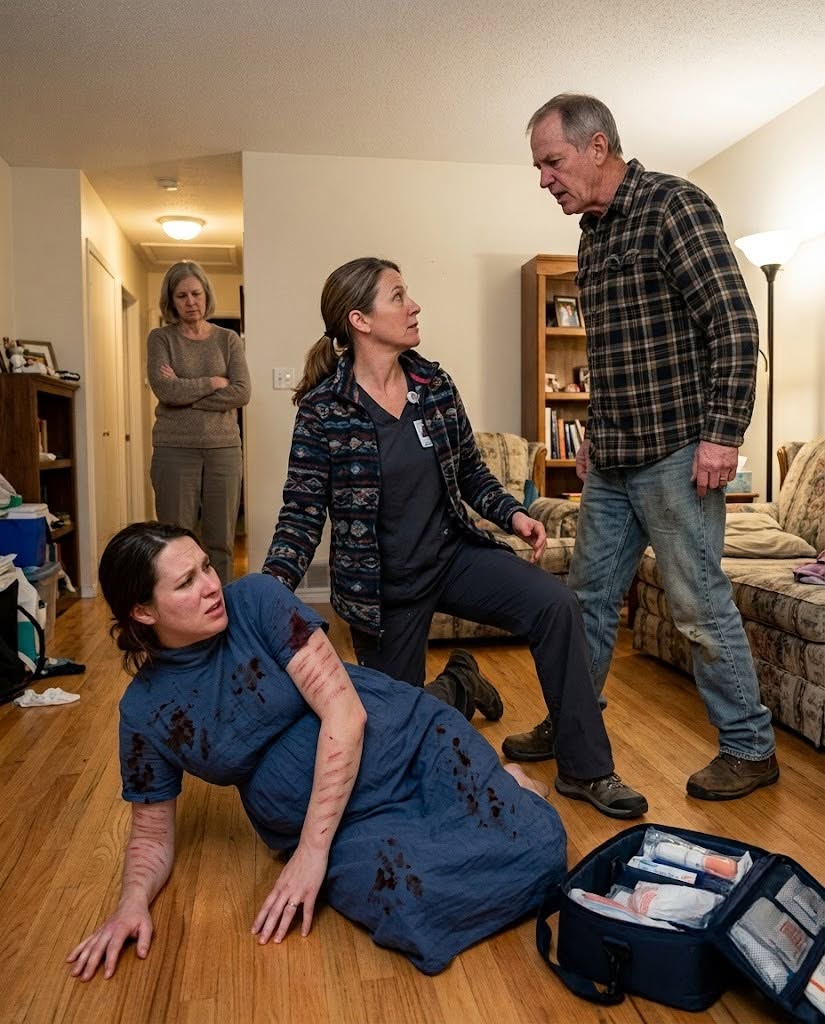
“She fell.”
He said it faster.
He said it calmly.
He said it like calmness could make the sentence more believable.
He looked at Mom before he looked at me.
And that glance brought back what panic had buried.
Before anyone called for help, I had heard them talking.
They had not been asking each other whether I was breathing normally.
They had not been deciding what I needed.
They had been deciding what to say.
Mom had whispered that Dad should just say I fell.
Dad had asked what they were supposed to do if I started talking.
Then Mom had supplied the other line.
Hysterical from shame.
The exact phrase she later gave the midwife.
My chest tightened when the memory returned because the lie was suddenly no longer something I suspected.
I had heard it being assembled.
“I didn’t fall,” I said.
Mom turned toward me so quickly it was almost a recoil.
Dad’s voice changed.
“You don’t know what you’re saying right now.”
That sentence was not new either.
The warning underneath it was familiar enough that I felt it before I processed the words.
For most of my life, Dad had been good at deciding when a conversation was finished.
He could do it with my name.
He could do it with a look.
He could do it by speaking more calmly than everybody else and making their fear look unreasonable beside him.
Mom had adapted to that system long before I was old enough to name it.
She agreed early.
She softened things.
She tried to predict which version of a problem would keep his anger moving past her instead of toward her.
Understanding that pattern did not erase what she had done to me that night.
She had still helped delay the call.
She had still repeated the lie.
She had still seen me on the floor and decided that keeping the story straight mattered more than letting somebody hear my version.
But the midwife had not grown up inside our rules.
She did not know she was supposed to stop when Dad used that tone.
She asked about consciousness.
She asked about pain.
She asked about the contractions.
Then she asked the question that tore straight through everything my parents had prepared.
Did I feel safe staying in that house with the people in the room?
I looked at Dad.
“No.”
One word was enough.
Mom immediately tried to fill the space around it.
She started crying as she explained that I had been trying to leave while upset.
Then she said they had needed to stop me.
The midwife became very still.
“You had to stop her?”
Mom’s face changed.
Dad’s did too.
It was the first time I saw both of them understand the same problem without rehearsing it first.
Their stories no longer fit together.
If I had simply fallen, there should have been no need to explain why I had been prevented from leaving.
Dad turned on Mom before she could say anything else.
“That’s not what she means.”
But it was too late.
The lie had not collapsed because I gave some perfect speech.
It collapsed because Mom accidentally told one piece of the truth while trying to defend the rest.
The midwife asked whether the door had been blocked.
Dad moved between her and the hallway.
“No one blocked anything.”
Mom stared down.
I pushed myself onto one elbow.
My arms shook from the effort.
“Mom.”
She did not look at me.
I said it again.
“Mom, tell her.”
Dad said my name.
Just my name.
But I knew the warning inside it.
Mom knew it too.
For years, that tone had meant there was nothing left to discuss.
Only this time, a third person was standing there.
A person who had not agreed that Dad got to decide when the truth was finished.
The midwife stood and positioned herself between us without touching him.
She said I needed to be evaluated and reminded him that I had clearly said I did not feel safe there.
Dad gave a short laugh.
He called it a family argument.
The midwife answered without raising her voice.
She was not judging a family argument, she said. She was looking at the patient in front of her.
That sentence landed differently than anything I had managed to say.
Not because it was louder.
Because it returned the room to the only thing my parents had been trying to move away from: me.
My condition.
My answer.
My right to speak about what had happened to my own body.
Mom finally lifted her head.
For a second, I expected the script again.
She could have repeated that I fell.
She could have called me emotional.
She could have decided that protecting Dad’s version was still the safest choice available to her.
Instead, she whispered that Dad had told her they could not call anyone until they agreed on what happened.
Dad turned toward her.
There was no way to put that sentence back.
It did not explain every mark on me.
It did not undo the delay.
It did not turn Mom into an innocent bystander.
But it confirmed the thing the midwife had already begun to see: the story she was given when she entered our house had been prepared before she arrived.
The midwife crossed to the front door and opened it wide.
The effect on the room was immediate.
Dad moved toward the doorway.
The midwife stayed close to me and made it clear that he was not going to interfere with the next step in my care.
Mom began shaking.
Then she admitted something else.
Dad had warned her that if she called before they got the story straight, she would be blamed for what had happened.
“Stop talking,” he told her.
Mom did not stop.
That mattered to me, but not in the simple way people sometimes want moments like that to matter.
I did not suddenly forget that she had helped him.
I did not suddenly feel safe with her because she finally admitted the truth in front of someone else.
Fear can explain a choice without repairing the damage caused by it.
Mom had spent years surviving his anger by moving herself out of its path.
That night, part of the way she moved herself out of its path was by helping him put me in front of it.
I could understand both things at once.
She was afraid of him.
She had failed me.
Now she was frightened and trying, late, to choose differently.
Another contraction hit.
I reached for the couch and tried to pull myself higher.
The midwife turned immediately toward me.
That reaction was so ordinary that it almost broke me.
I moved in pain, and she responded to the pain.
No accusation.
No explanation of my personality.
No demand that I first prove whether I deserved help.
Dad tried once more to say everybody was overreacting.
Mom went to the side table.
She picked up the phone.
Then she held it out toward the midwife.
That was where the moment in the hallway began.
Dad stepped across before the phone could change hands.
He planted himself between Mom and the midwife as if he could still restore the old order by controlling one doorway and one object.
He looked at Mom.
Mom looked at the midwife.
The midwife looked at me.
I was still on the floor beside the couch, one hand pressed against the cushion, trying to breathe through the tightening in my stomach.
Dad started speaking again.
He said this was getting out of hand.
He said Mom was upset.
He said I was upset.
He said everybody needed to calm down before somebody made a mistake.
The pattern was almost perfect.
Turn the danger into emotion.
Turn the emotion into confusion.
Turn the confusion into a reason to delay.
Then keep delaying until his version becomes the easiest version for everyone else to accept.
The midwife did not debate any of it.
She asked Mom a simple question.
Was she trying to give her the phone?
Mom swallowed.
“Yes.”
Dad turned his head toward her.
He did not shout.
He did not have to.
Mom’s hand dipped an inch.
For one terrible second, I thought that would be enough to pull her back into the role she had played all evening.
Then I saw her fingers tighten around the phone instead of lowering it to the table.
Mom stepped sideways.
Dad shifted with her.
Mom stopped.
Mom looked directly at him.
Mom said, “Move.”
It was barely above a whisper.
He stared at her as though the word itself were a betrayal.
Maybe to him it was.
For years, her fear had functioned like agreement.
That night, he had counted on it when they practiced the story.
He had counted on it when the midwife arrived.
He had counted on it when Mom repeated that I was hysterical.
He had counted on it when he blocked the hallway.
Now the same woman he expected to reinforce his version was standing there holding the one object he did not want passed forward.
The phone.
Not evidence of every unanswered question.
Not proof of every moment before I ended up on the floor.
Just the ordinary thing that should have been used much earlier to ask for help.
The midwife stayed where she was.
She did not reach around Dad or turn the confrontation physical.
She kept one hand close to me and told Mom that if she wanted to hand over the phone, she could do it.
That permission seemed almost absurdly small.
But I watched Mom react to it as if someone had opened another door inside the room.
Dad had spent the night telling us what things meant.
My fear meant hysteria.
My injuries meant a fall.
My attempt to leave meant I needed to be stopped.
Mom’s hesitation meant she agreed with him.
Now somebody else was refusing to let him define every action before it happened.
I felt another tightening beginning low in my abdomen.
I closed my eyes for a moment and concentrated on breathing.
When I opened them, Mom was still holding the phone.
Dad was still in the hallway.
The midwife was still beside me.
Nothing about the scene looked dramatic enough to explain how much had changed.
There was no speech that fixed our family.
There was no instant forgiveness.
There was no clean division between one person who was afraid and another person who had caused harm.
There was only a series of choices, each smaller than the lie that had covered them.
I chose to say I had not fallen.
I chose to answer no when I was asked whether I felt safe.
The midwife chose to keep addressing me as the patient even when Dad tried to take over.
Mom chose, finally, to admit that the story had been arranged before the call.
And now she had one more choice in her hand.
Dad spoke her name.
She flinched.
I recognized the movement because mine had looked almost the same when he stepped toward me earlier.
The midwife recognized it too.
Mom looked down at the phone.
Then she stepped around Dad instead of backing away from him.
He moved half a step as if to close the space again, but the midwife’s position beside me meant he could not pretend the movement was casual anymore.
Mom extended her arm.
The midwife reached out.
Their hands met around the phone.
Mom let go.
Dad did not touch it.
I watched the phone settle into the midwife’s hand while another contraction moved through me, and the strangest part was how ordinary the object looked after everything that had been built around it.
A phone on a side table had helped mark the delay.
A phone in Mom’s hand had become a test of whether she would keep protecting the rehearsed story.
Now it was simply a way to reach help without waiting for Dad to approve the words first.
The midwife kept the phone.
Mom stayed on my side of the hallway.
Dad was still there, still angry, still trying to control what came next.
But the sentence they had practiced was finished.
No one in that room was repeating that I fell anymore.