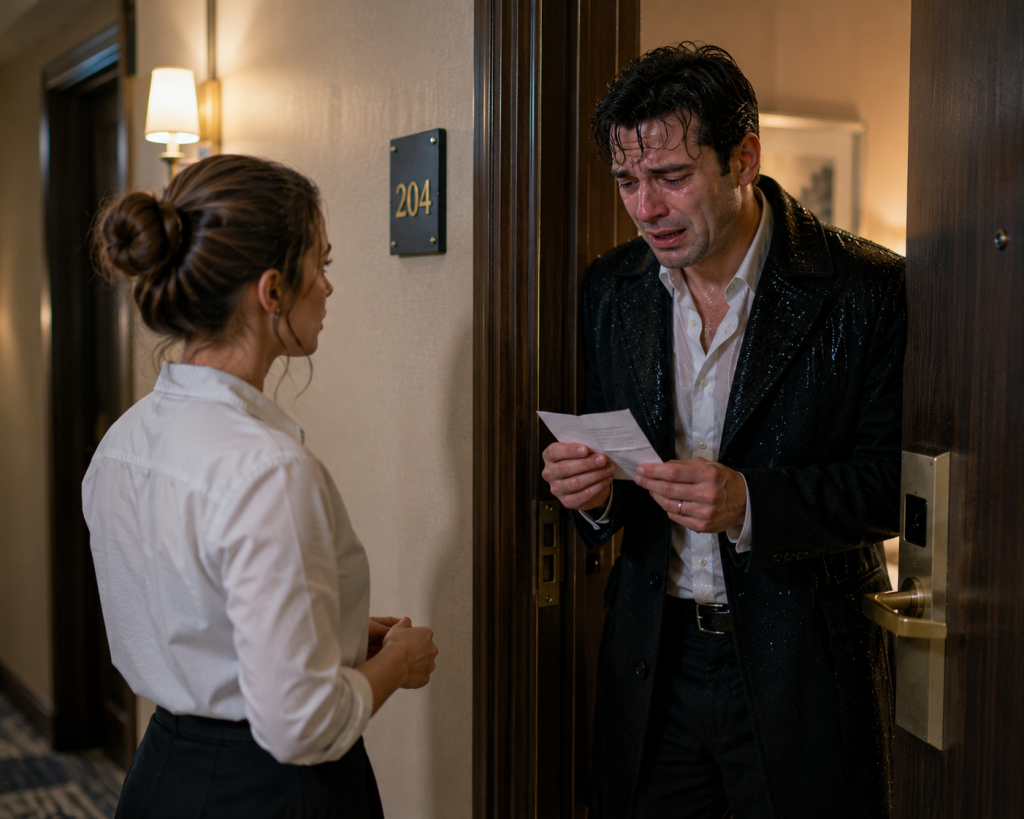
Graham Weston opened the door with tears streaming down his face.
For one suspended second, neither of us spoke.
The hallway light flickered above him, turning his face pale, then shadowed, then pale again. He looked different without the distance of the lobby between us. Younger somehow, though lines of exhaustion had settled around his eyes. His shirt was soaked through. His hair still dripped rainwater onto the carpet. One hand gripped the folded note as if it were the only solid thing left in the world.
I stood there in my thin cardigan, suddenly aware of how strange it must have looked. A woman who did not work at the hotel, not really, standing outside his room after midnight, after slipping a note beneath his door.
“I’m sorry,” I whispered. “I shouldn’t have—”
“What made you write this?” he asked.
His voice was low and rough, not angry. That made it worse. Anger would have given me something to defend myself against. This was something else entirely.
I looked down at the paper in his hand.
I had written only one sentence.
Please stay until morning. Someone in this world still needs you here.
“I saw you outside,” I said carefully. “In the rain.”
His fingers tightened around the note.
“I didn’t mean to intrude,” I added. “I just… I don’t know. I couldn’t leave without saying something.”
He stared at me for a long moment. Then he lowered his eyes to the note again, as if reading it for the hundredth time.
“What’s your name?” he asked.
“Clara.”
“Clara,” he repeated.
The way he said it made my name sound unfamiliar, like a word he had once known but forgotten.
“I’m sorry,” I said again, because it was the only thing I could think of.
He shook his head faintly.
“No. Don’t be.”
A quiet stretched between us. Behind him, the room was almost completely dark except for a narrow slice of yellow light from the bathroom. I saw an open suitcase near the foot of the bed, a pair of polished shoes placed neatly beside it, and a black leather wallet on the dresser. Everything in the room looked too orderly, too deliberate.
Graham stepped back from the doorway.
“Would you come in for a minute?”
Every sensible instinct in me said no.
I barely knew this man. I had only been helping at the hotel for one night. My phone was downstairs in my bag behind the front desk, and the manager had already disappeared into the back office to count receipts. The hallway was empty. The hour was late.
But something in Graham’s expression kept me from walking away.
Not desperation exactly. Not even fear.
Recognition.
As though the note had found a place inside him that no one had reached in a very long time.
“I can stand by the door,” I said.
He nodded immediately, accepting the boundary without question. “Of course.”
I stepped just inside the room, leaving the door open behind me.
The cold hit me first. The balcony door was slightly ajar, letting in the damp breath of the storm. Rain tapped against the railing outside. The air smelled of wet wool, old wood, and the faint citrus soap hotels always seemed to use.
Graham walked to the balcony door and shut it. Then he stood with his back to me, one palm pressed against the glass.
“I used to think I was good at hiding things,” he said.
I did not answer.
He turned. “Apparently I’m not.”
“People hide pain better in daylight,” I said softly.
That earned the faintest change in his face. Not a smile, but almost.
“You sound like someone who knows.”
I folded my arms against the cold. “Most people do.”
He looked at the note again.
“What you wrote,” he said, “you had no way of knowing…”
He stopped.
“No way of knowing what?”
His jaw tightened. For a moment I thought he would close down completely, thank me politely, and send me back into the hallway where this night belonged.
Instead, he crossed to the dresser and picked up his wallet. From inside it, he removed a small photograph.
He held it out to me.
I hesitated before taking it.
The picture showed a woman standing beneath a white flowering tree, laughing at something outside the frame. She had one hand raised to shield her eyes from the sun. There was wind in her hair and joy in her face, the kind of joy that looked effortless until life taught you it never was.
“My wife,” Graham said. “Evelyn.”
“She’s beautiful.”
“She was.”
The word settled heavily.
I looked up.
Graham leaned against the dresser, eyes fixed somewhere beyond the walls. “She died three years ago tonight.”
The storm outside seemed to grow quieter, though I knew it had not.
“I’m sorry,” I said.
He nodded once, like a man who had heard those words so many times they had become part of the weather.
“I checked into this hotel the night after the funeral,” he continued. “Not this room. Room 201, I think. I couldn’t go home. Everywhere in the house was her. Her books beside the bed, her coat on the chair, her handwriting on the grocery list. So I drove until I couldn’t anymore. This was the first place with a vacancy.”
His eyes moved to the rain-streaked window.
“I’ve come back every year on this date.”
I glanced toward the open suitcase. “To remember her?”
“At first.” His voice became quieter. “Then to punish myself.”
The honesty of it made my throat tighten.
“I don’t understand,” I said.
He looked at me then, and I saw how much he wanted not to say the next words. How many years he had spent building walls around them.
“She called me that night,” he said. “The night she died. I didn’t answer.”
I stayed silent.
“I was in a meeting. Important investors. A deal I’d spent eighteen months trying to close.” He let out a small, humorless breath. “I saw her name on the screen and sent it to voicemail. Then she called again. I turned the phone face down.”
He closed his eyes.
“By the time I called back, a police officer answered.”
The room seemed to shrink around us.
“She’d been driving home in the rain,” he said. “A truck hydroplaned. They said it was instant.”
There was no melodrama in his voice. That made it ache more. He had told himself this story so many times he had worn the edges smooth, but the center was still sharp.
“I’m sorry,” I whispered.
“I listened to the voicemail afterward,” he said. “She wasn’t upset. She wasn’t asking for anything urgent. She just said she hoped my meeting had gone well. She said she’d made soup because she knew I’d forget dinner. Then she said…”
He stopped and pressed his thumb hard against the folded note.
“She said, ‘Come home when you can. I still need you here.’”
My breath caught.
The sentence I had written.
Not exact. But close enough to feel impossible.
Graham looked at me with fresh tears in his eyes.
“How did you know to write that?”
“I didn’t,” I said. “I swear I didn’t.”
He studied me, searching for some hidden explanation. A prank. A trick. A cruel coincidence dressed as mercy.
But there was nothing to find.
“I just saw you sitting out there,” I said. “And those were the words that came.”
For the first time, his composure broke entirely.
He sat on the edge of the bed and covered his face with both hands. His shoulders shook once, then again, in a silent grief that seemed too large for the small hotel room.
I stood near the open door, feeling helpless.
I had no training for this. No comforting wisdom. No careful phrases polished by experience. I was a bookstore clerk who had taken a friend’s shift because Jenna had a fever. I still had coffee stains on my sleeve and a receipt from the bus crumpled in my pocket.
But maybe that was why I stayed.
Because for once, there was nothing official to do. No form to fill out. No policy to follow. Just a person in front of another person, both of us unsure how to survive the moment.
After a while, Graham lowered his hands.
“I was going to leave before sunrise,” he said.
Something cold passed through me.
“Leave where?”
He looked at the floor. “I don’t know.”
It was not an answer, and it was.
I took one careful step closer. “Then don’t.”
His eyes lifted to mine.
“Stay until morning,” I said. “That’s all the note asked. You don’t have to figure out your whole life tonight. Just morning.”
He gave a shaky breath, almost a laugh, but not quite. “You make it sound simple.”
“It isn’t,” I said. “But it’s smaller than forever.”
The storm rumbled beyond the windows.
Graham turned the photograph over in his hands. On the back, in blue ink, someone had written: Say yes to the ordinary days.
“Did she write that?” I asked.
He nodded. “Evelyn had a thing about ordinary days. She said people spent too much time waiting for their lives to become grand enough to appreciate.”
“She sounds wise.”
“She was stubborn,” he said, and this time something like warmth flickered through the grief. “Which was usually the same thing.”
I smiled faintly.
He looked down at the photo. “She would have liked you.”
“You don’t know me.”
“She liked people who noticed.”
The words landed in a place I had not expected.
Noticed.
Most of my life, I had been told I noticed too much. Too many expressions. Too many shifts in voice. Too many quiet discomforts no one else wanted named. My mother used to say I carried strangers’ sadness home like stray cats. My ex-boyfriend called it exhausting. Even Jenna, who loved me, often laughed and told me not every silence was a puzzle to solve.
But in that room, with rain blurring the window and a grieving man holding my note, noticing felt less like a flaw.
“Why were you working tonight?” Graham asked.
“My friend was sick. I’m covering.”
“You don’t work here?”
“No. I work at a bookstore across town. Well, worked.” I winced at my own honesty. “It closed last month. I’m between things.”
He watched me with quiet attention.
“I’m sorry.”
“It was a small shop. We knew it was coming.” I looked at the carpet. “Still hurts.”
“What will you do now?”
“I don’t know.”
The answer embarrassed me more than I expected. At thirty-two, I thought I would have had a firmer response. A plan. A direction. Something impressive enough to offer a millionaire in a hotel room after midnight.
But Graham did not seem disappointed. He seemed to understand the terror of an empty map.
“I built a company by pretending I always knew what came next,” he said. “People pay a lot of money to believe certainty is contagious.”
“You don’t sound proud of that.”
“I was once.”
He rose and walked to the small desk by the window. A sleek silver laptop sat open but asleep. Beside it was a folder with a company logo embossed in gold: Weston Hospitality Group.
I noticed it only then.
The name. Weston.
“You own hotels?” I asked.
“Some.”
“This hotel?”
He hesitated. “Technically, yes.”
My eyes widened. “You own this hotel?”
“Through a holding company. It’s one of the older properties we acquired years ago.”
Suddenly, the shabby lobby, the flickering light, the outdated reservation system, and my awkward check-in all rearranged themselves around a new fact.
I had checked the owner into his own hotel.
“I didn’t know,” I said.
“I know.”
“Jenna didn’t tell me.”
“She probably doesn’t know either. I haven’t been here as Graham Weston in any official capacity for years.”
I looked at him, confused. “Then why book a room like a regular guest?”
“Because that’s all I wanted to be tonight.”
There was something final in his tone, but not unkind.
I remembered the way he had paused in the lobby after receiving the key, as if waiting for someone to recognize him or stop him or say the right thing. No one had. Not until the note.
“Your staff might panic if they knew you were here,” I said.
A ghost of a smile appeared. “That’s one reason not to tell them.”
“And the other?”
His eyes shifted toward the rain.
“To see what remains when no one is trying to impress me.”
I thought of the torn carpet near the elevator. The dusty artificial plant by the stairwell. The vending machine that hummed angrily and accepted only exact change. The kind manager who had returned late with a plastic bag of medicine for Jenna even though she did not have to.
“What did you see?” I asked.
Graham did not answer immediately.
“I saw neglect,” he said at last. “Some of it mine.”
The admission hung between us.
He ran a hand through his damp hair and seemed, for the first time, embarrassed.
“After Evelyn died, I stopped visiting properties myself. I made decisions from reports. Numbers. Spreadsheets. Profit margins.” He looked around the room. “It’s easy to let places become invisible when you don’t have to sleep in them.”
Something about the way he said places made me think he meant people too.
He sat in the chair by the desk and held the note flat beneath his palm.
“You said someone still needs me here,” he murmured.
“I didn’t mean—”
“I know.” He looked up. “But maybe you were right.”
Before I could respond, a soft knock sounded against the doorframe.
Both of us turned.
The night manager, Mrs. Alvarez, stood in the hallway wearing a gray cardigan over her uniform. Her silver hair was pinned loosely at the back of her head, and concern creased her face.
“Clara?” she said. “Is everything all right?”
My stomach dropped.
I stepped toward the door. “Yes. I’m sorry. I was just—”
Mrs. Alvarez’s gaze moved past me to Graham.
For a moment, she looked confused.
Then recognition dawned.
Her face changed so quickly that I almost missed it. Not panic. Not surprise exactly.
Pain.
“Mr. Weston,” she said softly.
Graham stood.
“Maria.”
The name emerged with a gentleness that made me look between them.
“You know each other?” I asked.
Mrs. Alvarez folded her hands in front of her. “I worked here when his wife was alive.”
Graham’s expression tightened.
“She remembered Evelyn’s tea,” he said.
Mrs. Alvarez looked down. “Chamomile with honey. Never lemon.”
The room fell quiet again, but it was a different quiet now, threaded with history.
“I didn’t mean to interrupt,” Mrs. Alvarez said. “I saw Clara come upstairs and wanted to make sure…”
“You did the right thing,” Graham said.
Her eyes moved to the note in his hand. She seemed to understand something without being told.
“Would you like coffee?” she asked.
It was such an ordinary question that my throat ached.
Graham blinked. “Coffee?”
“You both look like you could use some.”
I expected him to refuse. Instead, he nodded.
“Yes,” he said. “Thank you.”
Ten minutes later, we sat in the darkened lobby while rain silvered the windows and the old coffee machine sputtered behind the desk.
Mrs. Alvarez had insisted we come downstairs. “No meaningful conversation should happen in a cold hotel room,” she had said, with a firmness neither of us challenged.
She brought three mugs to the small seating area near the fireplace that no longer worked. Graham wrapped his hands around his cup but did not drink. I sat opposite him, still unsure whether I belonged there.
Mrs. Alvarez sat beside me.
For a while, the only sound was rain.
Then Graham said, “How long have you worked here, Maria?”
“Seventeen years.”
His expression shifted. “Seventeen?”
“Yes.”
“I thought…”
“You thought staff turned over every few years because that is what the reports say.” There was no accusation in her voice. Only weary truth. “Many do. Some of us stay.”
He absorbed that.
“Why?”
She gave a small shrug. “People need work. Guests need clean rooms. Somebody has to remember where the fuse box is.”
Despite everything, I almost smiled.
Graham looked around the lobby with new eyes. “I should have come sooner.”
Mrs. Alvarez did not rush to comfort him. I respected her for that.
“Yes,” she said.
He lowered his gaze.
“But you came tonight,” she added.
The words did not absolve him. They simply left a door open.
Graham took a slow breath. “What does this place need?”
Mrs. Alvarez looked startled. “Mr. Weston, it’s after midnight.”
“What does it need?” he repeated.
She studied him. Perhaps she was deciding whether this was grief speaking, or guilt, or the beginning of something real.
Finally, she set her mug down.
“The roof above the laundry leaks when it rains hard. The elevator sticks on the third floor. The night clerk position has been empty for months because the wage is too low. Housekeeping is short two people. The boiler makes a noise that worries me, though the repairman says it will hold.” She paused. “And the sign outside has been missing two letters since March.”
Graham listened without interrupting.
With each item, something in his face seemed to settle—not into shame, but responsibility.
“Why wasn’t I told?” he asked.
Mrs. Alvarez looked at him directly. “You were. Not by me personally, perhaps. But someone told someone who told someone who made a note somewhere. That is how things disappear in large companies.”
The truth of that seemed to strike him harder than anger would have.
He nodded slowly. “I understand.”
“No,” she said. “You are beginning to.”
I looked at Mrs. Alvarez in surprise. She was braver than I would have been.
Graham did not defend himself.
“Then help me understand,” he said.
Mrs. Alvarez softened. “Tomorrow.”
His eyes flicked to the windows, to the darkness beyond them.
“Tomorrow,” he repeated.
The word sounded difficult in his mouth.
I realized then that morning was no longer just a line from my note. It had become a promise he was trying to make and did not know whether he deserved to keep.
Mrs. Alvarez rose. “I’ll make a list.”
“Maria,” Graham said.
She stopped.
“Thank you.”
Her expression changed again, sadness and kindness crossing it together.
“Your wife once sat right there,” she said, nodding toward the chair where I was sitting. “She told me this hotel had good bones.”
Graham closed his eyes briefly.
“She said that about everything,” he murmured.
“No,” Mrs. Alvarez said. “Only things she believed could be saved.”
Then she returned to the desk, leaving us with the rain and the weight of what she had said.
I stared into my coffee.
“She’s formidable,” I said.
“She used to frighten regional managers.”
“She still could.”
That almost-smile came back, a little stronger this time.
Then he looked at me. “You should go home. I’ve kept you too long.”
I glanced toward the lobby windows. The rain had not let up. My bus had stopped running nearly an hour ago.
“I can call a ride,” I said, though the thought of the expense made my stomach tighten.
Graham seemed to notice.
“I can have a car take you.”
“No.”
The word came out too quickly.
He blinked.
I flushed. “Sorry. I just… I didn’t write the note because I wanted anything.”
“I didn’t think you did.”
“I know. But people with money sometimes don’t realize how quickly kindness can start to feel like debt.”
He was quiet for a moment.
“That’s fair,” he said.
I expected him to argue, to insist, to smooth over the discomfort with generosity. Instead, he accepted it. That made me trust him a fraction more.
Mrs. Alvarez called from the desk. “The staff room sofa is dry, Clara. Better than waiting outside.”
“I couldn’t.”
“You can,” she said. “And you will. Jenna would yell at me if I let you walk home in this.”
So that was how I ended up in the hotel staff room at nearly two in the morning, wrapped in a spare blanket that smelled faintly of laundry detergent, trying to sleep while the entire night replayed behind my closed eyes.
Graham’s face in the doorway.
The photograph of Evelyn.
The sentence I could not have known.
The owner of the hotel sitting in his own neglected lobby, learning the names of problems that had been waiting for him.
I slept only in fragments.
Sometime before dawn, I woke to voices.
At first, I thought I was dreaming. The staff room door was cracked open, and a thin line of light stretched across the floor. Beyond it, low voices moved through the lobby.
Graham’s voice.
Mrs. Alvarez’s.
And a third voice I did not recognize.
I sat up slowly, the blanket slipping from my shoulders.
“I told you he was here,” the unknown voice said.
A man. Tense. Irritated.
“You shouldn’t have come,” Graham replied.
“You stopped answering your phone.”
“That was intentional.”
“Do you have any idea what this looks like?”
I frowned.
The stranger lowered his voice, but not enough. “The board meeting is at nine. You cannot walk in there emotional and start making promises about one failing property because of nostalgia.”
“This isn’t nostalgia,” Graham said.
“No? Then what is it?”
A pause.
“Clarity.”
The other man scoffed. “Clarity at two in the morning in a dying hotel?”
I stood and moved closer to the door.
Mrs. Alvarez said, “This hotel is not dying.”
The stranger let out a short breath. “I’m sorry, but who are you?”
“The person who knows where the fuse box is,” Graham said.
I could almost hear Mrs. Alvarez’s satisfied silence.
The stranger spoke again. “Graham, listen to me. Sell the property. That was the plan. Sell this one, sell Briar House, close the two rural sites, and move forward with the luxury expansion. You agreed.”
“I agreed to review options.”
“You agreed enough for contracts to be drafted.”
My hand tightened on the doorframe.
Sell the hotel?
Graham said nothing.
The stranger continued, smoother now. “This place is a drain. You know it. The land is worth more than the building. We have a buyer ready. Quiet, clean, fast. By next month, this will be off your books.”
Mrs. Alvarez’s voice was calm but strained. “And the staff?”
“The staff would receive standard severance,” the man said.
“Standard,” she repeated.
No one spoke for a moment.
Then Graham said, “Leave the documents with me.”
The stranger exhaled in relief. “Good. Review them before the meeting.”
“I said leave them. I didn’t say I’d sign.”
“Graham.”
“I’ll see you at nine, Daniel.”
Daniel. The name sounded sharp in the quiet lobby.
Footsteps crossed the floor. Papers rustled. The front door opened, letting in a burst of rain and cold, then closed again.
I stepped back from the staff room door, heart beating fast.
A few seconds later, Mrs. Alvarez appeared in the doorway.
She did not look surprised to find me awake.
“Coffee?” she asked.
By seven in the morning, the storm had thinned into a gray drizzle.
The hotel looked different in daylight. Not better exactly, but more honest. The worn edges were visible now. The chipped paint. The old brass fixtures polished by years of hands. The framed black-and-white photographs of the town back when the streets were full of shop awnings and Sunday hats.
Graham sat at a corner table in the breakfast room with a stack of documents in front of him. He had showered and changed into a dark suit. He looked like the man newspapers probably photographed at charity galas and business conferences, but his eyes still carried the night.
Mrs. Alvarez had made eggs and toast, though breakfast was not officially included on weekdays. She placed a plate in front of him as if daring him not to eat.
I helped wipe tables because I needed something to do with my hands.
At half past seven, Graham called me over.
“Clara.”
I approached cautiously.
On the table lay a contract, thick and clipped. The top page was filled with language I could barely follow, but one phrase stood out.
Asset Transfer Agreement.
“You heard some of that,” he said.
I could have lied. “Yes.”
“This hotel may be sold.”
“May be?”
He tapped the contract but did not open it. “Before last night, I thought signing this would be simple.”
“And now?”
“Now nothing is simple.”
I sat across from him.
He seemed to choose his next words carefully.
“Evelyn loved places like this. Not because they were charming in some decorative way. Because they held stories. She said modern luxury often tries to make guests forget where they are. Hotels like this remind them.”
I looked around the breakfast room. The ceiling fan clicked softly with every rotation. Rainwater streaked the windows. A couple in their seventies shared toast at the far table and spoke in murmurs. Behind the counter, Mrs. Alvarez wrote a maintenance list with the concentration of a general preparing for battle.
“It does have good bones,” I said.
Graham’s gaze moved to me. “You remembered.”
“She sounds hard to forget.”
“She is.”
Not was.
Is.
That small shift told me something had changed.
He leaned back. “The buyer wants to turn it into short-term luxury suites. Most of the staff would be gone. The building exterior would remain, but everything inside would be stripped.”
I felt a strange pang for a place I had known less than twenty-four hours.
“What will you do?”
He looked at the contract.
“I don’t know yet.”
It was the second time that night one of us had said those words. This time, they did not sound like failure.
Before I could answer, the front door opened.
A young woman stepped inside, shaking rain from a red umbrella. She wore tailored trousers, white sneakers, and a camel coat that probably cost more than my rent. Her hair was pulled into a smooth knot, but damp curls had escaped around her face. She looked about twenty-five, with Graham’s dark eyes and someone else’s chin.
She scanned the lobby, found him, and froze.
“Dad.”
Graham stood so quickly his chair scraped the floor.
“Lily.”
The name struck the room like a bell.
For a moment, neither moved.
Then the young woman crossed the lobby and stopped several feet from him, close enough to show she had come, far enough to show the distance remained.
“You answered Daniel but not me?” she asked.
“I didn’t answer Daniel. He found me.”
Lily’s eyes shone, though her voice stayed controlled. “I called you seventeen times.”
Graham’s face changed. “I’m sorry.”
“You always say that.”
The words were not loud, but they landed hard.
I started to step away, but Graham glanced at me.
“Clara,” he said quietly, “this is my daughter, Lily.”
Lily looked at me. Her gaze flicked over my borrowed hotel cardigan, my damp shoes, my tired face. Not unkindly, but with suspicion sharpened by fear.
“Are you staff?” she asked.
“Not exactly.”
“That’s comforting.”
“Lily,” Graham said.
“No, it’s fine.” She turned back to him. “I spend half the night calling hospitals because Daniel says you vanished, and I find you here with strangers discussing business?”
Graham flinched.
“We weren’t discussing business at first,” I said before I could stop myself.
Lily’s eyes returned to me.
I swallowed. “I’m sorry. That sounded worse than I meant.”
To my surprise, Lily gave a brittle little laugh. “At least someone here knows that.”
Mrs. Alvarez appeared with a cup of coffee and set it gently on the table nearest Lily.
“Cream, no sugar,” she said.
Lily stared at the cup. “You remember?”
“Your mother said sugar made you dramatic.”
A flash of emotion crossed Lily’s face so quickly it hurt to see.
“She said that?”
“Often.”
Lily sat down as if her knees had weakened.
Graham remained standing, helpless in a way that made him seem older.
“I didn’t know you still came here,” Lily said, her voice quieter.
“I didn’t tell anyone.”
“Clearly.”
“I thought it was easier.”
“For whom?”
He did not answer.
Lily’s eyes filled. “Do you know what today is like for me? Every year you disappear into your grief, and I’m left wondering whether there’s room for mine.”
Graham’s face went pale.
I looked down, feeling the intimacy of the moment and my own intrusion. Yet no one asked me to leave, and Mrs. Alvarez stayed near the counter, still as a witness.
“I didn’t know,” Graham said.
Lily shook her head. “Because you never asked.”
The silence that followed was not empty. It was packed with years.
Graham lowered himself slowly into the chair across from her.
“I thought talking about your mother would hurt you.”
“It does hurt,” Lily said. “Not talking about her hurts more.”
He covered his mouth with one hand, eyes shining.
Lily looked toward the windows. “I was thirteen when she died. Everyone told me to be strong because you were falling apart. So I was. I became excellent at being fine.”
Her voice trembled on the last word.
Graham whispered, “Lily.”
“No. Let me finish.” She drew a breath. “I miss her laugh. I miss how she sang wrong lyrics on purpose. I miss that she always bought too many peaches because she believed optimism belonged in fruit bowls. And I hate that for three years I’ve been pretending those details don’t matter because you couldn’t bear them.”
Graham bowed his head.
“They matter,” he said.
“Then say something about her.”
He looked up slowly.
Lily waited.
Graham’s hands shook against the table.
“She kept a pair of ridiculous yellow boots by the back door,” he said, voice uneven. “She claimed they made rainy days less arrogant.”
A sound escaped Lily, half laugh, half sob.
“She wore them to my school conference,” she said.
“And told your math teacher fractions were a conspiracy.”
Lily laughed again, crying now.
“He didn’t know what to say.”
“No one ever did.”
For the first time since she entered, Lily’s face softened.
Graham reached across the table, then stopped short, leaving the choice to her.
After a moment, Lily placed her hand in his.
It was not a perfect reconciliation. Those only happened in movies and speeches. But it was contact. It was beginning.
Mrs. Alvarez turned away quickly, pretending to rearrange mugs.
I stared hard at the rain.
A little later, Lily joined us at Graham’s table. The contract still lay there, patient and threatening.
“What is this?” she asked.
“An offer to sell the hotel.”
Lily’s expression tightened. “Daniel’s been pushing that for months.”
“You knew?”
“He asked me to talk sense into you.”
“Did you?”
“No.”
“Why?”
She looked around the room. “Because Mom loved this place.”
Graham went still.
Lily reached into her coat pocket and pulled out a small envelope, worn soft at the corners.
“I came because I found this last week,” she said. “In one of Mom’s old recipe books.”
Graham took the envelope as if it might break.
On the front, in looping blue handwriting, was written: For a rainy day at the old hotel.
My skin prickled.
Graham opened it carefully and unfolded a single sheet of paper.
He read silently. Then he sat back, color draining from his face.
“What?” Lily asked.
He handed her the letter.
She read aloud, softly.
“Graham, if you find this, it means I was right about you hiding in that hotel again. Don’t look offended. You are very predictable for a man who thinks he is mysterious.”
Lily’s voice wavered, but she smiled through it.
“Remember what I told you: grief is not a room you are meant to live in. Visit when you must. Open the windows. Then come back to the people who still need you.”
She stopped and pressed her lips together.
Graham’s eyes moved to me.
The words were not exact.
But again, impossibly close.
Lily continued.
“Do not let the Weston name become a collection of buildings no one loves. Start with the old hotel. It has good bones. So do you.”
Mrs. Alvarez covered her mouth.
I felt tears sting my eyes.
Lily lowered the letter. “Dad.”
Graham stared at Evelyn’s handwriting.
“She wrote this before the accident,” he whispered.
“How could she know?” Lily asked.
He shook his head. “She knew me.”
The simple answer felt truer than any mystery.
For the next hour, the breakfast room became something between a family conversation and an emergency meeting. Mrs. Alvarez brought her maintenance list. Lily added notes on staffing and community partnerships. Graham asked questions and wrote down answers. Not performative questions. Real ones.
What would it cost to repair the roof properly?
How many employees had left in the last year?
Which local businesses still operated nearby?
Could the empty storefront next door become a small café or bookstore?
At that, Lily looked at me.
“You said you worked at a bookstore?”
“Used to,” I said.
“What happened?”
“Rent went up. Sales went down. The owner retired rather than fight both.”
Graham looked thoughtful.
I immediately lifted a hand. “No. Please don’t turn my unemployment into a business idea because I was nice to you one time.”
Lily smiled despite herself.
Graham leaned back. “Noted.”
“I mean it.”
“I believe you.”
But he wrote something on the edge of the maintenance list anyway.
By nine o’clock, the board meeting began over video call in the small conference room behind the lobby. Graham asked Lily to sit beside him. Mrs. Alvarez declined to join, saying someone had to keep the hotel from collapsing while executives discussed whether it was worth saving.
I intended to leave then. Really leave. My clothes were wrinkled, my hair had dried badly, and my entire life still existed somewhere beyond the hotel doors, unresolved and waiting.
But as I crossed the lobby, Graham stepped out of the conference room.
“Clara.”
I turned.
He held the folded note I had written.
“I know you don’t want anything from me,” he said.
“I don’t.”
“I’m not offering anything.” He paused. “I’m asking something.”
That stopped me.
“What?”
“Would you stay for the meeting?”
I laughed once, confused. “Why?”
“Because last night, you saw a person instead of a problem. I need someone in that room who knows the difference.”
The request was absurd.
I was not a consultant. Not an executive. Not family. I did not understand contracts, hospitality strategy, or board politics. I had been drafted into this story by rain, friendship, and one impulsive sentence on hotel stationery.
“I don’t belong in there,” I said.
“Neither did I, for a long time,” he replied. “Maybe belonging is less important than telling the truth.”
Lily appeared behind him. “For what it’s worth, Daniel will hate it.”
“That is not a professional reason,” Graham said.
“No,” Lily agreed. “It’s just a bonus.”
Against my better judgment, I stayed.
The board meeting was colder than the storm.
Faces filled the screen in neat rectangles. Daniel sat in an office with glass walls and expensive art behind him. He looked older than his voice had sounded, with silver at his temples and the composed expression of someone accustomed to winning by appearing reasonable.
The sale, he explained, was practical. The hotel’s revenue had declined for years. Deferred maintenance made reinvestment inefficient. The neighborhood had changed. Capital should be directed toward higher-growth assets.
Every phrase sounded clean. Harmless.
And each one seemed to erase someone.
Graham listened without interrupting.
When Daniel finished, he said, “I’m not signing.”
The room went very still.
Daniel’s smile tightened. “Perhaps we should discuss after you’ve had time to rest.”
“I’ve rested enough.”
A woman on the board asked, “What alternative do you propose?”
Graham looked at Mrs. Alvarez’s list, Evelyn’s letter, then at Lily.
“We renovate. Not into luxury suites. Into what this hotel should have become years ago. A restored neighborhood hotel with fair wages, local partnerships, and leadership that visits in person.”
Daniel leaned forward. “That is sentiment, not strategy.”
“No,” Graham said. “Sentiment is ignoring a property for years because it hurts to remember why you kept it.”
Daniel’s jaw tightened.
Graham continued, “Strategy is recognizing that neglect creates the numbers we then use to justify abandonment.”
Lily looked at him with something like awe.
Another board member asked, “And who would oversee this turnaround?”
Graham glanced at Mrs. Alvarez, who had reluctantly joined near the door.
“Maria Alvarez will be general manager if she accepts.”
Mrs. Alvarez blinked. “Mr. Weston—”
“With a salary that reflects the job she has already been doing,” Graham added.
Her mouth closed.
“And you?” Daniel asked. “You suddenly plan to manage a small hotel renovation personally?”
“No,” Graham said. “I plan to pay attention.”
The words were simple, but something in them shifted the room.
The discussion continued for another forty minutes. There were objections, cost concerns, timelines, projections. Graham did not win every point. Life did not transform because of one emotional night and a dead woman’s letter. But by the end, the sale was tabled. A renovation proposal was requested. Emergency repairs were approved.
The hotel, at least for now, had been given morning.
After the call ended, no one spoke.
Then Mrs. Alvarez sat down heavily.
“I need to call my husband,” she said. “He will think I’m lying.”
Lily laughed.
Graham looked exhausted, but not empty.
I slipped out of the conference room and into the lobby, where weak sunlight finally broke through the clouds. It touched the scratched floorboards, the brass bell at the front desk, the old photographs on the wall. The hotel did not glow. It simply appeared, imperfect and real.
I was reaching for my bag behind the desk when I noticed something tucked beside the guest ledger.
A small cream envelope.
My name was written on the front.
Clara.
The handwriting was blue, looping, and unmistakably the same as the letter Lily had brought.
For several seconds, I could not move.
I looked toward the conference room. Graham, Lily, and Mrs. Alvarez were still inside, voices low and relieved.
Slowly, I picked up the envelope.
The paper was old but clean, as if it had been protected for years. My hands trembled as I turned it over.
It was sealed.
That made no sense.
Evelyn Weston had died three years ago. I had never met her. I had never been inside this hotel before last night. Jenna had only called me two hours before Graham arrived. No one could have known I would be here.
No one could have written my name.
I should have called Graham immediately.
Instead, I opened it.
Inside was a single folded page.
At the top, in the same blue handwriting, were six words.
If you are Clara, forgive me.
The lobby seemed to tilt beneath my feet.
I read the next line, and the breath left my body.
I knew your mother.
END OF PART 2 – LIKE, SHARE AND COMMENT “”THE ENTIRE STORY”” IF YOU WANT TO READ THE FULL STORY