PART 2
The woman on the other end of the call did not ask unnecessary questions.
Her name was Elena Ward, and for the past eleven years she had served as general counsel for Carter Infrastructure Group. She had guided the company through contract disputes, labor negotiations, regulatory investigations, and one complicated acquisition that had nearly collapsed under the weight of hidden debt.
She had never heard me use the words emergency asset preservation before.
“Daniel,” she said carefully, “are you in immediate danger?”
“No.”
“Is Emma?”
I looked down at my wife.
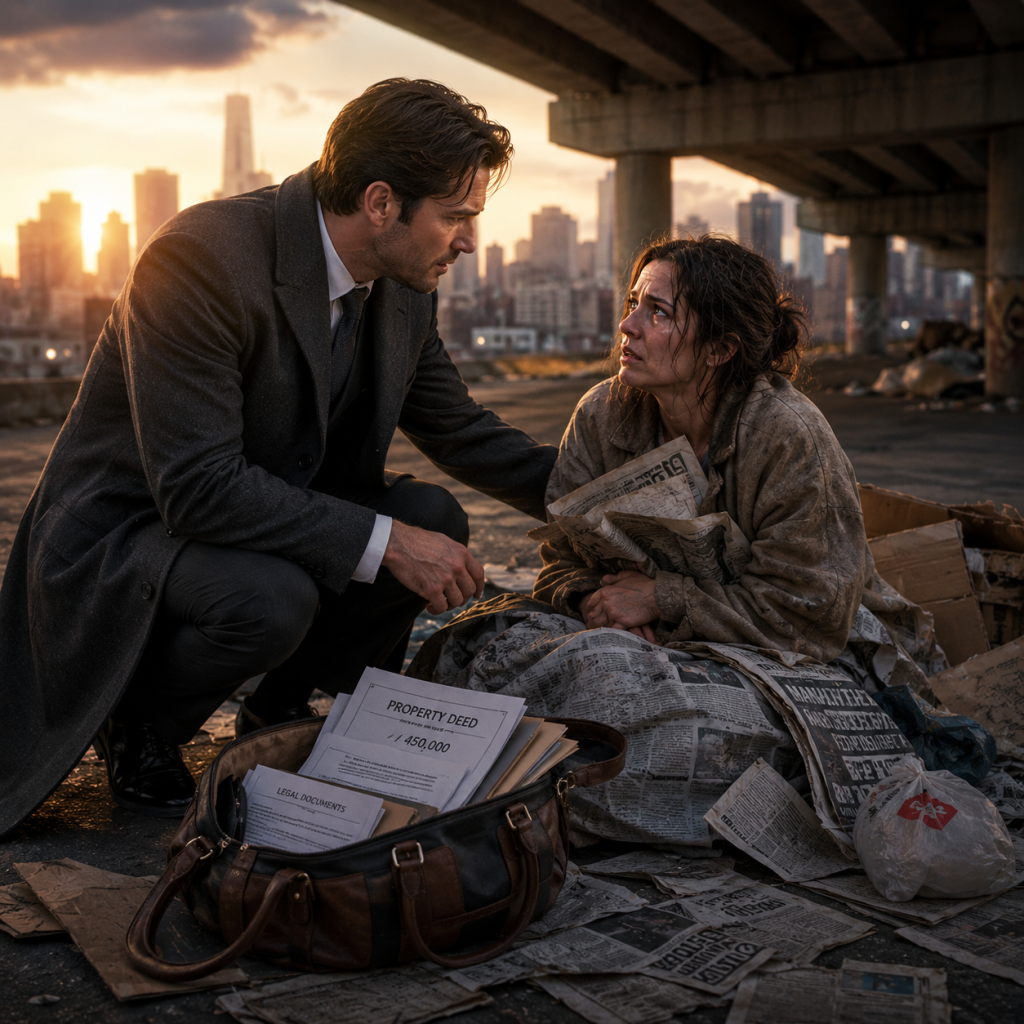
She was still sitting beneath the overpass, wrapped in my coat. Morning traffic thundered above us, making the concrete tremble every few seconds. She held the torn blanket tightly around herself, as though some part of her still expected the city to take even that away.
“Not at this moment,” I said. “But she needs medical attention, somewhere private.”
“I’ll arrange it. Where are you?”
I gave her the location.
“Do not confront Ryan,” Elena said. “Do not call the police yet. Not until we understand what was signed, what was recorded, and where the money went.”
“I wasn’t planning to confront him.”
There was a pause.
“Good,” she replied.
She knew me well enough to understand what that answer meant.
I ended the call and crouched beside Emma.
“We’re leaving,” I told her.
She looked toward the sidewalk beyond the concrete pillars. “I don’t have anywhere to go.”
“You do now.”
Her eyes moved back to mine.
There was no relief in them yet. Only hesitation.
That hurt more than anything.
She had known me for sixteen years. We had shared a home, a marriage, a thousand ordinary mornings. Yet as I reached for her hand, she flinched before she caught herself.
I froze.
“Emma.”
“I’m sorry,” she whispered.
“No. Don’t apologize.”
She lowered her gaze.
I wanted to ask who had made her afraid of being touched. I wanted names, dates, explanations. But the questions crowded behind my teeth, each one too sharp for the moment.
Instead, I removed my scarf and wrapped it around her neck.
“We’ll take this one step at a time,” I said.
She nodded, though she did not look convinced.
Twenty minutes later, a black sedan pulled beneath the overpass. Elena had sent Marcus Lee, the company’s head of security. Marcus was a former Chicago police detective, but he had none of the theatrical habits people expected from men with his background. He was soft-spoken, observant, and rarely raised his voice.
When he stepped from the car, he did not stare at Emma.
He simply opened the rear door and said, “Mrs. Carter, the seat warmer is on. There’s water inside. We can stop anywhere you need.”
That small kindness nearly undid her.
She stood slowly, leaning against me. Her legs trembled after only a few steps.
I felt the fragile weight of her hand on my arm and realized how much strength she had lost.
In my memory, Emma was always moving.
She danced while cooking. She walked quickly through airports. She climbed ladders to paint rooms herself because she insisted contractors never understood the exact shade of blue she wanted.
Now every step seemed to require a decision.
Marcus drove us to a private medical clinic near Lakeshore Drive. Elena had chosen it because the staff handled sensitive cases involving trauma, domestic instability, and vulnerable adults. No reporters. No company employees. No unnecessary paperwork at the front desk.
A doctor named Priya Nair examined Emma while I waited in a small consultation room.
The walls were pale green. A painting of Lake Michigan hung above a narrow bookshelf. Somewhere down the hall, a printer hummed.
I sat alone, staring at my hands.
For years, those hands had signed contracts worth hundreds of millions of dollars.
They had shaken hands with mayors, governors, investors, union leaders.
They had built bridges.
They had not protected my wife.
The thought settled in my chest like iron.
My phone vibrated.
Elena.
I answered immediately.
“I’ve pulled the public property records,” she said. “The house was transferred twenty-eight months ago.”
“To Ryan?”
“No. To an entity called Northline Residential Holdings.”
“Who owns it?”
“I’m still tracing that. The sale price was four hundred and twelve thousand dollars.”
“Our house was worth at least four-fifty.”
“At the time, probably more.”
“Where did the money go?”
“The closing statement shows the mortgage was paid off. After taxes, fees, and a home-equity line, the remaining funds were transferred to a joint account in your name and Emma’s.”
“I never opened a joint account for that sale.”
“I know.”
My grip tightened around the phone.
“What happened next?”
“The account was emptied over six months. Most transfers went to three businesses. One appears connected to Ryan. The other two may be shell companies.”
“May be?”
“I don’t speculate until I have records.”
I closed my eyes.
That was why I trusted Elena.
She did not tell people what they wanted to hear. She told them what she could prove.
“The documents Emma gave me include an affidavit,” I said. “It looks notarized.”
“Send me photographs of everything.”
I placed the documents on the table and photographed each page.
As I worked, something caught my attention.
The affidavit claimed Emma had authorized Ryan to act as her limited financial representative during her rehabilitation.
At the bottom was a signature that looked like hers.
Not exactly.
The first letter leaned too far right. The last name was compressed, as though the person signing had run out of room.
I had watched Emma sign birthday cards, checks, hotel forms, school donation letters, and our marriage certificate.
Her handwriting had a rhythm.
This signature looked like an imitation of that rhythm.
“Elena,” I said, “I don’t think she signed all of these.”
“That matters.”
“She said she was medicated.”
“It matters even more if someone added documents later.”
A knock sounded at the door.
Dr. Nair entered, closing it quietly behind her.
“I have to go,” I told Elena.
“Send me the clinic address. I’ll be there within the hour.”
The call ended.
Dr. Nair sat across from me.
She was in her early forties, with tired but attentive eyes. She rested a tablet on her lap.
“Your wife has given me permission to discuss her condition with you.”
“How is she?”
“Dehydrated. Malnourished, though not severely enough to require hospitalization. She has an untreated wrist fracture that healed poorly, chronic pain in her left hip, and signs of prolonged stress.”
My throat tightened.
“Can you help her?”
“Yes. But recovery will take time. She needs stable housing, follow-up care, physical therapy, proper nutrition, and—if she agrees—someone trained in trauma counseling.”
“Whatever she needs.”
Dr. Nair studied me for a moment.
“Mr. Carter, I’m going to say something that may be difficult to hear.”
I sat straighter.
“Your wife is frightened of losing control over her own life.”
“I’m not going to control her.”
“I’m not suggesting you intend to. But right now, even kindness may feel like another decision being made on her behalf.”
The words struck harder than I expected.
“What should I do?”
“Ask. Don’t assume. Give her choices, even small ones. Which room she wants. What she wants to eat. Who she wants present. Whether she wants to talk.”
I looked through the narrow window in the door.
Emma sat in the examination room across the hall. A nurse was helping her drink broth from a paper cup.
“What if she doesn’t trust me?”
“Then you earn it again.”
There was no accusation in the doctor’s voice.
That made it worse.
I nodded.
When Emma emerged an hour later, she wore clean gray sweatpants, a cream sweater, and soft shoes provided by the clinic. Her hair had been brushed and loosely tied back. She still looked exhausted, but the simple dignity of fresh clothes had changed the way she carried herself.
Not much.
Just enough for me to notice.
Elena arrived moments later.
She had always been composed, whether walking into a courtroom or stepping off a delayed flight at midnight. But when she saw Emma, her expression changed.
“Emma,” she said.
Emma gave a faint smile. “Hello, Elena.”
Elena approached slowly. “May I hug you?”
Emma’s eyes filled.
“Yes.”
They embraced in the middle of the clinic hallway.
I turned away.
There are moments in life when grief is too private even for the person who shares it.
We moved into a conference room, where Elena arranged the documents across a long table. Marcus stood near the door, silent.
Emma sat beside me, though not close enough for our shoulders to touch.
Elena examined every page.
“Do you remember signing this power of attorney?” she asked.
Emma leaned forward.
“I remember Ryan bringing a folder to the rehabilitation center. He said the insurance company needed signatures. There were several pages.”
“Did you read them?”
“I tried. My vision was blurry. I was taking pain medication, and I had a concussion.”
“Was anyone else present?”
“A nurse came in once. Ryan told her we were discussing family finances.”
“Do you remember the nurse’s name?”
“No.”
“Do you remember the date?”
“Not exactly. Late October. There were paper leaves taped to the windows.”
Elena made a note.
“What happened after you left rehabilitation?”
Emma’s hands tightened together.
“Ryan said the house needed repairs after a pipe burst. He put me in a motel near Oak Park.”
“For how long?”
“Three weeks. Then he stopped paying.”
“Did you contact Daniel?”
“I tried.”
I looked at her.
She did not look back.
“I called his international number,” she continued. “A man answered once and said Daniel was unavailable. After that, the number stopped connecting.”
“My number never changed.”
“I know that now.”
My pulse quickened.
“Who answered?”
“I don’t know. He sounded American. He said he was part of your travel staff.”
“I didn’t have travel staff.”
Emma’s eyes finally met mine.
“I wrote emails too.”
“I never received them.”
“I sent dozens.”
“I wrote to you every week.”
“I received six messages in three years.”
The room went quiet.
Elena slowly lowered her pen.
“What did the messages say?” she asked Emma.
“That Daniel needed space. That he was overwhelmed by work. That he felt guilty about the accident and didn’t know how to face me.”
I stared at her.
“I never wrote that.”
“I know,” she said again.
There was no bitterness in her voice.
Only exhaustion.
I pulled out my phone and opened the private email account Emma and I had used since our engagement.
Her name appeared in the search bar.
Hundreds of messages should have filled the screen.
There were only six.
The last was dated nearly three years earlier.
I turned the phone toward Elena.
She studied it.
“Your account may have been accessed,” she said. “Messages could have been deleted or diverted through forwarding rules.”
“Can you recover them?”
“Possibly. But do not alter the account. I’ll have a forensic specialist preserve it.”
Emma looked from Elena to me.
“Ryan had access to your home office,” she said quietly. “Your old laptop was there.”
I remembered the device. I had left it in a locked cabinet before traveling overseas. It contained archived correspondence, tax documents, and copies of identification records.
“Did he know the cabinet code?” Elena asked.
“No.”
Emma swallowed. “Chloe did.”
I felt something cold move through me.
“How?”
“You gave it to her the night of the accident.”
The memory returned in fragments.
A hospital corridor.
Rain against dark windows.
Emma in surgery.
Ryan beside me, pale and shaking.
Chloe holding my phone because my hands would not stop trembling.
I had been ordered to return to Frankfurt two days later or risk losing the bridge contract that employed thousands of people. Chloe had promised to bring Emma’s insurance records, medical directives, and passport to the hospital.
I must have given her the code.
I had trusted her.
“Could Chloe have managed the financial documents?” Elena asked.
Emma hesitated.
“Ryan always brought the papers. But Chloe handled everything else. She answered his phone. She spoke to the motel. She brought my clothes.”
“Was she unkind to you?”
“No.”
The answer surprised everyone.
Emma noticed.
“She was distant,” she clarified. “Nervous. But not cruel. Once, she left two hundred dollars in my purse. She told me not to mention it to Ryan.”
“Why?”
“She said he was under pressure.”
“What kind of pressure?”
“She wouldn’t explain.”
Elena drew a line beneath something in her notes.
“We need to separate what we know from what we suspect,” she said. “We know property was transferred. We know Emma’s legal capacity at the time may have been compromised. We know communications between Daniel and Emma appear to have been interfered with. We do not yet know who created the documents, who accessed the accounts, or who ultimately received the money.”
“It was Ryan,” I said.
Elena looked at me.
“Maybe.”
“You don’t believe her?”
“I believe Emma. I also believe that fraud involving property, bank accounts, email systems, medical records, and notarized documents is rarely as simple as one angry relative acting alone.”
Marcus spoke for the first time.
“Do we know where Ryan is?”
Elena glanced at me.
I did.
For months, my brother had sent cheerful updates from a newly purchased home in Highland Park. In the photographs, he stood beside an outdoor fireplace, holding a glass of wine. Chloe smiled beside him in designer clothes. Their daughter, Lily, often appeared in the background with their golden retriever.
Ryan had told me his consulting business was doing well.
I had congratulated him.
The memory filled me with shame.
“He thinks I’m still in Singapore,” I said.
“When were you supposed to return?” Marcus asked.
“Next Thursday.”
“That gives us a few days.”
Emma shook her head.
“No.”
We all turned toward her.
“I don’t want anyone watching him. I don’t want strangers following Chloe or frightening Lily.”
“Emma,” I said, “we have to find out what happened.”
“I know. But Lily is ten. None of this is her fault.”
Even after everything, she was protecting a child who belonged to the people who had abandoned her.
I wanted to tell her she did not need to think about anyone else.
Then I remembered Dr. Nair’s words.
Ask. Don’t assume.
“What would feel right to you?” I said.
Emma looked surprised by the question.
She thought for a moment.
“Documents first. Quietly. No one goes to the house. No confrontation.”
Elena nodded. “That is also the safest legal approach.”
I disliked it.
But I agreed.
The next problem was where Emma would stay.
I owned a condominium downtown, purchased years earlier for business meetings and late nights. It overlooked the river from the thirty-second floor and had been maintained by a property manager while I traveled.
It was secure.
It was private.
It was also filled with expensive furniture chosen by a designer Emma had never met.
When I offered it, she stared at the table.
“I don’t want to be hidden away.”
“You wouldn’t be.”
“Would anyone know I was there?”
“Only the people in this room.”
“That sounds like being hidden.”
I forced myself not to answer too quickly.
“What would you prefer?”
“A hotel.”
“It might be difficult to keep your location private.”
“I don’t care about the location. I care about being able to leave.”
The words were quiet.
They landed heavily.
“You could leave the condo whenever you wanted.”
“Would Marcus be outside?”
I looked at him.
Marcus looked at Elena.
“No security unless you request it,” I said.
Emma nodded slowly.
“I’ll stay at the condo for one night.”
One night.
I accepted it as a gift.
By noon, we were standing inside the apartment.
Sunlight poured through floor-to-ceiling windows. The Chicago River moved below us in a ribbon of dark green. Boats passed beneath the bridges, small and bright against the water.
Emma walked through the living room without touching anything.
“This doesn’t look like you,” she said.
“It isn’t.”
She glanced at me.
“I mean, I bought it,” I added. “But I barely lived here.”
“Did you ever bring anyone here?”
The question was soft, almost casual.
It took me a moment to understand.
“No.”
She turned toward the window.
“I wouldn’t blame you.”
“Emma.”
“You thought I left.”
“No. I thought you needed space after the accident. That’s what Ryan told me.”
“And you accepted that?”
The pain in her voice was controlled, which made it sharper.
“I called.”
“How often?”
“At first, every day. Ryan said you became distressed whenever I contacted you. He said the doctors wanted communication limited.”
“Did you ask to speak to a doctor?”
“Yes.”
“And?”
“He arranged a call.”
Emma turned.
“With whom?”
“A man who introduced himself as Dr. Kaplan. He said your recovery was complicated by severe anxiety. He recommended that I stop calling for several weeks.”
“There was no Dr. Kaplan.”
“I know that now.”
“Did you ever come home?”
The question I had been dreading.
“Twice.”
Her face changed.
“You came back?”
“The first time, Ryan met me at the airport. He said you had been transferred to a rehabilitation center in Wisconsin. He convinced me not to visit because you were having panic episodes.”
“You didn’t check?”
“I called the number he gave me. A woman confirmed you were a patient.”
“I was never in Wisconsin.”
“I know.”
The words sounded useless each time I said them.
Emma walked to the kitchen counter and gripped the edge.
“And the second time?”
“Eight months later. Ryan told me you had moved in with an aunt in Arizona.”
“I don’t have an aunt in Arizona.”
“He said you didn’t want me to know the address.”
She laughed once.
It was not amusement.
“You believed I vanished without speaking to you, abandoned our home, and refused to let you know where I was.”
“I believed you were angry.”
“For four years?”
“I believed you were hurt.”
She faced me then.
Her eyes were bright with tears, but her voice did not rise.
“You build tunnels through mountains, Daniel. You move governments and banks and entire crews across continents. But when your wife disappeared, you let your brother answer the questions.”
I had no defense.
Every explanation sounded like an excuse.
The contracts had been urgent.
The project had been at risk.
Thousands of jobs had depended on my decisions.
None of those things answered the only question that mattered.
Why had I not come home and found her myself?
“I failed you,” I said.
Emma looked away.
“I’m not asking you to say that.”
“I know.”
“I’m not asking you to punish yourself.”
“I know.”
“I needed you to look for me.”
My throat tightened.
“I should have.”
The room remained silent.
Outside, a tour boat moved slowly along the river. A guide’s amplified voice floated faintly upward, telling strangers about the city’s architecture.
Emma wiped her face.
“I need to rest.”
“Of course.”
I showed her the bedroom.
She paused at the door.
“Where will you sleep?”
“The guest room.”
“Good.”
It was not cruel.
It was honest.
I brought her a glass of water and placed it on the nightstand.
Before I left, she spoke.
“Daniel.”
I turned.
“When you called all those years, did you ever leave messages?”
“Hundreds.”
“I never heard them.”
I nodded.
She looked down at the blanket.
“I want to hear them someday.”
Then she closed the door.
For the next six hours, the apartment became a temporary command center.
Elena arrived with two forensic accountants and an information-security specialist named Noah Patel. They worked at the dining table beneath a sculptural light fixture that looked too elegant for the stacks of legal records spreading across the surface.
I stayed in the living room, close enough to answer questions but far enough not to disturb Emma.
The first discovery came shortly after three in the afternoon.
Noah recovered an email forwarding rule created on my account the week after Emma’s accident. Every message containing her name had been silently copied to an external address and moved into a hidden archive.
The rule was created from an internet connection associated with my house.
The external address used a meaningless string of numbers.
But its recovery phone number ended in four digits I recognized.
Chloe’s birthday.
I stared at the screen.
“So Chloe did it.”
“Not necessarily,” Noah said. “Someone could have used her number. We need provider records.”
“Can you restore the messages?”
“I already found several hundred.”
He opened the archive.
Emma’s emails filled the screen.
The first messages were confused.
Daniel, Ryan says you cannot call because of the bridge inspections. Please call when you can. I need to hear your voice.
Then worried.
The rehabilitation center says my insurance is delayed. Ryan says your company changed providers. Is that true?
Then frightened.
Something is wrong with the house. Ryan won’t give me the keys. He says you approved the sale. Please tell me you approved it.
Later, desperate.
I am at the Lakeside Motor Lodge, room 218. I don’t know how long I can stay. Please come home.
My vision blurred.
There were messages I could not read.
Not yet.
I closed the laptop.
Elena placed a hand near mine, not touching.
“There’s more,” she said.
I looked up.
One of the accountants had traced payments from the sale.
A portion had gone to Ryan’s consulting company.
Another portion had paid off personal debts.
But nearly one hundred and sixty thousand dollars had been transferred to a trust.
“What trust?” I asked.
“The Margaret Carter Family Trust.”
My mother’s name.
She had died six years earlier.
“I’ve never heard of it.”
“The trust was created fourteen months after her death,” Elena said.
“By Ryan?”
“The listed trustee is Chloe.”
I stood and walked to the windows.
My reflection looked unfamiliar in the glass.
Behind me, Chicago stretched toward the horizon, vast and orderly from a distance.
Up close, everything was more complicated.
“Why create a trust in my mother’s name?” I asked.
“That’s what we need to understand,” Elena replied.
“Who benefited?”
“The document is incomplete in the public filing. We’ll need the trust instrument.”
Marcus entered from the hallway.
He had gone to collect prescription records and copies of Emma’s motel receipts.
“There’s something else,” he said.
He placed a photocopied envelope on the table.
The original had been found among Emma’s papers.
It was addressed to her in handwritten block letters and postmarked nine months after the house sale.
Inside was a cashier’s check for five thousand dollars.
Unsigned.
Emma had never cashed it.
“Why not?” I asked when she later joined us.
She stood in the doorway wearing a robe over her clothes.
“Because I didn’t know where it came from.”
“There was no note?”
She shook her head.
Elena held the envelope beneath the light.
“The postmark is from Milwaukee.”
I looked at Emma.
“Do you know anyone there?”
“No.”
“Did Ryan travel there?”
“Not that I know of.”
Marcus examined the photocopy.
“The check was purchased at a credit union. We may be able to identify the buyer with a subpoena.”
Emma moved toward the table.
When she saw the recovered emails on Noah’s screen, she stopped.
“You found them.”
“Yes,” I said.
She touched the back of an empty chair.
“Did you read them?”
“Some.”
Her face tightened with embarrassment.
“I was not always thinking clearly.”
“You don’t have to explain anything.”
“I said terrible things.”
“You were scared.”
“I thought you had chosen the company over me.”
I stood.
The distance between us was only a few feet, but it felt like a border.
“I did choose the company too often,” I said. “Maybe not in the way you believed, but enough that the lie seemed possible.”
Emma lowered her eyes.
That truth had been waiting between us since morning.
Ryan’s deception had separated us.
But he had used a crack that already existed.
I had spent years promising Emma that the next project would be different. The next contract would require fewer flights. The next year would leave us more time.
There was always another bridge.
Another deadline.
Another city.
Our marriage had not failed.
But I had left too much of it unattended.
Emma sat at the table.
“I kept thinking you would walk through the motel door,” she said. “Every time footsteps stopped outside my room, I thought it was you.”
I sat across from her.
“I’m sorry.”
She nodded.
It was not forgiveness.
But it was the first time she accepted the words without turning away.
Elena closed the folders.
“We should stop for tonight.”
“No,” Emma said.
Everyone looked at her.
“I want to know about the trust.”
“Finding the full document may take time.”
“Is there another way?”
Elena hesitated.
“There might be a reference in your mother’s probate records.”
My mother’s estate had been simple.
At least I thought it had.
She owned a modest home in Evanston, some savings, and a collection of antique furniture no one wanted to divide. After her death, Ryan and I had sold the house and split the proceeds equally.
Or so I remembered.
Elena accessed the county probate system.
The original filings appeared quickly.
My mother’s will.
The asset inventory.
The final accounting.
Then Noah noticed an attachment.
A sealed petition filed by the estate attorney six months after probate had closed.
“Can you open it?” I asked.
“No,” Elena said. “It was restricted by court order.”
“Why?”
She read the docket entry twice.
“Petition concerning omitted heir.”
The words seemed to shift on the screen.
“Omitted heir?” I said.
Emma looked at me.
“Could your mother have had another child?”
“No.”
But the answer came too quickly.
I remembered something my mother once said near the end of her life. She had been in the hospital, drifting in and out of sleep. I sat beside her while Ryan went downstairs for coffee.
She took my hand and whispered, There are things I should have told you boys.
I assumed she meant the ordinary regrets of a dying parent.
I had told her not to worry.
I had told her to rest.
The next morning, she died.
Elena searched for the estate attorney’s name.
“Samuel Brenner,” she said. “He retired two years ago.”
“Is he still alive?”
Marcus checked.
“Yes. He lives in Wilmette.”
Emma studied the docket.
“What does an omitted heir have to do with our house?”
“We don’t know,” Elena said.
But I was beginning to see a possibility.
A trust created in my mother’s name.
Property money diverted into it.
A sealed petition involving another heir.
Perhaps Ryan had not simply stolen the money.
Perhaps he believed he was moving it somewhere it belonged.
That did not excuse what he had done to Emma.
Nothing could.
But the shape of the betrayal was changing.
At seven in the evening, everyone left except Marcus, who remained in the lobby downstairs.
Emma and I ordered soup, bread, and tea.
We ate at opposite ends of the kitchen island.
For the first time all day, no one asked questions.
The quiet felt almost normal.
Emma tore her bread into small pieces.
“Do you remember our first apartment?” she asked.
“Above the laundromat?”
“The radiator screamed all winter.”
“And the bedroom window wouldn’t close.”
“You stuffed towels around it.”
“They froze to the frame.”
She smiled faintly.
That smile opened something in me.
“We had one chair,” I said.
“It was a terrible chair.”
“You chose it.”
“I was twenty-three. I made mistakes.”
The humor lasted only a moment, but it mattered.
It reminded me that somewhere beneath the fear, humiliation, and lost years, the woman I married was still there.
Not unchanged.
Not waiting to return to the person she had been.
But present.
“I don’t know what happens to us,” she said.
“I know.”
“You came back expecting a wife who had simply been away.”
“I came back hoping we could repair things.”
“You didn’t know they were broken.”
“No.”
She turned her cup slowly between her palms.
“I may never want that house back, even if it can be recovered.”
“We don’t have to take it back.”
“It was ours.”
“It was a building.”
“It was where we planned to have children.”
The words stopped me.
We had spoken about children for years.
Then the projects became larger, the absences longer, and the timing never felt right.
After the accident, I had stopped imagining that future because I believed Emma no longer wanted it with me.
She looked toward the dark windows.
“Ryan knew what the house meant.”
“Yes.”
“That’s what I cannot understand. He could have taken money. He could have lied. But he erased our life as if it had never mattered.”
I moved my hand across the counter, stopping halfway between us.
“I’ll help you find out why.”
She looked at my hand.
After a long moment, she placed hers beside it.
Not in mine.
Beside it.
A small space remained between our fingers.
It was the closest we had been all day.
At eight thirty, Elena called.
She had located the retired estate attorney.
Samuel Brenner had agreed to meet us the following morning, but only after hearing Emma’s name.
“What did he say?” I asked.
“That he wondered how long it would take for one of you to find her.”
I stood so quickly that the chair struck the floor.
Emma’s face went pale.
“He knew?” I said.
“He would not explain by phone.”
“Where is he?”
“At home. Daniel, do not go there tonight.”
“He knew Emma was missing.”
“We don’t know what he knew.”
“He said he was waiting for us to find her.”
“And he is eighty-two years old, in poor health, and frightened enough to insist his daughter be present for the meeting. Going there angry will not help.”
Emma touched my wrist.
The gesture stopped me more effectively than Elena’s warning.
“Tomorrow,” she said.
I looked at her hand.
Then at her face.
“Tomorrow,” I agreed.
That night, I lay awake in the guest room.
The city glowed beyond the windows. Every few minutes, a train crossed the river, its lights reflected in the black water below.
At midnight, I heard footsteps in the hallway.
Emma stood outside the guest-room door.
“Are you awake?” she asked.
“Yes.”
She entered but remained near the doorway.
“I had a dream.”
“Do you want to talk about it?”
“No.”
I sat up.
She looked small in the borrowed robe, but there was a steadiness in her expression that had not been there beneath the overpass.
“Can I sit here for a while?”
“Of course.”
She sat in the chair beside the window.
Neither of us spoke.
After several minutes, she said, “There was a woman at the rehabilitation center.”
“What woman?”
“She visited twice. I thought she was a social worker.”
“What did she want?”
“She asked questions about my marriage. About your mother. About whether you and Ryan looked alike.”
I frowned.
“What did she look like?”
“Older. Sixties, maybe. Silver hair. Very neat. She wore a blue coat.”
“Did she give you a name?”
“Margaret.”
My mother’s name.
I felt the room narrow around us.
“Did she have identification?”
“I don’t remember.”
“What exactly did she ask?”
Emma closed her eyes, searching the memory.
“She wanted to know whether your mother ever talked about a baby girl.”
My heartbeat slowed.
“A baby girl?”
“She asked whether your mother had been pregnant before you and Ryan were born.”
“And what did you say?”
“I said I didn’t know.”
Emma opened her eyes.
“Daniel, I had forgotten about her until tonight.”
“Did you tell Ryan?”
“Yes.”
“What did he do?”
“He became angry. He said the woman was confused and should never have been allowed inside.”
“Did she come back?”
“Once.”
“What happened?”
“She left something for me.”
Emma stood.
“I kept it for months. Then I thought I lost it.”
“What was it?”
“A photograph.”
She crossed the room and returned to the bedroom.
A minute later, she came back holding the worn plastic grocery bag from beneath the overpass.
She emptied the remaining papers onto the desk.
From the bottom seam, she pulled a small photograph wrapped in tissue.
It showed my mother as a young woman.
I recognized her immediately, though she could not have been more than nineteen.
She stood outside a church wearing a pale dress.
Beside her was another young woman holding a newborn baby.
On the back, someone had written three lines in faded ink.
Margaret and Evelyn.
St. Anne’s, 1972.
One daughter kept. One daughter promised.
I read the words twice.
Then I noticed something else.
In the lower corner of the photograph, reflected in the church window, stood a man.
The image was blurred, but his face was familiar.
I had seen him in company photographs, family dinners, and holiday cards for most of my life.
It was Samuel Brenner.
My mother’s estate attorney.
And in his arms, he was holding a second baby.
The following morning, Elena arrived just after dawn.
She examined the photograph beneath a magnifying lamp, then placed it carefully in an evidence sleeve.
“This changes the questions we ask,” she said.
“Could Ryan know about this?” Emma asked.
“He created a trust in your mother’s name,” I said. “He must know something.”
Elena did not answer.
Her phone rang.
She looked at the screen.
“It’s Brenner’s daughter.”
She answered and listened without speaking.
Her expression shifted.
“When?” she asked.
A pause.
“Was anyone with him?”
Another pause.
“All right. Do not touch his office. I’ll contact the appropriate people.”
She ended the call.
“What happened?” I asked.
“Samuel Brenner was taken to the hospital early this morning. His daughter found him unconscious in his study.”
Emma rose from the sofa.
“Is he alive?”
“Yes. But he cannot meet with us.”
I looked toward the photograph.
“Did someone hurt him?”
“There is no evidence of that. His daughter believes he suffered a stroke.”
The timing felt impossible to ignore, yet Elena’s warning was clear.
Do not invent answers before the facts arrive.
Then she held up her phone.
“Before the ambulance came, he regained consciousness for less than a minute. He told his daughter to give Daniel the key.”
“What key?”
“She didn’t know.”
At that moment, a message appeared on my phone.
It came from an unknown number.
There was no greeting.
Only a photograph of a small brass key resting on a sheet of paper.
Beneath it were four words.
ASK EMMA ABOUT THE LOCKER.
I turned the screen toward her.
The color drained from her face.
“What locker?” I asked.
For several seconds, she did not answer.
Then she looked toward the grocery bag of documents.
“When I was discharged from rehabilitation,” she said slowly, “the woman in the blue coat took me to Union Station.”
“Margaret?”
Emma nodded.
“She rented a storage locker under my name. She said it contained proof that your mother had tried to protect us.”
“Protect us from whom?”
Emma looked at the message again.
“I never opened it.”
“Why not?”
“Because the next morning, she disappeared.”
The room went still.
“Daniel,” Emma whispered, “I don’t think your brother was the first person who lied to us.”
END OF PART 2 – LIKE, SHARE AND COMMENT “THE ENTIRE STORY” IF YOU WANT TO READ THE FULL STORY