PART 1 — The Child They Wanted Hidden
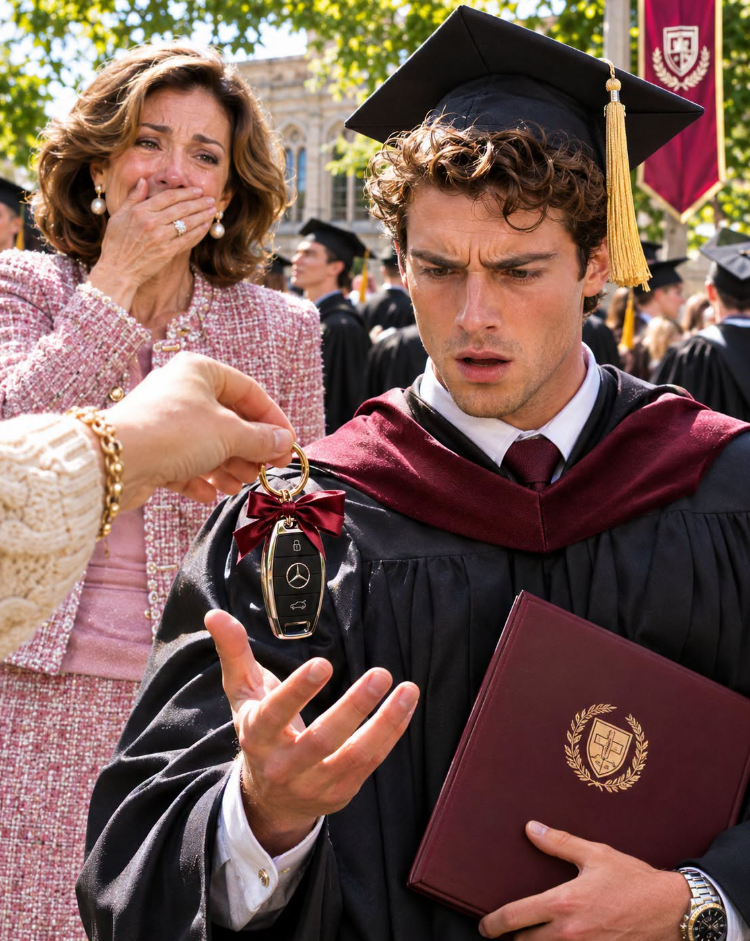
“Thank you for raising my son all these years, Ryan, but he doesn’t need to live surrounded by sawdust and rusted tools anymore. Now he’s going to have a Porsche and a real family.” My sister, Victoria, delivered that announcement where dozens of people could hear her, placing the keys to a sports car worth more than my house into Matthew’s palm. Her smile suggested she had just bestowed an extraordinary kindness rather than insulted the life we had built together. What she didn’t know was that Matthew had been preparing for this moment for weeks. Before I can explain what unfolded at his graduation, however, I need to return to the night eighteen years earlier when my family decided that protecting my sister’s future meant surrendering mine.
At my parents’ house, I discovered Victoria crying on the living room couch. She was seventeen and approaching her sixth month of pregnancy. The baby’s father had disappeared as soon as he learned about the pregnancy, leaving my parents scrambling to protect the reputation they treasured among their country-club friends in East Grand Rapids. Their concern wasn’t how to support their daughter or welcome her child. They wanted the situation concealed before it could disturb the version of our family they presented to everyone else. My mother spoke as though the decision had already been made and my presence was merely a formality. “You are going to take responsibility for the child,” she declared. For a moment, I genuinely believed I had misunderstood her.
Their position soon became unmistakable. If I wouldn’t raise the baby, they intended to arrange a closed private adoption and remove every trace of him from our family’s story. I couldn’t accept the thought of my nephew growing up without knowing where he came from simply because the adults around him found his existence inconvenient. So I agreed. When Matthew arrived, Victoria barely wanted to hold him. My parents transferred enough money to settle the hospital bill, then left without even saying goodbye. I bought his first receiving blanket. I carried him against my chest through long nights in the workshop, pacing back and forth while his colic kept him crying. Their unwanted complication had become the tiny person depending on me for everything.
Long before he could have pronounced Ryan properly, Matthew knew me as Dad. Victoria, meanwhile, went to Chicago with our parents paying her expenses. Eighteen years passed without a single birthday card from her. My mother sometimes called, although her conversations rarely offered anything resembling support. Instead, she reinforced the conditions under which she expected Matthew and me to exist. “Don’t even think about bringing that boy to our holiday dinners. Nobody needs to know what happened.” I kept believing there must be some limit to the humiliation she was prepared to inflict. Surely, I thought, she would eventually recognize that Matthew was a child, not a threat to the family’s reputation. I was wrong about that, too.
On the afternoon Matthew turned fifteen, we attended a brief family gathering. My mother looked directly at him and said, “Don’t get confused, young man. Just because Ryan raised you doesn’t mean you have any right to a place among us.” There was no ambiguity for him to misunderstand, no softened version of the message I could offer afterward. He heard exactly what she intended him to hear. I had spent years absorbing her judgments myself, but hearing her direct that rejection at my son was something else entirely. Before I could find the words to answer her, Matthew responded with a steadiness I hadn’t expected from someone who had just been hurt so deliberately.
He didn’t plead for acceptance or try to convince her that he deserved a place at her table. He didn’t turn toward Victoria hoping she would finally claim him, either. What happened next made the room’s expensive surroundings and carefully maintained appearances seem suddenly meaningless. My mother had tried to remind him that he stood outside the family she considered important. Matthew answered by making it clear that he had never needed her permission to belong somewhere. I could hear the quiet composure in his voice, and it stunned me more than an angry response ever could have. My son already understood something I had spent most of my adult life struggling to learn.
“Don’t worry, Mrs. Hayes,” Matthew replied with a quiet composure that stunned me. “I already have a family. My dad is right here with me.” Then he reached for my hand. My mother’s face reddened, Victoria fixed her attention on her wineglass, and my father abruptly became occupied with his phone. Nobody offered an apology. Nobody challenged what my mother had said. Matthew and I left before dinner was served. The gesture of his hand around mine stayed with me as we walked away. She had tried to make him feel that he had no one, and he had answered by reminding everyone present that he knew precisely who had stayed.
During the drive home, Matthew watched the streetlights slide past without saying much. Back at the shop, he collected two root beers from the little refrigerator and settled beside me on the workbench. “Dad… why didn’t they ever want me?” The question broke my heart. He had known the facts since he was thirteen, when I showed him the adoption decree and explained that Victoria was his biological mother. I had never concealed his beginnings or pretended the paperwork said something different. Yet understanding a history on paper offered no protection against hearing his grandmother reject him in person. There was no explanation I could give that would make her behavior reasonable, because it wasn’t.
“You didn’t do anything wrong, buddy,” I told him. “Some people simply don’t know how to love, no matter how many advantages they’re handed.” Matthew lowered his eyes to my rough, scarred hands. “Then I’m really glad you knew how.” That conversation changed something in me. I had spent so long feeling judged by my relatives that I hadn’t recognized how little their approval mattered beside my son’s trust. That night, sitting with him in the place they considered beneath them, I understood that I no longer had anything to prove. Matthew knew who I was. He knew what our life together meant. For a while, I believed that understanding would be enough to keep the rest of the family at a distance.
Two years later, they pushed their way back into our lives. Matthew was finishing high school at the top of his class. He was valedictorian, had won a regional math olympiad, and had earned a full scholarship to study architecture at the University of Michigan. Every time his photograph appeared in the local newspaper, I found myself tearing up with pride. Then a cousin inadvertently included him in an extended-family group chat while circulating graduation announcements. Nobody noticed that his number remained among the recipients. One evening, Matthew came into the kitchen and handed over his phone. My mother had written that Ryan’s work as an unpaid babysitter was finished and it was time to concentrate on Victoria’s future.
Victoria’s response explained why my son had suddenly become useful. Arthur wanted to marry a family-oriented woman, she wrote, and reconnecting with Matthew would let her demonstrate what a devoted mother she was. A handsome son with impressive academic prospects would look wonderful in engagement photographs. Reading it made me feel sick. Arthur Sterling was a successful Chicago property developer worth tens of millions. He and Victoria had begun dating several months earlier. She had told him that her strict parents forced her to surrender her newborn at seventeen and that she had mourned the separation for nearly twenty years. Arthur believed he was helping repair a terrible wound. He had no idea he was being offered a carefully constructed fiction.
“We have to tell him the truth,” I told Matthew. “We will, Dad,” he said calmly. “I just want you to see how far they’re willing to take this first.” Over the following weeks, Victoria filled his phone with affectionate messages about how much she had suffered without him and how desperately she wanted to recover the lost years. She promised the graduation present he had always wanted. Eventually, the purpose beneath all that sweetness emerged: during his valedictorian address, she wanted him to thank her and call her Mom while Arthur sat beside her. She described it as the happiest moment she could imagine. Matthew sent a four-word response: See you at graduation. He didn’t explain his plan to me.
On graduation morning, I found him at his bedroom mirror fastening the buttons of a crisp white shirt. Before putting on his cap and gown, he opened the small cedar keepsake box we had made together years before. Inside lay a faded square of blue flannel, cut from the work shirt I had wrapped around him on the night he was born. He lifted it out carefully. “I want to keep this on me today, Dad.” He placed it inside his suit jacket. I knew what the fabric meant to us, but I still didn’t understand the role it would play that afternoon. I only knew that he was carrying a little piece of our beginning into one of the biggest days of his life.
More than four hundred people gathered in the high school auditorium. Victoria made her entrance with Arthur and my parents, dressed in a designer suit and diamonds that flashed beneath the lights. Before the ceremony started, she approached Matthew and embraced him extravagantly where local photographers could see. Then she displayed a shining silver Porsche key fob. “Happy graduation, sweetheart. A brand-new Carrera—so you never have to ride around in Ryan’s beat-up old truck again.” Matthew accepted the keys without returning her smile. She turned toward me, looking pleased with herself. “Thank you for looking after him, little brother. I think it’s finally time he came home to his real mother.”
Several families standing nearby heard her clearly. For a moment, I couldn’t seem to draw a proper breath. Everything she had ignored for eighteen years had been reduced to a temporary favor, something she could now replace with a car and a performance. Matthew leaned toward me before I could answer. “Don’t say a word, Dad. Everything ends today.” I didn’t know what he intended to do, but there was nothing uncertain in his voice. Soon afterward, the principal introduced the graduating class’s valedictorian. Matthew walked to the podium without carrying a single note card. Victoria lifted her iPhone, ready to record the moment she believed would complete her return as a devoted mother.
My son adjusted the microphone and looked directly at her. Then he spoke the sentence that erased her smile. “Today, I want to tell you the story of a woman who claims to be my mother… and the man she just called a babysitter.” The room fell completely quiet. Victoria still had her phone raised, but the expression on her face had changed. I sat motionless, hearing the words settle over the audience and realizing that Matthew had chosen this moment for the truth he had promised we would tell. Before anyone could interrupt, he slipped a hand inside his jacket. Every eye remained on him as he began to pull something from his pocket.
PART 2 — The Truth He Carried
Matthew drew out the little square of blue flannel. Repeated handling had softened the cloth and worn its edges; its faded color looked almost insignificant against the costly suits and watches throughout the auditorium. To anyone else, it might have seemed like an odd thing to bring to a graduation ceremony. To me, there could have been nothing more recognizable. It came from the shirt I had used to keep him warm on his first night alive. Seeing it held beside that microphone sent my heart into my throat. He had carried our history onto the stage, not in an accusation or a photograph, but in a piece of fabric I had never imagined anyone else would care about.
“This piece of cloth in my hand,” Matthew began, his voice steady across the auditorium speakers, “isn’t worth a dime. If I tried to sell it, nobody would pay fifty cents. To me, though, it’s the most priceless thing I own.” Victoria’s phone began to lower. In the front row, my mother shifted in her seat. “Eighteen years ago, a seventeen-year-old girl had a baby she didn’t want to raise,” Matthew continued. “Her family had money, country club memberships, and connections that could buy almost anything. Still, there was one thing they cared about far more than that newborn’s life: what their wealthy friends might whisper behind their backs.” People began turning toward one another across the rows.
“So they decided to hide him away. Not because he was sick, and not because he did anything wrong—simply because his existence threatened the image of a respectable family.” Victoria stopped recording. “Matthew…” she breathed from the front row. He didn’t let the interruption unsettle him. “When I was born, my biological mother walked out. My grandparents refused to take responsibility for me either. Yet there was a twenty-four-year-old guy who had just started his own small business.” His gaze moved through the auditorium until he found me. “That man was my Uncle Ryan. Even though he didn’t have much money or a clue how to raise a newborn, he decided to become my dad.”
The first tears slipped down my face before I could stop them. “My dad gave up almost everything for me. He lost the woman he was engaged to marry. He sold woodworking equipment he had spent years saving up to buy. He turned down opportunities that never came around again.” His voice wavered a little, but he continued. “And he never once made me feel like I was a burden.” The silence in the auditorium was absolute. I had never cataloged those losses for him as debts he would someday need to repay. They were decisions I had made because he needed me. Hearing him name them now, in front of so many people, left me overwhelmed.
“When I spiked a fever at two in the morning, he stayed awake beside my bed. When I crashed my bike, he cleaned my scraped knees. While other kids bragged about summer trips to Europe, we built bookshelves together in his workshop and celebrated with tacos from a food truck.” Parents throughout the audience were wiping their eyes. “My dad couldn’t buy me hundred-dollar sneakers, yet he always made time to listen. He never missed a single parent-teacher conference. Whenever someone asked me what I wanted to be when I grew up, I always gave the same answer: I wanted to be just like him.” I could barely see him clearly through my own tears.
He raised the worn blue cloth again. “The first night I spent on this earth, nobody had bothered to pack a baby blanket for me. My dad wrapped me in his own flannel work shirt. We kept a square of it because he told me it was a reminder of the day his life changed forever.” I covered my mouth, trying not to sob where everyone could hear me. The memory was so clear that, for a moment, the years between that frightened young carpenter and the man sitting in the auditorium seemed to disappear. I had thought I was simply doing what the baby in my arms required. Matthew had kept the evidence of that beginning as something precious.
“Today, someone handed me the keys to an expensive sports car and told me I didn’t need to live around old tools anymore. What that person doesn’t understand is that my dad’s shop was never a place I needed to escape from.” He let the words rest in the silence before finishing. “That workshop was my home. And the man who works there is my father.” Then he pointed toward me. “Dad… would you stand up?” I shook my head, overcome by everything I was feeling. Standing before that room seemed impossible. I had come to celebrate him, not to become part of his speech, and I couldn’t yet trust myself to move.
“Please,” he insisted gently. “I want everyone in this room to see the man who taught me that family isn’t proven by money—it’s proven by the years you choose to stay when loving someone gets hard.” Slowly, I got to my feet. His AP Calculus teacher stood first and began to clap. Students followed, then parents and other teachers. In seconds, almost the entire auditorium was standing. I had spent so many years being reminded of what my family thought I lacked that I scarcely knew how to receive what was happening. Matthew stood at the microphone, smiling through tears, and looked at me as though there had never been any question about who deserved to be acknowledged.
“Thank you for choosing me, Dad. If I had to be born all over again and got to pick who raised me, I’d choose you a thousand times over.” I couldn’t have said how long the applause continued. I only knew that I was crying harder than I had since Lauren left me with a three-week-old baby. Back then, I had been terrified of everything I didn’t know. In the years since, I had often assumed that the quiet decisions—the work declined, the money stretched, the nights spent awake—passed unnoticed. Yet my son had noticed. He had understood far more than I realized, and now he was telling me that none of it had been invisible.
The standing ovation surrounded us while Matthew held the faded cloth onstage. When he finally came down, the principal greeted him with a warm handshake. Victoria remained rigid in her chair, the color gone from beneath her makeup. Arthur was still beside her, but their hands were no longer joined. My mother pressed her lips together and glanced anxiously at acquaintances throughout the room. Even then, her concern wasn’t what Matthew had endured. She was thinking about what people would say once they reached the parking lot. She had reason to worry. The speech had broken the silence she depended upon, but it was not the end of what Matthew had prepared.
After the ceremony, the school lawn filled with families taking photographs in the sunshine. Classmates and teachers gathered around Matthew, hugging him and offering congratulations. Then we heard hurried footsteps behind us. “Matthew Hayes!” Victoria approached with fury in her eyes, her heels sinking into the grass. Arthur followed several steps back, with my parents alongside him. “What the hell was that?!” my sister hissed. Matthew faced her without losing his composure. “My valedictorian speech.” “You humiliated me in front of hundreds of people!” “I simply told the truth about how I grew up.” “You painted me out to be a monster!” For a few seconds, he simply looked at her.
“What exactly did you want me to say, Victoria? That you stayed up with me when I had the flu? That you drove me to school? That you showed up to my birthdays?” Her mouth opened, but no answer came. “I’ve had eighteen birthdays, Victoria. You could have shown up to any one of them.” Tears filled her eyes. “You have no idea how hard things were for me back then.” Arthur moved forward. When he spoke, his voice was restrained, precise, and sharp enough to cut through her protests. “That’s exactly what I’m trying to understand.” He turned his attention to Matthew rather than allowing Victoria to answer for him.
“Victoria told me her parents forced her to give you up, and that Ryan legally blocked her from ever having contact with you.” A chill ran through me. I had known she was lying, but I hadn’t realized how much blame she had placed on me to make herself appear innocent. “She told me she spent years trying to rebuild a relationship,” Arthur continued, “but custody restrictions kept her away, and she was still hoping to repair the damage.” Matthew listened, then nodded slowly. “Mr. Sterling, did she happen to mention the last time she called me before she met you?” Arthur said nothing. “Because I can tell you,” Matthew said evenly. “Never.”
“That’s not fair!” Victoria burst out. “Ryan always held a grudge against me!” I could no longer let that pass without an answer. “Victoria, I never once stopped you from seeing Matthew. You told me yourself you didn’t want us reaching out.” My mother lifted a hand as though she could bring the conversation to a halt by command. “Enough. We are not airing private family business in front of strangers.” Matthew opened the zipper of his diploma folder. “Grandma, you made this story public the second you decided to use me as a prop to impress Mr. Sterling. I wasn’t the one who invited him here under false pretenses.”
From inside the folder, he removed several carefully folded documents. “Mr. Sterling, these are certified copies of my adoption file from Kent County family court. My dad petitioned for guardianship first. Years later, when the adoption was finalized, Victoria signed full voluntary consent before a judge.” Arthur accepted the pages and studied them closely. Everything he needed was there: dates, official seals, and Victoria’s signature. There had been no custody fight and no order preventing her from visiting. The record showed something much simpler and more painful. The people with money and security had chosen not to take responsibility, while the young man with a small workshop had agreed to carry it.
Arthur eventually looked up from the documents. “Victoria, you swore to me you never consented to the adoption.” She stumbled over her reply. “I… I was barely seventeen. My mother pressured me. I didn’t understand what I was signing.” “I can believe you were scared at seventeen,” Arthur replied evenly. “What I can’t excuse is why you lied to my face now, as a grown woman.” My mother attempted to recover control of the conversation. “Arthur, you have to understand our family has a complicated history.” He didn’t yield to her polished tone. “Every family has complications, Mrs. Hayes,” Arthur said coolly. “Not every family fabricates a tragedy to cover them up.”
Matthew unlocked his phone. “There’s one more thing.” Victoria’s shoulders stiffened immediately. He opened the saved screenshots from the family conversation. “I don’t want you walking away thinking this is just a misunderstanding. You deserve to know why Victoria suddenly started texting me the exact week the two of you began discussing marriage.” First, he showed Arthur the messages my mother had sent. Then he moved to Victoria’s replies. This was no longer a dispute between competing memories of a difficult pregnancy. These were recent words, written when my sister believed Matthew couldn’t see them, explaining exactly why she had decided to perform the role of a loving mother.
Arthur read without speaking. His jaw tightened when he reached the message describing Matthew as the perfect angle for winning him over: intelligent, photogenic, and useful as proof that Victoria had always wanted a real family. The next message said that Ryan had already done the difficult work; she only needed to arrive at the finish and enjoy the attractive part. I watched Arthur’s expression while he took in what she had written. The story she had sold him had depended upon grief, devotion, and a separation she claimed she had never wanted. On the screen in front of him was her own explanation, stripped of every sentimental detail she had used to make it believable.
The documents had dismantled her claim that she had been legally kept away. The messages went further. They revealed that Matthew’s achievements, his appearance, and even the affection she asked him to display at graduation had been folded into her plan for marriage. She had wanted an audience when she gave him the Porsche. She had wanted a recording when he called her Mom. Now Arthur had an audience of a different kind: the people whose lives she had rewritten, standing close enough to answer for themselves. He finished reading, then lifted his eyes from the phone. His voice fell almost to a whisper. “You wrote this?”
PART 3 — What No Fortune Could Buy
Victoria reached abruptly for the phone. “Those are private texts! Matthew had no right to show you!” My son moved smoothly beyond her reach. “I didn’t write them, Victoria. You did.” Arthur looked at the screen once more before facing her. “You were actually planning to use your own son as leverage to get me to propose?” “No—it wasn’t like that!” she cried desperately. “I love you!” “If you loved me, you would have trusted me enough to tell me the truth.” She began sobbing. “You don’t understand! I was terrified of losing you!” He took a slow breath before answering. “So you chose to lie to me for months instead.” For the first time, she seemed to understand that the speech hadn’t created this disaster. Her own decisions had brought her here.
My mother stepped toward him. “Arthur, please, let’s drive back to the house and discuss this calmly. Don’t make a rash decision.” He shook his head. “I don’t need any more explanations. Victoria led me to believe I was helping reunite a devoted mother with a child stolen from her.” Then he addressed Matthew with unmistakable respect. “I am deeply sorry for getting dragged into this—and for believing a story without ever asking you first.” “You had no way of knowing the truth when nobody around you was telling it.” Arthur returned the adoption records and faced Victoria. “I cannot marry someone capable of lying about something like this. Our engagement is over.” She stood frozen. “Arthur, please—” “Respect my decision.”
He walked away without another spectacle. Victoria hurried after him for two steps, then stopped when his driver opened the back door of a black sedan. She returned with mascara streaking her face. “You ruined my life!” she screamed at both of us. “Both of you!” Matthew’s voice remained level. “No, Victoria. You made your choices. We just stopped hiding them for you.” He took the silver Porsche fob from his pocket and held it toward her. For a strange moment, hope crossed her face, as though the car might still provide a way out. “I don’t want your car,” Matthew said quietly. “It’s yours,” she pleaded weakly. “I bought it for you.”
“I didn’t ask for it, and I won’t accept a gift that comes with strings attached.” He placed the keys carefully on a nearby stone bench. “You don’t need to buy me expensive things to earn forgiveness—and you don’t get to demand I call you Mom when you’ve never once tried to know who I am.” Victoria cried openly. “I’m the woman who gave you life.” The sadness in Matthew’s expression hurt me all over again. “I’ve never denied that. Still, he’s the man who gave me a life.” He moved to my side and rested an arm around my shoulders. “And I’m never letting anyone make him feel small for raising me again.”
My mother shook with anger. “You must be thrilled, Ryan. You always wanted to turn us against your sister.” I looked directly at her. For once, I felt no need to defend my existence or apologize for the life I had chosen. “Mom, I spent eighteen years never asking you for a dime—no money, no favors, no credit. All I ever wanted was for you to treat Matthew with basic decency.” “We gave you the chance to be a father!” she snapped. Her words seemed to stop everything around us. Then my father, silent through the confrontation until that moment, finally spoke. “Beatrice, stop.” Every one of us turned toward him.
“Ryan doesn’t owe us a damn thing,” my father said, his voice cracking. “We’re the ones who failed him.” My mother stared in outrage, but he lowered his gaze. “I was a coward too,” he admitted quietly. “I knew what we did was wrong, and I never had the spine to stop it.” I had never heard him accept responsibility so plainly. It didn’t cancel eighteen years of silence or undo what his refusal to intervene had allowed. Still, for that brief moment, he was no longer sheltering behind my mother. Matthew squeezed my shoulder. “Come on, Dad. Let’s get a picture together by the truck.” We left without answering her continuing protests.
That afternoon, Matthew and I stood beside my rusty blue pickup in the school parking lot. He held his diploma, and my eyes were red and swollen from crying. There was no luxury car in our photograph, no designer clothing meant to suggest importance. There were simply two people smiling as though they had received the greatest prize imaginable. In the ways that counted, we had. The months afterward brought consequences I had never sought. Arthur did not reconsider the engagement. He also withdrew his investment from two real estate ventures he had been arranging with Victoria. She had accumulated substantial credit card debt while counting on a millionaire wedding. Without that imagined future, her finances became a serious problem.
My parents faced consequences of their own. Several members of their country club had been at graduation, and my mother could no longer control the account of what had happened. Friends became distant. Uncomfortable questions followed them. The reputation she had protected at Matthew’s expense was now something she couldn’t repair simply by refusing to discuss it. None of that pleased me in the way she probably imagined. Raising Matthew had never been a strategy for revenge. I hadn’t spent eighteen years waiting for a chance to embarrass them. I had raised a child I loved, and I wanted his future to be about more than the people who had failed to appreciate him.
Almost four months after graduation, Victoria arrived alone at my shop on a cool October afternoon. She wore jeans and a plain sweater. The diamonds and designer labels were gone. For a while, she said nothing, looking around at the maple benches, the hand planes on the pegboard, and the photographs of Matthew along the office wall. “I’ve never been inside your shop,” she said softly. “No,” I replied. “You never wanted to.” The silence that followed felt different from the ones our family used to avoid unpleasant truths. She stopped beside a faded picture of five-year-old Matthew sitting on my shoulders with a balsa-wood airplane in his hands. “Did he make that?” “We built it together.”
Victoria ran her fingertips along the wooden picture frame. “I missed everything, didn’t I?” I had no answer that could soften the truth. Tears slipped down her face, but this time no wealthy fiancé stood nearby, no camera was recording, and there was nobody she needed to impress. “I always told myself I could come back whenever I was ready,” she whispered. “That there would always be time.” I leaned against the workbench. “Kids don’t pause their childhood waiting for adults to grow up.” She lowered her head. “Do you think Matthew could ever forgive me?” The question remained between us, surrounded by the tools and photographs from a life she had chosen not to enter.
“I honestly don’t know. That’s his call to make.” She asked, “Would you put in a good word for me?” I studied her for several seconds before answering. “I’ll tell him you stopped by. Beyond that, I won’t push him. He spent way too many years being used to satisfy other people’s expectations.” She nodded. There was nothing I could promise on his behalf, and I wasn’t going to turn his forgiveness into another obligation someone else placed upon him. Before she left, Victoria set a little brown paper bag on the workbench. Inside were a heavyweight vellum sketchbook and professional drafting pencils. It was a modest offering compared with a Porsche, but it came without conditions.
When Matthew returned that evening from spending time with friends, I told him about her visit. I didn’t try to decide what it meant for him or tell him how he ought to feel. He listened, opened the paper bag, and brushed his fingers over the pencils. “Maybe one day I’ll be ready to talk to her,” he said thoughtfully. “Just not yet.” “You don’t have to do a thing until you’re ready.” He smiled at me. “Thanks, Dad.” That was all he needed to say. Victoria’s regret could be real without requiring him to set aside eighteen years of hurt on her schedule. Whatever happened next between them would have to begin with a choice that belonged to him.
Six months after graduation, it was finally time to take him to Ann Arbor for his freshman year at the University of Michigan. I checked for the third time that his dorm documents and scholarship information were safely inside his backpack. He laughed at me. “Dad, I’m not five anymore.” “I know. You still lose your keys twice a week.” “Pretty sure I inherited that from you.” We laughed together in the driveway. It was the sort of exchange we had shared so often that its familiarity almost disguised how much was changing. The boy who had grown up beside my workbench was about to begin building a life in a place where I wouldn’t be just a room away.
Before getting into the car, Matthew reached inside his jacket and brought out the worn piece of blue flannel. “I want you to hang on to this.” I shook my head. “That’s yours, buddy.” He held it toward me anyway. “No, Dad. You gave it to me when I needed it most. Now I want you to keep it safe until I come home for Thanksgiving.” Then he pulled me into a fierce hug. For an instant, the young man preparing to leave and the newborn I had once held seemed to exist together. I remembered how small he had been against my chest and felt how firmly he was holding me now.
“I’m so proud of you, Matthew.” “Love you too, Dad.” We drove to campus, unpacked his dorm room, and began the part of parenthood I had always known was coming without ever being ready for it. Afterward, I drove back to Grand Rapids and went straight into the workshop. The familiar smells met me as they always did: freshly cut white oak and wood glue, with Matthew’s old pencil marks still on the bench from when he was learning to read a tape measure. The place hadn’t changed while I was gone, yet returning without him made me notice everything he had left behind. Our life together was written into that room.
I sat on my stool facing our graduation photograph. For years, my family had encouraged me to believe I had wasted my youth on a child who wasn’t biologically mine. Their judgment had followed me through workdays and sleepless nights, sometimes quietly enough that I mistook it for my own. Now I could see how wrong it had been. They had measured the decision only by what I gave up. They never understood what I received in return: the years of watching Matthew become himself, the trust he placed in me, and the ordinary moments that had become the center of my life. Nothing in that photograph looked like a wasted future.
Victoria had believed a Porsche could compensate for eighteen missing years. My mother had believed wealth and a family name determined who belonged. I was only a cabinetmaker from Michigan, but I had built something neither of them had known how to value. My son understood love without needing it dressed in expensive gifts. He knew the difference between someone who wanted to be photographed beside him and someone who had stayed beside him when there was no audience at all. The workshop they mocked had given him a home. The old pickup they dismissed had carried us through our life together. Neither needed to look impressive for the life itself to matter.
On the night Matthew was born, everyone around me treated the decision as the surrender of my future for someone else’s mistake. Eighteen years later, he stood behind a podium and called me his father with a pride I could never have purchased. Looking back, I understood that taking him home had not been the ruin of the life I might have had. It had been the beginning of the life that mattered most to me. The sacrifices were real, but they were not the whole story. They had led to the person smiling beside me in that photograph. Given the same choice again, I would never have needed to hesitate.
Parenthood wasn’t contained in the price of a present or the polished pictures someone shared for applause. It lived in the nights without sleep, the promises honored without witnesses, the hugs nobody photographed, and the decision to remain when leaving would have been easier. If anyone ever again described me as Matthew’s babysitter, I wouldn’t spend my breath arguing. I could look at the picture of him holding his diploma and remember the truth for myself. Victoria brought him into the world. I had the privilege of staying beside him while he learned to live in it. No fortune, sports car, or inherited name could purchase what those years had given us.
The blue flannel was back in my keeping until Thanksgiving, and my son was beginning the future he had earned. I knew what I had chosen eighteen years before, and I knew it had been the best decision of my life. What I could not know was whether Matthew would ever be ready to forgive Victoria—or whether my mother would finally understand the hurt she had caused. Those questions remained beyond anything I could build, repair, or decide for him. For once, I wouldn’t try to supply the answer. After everything that had happened, the next choice was Matthew’s—and he had not made it yet.