I framed houses for Dad’s company for 19 years. I ran his best crew, did his bids, and covered $28,000 of his payroll. At Sunday supper, he made my sister’s husband his partner and smiled at me: “You’ll still have a job.” I said, “I don’t need a job, Dad. I’ve got a trade.”
I framed houses for Dad’s company for 19 years. I ran his best crew, did his bids, and covered $28,000 of his payroll. At Sunday supper, he made my sister’s husband his partner and smiled at me: “You’ll still have a job.”
I said, “I don’t need a job, Dad. I’ve got a trade.”
“You’ll still have a job, Wade,” my father toasted at Sunday supper, handing half our company to my brother-in-law, Trent.
I’m Wade, 35, and I spent 19 years framing his houses and covering $28,000 of his payroll.
One year later, at 5:50 on a freezing Saturday morning, Dad stood outside my shop, begging me to finish his $4 million mansion on Schweitzer Ridge at cost under his name.
I looked him in the eye and said, “Ride up with me, Dad.”
He didn’t know my crew had already been framing it since Thursday.
Thank you for watching this video. Before I take you back there, do me one small favor. Take a second to like and subscribe, and tell me in the comments where you’re watching from and what time it is where you are. It helps more than you know.
That Saturday morning in October of 2026 was 34° in Sandpoint, Idaho, with a sharp wind blowing off Lake Pend Oreille that cut straight through a flannel jacket.
My father was standing on the frozen gravel outside my shop with both hands buried deep in his coat pockets.
Frost covered the entire windshield of his dark blue Ford pickup, and he hadn’t bothered to scrape more than a peephole the size of a dinner plate on the driver’s side. He had driven eight miles out of town, squinting through that little circle of glass.
Over in the passenger seat, his son-in-law, Trent, sat hunched down with the heater blasting and the engine idling, refusing to even look toward my shop doors.
Dad didn’t offer a good morning. He didn’t ask about my wife or my four-year-old boy.
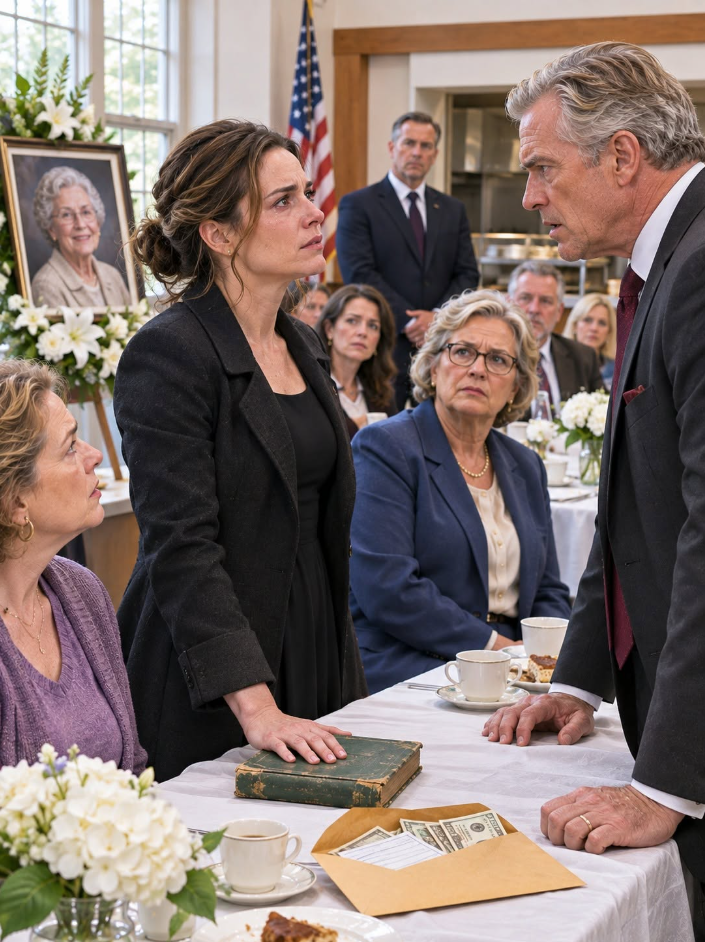
He just looked at my boots and said, “I’m begging you, Wade. I need you to save the $4 million mansion up on Schweitzer Ridge. Bring your crew Monday and finish it at cost under our name.”
“Howard is nervous. If he sees my son on that deck, he keeps us on the job. We get the next draw, and I’ll make it right with you on the next house.”
Every builder, lumber driver, and inspector in Bonner County knew about that house.
7,800 square feet under roof, perched high on the timbered ridge above town with panoramic views of the lake. A two-story stone stair tower, exposed Douglas fir beams in the great room, and a deep wraparound porch on three sides.
It was the biggest, most expensive custom home Mercer Framing had ever been hired to build.
And now my father wanted me to bail them out at cost under his company’s name, 12 months after he told me I would still have a job working under my brother-in-law.
I stood there in the cold for a long moment, watching my breath hang in the air between us.
And then I said, “Ride up with me, Dad.”
His shoulders dropped an inch with relief. He thought I was folding, just like I had done my entire life.
He had no idea that the rolled-up blueprints for that exact mansion were already sitting on the dashboard of my truck, or that my seven-man crew had left for the ridge at five in the morning, or that they had already been tearing out his crew’s mistakes since Thursday.
To understand how a father and son end up standing on frozen gravel like strangers, you have to know a little bit about my family, my sister’s husband, and an old porch on Fourth Street that collapsed underneath my grandmother when I was nine years old.
My father is Merl Mercer.
He started Mercer Framing back in 1993 with one beat-up pickup, two air compressors, and a rough-around-the-edges helper named Doorin, who liked his whiskey a little too much at lunch.
Doorin didn’t last past the first winter, but the company did.
For more than 30 years, Dad framed houses all across the northern panhandle of Idaho: Sandpoint, Ponderay, Dover, Cocolalla, and down along the river toward Priest River.
I want to be fair to him right from the start, because fairness matters when you’re telling the truth about family.
My father was a genuinely gifted framer. He could spread a set of architectural blueprints across the hood of his truck and spot an engineer’s math error before he ever turned to the second page.
He also had one habit I can still hear clear as a bell.
On Sunday afternoons after church and lunch, he would load the family into whatever pickup he was driving that year and cruise slowly through the neighborhoods around town.
Every single time we passed a house he had framed, he would tap the center of the steering wheel twice.
Two short, sharp honks.
“That’s a Mercer,” he would say proudly, nodding toward the roofline.
Some Sundays, driving through a new subdivision, it sounded like a wedding parade.
My mother is Wanda.
She ran the front office at Sandpoint Elementary for 26 years and could recognize nearly every kid in town just from the back of their coat walking down the hallway.
Mom was the quiet glue in our house, and she had a peculiar way of keeping the peace whenever tension started rising in the kitchen.
If she sensed an argument brewing between Dad and me, she wouldn’t raise her voice or take sides.
She would simply walk over to the cupboard, pull down an extra ceramic dinner plate, and set it at an empty spot at the table for nobody at all.
It almost always worked.
Nobody wants to start a shouting match across a table with a ghost sitting at it.
My younger sister, Tessa, came along two years after me.
She had her son Grant when she was 19 and raised him mostly on her own while working the front desk at a dental clinic in town.
I always loved Tessa, and I still do.
She never had a mean bone in her body, though she learned very early in life that the safest, easiest place to stand in our family was right next to whatever Dad wanted.
Then, in the spring of 2023, Tessa married Trenton Caldwell, though everybody called him Trent.
Trent sold windows, doors, and trim packages for a regional building supply company down in Coeur d’Alene.
He held a four-year degree in construction management from the state university, and he brought it up in conversation the exact same way combat veterans bring up their service.
He owned a crisp white hard hat with his name printed on a glossy label across the front.
In all the years I knew him, that hard hat never got a single scratch, smudge, or sawdust mark on it.
He kept it resting prominently on the dashboard of his clean sedan so folks in the grocery store parking lot would know he was in the building trade.
Worst of all, Trent referred to experienced carpenters as “labor.”
Not the crew. Not the framers. Not the men.
Just labor.
“I’ll get labor out there on Tuesday,” he would say, checking his smartwatch.
“Labor is running behind schedule this week.”
The very first time he used that word at my parents’ Sunday dinner table, Boyd Whitaker, who had served as Dad’s loyal foreman for 12 years, happened to be eating pot roast with us.
Boyd slowly set his fork down beside his plate and stared at his potatoes for a full minute without saying a word.
Dad, however, thought Trent was the sharpest young mind he had ever encountered.
Trent knew how to flatter bankers, smooth-talk wealthy out-of-state buyers, and run a digital takeoff program on his tablet that calculated lumber lists in 20 minutes flat.
Dad watched that tablet screen like a seven-year-old boy watching a magician pull quarters out of thin air.
Never mind that I had been doing material takeoffs by hand with a carpenter’s pencil and a scale ruler for 10 years straight with zero mistakes.
Nobody ever looked at my yellow legal pads like they were magic.
That was fine by me.
A pencil doesn’t do parlor tricks. It just builds straight walls.
The man who actually taught me how to build was my grandfather, Orson Mercer.
Grandpa was an old-school finish and rough carpenter in Sandpoint long before production framing crews existed in northern Idaho.
He built front porches mostly.
Half the wide wraparound wooden porches still standing on the older Victorian and Craftsman homes on the north side of town were built by Grandpa Orson’s hands.
He and my grandmother, Opal, lived on Fourth Street in a tidy white clapboard house with a deep shaded front porch and a heavy oak porch swing he had hung for her the summer they were married.
In July of the year 2000, I was nine years old and staying with them for a week while my parents went out of town.
One warm evening just before dusk, Grandma Opal walked out onto the porch carrying two tall glasses of sweet iced tea.
She sat down on that oak swing, gave a gentle push with her heel, and the entire ceiling above her gave way.
The heavy timber joist the swing chains were anchored into had been slowly splitting from hidden moisture rot for years where nobody could see it.
It let go all at once with a sound like a rifle shot.
Grandma crashed hard onto the pine floorboards, shattering her left wrist in two places.
I can still see Grandpa Orson dropping to his knees beside her in the spilled iced tea, his face pale as chalk, holding her arm steady until the ambulance arrived.
That autumn, after Grandma’s cast finally came off, Grandpa tore out the entire tongue-and-groove ceiling of that porch.
He cut and fitted fresh structural blocking, thick 2x8s, doubled up, glued, nailed, and bolted directly through the main floor joists with heavy steel carriage bolts right where the chains would hang.
I stood on the porch below, holding his heavy metal flashlight steady while he worked.
He was 71 years old, standing near the top of a wooden stepladder in his overalls, barely saying a word for three hours.
When he finished tightening the last nut, he hung the oak swing back up, climbed down, and sat on it himself first, bouncing his full weight to test every joint.
Then he stood up, pointed a thick, calloused finger straight at my chest, and gave me a rule that has echoed inside my head on every single job site I have ever stepped onto since.
“Anything that holds a person, Wade,” he said quietly, “you build for two grandmas.”
He meant you build it twice as strong as any code book says it needs to be.
And he meant you never trust what you can’t see behind the finished boards.
I started riding along on Dad’s framing crew during the summers when I was 15.
For three summers straight, I swept concrete slabs, hauled bundles of studs on my shoulder, and cut blocking on a chop saw until my right forearm was noticeably thicker than my left.
The week after I graduated high school at 18, I went full-time.
By 21, I was running a framing crew of my own under Dad’s banner, mostly handling the tricky custom homes around the lake because the local builders specifically requested my crew when the rooflines got complicated.
On the very first front porch I ever framed completely by myself, a cozy Craftsman cottage out near Dover, I put in hidden swing blocking.
Nobody asked for it. It wasn’t drawn on the architect’s plans, and nobody paid me a dime extra for it.
I simply cut two pieces of doubled 2×8 lumber, spaced them five feet apart right over the center of the porch deck, and bolted them solidly between the ceiling joists.
It cost me roughly $15 in scrap lumber and 20 minutes of labor after quitting time.
Then I did the exact same thing on the next porch and the one after that.
Before long, it turned into an automatic habit, and eventually it became a quiet personal signature.
Whenever the finished carpenters came through a few weeks later and nailed up the painted beadboard ceiling, I would drive back out to the house some evening, climb up into the attic crawl space or check my notebook measurements, and gently tap two tiny brass upholstery tacks into the ceiling boards directly beneath the center of my hidden wood blocking.
Those little brass tacks came in boxes of 25 for 91 cents at the hardware store downtown.
Unless you were standing directly underneath, squinting upward, you would never notice them against the paint.
Then, on the afternoon the new family moved in, I would stop by and hand the homeowner a small brown paper lunch sack containing two heavy-duty galvanized steel eyebolts, half an inch thick and six inches long, complete with washers and locking nuts.
“There’s a swing waiting up there,” I would tell them with a smile. “You just can’t see it yet. Look for the two brass tacks.”
Most people laughed and thanked me politely, figuring I was just making small talk.
Every so often, though, sometimes a year later, sometimes five years down the road, my phone would buzz with a text message from an unfamiliar number.
“Hey, Wade, it’s the Delgatos over on Boyer Avenue,” the message would read. “We finally hung the swing.”
Attached would be a photograph of a silver-haired grandmother smiling on a cedar swing or a golden retriever curled up asleep on the cushions where he wasn’t supposed to be.
By the autumn of 2026, I had installed hidden swing blocking in roughly 450 porches across northern Idaho.
I knew for a fact that 61 swings had been hung from them.
I kept every single one of those photos saved in a dedicated folder on my phone.
Sixty-one isn’t a staggering number in the grand scheme of things, I suppose, but every single one of those photos represents a real family sitting outside their own front door in the evening, and not one of them is ever going to crash onto the floorboards.
Dad knew about my swing-blocking habit.
Of course, he thought it was a foolish waste of $15 and company time.
“The builder didn’t spec it, Wade,” he would grumble whenever he spotted me bolting the extra lumber into a porch ceiling.
“The builder didn’t spec your chewing gum either, Dad,” I would tell him.
For a long time, gentle banter like that was as close as the two of us ever came to an argument.
The very first thing my father ever took from me was a framing nailer I never got the chance to own.
I was 17 years old, and I had spent the entire summer sweating to save up for it.
It was a used Milwaukee coil framing nailer belonging to an older framer up in Priest River who was retiring because of bad knees.
He offered it to me for $850, complete with two extra aluminum magazines and 50 feet of braided air hose.
I had spent three months cutting, blocking, and hauling plywood at $8.50 an hour to scrape that money together.
Every Friday afternoon, Dad paid me with a company check, and Mom would drive down to the bank in Sandpoint and deposit it into the youth savings account Dad had opened in my name when I was 12.
Because I had been a minor when he opened it, his name was still listed as joint owner on the account.
The week before I was scheduled to drive up to Priest River to buy that nailer, I asked Mom for the bank passbook at the kitchen table.
When I flipped it open and looked at the bottom line, the remaining balance printed in black ink was $14.
Tessa had cracked one of her front teeth on a backyard trampoline earlier that spring, and after their dental insurance paid its share, the specialist in Coeur d’Alene wanted $836 for the porcelain crown.
Dad didn’t even try to pretend it was a misunderstanding or a temporary loan.
When I asked him about it in the hallway, he looked me straight in the face and said, “A nailer is a want, Wade. A front tooth is a bearing wall.”
He gave my shoulder a firm pat and walked out to his truck.
Nobody ever mentioned paying that money back. Not once in the next 18 years.
I went back to work Monday morning, running the company’s worn-out old nail gun for another full year.
The heavy one with the leaky seal that double-fired unexpectedly whenever the morning temperature dipped below freezing.
Tessa got her tooth fixed, and I never held a drop of resentment toward her.
It wasn’t her signature on the bank withdrawal slip.
I was 17. I lived under his roof, and I swallowed it whole.
Seven years went by before the next time.
The spring I turned 24, a residential developer down in Coeur d’Alene hired Mercer Framing to frame a 14-house subdivision on the south edge of town.
It was repetitive production work. The same three floor plans flipped and mirrored down both sides of a cul-de-sac.
But the developer was racing the calendar because his construction loan carried a strict completion deadline.
He told Dad in plain English that if our crew got all 14 houses framed and dried in before the end of June, he would pay a $12,000 early-completion bonus.
Dad handed the project to me.
Better yet, he stood in the gravel yard in front of all five men on my crew and made a public promise.
“You boys finish ahead of that deadline,” Dad declared, “and that 12 grand is yours. Split it up however Wade says.”
My crew worked like machines that month.
We gave up two Saturdays and a Sunday, working under floodlights until dark to beat an early summer rainstorm, and we nailed off the final roof sheathing on June 11th, nearly three weeks ahead of schedule.
True to his word, the developer wrote out a check for $12,000 made payable to Mercer Framing.
I saw the check with my own eyes when it came into the office.
Three weeks passed, and Friday paychecks came and went without a single extra dollar showing up for my crew.
Then one Monday morning, I pulled into the company yard and saw a used yellow telehandler parked beside the lumber racks.
A heavy-duty telescoping forklift with big lug tires for hoisting roof trusses and bundles of plywood up to second-story decks.
Dad had used our $12,000 bonus as the down payment.
I walked into his office and shut the wooden door behind me before asking about the crew’s money.
Dad leaned back in his leather chair and spread his hands.
“It’s an investment in the company, Wade,” he said smoothly. “That lift is going to save your back every single week. Besides, this whole outfit is going to be yours someday. What’s the difference whether the money sits in your pocket or in company iron?”
“The difference,” I said, keeping my voice low so the guys outside wouldn’t hear, “is that I looked five grown men in the eye and promised them they would get paid for giving up their weekends.”
“So tell them they’re working for a modern outfit with a forklift now,” Dad replied without blinking.
I stood there looking at him for a long moment.
Then I asked him to put it in writing.
Not the $12,000 bonus. I knew that money was already gone into the machinery dealer’s bank account.
I asked him to write down the someday.
“If Mercer Framing is going to be mine someday, Dad, let’s put it on paper right now,” I told him. “Sign a simple succession agreement, and I’ll never bring up another bonus as long as I live.”
Dad laughed.
He actually leaned back and laughed out loud like I had just told a great joke.
“Papers are for strangers, son,” he said, waving his hand dismissively.
I didn’t argue with him.
I walked out of his office, drove straight down to my bank, and withdrew $1,500 from my own personal savings.
That Friday afternoon, I handed each of the five men on my crew $300 in crisp cash out behind the lumber pile so they wouldn’t walk away empty-handed from the sweat they had put in.
That very same week, I took two quiet steps that I have never once regretted.
First, I closed out the old joint savings account Dad had opened when I was 12 and moved every dime of my money into a private account at an independent credit union across town.
Second, I stopped at an engineering supply store and bought what I call my job book: a thick yellow waterproof field notebook with grid pages, just like land surveyors carry in the rain.
From that day forward, I wrote down every house we framed, every date, every overtime hour, and every single promise anybody made to me.
I also bought a sturdy manila envelope to keep tucked behind the seat of my pickup.
And inside it, I filed the original store receipt for every single tool, saw, compressor, and framing nailer I purchased with my own money from that day on.
In 2019, I finally built a house of my own on a quiet wooded lot up past the high school on the north side of Sandpoint.
It was 1,500 square feet, three bedrooms, cedar siding, and a deep covered porch running clean across the front.
The very day we got the roof sheathing nailed down, before we even hung the front door, I installed doubled 2×8 swing blocking above that porch and hung a heavy cedar swing from thick galvanized chains.
That same summer, driving home down Pataha Road east of town after a long day setting trusses, I spotted an elderly woman standing out in her front yard, staring up at her porch ceiling.
One end of her wooden porch swing was hanging limply by a single rusty chain.
The other end was resting crookedly on the painted floorboards, a snapped steel hook dangling uselessly from the end link.
I pulled my pickup onto the gravel shoulder and walked up her front walk.
You would have stopped, too.
Her name was Estelle Kowalski, and she was 78 years old.
Her late husband, Fred, had farmed hay and raised cattle out along the river for 50 years before passing away two winters earlier.
With tears brimming behind her glasses, she told me that swing had been Fred’s wedding gift to her back in 1960.
“It never gave out once,” she said softly, touching the chipped armrest. “Not in 59 years.”
“The wood up behind that ceiling is just tired, ma’am,” I told her gently. “It’s not the swing’s fault.”
I drove straight home, loaded my cordless saws, two lengths of heavy fir lumber, and a box of lag bolts into the bed of my truck, and came back that very same evening.
I carefully pried back the porch ceiling boards, installed proper doubled 2×8 blocking bolted tight between the joists, closed the ceiling back up neatly, and hung her swing on brand-new stainless steel eyebolts.
Took me a little over two hours in the fading summer light.
When I finished, I sat down on the swing first and bounced my full weight on it, just like Grandpa Orson taught me.
Then I stood up and let Estelle take her seat.
She immediately reached into her cardigan pocket for a folded $20 bill and tried to press it into my palm.
I closed her fingers back over it and refused to take a cent.
So the next afternoon, she walked out to my truck carrying a warm glass baking dish covered in foil, filled with homemade cinnamon apple pie baked from the trees in her own orchard.
The following Friday, she brought another one, and that became our rhythm from that summer onward.
Estelle Kowalski’s apple pie is the finest thing in Bonner County, and I will gladly argue with anybody who claims otherwise.
The year after that, in 2020, I married Holly.
She works as an emergency room nurse at the community hospital in Sandpoint.
I actually met her on a Tuesday afternoon after a framing square slipped off a scaffold in Ponderay and sliced open the web of my left thumb.
She stitched me up without flinching, handed me a tetanus shot, and told me I had surprisingly steady hands for a rough carpenter.
I wasn’t entirely sure if that counted as a compliment, but I asked her out for coffee the moment the bandages came off, and I married her eight months later.
Our son, Owen, was born in the spring of 2022, bringing a whole new kind of noise and purpose into our little house north of town.
The third time my father took something vital from me happened the year before Owen arrived.
Anybody in the building trade remembers the summer of 2021, when framing lumber prices shot through the roof overnight and every bank construction draw seemed to arrive three weeks late.
In July of that year, a custom home builder down in Hayden owed Mercer Framing nearly $45,000 and kept stalling every Friday with excuses about bank paperwork.
On a warm Thursday evening just before dark, Dad pulled into my driveway.
He didn’t knock on the front door.
He walked up onto my porch and sat down on my cedar swing, which was the first and only time he ever sat on it, staring out across the pine trees with his elbows resting on his knees.
“I can’t make payroll tomorrow morning, Wade,” he said quietly.
There were 14 men on the company payroll that summer.
Fourteen local families counting on their Friday checks to buy groceries and pay mortgages.
Holly and I had $28,000 sitting in our credit union savings account.
We had scraped every dollar of it together over three years so we could buy a reliable used family sport utility vehicle before we started trying for a baby.
I excused myself, walked inside the kitchen, and explained the situation to Holly.
She listened carefully, wiped her hands on a dish towel, and looked me straight in the eyes.
“If you lend it to him, Wade, get it in writing,” she said calmly. “Not because he’s a bad man, but because family memories get short when money gets tight.”
So I did.
I sat down at our kitchen table that night and typed up a clean, single-page promissory note on our home computer.
$28,000 loan to Mercer Framing by Wade Mercer, to be repaid in full within 12 months.
I carried it out to the porch with a clipboard and a ballpoint pen.
Dad didn’t laugh this time.
He stared at that piece of paper for a long, heavy minute before signing his name at the bottom.
Mom, who had ridden out with him in the truck, signed right underneath him as a witness.
Dad paid back $4,000 that autumn. $2,000 in October, and $2,000 right before Thanksgiving.
Then the payments simply stopped.
I brought it up gently once the following spring when we were loading trusses at the yard.
“It’s a tight year, son,” he said, avoiding my eyes while checking his clipboard. “Margins are razor-thin right now.”
I opened my yellow waterproof job book that afternoon and wrote down the balance on a fresh line.
$24,000 still owed.
I didn’t press him, and the honest truth is that I still believed him about someday.
I genuinely figured that within a few years he would hand me the keys to the main shop, the yellow telehandler, and the Mercer Framing name on the trucks, and that $24,000 would simply dissolve into the family business.
After all, I ran his best framing crew, did all his material takeoffs by hand, and trained every green kid he hired.
I figured 19 years of loyalty had to count for something.
Then Tessa married Trent Caldwell in the spring of 2023.
And about a year after their wedding, the way Dad talked at Sunday supper started changing.
“Trent has got some sharp ideas,” Dad would say over dinner, gesturing with his fork. “Trent says we’re leaving serious money on the table by sticking to the old ways.”
Trent would sit there nodding smugly, adjusting his wristwatch.
At first, I didn’t pay much mind to it.
Trent had business ideas the way a hound dog has fleas, and most of them didn’t seem to last past a single season.
Then came Sunday, the 19th of October, 2025.
It was a crisp autumn evening at Mom and Dad’s house on Fourth Street.
The exact same house Grandpa Orson had built decades earlier, with the same deep front porch and the red maples along the curb just turning gold in the 52° air.
Mom had slow-cooked a big beef pot roast with carrots and little red potatoes.
Holly was sitting beside me with Owen, who was three years old and stubbornly refused to touch anything orange on his plate.
Tessa and Trent were across from us alongside Tessa’s teenage son, Grant, who was 13 and mostly kept his head down staring at his phone.
Mom set seven ceramic plates around the dining table.
Then, halfway through passing the bread basket, she stood up quietly, walked over to the cupboard, and set an eighth empty plate at the far end of the table.
My stomach tightened right then.
I should have known what was coming.
Dad tapped the side of his water glass twice with his butter knife.
He stood up at the head of the table, which he almost never did on a Sunday.
He cleared his throat and announced that he had been doing a lot of thinking lately about the future of Mercer Framing.
He reminded us that he was 62 years old.
His lower back wasn’t what it used to be after 30 years on concrete slabs, and it was time to start handing the reins over to the next generation.
I slowly set my fork down beside my plate.
I will be completely honest with you.
For two heartbeats, I genuinely thought he was about to say my name.
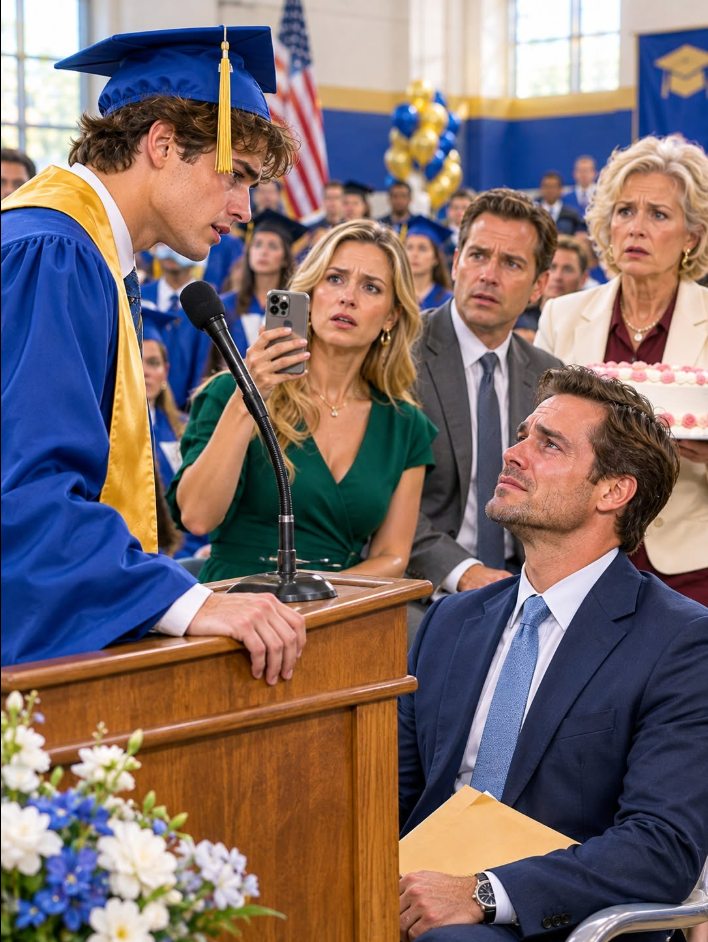
“So, starting on the first of November,” Dad announced, raising his water glass like he was toasting a championship, “Trent is coming on as my full partner, 50/50. He’s going to run all the bids, handle the banks, and deal with the custom builders. He’s got the college degree for it, and he’s got the business head for it. Mercer Framing is finally going to grow.”
Trent stood up immediately, beaming from ear to ear, and reached across the roast to shake Dad’s hand firmly.
Tessa clapped softly with a nervous smile.
Mom kept her eyes fixed entirely on that eighth empty plate.
Then Dad turned toward my side of the table.
He was smiling broadly like he had saved the very best news for last.
“You’ll still have a job, Wade,” he said warmly. “Same crew, same pay. Trent’s just going to handle the business end from now on.”
Trent looked at me and gave a brisk, patronizing nod.
“We’re definitely going to need good labor,” he said smoothly. “And everybody knows you’re the best labor we’ve got.”
Nobody at that table breathed a word for 10 full seconds.
Beside me, little Owen was quietly trying to bury a boiled carrot underneath his paper napkin.
Inside my head, everything went crystal clear.
I thought about the $850 taken out of my passbook when I was 17.
I thought about the $12,000 subdivision bonus that magically turned into a yellow forklift.
I thought about the page in my yellow job book showing $24,000 still unpaid.
And I thought about 19 years of houses Dad had proudly honked his horn at every Sunday afternoon.
I folded my paper napkin neatly and laid it beside my untouched plate.
I looked straight at my father and said, “I don’t need a job, Dad. I’ve got a trade.”
Then I stood up.
Holly stood up right beside me without saying a word and lifted Owen into her arms.
Carrot and all.
I leaned down, kissed my mother gently on the cheek, told Tessa I wished her well if she was truly happy, and walked out across Grandpa Orson’s front porch toward my pickup.
Dad followed me out as far as the top porch step, his smile finally gone.
“Where do you think you’re going to go?” he called out after me, his voice sharp with irritation.
I didn’t turn around to answer him.
Truth be told, I didn’t know yet.
Monday morning at six o’clock sharp, I drove down to the Mercer Framing shop on the edge of town just like I had done every weekday morning for 19 years.
Only this time, I didn’t walk into the office for coffee or blueprints.
I backed my pickup straight up to the tandem equipment trailer, unlocked the side doors, and began loading my own tools into the bed of my truck.
Two framing nailers, my coil siding gun, my heavy worm-drive circular saw, my portable air compressor, my four-foot and six-foot levels, and my aluminum framing squares.
Every single piece of gear I lifted into my truck had an original purchase receipt tucked safely inside the manila envelope resting on my passenger seat.
Boyd Whitaker pulled his old Chevy into the gravel yard while I was strapping down the compressor.
Boyd was 52 years old, lean as fence wire, and had served as Dad’s rock-solid foreman for 12 years after moving up to Idaho from Montana in his twenties.
He climbed out holding his battered steel thermos, walked over, and watched me coil my air hoses in silence for a full minute.
“Tessa’s husband?” Boyd asked quietly.
“Fifty-percent partner,” I replied, cinching down a ratchet strap. “Starting the first of next month.”
Boyd nodded slowly, taking a sip of black coffee.
“He called me labor at the company barbecue back in August,” Boyd said, his jaw tightening. “Said it right to my face while my wife was standing two feet away holding a paper plate.”
He took another slow sip and looked toward the closed office door.
“You planning on starting something on your own?”
“I don’t know yet, Boyd,” I admitted. “Honestly, all I’ve got right now is an old pickup and a pile of nail guns.”
“Well, I’ve got a pickup and some nail guns, too,” Boyd said matter-of-factly. “And young Clay has got a pickup and zero common sense. That makes three trucks right there.”
I looked him in the eye and told him straight that I couldn’t match Dad’s hourly pay scale for at least the first few months until cash flow built up.
Boyd waved a calloused hand dismissively.
“At least you’re telling me upfront what’s in the pot,” he said. “That’s already more honesty than I’ve gotten out of your old man in five years.”
By Friday afternoon of that very same week, both Boyd and Clay had handed Dad their two weeks’ notice.
Our biggest immediate headache wasn’t finding tools.
It was finding a dry place to operate out of.
A serious northern Idaho framing crew needs a covered building to keep kiln-dried lumber out of the rain and enough open floor space to assemble wall panels indoors once the November snow starts flying.
That Wednesday afternoon, I was sitting on Estelle Kowalski’s front porch swing, eating a warm slice of apple pie, doing my best to keep my troubles to myself, when she looked over her reading glasses and asked me point-blank what was weighing on my mind.
So I told her the whole story from start to finish.
She listened quietly without interrupting once, her hands folded in her lap.
When I finished, she pointed her chin out past her backyard garden toward Fred’s old agricultural machine shed.
A massive 40-by-60-foot steel building with a smooth poured concrete slab, high ceilings, and two wide sliding barn doors.
It had been sitting completely empty since she sold off Fred’s tractor and hay baler two years back.
“Fred would hate seeing that good concrete floor gathering dust,” Estelle said firmly. “$100 a month. And in exchange, you drive me down to Spokane once a month for my eye doctor appointments, because I’m not supposed to get behind the wheel after they put those dilating drops in.”
“Miss Estelle,” I protested, “$100 isn’t rent for a shop that size. That’s pure charity.”
“Then let it be charity,” she shot back with a spark in her eyes. “I’ve been going to church for 70 years, Wade. I know how charity works.”
And just like that, Pend Oreille Framing was born.
Named after the wide, cold river that winds past Sandpoint.
Three men, three pickups, a rented steel machine shed out on Pataha Road, and a 78-year-old landlady who walked down to the shop every Friday afternoon at 3:00 sharp, carrying a fresh pan of warm apple pie.
Boyd swore up and down it was the first construction outfit he had ever worked for that came with a guaranteed weekly dessert schedule.
Buying a used tandem equipment trailer cleaned out most of our spare cash, leaving Holly and me with just $6,800 in our checking account to survive on.
Holly immediately picked up two extra night shifts a week at the hospital emergency room, and we didn’t spend a dime eating at a restaurant for 12 straight months.
Little Owen didn’t seem to notice a thing, though he still stubbornly refused to eat anything colored orange.
Dad’s first text message arrived on Tuesday morning, two days after Sunday supper.
“The Milwaukee nailers are company property,” it read. “Bring them back to the shop today.”
I didn’t bother typing a reply.
I simply laid my store receipts out across the hood of my pickup, snapped a clear photograph, and texted it straight to his phone.
He never answered that message.
Trent sent his own text two weeks later in November.
“Hey, bro, no hard feelings,” he wrote. “Doors are always open here. We’re definitely going to need extra labor come spring.”
I stared at my phone screen for two seconds, typed back, “Good luck, Trent,” and went back to snapping chalk lines.
Mom called me a week before Christmas.
Her voice sounded tired and small over the line.
“Your father misses you, Wade,” she said softly. “Please bring Holly and Owen over on Christmas Eve. He won’t say anything about the business. I promise.”
I stood by my kitchen window, looking out at the snow falling on my front porch.
“Is he sorry, Mom?” I asked gently.
The line went completely silent for several seconds.
Finally, she sighed and said, “He’s your father, Wade.”
“Not this Christmas, Mom,” I told her quietly.
The next morning, I had a local florist deliver a big red poinsettia to her front porch because she was my mother, and none of that mess had ever been her idea.
General contractors in a small town talk constantly at the lumberyard counter, mostly about which subcontractors actually show up sober on Monday morning and build things square.
A veteran custom home builder over in Dover had been requesting my crew specifically for six straight years.
The very week he heard through the grapevine that I had hung out my own shingle, he called my cell phone and handed Pend Oreille Framing a two-story timber home overlooking the river.
That job led directly to a major lakefront addition in Cocolalla, which led to a custom workshop buildout in Priest River.
We framed straight through the bitter Idaho winter, prebuilding heavy exterior wall sections inside Estelle’s dry steel shed whenever blizzards blew across the lake, then hauling them out on our tandem trailer to stand them up the moment the skies cleared.
By March of 2026, I had hired two more experienced framers, bringing our crew to five men.
By June, we were running seven strong.
I paid every single man on my payroll every Friday afternoon at 4:00, and not one single check ever bounced or came back short.
Looking back, I am prouder of that Friday payroll record than of any roofline we ever raised.
Every single front porch my new company framed received hidden swing blocking.
No exceptions.
At first, Boyd used to chuckle and call me sentimental for wasting 20 minutes at the end of a long day.
Before long, however, I would walk around the corner of a house and find Boyd already up on a stepladder, cutting and bolting the doubled 2x8s into place before I could even reach for my tape measure.
“Two grandmas,” he would grunt, tapping the solid timber with his hammer.
He loved telling Grandpa Orson’s story to every new carpenter we hired.
And each time he told it, the details grew slightly more dramatic.
By the middle of summer, in Boyd’s telling of the legend, my poor grandmother had broken both arms, a collarbone, and a hip when that old swing came down.
Meanwhile, whispers started drifting through the lumberyards about trouble brewing over at Mercer Framing.
Jobs falling behind schedule, experienced hands walking off, and a new partner who spent more time staring at his tablet screen than walking the decks.
All of which brings me directly to Howard Lindholm.
Howard Lindholm is a veteran custom home builder out of Sandpoint who owns Lindholm Custom Homes.
He is 61 years old, lean and silver-haired, with reading glasses hanging on a cord around his neck that he rarely puts on.
Howard builds massive mountain and lakefront residences for retired executives and surgeons moving to northern Idaho for the quiet.
He had hired Mercer Framing for 20 years straight, and for the last 10, he specifically requested my crew whenever the blueprints got complicated.
In March of 2026, Howard called me about a flagship project breaking ground high up on Schweitzer Ridge overlooking Lake Pend Oreille.
7,800 square feet under roof, two stories, a stone stair tower, a great room with exposed Douglas fir trusses, and a deep wraparound porch on three sides.
The owners were a retired orthopedic surgeon from Seattle named Dr. Miriam Gallagher and her husband.
Howard needed framing bids by mid-April.
I spent four late nights at my kitchen table with a carpenter’s pencil, a scale ruler, and the rolled plans.
Because the house sat exposed on a high ridge where winter storms roared off the lake at 70 mph, the engineering was demanding.
Steel moment frames, 30-foot glulam beams, shear walls on every corner with heavy hold-down anchors, and a strict nailing schedule.
My honest, rock-solid number came out to $295,000.
Since I had already promised two loyal builders my June and July schedule, the earliest I could start was the first week of August.
I handed Howard the bid folder in person on April 14th.
He flipped through my breakdown sheets, nodded, and said, “That’s right about what I figured, Wade. Your father is bidding it, too, with his new partner.”
“I figured he would,” I said.
Two days later, Trent texted me.
“Howard says you bid the Ridge house. Stay in your lane, bro. That’s a Mercer house.”
I typed back, “I’m working,” and went back to snapping chalk lines.
Howard called the last week of April sounding genuinely apologetic.
Mercer Framing had come in at $218,000 and promised to start on July 1st.
Dad had shaken Howard’s hand and reminded him that 20 years together ought to count for something.
“It does count, Howard,” I told him sincerely. “I hope it goes smooth for you.”
After hanging up, though, I sat on my tailgate staring at the mountains.
$218,000 was $77,000 below my bid on a house with that many hips and valleys.
Either Trent’s tablet had missed half the structural hardware, or somebody was planning to cut corners on that ridge.
I didn’t like either option.
That same week, my sister Tessa drove out to Estelle’s machine shed on a quiet Sunday afternoon with her 14-year-old son, Grant.
Grant wandered off to watch Clay run the miter saw while Tessa sat heavily on a stack of 2x4s and stared at her hands.
“Mom told me not to tell you this,” Tessa said quietly. “I’m telling you anyway.”
What she shared over the next 20 minutes completely changed how I saw that October pot roast dinner.
Everybody in town knew about the spec house down in Ponderay.
The summer after their wedding, Trent had talked Dad into buying a lot and building a luxury spec house based on a projection on Trent’s tablet.
The Caldwell model, supposed to clear $120,000 in profit.
My crew had framed the shell before I left.
What I didn’t know was how they financed it.
Trent’s parents, who owned storage units in Coeur d’Alene, had lent Dad $115,000 in cash.
The house took 11 months to finish because Trent kept changing tile, cabinets, and trim midstream.
Then it sat unsold for 14 months as interest rates spiked, finally selling at the end of summer 2025 for $92,000 less than it cost to build.
Dad couldn’t pay Trent’s parents back.
“So they worked out a deal,” Tessa said, her voice tight with shame. “Fifty percent of Mercer Framing signed over to Trent in place of the money.”
That was the big partnership.
That was the water-glass toast at Sunday supper.
“Dad also took out a second mortgage against the main shop lot to cover the rest. He didn’t make Trent partner because Trent is smart, Wade. He made him partner because he owed his parents $115,000 and couldn’t pay it.”
I sat on an overturned five-gallon bucket without speaking for a long time.
“Why tell me now, Tessa?” I asked.
She looked across the floor toward Grant, who was holding a scrap board while Clay showed him how to read a framing square, grinning like it was Christmas morning.
“Because he’s going to need a real man to learn from,” she whispered, wiping her eyes. “And it sure isn’t going to be Trent.”
“Tell him he can come out Saturdays once school lets out,” I said. “He can sweep floors and cut blocking for $12 an hour.”
Tessa cried quietly for a minute, and I let her.
After she drove home, I wrote the whole truth down in my yellow waterproof job book.
The company I had been promised my whole life had been handed over to pay for a bad real estate gamble.
Strangely, I realized it would have hurt less if Dad had simply liked Trent better.
Mercer Framing broke ground on Schweitzer Ridge on July 6th.
I didn’t drive up there to look.
In northern Idaho construction, lumber drivers, inspectors, and electricians talk constantly.
By late July, I heard Dad’s crew was down to six men. Three of them green kids hired off online ads.
In mid-August, Dad texted me for the first time since January.
“Need two of your guys for a week on the ridge. We’ll pay cash.”
“They’re booked solid,” I wrote back.
And they were.
We had three houses running simultaneously.
In early September, a master electrician told me at the hardware store that the county building inspector had failed the shear walls on the Schweitzer Ridge mansion twice in one week.
The plans required nails every three inches along the plywood edges for wind loads.
The inspector found them spaced at six inches.
When somebody went back to add nails in between, they turned the air compressor up too high to rush the job, driving half the nail heads straight through the outer veneer of the plywood.
An overdriven nail in a shear wall is as useless as no nail at all.
It looks fine from the driveway, but in a 70 mph storm off the lake, that sheathing will peel right off the studs.
It got worse.
A week later, the plumber discovered that one of Dad’s new hires had taken a saw and cut clean through the bottom structural flange of two engineered floor joists upstairs just to squeeze a drain pipe past.
You can drill small holes through the center web where the chart allows.
Never the bottom flange that holds the second floor up.
Then, around October 1st, word spread through every supply counter in town that Mercer Framing’s payroll checks had bounced two weeks in a row.
On Friday, October 2nd, at noon sharp, Dad’s entire crew packed their bags, drove down off the ridge, and never came back.
I took zero pleasure in hearing it.
I had trained half those men, and it was still my family’s name on those trucks.
On Thursday, October 8th, Howard Lindholm officially fired Mercer Framing.
He called me the following Monday afternoon, the 12th.
“Is your number still good, Wade?” he asked bluntly.
“Which number?”
“$295,000. I know it’s going to cost me plenty more now with everything we have to tear out, but I need to know if you’ll take it.”
I drove up Schweitzer Ridge with Boyd on Tuesday afternoon and walked the house with Howard.
The first-floor walls were up, and half the second-floor deck was laid, with no roof yet.
From the driveway, it looked grand.
Walking up to the north wall, Boyd laid his palm flat on the sheathing and ran his thumb down a vertical line of nail heads.
Every single one was sunk deep into the wood.
Boyd stayed quiet and just looked at me.
Inside, we found the two ruined floor joists.
Over the 18-foot kitchen window, we found three nailed 2x12s where the engineer required a steel flitch beam.
When I put my six-foot level against the great room walls, they leaned out of plumb by three-quarters of an inch over 10 feet, with zero temporary bracing, having stood crooked through two weeks of mountain wind.
I walked Howard through everything that had to be ripped down to the foundation bolts and rebuilt, plus the added cost.
Howard jotted notes on the back of the plans without putting on his reading glasses, circled a final number, and held out his hand.
On Wednesday afternoon, October 14th, I sat at Howard’s kitchen table and signed a formal contract under Pend Oreille Framing.
My name on the line.
My seven-man crew started up on the ridge Thursday morning at 7:00, hooking crowbars into that ruined north wall first thing.
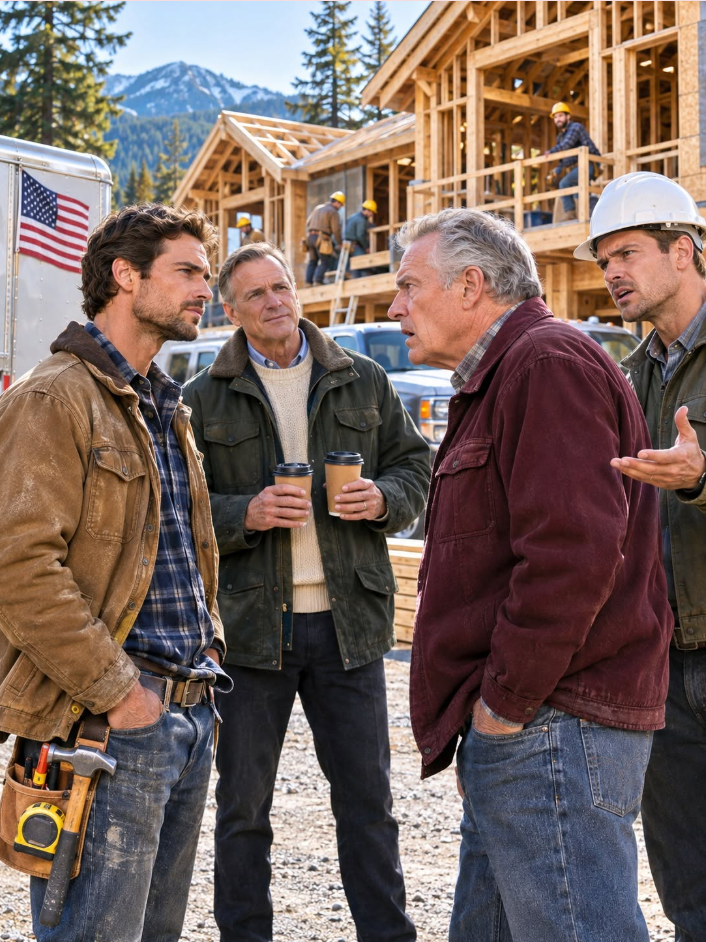
Which brings us back to Saturday morning, October 17th, at 10 minutes to six, when Dad pulled onto the frozen gravel outside Estelle’s shed with frost on his windshield and Trent hiding in the passenger seat.
Dad hadn’t heard Howard hired me.
He had been too ashamed to call anyone in the trade all week, and nobody was calling him.
“Ride up with me, Dad,” I had told him in the cold.
Trent rolled his window down two inches and called out, “We’ll follow you.”
They followed my taillights 35 miles up the dark switchbacks of Schweitzer Mountain Road while the valley still slept.
When I rounded the final bend into the clearing, five work trucks were parked neatly by the turnaround.
Mine made six.
My tandem trailer sat backed up to the porch steps with Pend Oreille Framing painted across the side in dark green letters Holly had chosen.
My crew had arrived at six to finish the second-floor deck before a rainstorm moved in.
Up on the second floor, Boyd stood against the morning sky with a sheet of subflooring on his shoulder.
Howard’s silver pickup was parked by the porch, as he came up every Saturday morning with coffee.
Dad pulled in behind me, stepped onto the gravel, and froze.
His eyes moved from the six trucks to my trailer, up to Boyd, and over to Howard.
He stood speechless for 20 seconds.
Trent climbed out the other side wearing his spotless white hard hat.
The first time I had ever seen it on his head.
Howard walked around the porch carrying two paper coffee cups, stopping short when he saw who had followed me up.
“Morning, Merl,” Howard said evenly. “I wondered when you’d come up for your sawhorses. They’re stacked by the dumpster.”
Dad looked from Howard to me.
“How long?”
“We started tearing out the north wall Thursday morning,” I said. “I signed with Howard on Wednesday.”
Trent found his voice first, marching up to Howard under that shiny white hard hat.
“Hold on. This is our contract. Mercer Framing has a signed agreement on this house. You can’t bring in another crew behind our backs. We have mechanics’ lien rights on everything we stood up here. We’ll tie this property up in court until next summer.”
Howard studied Trent like a rancher eyeing a stray dog in the wrong pasture.
“You had a contract, Trent,” Howard replied calmly. “What you have now is a termination notice. It arrived at your shop by certified mail on the eighth. You signed for it yourself. I’ve got the green postal card in my glove box.”
Howard took a slow sip of coffee.
“Furthermore, I went down to the lumberyard on October 1st and paid off your delinquent material bill out of my own pocket. $38,000, because they were about to slap a lien on my client’s house for your unpaid account.”
“So, if you want to talk about liens, Trent, we can sit down with my lawyer Monday morning and talk about how much you owe me.”
Trent opened his mouth, blinked, and shut it without a word.
Then Dad stepped toward me.
Not Howard.
“I taught you everything you know, Wade,” Dad said quietly.
Dad never yelled when he was hurt.
“Every wall you ever stood up, I showed you how. And you go behind my back to the one builder who stuck by me for 20 years.”
“I didn’t go behind your back, Dad,” I said steadily. “I bid it in April, right out in the open. Same as you. Howard picked your number.”
I walked him over to the north corner where half the ruined sheathing still stood untouched.
“Look at it,” I said.
Dad had been framing since before I was born.
He didn’t need an explanation.
He laid his palm flat on the plywood and ran his thumb down the line of sunk nail heads just like Boyd had.
Then he checked the six-inch spacing.
I watched him do the math in his head, his hand resting on that wall a long time.
“Who shot these?” Dad asked, barely above a whisper.
“Your crew,” I said. “In August, after the inspector failed it the first time, somebody shot extra nails in between with the compressor turned way up to go faster. That’s why every head is sunk.”
Dad turned slowly to look at Trent, who had retreated five paces and was staring intently at his phone.
“What did you bid this, Wade?” Dad asked.
“$295,000. Same as April.”
“Trent bid it at $218,000,” Dad said slowly, as if hearing the number out loud for the first time.
Maybe he had let that tablet do all the thinking.
$77,000 short on this roof.
Silence fell heavy over the ridge.
Up on the second floor, Boyd set his sheet of plywood down gently and stood with his hands on his hips.
Just then, Dr. Miriam Gallagher walked around the porch corner in her green raincoat, having driven up with Howard to see her house.
She looked at Dad, then at Trent’s white hard hat, and put it together immediately.
“You’re the previous framers,” she said calmly.
“Yes, ma’am,” Dad answered.
To give him credit, he didn’t hide behind Trent.
“Mr. Mercer,” she said, pointing up at the bare porch ceiling joists. “This young man showed me something on Thursday I want you to see.”
Wedged tightly between two joists, right over where she would eventually sit with her coffee, was a doubled 2×8 bolted with steel carriage bolts.
And five feet away sat another.
“Wade told me that’s for my porch swing,” she smiled. “I never asked for it. My husband and I have built three houses in 40 years, Mr. Mercer, and nobody ever did that for us before.”
Dad stared up at that blocking for a long moment.
He knew immediately where it came from.
Fourth Street. His own father’s hands and a broken wrist 26 years ago.
Then Dad spoke the one line I didn’t expect.
“That’s my dad’s,” he murmured.
“No, sir,” I said gently. “It’s mine now. He gave it to me.”
Dad nodded slowly.
He took his hand off the ruined wall, looked at my trailer, my seven men, and the morning sun rising across Lake Pend Oreille.
Because he was still my father, he tried one last time, soft and pleading.
“At cost, Wade. Just this once, for the name.”
“You’ve had me at cost for 19 years, Dad,” I told him quietly. “I’m not doing it anymore.”
He didn’t argue.
He walked over to the dumpster, picked up his two battered wooden sawhorses with his initials burned into the legs, and carried them to his pickup one at a time.
Trent stood beside the passenger door staring at his phone and didn’t lift a finger to help.
Howard handed me the warm coffee.
“Well,” he said, “that’s one way to start a Saturday.”
Before Dad climbed in, I walked down to his truck and tapped the window.
He rolled it down halfway while Trent stared straight ahead through the frost peephole.
“Supper is every other Sunday at our house, starting in November,” I told him. “Call first. Just you and Mom.”
Dad studied my face, gave one firm nod, rolled up the window, and drove down off the ridge.
Trent never came to supper.
He wasn’t invited.
We got the Schweitzer Ridge mansion under roof the Tuesday before Thanksgiving.
Boyd swore it was the truest roof he had ever stood on.
And Boyd never said that about anything, including his own wedding.
Mercer Framing is still technically around.
Sort of.
Dad sold the yellow telehandler in December and the town shop lot in February, covering most of what he owed the bank.
Whatever he worked out with Trent’s parents, I never asked.
Trent went back to selling replacement windows in Coeur d’Alene, where talking is the whole job.
Dad frames backyard decks and sheds now with one helper, and his back is happier for it.
On the first of every month, a plain envelope lands in my mailbox with a postal money order for $250 and “Wade loan” written across the memo line in his carpenter’s pencil.
By my job book, he has about six years left to go.
I never tell him to stop, and he never asks.
He calls before supper every other Sunday.
Mom always brings a warm pie, and Dad brings nothing, which suits me fine.
Just last Sunday after supper, Dad walked out and sat on my porch swing with four-year-old Owen beside him.
After swinging quietly for a bit, Dad looked up at the ceiling and spotted the two tiny brass tacks right above the chains.
“What’s it hung from?” he asked.
“Doubled 2x8s,” I said. “Bolted.”
“Built for two grandmas,” Dad murmured softly.
He hadn’t spoken those words since Grandpa Orson died.
And I didn’t know he remembered them.
Estelle Kowalski is 85 now.
I still drive her to Spokane for her eye doctor.
She still refuses to raise my rent, and the warm apple pies still arrive every Friday at three.
Grant comes out every Saturday at 15, cutting blocking with Boyd watching him like a hawk.
Last month, I let Grant install his first set of hidden swing blocking on a cottage in Dover.
Standing across the yard on moving day, I heard him hand the owners the paper sack of eyebolts and say, “There’s a swing waiting up there. You just can’t see it yet.”
And last week, Dr. Gallagher sent a photo of her and her husband bundled up on a cedar porch swing overlooking Lake Pend Oreille.
That makes 62.
Back on the night of that Sunday pot roast, my father told me I would still have a job.
Turns out he was right.
I have one, and so do seven other men, and every one of their checks clears on Friday.
Thank you so much for spending your time with me and listening to my story.
Have you ever worked your heart out for family only to watch someone else take the credit?
Share your thoughts and your own story in the comments below. I read every single one.
And if this story resonated with you, please hit that like button and subscribe to the channel for more real, down-to-earth stories every week.