PART 1: The Day the Family Bank Closed
Military service teaches certain principles so thoroughly that they seem to settle into your bones: protect your supply routes, keep track of your people, and never walk away from your post. During six years as an Army logistics officer, including two exhausting deployments spent coordinating forward supplies through dust, mortar attacks, and endless paperwork, those rules governed my life. When I left as a captain at twenty-eight and moved into private civil infrastructure consulting, I believed my time on a battlefield had ended. Instead, the battlefield merely changed. The people draining my resources wore expensive bohemian dresses, drove leased SUVs beyond their means, and affectionately described me as their “rock.”
Nobody had asked whether I wanted the assignment. I acquired it through one small emergency loan after another, swallowing my objections because protecting people I loved seemed easier than watching them collide with consequences. That arrangement finally broke on the second Saturday of October, at Meadowview Heritage Farm. My nephew, Tyler, was turning ten. He was a quiet, reflective child with none of his parents’ appetite for attention. Crowds made him retreat into himself, mechanical drawings fascinated him, and farm animals inspired a tender enthusiasm that could transform his whole face. For his birthday, he wanted nothing more extravagant than an afternoon among rescued goats, miniature horses, and alpacas.
I was not doing any of it for my sister, and certainly not for Travis, whose great talent was delivering cryptocurrency lectures while holding craft bourbon. I was remembering Tyler’s ninth birthday. Jenna had tried to reserve a trampoline park with only forty-eight hours’ notice. When that plan predictably collapsed, I found him on their front steps, sobbing into his sleeves. Sixteen hundred dollars secured a last-minute private rental and rescued the afternoon. Neither parent ever repaid a cent or sent so much as a thank-you note. Now, beside Meadowview’s wooden paddock fence, I watched a pygmy goat nibble dried clover from Tyler’s palm. His unguarded happiness loosened the pressure in my chest.
Autumn air carried the smells of hay, wet soil, and fresh pine bedding. Adjusting my olive jacket, I assured myself that everything was fine because the child was happy. Taking the impact myself had always seemed preferable to letting him suffer it. I had arrived two hours early, carried six cases of mineral water from my truck, arranged the pergola seating, wiped down picnic tables, and added fifty dollars to the pizza crew’s tip so hot food would keep appearing. Jenna spent that time beneath an oak, positioning her ring light for flattering photographs. Nearby, Travis addressed bewildered school parents, thumbs tucked into his spotless designer jeans.
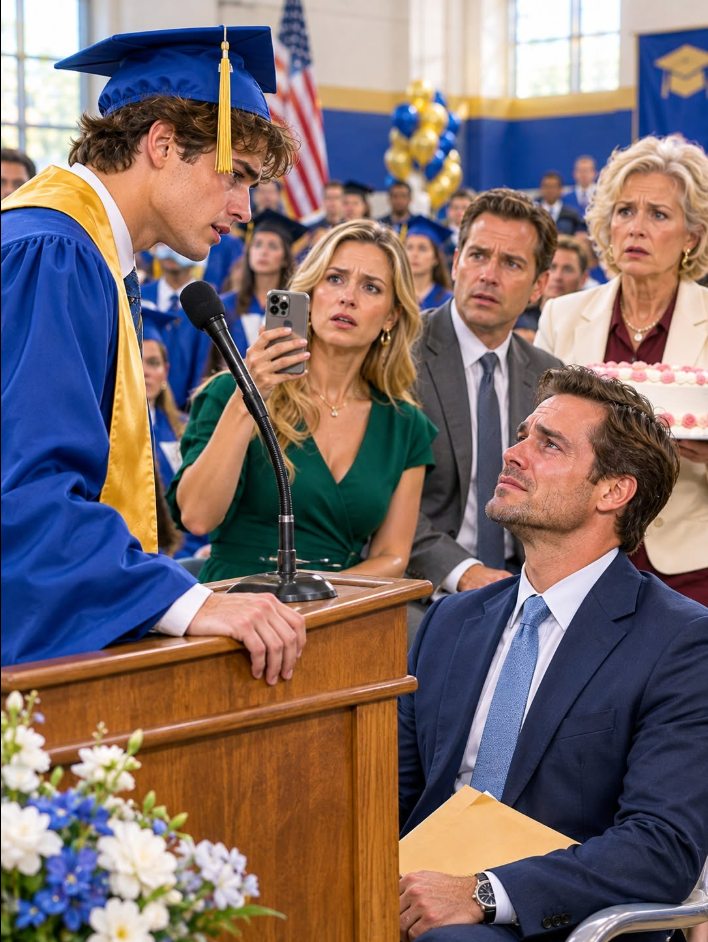
“All about market positioning,” he announced, rotating his diet soda as though it were aged scotch. “You’ve got to anticipate the turn. Most people just lack the vision to execute.” I pushed down my resentment and headed toward dessert. A custom two-tier chocolate cake, decorated with sculpted sugar livestock, occupied the center of the table. Jenna had handled that purchase by supplying the bakery with my billing number. “Attention, everyone! Cake time for the birthday boy!” she called, her bracelets rattling. Her flowing ivory-and-ochre dress looked chosen for a magazine spread. Children crowded beneath the pergola, sang “Happy Birthday,” and cheered as Tyler extinguished ten candles, flushed with pleased embarrassment.
Jenna distributed slices with camera-ready elegance while Travis stood behind her, his arm draped over her shoulder, accepting the other parents’ approval. Then she faced me. Her bright expression narrowed into a pointed smile, and she offered a paper plate bearing a small portion. “Here you go, Captain,” she said during a sudden pause in conversation. “Figured this was the absolute least I could do, considering you’re always buying your way into being the favorite.” A nearby mother stopped with her fork raised. I looked from the cake to my sister. “What did you say?” Jenna answered with a light laugh that contained no kindness.
“Oh, come on, Erin. Don’t look so wounded. We all know the game. You don’t have kids, you don’t have a partner, so you spend your surplus cash trying to outshine everyone else. But throwing money around doesn’t make you a mother. You’re just the family wallet. That’s really all you’ve ever been to us.” Travis chuckled and lifted his drink. “Got to give credit where it’s due, hon. It’s definitely convenient having our own personal ATM on speed dial.” Three feet away, my mother continued folding napkins without raising her head. “Let it go, Erin,” she murmured. “Not today. Don’t cause a scene. Just let it go.”
Something cold and immovable settled beneath my ribs. Those familiar words had excused Jenna backing my sedan into a bollard and refusing the deductible. They had excused Travis using my retail account to order an eight-hundred-dollar iPad for “Tyler’s educational advancement.” Every sacrifice had ended with another instruction to remain quiet. I did not shout or shake. A broken supply link required containment, not argument. I placed the cake plate carefully on a bench and walked to the presents. Beside Tyler’s gifts lay a thick cream envelope, addressed in my handwriting: To Tyler, for your next horizon. Inside was a certified draft for seventy-five hundred dollars, payable to Oakridge Preparatory Academy. I closed my fingers around it.
Tyler had earned admission to the private STEM academy, but his parents had conveniently neglected the approaching semester’s tuition. I lifted the envelope from the table. Jenna’s satisfaction flickered into alarm. “Wait… Erin? What are you doing with Tyler’s gift?” I tucked it inside my utility jacket, zipped the pocket, and looked directly at her. “I’m balancing the ledger,” I said. “Good luck with Oakridge next term, Jenna. I just canceled the tuition.” Color left her face. Her breath caught, harsh and ragged. I turned toward the gravel walkway. Behind me came the rapid crunch of heavy boots and the furious sound of a man realizing that the arrangement supporting his lifestyle had just ended.
My boots struck the path at an even pace. Five steps became ten while the celebration behind me dissolved into strained silence. “Erin! Stop right there! Hey!” Travis caught me at the weathered iron cattle gate separating the farm from the parking area. Breathing hard, his face blotched red, he planted himself in front of me with his hands on his hips. He attempted to make his six-foot height intimidating. I had faced drunken infantry sergeants twice his size who genuinely knew how to fight. Beside those memories, he resembled an enraged shop-window mannequin. “What the hell is wrong with you?” he demanded, lowering his voice to keep the guests from hearing.
“You’re going to pull a stunt like that in front of Jenna’s friends? Hand over that envelope. Right now.” I held my ground. “Get out of my operational space, Travis,” I answered without inflection. “Operational space?” He flung up his hands. “Listen to yourself! You’re not in the desert anymore, Erin! You don’t get to march in here, play the benevolent savior, and then throw a temper tantrum like a spoiled child because Jenna made a little joke!” I tipped my head. “A joke.” Meeting his eyes, I continued, “Calling me an emotionless wallet who buys affection because I have no family of my own. That’s your idea of domestic humor?”
“She was venting!” he snapped, leaning close enough for me to smell the sweetness of his soda. “You know how stressed she is! She planned this entire event from scratch—” I began counting on my fingers. “I paid the six-hundred-dollar venue deposit,” I interrupted. “I paid the eight-hundred-dollar balance on Tuesday. I paid the pizza truck caterer fourteen hundred dollars so your son wouldn’t starve while you drank soda in your fifty-dollar haircut. I bought the cake. I rented the benches. The only thing you and Jenna planned was how to look rich on your social media feeds without spending a single dollar of your own money.”
His jaw worked, and his confident expression fractured. For an instant, nothing concealed the desperation beneath it. Then his manner changed. “We’re family, Erin,” he said, adopting the confidential voice he used when a debt needed extending. “You don’t understand the pressures we’re under. The cost of living, the mortgage… Tyler needs that academy. Oakridge is his future. You promised you’d cover the fall term.” I moved forward. “I never promised,” I corrected. I neither raised my voice nor lifted a hand, but he retreated half a step, his heels shifting on the gravel. “You assumed,” I continued, maintaining the steady posture that had carried me through far more dangerous confrontations.
“You assumed because I didn’t scream, because I didn’t demand payment, that I was weak. You mistook my love for my nephew as a lifetime line of credit for your incompetence. That check in my pocket? I had already notified the school’s finance office this morning that the draft was subject to my final sign-off. As of right now, Tyler’s enrollment balance is pending. The deadline for full payment is next Friday at five o’clock. You’re a grown man. Write the check yourself.” Whatever restraint he had left disappeared. “You know damn well I don’t have seven grand!” he shouted. “We just paid off the lease on the Audi! You’re doing this out of pure, vindictive spite! You want to ruin our kid’s life to punish us?”
“No,” I said, an unfamiliar clarity moving through me. “Tyler is collateral damage to your vanity, not my boundary. If you spent half as much time working as you do posturing, you could afford his tuition twice over. We are done, Travis. Not another dime. Not for rent, not for mechanics, not for private schools. The bank is permanently closed.” His fists tightened while his chest rose and fell. “You’re a cold, selfish creature, you know that? Must be real nice sitting up on your high horse with your government pension and your consultant salary, looking down at everyone who actually has to hustle! Some of us have real lives! Real families! You’re just a miserable, bitter woman who’s going to die completely alone!”
The insults were intended to locate the old vulnerability that had kept me useful: the fear that refusing sacrifice meant forfeiting love. This time, they landed without penetrating. “I may be alone, Travis,” I whispered, holding his eyes until he looked aside, “but everything in my life is bought and paid for by my own blood and sweat. Tomorrow morning, when the sun comes up, you’ll still be a parasite living on borrowed time.” I went around him. He made no move to stop me. Behind me stood a man who had dismantled his own lifeboat for firewood and only now noticed that it was floating away.
I unlocked my gray Tacoma, climbed inside, and shut out the farm, the wind, and his receding footsteps. For a while, I sat gripping the wheel in the sealed quiet. My pulse remained level—seventy-two beats a minute—but a much older pain opened underneath that control. At thirty-four, I was confronting the possibility that my usefulness had been the only value my relatives recognized. The phone on the passenger seat lit up and rattled against its tray. Jenna had called three times in ninety seconds. Then her message appeared: WHAT THE HELL DID YOU DO? TYLER IS HYSTERICAL! THE PRINCIPAL AT OAKRIDGE JUST SENT AN AUTOMATED FINANCIAL SUSPENSION NOTICE TO MY EMAIL! YOU GET BACK HERE RIGHT NOW AND FIX THIS OR YOU ARE DEAD TO ME!
Before I could absorb it, my banking application sounded an urgent alert: External transfer request initiated: $7,500.00 to OAKRIDGE ACADEMY via linked debit profile (User: Jenna Vance-Miller). Authorize? (YES/NO). My breath stopped. Three years earlier, I had used my secondary emergency card while helping Jenna establish Tyler’s application portal. She had quietly retained the information in her autofill settings. Now, while I was still in the parking lot, she was trying to force the tuition payment through my account. I selected NO with a steady thumb, froze the account, and backed out toward the highway. The first confrontation was finished. But the attempted transfer made one thing unmistakable: my family had not accepted my refusal. They were preparing their next attack.
PART 2: What the Ledger Revealed
The trip home to Redwood Ridge took forty-five minutes. Beyond the windshield, the coastal mountains darkened beneath a sky streaked with rusty orange and bruised purple. My house was a modest mid-century ranch on the outskirts, purchased with military savings and renovated with my own hands. Douglas firs screened it from view. An eight-foot fence, an iron gate, and a hardwired security system protected the property. Years of military planning had made a secure perimeter feel less like an indulgence than a necessity. I drove onto the gravel, waited for the gate to close, and switched off the engine. For the first time since arriving at the farm, nobody was demanding anything.
“Erin, it’s Mom,” she began. “I am beside myself. Absolutely beside myself. You humiliated your sister in front of her friends. You broke Tyler’s heart on his tenth birthday. Do you have any idea the scene you caused? Jenna is having panic attacks on the floor. Tyler locked himself in his room. We do not treat family like this. Blood does not abandon blood over money. You call your sister right now and you apologize, and you reinstate that tuition. I didn’t raise you to be this heartless.” I deleted it. Jenna’s recording followed, stripped of the breathy charm she reserved for an audience.
A walnut desk, two monitors, and steel filing cabinets filled the practical room. I unlocked a lower drawer, removed a heavy fireproof document box, and opened it on the desktop. On top lay a black leather binder labeled Vance / Miller Financial Ledger (2019–Present). I had not assembled it to punish anyone. Keeping accurate records was simply how I had been trained to work. When my sister’s temporary financial emergencies became routine five years earlier, I began preserving every receipt. Roof repairs, Tyler’s dental surgery, overdue utilities that would otherwise leave his house without winter heat—each payment went into the spreadsheet. Documentation had become the only orderly element of an increasingly disorderly arrangement.
I turned to the summary printed two weeks earlier. Total Disbursed: $61,437.88. Total Reimbursed: $0.00. Sixty-one thousand, four hundred and thirty-seven dollars. The number represented a house down payment or the foundation of a retirement account. Instead, it had disappeared into the machinery of my sister’s appearances and my mother’s unwillingness to challenge her. Sitting at the desk, I opened an encrypted email conversation with Marcus Rivera. We had served together in the 10th Mountain Division. An executive officer who understood responsibility, he had retired two years before and become Oakridge’s Director of Admissions and Institutional Development. His intervention was the reason Tyler had received an interview.
I composed the message: Marcus, Ref: Tyler Miller – 5th Grade Enrollment. Effective immediately, I am officially rescinding my personal financial sponsorship for Tyler Miller’s academic account. Due to severe, ongoing misrepresentation of household income and persistent bad-faith financial conduct by his legal guardians, Jenna and Travis Miller, I can no longer serve as guarantor. I have attached an itemized ledger detailing $61k in historical familial support over the last five years to provide institutional context. Tyler is an exceptional, blameless child with immense technical potential. My desire is not to see him removed from the academy, but to force his parents to assume direct financial accountability.
I continued: If Oakridge offers a work-study hardship program or an independent merit scholarship that excludes parental control, I am willing to quietly endow it under an anonymous trust. But under no circumstances is my name or credit to be linked to Jenna or Travis Miller moving forward. Stand down on all previous arrangements. Respectfully, Erin Vance, Former CPT, USA. After attaching the encrypted ledger, I reviewed the email and sent it. Less than four minutes later, Marcus replied: Erin, Message received and fully understood. I’ve reviewed the file. Frankly, the finance committee had already flagged their file twice for erratic payment histories and bouncing preliminary checks. Your sponsorship was the only thing keeping the bursar from issuing a formal collections notice last month.
The rest of his answer read: Tyler will not be dumped on the street tomorrow. I will call a mandatory administrative conference with Jenna and Travis for Monday morning. They will either present certified funds or apply for the work-study scholarship under strict oversight. You carried this pack far longer than you should have, Captain. Get some rest. I’ll hold this line. Marcus. I finally drew a full breath. Tyler had a possible route forward without keeping me financially captive. I secured the binder, closed the computer, and went to make black tea. Near nine, rain beat against the windows and wind tore through the trees. I assumed the weather would keep my relatives away until Monday.
At 9:42, the gate intercom shattered the quiet, immediately followed by an insistent car horn. On the security screen, Travis’s black Audi and my mother’s blue sedan crowded the iron entrance. Headlights cut through pouring rain. Jenna stood at the call box, soaked hair pressed against her head, hammering it with her fists and screaming toward the camera. I left the gate locked. Letting an enraged person cross a secured boundary would surrender the only control I possessed. I lifted the intercom handset. “Jenna. Step away from the gate.” Her answer came through distorted by the storm: “Open this damn gate, Erin! Open it right now! Mom is in the car! We are not leaving until you fix this! You destroyed my son’s life today! Open the gate!”
“You have thirty seconds to return to your vehicle,” I told her evenly. “If you damage that gate or continue blaring the horn, I will press the silent alarm. The sheriff’s substation is four miles away. Deputy Miller will be here in eight minutes, and you can explain to him why you’re trespassing on private property in the middle of a storm.” She screamed, “You wouldn’t dare! We’re your family!” I answered, “Twenty seconds.” Travis emerged under a large golf umbrella and caught her arm. His face was furious in the headlights, but the mention of law enforcement had punctured his courage. An arrest would hardly improve the country-club connections he wanted so badly.
Leaning toward the speaker, he shouted over the wind. “We’re going to the diner on the highway, Erin. Mom wants to talk to you. Tomorrow morning. Ten AM. If you don’t show up, she’s coming back with the entire family. You owe her the decency of a conversation!” I released the button, muted the exterior sound, and watched. They argued in the downpour for two more minutes before Travis pushed Jenna into the Audi’s passenger seat. My mother reversed first. The Audi followed, both sets of taillights vanishing into rain. I stayed awake afterward, not because I feared them, but because their next approach would require a different preparation.
A failed direct confrontation would give way to guilt, family history, and public shame. Those had always been my mother’s preferred instruments. By six, the storm had passed, leaving the sky cold and clear. I dressed in a fitted charcoal wool sweater, dark denim, and understated boots, securing my hair in a low knot. On the kitchen counter lay a legal-size manila folder containing paperwork my estate attorney had prepared eight months earlier, when my father’s declining health began generating speculation about his will. It held my irrevocable resignation as designated executor of the Vance Family Living Trust and a notarized Affidavit of Financial Severance. The arrangement everyone considered inevitable was no longer acceptable to me.
My parents had always assumed I would manage their property and untangle whatever remained after they were gone. “Erin is the only one who can manage the property when we’re gone,” my father used to say. In practice, that meant I would clear their debts, sell the land, and deliver the proceeds in whatever way kept Jenna from becoming upset. At 9:45, I parked outside The Rusty Anchor Diner, halfway between Redwood Ridge and the suburbs. Inside, stale coffee, grilled onions, and damp vinyl scented the air. My mother occupied a rear booth in her beige cashmere cardigan, looking like a ruler unjustly deprived of her throne. Jenna and Travis were absent.
I sat across from her without smiling or ordering. “You look tired, Erin,” she began softly. “You always carry so much tension. You’ve been that way ever since you came back from the service.” I rested my hands on the table. “Get to the point, Mom. I have a conference call at eleven.” She closed her eyes and sighed. “Your sister didn’t sleep a wink last night. She threw up three times. Do you feel good about that? Do you feel powerful, holding that boy’s future hostage over a silly, thoughtless comment made over birthday cake?” I raised an eyebrow. “Is that what Jenna told you? That it was just a silly comment?”
“It doesn’t matter what she said!” Her gentle manner split open. “You are the eldest! You are the one who has the means! God blessed you with a high-paying career, no dependents, and zero responsibilities! Jenna has a child! She has a husband trying to establish a business! It is your duty as her sister to lift her up, not kick the ladder out from beneath her!” I took the black binder from my tote and placed it between us with a heavy thud. “I haven’t just lifted her up, Mother. I built the entire house she’s living in.” She frowned. “What is this theatrical nonsense?” I said, “Open it.”
“I am not reading your spreadsheets, Erin. Love does not keep a ledger.” I answered immediately. “Fraud does. Open it, or this meeting ends right now.” Her irritated fingers trembled as she turned the cover. First came five years of itemized payments. Then emergency-room checks beside Jenna’s Instagram photographs from a Scottsdale luxury resort during the same week. Utility shutoff notices I had settled appeared alongside Travis’s Audi lease. Receipts documented Tyler’s school materials, clothing, coats, and dental treatment. My mother’s gaze moved rapidly over the pages while her mouth compressed into a pale line. The evidence required no raised voice and offered no convenient place to hide.
“Sixty-one thousand dollars, Mom,” I said quietly. “That is the cold, hard cash I have handed to your younger daughter since 2019. Not including the sixteen hundred dollars I spent on Tyler’s birthday last year, or the three thousand dollars I spent on his party yesterday. And yesterday, while eating the cake I paid for, in front of twenty strangers, Jenna told me I was nothing more than an ATM. And your son-in-law laughed.” She shoved the binder away. “She was under pressure, Erin! People say things they don’t mean when they feel inferior to you! You’ve always made her feel small with your… your accomplishments, your cold efficiency! Can’t you have some Christian charity? She’s your sister!”
“Christian charity is given freely to the humble, Mother,” I replied. “It is not extorted by narcissists who spit in your face while picking your pocket.” She leaned forward. “So you’re just going to throw Tyler away? You’re going to punish an innocent child to satisfy your monstrous pride?” I kept my voice smooth. “Tyler is already protected. I spoke with Marcus Rivera at Oakridge this morning. The academy is offering him a work-study merit scholarship that covers seventy percent of his tuition. The remaining balance is two thousand two hundred dollars a semester.” She blinked. “Two thousand…? But Jenna said—” For the first time, her certainty faltered.
“Jenna lied. Jenna wanted me to pay the full seven thousand five hundred so she and Travis could pocket the difference or spend it on country club dues. If Jenna and Travis want Tyler to stay at Oakridge, they only have to come up with two thousand two hundred dollars. Travis can sell his golf clubs. Jenna can return three of her designer handbags. It’s entirely within their reach.” My mother’s face became mottled and gray. Her accusation against the heartless aunt had lost its foundation. “You think you’ve won, don’t you?” she whispered, shaking with hatred. “You think you can control everyone with your money and your rules.”
I placed the second folder over the ledger. “That,” I explained, “is my formal resignation as Executor of the Vance Family Trust. I have already filed a copy with the county probate clerk and sent an official notice to Dad’s attorney. As of today, I have no legal, financial, or moral responsibility for any asset, debt, or property belonging to you, Dad, or Jenna. When the time comes, Mom, you can appoint Travis as executor. Let him figure out how to divide the family estate.” She recoiled. “You… you can’t do that! Your father trusted you! Travis doesn’t know anything about probate! He’ll make a mess of it!”
“Then you better start teaching him,” I said. Standing, I smoothed my sweater. Looking at her brought none of the guilt or fear that had governed me for thirty-four years, only a startlingly clean detachment. Tears of frustrated anger finally spilled over her cheeks. “I hope you can live with what you’ve done to this family,” she hissed. I met her eyes peacefully. “Mother,” I said, “for the first time in seven years, I am actually living.” I left the paperwork on the table and walked outside into air that smelled of fallen leaves and washed pavement. At home, I locked the gate and enjoyed three days without a call or message.
Then, on Wednesday afternoon, someone tapped hesitantly at my front door. I checked the monitor, expecting another attempt to force the boundary I had established. But Jenna was not on the porch. Neither were Travis or my mother. Tyler stood there alone, his school backpack hanging from one shoulder. He looked small, exhausted, and unbearably isolated. The silence I had fought to recover suddenly felt different. Whatever had brought him to my door had happened inside the house I could no longer protect him from simply by paying its bills.
PART 3: The Child Who Was Never the Debt
I turned the deadbolt and opened the heavy oak door. Tyler stood on the mat with both hands buried in the pockets of an oversized hoodie. Moisture darkened his sneakers from the roadside walk, and the wind had disturbed his hair. When he looked up, his hazel eyes held the kind of careful understanding no ten-year-old should need. The backpack on his shoulder made him seem even smaller. He had arrived without the noise, threats, or demands that had accompanied the adults in his family. There was only a tired child at my threshold, uncertain whether the anger surrounding him had also closed my door.
He followed me into the kitchen, where the kettle was already warming. I filled a mug with warm apple cider, set shortbread cookies on a plate, and placed both in front of him at the counter. Then I took the opposite stool. For three minutes, we said nothing. He curled his pale fingers around the mug and watched the steam. I let the silence remain. He had not come looking for another adult to fill a room with instructions. Whatever he needed to say deserved space, and whatever he feared deserved an answer that did not make him responsible for anyone else’s feelings.
I kept every trace of that anger away from my face. He had already been made to carry enough adult conflict. Adding my outrage would only give him another burden. I leaned across the counter and rested my hand over his knuckles. “Tyler,” I said, “Look at me.” He raised his eyes. “I do not hate you,” I told him with complete certainty. “I will never hate you. What happened on Saturday was between grown-ups who needed to learn a very hard lesson about respect and honesty. It had nothing to do with you. Do you understand me?” He sniffed and nodded, though his worry did not immediately disappear.
“Did you really cancel my school?” he asked. I chose my explanation carefully. “I changed the way it’s being paid for. Mr. Rivera at Oakridge set up a special scholarship just for you. Because you’re smart, because you work hard, and because you earned it on your own merit. Your mom and dad have to pay a very small part of it now. That is their job as your parents. It was never my job, even though I did it for a long time.” I wanted him to understand the distinction without feeling that the care behind my earlier help had been withdrawn.
He lowered his gaze to the cider. “They’re not going to pay it. Dad said he’s not giving a single dollar to that ‘snob academy’ if you’re not footing the bill.” There it was, stripped of Travis’s excuses and posturing. Maintaining his pride mattered more to him than keeping the opportunity he had insisted was essential to his son. I could not make that choice decent by paying to conceal it again. Nor could I pretend Tyler had invented the problem or could solve it himself. He was a child caught between grown people’s decisions, and he deserved a future larger than their quarrel.
“Then here is what we are going to do,” I said. I went to my desk and retrieved a small sealed envelope, navy blue, then returned and laid it on the counter. “What’s that?” he asked. “Inside that envelope is a secure debit card connected to a private educational trust,” I explained. “Your name is on the account. Mine is the only other name on it. Your parents do not have access to it, they cannot see the statements, and they cannot touch a single penny.” His eyes widened as he studied it. For the first time since entering, his attention moved away from the conflict he had brought with him.
“Is it for the school?” he asked. “No,” I answered firmly. “If your parents refuse to pay the two thousand dollars, Oakridge will transition you to the public middle school down the street. And do you know what? That public school has a fantastic robotics team. It has a great science lab. You will still become an engineer, Tyler. Because an engineer isn’t made by a private school’s crest on a blazer. An engineer is made right here.” I touched his temple lightly. A small, unsteady smile appeared. The possibility his mother had told him was gone began, slowly, to belong to him again.
“That card,” I continued, “has two hundred dollars deposited into it every month. It is for your books. It is for your drafting pens, your computer parts, your museum passes, and your winter boots if your feet grow and nobody buys you new ones. If you ever need something vital and your parents say they don’t have the money, you use that card. But you do not give that card to your mother to buy groceries or gas. It is your lifeline. Can you keep that secret for me?” He picked up the envelope and tucked it into the deepest zippered compartment of his backpack. “I promise, Aunt Erin. I swear on my life.”
“Don’t swear on your life, buddy,” I whispered. I reached across and gathered him into a close, warm embrace. “Just live it.” Holding him, I felt the difference between choosing to help someone and being consumed by people who considered that help an entitlement. My nephew was not a ledger entry, and loving him did not require surrendering every boundary his parents disliked. He needed reassurance, materials, room to learn, and an adult who did not confuse his value with the school crest on his clothes. None of that required me to restore the arrangement that had nearly hollowed me out.
We spent the next two hours in the living room. I made grilled cheese sandwiches and tomato soup. We left Jenna and Travis out of the conversation. Instead, I brought out architectural drafting templates saved from my college engineering courses and showed him how to calculate the way a suspension bridge distributes its load. As we worked, his expression changed. The tense watchfulness receded, replaced by the familiar bright concentration I loved. His curiosity had survived the shouting at home. It had not vanished with the threat of leaving Oakridge. Given quiet, attention, and something meaningful to examine, it returned as naturally as light entering an opened room.
At five, my phone rang with an unfamiliar number. The caller was from the public library’s security desk. Jenna was there, frantic because Tyler had not emerged from the computer lab after school, threatening to involve the police. I kept my answer calm. “He’s with me,” I told the guard. “I am putting him in an Uber right now. He will be at the library doors in twelve minutes.” The afternoon could not remain suspended inside my house. He still had to return to the life his parents were responsible for managing, and I still had to maintain the distinction between being his refuge and financing their avoidance.
Before leaving for the waiting car, Tyler turned back. The weight that had curved his shoulders on arrival had lifted. “Aunt Erin?” he asked. “Yeah, Tyler?” He studied me with the same serious attention he gave a drawing whose structure was beginning to make sense. “You look different than you used to.” I smiled. “Different how?” His forehead creased as he considered his answer. “You don’t look like you’re waiting for an explosion anymore.” Then he left. The door closed, and the car rolled away along the gravel drive while his observation remained with me in the gathering dusk.
I stood on the porch and let those words settle. He had recognized something I had not yet fully named. For seven years, I had lived braced for impact. Every ring of the phone might announce another unpaid bill, another preventable crisis, another urgent request that would somehow become my obligation before the conversation ended. I had treated those moments like incoming fire, responding before I considered whether the position was mine to defend. The work of protecting everyone had become so constant that waiting for the next disaster felt normal. Tyler had noticed when my body finally stopped expecting it.
What followed was quieter than the confrontation at the farm, but it demanded its own discipline. Maintaining a boundary was not one dramatic declaration followed by effortless peace. It was allowing the consequences I had repeatedly interrupted to reach the adults who created them. It was refusing to mistake their discomfort for evidence that I had done something wrong. I did not need another argument to prove the ledger existed, and I did not need to keep defending the fact that Tyler’s future mattered to me. Both things could be true: I could love my nephew, and his parents could remain responsible for their own choices.
Jenna and Travis did not pay the remaining tuition. True to the warning Tyler had brought me, Travis removed him from Oakridge and enrolled him at the local public middle school. To their social circle, he announced that the academy was “elitist and ideologically corrupt.” The explanation protected his pride, but it did not determine what happened next for his son. The building changed. The resources available to Tyler changed. His curiosity did not. He still wanted to understand how things worked, still examined the world as though every mechanism contained a question worth answering. Neither his father’s indignation nor the absence of a private-school blazer could erase that.
Within three months, he joined the regional junior robotics league. Using the card, he purchased microcontrollers, servo motors, and programming books. The purchases were the kind of practical, purposeful expenses that had always made helping him feel worthwhile. In February, his team placed second in the state semifinals. He sent photographs of his trophy from a tablet at the school library. Looking at those pictures, I saw the proof of what I had tried to tell him at my counter. His ability had not belonged to Oakridge, to his parents’ public image, or to my willingness to keep writing larger checks. It had belonged to him all along.
I stayed away from the award banquet. My appearance would have given Jenna another opportunity for a public performance, and I would not turn his achievement into the backdrop for our conflict. Loving him meant allowing that victory to remain his. I did not need to stand in the room to know what he had accomplished. There had been a time when I would have confused absence with abandonment, as though care counted only when I absorbed every difficulty personally. Now I could recognize another kind of protection: stepping back far enough that the adults’ dispute did not eclipse the child’s happiness.
Jenna stopped calling. As their actual finances asserted themselves, her carefully staged influencer posts became less frequent. In January, the black Audi disappeared from the driveway, replaced by a sensible sedan ten years old. Travis accepted an entry-level fleet-dispatching job. It involved real hours, ordinary pay, and the kind of work his speeches about vision had never substituted for. Their lives were finally being fitted to their income rather than mine. I did not create that adjustment. I merely stopped funding the illusion that had postponed it. Watching from a distance, I understood how much of their apparent stability had depended on my willingness to remain permanently available.
My mother made two more attempts through holiday cards. Her notes spoke of “forgiveness” and “healing old wounds,” but offered no accountability for how the wounds had been made. I did not answer. Reconciliation could not mean restoring the same arrangement under softer language. I had spent too long treating the preservation of family appearances as a moral duty greater than honesty. Forgiveness offered without responsibility would only become another permission slip. I could leave the cards unanswered without becoming the heartless woman she had described in the diner. Her description was not a verdict. It was the language she used when the old pressure stopped working.
For myself, I reclaimed something I had repeatedly deferred. The seventy-five hundred dollars once reserved for the tuition draft paid for a three-week solo trekking expedition through the high passes of Chilean Patagonia. I had postponed the journey for five years. Each time, a loan, a crisis, or somebody else’s urgent need had displaced it. There had always been a reason to stay available, to preserve a financial cushion for disasters that were not mine, to keep holding up a sky others insisted would collapse without me. This time, I used my money for the life I had worked to build rather than another rescue whose necessity would soon be forgotten.
On a wind-scoured glacial ridge in the Southern Hemisphere, I watched morning light break across the granite horns of Torres del Paine. The wind roared with an immense, clean force. There was no cell service, no stream of demands, no frantic message requiring an immediate transfer. No ledger waited to justify the cost of being tolerated. The cold air filled my lungs, and the landscape asked nothing of me. I had spent my youth learning to fight and my adult years learning to serve. Neither lesson had taught me, until now, that there were burdens I could set down without betraying anyone worth protecting.
Standing beneath those mountains, I finally understood the maneuver that had eluded me longer than any military exercise: laying down the pack, leaving the battlefield, and allowing the people who used me to face their own lives. Behind me were the unpaid expectations I had mistaken for orders. Ahead was a life no longer organized around their next emergency. I had stopped waiting for the explosion. The question now belonged to the family I had left behind: when their next crisis came, what would they do without me?