PART 2
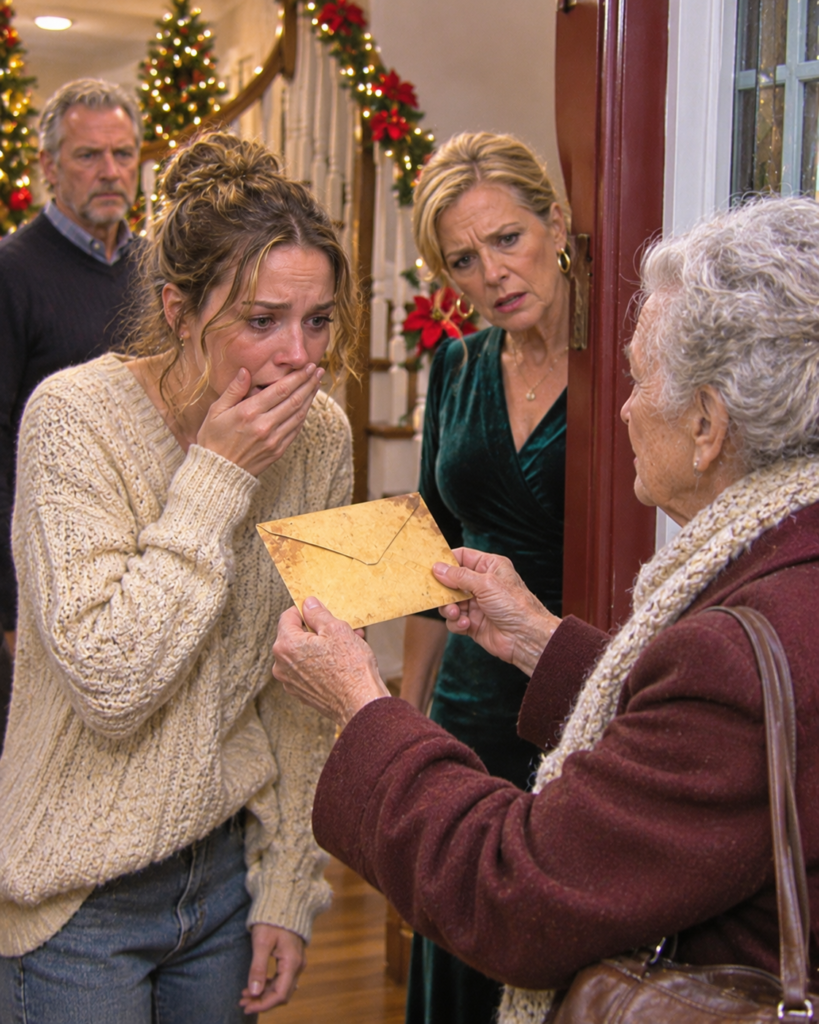
“My name is Myrtle,” the old woman said. “I was your mother’s piano teacher. When she was eight years old.”
Imelda frowned. “You’re the one who bought it?” “I am. I recognized it in the listing photos the moment I saw it. I’d tuned that piano for her a dozen times.”
She turned back to me.
“Last week, I had it tuned again. When the tuner opened the back panel, he found this. Taped inside. Behind the soundboard.”
My hands were shaking so badly that Myrtle had to help me open the envelope.
Inside was a letter in my mother’s handwriting. And a second paper, folded in thirds, with a notary’s stamp at the bottom.
I read the letter standing in the doorway.
“My Larkin. If you’re reading this, someone moved the piano, and you finally looked inside. I’m sorry I couldn’t tell you. I was afraid someone might take it before you were old enough.
This piano is yours. Not the house’s. Not your father’s. Yours. I wrote it into my will, and I put a copy here in case anyone forgets.
It was my grandmother’s. It’s a 1912 Steinway upright. People see the chips and think it’s junk. It isn’t. Have it looked at someday.
That’s my promise. You will always have something of mine that no one can take away.
Play something for me. Even the silly cat song. I’ll hear it. Love, Mom.”
The second paper was a copy of a page from her will. Signed. Notarized. “My piano, I leave to my daughter, Larkin, and to no one else.”
I sat down on the bottom stair and cried.
Myrtle looked at Imelda.
“Do you know what that piano is worth?” she asked quietly.
“I sold it for $9,000. That’s what it’s worth.”
“I had it appraised on Monday,” Myrtle said. “About $46,000. I knew it was special. I didn’t know it was hers until I found this.”
Imelda went white.
“Well, I didn’t know about any will.”
“You didn’t ask,” I said.
That’s when my father walked out of the kitchen.
He’d heard everything.
He took the will from my hands and read it. His eyes went red.
“I knew,” he said. “I forgot. Or I let myself forget.”
He turned to his wife.
“Imelda. You sold something that belonged to my daughter. You told her that her mother was dead like it was nothing. And I stood there. I’m done standing there.”
It was the first time in nine years I’d heard my father raise his voice.
Myrtle refused to keep the piano.
“I paid for an instrument,” she said. “I didn’t pay for your mother’s promise.”
She had it delivered to my apartment in Tacoma the week after Christmas. She wouldn’t let me pay her back.
My father did. He sold one of the new cars and gave Myrtle her $9,000. Imelda didn’t speak to him for a month.
They’re separated now. Dad is in counseling. He calls me every Sunday.
Myrtle comes to my apartment on Thursday nights. She’s teaching me to play again, the way she taught my mother when she was eight.
Last week, I played the silly cat song for the first time in eleven years.
My hands were clumsy. I got half the notes wrong.
Myrtle laughed until she cried.
“Your mother got them wrong too,” she said.
THE END.