PART 2
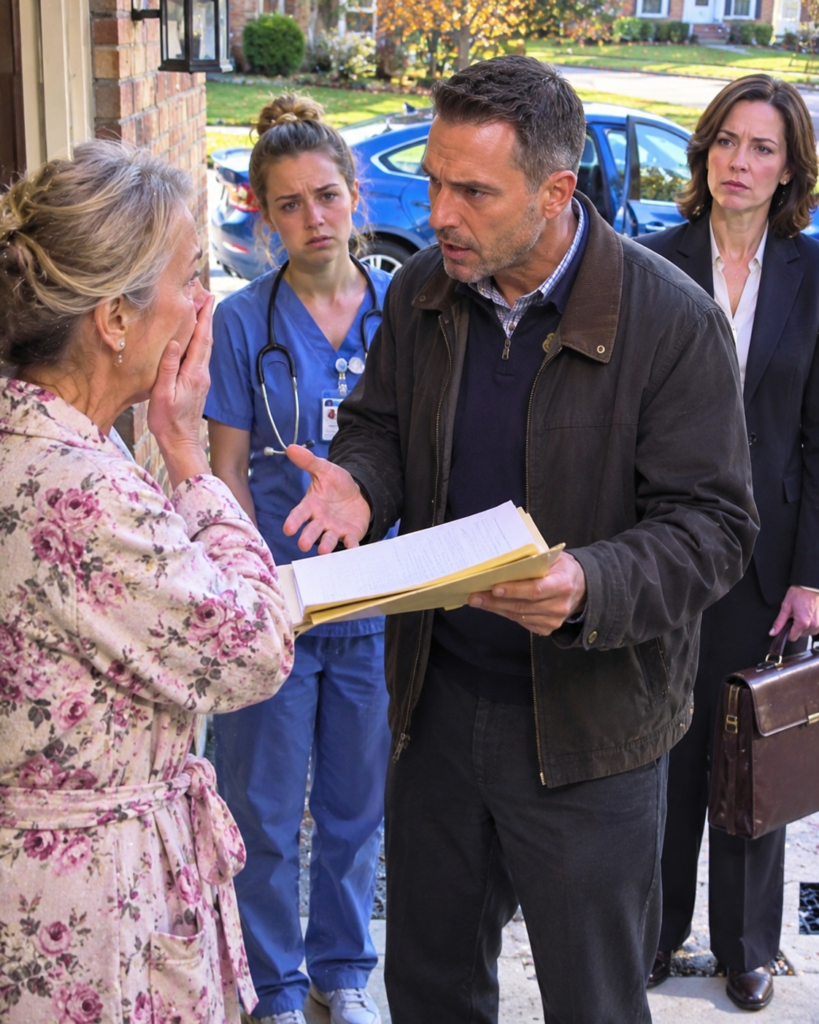
“Good morning, Russell,” the woman in the gray suit said. “My name is Ms. Rowley. I’m your mother’s attorney.”
Russell stared at her. “Her what?”
“May we come in? It’s cold.”
We sat at the same kitchen table where he’d handed me the pen twelve hours earlier. Lyla made coffee. She didn’t look at her father.
Russell put the folder on the table.
“The county website says the house isn’t in your name, Mom. It says it belongs to something called the ‘Thurman and Paulette Family Trust.’ What is that?”
Ms. Rowley opened her briefcase.
“Three years ago, your mother placed this house in a trust. Legally, she doesn’t own it as a private person anymore. The trust owns it. She manages it as trustee, and she can live here for the rest of her life.”
“So the deed she signed last night…”
“Is worthless,” Ms. Rowley said. “Your mother signed it as Paulette, the private person. Paulette, the private person, doesn’t own this house. You can’t give away something you don’t own.”
Russell looked at me.
“You knew that when you signed it?”
“I knew,” I said.
“Then why did you sign?”
“Because I wanted to see if you would really take it.”
He couldn’t answer.
Ms. Rowley slid another paper across the table.
“There’s something else. When your mother passes, the house goes to the person she named as the trust’s beneficiary.”
Russell read the name.
Then he looked at his daughter.
“Lyla?”
Lyla finally spoke.
“Dad, I didn’t ask for it. Grandma decided that three years ago. I found out last spring when I was fixing her computer.”
She took a deep breath.
“And I found something else on her computer. Emails Mom sent her by mistake. Meant for you.”
She put her phone on the table.
On the screen was an email from Regan.
“Once she signs, we list the house in January. Maple Grove has a room open. If she fights, we’ll tell the judge she has dementia. Your mom’s stove story will be enough.”
Russell read it twice.
His face changed. Not angry. Ashamed.
“I didn’t know she wrote that,” he said quietly. “I knew she wanted the house. I didn’t know about the judge.”
“You held the pen, Russell,” I said.
He covered his face with his hands.
Ms. Rowley stood up.
“Your mother’s doctor examined her last week at my request. She is fully competent. I have it in writing. If anyone tries to file for guardianship, that letter and this email will be the first things the judge sees.”
Russell left without saying goodbye.
Regan called me that afternoon. Screaming. I hung up.
For two weeks, I didn’t hear from my son.
Then, on December 20th, he showed up at my door. Alone. Carrying a pecan pie from the grocery store.
“Mom, I’m sorry. I let her talk me into it. I was scared of money. I was wrong.”
I let him in.
We are not fixed. But we are talking.
Regan didn’t come for Christmas. She said I’d made everything difficult.
She was right.
Lyla came. And Russell came. And the two younger grandchildren came, because their father brought them.
We baked Thurman’s mother’s sweet potato pie together in my kitchen.
In my house.
THE END.