PART 1 — The Message Before the Meeting
The message came as I prepared coffee in our Chicago condo above Lake Shore Drive. The number was unfamiliar. There was no introduction, only a video accompanied by a sentence: “So you can see what your husband does when he says he’s working.” I knew it was Grant almost before the clip opened. He stood in a hotel room without his tie, his clothes disheveled, laughing beside a dark-haired woman. Then she turned toward the camera, and the floor seemed to move beneath me.
There were no tears. My entire reply was: “Thanks for letting me know, Camille.” Just then, the shower stopped running. Grant emerged from the bathroom, fastening his watch, and pressed a kiss to my forehead as though this were any ordinary morning. “Ready for tonight, Marianne?” I met his gaze. I was forty-two, and I had never been so ashamed on behalf of someone I still loved. “More than ever,” I said.
Over breakfast, Grant moved through his emails while I watched his untroubled expression. Maintaining another deception didn’t even appear to concern him. At 8:10, I went out without offering an explanation. I drove to the company headquarters and approached the private garage. Recognizing me, the guard lifted the barrier. My connection to that building predated my marriage, before people had come to think of me chiefly as Grant Rhodes’s unobtrusive wife.
“Access to tonight’s presentation. And I need you to review the documents Grant submitted for the investor vote.” His expression shifted. “Do you have reason to distrust those too?” I thought of the paperwork Grant had brought me months before. He had described it as an authorization for a routine meeting. I also remembered that he had kept the transaction’s completed document package out of my hands. “I don’t know yet. That’s why I came to you.”
Gabriel pulled open a drawer and removed a blue folder marked with my father’s initials. He laid it between us. “If you find what you suspect, this stops being only a marital problem.” “I know.” Until then, the video had occupied nearly every corner of my mind. Now the documents beside it demanded attention too. There was what Grant had done to our marriage, and there was whatever he had done while assuming I would keep trusting him.
“And if you decide to speak in front of the board, there’s no going back to the life you had yesterday.” I glanced down at my wedding ring, then back at the blue folder. “I can’t go back to that life.” We devoted the day to dates, authorizations, and successive versions of the presentation, working through the material Grant had submitted rather than relying on what he had told me about it.
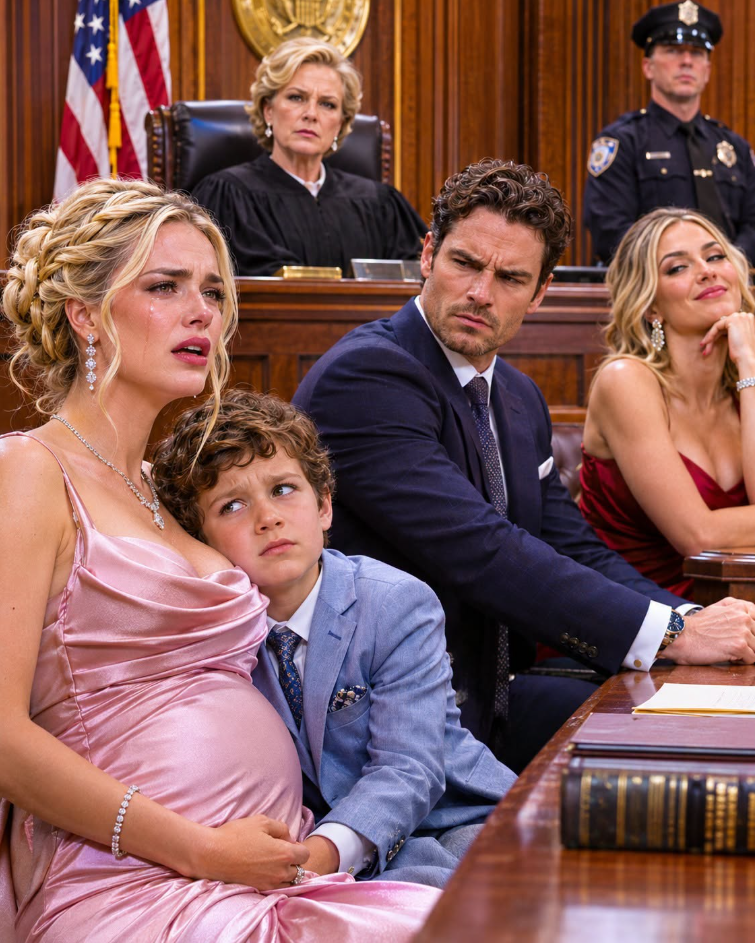
That evening, shortly before nine, I entered the main meeting hall. Lorraine occupied a seat in the front row. Camille appeared through a side entrance in a red dress. When she noticed that I had not vanished as instructed, she offered a fleeting smile. At 8:57, Grant lifted the microphone. “Before we begin, we’ll watch a video prepared by the Communications department.” The lights lowered. From the booth, the technician looked toward me. I gave a single nod.
The opening image filled the enormous screen, and the smile disappeared from my husband’s face. There he was in the hotel room, bending toward Camille with an ease that made their relationship unmistakable. A murmur passed through the audience. Grant briefly lowered the microphone, while Camille stood motionless by the side door. After only a few seconds, the screen went dark.
I had instructed the technician to stop the recording before anything intimate appeared. Their bodies were not necessary evidence of their dishonesty. I didn’t want to become someone who would expose them that way. Grant turned furiously toward the booth. Then he noticed me getting up at the back of the room. “Marianne, what the hell are you doing?” he demanded, forgetting that his microphone was still on.
I started down the aisle beneath five hundred watching eyes. My heels rang sharply against the marble. For twenty years, I had played the quiet wife at gatherings like this, replenishing his water and smiling at his jokes. Apparently, I still knew how to walk through the room on my own. “Showing part of what I received this morning,” I said. “The rest doesn’t belong in this room.”
Camille recovered enough to speak. “This is a private matter. It shouldn’t be discussed in front of the shareholders.” “You’re right,” I said. “An affair shouldn’t be settled here. If that were all this was, I’d have stayed home.” Facing the tables, I continued. “But this morning I was also told to disappear before this meeting. And I want to know why anyone thought my absence would matter.”
I removed the blue folder from my bag. Grant came toward me. “She’s confusing a marital crisis with business decisions,” he told the audience, attempting a smile that appealed for understanding. “She’s been under tremendous stress. I think we should take a short recess.” “We won’t,” Gabriel said. He was already standing at the long table.
Gabriel spoke without increasing his volume. He had never needed to. For three decades, that voice had resolved arguments within these walls. People quieted for him with an instinctive respect they had never quite extended to my husband. “I’d like page seventeen of the official presentation projected,” he said. “The one on the investor authorizations.”
The technician paused and glanced toward the chairman, who nodded his permission. A slide replaced the dark screen. Its layout was polished and straightforward, with the heading Shareholder Consents. The paragraph beneath it asserted that every shareholder concerned had examined and approved the proposed transaction with the incoming investors. Below that statement appeared a list of names, each accompanied by a checkmark.
On the fourth line was my own: Marianne Armstead, represented by Grant Rhodes. There it stood, presented to the people preparing to vote, as though I had read the transaction and willingly authorized my husband to act for me. “That’s my name,” I said. “And that’s not my consent.”
PART 2 — What My Signature Could Not Hide
Whispers spread across the hall. “Mrs. Rhodes signed a power of attorney,” Grant said at once. “I have it on file. She’s forgotten, which is understandable given…” “Mr. Rhodes,” Irene Walsh interrupted. Irene was the board secretary, a gray-haired woman in her sixties who had been recording the company’s proceedings since before Grant was old enough to drive. That afternoon, she had worked beside Gabriel, retrieving original records from the vault.
Now she raised one sheet of paper. “The power of attorney in our file was signed eleven months ago,” she said, speaking with the precision of someone establishing an official record. “Its stated purpose is the approval of routine annual accounts. It contains an expiration date, which has passed. It does not mention the transaction before us tonight.” Grant answered, “It was a general authorization.” “It was a limited one,” Irene said. “I have the original. I’m happy to circulate it.”
Eighteen percent of Armstead Group belonged to me. My father had left me that holding, and throughout my marriage I had allowed it to remain a quiet presence in the background. I voted as Grant advised and signed the documents he pushed across the kitchen island while we drank coffee. I had called that trust. In front of the projected slide, I recognized how much convenience had been mixed into it, for both of us.
Grant leaned close enough to keep his next words between us. “You don’t understand what you’re setting off,” he whispered. “I understand exactly what I signed,” I answered softly. “And what I didn’t.” Lorraine rose in the front row, the pearls at her neck shaking. “Marianne, stop this at once. You are humiliating my son.”
For the first time since I had met her, the people nearby did not respond. No director offered an agreeing nod. Several lowered their eyes to their hands. In her beautiful cream suit, Lorraine remained standing without support, and I came close to feeling sorry for her. Her certainty had always seemed to carry other people along with it. This time, nobody followed.
Camille attempted to regain control. She advanced with the composure she used professionally. “I want to apologize to everyone. The video was a mistake. I only wanted Marianne to know about a painful situation. I never intended it to appear here.” “I never said you did,” I replied. “I asked the technician to run it.” Her lips parted, then closed again.
I brought out my phone and approached Walter Pruitt, the company’s general counsel. A calm man seated in the second row, he had been making notes without drawing attention to himself. I showed him the second message: “If you have any dignity left, disappear before the meeting. Grant already chose.” I neither displayed it on the large screen nor repeated it to the audience. Instead, I requested that it be entered into the record confidentially.
I explained that the messages had arrived from an unidentified number. Without an investigation, I could not establish who had sent either one. I had no intention of making an accusation I couldn’t substantiate. What mattered was formally preserving the information I possessed. Walter read the screen and returned my phone. Then he faced Camille. “Ms. Sorensen, would you like to clarify any of your statements before we continue?” She lowered her eyes.
The person who redirected the meeting was Theresa Lund, representing the lead investor. She had arrived from New York that afternoon and had remained at the table’s far end, a legal pad before her and her expression unreadable. Now she stood. “Mr. Chairman, I’d like to request that any vote on this transaction be suspended until every shareholder authorization has been independently verified. My clients are prepared to invest a great deal of money tonight. They are not prepared to do it on the strength of a document that one of the named shareholders says she never approved.”
“It’s an administrative error,” Grant said quickly. “A clerical oversight. Someone in my office…” Irene answered him. “The presentation passed through Corporate Communications before it was circulated,” she said. “That’s standard procedure.” Faces turned toward Camille throughout the room. Irene was careful to add, “That doesn’t tell us who altered the file,” and then, “But it tells us where to look.”
Gabriel got to his feet once more. “I move that the board halt the transaction pending an independent review,” he said, “and that Mr. Rhodes be placed on temporary leave from his executive duties until the review is complete. Not as a punishment. As a precaution.” Silence followed. It lasted long enough for the creak of a chair to be clearly audible.
At last, the chairman asked, “All in favor?” Hands began to lift. The first few rose cautiously; others followed with an odd sense of relief, as though the room had finally been allowed to question something it had been expected to accept. The decision was not unanimous. It was not remotely close, either.
After the session, Grant overtook me by the elevators. His tie had slipped loose, and his eyes were red. Behind us, people departed in small groups, speaking with subdued urgency. “You ended my career over an affair,” he said. I could hardly believe he was still reducing months of deception to an affair, as if we were discussing one disastrous evening rather than an ongoing arrangement.
“No, Grant. Your relationship with Camille ended our marriage. What you did with my signature put your job at risk. Those are different choices, and you made both.” He put out a hand toward my arm. I moved away before he could take it.
For the first time in our twenty years together, I did not feel responsible for comforting him. I didn’t have to supply an explanation that softened his responsibility or made his decisions easier to excuse. The familiar instinct surfaced anyway. I recognized it as an old habit and allowed it to pass without obeying it.
“Marianne,” he said, using the tone that always appeared when he wanted something from me. “We can fix this. We can talk about it at home.” “I’m not going home with you.” He looked at me and asked, “Where are you going to go?”
PART 3 — A Name That Belonged to Me
I nearly smiled. The question seemed so small beside everything its answer contained. “Anywhere,” I told him. “I have options now.” The elevator doors opened, and I entered without him. In the lobby, Lorraine approached with her coat draped over one arm and a driver waiting outside. Her voice was quiet and unsteady as she accused me of making a public scandal out of a family problem. Wives, she told me, kept such matters private. Her son had made a mistake; making a mistake was not a crime.
“He submitted a consent form with my name on it,” I said. “I never gave it.” She started to speak, stopped, and suddenly looked much older. “Marianne, please. He’s my son.” “I know,” I answered gently. “That’s why I’m not going to say what I’m thinking.” I took a car back to the condo. Its stillness was the kind that settles over rooms after the people who belong in them have already gone.
I placed Grant’s keys beside the coffee maker on the kitchen island. Into one suitcase went my passport, my mother’s jewelry, my father’s letters, and enough clothing for a few changes. Then I phoned a friend who owned a little guesthouse in Evanston. “Come now,” she said. So I did. The following morning, I contacted an attorney.
Diane Hargrove worked in an office above a bookstore on Michigan Avenue. For ninety minutes, she listened without interrupting, filling her notes with small, sloping handwriting. When I had finished, she asked, “Do you want to save the marriage?” “No.” Her second question was, “Do you want to keep your seat at the table?”
“Yes. And I want to read everything before I sign it ever again.” For the first time during our meeting, Diane smiled. “Then we can work with that.” The video remained in the company’s secured evidence files and was never circulated again. Diane insisted on that restriction, and I agreed before she had even finished explaining it.
I understood that projecting even those brief seconds had been a serious choice. In my mind, I had spent a night in a hotel conference room going over every reason I might come to regret it. Ultimately, I had decided I could bear the consequences of revealing a lie, but not of exposing a body. My own hurt did not give me permission to disregard someone else’s privacy, including the privacy of people who had disregarded mine.
Over the next six weeks, an independent firm examined the company records. Its review established that the statement of authorization had entered the presentation without my approval. Grant was unable to produce evidence that I had empowered him to represent me in the transaction. Nor could he account for having told the investors that I had.
On a Tuesday morning, he resigned by email. The message was three lines long and contained no reference to me. The internal investigation also uncovered irregular changes to files circulated through Corporate Communications. Those changes had been made late at night using one account. After the appropriate process had run its course, Camille left her job.
I never discovered the particulars of her departure, and I did not seek them out. Three weeks after leaving, she sent a message. It said, I’m sorry for how it came to you. I read it a single time and left it unanswered. An apology can be sincere without receiving a response.
The investors requested corrected documentation and renewed negotiations under revised terms. Nothing was miraculously repaired. There was no immediate triumph. What followed involved attorneys, difficult meetings, nights without sleep, and the recognition that some trust could not be restored. At the guesthouse, I sometimes woke reaching toward the place where my husband no longer slept. Other evenings, I sat on the bed with Gabriel’s folder across my knees, studying my father’s handwriting until the words blurred.
There were other changes, too. I began learning the company to which I had been quietly connected for twenty years. Irene spent three afternoons guiding me through minutes, bylaws, and long-standing disputes. I worked through audit reports until I could discuss them with Theresa Lund without referring to notes. On Thursdays, Gabriel took me to lunch.
Over those lunches, he told stories about my father that I had never heard. Nobody had kept them from me; I had simply never asked. Once, while spreading butter on a roll, Gabriel said, “He’d have been proud of you.” “He’d have been furious I waited so long.” “Both,” Gabriel replied. “That’s how he was.”
I filed for divorce in the spring. The process dragged on, exhausting and nearly dull, as real endings so often are. Twice, Grant’s attorney attempted to characterize my actions as spite. Diane produced the original power of attorney, the relevant file notes, and Irene’s sworn statement. In one afternoon, that argument collapsed. Grant did not challenge what belonged to me. In the end, he challenged very little.
I accepted an active place on the board, no longer handing my voice to anyone else. After the paperwork had been corrected, Theresa Lund’s investors returned with a smaller, safer proposal. I read every page twice, holding a pen. I asked fourteen questions. Two were naive. Three were pointed enough to make the lawyers revise a clause. When the proposal came to a vote, I raised my hand and gave my approval in my own voice.
In June, Gabriel gave the blue folder back to me. It had been my father’s, and the documents inside were the ones he had saved to remind himself that a family name carried no meaning without responsibility. Small, stubborn handwriting filled the margins. I contributed a page of my own: a copy of the expired power of attorney, marked with one sentence in my handwriting. Never again without reading it first.
The folder went into the upper drawer of my new desk. My office was on the fourteenth floor, two doors from Gabriel’s. It wasn’t the corner office Grant had wanted so badly. Instead of expansive corner windows, mine overlooked a parking structure and a very small tree. I preferred it.
Late that summer, I stood making coffee in my new apartment in Lincoln Park. It was a small home, with a window that gathered sunlight by seven. Across the lake, the morning unfolded in muted bands of gold and gray. My phone rested silently on the counter. I had stopped waiting for Camille to apologize or Grant to make promises.
There was an unfamiliar, almost peaceful feeling in realizing that the silence I had dreaded was simply quiet. I remembered the woman in the other kitchen months earlier, playing the same video three times because she could not comprehend it all at once. I wished I could tell her that the worst morning she had ever known would also become the morning she stopped seeking permission.
The marriage I thought I had was gone. Yet something else had returned to me, something I had surrendered over the years in pieces so small I barely noticed them leaving: a signature offered without reading, a silence maintained, a smile at a dinner when I had wanted to speak. I had recovered the right to choose for myself.
I took my coffee to the window and watched the lake awaken.