PART 1 — The Picture That Stopped the Hearing
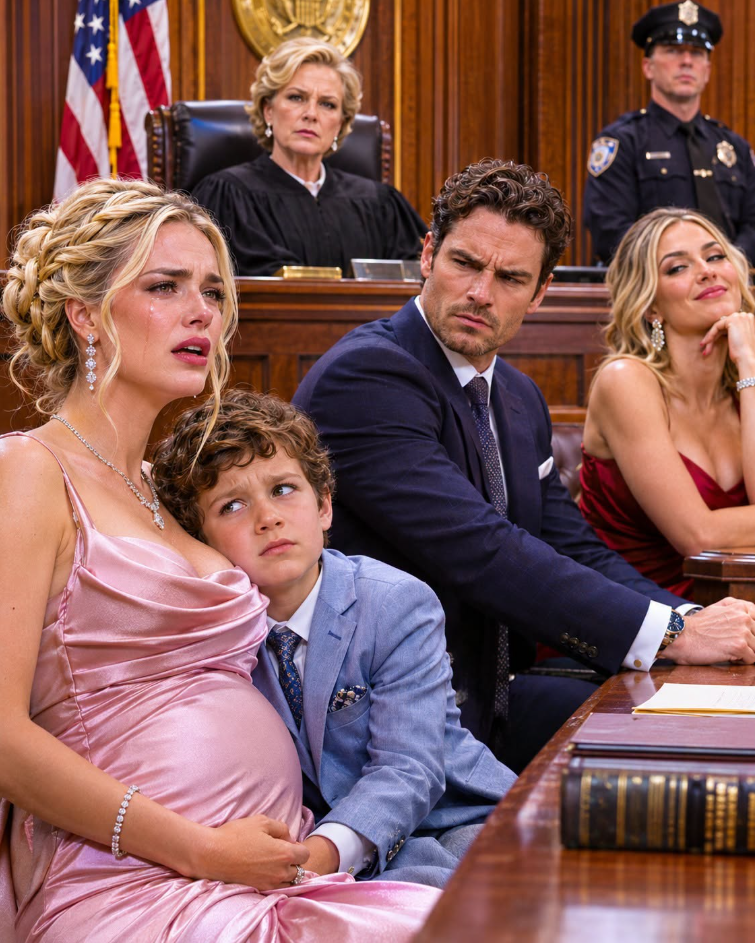
Eight months pregnant, I told the divorce judge that my husband could have the house, both vehicles, and everything in our joint account. After discovering his affair, I wanted only a quiet, secure future for my children. Then our six-year-old son produced a drawing of his father and his mistress practicing my signature. My husband’s face drained of color. His sudden panic would lead us to paperwork that revealed something far more disturbing than infidelity.
On Melissa’s wrist glittered a diamond bracelet I recognized immediately. Julian had charged it to the same shared credit card we used to buy groceries and cover household bills. Neither of them looked especially embarrassed. For nearly a year, I had endured late meetings, unexplained hotel expenses, the scent of another woman’s perfume, and excuses that grew less convincing every week. When I confronted him, he hadn’t bothered denying the affair.
Judge Evelyn Mercer did not share their enthusiasm. “Mrs. Collins, the court must ensure that any agreement is fair and that your children’s interests are protected.” I nodded because I understood what she meant. Still, understanding did not change how desperately I wanted to leave behind a marriage that had become unbearable. At that moment, peace felt more valuable than anything we owned together.
Julian knew about the trust, but he had never been given authority over it. When I asked him about the inquiry, he brushed it aside as ordinary divorce paperwork. His casual response unsettled me more than an argument would have. Before I could make sense of that concern, a court officer approached the bench with a message. Judge Mercer read it, then announced, “An issue has arisen involving your son.”
My heart began pounding. Leo was six years old and supposed to be in the courthouse family-services area with Oliver, his favorite stuffed rabbit. A child advocate named Angela Reed entered with a folder, and Leo appeared beside her for a moment, looking frightened. “Mommy,” he whispered. Every instinct urged me to rush toward him. Angela reassured him instead and arranged for him to return to a comfortable waiting area.
Then she laid a drawing in front of the attorneys. At first, it seemed like nothing more than a child’s picture: a broad brown rectangle for our dining table, three stick figures nearby, and sheets of paper scattered across the tabletop. Two figures were labeled DAD and MELISSA. On the drawn pages, Leo had written MOM, with looping marks underneath. Angela explained that he had become upset while talking about the divorce and had volunteered a memory from home.
“He said his father and Ms. Grant were practicing his mother’s name.” Silence settled over the courtroom. Julian had gone pale, while Melissa tightened her grip on her handbag. Angela said Leo had gone downstairs for water one evening and found them at the dining table, writing my name over and over. I remembered that night. Julian had told me to remain upstairs because he was reviewing confidential business papers. I had heard rustling pages and Melissa’s laughter.
“Julian,” I whispered, “why were you practicing my signature?” His answer came at once. “I wasn’t!” I stared at him. “Then what did Leo see?” He snapped, “He’s six! Children misunderstand things!” Judge Mercer ordered him to sit, and Caroline asked for time to investigate what Leo had disclosed. As the hearing broke for a recess, Melissa dropped a folder. Papers slid across the floor, and Caroline bent down to help gather them.
Then Caroline stopped moving. One sheet bore the letterhead of the institution responsible for my father’s inheritance. Near the bottom appeared my full legal name: Audrey Hayes Collins. She turned toward me. “Audrey, did you authorize Julian to exercise control over your father’s investment account?” I looked at the page. “No.” Julian suddenly shouted at Melissa, “I told you not to bring that folder!” His outburst made his earlier panic horribly clear.
The judge postponed the property settlement while the paperwork could be examined. Nothing was finalized that morning. Caroline explained that the document appeared to give Julian limited administrative authority over my father’s trust, although nobody had established whether it was authentic. I could not understand how he had obtained it. Dad had deliberately structured the trust to prevent unauthorized interference with my finances.
My father had also been wary of Julian. Years before, Julian had approached him for money to support a business venture, and Dad had refused. I had thought he was being needlessly suspicious. Remembering that refusal now, I was no longer so sure. Caroline contacted Peter, who said the trust administrator had already flagged an irregular request involving my personal information and a signature that resembled mine.
The timing was even more troubling. The first suspicious inquiry had occurred eleven weeks before I filed for divorce. Around then, Julian had urged me to simplify our finances by combining accounts. When I refused, he became angry, then apologized with flowers. I had accepted the apology at the time. Now, viewed alongside the document from Melissa’s folder, those gestures carried a different meaning.
That afternoon, I took Leo to stay with my longtime friend Rebecca Morgan. Her house felt quiet and welcoming, and Leo built a pillow fort while I struggled to absorb the day’s discoveries. Then Julian’s messages began arriving. You have no idea what you’ve started. Another followed: Ask your lawyer what happens when a child lies in court. My hands shook. Leo had not lied; he had drawn something he remembered seeing. I forwarded everything to Caroline.
An anonymous email arrived that evening with my father’s name in the subject line. Attached was a photograph of our dining table buried beneath paperwork. On a yellow legal pad, someone had written my name repeatedly. I recognized Melissa’s handwriting. Under the practice signatures was an instruction that made my stomach tighten: MAKE SURE THE DATE MATCHES AUDREY’S HOSPITAL VISIT.
Eleven weeks earlier, complications with my pregnancy had put me in the hospital. Julian had been there with me. I remembered him asking a nurse whether the medication would make me sleepy. Before I could settle the rising fear that memory brought, a second anonymous message arrived: Check what your husband had you sign while you were in the hospital.
Then I remembered the clipboard. Julian had said there were insurance forms that needed my signature. I had been frightened for my baby, exhausted, and unable to concentrate properly. He had pointed out several places where I needed to sign, and I had followed his instructions. Now I could picture the clipboard in front of me—but not the contents of the pages.
Caroline immediately requested my hospital records and copies of everything submitted to the trust administrator. The institution confirmed that the questionable materials carried the date of my hospital visit. Thankfully, the requested changes had not gone through. Its verification process had uncovered inconsistencies. That safeguard had held, but the papers revealed that the request involved more than ordinary access to an account.
Another document appeared to give Julian certain powers if I became unable to manage my financial affairs. A separate provision involved assets meant for my children. My father had created that inheritance to preserve our future, yet someone seemed to be trying to use it as a means of controlling us. I kept returning to the same memory: Julian beside my hospital bed, pointing to the lines, while I signed papers I could no longer remember reading.
PART 2 — The People Behind the Paperwork
As the investigation moved forward, Julian grew more aggressive. He accused me of being emotionally unstable and claimed I was encouraging Leo to invent allegations. Melissa supported his accusations in a written statement. Caroline responded by assembling the records: medical appointments, messages, financial documents, photographs, and communications tied to the questionable trust authorizations. Instead of accepting their account, she began placing each claim beside the evidence.
Peter also located an old letter my father had written shortly before his death. In it, Dad instructed the trust administrator to apply additional safeguards whenever anyone requested authority over my inheritance. He had specifically warned about attempts to use my marriage to influence financial decisions. I struggled to accept that he had recognized a danger years before I had begun to see it myself.
There was more in the trust’s files. Peter found a confidential memorandum concerning a conversation about Julian’s business finances. Apparently, Dad had suspected Julian of promising access to assets he did not legally control. Investigators also identified Melissa as a contact associated with the outside company involved in preparing the suspicious documents. I began reconsidering everything I thought I understood about her place in Julian’s life. Had she become part of his financial plans as well as his affair?
One evening, Julian called from a number I did not recognize. “Audrey, we need to settle this privately.” I answered, “Then explain why my signature appears on documents I never approved.” He hesitated before returning to the same excuse. “Leo misunderstood what he saw.” I pressed him. “What were you and Melissa doing?” This time, he said, “Trying to solve a temporary financial problem.” My breath caught. “With my father’s money?”
He would not answer that question directly. Instead, he warned that continuing the investigation would cause serious difficulties, then claimed my father had left obligations I knew nothing about. I ended the conversation and wrote down everything for Caroline. Soon afterward, Julian’s attorney proposed a settlement that left me furious: Julian would consider withdrawing certain parenting requests if I agreed not to pursue the disputed financial allegations in the divorce proceedings.
It looked as though he was using our son as leverage. Caroline reminded me that decisions about parenting had to be considered separately from the financial dispute. I asked her to bring the proposal before the court. “I don’t want revenge,” I said. “I want my children protected.” Then Peter uncovered another document, this one apparently involving financial authority connected to both Leo and my unborn daughter. It did not automatically alter custody or override their legal protections, but its provisions raised disturbing questions.
The final page contained a name I would never have expected: Thomas Whitaker. For nearly twenty years, he had served as my father’s trusted estate attorney. He had attended family celebrations and watched Leo grow. Now the disputed paperwork identified him as an authorized representative. I felt sick at the possibility that someone Dad trusted had helped Julian. Before I could take in the discovery, a sharp pain spread across my abdomen. Then I saw blood on my maternity dress.
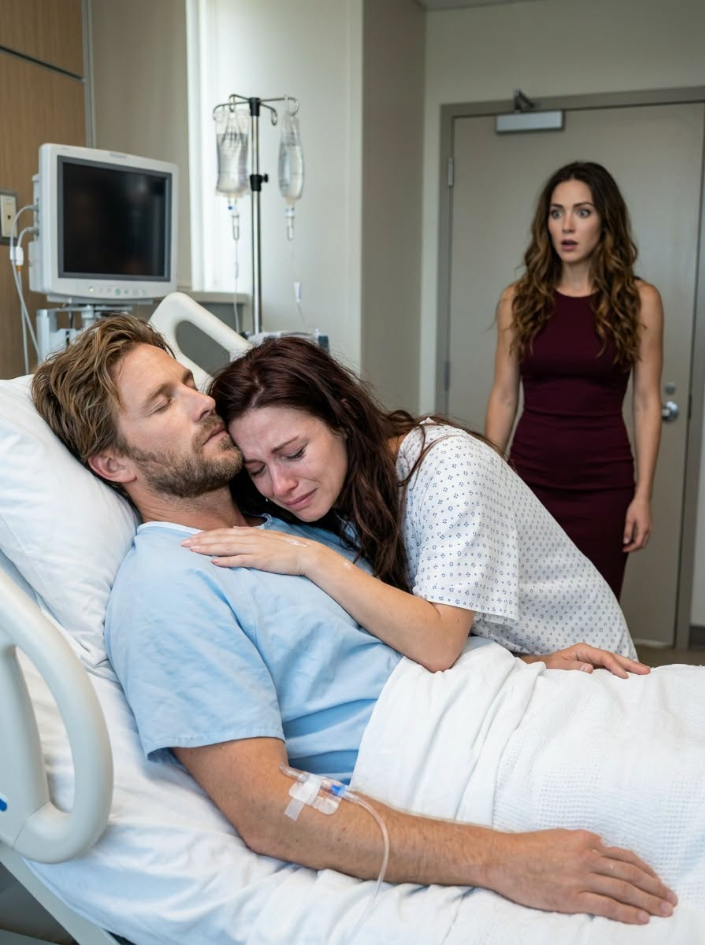
Rebecca caught my arm. “Audrey, we need an ambulance!” At the hospital, doctors examined me quickly and monitored my daughter. Her heartbeat remained reassuring, but I needed to stay under observation. I was terrified that the stress might cost me my baby. Rebecca promised to keep Leo safe while Caroline continued examining the documents. Records suggested Thomas had communicated with people preparing the disputed authorizations and received consulting payments connected to an outside business entity.
I could not understand why he had involved himself. My father had trusted him completely. Then another message from Julian arrived: Thomas says this can still be fixed. A second followed: If you want Leo to stay out of this, tell Caroline to stop. Attached was a photograph of Rebecca’s home. Beside the porch, clearly visible, stood Leo’s red bicycle.
I called Rebecca immediately. She answered frightened but unharmed. Someone had approached the house and tried the back door. When she reviewed the security camera footage, she recognized the man: Thomas Whitaker. Police were contacted, and the recording was preserved. Leo was safe, but I was terrified. The man whose name had appeared among the disputed documents had now been recorded at the house where my son was staying.
The investigation soon brought Julian’s financial situation into focus. His business was in serious trouble after a development project failed, leaving him burdened with debt. He had apparently assured certain associates that family assets could support future financing. But my father’s trust was not his to offer. The institution required proper authorization, and I had repeatedly refused to give him access. His determination to obtain my signature began to make dreadful sense.
So did Melissa’s practice pages. Over the following weeks, investigators examined electronic submission records, correspondence about financing, and the questioned documents themselves. They found that several pages had been assembled using material from different sources. One supporting declaration supposedly came from a nurse who had witnessed me approve financial documents during my hospital stay. The nurse denied signing any such statement.
Other records tied the submissions to Julian’s office and associated accounts. The accumulating evidence became harder for him to explain. Caroline also uncovered communications showing Melissa’s involvement in preparing signature samples. Thomas maintained that his role had been limited to administrative guidance, but the records pointed to more extensive participation than he had first acknowledged. The documents, payments, and messages were beginning to contradict the explanations they had offered.
Eventually, the disputed matters came back before the court. I returned with a different purpose from the one that had brought me to the first hearing. I was no longer willing to surrender everything merely to get away from Julian. I wanted the facts examined. The house, the accounts, and the exhaustion that had once made me willing to abandon any argument no longer outweighed the need to protect my children and the safeguards Dad had created.
When I testified, Julian’s attorney asked why I had been willing to give up the marital home. He suggested that my pregnancy and emotional distress had impaired my judgment. I admitted I had been exhausted. I acknowledged how desperately I had wanted the divorce finished. Neither admission was difficult; both were true. But neither explained away the documents submitted in my name or the authority Julian had tried to obtain.
I looked directly at Judge Mercer. “Wanting to leave my marriage doesn’t mean I gave my husband permission to control my father’s inheritance or make decisions for my children.” My voice stayed steady. For the first time in months, I could say no without feeling frightened by the word. Wanting an end to my marriage had never meant agreeing to surrender my independence.
Melissa later admitted that she had helped organize signature samples and prepare documents associated with Julian’s financial requests. Thomas faced questions about his communications and the consulting payments. He continued to insist he had believed the work was legitimate. After everything we had found, hearing him describe it that way was difficult. He had known my father, understood the trust, and been familiar with the protections he was supposed to help preserve.
Then Caroline introduced something I had not expected: a recording my father had kept of an earlier conversation involving Julian and Thomas. The recording was authenticated, and the relevant portion was admitted. The courtroom grew quiet. My father had been gone long enough that hearing his voice in that room was something I had never imagined. Yet he had preserved this conversation, just as he had left instructions and safeguards in the trust records.
Until then, much of what I understood had come from documents, messages, and other people’s accounts. Now the court was about to hear the conversation itself. Julian’s explanations, Thomas’s claims of limited involvement, and my father’s concerns would no longer exist only as competing descriptions. The recording was ready to play—and I was about to hear what Dad had asked them before I ever knew there was a reason to be afraid.
PART 3 — The Signature That Belonged to Me
Then my father’s voice filled the courtroom. “Julian, I need to know whether you’re planning to use Audrey’s inheritance to support your business obligations.” Julian denied it. Thomas spoke next, explaining that the trust imposed restrictions. Dad insisted that those safeguards were clear. Hearing him discuss my future with the two men sitting at the center of this case made the room around me seem suddenly distant.
Then came Julian’s answer, and it chilled me. “If Audrey refuses, there are other ways to obtain authority.” I covered my mouth. My father asked what he meant. Julian suggested that a husband should be permitted to make decisions if his wife became unable to manage her affairs. Dad challenged him immediately. “That doesn’t give you the right to take away her independence.”
The next words were ones I knew I would carry for the rest of my life. “Audrey is not a financial instrument, and neither are her children.” Tears ran down my face. My father had understood the danger long before I did. He had recognized that the issue was not simply access to money, but the possibility of someone treating my life and my children’s future as resources he was entitled to use.
Thomas eventually admitted that Julian had asked him for help after his business began to struggle. At first, he had refused. Later, however, he accepted consulting work through an associated company, and his involvement gradually widened. He reviewed draft documents, communicated with Melissa, and received payments. When questions emerged about the authenticity of the paperwork, he did not alert the people responsible for safeguarding the trust.
“I should have warned Audrey,” he admitted. I looked at him. “You should have honored the promise you made to my father.” Thomas lowered his head. For the first time, the full picture seemed clear. Julian had not only betrayed our marriage. He had hidden financial difficulties, misrepresented his access to family assets, and tried to acquire powers that were never his.
Melissa had assisted with questionable paperwork. Thomas had failed to uphold the protections my father established. And when I began resisting, Julian had tried to frighten me into silence. None of those facts erased the others. Together, they explained the signatures, the dates, the pressure, and the alarming messages that had followed Leo’s drawing.
The legal proceedings continued, and the disputed signatures and authorizations were examined through the appropriate processes. Ultimately, the questioned documents were not accepted as valid. Julian obtained no authority over my father’s trust. The inheritance remained protected for me and my children. What he had attempted to secure through that paperwork was not granted to him.
The divorce settlement was handled separately, with proper financial disclosure. I decided not to keep the marital house. Instead, I found a smaller home with a fenced backyard and sufficient space for Leo and his baby sister. Choosing to leave that house was different from offering everything away in exhaustion. This time, it was a decision made with the facts before me and my children’s needs in mind.
The criminal and professional investigations also brought consequences. Julian eventually pleaded guilty to offenses connected with the fraudulent paperwork and financing scheme. He received a custodial sentence and financial penalties. Thomas faced both disciplinary and criminal proceedings and lost his ability to practice law. Melissa cooperated with investigators and accepted consequences for her role.
None of those outcomes could undo what had happened. They could not repair my marriage or return the months Leo had spent frightened of upsetting his father. But they affirmed that the truth mattered. My father’s warning remained with me: “Audrey is not a financial instrument, and neither are her children.” The trust was protected, and so was my right to make decisions about my own life.
The family court established parenting arrangements according to the children’s well-being and the relevant circumstances. I made certain Leo received emotional support. I never told him that he had defeated his father. He was a little boy who had drawn something he had seen, not someone responsible for investigating adults or rescuing his family. Those responsibilities had never belonged to him.
Little by little, he began to feel safe again. He stopped worrying that speaking honestly would make people stop loving him. Dinosaurs, spaceships, and fire trucks returned to his drawings. Watching those ordinary subjects fill his pages mattered more to me than any suggestion that he had done something heroic. I wanted him to be six, with room to imagine things that had nothing to do with courtrooms.
Three weeks after the final financial hearing, my daughter was born. I named her Clara Daniel Collins. Daniel was for my father, who had worked so carefully to protect our future. When Leo came to meet her, he approached the hospital bassinet carrying Oliver, his stuffed rabbit. “She’s really tiny,” he whispered. “She is.” He studied her. “Can she hear me?” “Of course.”
He bent closer to the bassinet. “Hello, Clara. I’m your big brother.” One of her tiny hands moved, and he gasped. “Mommy, she likes me!” I laughed through my tears. “She already loves you.” He gently placed Oliver beside her blanket, then reconsidered. “Maybe I’ll keep Oliver until she’s big enough to play with him.” “That’s probably a good idea,” I replied.
The months that followed filled our smaller home with ordinary sounds: Clara crying in the night, Leo laughing at cartoons, the washing machine running, Rebecca arriving with groceries. There were hard days, but we were safe. After everything that had happened, the ordinary parts of our life no longer felt insignificant. They were simply ours.
Sometimes I grieved for the future I had once imagined with Julian. What I missed most, though, was the idea of a happy marriage rather than the marriage we had actually shared. Slowly, I stopped measuring my life only by what had been taken from it. There were still difficult feelings to work through, but loss no longer defined every part of the future.
Almost a year after the first divorce hearing, I found Leo drawing at the kitchen table. Sunlight came through the windows, and Clara slept nearby. His picture showed a woman, a little boy, and a baby in a stroller beneath a bright yellow sun. “What are you drawing, sweetheart?” I asked. “Our family.” He pointed out the figures. “That’s you. That’s me. And that’s Clara.”
Then I noticed an older man near the edge of the page. He wore boots. “Who’s that?” I asked. “Grandpa Daniel,” Leo replied. My throat tightened. Dad had died when Leo was young, but my son remembered his stories, his laughter, and the afternoons they had shared. “Grandpa’s watching us,” Leo said. I knelt beside him. “That’s a beautiful thought.”
Leo picked up a blue crayon and carefully wrote beneath the drawing. His letters were uneven, with some leaning sideways, but every word was clear: MOMMY IS HAPPY NOW. I covered my mouth as tears filled my eyes. He looked worried. “Did I spell it wrong?” I shook my head. “No, sweetheart.” He searched my face. “Then why are you crying?” I gathered him into my arms. “Because you got it exactly right.”
That evening, I put his picture on the refrigerator. Not inside an evidence folder. Not among court papers or financial statements. On the refrigerator, where a child’s artwork belonged. The earlier drawing had helped reveal something terrible, but this one belonged to the life we were building afterward. It was our family as Leo saw us now.
When I eventually signed the final paperwork closing that chapter, I studied my signature for a long moment. It was mine. No one had copied it, pressured me into writing it, or decided what it meant without my permission. I had once believed that leaving Julian meant losing everything. Instead, my son’s innocent drawing had helped expose the truth and protect the people who mattered most.
I had not lost my future. I had finally reclaimed the right to choose it. This time, when I signed my name, I did so because I was free—and whatever came next would be mine to choose.