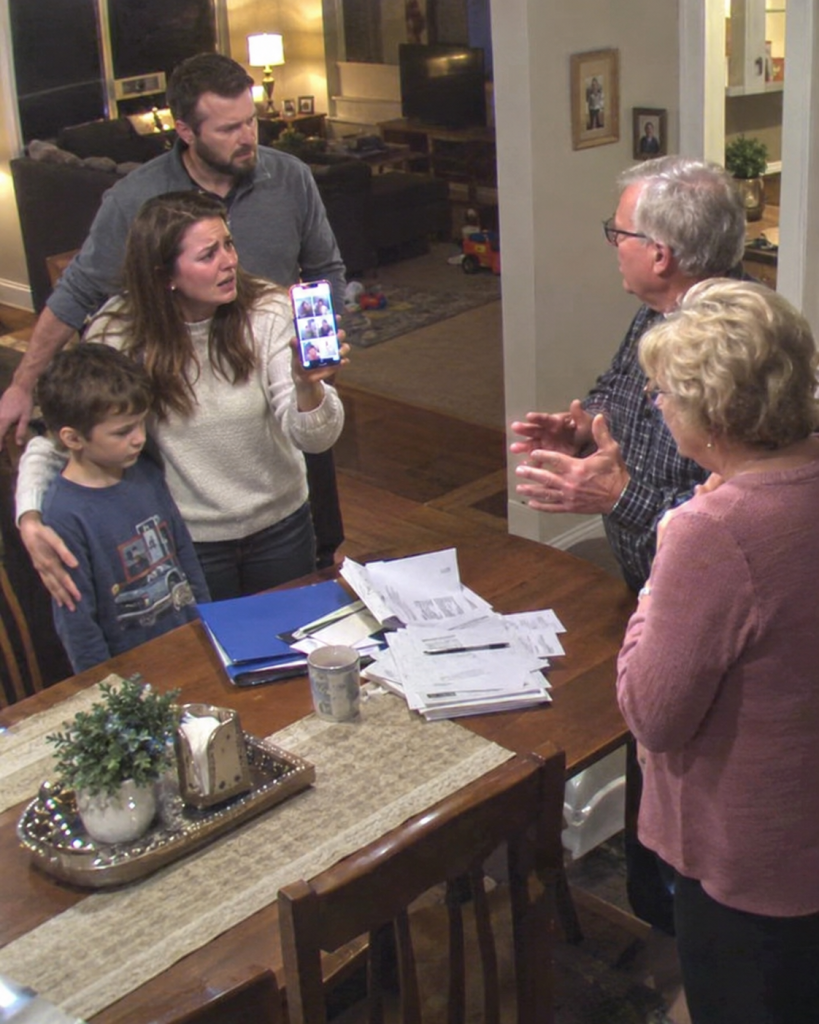
The message glowed on Mom’s phone between us.
“Did Elena’s $800 come through? I still owe the party company.”
For several seconds, no one moved.
Dad’s face lost its color.
Mom stared at the screen as though the words had appeared there by accident, written by someone else’s hand.
Behind me, Mason stood barefoot in the hallway, still holding his fork.
He had read the message too.
Mom reached for the phone.
“Elena, give me that.”
I picked it up before she could.
Dad stepped into the house without being invited.
“That is your mother’s private property.”
“And the $800 Veronica is waiting for is mine.”
His jaw tightened.
“You have no idea what that message means.”
“It looks fairly clear.”
Jake came up behind me carrying the folder we had prepared the night before.
He placed it on the entry table with a soft thud.
Thirty-six bank statements sat inside, each transfer highlighted in yellow.
Dad looked at the folder, then at Jake.
“You stay out of family business.”
Jake’s voice remained calm.
“When family business removes $800 from our household every month, it becomes my business too.”
Mom’s phone buzzed again in my hand.
Another preview from Veronica appeared.
“Don’t tell Elena you used her transfer for the balloon wall.
She’ll make everything about Mason again.”
I read it aloud.
Mom stopped reaching for the phone.
Dad stared at the floor.
Mason’s small voice came from behind me.
“My birthday money bought their party?”
Mom covered her mouth.
“Oh, sweetheart, no.
It wasn’t like that.”
He looked at her with an expression no seven-year-old should have learned so early.
“You said you didn’t have money to come to mine.”
“We didn’t say we didn’t want to come,” Mom replied quickly.
“There were circumstances.”
“What circumstances?” I asked.
Dad pointed toward the kitchen.
“Send him to his room.
Adults need to talk.”
“No,” I said.
“You came to his house and pounded on his door because his mother stopped paying you.
You don’t get to pretend he isn’t part of this.”
Jake crouched beside Mason and gently took the fork from his hand.
“Buddy, why don’t you finish breakfast in the living room? Put on your dinosaur show.”
Mason looked at me before he moved.
“Are you going to give them more money?”
“No.”
The answer came without hesitation.
He nodded once and walked away.
Dad watched him go, then turned on me.
“You are teaching that boy to disrespect his grandparents.”
“No.
I’m teaching him that love doesn’t require a monthly payment.”
Mom began crying again, but the tears no longer affected me the way they used to.
For years, tears had ended every difficult conversation.
Mom cried, Dad became angry on her behalf, and I apologized for whatever truth had upset them.
That morning, I remained standing.
I opened the folder and slid the first page toward them.
“January, three years ago.
Eight hundred dollars.”
I placed another statement beside it.
“February.
Eight hundred.”
Then another.
“March.”
Dad slapped his palm against the table.
“We know how much you sent.”
“Do you? Because the total is $28,800.”
Mom sank into a dining chair.
I continued arranging the statements in rows.
“When you first asked for help, you said Dad’s prescriptions had increased by almost five hundred dollars a month.
I offered to pay the pharmacy directly.”
“You made it sound like we were beggars,” Dad said.
“So I transferred cash instead.”
“We used it for household expenses,” Mom murmured.
“Which ones?”
“Food.
Utilities.
Medical things.”
“Show me.”
Dad’s head snapped up.
“Excuse me?”
“You arrived at my house demanding money.
If this is about medication or electricity, show me the bills.
I’ll review them right now.”
“We don’t owe you an audit.”
“Then I don’t owe you another transfer.”
The room became very still.
Dad had expected guilt.
He had expected me to panic at the sight of Mom crying and restore the payment before breakfast was over.
He had not expected questions.
Mom twisted her wedding ring around her finger.
“Your sister has been struggling.”
There it was.
Not a full confession, but the first crack.
“With what?” I asked.
“She has three children.”
“That is not an answer.”
“Private school is expensive,” Mom said.
“And their mortgage went up.”
I stared at her.
Veronica’s husband was a regional sales director.
They lived in a five-bedroom house with a heated pool.
She posted photographs from beach resorts twice a year.
Meanwhile, I had stood in a grocery store considering whether saving two dollars on cereal would help us cover Mason’s birthday.
“How much of our money went to her?”
Dad folded his arms.
“It is all family money.”
“No.
It was money Jake and I earned.”
“You have a stable household,” he said.
“Veronica needs more support.”
“Why?”
“Because her life is more expensive.”
The cruelty of the sentence was almost elegant in its simplicity.
My sister wanted more, so my parents decided I should live with less.
Mom reached for my hand.
I moved it away.
“We never meant to hurt Mason,” she said.
“You didn’t forget his birthday.
You made a choice.”
“The party for Veronica’s children had already been booked.”
“So you skipped his party because seeing the difference might have embarrassed you.”
Neither of them answered.
That silence told me I was right.
Dad pulled out a chair and sat as though he were preparing to explain something to an unreasonable employee.
“Your sister’s children attend a school where appearances matter.
They have classmates from wealthy families.
A disappointing party could affect them socially.”
I actually laughed.
It was not a happy sound.
“Mason asked whether his grandparents were coming.
That was the only appearance he cared about.”
Mom wiped her cheeks.
“We planned to make it up to him.”
“How?”
“We were going to take him for ice cream.”
A taco bar, a bounce house, designer decorations, and tables stacked with gifts for Veronica’s children.
One ice cream for mine.
Dad pushed the folder back toward me.
“Enough.
Restore the transfer, and we will discuss a better arrangement later.”
“No.”
His eyes narrowed.
“You are willing to let your parents struggle over one misunderstanding?”
“It wasn’t one misunderstanding.
It was thirty-six payments and three years of lies.”
Mom’s phone began ringing.
Veronica’s name filled the screen.
Mom snatched it from my hand and declined the call.
A moment later, headlights flashed through the front window.
A white SUV swung into our driveway so quickly that one tire rolled over the edge of the lawn.
Veronica climbed out wearing oversized sunglasses and carrying an expensive leather purse.
She marched through the open front door.
“What is wrong with you?” she demanded before even looking at Mason’s half-eaten breakfast.
“Mom said you canceled the money without warning.”
“You knew where it came from.”
She pulled off her sunglasses.
“Of course I knew.
Mom told me you were helping the family.”
“You texted her asking whether Elena’s $800 had arrived.” Jake’s voice was quiet.
“That sounds more specific than helping the family.”
Veronica looked at him with open irritation.
“This doesn’t concern you.”
“It paid for your party,” he said.
“It concerns me.”
Her eyes shifted to the folder.
For the first time, she seemed uncertain.
I asked her directly.
“How long have they been giving you money from my transfers?”
She looked at Mom.
Mom looked at Dad.
Dad said, “Do not interrogate your sister.”
Veronica set her purse on the table.
“I don’t keep track of which dollar comes from which account.”
“How much?”
She sighed dramatically.
“Sometimes they help with tuition.
Sometimes activities.
The twins needed new tablets.
There was the dance competition in Dallas.
Then the party deposits.”
“The vacations?” I asked.
Her silence answered that question.
I felt something inside me go cold and clear.
My parents had not needed help surviving.
They had chosen me to subsidize Veronica’s lifestyle.
“Why me?” I asked.
Mom whispered, “Because you could handle it.”
I looked down at the generic cereal box on the kitchen counter.
“You never asked whether we could handle it.”
Dad leaned forward.
“Jake earns good money.”
“So does Veronica’s husband.”
“He has significant obligations.”
“We all have obligations.”
Veronica crossed her arms.
“Mom said you didn’t mind.
She said you liked feeling needed.”
I turned to my mother.
She could not meet my eyes.
That admission hurt differently from the money.
It meant Mom had not merely accepted my help.
She had built a story around it, one in which I was grateful to be used.
“I asked every few months whether things were improving,” I said.
“You always told me Dad’s health was getting worse.”
“His health is private,” Mom replied.
“You used it to ask for money.
It stopped being private the moment it became the reason for a recurring transfer.”
Dad stood again.
“I will not be spoken to this way in front of my family.”
“This is my home.”
He pointed at me.
“Then perhaps you no longer need to be part of ours.”
Mom gasped softly, but she did not tell him to stop.
Dad continued.
“If you turn your back on us now, do not expect to be included in the will.”
Jake inhaled sharply.
I looked at Dad and realized he believed that threat would work.
“You already left everything to Veronica, didn’t you?”
Mom’s eyes closed.
Veronica looked away.
Dad said nothing.

The answer had been waiting in the room long before I asked the question.
I gathered the statements and returned them to the folder.
“Here is what happens now.
The transfers are finished.
Permanently.”
Dad opened his mouth, but I kept speaking.
“If there is a genuine medical emergency, send me the bill.
I will decide whether I can pay the provider directly.
I will not send cash.”
“We are not children,” he snapped.
“Then stop demanding an allowance.”
Veronica grabbed her purse.
“You’re punishing my children because you’re jealous.”
“No.
Your children have parents.”
“You know we planned around that money.”
“That was your mistake.”
Mom stood slowly.
“Elena, please.
At least send this month’s payment.
The party company is still owed money.”
I stared at her.
Even after Mason heard everything, even after the lies were exposed, her first concern was Veronica’s vendor.
“No.”
Dad’s face hardened.
“You will regret humiliating this family.”
I walked to the front door and opened it.
“The only reason this is humiliating is because it is true.”
Veronica left first.
Dad followed, muttering that I was selfish and unstable.
Mom lingered on the porch.
For one second, I thought she might apologize.
Instead, she said, “Your sister’s children shouldn’t suffer because you’re angry.”
I closed the door.
Mason’s dinosaur show played quietly in the living room, but he was not watching it.
He sat curled into the corner of the couch.
I knelt in front of him.
“I’m sorry you heard that.”
He studied my face.
“Did Grandma like their birthday more than mine?”
My instinct was to soften the truth, but soft lies had caused enough damage.
“Grandma and Grandpa made an unfair choice.”
“Because their party was bigger?”
“No.
Because they should have shown up for you, no matter how big or small your party was.”
He thought about that.
“Are they mad at me?”
“None of this is your fault.”
“Are they coming back?”
“Not until they can treat you with kindness.”
He nodded and leaned against me.
That afternoon, I moved the first $800 into a new savings account in Mason’s name.
Jake sat beside me while I completed the transfer.
“What should we call it?” he asked.
I typed two words into the account nickname field.
Mason’s Future.
The family backlash began the next day.
An aunt called to tell me Dad had suffered a blood-pressure episode because of my cruelty.
A cousin messaged that Mom was devastated.
Two relatives said I should never mix money with family.
I agreed with the last statement.
Then I sent each of them one photograph: the page showing thirty-six transfers and the screenshot of Veronica’s message.
The calls changed.
My uncle Raymond contacted me that evening.
“Elena,” he said carefully, “how long were you sending them money?”
When I told him, he became quiet.
Then he admitted he had been sending Dad $300 a month for nearly a year after being told they could not afford medication.
A week later, three more relatives compared stories.
My parents had collected money from multiple family members while paying Veronica’s private-school costs, vacations, dance fees, and parties.
Uncle Raymond requested a family meeting.
Dad refused to attend until Raymond said everyone would stop sending money unless receipts were provided.
The meeting took place at my aunt’s dining table.
Dad arrived carrying a folder of his own, but it contained only a few utility bills and one pharmacy receipt from eleven months earlier.
The documented expenses did not come close to the amount they had received.
Under pressure, Mom finally admitted the truth.
The first few transfers had helped with legitimate costs.
Then Veronica fell behind on tuition.
After that, there was always another reason she needed money.
Dad had decided that I was the logical source because Jake and I were “responsible.”
Responsibility had become the excuse for exploiting us.
Veronica accused everyone of attacking her children.
Raymond asked why her children’s dance competitions mattered more than Mason’s birthday.
She had no answer.
By the end of the meeting, every relative had stopped the automatic payments.
Dad called it betrayal.
Raymond called it accountability.
The consequences were not cinematic.
No police arrived.
No one was dragged away in handcuffs.
Reality was quieter.
Veronica canceled a planned winter vacation.
Her children transferred out of one expensive activity.
She and her husband finally created a budget based on their own income.
My parents remained in their paid-off home.
Their electricity stayed on.
Dad continued receiving his pension.
His prescriptions, we learned, were mostly covered by insurance.
They had never been one missed transfer away from disaster.
They had simply become accustomed to other people financing their choices.
Dad did not speak to me for four months.
Mom sent occasional messages that began with “I miss my grandson” and ended with a complaint about how hard life had become.
I answered only when she took responsibility for something specific.
Most of the time, she did not.
Then, one rainy afternoon, she came to the door alone.
She did not pound.
She knocked once and waited.
I stepped onto the porch instead of inviting her inside.
She looked older than she had at Veronica’s party.
“I owe you an apology,” she said.
I waited.
She took a folded piece of paper from her purse.
It was not a bill or a request for money.
It was a handwritten list of every lie she remembered telling me about their finances.
“I kept choosing the child who demanded the most,” she said.
“I told myself you needed less because you were stronger.”
“That did not make me need you less.”
“I know.”
Her voice broke, but this time she did not use tears to escape the conversation.
“I hurt Mason.”
“Yes.”
“I want to apologize to him, but only if you think it would help him.”
It was the first time she had asked what Mason needed instead of telling me what Veronica’s children deserved.
I did not forgive her that day.
Trust built over years does not return because someone finally names the damage.
But I allowed her to write him a letter.
Dad never apologized.
He sent a birthday card the following year with fifty dollars inside and no message beyond his signature.
I returned the money and kept the card in case Mason wanted it someday.
For his eighth birthday, we held another backyard party.
The cake leaned again.
Jake burned the first batch of hot dogs.
A sudden breeze tore down half the decorations.
Mason laughed through all of it.
Mom attended for one hour.
She brought a single wrapped book and arrived early to help set up chairs.
She did not mention Veronica.
She did not cry.
She did not ask for anything.
When Mason blew out his candles, I watched his eyes move around the yard, counting the people who had come.
This time, he did not ask who was missing.
That night, after he went to bed, I transferred another $800 into his savings account.
The balance had grown enough to feel real.
Jake looked over my shoulder at the screen.
“Any guilt?” he asked.
I thought about the grocery aisle, the canceled cereal, the thirty-six yellow highlights, and my father’s fist shaking our windows because he believed my obedience belonged to him.
“No,” I said.
For three years, I had mistaken being useful for being loved.
Now the money stayed in the home where love had never required an invoice.