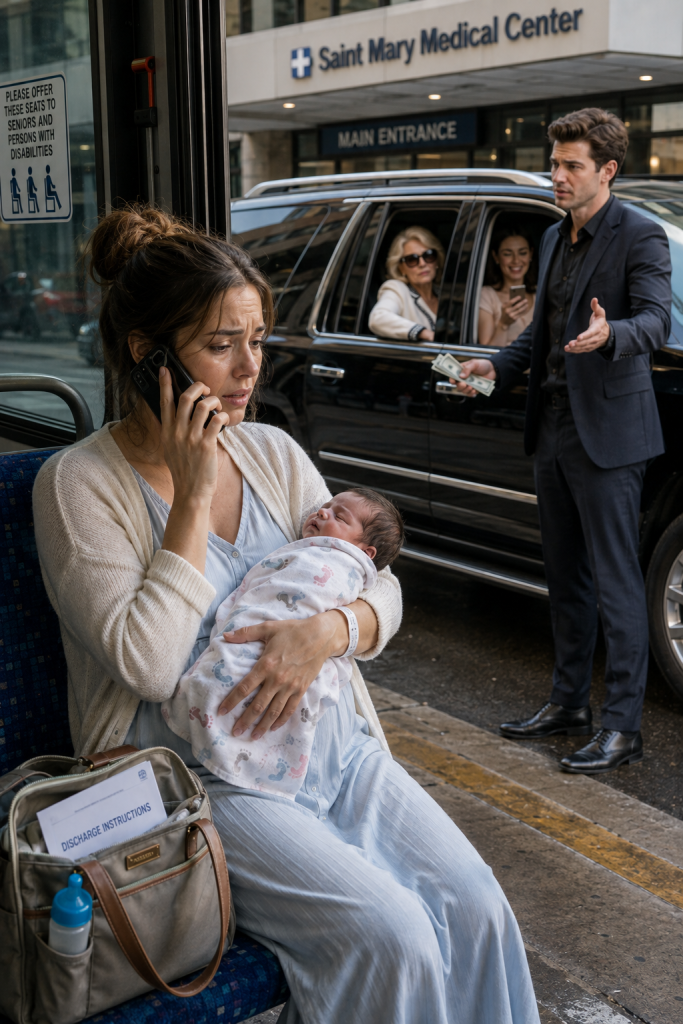
Behind us, Jasper’s SUV continued toward an expensive family lunch.
Mine continued down the bus route.
For the first time in two years, I understood the difference.
The black SUV had leather seats, tinted windows, and the kind of quiet engine that made Jasper feel powerful whenever he pulled up to restaurants, investor meetings, or office buildings where men in expensive suits judged one another by the cars they arrived in.
But the bus held me.
The bus driver had lowered the step for me without being asked. An older woman across the aisle had shifted her grocery bag onto her lap so I would have more room for Toby’s diaper bag. A young man with headphones had stood so I could sit by the window, then turned his face away as if he knew dignity sometimes needed privacy more than attention.
Jasper had luxury.
I had decency.
That was the first thing I noticed after calling my father.
“Hailey,” Dad said, his voice controlled in a way that told me he was angrier than if he had shouted. “What bus are you on?”
I looked up at the digital sign near the front. “Route 14. Heading east.”
“Stay on the line.”
“Dad, I can—”
“No,” he said. “You have a five-day-old newborn and a surgical incision. You are done proving you can endure things no one should have asked you to endure.”
The words landed harder than I expected.
Maybe because, for months, I had been trying to do exactly that.
Endure.
Endure Jasper’s impatience. Endure Gillian’s little insults. Endure Priscilla’s jokes about how I was “still carrying baby weight” before the baby had even arrived. Endure being called dramatic whenever I asked for kindness so basic that strangers on a city bus understood it better than my husband.
“Toby is asleep,” I whispered.
“I’m glad,” Dad said. “Where is your pain level?”
The question nearly undid me.
Not because it was complicated.
Because someone had finally asked.
“High,” I admitted.
“Bleeding?”
“Not more than they told me to expect.”
“Dizzy?”
“A little.”
“Are you alone?”
I looked around the bus. “Not exactly.”
That made his voice change. “Meaning?”
“I mean there are strangers around me who are treating me better than my husband did.”
Silence.
Then Dad said, “All right. Listen carefully. My driver and two security officers are going to meet you at the Riverside stop. It should be nine minutes from where you are. They will have identification. You will not go back to the apartment. You will not speak to Jasper. You will not answer calls from his family. I’m sending Dr. Patel to the house.”
“The house?”
“My house.”
I closed my eyes.
I had not been there much since marrying Jasper.
Not because Dad had shut me out. He never had. But Jasper hated going there. The first time he visited, he stood beneath the chandelier in the foyer and said, “Your father lives like he’s trying to impress people who already know he’s rich.” He had said it lightly, almost joking, but I had heard the envy beneath it.
After that, he always found reasons for us to avoid my father’s home.
Too far.
Too formal.
Too much scrutiny.
Too much Finnley Robertson.
I had let him.
I told myself marriage meant building a life with my husband, not retreating into the protection of my father’s name every time things became difficult.
But there is a difference between independence and isolation.
Jasper had spent two years teaching me to confuse them.
“Dad,” I said, my voice shaking now, “he has the SUV.”
“The Escalade?”
“Yes.”
“The one titled to you?”
“Yes.”
“Good.”
The word was quiet.
I opened my eyes.
“Good?”
“That makes this cleaner.”
For one second, despite the pain and humiliation, something almost like laughter pressed against my throat.
My father did not raise his voice when he went to war.
He organized.
“Dad.”
“Yes?”
“Please don’t destroy him just because you’re angry.”
Another silence.
Then his voice came back, softer.
“Hailey, I am not going to destroy Jasper because I am angry. I am going to protect my daughter and grandson because he has shown me who he is. What happens to him after that will depend on what he has built, what he has lied about, and what he tries to take.”
I looked down at Toby.
His tiny mouth moved in sleep. One fist rested against my hospital gown beneath the loose cardigan the discharge nurse had helped me put on. He had Jasper’s chin. That hurt to notice, but I did not look away.
“His name is Toby,” I whispered.
Dad’s voice broke, just slightly.
“I know, sweetheart.”
I had accidentally called him Leo on the phone. Exhaustion, pain, shock, maybe all of it. I had been holding my son and still felt so unreal in my own body that even his name had slipped through my hands for a second.
But Dad knew.
Dad had remembered the name I chose.
At the Riverside stop, the bus sighed to the curb.
Through the window, I saw three people waiting beneath the shelter.
One was Martin, my father’s driver, who had worked for our family since I was fourteen and still called me Miss Hailey even after I told him a hundred times to stop. Beside him stood a woman in a dark coat and a man with an earpiece visible against his collar. The woman stepped forward as the bus doors opened and showed her identification before reaching for me.
“Mrs. Vale?” she asked.
The name struck me wrong.
Mrs. Vale.
Jasper’s name.
I looked at Toby.
Then I looked back at her.
“Hailey Robertson,” I said.
Her expression did not change, but I saw that she understood.
“Ms. Robertson,” she corrected. “I’m Elise Grant. Your father sent us.”
The bus driver lowered the step again.
Elise did not touch me until I nodded permission. Then she supported my elbow, steady but not possessive, while Martin took the diaper bag and the second security officer shielded us from the wind.
As I stepped down, the incision pulled so sharply that my vision flashed white.
Elise caught me before I stumbled.
“Slowly,” she said. “No rushing.”
A stranger had said what my husband had not.
No rushing.
They put me in the back seat of a warm sedan. Elise sat beside me while Martin drove. The second officer followed in another car. Toby slept through all of it, warm against my chest, protected by people Jasper would have called dramatic if I had asked for them the day before.
My phone began ringing before we reached the freeway.
Jasper.
I stared at his name.
The screen went dark.
Then lit again.
Jasper.
Then Gillian.
Then Priscilla.
Then Jasper again.
Elise glanced down. “Your father asked that you not answer.”
“I wasn’t going to.”
But my hands were trembling.
Not because I wanted to talk to him.
Because for two years, not answering Jasper had been treated like a crime.
If I took too long to respond, he accused me of embarrassing him. If I ignored Gillian, she called him and told him I was disrespectful. If I turned my phone off, Priscilla joked that motherhood would be good for me because “at least the baby would teach Hailey she can’t have everything her way.”
My way.
I had not even gotten the front seat of my own car after abdominal surgery.
When we reached my father’s estate, he was waiting outside.
Finnley Robertson did not usually wait outside for anyone.
He stood at the top of the stone steps in a navy sweater and slacks, his silver hair wind-touched, his face pale with rage held under discipline. Behind him, the front doors were open. A nurse waited in the foyer. So did Dr. Patel and my father’s general counsel, Marina Sato.
I stepped out of the car slowly.
Dad came down the steps.
For one moment, he did not touch me. He looked at my face, my hospital bracelet, Toby’s blanket, the way I held myself because every breath hurt.
Then he reached for me.
I leaned into him carefully, and the first sob finally escaped.
Not loud.
Not dramatic.
Just one sound from the bottom of a body that had been expected to bleed, nurse, walk, smile, and take the bus.
Dad held me like he had been waiting two years for me to let him.
“I’m sorry,” I whispered.
His arms tightened.
“No,” he said. “Do not apologize for coming home.”
Inside, Dr. Patel checked my incision. The nurse helped me change. Toby was examined, fed, changed, and settled in a bassinet that appeared so quickly I knew my father had already had a nursery prepared somewhere in the house, probably from the day I told him I was pregnant.
He had hoped I would come home.
He had just never forced the door open.
That hurt in a different way.
By evening, I had given Marina everything.
The hospital discharge papers. The bus fare. The text messages. The months of insults. Jasper’s use of the SUV. His access to my accounts. The company investors. The way Gillian had moved into our apartment for the first two weeks after Toby’s birth and somehow made me feel like the guest. The way Jasper had told the nurses he was “exhausted” and needed to rest while I learned to stand upright with stitches across my abdomen.
Marina wrote without interrupting.
My father sat beside the fireplace, holding Toby with the stillness of a man afraid to disturb a miracle.
When I finished, my throat was raw.
Marina closed her notebook.
“Hailey,” she said, “has Jasper ever threatened to keep the baby from you?”
I looked down.
That was answer enough.
Dad’s head lifted.
“What did he say?”
I swallowed.
“He said if I kept acting unstable after delivery, he would have to make decisions for Toby without me.”
My father’s face changed.
Not dramatically.
Worse.
It went still.
Marina’s pen moved again. “When?”
“Three nights ago. In the hospital. I cried because Gillian told the nurse she should take Toby to the nursery so I could ‘stop acting possessive.’ Jasper said I was making everyone uncomfortable.”
Marina nodded once.
“We move immediately.”
“What does that mean?”
“It means we file for emergency custody protections. It means we notify your apartment management that Jasper is not authorized to remove your belongings. It means the SUV is recovered because it is titled in your name. It means company counsel reviews every representation Jasper made to investors involving your family connection, whether explicit or implied.”
I looked at Dad.
He did not look away.
“What did you do?” I asked.
He gently adjusted Toby’s blanket before answering.
“I made calls.”
“Dad.”
“I did not say anything untrue.”
“That’s not what I asked.”
For the first time that day, something like pride moved through his eyes.
“My daughter,” he said quietly, “is still an excellent negotiator when she’s exhausted.”
Despite everything, I almost smiled.
Then he said, “Robertson Global did not invest in Jasper’s company directly. You know that. But three of his major investors came through relationships connected to me. They believed he was family-adjacent. Stable. Vetted. They believed he had discipline because I allowed them to believe my silence was approval.”
My stomach tightened.
“I never asked you to do that.”
“No. You asked me not to interfere. I respected that. But I did not leave you unprotected. There are clauses, Hailey. Conduct clauses. Disclosure clauses. Key relationship clauses. Misrepresentation clauses. I don’t know yet what Jasper has violated, but I know men like him often lie more when they believe no one important is listening.”
As if summoned by the words, my phone rang again.
Jasper.
This time, Marina took it gently from my hand.
“May I?”
I nodded.
She answered on speaker.
“Hailey, where the hell are you?” Jasper snapped before anyone spoke. “Do you have any idea what you’ve done? The valet says the SUV was released to some security company, my mother is humiliated, and now Victor Lang’s office is asking questions about my personal conduct clause. Are you insane?”
My father looked down at Toby.
Marina said calmly, “This is Marina Sato, counsel for Hailey Robertson.”
The silence on the line was immediate.
Then Jasper laughed.
Not confidently.
Reflexively.
“Counsel? Hailey, stop this. Put my wife on the phone.”
“Ms. Robertson is recovering from surgery and caring for her newborn. You may communicate through counsel.”
“Ms. Robertson?” His voice sharpened. “She’s my wife.”
“Not your property.”
The room went silent.
Jasper exhaled hard. “This is ridiculous. We had a disagreement. She overreacted.”
“Did you leave your five-day postpartum wife outside a hospital with bus fare while you took her vehicle to lunch with your mother and sister?”
He did not answer quickly enough.
Marina continued, “That question will be asked again in court. I suggest you become familiar with the truth before then.”
“My son is with her,” Jasper said.
Dad’s eyes lifted.
Marina’s voice cooled. “Yes. The newborn she delivered by C-section five days ago is with his mother.”
“I have rights.”
“You do. You also have responsibilities. We will discuss both.”
“I want to speak to Hailey.”
“No.”
“You can’t keep me from my wife.”
“My client has requested no direct contact tonight.”
“Hailey!” he shouted. “I know you’re there. Stop hiding behind your father.”
My father stood.
For a moment, I thought he would take the phone.
He did not.
He had enough control not to give Jasper the confrontation he wanted.
Marina ended the call.
My phone immediately lit with text after text.
You embarrassed me.
You stole the car.
My mother is crying.
You’re unstable.
You can’t just run to Daddy every time you don’t get your way.
Bring my son home.
That last one made my hand tighten around the blanket.
Bring my son home.
Not our son.
My son.
Marina took screenshots.
Dad placed Toby gently into my arms and sat beside me.
“Hailey,” he said, “I need you to hear me carefully. You are not weak because you called me. You are not childish because you needed help. He left you on a bus stop with a surgical wound and a newborn. The shame belongs entirely to him.”
I looked down at Toby.
His tiny eyes opened for half a second, unfocused and dark.
“I almost went home,” I whispered.
“I know.”
“I almost heated the leftovers.”
Dad closed his eyes.
“I know.”
“I almost apologized for making lunch difficult.”
His hand closed over mine.
“But you didn’t.”
No.
I didn’t.
That night, while Jasper sat somewhere in the apartment I had furnished, calling me unstable to anyone who would listen, I slept in my childhood bedroom with my newborn beside me and a security team downstairs.
For the first time since Toby was born, nobody told me I was being dramatic for needing rest.
PART 3
Jasper came to my father’s house the next morning.
Of course he did.
Men like Jasper do not recognize a locked gate as a boundary. They recognize it as an insult.
He arrived at 8:37 in a rideshare, wearing yesterday’s clothes and the expression of a man who had spent the night discovering that wealth stops feeling imaginary when it moves against you. The SUV had already been recovered from the restaurant valet the day before. The valet had released it only after confirming ownership and speaking with my attorney. Jasper had screamed loudly enough that Priscilla recorded part of it accidentally while trying to film “proof” of my cruelty.
Marina had that video too.
At the gate, Jasper demanded entry.
Security refused.
He called me twelve times.
I did not answer.
Then he called my father.
Dad answered from the breakfast table, where I sat in a loose robe with Toby asleep in the bassinet beside me. Dr. Patel had ordered strict rest. The nurse had ordered soup. My father had ordered both of them to ignore me if I tried to act fine.
He put Jasper on speaker.
“Finnley,” Jasper said, forcing warmth into his voice. “I think this has gotten out of hand.”
Dad stirred sugar into his coffee.
He never took sugar.
That was how I knew his hands needed something to do.
“Do you?”
“Hailey’s emotional. The birth was difficult. I’m sure she told you a version that made me look terrible.”
“She told me you gave her bus fare.”
Jasper sighed. “That was obviously not ideal.”
“Not ideal,” Dad repeated.
“I had family obligations.”
“You had a wife who had just been discharged after surgery.”
“My mother had flown in.”
“My grandson had just been born.”
There was silence.
Then Jasper shifted tactics.
“Look, I respect you. I always have. But this is between husband and wife.”
“No,” Dad said. “This became family business when you abandoned my daughter outside a hospital and tried to claim my grandson after treating both of them as an inconvenience.”
Jasper’s voice hardened. “You don’t want to start a war with me.”
I looked at Dad.
He looked almost interested.
“A war?”
“My company matters to a lot of powerful people.”
Dad leaned back.
“Jasper, three of those powerful people called me before nine this morning to ask whether I had confidence in your judgment.”
The silence was immediate.
Dad continued, “I told them the truth.”
“What truth?”
“That I no longer do.”
Jasper’s breath changed.
“You son of a—”
Dad ended the call.
I stared at him.
He took a sip of coffee and grimaced because he hated sugar.
“You baited him.”
“No,” Dad said. “I allowed him room to introduce himself.”
By noon, Jasper was no longer outside the gate.
By two, Marina had filed the emergency petition.
By three, apartment management confirmed that Jasper had attempted to remove Toby’s nursery furniture from the apartment, claiming I had “abandoned the family home” and that he was “reclaiming marital property.” He had been denied because Marina had already sent notice that no property connected to the newborn, medical recovery, or jointly disputed assets was to be removed.
By five, Jasper’s lead investor suspended the next funding tranche pending review.
That was when Gillian called me.
I let Marina answer.
Gillian did not wait for a greeting.
“You vicious little girl,” she hissed. “You waited until my son was vulnerable and humiliated him.”
Marina’s eyebrow lifted.
“I am counsel for Hailey Robertson. You are on speaker.”
Gillian stopped.
Then she recovered.
“Good. Then you can tell her this. She is not the first woman to have a baby. She is not special. She has poisoned my son against his own family, and now she is using her father’s money to steal my grandchild.”
My father, sitting across the room with Toby on his shoulder, closed his eyes.
Marina said, “Did you advise Jasper to leave Hailey at the hospital?”
“She was perfectly capable of taking a bus.”
Marina wrote something down.
Gillian realized too late.
“I mean—”
“Were you aware Hailey was five days postoperative from a C-section?”
“She was discharged.”
“Were you aware the vehicle Jasper took was titled to Hailey?”
“She’s his wife.”
“That was not the question.”
Gillian’s voice sharpened. “This is absurd. In my day, women did not collapse over every little discomfort.”
I looked down at the steri-strips beneath my robe, the bruising around my abdomen, the swelling in my feet, the milk stains on my nightgown, the tiny child who needed me alive more than anyone needed Gillian’s approval.
For the first time, I wanted to speak.
Marina saw it and nodded.
“Gillian,” I said.
Silence.
Then, coldly, “Hailey.”
“You will not speak to me again unless my attorney is present. You will not come near Toby. You will not call me unstable because I refused to take a bus five days after surgery. And you will not confuse surviving your own mistreatment with the right to pass it down to me.”
Her breath caught.
“You ungrateful—”
Marina ended the call.
My hands were shaking.
But not from fear.
Dad looked at me over Toby’s head.
“That was your mother’s voice,” he said softly.
I almost smiled.
My mother had died when I was sixteen. She had been gentle, elegant, and absolutely terrifying when someone mistook kindness for permission.
“I hope so,” I whispered.
The first hearing was held four days later.
I wore a loose black dress, compression garments beneath it, and flats because heels were impossible. Toby stayed at my father’s house with the nurse and security. Walking from the car to the courthouse doors felt like crossing a desert with stitches in my body, but I refused the wheelchair until Marina leaned close and said, “Strength is not measured by how much pain you perform in public.”
So I sat.
That was its own kind of rebellion.
Jasper arrived with an expensive attorney, Gillian, Priscilla, and the expression of a man who still believed the room could be managed if he found the right audience.
The judge was not the right audience.
Marina presented the facts cleanly.
Discharge time.
Medical records.
C-section status.
Bus fare.
Vehicle title.
Texts.
Phone logs.
Witness statement from the bus driver.
Statement from the discharge nurse who had watched Jasper leave.
Valet documentation.
Gillian’s call.
Jasper’s messages referring to Toby as “my son” and accusing me of instability.
Marina did not raise her voice once.
She did not need to.
The truth sounded worse when spoken calmly.
Jasper’s attorney argued that I had overreacted, that postpartum emotions were high, that Jasper had believed I wanted space, that his family lunch had been planned in advance, that no actual harm occurred because I had safely reached my father’s residence.
The judge looked at Jasper.
“Mr. Vale, did you arrange alternate transportation suitable for your wife’s medical condition and newborn child?”
Jasper shifted. “I gave her money for transportation.”
“That was not my question.”
His attorney touched his arm.
Jasper swallowed. “No.”
“Did you take the vehicle titled in her name?”
“It was used as a family vehicle.”
“Did you ask whether she consented to that use while she and the baby were being discharged?”
He looked down.
“No.”
“Did you refer to her as unstable in writing?”
“She had just had a baby.”
The judge’s expression hardened.
“That is not an answer. It is a context you appear to have used as a weapon.”
Jasper went red.
Gillian muttered something under her breath.
The judge looked toward her.
“Ma’am, one more sound and you may wait outside.”
Priscilla stopped smiling.
Temporary orders were entered that day.
Toby remained with me.
Jasper received supervised visitation pending further review.
No direct contact except through a parenting app and attorneys.
No removal of Toby from my physical custody without written agreement or court order.
The SUV remained with me.
Jasper was barred from entering my father’s property, from removing items from the apartment, and from making public statements about my mental capacity or parenting.
When the judge finished, I felt no triumph.
Only breath.
As we left the courtroom, Jasper caught up near the hallway.
Marina stepped between us.
“I just want to talk to my wife,” he said.
I looked at him.
For the first time since the hospital, he looked at me as if I had become a stranger.
Maybe I had.
Or maybe I had finally become someone he could not use.
“You left your wife at the curb,” I said. “Speak to my attorney.”
His face twisted.
“You think your father’s money makes you untouchable.”
“No,” I said. “My father’s money got me a safe ride. Your behavior made me untouchable to you.”
I rolled myself toward the elevator before he could answer.
The business consequences came slower, but they came.
Jasper’s company did not collapse in a single dramatic afternoon. Men like him often survive longer than they should because confidence can look like competence from far enough away. But once people began reading closely, the image he had built started to split.
He had implied Robertson family backing in investor conversations without written authorization.
He had used the SUV in company branding shoots and investor decks without disclosing it was my personal asset.
He had listed “family office support” as part of his runway assumptions.
He had told one investor, in writing, that “Hailey’s family is aligned long-term,” though I had never seen the document.
Dad did not have to ruin him.
The documents did the work.
Within six weeks, Jasper stepped down as CEO pending board review. Within three months, his equity was diluted after emergency restructuring. Within five, the company survived under new management without him, which I found more satisfying than if it had failed.
Failure would have let him call himself a martyr.
Survival without him told the cleaner truth.
He had never been the genius.
He had been the liability.
The divorce took nine months.
During that time, I learned how grief and relief can occupy the same body.
I grieved the marriage I thought I had.
The version of Jasper who brought me tea when we were dating. The man who once stood in the rain outside my apartment because I had the flu and he wanted to leave soup at my door. The man who said he admired that I wanted to be loved without my father’s name attached.
Maybe that man had existed.
Maybe he had only been the costume ambition wore before it felt secure.
Either way, he was gone.
Or I was.
Supervised visitation was hard.
At first, Jasper used every session to perform injury. He brought tiny designer outfits with tags still attached. He asked the supervisor whether I had “coached” Toby against him, though Toby was too young to do anything but sleep, cry, and stare at ceiling fans. He took photos angled to show himself as devoted, then lost permission to post them when he tried to use one with a caption about fathers fighting alienation.
Eventually, he stopped performing so loudly.
Not because he became kind.
Because consequences trained him where empathy had failed.
Gillian tried twice to attend visitation without approval.
Both times she was turned away.
The second time, she shouted in the lobby until security escorted her out.
Priscilla sent me one message months later.
You always thought you were better than us.
I read it while Toby slept on my chest in the nursery my father had prepared.
Then I deleted it.
Not because it did not hurt.
Because not every insult deserves storage.
By the time Toby was one year old, I had moved into a house of my own.
Not my father’s mansion.
Not Jasper’s apartment.
Mine.
A quiet brick house with a garden, a nursery full of sunlight, and a front door that locked with a sound I found deeply comforting. Dad argued that the security system was excessive. Then he installed an even better one when I was not looking.
I returned to work gradually, not because I needed money, but because I needed a life not defined only by what Jasper had done to me. I joined Robertson Global’s foundation division, overseeing maternal recovery initiatives and emergency transportation grants for postpartum women leaving hospitals without support.
The first grant paid for rides, nurse visits, and temporary lodging for women who had no Finnley Robertson to call.
That mattered to me.
More than revenge.
More than headlines.
More than watching Jasper learn that investors cared about character once character became a risk line on a balance sheet.
On Toby’s first birthday, we held a small party in my garden.
Dad came early and pretended he was not emotional while assembling a wooden toy car. Marina came with a gift bag and no patience for balloons. Martin stood near the patio with cake on a napkin, smiling whenever Toby laughed. Dr. Patel sent a card. The bus driver, Mr. Alvarez, came too, because I had tracked him down through the transit office and thanked him properly months before.
He seemed embarrassed by the invitation.
“I only lowered the bus,” he said.
“No,” I told him. “You lowered the bus when someone else had lowered my worth. There is a difference.”
He did not know what to do with that, so he ate two slices of cake.
Jasper sent a gift through the parenting app.
A silver rattle.
Expensive. Engraved. Late.
I placed it in a drawer.
Maybe Toby could decide someday what it meant.
That evening, after everyone left, Dad and I sat on the patio while Toby slept inside.
The garden lights glowed softly. Somewhere beyond the wall, traffic moved like distant water.
Dad looked older than he had the day he took my call.
Or maybe I was finally old enough to notice.
“I keep thinking,” I said, “that I should have called you sooner.”
He turned his glass in his hand.
“I keep thinking I should have pushed harder.”
“I told you not to.”
“You did.”
“And you listened.”
“I did.”
We sat with that.
Then he said, “I was afraid if I pushed, you would mistake protection for control.”
“I might have.”
“I know.”
I looked through the window toward the nursery monitor on the kitchen counter.
“Toby will never wonder whether he is allowed to call me,” I said.
Dad’s eyes shone.
“No,” he replied. “He won’t.”
Years later, people would reduce the story to its sharpest edge.
They would say my husband made me take a bus five days after a C-section, and my billionaire father destroyed him.
That version was satisfying.
It was also incomplete.
My father did not save me by being powerful.
He saved me first by answering the phone.
The bus driver helped save me by lowering the step.
Marina helped save me by turning pain into admissible facts.
Dr. Patel helped save me by saying my body mattered.
The judge helped save me by recognizing that postpartum vulnerability was not instability.
And I saved myself when I looked down at those few bills in my palm and finally understood that humiliation only becomes permanent if you obey it.
Jasper thought he had sent me home.
He had not.
He had sent me back to myself.
The day Toby was born, I thought I had become a mother because I brought him into the world.
Five days later, outside the hospital, I became a different kind of mother.
The kind who would not let her son learn that love meant abandoning someone in pain because lunch mattered more.
The kind who would not let cruelty hide inside family tradition.
The kind who could sit on a city bus with stitches in her body and a newborn against her heart, make one phone call, and change the entire direction of her life.
Jasper gave me bus fare.
I used it to find the road out.