The November rain drove into my face like shattered glass, turning the pavement outside Boulangerie Patisserie into a slick, treacherous mirror. I was seventy-two years old, relying on a cane for a bad knee, and clutching a massive, intricately decorated three-tiered unicorn cake in a pristine white box.
It was my granddaughter Chloe’s seventh birthday. I hadn’t planned to be out in a storm. But two hours earlier, my phone had rung with the shrill, demanding tone I’d come to associate entirely with my daughter-in-law, Ashley.
“Helen, it’s a disaster,” she had declared, her voice lacking any actual panic, replaced instead by a practiced sigh. “My nail technician was running an hour behind, and the caterers are already setting up at the house. If I leave now to get Chloe’s cake, the whole schedule is ruined. You can grab it, right? It’s already paid for.”
I had just stepped out of the bakery, the heavy box balanced precariously in my arms, when my cane slipped on a patch of wet oil slicked across the concrete.
There was no time to brace myself. I didn’t even have time to cry out.
Passersby eventually rushed over, their voices muffled as if underwater. The ambulance siren was a distant wail that slowly became my entire world. Three surgeries followed. Titanium pins, bone grafts, and months of grueling, tear-soaked physical therapy in a sterile rehabilitation center. When I was finally released, I was confined to a wheelchair, a prisoner in my own failing body.
But the physical pain was nothing compared to the silence.
I returned to a house I could no longer navigate. My bedroom was upstairs. The full bathroom was upstairs. I spent my days trapped in the living room, sleeping on a cramped sofa, washing myself with a sponge at the kitchen sink. I was surviving on an $800 monthly Social Security check, which barely covered groceries and utilities.
I needed help. I needed my son.
“Michael, I can’t do this anymore,” I confessed, my voice breaking. “I need somewhere to stay. Just temporarily, until I can figure out the stairs or… or get some help.”
A long, heavy silence stretched across the line. “Mom, I’ll talk to Ashley. Let me call you back.”
He never did.
Two days passed. The silence in my house grew deafening. It was then, while staring at the peeling wallpaper in my hallway, that the mail carrier dropped a certified letter through the slot. It was from the bank. I tore open the thick envelope, my eyes scanning the bold, mechanical print.
Notice of Intent to Foreclose.
My stomach plummeted, a cold dread coiling in my gut. I had missed three payments. Not because I was careless, but because there was simply no money left. And as I stared at the terrifying legal jargon threatening to strip me of the only shelter I had, the bitter, agonizing truth of why I was broke washed over me, setting the stage for a desperate choice.
Eight years ago, Michael had sat in the very living room where I now slept, weeping into his hands. His startup was failing, his debts were mounting, and Ashley was threatening to take the children and leave if he couldn’t provide the lifestyle she believed she was owed. He needed an infusion of cash—a massive one—not just to save his business, but to buy the sprawling suburban estate Ashley had her heart set on.
Robert had been furious. “He’s a grown man, Helen,” my husband had warned, pacing the floorboards. “We are nearing retirement. We cannot drain our safety net to fund his vanity.”
But Michael was my boy. My only child. I couldn’t bear to see him destroyed. I begged Robert. I wept. I pleaded. Finally, out of sheer exhaustion and his deep love for me, Robert relented. But we didn’t just give him our savings. We went to the bank, secretly leveraged the equity of our paid-off home, and took out a massive secondary mortgage. We handed Michael a check for four hundred thousand dollars.
“It’s a bridge loan, Mom, Dad,” Michael had sworn, his eyes wide with gratitude. “Two years, max. I’ll pay back every cent with interest. You’ll see.”
He bought the mansion. His business turned around. He became wildly successful.
And the repayments? They came in sporadic, tiny drips for the first year, then stopped entirely when Robert got sick. When Robert passed away, Michael attended the funeral in a custom Italian suit, patted my shoulder, and told me not to worry about a thing. But he never mentioned the money again. I was left making the crushing mortgage payments on a loan that had built his empire, bleeding my meager pension dry until there was nothing left.
Now, clutching the foreclosure notice, panic overrode my pride. I was about to be thrown onto the street.
I packed a small overnight bag, maneuvering my wheelchair with desperate, jerky movements. I called a specialized medical taxi, spending my grocery money for the week on the fare. I was going to my son’s house. I wouldn’t call ahead. I wouldn’t allow him to dodge me. If he saw his crippled mother, the woman who had sacrificed her financial security for his success, sitting on his doorstep, he would have to take me in. He was my flesh and blood.
The taxi wound its way through the affluent gated community of Oak Creek Estates. The houses here weren’t just homes; they were monuments to wealth. The cab pulled up the long, sweeping driveway of Michael’s estate.
My heart hammered against my ribs as the driver helped me into my wheelchair and brought my bag to the massive double-oak front doors.
“Good luck, ma’am,” the driver said gently before pulling away.
I sat there for a moment, gathering my courage. I could hear the faint, elegant strains of a string quartet drifting from the backyard. Muted laughter. The clinking of crystal.
I reached up and pressed the illuminated doorbell.
Footsteps approached. The heavy door swung inward.
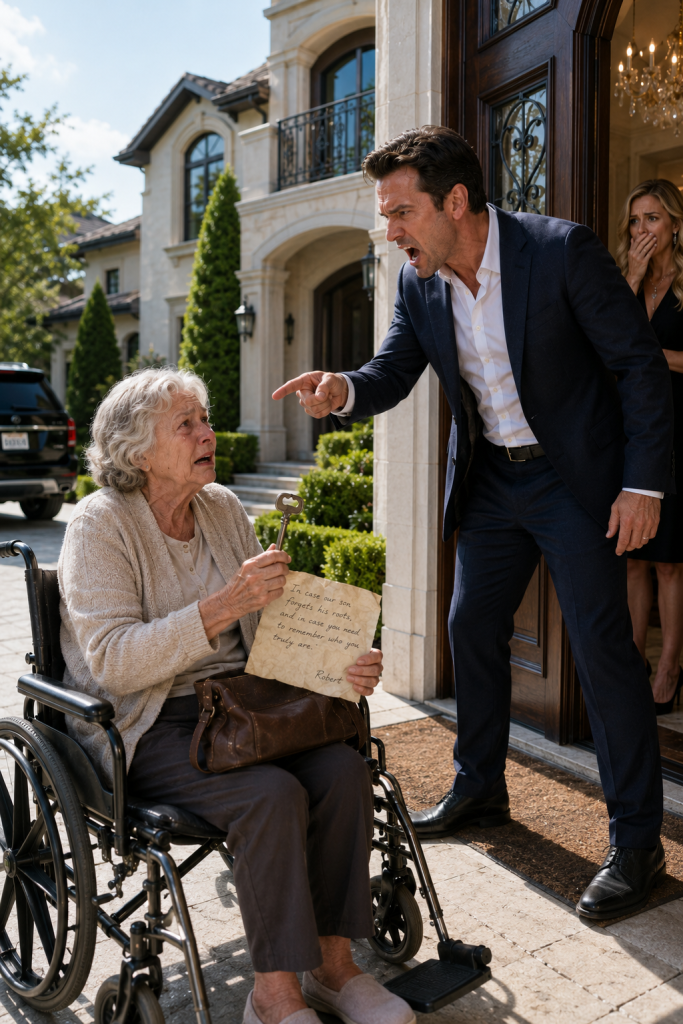
Michael stood there, wearing a perfectly tailored tuxedo. A crystal tumbler of scotch rested in his hand. When his eyes fell on me—wet from a light drizzle, sitting in a battered metal wheelchair with a cheap canvas bag on my lap—the color drained completely from his face.
It wasn’t concern that washed over his features. It wasn’t pity.
It was absolute, unadulterated horror.
“Mom?” he hissed, his eyes darting frantically over his shoulder toward the foyer. “What the hell are you doing here?”
“I have nowhere else to go, Michael,” I said, my voice trembling but determined. “The bank sent a foreclosure notice. I can’t stay in the house. I just need a place to sleep until we can sort this out.”
The string quartet music swelled from the rear of the house. A woman’s high-pitched laugh echoed through the grand hallway.
“Are you out of your mind?” Michael whispered fiercely, stepping onto the porch and pulling the door mostly shut behind him. “Do you know who is in my house right now? Marcus Vance. The senior partner at the firm. I am up for managing director tonight, Helen. Tonight.”
He had called me Helen. Not Mom.
“Michael, please. I’m your mother.”
“You can’t be seen like this,” he panicked, looking at my mud-spattered wheels and my faded coat. He grabbed the handles of my wheelchair. Before I could protest, he jerked me backward, spinning the chair around.
“Michael! What are you doing?” I cried out, grabbing the armrests.
“I’m solving a problem,” he muttered through gritted teeth. He pushed me swiftly down the wrap-around porch, away from the grand entrance, toward the side of the house. He shoved open a heavy side door and wheeled me into absolute darkness.
The heavy scent of gasoline, expensive leather polish, and cold concrete hit my nose. He had pushed me into his multi-car garage. He parked me roughly between a sleek Mercedes and a vintage Porsche.
“Stay here,” he commanded, his voice cold and sharp as a scalpel in the dark. “Do not make a sound. Do not come out. I will deal with you when the guests leave.”
“Michael, it’s freezing in here!” I pleaded, tears finally spilling over my wrinkled cheeks.
He didn’t answer. The door slammed shut, plunging me into pitch blackness. I heard the deadbolt click.
I sat there in the frigid, oily dark, my broken hip aching fiercely in the damp air. The humiliation was a physical weight, pressing down on my chest until I could barely breathe. I was a stray dog. A dirty secret to be hidden away so I wouldn’t ruin his aesthetic. Hours bled by. I shivered uncontrollably, listening to the muffled sounds of wealth and privilege vibrating through the walls.
Suddenly, the door from the house clicked open. A slice of warm, golden light spilled into the garage.
Ashley stood in the doorway, silhouetted in a stunning emerald evening gown. She didn’t turn on the overhead lights. She stepped delicately into the garage, careful not to let her heels touch any oil spots, and approached my wheelchair.
“Helen,” she said, her tone dripping with a mixture of pity and profound irritation. “This was incredibly selfish of you.”
I couldn’t speak. My jaw was locked from the cold and the shock.
Ashley reached into her designer clutch. She pulled out a crumpled wad of twenty-dollar bills and a glossy, trifold pamphlet, dropping them unceremoniously onto my lap.
“Michael called a car for you. It’s waiting at the end of the driveway. He can’t have a cab pulling up to the front door right now. The driver will help you down.”
I looked down at the pamphlet in the dim light. Sunset Pines State Care Facility.
“It’s a government facility,” Ashley said brightly, though her eyes were dead. “They take people with… financial limitations. We’ll have someone come pack up your house before the bank takes it. Goodnight, Helen.”
She turned on her heel, walked back into the warmth of the house, and shut the door. The deadbolt slid into place with a final, echoing thud.
I was entirely, utterly alone.
I wheeled myself out into the cold night, found the waiting town car, and endured the silent ride back to my empty, condemned house. When the driver dropped me off, I found a bright yellow notice stapled to my front door.
Property Seized. Eviction in 48 Hours.
I had lost everything. My son, my dignity, and now, my home.
The next morning, the house felt like a tomb. The air was stale, thick with the dust of memories I was about to be violently separated from. I had forty-eight hours to pack thirty-five years of a life into whatever cardboard boxes I could find.
I started in Robert’s old home office on the ground floor. It was the only room I could access easily, and the hardest one to face. The room still smelled faintly of his cherry pipe tobacco and old paper.
My hands were shaking as I began pulling files from the heavy oak desk. Receipts from vacations we took when Michael was young. Old tax returns. I threw them all into a black trash bag. What did any of it matter now? I was a discarded woman, headed for a state-run ward where I would likely die in a bed that smelled of bleach and someone else’s despair.
I reached up to take down the large, framed portrait of Robert that hung above his desk. It was taken on our twenty-fifth anniversary. He looked so handsome, so fiercely protective.
“You left me, Robert,” I whispered to the glass, hot tears blurring my vision. “You left me to the wolves, and the worst one was our own son.”
A sudden, sharp pain flared in my hip. My knee buckled. The heavy mahogany frame slipped from my trembling fingers.
It hit the corner of the desk and crashed onto the hardwood floor with a deafening shatter. Glass exploded across the room like glittering shrapnel.
“No, no, no!” I sobbed, dropping clumsily to my knees, ignoring the agonizing flare of pain. I reached into the wreckage, desperately trying to salvage the photograph.
As I pulled the torn picture away from the broken wood, the thick cardboard backing of the frame fell apart. Something small and metallic clattered onto the floor, rolling away and coming to a stop against the leg of the desk.
I frowned, wiping my eyes with the back of my dusty sleeve. I crawled forward and picked it up.
It was a key.
It wasn’t a house key, or a car key. It was heavy, made of brushed steel, with a complex, asymmetrical grooving pattern and a series of numbers engraved on the head: 744-B.
I looked back at the ruined frame. Wedged inside the split cardboard backing, where the key had been hidden, was a folded piece of yellowed stationary. I pulled it out with trembling fingers.
It was Robert’s handwriting. Crisp, precise, and deliberate.
Helen,
If you are reading this, it means I am gone, and the worst has come to pass. I never trusted Michael’s ambition, nor the woman who fuels it. I knew that boy would drain us if we let him, and I knew your heart was too kind to stop him.
The money we gave him for that house? I didn’t get it from a secondary mortgage on our home, my love. I forged those bank papers to make you and Michael believe we were broke, so he would stop asking for more.
I took the money from my private investments. Investments I started before we were even married. The house is completely paid off. The eviction notice you might be facing is fake—a failsafe I arranged with an old friend at the bank to trigger if the property taxes went unpaid for too long, just to wake you up to reality.
You are not poor, Helen. Far from it.
Take this key to the Vanguard Private Wealth Depository on 5th Avenue. Box 744-B. In case our son forgets his roots, and in case you need to remember who you truly are.
With all my love, Robert.
I sat on the floor, surrounded by broken glass, my heart hammering a frantic, wild rhythm against my ribs. I read the letter again. And again.
The tears of despair stopped. Slowly, a new, entirely unfamiliar sensation began to bloom in the center of my chest. It wasn’t sorrow. It wasn’t fear.
It was a cold, searing, magnificent fury.
I looked at the steel key in the palm of my hand. It didn’t look like a piece of metal anymore. It looked like a sword.
Two hours later, I wasn’t wearing my faded wool coat. I had dug into the back of my closet and retrieved the tailored black Chanel suit Robert had bought me for our thirtieth anniversary, miraculously preserved in a garment bag. I pinned my silver hair up into a severe, elegant twist. I applied a coat of crimson lipstick.
I didn’t take a medical transport. I called a private black car service, paying with a credit card I hadn’t used in a decade.
The Vanguard Private Wealth Depository was an imposing fortress of marble and tinted glass in the heart of the financial district. There were no tellers, no screaming children, no lines. Just silent, immaculately dressed security guards and a mahogany reception desk.
I rolled my wheelchair up to the desk. The sharply dressed concierge looked up, his polite smile freezing for a fraction of a second at the sight of my chair before professional training took over.
“Good afternoon, Madam. How may I assist you?”
I didn’t speak. I simply placed the heavy steel key on the polished mahogany. 744-B.
The concierge’s eyes widened marginally. His posture straightened. “Of course, Mrs. Sterling. We have been waiting for you. Mr. Sterling left specific instructions. Right this way.”
He didn’t ask for my ID. He didn’t ask me to fill out forms. He ushered me through a series of biometric security doors and into a private, soundproof viewing room lined with velvet. A few minutes later, two guards carried in a massive, heavy steel box and placed it on the table before me.
“Take your time, Madam. Press the button under the desk when you are finished.” They bowed and left, sealing the heavy vault door behind them.
I sat alone in the silence. I took a deep breath, inserted the key, and turned it. The lock disengaged with a heavy, satisfying clunk.
I opened the lid.
It wasn’t filled with gold bars or stacks of cash. It was filled with thick, neatly organized leather binders and legal documents.
I opened the first binder. It was a summary of accounts. Mutual funds, high-yield bonds, international real estate holdings. I stared at the bottom line, my vision blurring. The number wasn’t just large; it was staggering. Robert hadn’t just been a good accountant; he had been a financial savant who played the long game perfectly in secret.
But it was the second binder that made my breath catch in my throat.
It was labeled Oak Creek Holdings, LLC.
I opened it and began to read the dense legal jargon. My eyes scanned over articles of incorporation, promissory notes, and deed transfers.
When Michael had bought his mansion, Robert hadn’t just handed him a check. Recognizing Michael’s reckless financial habits, Robert had structured the “loan” through a shell corporation. Robert—and by extension, as his sole heir, me—was the majority shareholder of Oak Creek Holdings.
And Oak Creek Holdings was the entity that legally owned the deed to Michael’s sprawling suburban estate. The house wasn’t in Michael’s name. It was in the company’s name.
Furthermore, because Michael had defaulted on the repayment terms written into the shadow contract for over five years, a specific clause had been activated.
I turned the page, reading Robert’s neat handwriting on a sticky note attached to a foreclosure authorization form.
Helen. If he breaks your heart, break his reality. All you have to do is sign.
Michael thought he had hidden me in the dark. He thought he could toss me a few crumpled bills and send me to a state ward while he drank scotch in his mansion.
He didn’t own the mansion.
I did.
I picked up the solid gold Montblanc pen resting at the bottom of the box.
Three weeks later, the physical therapy on my hip was progressing beautifully. Perhaps it was the world-class private specialists I had hired, or perhaps it was simply the sheer, intoxicating power of having my life back in my own hands. I was walking with a stylish silver-handled cane now, the wheelchair relegated to the back of the closet in my new, sprawling penthouse overlooking the city skyline.
I had paid off the “fake” arrears on my old house and gifted the property to a lovely young family from my church who had been struggling to make ends meet. I didn’t need it anymore.
It was a crisp Tuesday morning when my private attorney, a ruthless man named Mr. Sterling (no relation, just a delightful coincidence), called me.
“Mrs. Sterling,” his voice crackled smoothly over the phone. “The papers were served at 8:00 AM sharp, exactly as you requested. The local sheriff’s department was on-site to enforce the eviction.”
“And their reaction?” I asked, sipping my Earl Grey tea from a bone china cup.
“I believe the legal term is ‘apoplectic,’ Madam. Your son attempted to call his own lawyers, only to be informed that the shell corporation structure was ironclad. They have until noon to vacate the premises.”
“Thank you, Richard,” I smiled, looking out over the city. “Send the cleaning crew in tomorrow. I want it listed on the market by Friday.”
At 11:45 AM, my cell phone rang. The caller ID flashed Michael.
I let it ring four times before answering.
“Hello?” I said, my tone mild and pleasant.
“Mom?!” Michael’s voice was ragged, panicked, completely stripped of the arrogant veneer he had worn in his tuxedo. I could hear Ashley sobbing hysterically in the background. “Mom, what is going on? The police are here! They’re telling us we have to leave the house! They handed me papers signed by you! There has to be a mistake!”
“There’s no mistake, Michael,” I said smoothly, tracing the rim of my teacup.
“You don’t own this house! We bought this house!” he screamed, the panic giving way to desperation.
“Actually, darling, Oak Creek Holdings LLC bought that house. With money your father provided under very specific contractual obligations that you ignored for half a decade. I am the sole owner of Oak Creek Holdings. Therefore, I own the house. And I have decided to liquidate the asset.”
Dead silence on the line. I could almost hear the gears grinding in his head as the reality of his ruin crashed down upon him.
“Mom… please,” his voice broke, suddenly sounding like a terrified little boy. “Ashley is losing her mind. Where are we supposed to go? The kids… my job… my reputation…”
“I’m sure you’ll figure something out,” I replied, echoing the exact words he had spoken to me not a month prior. “You’re a very resourceful man, Michael. You’re up for managing director, aren’t you?”
“Mom, you can’t do this to us. We’re family!”
I thought about the freezing, gasoline-scented dark of the garage. I thought about the crumpled twenty-dollar bills thrown in my lap. I thought about the flyer for the state-run nursing home.
“Family,” I mused aloud. “That’s an interesting concept. Hang on a second, Michael.”
I walked over to my designer handbag, reached inside, and pulled out the crumpled government pamphlet Ashley had given me.
“I do have a suggestion,” I said into the phone. “There’s a lovely facility called Sunset Pines. It’s state-run. They take people with… financial limitations. It might be a tight squeeze for four of you, but I hear they have government programs you might qualify for.”
“Mom—”
“Don’t worry about it, Michael. Just be realistic.”
I hung up the phone.
I didn’t block his number. I wanted to see the missed calls pile up. I walked over to the floor-to-ceiling windows of my penthouse, looking down at the bustling city below. The rain was starting to fall again, but this time, I wasn’t cold. I wasn’t trapped.
Robert had given me the sword, but I was the one who had swung it. I had closed the door on the son who had closed his on me, and in doing so, I had finally opened the door to the rest of my life.