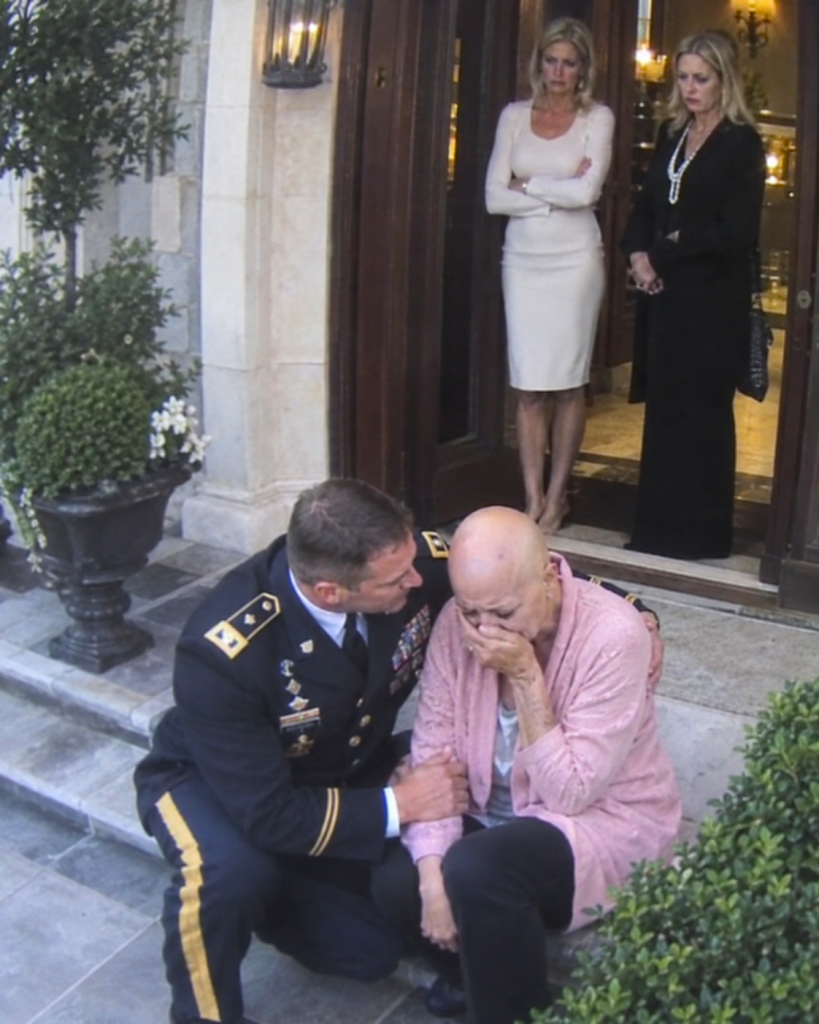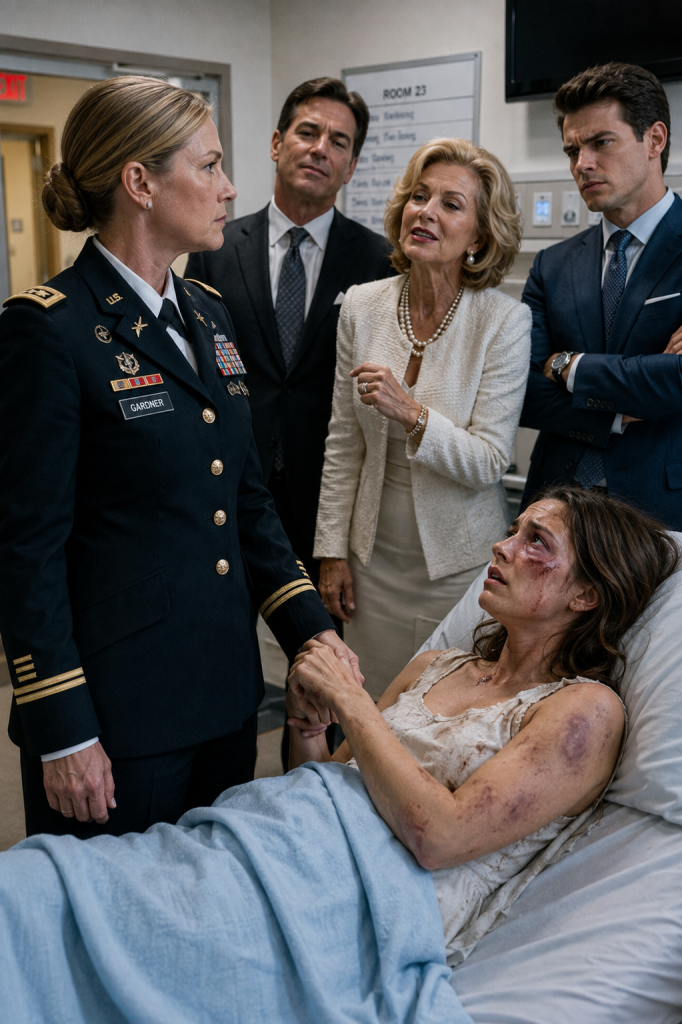
I did not answer Patricia Ferguson.
I did not tell Gregory to wipe the smirk off his face. I did not remind Nicholas that a wedding ring was not a deed of ownership. I did not ask Abigail to repeat what she had already forced herself to say through a swollen lip and a trembling body.
Instead, I turned toward the nurse standing just outside the observation room.
“Please call the attending physician,” I said. “And hospital security.”
Patricia’s smile thinned.
“That won’t be necessary.”
I looked at her then, really looked at her. She had the kind of face that was used to doors opening before she touched them. Perfect hair, perfect pearls, perfect posture. A woman who had learned long ago that wealth could soften ugly truths until they became misunderstandings.
“My daughter is injured,” I said. “It is necessary.”
Nicholas took one step forward. “You’re making this worse.”
Abigail flinched.
It was small, almost invisible, but I saw it. I saw the way her shoulders pulled inward at the sound of his voice. I saw the way her fingers clutched the edge of the blanket, as if the thin cotton could become a wall between them.
That one movement told me more than Nicholas ever could.
I placed myself between him and my daughter.
“Do not come any closer.”
My voice was quiet. Not soft. Not uncertain. Just quiet.
For the first time, Nicholas hesitated.
Gregory chuckled, but the sound did not carry the same confidence it had moments earlier. “This is ridiculous. We came here to check on her.”
“No,” Abigail whispered behind me.
Her voice was fragile, but it cut through the room like a match struck in darkness.
“You came here to make sure I stayed quiet.”
The nurse returned with two security officers and a doctor in a white coat whose badge read Dr. Elaine Morris. She had kind eyes, but they sharpened the moment she took in the room.
“Everyone who is not immediate medical support needs to step out,” Dr. Morris said.
Patricia lifted her chin. “I am her mother-in-law.”
“I said immediate medical support.”
Gregory’s face hardened. “Do you know who we are?”
Dr. Morris looked at him with the tired patience of someone who had been asked that question too many times by too many people who thought it mattered.
“I know this is my patient’s room,” she said. “And I know she appears frightened. Please leave.”
Nicholas looked past me toward Abigail. “Think very carefully before you do this.”
Abigail closed her eyes.
I felt something in me strain against its own restraint. It would have been easy, dangerously easy, to answer him in the language of command. To fill the room with a voice that had crossed deserts, briefing rooms, and battle lines. But Abigail did not need a commander right now.
She needed her mother.
So I reached back without looking and found her hand.
“She is thinking clearly,” I said. “You need to leave.”
For a moment, no one moved. Then Patricia exhaled, smooth and controlled.
“Fine. We’ll let the hospital do its job.” Her eyes settled on Abigail. “But lies have consequences, dear.”
Security escorted them out.
The room seemed to expand after they left, as if the air itself had been holding its breath.
Abigail’s hand went limp in mine.
“Mom,” she whispered, “I’m sorry.”
Those two words nearly undid me.
I sat carefully on the edge of the bed, close enough for her to feel me there, not so close that she would feel trapped.
“You have nothing to apologize for.”
Tears slid into her hairline. “I should have told you.”
“Yes,” I said gently. “But we are not starting with what should have happened. We are starting with what happens now.”
Dr. Morris moved closer, her voice low and steady. “Abigail, I need to examine you properly. We can document your injuries, take photographs for your medical record, and discuss options. Nothing happens without your consent unless there is an immediate medical emergency. Do you understand?”
Abigail swallowed. “Will they find out?”
“They may know you were treated,” Dr. Morris said carefully, “but your medical details are protected. We also have a social worker who can help with safety planning.”
Abigail looked at me then, and for the first time since I had entered the hospital, I saw the woman she had been fighting to remain. Terrified, yes. Hurt, yes. But still there.
“I don’t want to go back,” she said.
“You won’t,” I answered.
I said it before I knew every detail. Before I knew where we would sleep that night, what calls would need to be made, what legal steps would follow, or how far the Fergusons’ influence truly reached.
But some promises were made before the plan existed.
This was one of them.
Dr. Morris asked if Abigail wanted me to stay during the examination. Abigail nodded immediately, and I stayed. I held her hand while the doctor noted bruising, tenderness, swelling. I kept my face calm while every observation landed inside me like a stone.
When the social worker arrived, she introduced herself as Marisol Vega. She was a short woman with silver-streaked hair and a canvas bag full of folders, but she carried herself with a grounded seriousness that made the room feel less unstable.
“Abigail,” Marisol said, “I know tonight is overwhelming. I’m not here to push you. I’m here to make sure you know your choices.”
Choices.
The word had weight.
Abigail had once had choices everywhere: what color to paint her apartment, what city to visit on vacation, what charity to volunteer with on weekends, whether to put cinnamon in her coffee. Somewhere along the way, Nicholas Ferguson had narrowed her life until every option felt like a hallway with a locked door at the end.
Marisol spoke calmly about protective orders, police reports, safe housing, documentation, and trusted contacts. She did not make it sound simple. She did not make it sound hopeless either.
“Do you have your identification?” she asked.
Abigail shook her head. “Nicholas kept most of my documents in the home office. Passport, birth certificate, some financial paperwork. He said it was safer that way.”
Patricia’s voice returned to me.
Our family has judges, politicians, and reporters who owe us favors.
I watched Abigail’s face as she admitted each small loss. The phone. The documents. The bank access Nicholas had slowly persuaded her to combine with his. The old friends who had stopped calling because she had canceled plans too many times. The way he had complained whenever she visited me at Fort Liberty, not with anger at first, but wounded disappointment.
You’re always choosing your mother over your husband.
That was how control entered a life, I realized. Not always as a locked door. Sometimes as a hurt expression. A sigh. A favor requested again and again until refusal felt cruel.
By midnight, Abigail was discharged with instructions, pain medication, and a packet of resources. Her injuries were serious, but not life-threatening. The phrase should have comforted me. It did not.
In the parking garage, the fluorescent lights hummed overhead. Abigail wore hospital scrubs because her dress had been placed in an evidence bag. She moved slowly, one arm wrapped around her ribs.
I opened the passenger door of my truck and helped her in.
She looked smaller under the harsh lights.
“I don’t want to go to your house,” she said.
I paused. “Why?”
“They know where it is.”
“They also know I am not easily startled.”
A faint, broken laugh escaped her, then disappeared. “Mom.”
“I know.” I closed the door gently, walked around, and got behind the wheel. “There’s a place near base. A furnished apartment I’ve used for visiting officers’ families in transition. It’s quiet, private, and secure enough for tonight. Tomorrow, we make better arrangements.”
Abigail leaned her head against the window. “You already have a plan?”
“I have the beginning of one.”
She watched the hospital disappear behind us. “I forgot what that felt like.”
“What?”
“Someone making a plan that wasn’t meant to trap me.”
I tightened my hands around the steering wheel, then loosened them deliberately.
Charlotte’s lights blurred past us. The city looked almost peaceful from the road, as if people were not breaking apart in quiet rooms behind bright windows. Abigail closed her eyes, but I knew she was not sleeping. Every few minutes, her breathing hitched as if some thought had caught her by the throat.
At the apartment, I checked the hallway before unlocking the door. Habit, some would call it. Survival, others. To me, it was simply the way my body had learned to enter unknown spaces.
The apartment was plain but clean: gray sofa, small kitchen, two bedrooms, a lamp with a crooked shade. Abigail stood just inside the doorway, staring as though she did not know what to do without someone telling her where to stand.
“You can take the bedroom on the left,” I said. “Bathroom is across the hall. I’ll make tea.”
“I don’t think I can sleep.”
“Then we won’t call it sleeping. We’ll call it resting.”
She gave another faint laugh.
In the kitchen, while water heated, I sent three messages. One to my commanding officer, requesting emergency personal leave. One to a trusted civilian attorney I had known for twelve years, asking for a confidential call at first opportunity. One to my younger brother Marcus, a former detective turned private investigator, asking only: Are you awake?
He replied within seconds.
For you? Always.
I stared at the screen for a moment, then typed back: Abigail is safe with me. I need advice, not action.
His response came quickly.
Understood. Tell me where and when.
I made chamomile tea and carried it to the living room. Abigail sat curled in the corner of the sofa, knees drawn to her chest, the blanket around her shoulders.
She accepted the mug with both hands.
“Did Dad know?” she asked.
Her father had been gone five years, taken by a heart attack on an ordinary Tuesday morning while fixing a cabinet hinge. Some griefs never became less strange. They simply became more familiar.
“No,” I said. “I don’t believe he did.”
“He would’ve hated Nicholas.”
“He might have hidden it politely for the first dinner.”
Abigail’s mouth trembled.
“Then he would’ve asked him too many questions about tire pressure and retirement accounts,” she said.
“And whether he knew how to change a breaker.”
“And Nicholas would’ve pretended he did.”
“And your father would’ve known he was lying.”
The memory settled between us, tender and painful.
For a few minutes, neither of us spoke.
Then Abigail said, “I think I married him because I was lonely.”
That confession came out so softly I almost missed it.
“You don’t have to explain tonight.”
“I do,” she said. “Maybe not to you. Maybe to myself.”
She stared into the tea.
“When Dad died, you went back to work so fast. I know you had to. I never blamed you. But the house got so quiet. Everyone kept saying I was strong because I was your daughter, and I tried to be. Nicholas showed up like he had studied exactly what I needed. Flowers on Dad’s birthday. Coffee when I worked late. He listened. At least I thought he did.”
I sat beside her, leaving space between us.
“At first, Patricia was kind,” Abigail continued. “Too kind. She bought me clothes for events, introduced me to people, said I had such natural grace. Then slowly, everything was a test. Was my dress appropriate? Had I spoken too casually? Why did I mention my job when Nicholas was clearly under pressure? Why did I laugh too loudly at dinner?”
She swallowed.
“And Nicholas would comfort me afterward. He’d say, ‘She’s difficult, but she means well.’ Then later, he started saying the same things she did.”
Outside, a car passed slowly down the street. Abigail stopped talking until the sound faded.
“Tonight was because of a fundraiser,” she said. “I heard Gregory talking to someone in the library. He said a woman named Lena had become a problem again. Nicholas saw me in the hallway. After we got home, I asked who Lena was.”
Her fingers tightened around the mug.
“He smiled at me like I was being silly. Then he asked if I had been listening at doors like hired help.”
“Lena,” I repeated.
Abigail nodded. “I don’t know her last name. I only know Gregory said she had ‘kept the wrong envelope.’”
That detail landed in the room with a quiet heaviness.
An envelope.
A woman named Lena.
A family with favors from judges, politicians, and reporters.
I did not say what I was thinking. Abigail had given enough of herself for one night.
“Drink your tea,” I said. “We’ll write down what you remember tomorrow.”
She shook her head. “I might forget.”
“You won’t.”
“I forgot myself for two years.”
The words broke open something in both of us.
I reached for the notebook on the coffee table. “Then we write tonight.”
So we did.
Not a formal statement. Not a legal document. Just memory, captured before fear could rearrange it.
Nicholas hiding her phone after arguments.
Patricia correcting her in front of guests, then insisting she was only trying to help.
Gregory making comments that sounded like jokes unless you were the one being measured by them.
The guest house.
The fundraiser.
Lena.
The envelope.
At 3:16 in the morning, Abigail finally slept.
I did not.
I stood in the kitchen beneath the low yellow light and read her notes again, each line written in her uneven hand. The temptation to move fast was powerful. Make calls. Confront people. Force doors open. Demand answers.
But speed was not the same as strategy.
I had spent my life learning the difference.
At dawn, Marcus arrived with coffee, breakfast sandwiches, and a face that went still the moment he saw me.
He did not ask if I was all right. He knew better.
“Where is she?”
“Sleeping.”
He nodded and placed the food on the counter. Marcus was six years younger than me, broader through the shoulders, with a beard gone mostly gray at the chin. He had the same eyes our mother had given us, dark and searching.
I handed him a copy of Abigail’s notes.
He read in silence. The longer he read, the more his expression changed from concern to something colder and more focused.
“Ferguson,” he said at last. “As in Ferguson Development?”
“Yes.”
He leaned back against the counter. “That family has been polishing its own reputation for decades. Real estate, charity boards, campaign donations. They’re not untouchable, but they’re used to people acting like they are.”
“I don’t want drama,” I said. “I want Abigail safe. I want the truth documented properly. I want no mistakes.”
Marcus looked at me. “That sounds exactly like you.”
“I mean it.”
“I know.” He tapped the notebook. “Lena might be important.”
“That’s what I thought.”
“I can ask around quietly. Public records. Old articles. Civil filings. Missing persons databases. Nothing reckless.”
“Nothing that can be framed as harassment.”
His mouth curved without humor. “You do remember I did this professionally.”
“I remember you once followed the wrong red Honda for forty minutes.”
“One time.”
“It had bumper stickers.”
He sighed. “It was raining.”
For the first time that morning, I almost smiled.
Then Abigail’s bedroom door opened.
She stepped into the hallway slowly, one hand against the wall. When she saw Marcus, she froze.
He lifted both hands slightly. “Hey, kid.”
Abigail’s face crumpled.
Marcus crossed the room in two strides, then stopped short, waiting. He did not pull her into a hug. He did not crowd her.
That waiting undid her more than any embrace could have.
She walked into his arms and began to cry.
He held her with a gentleness that seemed almost impossible for a man his size.
“I’m sorry,” she sobbed.
Marcus closed his eyes. “No. Don’t start there.”
By late morning, the apartment had become a quiet command center, though I would never have called it that aloud. Abigail showered and changed into soft clothes I had brought from my emergency bag. Marisol called to check on her. My attorney, Dana Whitcomb, joined us by video.
Dana was in her fifties, sharp-eyed and practical, with a voice that could cut through panic without sounding cold.
“First priority is safety,” Dana said. “Second is documentation. Third is preventing the Fergusons from shaping the story before Abigail decides how to proceed.”
Abigail sat beside me, pale but attentive.
“Do I have to go to court right away?” she asked.
“Not necessarily,” Dana said. “You have options. A protective order is one. A police report is another. Separation proceedings, recovery of personal documents, financial protections—we can handle these in stages. You don’t need to solve your whole life today.”
Abigail breathed out, as if someone had removed a weight from her chest.
“What about them saying I’m unstable?”
Dana’s expression softened. “People who rely on that word often use it because they’re afraid of specifics. Specifics are stronger.”
After the call, Abigail asked to be alone for a while. She went into the bedroom, leaving the door half open.
Marcus and I stayed in the kitchen.
“I found three Lenas connected to Ferguson Development,” he said quietly, turning his laptop toward me. “One is a landscape architect in Raleigh, one is a donor relations consultant in Atlanta, and one is Lena Hart.”
He clicked a file.
A photograph appeared from a local news article dated four years earlier. A young woman with auburn hair stood beside Gregory Ferguson at a charity gala, both smiling toward the camera.
“Who is she?” I asked.
“Former executive assistant to Gregory. Worked for the family office for eighteen months. Then she disappeared from public view. No social media updates after October of that year. No LinkedIn changes. No obituary. No missing persons report that I can find.”
“That doesn’t mean she vanished.”
“No,” Marcus agreed. “But it means someone stopped leaving ordinary traces.”
He clicked again. Another document appeared: a civil complaint filed three years earlier, then voluntarily dismissed within weeks. The plaintiff’s name had been sealed in the public summary, but the defendant was Ferguson Holdings.
“What kind of complaint?”
“Employment dispute, according to the docket category. Wrongful termination or something close. Details sealed.”
“Can you get them?”
“Not legally without cause or permission.”
“Then don’t.”
He gave me a look. “I wasn’t going to.”
Before I could answer, Abigail spoke from the hallway.
“Lena Hart.”
Marcus and I turned.
Abigail stood barefoot in the doorway, gripping the frame.
“You know her?” I asked.
Her face had gone even paler. “Not personally. But I’ve seen her.”
“Where?”
“In a photograph.” Abigail pressed a hand to her forehead. “In Nicholas’s desk. Months ago. I was looking for stamps. There was a drawer that stuck, and when I pulled it too hard, a stack of papers slid forward. A photo fell out.”
“What was in it?”
“Lena. I didn’t know her name then. She was standing on the back terrace of the Ferguson house. She looked upset. Patricia was beside her.”
Marcus moved carefully. “Was there anything written on the photo?”
Abigail closed her eyes, trying to reach the memory.
“Yes,” she said. “On the back. One word.”
I waited.
“Settlement.”
The room went silent.
Abigail opened her eyes. “What does that mean?”
“It may mean nothing by itself,” I said.
She looked at me as if she wanted to believe me and knew she could not.
I softened my voice. “It means we keep writing things down. It means we do not jump to conclusions before we have facts.”
Marcus nodded. “And it means I look for Lena Hart by completely ordinary methods.”
That afternoon, the first message came from Nicholas.
Abigail’s replacement phone buzzed on the coffee table. She stared at it as though it had hissed.
Dana had advised her not to respond to anything from the Fergusons, but to preserve every message.
The text read:
Abby, this has gone too far. My mother is devastated. Come home so we can talk like adults. You know how things get when you exaggerate.
Abigail’s breathing changed.
I reached for the phone, then stopped. “Do you want me to read it aloud or just save it?”
“Save it,” she said.
Another message appeared seconds later.
I love you. Don’t let your mother turn this into something ugly.
Abigail laughed once, a sound without joy.
“He always does that.”
“What?”
“Makes himself the loving one. Everyone else is the problem.”
A third message arrived from Patricia.
Dear Abigail, I know emotions are high. I have already spoken with Dr. Bellamy, and we are prepared to arrange the care you clearly need. No one wants this to become public.
Dr. Bellamy.
Abigail recoiled. “That’s the psychiatrist Patricia made me see last year.”
“Made you?” Marcus asked.
“She said it would help me adjust to family pressure. Nicholas drove me there. Dr. Bellamy barely asked questions. Patricia had already spoken to him before my appointment.”
I looked at Marcus.
He was already writing down the name.
Dana called again after we forwarded the messages.
“Do not respond,” she said. “These are useful. Especially the part about arranging care. I’ll send a formal notice that all communication goes through counsel.”
“Will that make them angry?” Abigail asked.
Dana’s voice was steady. “Possibly. But anger is not the same as power.”
That sentence stayed with me.
The next two days unfolded slowly, almost painfully. Not because nothing happened, but because everything happened in careful, measured steps.
Abigail filed a police report with me and Dana present. The officer who took her statement was respectful and patient. He did not promise outcomes. He did not dismiss her either. That mattered more than he probably knew.
Dana petitioned for temporary protection. Marcus located a secure place for Abigail to stay longer term. I extended my leave through official channels without offering unnecessary details to anyone who did not need them.
And the Fergusons reacted exactly as Dana had predicted.
First came concern.
Then confusion.
Then disappointment.
Then pressure through mutual acquaintances.
A woman from one of Abigail’s charity boards left a voicemail saying Patricia was “beside herself” and hoped Abigail would not “ruin years of good work over a private marital disagreement.”
A reporter requested comment on “rumors of a domestic misunderstanding involving a prominent local family.”
An old college friend of Abigail’s sent a cautious message: Are you okay? Nicholas said your mom took you somewhere and won’t let anyone speak to you.
That one hurt her most.
“He’s making me sound kidnapped,” Abigail said, sitting on the floor with her back against the sofa. “And part of me still wants to explain it so no one thinks badly of me.”
“That part of you is tired,” I said. “Let Dana answer.”
“I hate that I need lawyers to say I’m not lying.”
“You don’t need them to make you honest. You need them to keep dishonest people from drowning out your voice.”
She looked at me for a long moment.
“Were you ever afraid like this?”
The question was not about deployments. Not really.
I sat beside her on the floor.
“Yes.”
She turned toward me.
“When?”
I considered giving the simple answer. A mother’s answer. Something broad enough to be true and vague enough to protect us both.
But Abigail had lived too long inside polished half-truths.
“When your father died,” I said. “I was afraid I would fail you. I was afraid that if I stopped moving, grief would swallow the house. So I kept moving. I told myself stability looked like schedules and work and getting things done. I didn’t realize you needed me to sit in the quiet with you.”
Her eyes filled.
“I knew you loved me.”
“I did. I do. But love still has to learn how to show up in the form someone needs.”
She wiped her cheek. “I didn’t know how to ask.”
“I didn’t know how to listen.”
That truth settled between us, painful but clean.
For the first time in days, Abigail leaned against my shoulder not because she was shaking, but because she chose to.
On the fourth day, Marcus called from his car.
“I found Lena Hart.”
I stepped into the apartment hallway and closed the door behind me.
“Alive?”
“Yes. Living under her middle name in Wilmington. She runs a small bookkeeping service.”
Relief came first. Then caution.
“Did you contact her?”
“No. I found a business registration, a mailing address, and one recent photo from a community fundraiser. She looks different, but it’s her.”
“Does she have any connection to Nicholas?”
“Not directly. Gregory was her supervisor. But there’s something else.” Marcus hesitated. “Her father owned a small construction company. Hart & Lowe Contracting. They did subcontract work on three Ferguson projects.”
“And?”
“One of those projects had a fatal accident six years ago. Worker fell from scaffolding. Investigation found safety violations by the subcontractor. Hart & Lowe folded within a year.”
I closed my eyes.
“Lena’s father?”
“No. A worker named Samuel Ortiz.”
“What does that have to do with Abigail?”
“I don’t know yet. But after the accident, Ferguson Development walked away clean. Hart & Lowe took most of the blame. Lena went to work for Gregory two years later.”
“That makes no sense.”
“Unless she was trying to find something.”
A door opened at the far end of the hallway. I lowered my voice.
“Do not contact her without Dana involved.”
“I know.”
“Marcus.”
“I know,” he repeated, gentler this time. “I’m not chasing shadows. I’m following paper.”
When I returned inside, Abigail looked up from the table where she had been sorting documents Dana had asked her to list.
“You heard something.”
I had never been good at hiding truth from my daughter.
“Marcus found Lena Hart.”
Her fingers stilled.
“Is she okay?”
“She appears to be.”
Abigail covered her mouth, and her shoulders sagged with relief. “I kept imagining the worst.”
“So did I.”
“Can we talk to her?”
“Not yet. Dana needs to handle it.”
Abigail nodded. Then, after a moment, she said, “There’s something I haven’t told you.”
I sat down across from her.
“The night before the fundraiser, Nicholas argued with Gregory in the garage. I heard Gregory say, ‘You married the colonel’s daughter and still couldn’t keep your house in order.’ Nicholas told him to lower his voice. Then Gregory said, ‘If Abby remembers what Lena remembered, Mother won’t protect you twice.’”
Every hair on my arms seemed to rise.
“Protect him from what?”
Abigail shook her head. “I don’t know. I thought maybe an affair. Some family scandal. I didn’t know what Lena had to do with it.”
“Why didn’t you mention this before?”
Her eyes dropped.
“Because I wasn’t sure I heard it right. Because I’m tired of sounding uncertain. Because every time I say something, I hear Nicholas telling me I’m confused.”
I reached across the table and placed my hand over hers.
“Uncertainty is not dishonesty. It is just uncertainty. We write it down exactly that way.”
So we did.
That evening, Dana came in person. She brought a portable scanner, two thick folders, and an expression that told me she had news she did not want to deliver carelessly.
Abigail sat upright, bracing herself.
“The temporary order was granted,” Dana said.
Abigail closed her eyes. “Okay.”
“That means Nicholas cannot contact you directly. Neither can third parties acting on his behalf. Violations should be documented and reported.”
“And my documents?”
“We sent a formal demand for return of personal property. Passport, birth certificate, financial records, personal devices, any medical documents.”
Abigail’s jaw tightened. “They won’t give them back.”
“They might not. But refusal creates a record.”
Dana placed one folder on the table.
“There’s another matter.”
I felt the room change.
“What matter?” I asked.
Dana looked at Abigail. “I reviewed the messages from Patricia, including the reference to Dr. Bellamy. I also requested your pharmacy records with your permission. There are prescriptions from last year that you said you never took.”
Abigail frowned. “What prescriptions?”
Dana slid a paper forward.
Abigail read it, then looked up slowly. “I don’t recognize these.”
“They were filled at a pharmacy near the Ferguson estate,” Dana said. “Three times.”
“I never picked them up.”
“Someone did.”
The apartment went very still.
I read the names of the medications. My mouth went dry.
“Could Nicholas have picked them up?” Abigail asked.
“Possibly,” Dana said. “A spouse sometimes can, depending on the circumstances and pharmacy policies. We’ll need records.”
Abigail pushed back from the table and stood. “So when he told people I was unstable, there was paperwork to make it look real.”
“No conclusion yet,” Dana said softly. “But it is a serious question.”
Abigail walked to the window.
Outside, the sky had turned the color of bruised lavender, evening pressing gently against the glass. For a long time she said nothing.
Then she turned back.
“I want to talk to Lena.”
Dana folded her hands. “I anticipated that. I located counsel who represented her briefly in the sealed employment matter. I cannot force contact, but I can send a discreet request through appropriate channels.”
“Will she answer?”
“I don’t know.”
Abigail nodded. “Ask her.”
Dana studied her face. “You understand she may not want to revisit any of this.”
“I understand.” Abigail’s voice shook, but held. “But if she knows something that can help me understand what happened in that house, I need to ask.”
That night, Abigail slept poorly. I heard her wake twice, pacing the hall, opening cabinets, turning on lights. Around four in the morning, I found her sitting at the kitchen table with my old field notebook in front of her.
“I remembered something else,” she said.
I sat across from her, robe pulled tight around me.
“What?”
“The guest house.”
I waited.
“When they locked me in, I tried the desk drawers. Most were empty. But one had old stationery in the back, behind the drawer liner. Ferguson crest at the top. There were impressions on the paper.”
“Impressions?”
“Like someone had written on a page above it, and the pressure left marks.”
My mind sharpened. “Did you keep it?”
She looked ashamed. “No. I was scared. I was focused on finding a way out.”
“You were surviving.”
“But I remember a name. Not from the words exactly. More like from the shapes pressed into the page.”
“What name?”
“Samuel,” she said. “And maybe the word ‘site.’”
Samuel Ortiz.
The worker who died.
The old accident was no longer floating at the edge of the story. It had stepped into the center of the room.
By morning, Dana had received a response from Lena Hart’s former attorney.
Lena was willing to speak.
Not on the phone. Not by email.
In person.
At a church garden in Wilmington, late afternoon, two days later.
Dana insisted on driving separately. Marcus came too, though he kept his distance, sitting on a bench near the entrance with a newspaper he did not read. Abigail wanted me beside her, and I was.
The church garden was small and carefully tended, with brick paths and white flowers bending in the coastal breeze. Wind chimes moved somewhere beneath the eaves, their sound faint and irregular.
Lena Hart arrived exactly at four.
She looked older than the photograph, though not by years alone. Her auburn hair was cut short now, tucked behind her ears. She wore simple slacks, a blue blouse, and no jewelry except a thin silver bracelet.
Her eyes found Abigail first.
“You look like her,” Lena said.
Abigail blinked. “Like who?”
Lena seemed to catch herself. She glanced at Dana, then at me.
“I’m sorry. I shouldn’t have started there.”
Dana kept her voice calm. “Lena, thank you for agreeing to meet. You can stop at any time.”
Lena nodded, but her gaze returned to Abigail.
“I heard you married Nicholas,” she said. “I hoped maybe he had changed.”
Abigail’s face tightened.
“He hadn’t,” Lena said quietly. “I’m sorry.”
We sat at a small iron table beneath a crepe myrtle tree. For a moment, the only sound was traffic in the distance and the restless music of the wind chimes.
Lena folded her hands.
“I worked for Gregory Ferguson,” she began. “At first, I thought I was lucky. Good salary, good benefits, impressive office. My father’s company had collapsed after the Ortiz accident, and we were drowning in bills. Gregory said he admired loyalty. Said he liked helping people who understood hard work.”
Her mouth twisted faintly.
“I believed him.”
She explained slowly, carefully, as though each sentence had to pass through a locked gate before she could speak it.
Her father’s company had not been responsible for the missing safety supports on the Ferguson project, she said. At least not according to records Lena had seen before they vanished. Hart & Lowe had warned Ferguson Development twice about rushed timelines and equipment issues. After Samuel Ortiz died, the warnings disappeared from the official file.
“My father signed a settlement because he was exhausted,” Lena said. “He thought fighting them would destroy what was left of us. Then he got sick. I went to work for Gregory because I wanted access. I thought if I could find the original emails, the inspection notes, anything…”
“You found something,” Abigail said.
Lena looked at her.
“Yes. And no.”
She took a small envelope from her purse. It was plain, cream-colored, worn at the corners.
My pulse shifted.
“I kept copies of what I could,” Lena said. “Not enough to reopen anything by itself. But enough to show the public story was incomplete.”
Dana leaned forward slightly. “Why was the civil case sealed?”
Lena’s eyes dropped to the envelope.
“Because Patricia Ferguson offered me a choice. Sign, accept money, and disappear quietly—or watch my father be accused of forging documents and causing Samuel Ortiz’s death. He was already dying. I couldn’t put him through it.”
Abigail’s eyes filled with tears. “I’m so sorry.”
Lena looked at her with a sadness that felt strangely personal.
“There’s more.”
The garden seemed to quiet.
Lena opened the envelope and removed a photograph. She placed it on the table.
It was old, maybe twenty-five years old, edges curled, colors faded. Patricia Ferguson stood on the terrace of the family estate beside a younger man I did not recognize. Between them stood a little girl with dark hair, perhaps six or seven years old, holding a stuffed rabbit by one ear.
Abigail stared at the image.
“Who is that child?”
Lena did not answer immediately.
Instead, she looked at me.
“Colonel Gardner,” she said, “before your daughter married Nicholas Ferguson, did anyone in that family ever mention knowing your husband?”
My breath caught.
“My husband?”
Lena nodded. “Daniel Gardner.”
The sound of his name in her mouth struck me with such force that for a moment I could not speak.
“No,” I said finally. “Why would they?”
Lena slid a second item across the table.
It was not a photograph.
It was a folded copy of an old letter, creased so many times the paper had begun to split. Dana reached for it first, but Abigail’s hand moved faster.
She unfolded it carefully.
I watched her face change as she read.
Confusion first.
Then disbelief.
Then something that looked like fear.
“Mom,” she whispered.
I took the letter from her.
The handwriting was Daniel’s.
My Daniel.
The man who had packed school lunches with uneven sandwiches. The man who had danced with Abigail in the kitchen when she was small. The man whose shirts I still could not bring myself to give away.
The letter was short.
Patricia,
I will not ask again. Stay away from my family. Whatever happened before my marriage is finished, and no threat you make will change that. Rebecca knows enough. Abigail is my daughter in every way that matters, and I will protect her from your family’s games if it costs me everything.
Daniel
The garden tilted around me.
For years, I had believed grief had taken every secret my husband had kept and buried them with him.
But there, under the soft afternoon light, his past sat open in my hands.
Abigail stared at me, barely breathing.
“What does that mean?” she asked.
Lena’s voice was almost a whisper.
“It means the Fergusons didn’t choose you by accident.”
I looked down at the old photograph again.
At Patricia.
At the unknown man.
At the little girl with dark hair.
Then I saw it.
The child’s eyes.
Abigail’s eyes.
PART 3
For several seconds, no one at the little iron table moved.
The church garden remained exactly as it had been a moment earlier—the white flowers nodding in the breeze, the wind chimes tapping softly beneath the eaves, the late afternoon sun warming the brick path. Somewhere beyond the hedges, a car door closed. A bird hopped along the grass near the fountain and lifted its head as if listening.
But the world I had known had shifted beneath my feet.
I held Daniel’s letter in both hands.
The paper trembled.
Not because of the wind.
Patricia,
I will not ask again. Stay away from my family. Whatever happened before my marriage is finished, and no threat you make will change that. Rebecca knows enough. Abigail is my daughter in every way that matters, and I will protect her from your family’s games if it costs me everything.
Daniel
I read the words once.
Then again.
Then a third time, slower, hoping that if I looked carefully enough, they might rearrange themselves into something less impossible.
Abigail sat across from me, staring at the photograph of the little girl on the terrace. Her face had gone still in a way that frightened me more than tears would have.
“Mom,” she said quietly, “what does this mean?”
I wanted to answer.
I had answered commanding officers under pressure. I had briefed rooms full of people who expected certainty. I had made decisions with incomplete information and accepted the weight of consequences.
But I did not know how to answer my daughter when the foundation of her life had just cracked open in front of her.
“I don’t know,” I said.
It was the hardest truth I had spoken in years.
Lena Hart lowered her eyes. “I’m sorry. I thought you knew something.”
Dana Whitcomb reached for the letter carefully, not taking it until I let go. The attorney in her scanned the lines, but the woman beneath the profession softened as she read.
“Lena,” Dana said, “where did you get this?”
Lena folded her hands on the table. “From Gregory’s archive cabinet.”
“Archive cabinet?” Marcus asked from behind us.
He had abandoned the newspaper. I had not even heard him approach.
Lena glanced toward him, wary.
“My brother,” I said. “Marcus. He’s helping us.”
She nodded, though the caution did not leave her face. “Gregory kept old files in a locked office at the estate. Legal settlements, property records, family correspondence. Most of it was boring. Some of it wasn’t. I copied anything that seemed connected to my father’s company, but there were other folders too.”
“And this was in one of them?” Dana asked.
“Yes. A folder labeled Gardner.”
My own name sounded strange coming from her.
Abigail’s voice was small. “There was a folder about us?”
“About your father,” Lena said. Then, after a pause, “And about you.”
Abigail stood so suddenly her chair scraped against the brick.
I reached for her, but she stepped back.
“About me,” she repeated.
The words were flat, too calm.
Lena’s eyes filled with regret. “I didn’t know what it meant. Not then. I only knew Patricia had some connection to Daniel Gardner, and Gregory seemed very interested in it. I kept the letter because it didn’t belong in their files.”
Abigail looked at me. Her eyes were shining now, but she refused to blink.
“Did Dad ever tell you about Patricia?”
A memory stirred at the edge of my mind, faint as dust in sunlight.
Daniel, years ago, standing at the kitchen sink after a charity dinner in Charlotte. He had been quiet on the drive home. When I asked if something was wrong, he kissed my forehead and said, “Just saw someone I used to know.”
Someone.
Not Patricia.
Not Ferguson.
Just someone.
I had been tired. Abigail had been eleven and half-asleep in the back seat. I let the answer pass.
Now that small moment returned with a sharpness that stole my breath.
“He may have,” I said. “Not by name.”
Abigail’s face tightened. “So he lied.”
“No,” I said, too quickly. Then I steadied myself. “He kept something from us. That is true. But we don’t know why.”
She looked away.
The sunlight caught the bruises fading along her jaw. Yellow at the edges now. Healing, but still visible.
I saw what the last days had demanded from her. She had escaped a marriage that had taught her to doubt her own memory. Now the past was asking her to doubt the people who had loved her most.
That was too much for one heart.
I stood and moved toward her slowly.
“Abigail.”
She shook her head. “Everyone keeps telling me not to jump to conclusions. But every time I wait, another secret appears.”
Dana placed the letter back into its envelope. “Then we gather facts in the right order.”
Abigail laughed once, painfully. “That sounds so reasonable.”
“It is not meant to erase how you feel,” Dana said. “It is meant to protect you from people who have had years to arrange the truth in ways that benefit them.”
Lena looked down at the photograph again.
“There was another file,” she said.
Every eye turned to her.
“I didn’t take it. I only saw the label before Gregory came back into the room.”
“What label?” Marcus asked.
Lena swallowed.
“Custody correspondence.”
The word custody seemed to strike Abigail physically. She pressed a hand against the back of the chair.
“No,” I whispered.
Not because I knew it was false.
Because I was afraid it was not.
Dana’s expression sharpened. “Did the file identify the parties?”
“No,” Lena said. “Only that phrase and the Gardner label beneath it.”
Abigail reached for the old photograph. Her fingers hovered over the child’s face but did not touch it.
“Is that me?” she asked.
Lena shook her head. “I don’t know.”
“But you said I look like her.”
“You do.”
Marcus leaned closer. “Could the child be Patricia’s?”
“I assumed so,” Lena said. “But I never heard Patricia mention a daughter.”
The garden fell quiet again.
A daughter.
A custody file.
Daniel’s letter.
Patricia’s warning.
Abigail slowly lowered herself back into the chair.
“I need air,” she said, though we were already outside.
I moved to her side. “Walk with me.”
For once, she did not argue.
We left the table and followed the brick path toward a small fountain at the center of the garden. Water slipped over stone in a gentle, endless rhythm. Abigail stood beside it, arms wrapped around herself.
“I don’t want to ask this,” she said.
I waited.
She turned toward me.
“Am I yours?”
The question broke something open inside me.
Not because I doubted the answer.
Because she did.
I took both of her hands in mine. “You are my daughter.”
Her chin trembled. “That’s not what I asked.”
“It is the only answer that matters to me.”
“Mom.”
I drew a breath. “I carried you in my heart before I ever held you. I was there when you had chickenpox and cried because the spots made you look like a strawberry. I was there when you broke your wrist trying to rescue a cat from a tree. I was there when you failed your driving test and pretended you didn’t care until you cried into a bowl of cereal.”
A tear slipped down her cheek.
“I am your mother,” I said. “Whatever papers exist, whatever Patricia thinks she owns, whatever Daniel hid because he believed he was protecting us—none of it changes that.”
Abigail closed her eyes.
“But it changes something.”
“Yes,” I whispered. “It does.”
She leaned forward until her forehead touched my shoulder.
For a moment, she was five years old again, and I was kneeling on a school sidewalk, tying her shoe while she told me she was not nervous about kindergarten, only “strategically concerned.”
I held her gently.
Behind us, Dana and Marcus continued speaking with Lena. Their voices were low, carried away by the breeze.
Abigail pulled back and wiped her face.
“Did you really not know?”
I met her eyes.
“I did not know this.”
She searched my face, and I let her. She deserved nothing hidden from me now.
After a long moment, she nodded.
Not fully reassured. Not healed.
But still standing with me.
That was enough for the next step.
We returned to the table.
Dana had placed everything into separate protective sleeves from her briefcase. The letter. The photograph. The envelope.
“Lena has agreed to provide a written statement about where she found these,” Dana said.
Lena nodded. “I kept notes too. Dates. File labels. People present at the estate.”
“Why come forward now?” Abigail asked.
It was not accusatory. Just weary.
Lena accepted the question with a small nod, as if she had expected it.
“Because I should have years ago.”
Abigail looked at her.
Lena continued, “At first, I told myself I was protecting my father. Then after he died, I told myself it was too late. Then I told myself the Fergusons would ruin my life if I spoke. Some of that was true. But fear can start as protection and become a locked room.”
Abigail absorbed that quietly.
“I know that room,” she said.
Lena’s eyes softened. “I thought you might.”
The words created a fragile bridge between them.
Not friendship. Not yet.
But recognition.
On the drive back from Wilmington, Abigail sat in the passenger seat with the window cracked open. The ocean air faded behind us, replaced by pine and highway heat. She held nothing in her hands, but I could tell she was still feeling the weight of the photograph.
Halfway home, she said, “I keep trying to remember my childhood and see if anything feels false.”
“That is understandable.”
“I hate it.”
“I know.”
“I don’t want to turn every birthday party, every bedtime story, every family vacation into evidence.”
“Then don’t.”
She looked over. “How?”
“Choose one memory and let it remain yours.”
She watched me, guarded but listening.
I thought for a moment.
“When you were eight, Daniel built you that crooked treehouse behind the house.”
“The one with the purple door?”
“Yes. He measured everything twice and still made the floor slant.”
A faint smile touched her mouth.
“He said it was on purpose so rainwater would run off.”
“He lied.”
“He absolutely lied.”
We both laughed softly, and the sound felt like a match struck against a cold wall.
“You painted the door,” I said. “Purple, because you said secret headquarters should never be beige.”
Abigail looked out the window. “Dad made a sign. Abigail’s Embassy.”
“You insisted it was sovereign territory.”
“I charged Marcus a cookie tax.”
“You did.”
Her smile faded, but it did not vanish completely.
“That memory is mine,” she said.
“Yes.”
“And whatever else is true, Dad loved me.”
I gripped the steering wheel.
“Yes,” I said. “He did.”
By the time we reached the apartment, dusk had settled. Marcus was already there, pacing near the kitchen counter, phone in hand. Dana had gone to her office to secure the documents.
Marcus looked up when we entered.
“We have a problem,” he said.
I felt Abigail stiffen beside me.
“What kind?” I asked.
“The quiet kind.”
He turned his phone toward us. On the screen was a local news website. The headline was cautious, polished, and poisonous.
PROMINENT FAMILY DENIES ALLEGATIONS AMID PRIVATE DOMESTIC DISPUTE
There were no names in the headline, but the article did not need them. It referenced a “decorated military officer,” a “troubled adult daughter,” and a “respected philanthropic family.” It quoted an unnamed source who expressed concern that “personal instability” was being “exploited for leverage.”
Abigail read the first paragraph, then handed the phone back as if it had burned her.
“That’s them,” she said.
Dana called seconds later.
“I’ve seen it,” she said when I answered. “Do not respond publicly.”
“They’re already painting her as unstable.”
“Yes. And they were careful. Too careful. Which means they are worried.”
Abigail sank onto the sofa.
Dana continued, “I am sending a preservation letter to the outlet and to the Fergusons’ counsel. We will request records of communications regarding Abigail. We will also note that further defamatory implications may carry consequences.”
“Will that stop them?” I asked.
“Maybe not. But it marks the line.”
After the call, Abigail sat silently for a long time.
Then she reached for the notebook.
“What are you doing?” Marcus asked.
“Writing down how I feel before they tell me what I feel.”
No one spoke.
She wrote for nearly twenty minutes. Not a legal statement. Not a public reply. Just a page in her own handwriting.
When she finished, she read it aloud.
“My name is Abigail Gardner Ferguson. I am not confused. I am not perfect. I am afraid, and I am healing, and I am telling the truth as clearly as I can. I do not need everyone to believe me today. I need to believe myself enough to keep going.”
Her voice cracked on the last sentence.
Marcus turned toward the window, pretending to study the street.
I sat beside her. “That is stronger than any article.”
She folded the page carefully and tucked it into the notebook.
“It doesn’t feel strong.”
“Most strength doesn’t,” Marcus said without turning around. “Usually it just feels like not quitting.”
The next morning brought rain.
It tapped against the apartment windows in soft, uneven patterns. Abigail stayed in bed late, exhausted by the day before. I let her sleep.
At nine, I received a call from Dana.
“I found something in the county records,” she said. “It may connect to the custody label Lena saw.”
I sat down at the kitchen table.
“What is it?”
“Twenty-six years ago, Daniel Gardner petitioned to amend a birth certificate.”
My hand tightened around the phone.
“For Abigail?”
“I can’t see the sealed record itself,” Dana said. “Only the docket entry. Family court. Closed. No public details.”
“What does that mean?”
“It could mean adoption. It could mean correction of parentage. It could mean several things. But it tells us there was a legal proceeding.”
I looked toward Abigail’s closed bedroom door.
“Can we access it?”
“Possibly. Abigail can petition because the record likely concerns her. It may take time.”
Time.
The word felt both necessary and unbearable.
“There’s more,” Dana said.
I closed my eyes.
“Tell me.”
“The judge assigned to the original sealed case was Harold Whitmore.”
The name meant nothing to me.
Dana’s silence told me it should.
“Who is he?” I asked.
“Retired now. But his son is currently legal counsel for Ferguson Development.”
I stood without realizing it.
“Are you saying the Fergusons had influence over Abigail’s records?”
“I am saying there is a connection worth examining carefully.”
After we ended the call, I remained at the table, listening to the rain.
Abigail appeared a few minutes later in sweatpants and an oversized cardigan. Her hair was loose around her face, and the bruising had faded enough that, in dim light, someone might miss it.
But I would never miss it.
“You know something,” she said.
I nodded. “Dana found a sealed family court record connected to Daniel and your birth certificate.”
She sat across from me.
Her face did not crumble this time.
“What kind of record?”
“We don’t know yet.”
She looked at the rain running down the glass.
“So there may be a legal answer.”
“Yes.”
“And it may take a while.”
“Yes.”
She nodded slowly. “Okay.”
I studied her. “Okay?”
“No,” she said honestly. “But I’m tired of breaking every time something new happens.”
She reached for the coffee pot with careful movements.
“Do you want breakfast?” I asked.
“I want pancakes.”
I blinked.
She looked at me. “The kind Dad made on Saturdays. Slightly burnt. Too much vanilla.”
A warmth rose behind my ribs, aching and sweet.
“I can do slightly burnt.”
“You always said you couldn’t.”
“I was being humble.”
“You were avoiding breakfast duty.”
“Both can be true.”
For the next hour, we made pancakes while rain washed the windows clean. Marcus arrived halfway through and accused us of starting without him. Abigail told him there was a cookie tax for late arrivals. He said inflation was out of control.
It was ordinary.
Beautifully, impossibly ordinary.
And beneath that ordinary morning, something began to return—not certainty, not innocence, but rhythm.
Abigail stirred batter with one hand and held the bowl steady with the other. I burned the first pancake, just enough to make her laugh. Marcus ate three before admitting he had already had breakfast.
For a little while, the Fergusons did not own the air.
After breakfast, Abigail asked to go to my house.
I hesitated.
“They know the address.”
“I know. But I need clothes. And I want to see Dad’s things.”
The last part came quietly.
Marcus offered to drive behind us. Dana approved with conditions: daylight, short visit, no contact with anyone unexpected, call if anything seemed disturbed.
My house sat at the end of a quiet street lined with magnolia trees. The lawn needed cutting. The porch light was still on from the night I had rushed to the hospital.
Abigail stood in the driveway for a moment before getting out.
“I was afraid I’d never feel safe here again,” she said.
“And?”
“I don’t know yet.”
Inside, the house smelled faintly of cedar, lemon polish, and old books. Everything was where I had left it: boots near the door, mail stacked on the hall table, a framed photograph of Daniel and Abigail at her college graduation.
She picked it up.
In the photo, Daniel’s arm was around her shoulders. Abigail wore a blue dress under her gown, smiling so widely her eyes nearly disappeared. Daniel looked proud enough to burst.
“His smile was real,” she said.
“Yes.”
She touched the frame with her thumb.
We packed clothes first. Soft sweaters, jeans, sneakers, the green scarf she had always borrowed and never returned. Then she stood in the hallway outside Daniel’s study.
“I want to look,” she said.
I unlocked the door.
Daniel’s study had remained mostly unchanged since his death. Books lined the walls. His reading glasses sat in a dish near the desk. A model sailboat Abigail had given him for Father’s Day rested on the shelf, one tiny mast slightly bent.
Abigail stepped inside carefully, as if entering a chapel.
“I used to think this room was boring,” she said. “Now I wish I’d asked him about every single thing in it.”
I opened the curtains. Gray light filled the room.
“We can start now.”
We searched slowly. Not as investigators at first, but as family members touching the edges of a life. Old notebooks. Tax files. Receipts. Photographs. Birthday cards Abigail had made as a child, all saved in a shoebox.
She found one with crooked glitter letters.
“Best Dad in the Univrse,” she read.
“You were nine.”
“I was betrayed by spelling.”
Under the humor, her voice trembled.
Then Marcus, who had been checking the lower bookshelf, said, “Rebecca.”
He had pulled out a thick hardcover copy of The Odyssey. Daniel’s favorite. Inside the hollowed center was a small metal key.
I stared at it.
“I never knew that was there.”
Marcus turned the key in his palm. “Safe deposit box, maybe.”
Abigail leaned closer. “There’s writing.”
On the key’s tag, faded but legible, were three characters.
B-17.
Dana arrived within forty minutes after I called. She examined the key without touching it directly.
“Daniel had accounts at First Carolina Bank, didn’t he?” she asked.
“Yes.”
“B could be box. Seventeen could be the number. We’ll need proper authorization.”
“I’m his widow.”
“That helps. But after five years, records may require paperwork. We’ll do it cleanly.”
Abigail looked at the hollowed book. “Why would Dad hide a key?”
No one answered.
Because every possible answer hurt.
Before leaving the study, Abigail reached for a framed photo I had almost forgotten. It showed Daniel in his twenties, standing with three other young adults at some sort of outdoor event. One was a woman with dark hair and elegant posture.
Abigail lifted the frame from the shelf.
“Mom.”
I came closer.
The woman was younger. Softer. Smiling in a way I had never seen on her adult face.
But it was unmistakably Patricia Ferguson.
My knees nearly weakened.
“I remember this photo,” I said. “Daniel told me it was from a summer internship program.”
“Did he say who she was?”
“No.”
Abigail turned the frame over. The paper backing was loose at one corner. Marcus took out a pocketknife and carefully lifted the tabs.
Behind the photograph was a second picture.
This one was smaller.
A hospital photograph.
A newborn wrapped in a pink blanket. On the back, in Daniel’s handwriting, were three words:
For when truth becomes safer than silence.
Below that was a date.
Abigail’s birthday.
She took the photo from Marcus with both hands.
No one spoke.
She stared at the newborn image, then looked at me.
“I’ve never seen this.”
I shook my head, unable to form words.
Dana stepped closer. “May I?”
Abigail handed it over carefully.
Dana examined the back. “This may be connected to the sealed record.”
Marcus was looking at the first photograph again, the one with young Patricia.
“There are names written on the border,” he said.
He read them aloud.
“Daniel Gardner. Patricia Langley. Thomas Whitmore. Elise Hart.”
Dana’s head lifted.
“Whitmore?” I said.
“Harold Whitmore’s family,” Dana said. “The judge.”
Marcus looked grim. “And Hart.”
Abigail’s eyes widened. “Lena Hart?”
“Maybe a relative,” he said.
Dana’s phone rang before anyone could say more. She checked the screen and stepped into the hallway.
We heard only pieces.
“Yes… when?… No, do not send it to anyone else… I’ll come now.”
She returned with an expression I had not seen before.
Not fear.
Urgency.
“That was Lena,” she said. “She found another copy of something she forgot she had. She says it mentions Abigail by name.”
Abigail clutched the newborn photo.
“What is it?”
Dana hesitated.
“A letter from Patricia.”
The room seemed to narrow around us.
“To whom?” I asked.
Dana looked from me to Abigail.
“To Daniel.”
Abigail’s voice dropped to a whisper.
“What does it say?”
Dana drew a slow breath.
“According to Lena, Patricia wrote that if Daniel did not return the child, she would make sure Rebecca learned the truth about the night Elise Hart disappeared.”
Marcus went completely still.
“Elise Hart,” he said.
The name from the photograph.
Lena’s relative.
The woman standing beside Daniel and Patricia all those years ago.
Rain tapped gently against the windows of Daniel’s study. The house was quiet around us, holding its breath.
Abigail looked down at the newborn photograph again.
Then at me.
Then at the smiling image of young Patricia Ferguson hidden behind glass for more than two decades.
“What child?” Abigail asked.
No one answered.
Because on the back of the old hospital photograph, beneath Daniel’s message and the date of Abigail’s birth, we had just noticed something else.
A name written so faintly it had almost disappeared.
Not Abigail.
Elise.