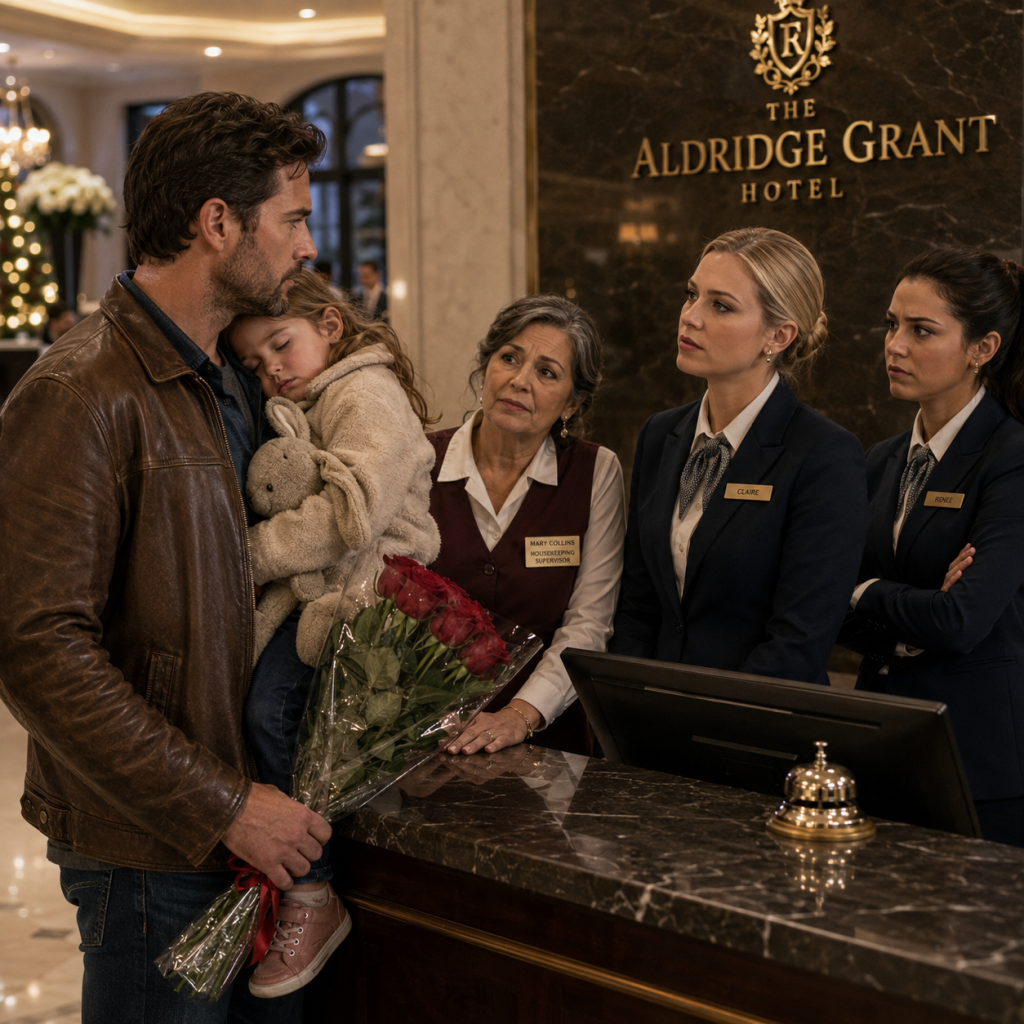
“There is a reservation.” Max said nothing. Claire stared at the screen.
“Maxwell Bennett. Executive suite. Ninth floor. Confirmed arrival tonight.”
The silence that followed was not loud, but it was complete.
Mary turned to Max.
“I’m very sorry for the delay, Mr. Bennett.”
Claire’s head snapped up at the way Mary said his name.
Not because she knew.
Because she cared.
Max looked at Mary and felt something inside him loosen. It had been a long day of keeping Sophie fed, entertained, buckled, calm, and safe. A long day of pretending the anniversary tomorrow was not sitting inside his chest like a stone. A long day of carrying roses through airports while strangers looked without seeing.
Mary had seen.
“That’s kind of you,” he said.
Mary noticed the bent rose stem. “Those are beautiful.”
Max looked down at the bouquet. “They’re for my wife.”
Mary’s expression softened.
“Anniversary?”
He nodded. “Tomorrow. Three years since we lost her.”
The words were simple, but saying them in a hotel lobby to a stranger made his throat tighten.
Mary’s eyes moved to Sophie.
“I’m sorry,” she said. “She looks like she’s had a long day.”
“She has.”
“And you too.”
Max almost laughed because the truth of it landed so gently.
Mary reached toward the bouquet, then paused. “May I?”
He nodded.
She adjusted the bent rose carefully, sliding it back into place with the others.
“Let me get you a vase before you go upstairs,” she said. “No sense letting them suffer after coming all this way.”
It was a small thing. Almost nothing. A vase. A flower stem. A sentence offered without a script.
But Max Bennett knew the difference between service and hospitality.
Service said, here is your key.
Hospitality said, I noticed what you were carrying.
Behind the desk, Claire printed the key cards with stiff movements. Renee stared at the screen as if it had betrayed her.
Mary returned with a simple glass vase half-filled with water. She placed it on the counter and helped Max ease the roses into it without waking Sophie.
“There,” she said. “That’ll hold them until your daughter can choose something better.”
Max looked at her.
“How did you know she chooses the vase?”
Mary smiled faintly.
“Kids like having a job when grief is too big for them.”
For the first time all night, Max had no answer.
Claire slid the key cards across the counter.
“Here you are, Mr. Bennett.”
Her voice had changed. It had become careful. Polished. Almost sweet.
Max looked at the cards, then at Claire.
“Now you see the reservation.”
Color rose in her cheeks.
“Yes, sir. It appears there was a system visibility issue.”
Mary’s face went still.
Max held Claire’s gaze.
“No,” he said quietly. “There was an effort issue.”
Renee looked down.
At that exact moment, Sophie opened her eyes.
She blinked at the lobby lights, confused and heavy with sleep. Then she turned her face toward Max’s neck.
“Daddy,” she whispered, “are we at the hotel?”
“Yes, sweetheart.”
“Can we see Mommy’s flowers?”
Max kissed her temple.
“Soon.”
Sophie looked at Mary.
“Did you fix them?”
Mary smiled.
“I helped a little.”
Sophie nodded solemnly, as if Mary had passed an important test, then closed her eyes again.
Max picked up the key cards.
“Please call the general manager,” he said.
Claire froze.
“Mr. Bennett, as I mentioned, he’s busy with the event.”
Max adjusted Sophie carefully and looked toward the brass crest on the wall.
“I’m aware of the event,” he said. “I approved the contract.”
The lobby seemed to inhale.
Claire stared at him.
Renee’s lips parted.
Mary looked from Max to the crest, then back again. Understanding dawned slowly across her face, not with fear, but with surprise.
Max reached into the inner pocket of his jacket and placed a business card on the counter.
Maxwell Bennett
Founder and Chief Executive Officer
Bennett Hospitality Group
Claire went pale.
Renee whispered, “Oh my God.”
Max’s voice remained calm.
“I need the general manager in this lobby. Now.”
Part 2
Owen Pierce arrived in less than four minutes.
Max knew because he watched the clock behind the front desk.
Those four minutes were among the longest Claire Whitman had ever lived. She stood behind the counter with her hands folded so tightly her knuckles blanched, stealing glances at Max as if hoping his business card might vanish and turn back into a misunderstanding.
Renee had stopped speaking entirely.
Mary remained beside the luggage cart, uncertain whether to leave. Max noticed. He also noticed that she had quietly moved the vase away from the edge of the counter so Sophie could not kick it in her sleep.
Even now, Mary was paying attention.
Owen Pierce stepped out of the elevator with the fast, controlled walk of a man trying not to run in front of guests. He was forty-eight, silver at the temples, expensive suit, sharp tie, the face of a manager who understood numbers, occupancy, brand standards, and the terrifying sound of a founder’s name appearing unexpectedly in his lobby after hours.
“Mr. Bennett,” Owen said. “I had no idea you were arriving tonight.”
“That was intentional.”
Owen swallowed. “Of course.”
His eyes moved to Sophie asleep on Max’s shoulder, then to the roses in the vase, then to Claire and Renee.
“I understand there’s been an issue.”
Max gave a short nod.
“There has.”
Claire stepped forward quickly.
“Mr. Pierce, it was a system error. The reservation didn’t populate in the standard search, and with the event upstairs—”
Mary’s voice cut through the explanation.
“It appeared when I told her to check the executive allocation tab.”
Owen looked at Mary.
Then at Claire.
“Is that true?”
Claire hesitated too long.
“Yes, but—”
“But what?” Max asked.
Claire turned to him, eyes shining now. “Mr. Bennett, I truly apologize. We’re under a lot of pressure tonight. The corporate event has been demanding, and we’ve had several walk-ins trying to get rooms we don’t have. I misunderstood the situation.”
Max glanced down at Sophie, still sleeping through the destruction of two careers.
“My daughter was not a situation,” he said.
Claire looked like she had been slapped.
The sentence sat in the lobby like a bell still ringing.
Owen drew himself straighter.
“Mr. Bennett, I’m deeply sorry. This is unacceptable.”
“What did you hear happened?” Max asked.
Owen looked uneasy. “Only that your reservation wasn’t found immediately.”
“That is not what happened.”
Renee suddenly spoke.
“Sir, we didn’t know who you were.”
Max turned to her slowly.
Mary closed her eyes for half a second.
Owen went completely still.
Max’s expression did not change, but his voice dropped.
“That is the problem, Renee.”
She seemed to realize it only after the words had left her mouth.
Max stepped closer to the desk. Sophie stirred but did not wake.
“I walked into this hotel as a father carrying a sleeping child. I had a confirmed reservation. I asked politely for help. I was told the hotel was full before anyone checked the right place. I was told to try another property. I was denied a manager. And when I asked for basic effort, I was treated like an inconvenience that had wandered in from the rain.”
Claire’s eyes filled with tears.
“Sir, I’m sorry.”
“I believe you’re sorry now.”
That was worse than shouting.
Owen looked at Claire and Renee with a disappointment that seemed older than the night itself.
Max continued.
“Mary walked by with towels. She saw more in ten seconds than the two people assigned to welcome guests saw in ten minutes.”
Mary shook her head slightly. “Mr. Bennett, I only—”
“You did your job,” Max said. “And theirs.”
The lobby doors turned again, letting in a couple in formal clothes laughing under one umbrella. They slowed when they sensed the tension, then hurried toward the elevators.
Owen lowered his voice.
“Would you prefer we speak privately?”
Max looked at Sophie.
“No. My daughter needs a bed, and I won’t keep her in this lobby any longer. But we will handle the immediate issue now.”
Claire’s breathing became uneven.
“Mr. Bennett, please. I need this job.”
For the first time, something like pain crossed Max’s face.
He did not enjoy this. Contrary to what people imagined about power, consequences did not feel clean to him. He had fired people before. He hated it every time. He knew jobs paid rent, bought groceries, kept cars running, supported parents and children and people no one else saw.
But he also knew what happened when small cruelties went unchallenged.
They became culture.
And culture, once infected, spread faster than any policy could contain.
Owen looked at him, waiting.
Max spoke carefully.
“Remove both of them from guest-facing duty immediately. Tonight.”
Claire covered her mouth.
Renee whispered, “Please.”
Max did not look away.
“Review the security footage. Pull the complaint logs for the last six months. Speak with staff. Speak with guests if necessary. If this is an isolated failure, handle it according to policy. If it is a pattern, end their employment.”
Owen nodded.
Claire’s shoulders dropped with a small, desperate breath. She had expected to be fired on the spot. She had received one narrow door through which the truth, not panic, would decide.
But then Owen’s expression darkened.
“Mr. Bennett,” he said quietly, “there may already be a pattern.”
Claire looked sharply at him.
Renee whispered, “Owen.”
Max’s eyes narrowed.
Owen exhaled.
“We’ve received guest comments. Nothing formal enough to trigger corporate review, but enough that I should have acted sooner. Tone complaints. Dismissive behavior. A family from Milwaukee said they were made to feel unwelcome because they arrived in work clothes. A nurse checking in after a double shift said she was ignored for nearly fifteen minutes. I addressed it verbally.”
Max stared at him.
“When?”
“Three weeks ago.”
“And nothing changed?”
Owen’s silence answered.
Claire began crying.
Renee said, “Those people exaggerated.”
Mary looked at her then, really looked at her.
“People usually shrink the hurt when they complain,” Mary said. “They don’t exaggerate it. They’re embarrassed they had to ask to be treated decently.”
Nobody spoke.
Max felt Sophie’s fingers tighten weakly in his jacket. She was waking again, caught by the shift in voices.
“Daddy?” she murmured.
“I’m here.”
“Are the ladies mad?”
Max closed his eyes for one second.
This was the part he hated most. Not the confrontation. Not the professional failure. The fact that a child had heard enough to know adults were not being kind.
“No, sweetheart,” he said softly. “They’re learning something important.”
Sophie opened her eyes and looked at Claire, whose face was wet with tears.
The child’s voice was small.
“Why didn’t she let us sleep?”
Claire broke.
“I’m sorry,” she whispered.
Sophie watched her with the serious confusion of a child who had known loss early enough to understand sadness but not cruelty.
Then Sophie turned toward Mary.
“Can we go upstairs now?”
Mary smiled at her.
“Yes, honey. You can.”
Owen signaled to a bellman, but Max shook his head.
“I’ve got her.”
Mary picked up the vase of roses.
“I’ll carry these.”
Max looked at her.
“You don’t have to.”
“I know.”
That was the answer that mattered.
They rode the elevator in silence, Max holding Sophie, Mary holding the roses, Owen standing beside them with the rigid posture of a man reviewing every mistake he had allowed under his roof.
On the ninth floor, the executive suite opened into warm lamplight. Sophie woke fully when Max laid her on the bed. She blinked at the room, then spotted the roses in Mary’s hands.
“Mommy’s flowers.”
Mary placed the vase on the small dining table.
“Where should they go until you pick the perfect spot?”
Sophie sat up, hair wild from sleep.
“By the window. Mommy liked windows.”
Max’s throat tightened.
Mary did not ask questions. She simply moved the vase to the window.
Outside, Chicago glittered in the rain.
Sophie slid off the bed and padded over in her socks. She touched one rose petal with a gentle finger.
“Daddy says red was her brave color,” she said.
Mary nodded.
“Sounds like your mommy knew what she was doing.”
Sophie smiled faintly.
“She did.”
Max turned away for a moment, pretending to check the thermostat.
Mary noticed. Of course she did.
Owen stood near the door.
“Mr. Bennett, I’ll personally ensure anything you need tonight is handled.”
Max looked back at him.
“What I needed tonight was already handled by the person least responsible for handling it.”
Owen accepted the rebuke without defense.
Mary looked uncomfortable.
“I should get back downstairs.”
Max walked her to the door.
“Mary.”
She stopped.
“Thank you.”
She smiled in that embarrassed way kind people often do when thanked for something they believe should have been automatic.
“Get that baby to sleep,” she said. “And get some sleep yourself.”
Sophie waved from near the window.
“Thank you for Mommy’s roses.”
Mary’s face changed. Just slightly. Enough for Max to see she would remember that sentence for a long time.
“You’re welcome, sweetheart.”
After the door closed, Max helped Sophie brush her teeth with the travel toothbrush from his bag. She was half asleep again by the time he tucked her under the white duvet.
“Daddy?”
“Yeah, Soph?”
“Was that lady an angel?”
Max sat beside her.
“Which lady?”
“The flower lady.”
He brushed hair from her forehead.
“No. Just a person who paid attention.”
Sophie considered this.
“Is that like being an angel?”
Max smiled sadly.
“Sometimes it’s better.”
She fell asleep holding Mr. Buttons under her chin.
Max stood by the window for a long time after that.
The roses looked brighter against the rain-black glass.
He thought of Grace.
Grace, who had always noticed everything. The waiter with shaking hands. The neighbor pretending she didn’t need help carrying groceries. The child at the playground sitting alone while other kids formed teams.
Max had built hotels because he liked buildings at first. Then he had built a company because Grace taught him buildings meant nothing if people felt invisible inside them.
His phone buzzed at 11:18 p.m.
Owen.
Max stepped into the sitting area and answered quietly.
“Yes?”
Owen’s voice was heavy.
“I reviewed the footage from tonight and pulled the notes from the last six months. It’s worse than I remembered.”
Max said nothing.
“There were nine guest complaints naming Claire or Renee directly. Three involved guests being told no rooms were available when rooms were later found. Two involved guests with children. One involved a disabled veteran who asked for assistance with luggage and was told the bell staff was busy.”
Max closed his eyes.
Owen continued.
“I failed to escalate it.”
“Yes,” Max said. “You did.”
“I’ve terminated Claire and Renee effective immediately, based on documented conduct and tonight’s incident. I’ve also placed myself under review with regional leadership.”
Max looked at the roses.
Fired on the spot.
The phrase would sound dramatic if anyone ever told the story. But it did not feel dramatic. It felt like a sad, necessary door closing after too many people had been pushed away from one that should have opened.
“Owen,” Max said, “tomorrow morning, I want every department head in a meeting. Not to discuss damage control. To discuss culture.”
“Yes, sir.”
“And Mary Collins attends.”
A pause.
“Housekeeping?”
“Guest experience,” Max said. “Whether her title knows it or not.”
Part 3
The next morning, Sophie chose the window ledge for Grace’s roses.
She stood in her pajamas, hair brushed into two uneven ponytails because Max had never mastered symmetry, and considered the room with the seriousness of a museum curator.
“Here,” she said. “Mommy can see the city.”
Max placed the vase where she pointed.
The roses had opened slightly overnight. One still leaned from the flight, imperfect and bright.
Sophie climbed into his lap on the sofa.
“Tell me a Mommy story.”
Max looked out at the gray Chicago morning.
“Your mom once made me turn the car around on the freeway.”
Sophie’s eyes widened.
“Was she mad?”
“No. She saw an old man drop a bag of oranges at a gas station, and everyone kept walking around him. We were already on the ramp to leave. She said, ‘Max, if we become people who don’t stop for oranges, we’re in trouble.’”
Sophie giggled.
“That sounds like Mommy.”
“It does.”
“Did you stop?”
“Of course. Your mother was small, but she could make a command sound like weather.”
Sophie leaned against him.
“Did the flower lady stop for oranges?”
Max smiled.
“Yes. I think she probably stops for oranges all the time.”
At nine o’clock, Max walked into the Aldridge Grant conference room carrying a paper cup of coffee and wearing the same brown leather jacket.
Every department head was there.
Owen stood at the front, pale but composed. Mary sat near the far end of the table as if trying to occupy as little space as possible. She wore her burgundy vest, hands folded in her lap, eyes lowered toward a notepad she had not written on.
Several managers glanced at her with curiosity.
Max did not open with a speech about standards.
He opened with a question.
“What is the first thing we sell?”
A revenue manager answered carefully.
“Rooms.”
Max shook his head.
A food and beverage director tried.
“Experience.”
“Too broad.”
Owen said nothing.
Mary looked up, then down again.
Max saw it.
“Mary?”
Her face flushed.
“Oh, I’m not sure I’m the person you’re asking.”
“I am.”
Mary hesitated.
Then she said, “Safety.”
The room went quiet.
Max nodded.
“Go on.”
Mary swallowed.
“People come to hotels because they’re away from what’s familiar. Even rich people. Even important people. They’re tired, or grieving, or celebrating, or scared, or pretending they’re not scared. They hand us their credit card, their luggage, sometimes their children, and they trust us not to make them feel foolish for needing a place to rest.”
Nobody moved.
Mary looked around, embarrassed by the attention, but continued.
“A room is what they pay for. Safety is what they remember.”
Max set his coffee down.
“That is the best definition of hospitality I’ve heard in eleven years.”
Mary’s eyes widened.
The department heads looked at her differently then.
Not because Max had praised her.
Because she had named something they all knew but had forgotten to say.
Max spent the next hour doing something that made the room uncomfortable. He read guest complaints out loud.
Not names. Not private details. Just the words.
“I felt like I didn’t belong.”
“The front desk made me feel stupid for asking.”
“My daughter asked why that woman was nicer to the businessman behind us.”
“My husband uses a cane, and we were treated like a problem.”
By the fourth complaint, no one was looking at their phones.
By the seventh, Owen’s eyes were wet.
Max closed the folder.
“These were not disasters,” he said. “No one died. No headline was written. No lawsuit was filed. That’s how cultures decay. Quietly. Through small humiliations that never become urgent enough for busy people to fix.”
He looked at Owen.
“Leadership failed here.”
Owen nodded.
“I failed.”
Max looked around the table.
“But failure can either become a cover-up or a turning point. We are choosing turning point.”
Then he turned to Mary.
“I’d like you to help us rebuild our training.”
Mary blinked.
“I’m sorry?”
“Not today. Not as extra work hidden inside your current job. Properly. Paid properly. With authority. I want a guest experience training program built around what you did last night.”
Mary stared at him.
“What I did last night was bring flowers a vase.”
“No,” Max said. “You saw a guest everyone else had reduced to a problem. Then you acted. That is the whole job.”
A housekeeping manager named Denise smiled softly from across the table.
Mary shook her head.
“Mr. Bennett, I clean rooms.”
“You lead people,” Max said. “You may have been doing it without the title, but that doesn’t mean the title shouldn’t catch up.”
Mary looked down at her hands.
“I raised three kids after my husband left,” she said quietly. “I’ve worked since I was sixteen. I don’t have a degree. I don’t know corporate language.”
Max leaned forward.
“Good.”
A few people smiled.
“I have enough corporate language in this company. What I need is someone who can explain to a nineteen-year-old front desk trainee that the man arriving late in a wrinkled jacket may be carrying more than luggage. I need someone who can teach a manager that a complaint about tone is not small to the person who had to swallow their dignity to make it. I need someone who knows the difference between a script and a welcome.”
Mary’s eyes shone.
“I’d have to think about it.”
“Of course.”
“And I’d need to talk to my daughter.”
“Good. Ask her if her mother should finally get paid for what she’s been teaching people for free.”
Mary laughed then, a small startled sound.
The room breathed again.
Two days later, Max and Sophie checked out of The Aldridge Grant.
The lobby looked different, though the marble was the same and the piano music still played. The difference was not decoration. It was alertness.
A young man at the front desk greeted Sophie by name because someone had placed a note in the reservation file, not about VIP status, but about Grace’s flowers. A bellman offered Max a bottle of water for the car without being asked. Denise from housekeeping stopped by with a small paper bag of cookies for Sophie.
Mary came down just before they left.
She looked nervous.
“I talked to my daughter,” she said.
“And?”
“She said if I didn’t take the opportunity, she’d drive down from Milwaukee and embarrass me in front of everyone.”
Max smiled.
“She sounds wise.”
“She sounds bossy.”
“Those often overlap.”
Mary handed Sophie a small card. On the front was a watercolor print of red roses from the hotel gift shop.
“For your mom’s flowers,” Mary said.
Sophie hugged her around the waist without warning.
Mary froze for half a second, then bent and hugged her back.
Max looked away because grief had strange manners. Sometimes it knocked you down with a song. Sometimes with a child hugging a woman in a hotel lobby.
When Sophie pulled back, she said, “Daddy says paying attention is better than being an angel.”
Mary looked at Max.
“Does he?”
Max shrugged.
“He was tired.”
Mary laughed.
Outside, the rain had stopped.
Max buckled Sophie into the back seat of their rental SUV. She held the rose card in her lap.
“Are the mean ladies gone?” she asked.
Max paused with his hand on the door.
“They won’t work here anymore.”
“Because they were mean?”
“Because they forgot people matter before they know who they are.”
Sophie considered that with the heavy seriousness children bring to simple truths adults spend years complicating.
“Will they remember now?”
Max looked back at the hotel.
“I hope so.”
One year later, the Bennett Hospitality Group held its annual leadership summit in Nashville.
The final session was not led by Max. It was led by Mary Collins, now Regional Director of Guest Experience Training, wearing a navy dress she had bought after trying on six and sending pictures to her daughters for approval.
On the screen behind her was not a chart.
It was a photograph of a glass vase holding slightly tired red roses.
Mary stood before eighty managers and new hires and told them a story.
She did not tell it dramatically. That was why it worked.
She told them about a father arriving late with a sleeping child. About roses bought in an airport. About two employees who saw a problem instead of a person. About a reservation hidden behind the wrong tab. About a little girl who needed a bed. About a company owner who did not look like anyone expected power to look.
Then she said, “Most guests will never be the owner. That’s exactly why this story matters.”
The room was silent.
Mary clicked to the next slide.
It contained one sentence.
You are not here to decide who deserves kindness.
She let them sit with it.
“You don’t need to know someone’s title to offer them dignity,” she said. “You don’t need permission to notice a bent flower stem. You don’t need a manager to tell you a tired parent needs help. And you don’t need a perfect system to do the right thing while the system catches up.”
In the back of the room, Max stood with Sophie beside him.
Sophie was seven now, taller, missing one front tooth, wearing a red cardigan because she said it was Mommy’s brave color.
She slipped her hand into Max’s.
“She’s good,” Sophie whispered.
“She is.”
“Mommy would like her.”
Max looked at the roses on the screen.
“Yes,” he said. “She would.”
After the session, managers lined up to speak with Mary. Some thanked her. Some admitted things. One front desk supervisor from Austin wiped his eyes and said he had once been the kid sleeping in a lobby chair while his mother begged for a room after leaving his father, and he had forgotten that memory until Mary gave it back to him.
Mary listened to every person like she had listened to Max that first night.
Fully.
Without rushing.
Without deciding too soon.
Later, when the ballroom emptied, Max found Mary gathering her notes.
“You changed the room,” he said.
Mary smiled.
“I just told them about flowers.”
“No,” Max said. “You taught them where to look.”
Mary glanced toward Sophie, who was spinning slowly under a chandelier, making her red cardigan flare.
“How is she doing?”
“Better,” Max said. “Grief still comes in waves. But she swims more now.”
Mary nodded.
“That’s good.”
Max reached into his jacket and handed her an envelope.
“What’s this?”
“A thank-you.”
Mary gave him a suspicious look. “I already have a salary, Mr. Bennett.”
“Open it.”
Inside was a photograph.
Not of a hotel. Not of a ballroom. Not of Max.
It was Sophie standing by the window of the Aldridge Grant suite one year earlier, placing Grace’s roses carefully on the ledge, her small hand touching the vase Mary had found.
On the back, in Sophie’s uneven handwriting, were the words:
Thank you for seeing us.
Mary pressed the photo to her chest.
For once, she had no immediate answer.
Max gave her the mercy of silence.
That evening, after the summit ended, Max and Sophie drove to a small flower shop near their hotel in Nashville. Sophie chose the roses herself this time, inspecting each bouquet with grave authority.
“Not those,” she said.
“Why not?”
“They look too perfect.”
Max smiled.
“Too perfect?”
“Mommy liked things that looked alive.”
So they bought a bouquet with one rose leaning slightly to the left.
Back in their hotel room, Sophie filled a vase with water while Max trimmed the stems with scissors borrowed from the front desk.
She placed the flowers by the window.
The city lights blinked below them.
“Tell me a Mommy story,” she said.
Max sat beside her.
“Your mom once told me hotels are like people.”
Sophie wrinkled her nose.
“That doesn’t make sense.”
“That’s what I said.”
“What did she mean?”
Max looked at the roses.
“She said some look beautiful from the outside, but you don’t know what they are until you walk in tired and see whether they make room for you.”
Sophie leaned against him.
“Daddy?”
“Yeah?”
“When I grow up, I want to be someone who makes room.”
Max put his arm around her and kissed the top of her head.
“You already are.”
Downstairs, in that same hotel, a young front desk trainee noticed a woman standing near the entrance with two crying toddlers, a dead phone, and panic she was trying to hide. The trainee had attended Mary’s session that morning.
He stepped out from behind the desk.
“Ma’am,” he said gently, “you look like you could use some help.”
No one important was watching.
No owner stood nearby.
No camera crew waited.
No headline would ever be written about the moment.
But the woman’s shoulders dropped with relief, and one of the toddlers stopped crying when the trainee offered him a cup of water with a lid.
That was how change really happened.
Not through a single firing, though sometimes consequences were necessary.
Not through a speech, though sometimes words opened a door.
It happened when one person remembered to look carefully at another person and chose not to look away.
Years later, Sophie would remember only pieces of the night at The Aldridge Grant. The rain on the windows. The shine of the lobby floor. The sound of her father’s heart under her ear. A woman with silver in her hair fixing roses that had traveled too far.
She would not remember Claire’s face clearly, or Renee’s voice, or the exact moment the business card touched the counter and changed everything.
But she would remember what Max told her afterward.
People show you who they are by how they treat you before they know your name.
And she would remember Mary.
Mary, who had carried towels and noticed grief.
Mary, who had understood that a sleeping child needed a bed, a tired father needed patience, and airport roses needed water.
Mary, who had not known she was standing in front of the owner.
Mary, who had not needed to know.
On the third anniversary of Grace’s death, Max had walked into his own hotel as a stranger and learned the truth about the place he had built.
Some people at the front desk had failed him.
One woman from housekeeping had saved the meaning of the whole company.
And because of her, thousands of guests who came after him were welcomed a little more gently, seen a little more clearly, and reminded in quiet ways that dignity should never depend on whether someone looks important enough to receive it.
THE END