My name is Arthur Pendelton. I live in the same sprawling, Victorian-style home my late wife, Eleanor, and I purchased when we were young, foolish, and barely scraping by. We bought it back when forever still felt like a certainty, not a gamble.
She passed away nine years ago. After the funeral, the house felt too large, the echoes too loud. My son, David, was all I had left in the world.
Perhaps that was my foundational error. Perhaps loving a child so fiercely blinds you to the man they are becoming. David was thirty-six, armed with an incomplete college education, a string of failed entrepreneurial ventures, and absolutely no self-control to manifest his grand illusions into reality. Four years ago, he stood on my porch in the pouring rain, asking if he could move into his old childhood bedroom “just for a short time” until he got back on his feet.
Then, Jessica moved in. She arrived with a collection of oversized designer handbags, a cloud of suffocatingly sweet perfume, permanent eyelash extensions, and the distinct, smug expression of someone entirely accustomed to spending money she had never earned.
Neither of them paid rent. Neither helped with the mounting property taxes. Neither bought groceries, nor did they ever lift a finger to fix the leaky faucet in the guest bathroom.
That Saturday morning, I woke early to cook my own seventieth birthday dinner.
I roasted a chicken with rosemary from Eleanor’s garden. I made garlic mashed potatoes, a crisp summer salad, and drove across town to pick up a lemon ricotta cake from the small Italian bakery Eleanor used to adore. I envisioned a quiet, respectful evening. A chance for David to sit across from me, perhaps utter a simple thank you, or share a memory of his mother.
When I finally woke, the sky outside was bruised with twilight. I could hear laughter drifting up the wooden staircase. Too much laughter. A cacophony of clinking glass and booming voices.
I descended the stairs slowly, my hand gripping the polished oak banister, and froze in the doorway of my own dining room.
And not a single soul had bothered to come upstairs and wake me.
I forced my facial muscles into a polite, thin mask. “You started without me?”
The raucous laughter died instantly. A heavy, uncomfortable silence settled over the room like a damp blanket. David looked up from the head of the table. My seat. Jessica was lounging in the chair where Eleanor used to sit, casually picking at a piece of my roasted chicken.
David chuckled, a nervous, high-pitched sound. “Oh, Dad, we thought you were out cold. You’re so quiet these days, you’re basically a ghost anyway.”
A few of his friends snickered. I should have turned on my heel and walked back up the stairs. But a stubborn pride rooted me to the spot. I stepped further into the room.
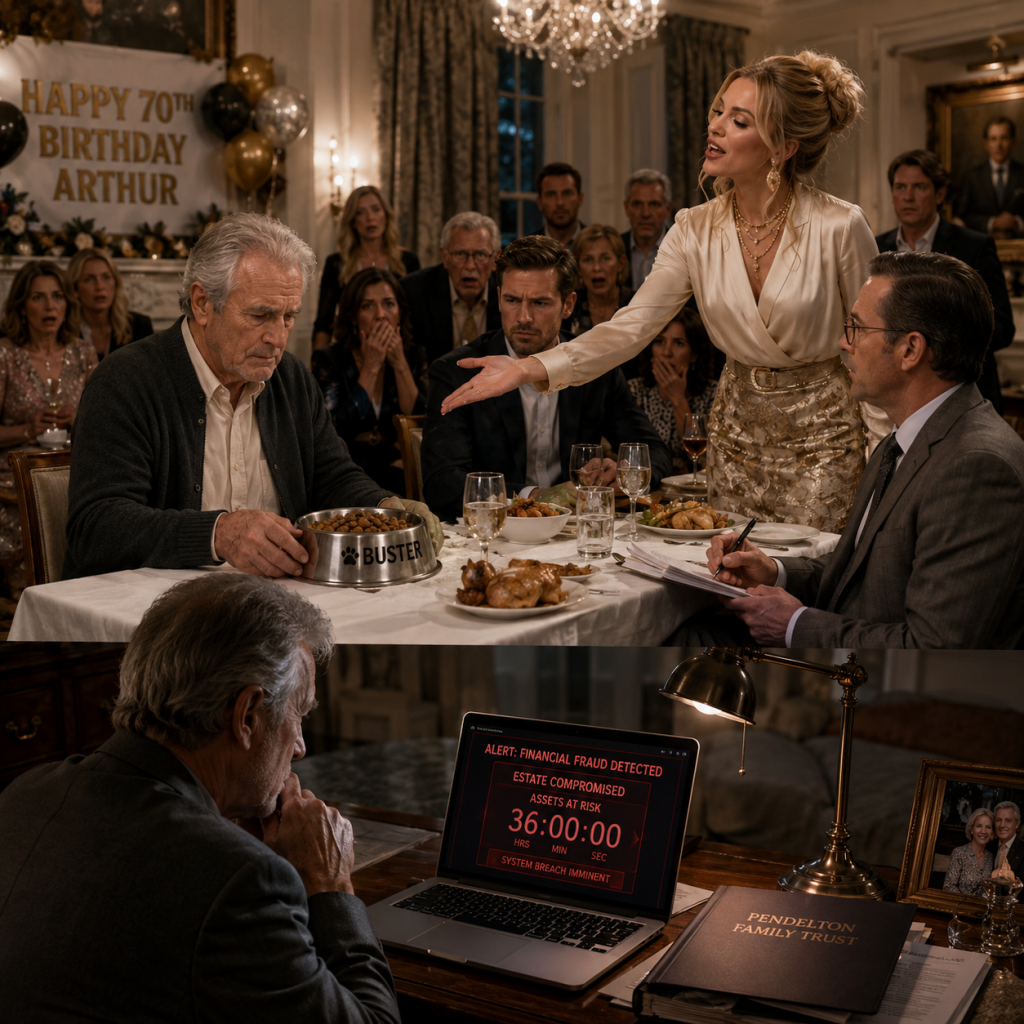
That was when Jessica stood up. She walked into the kitchen and returned holding an old, dented metal bowl. It was Buster’s bowl—our golden retriever who had passed away five years prior.
Jessica set it down right at the edge of the table, near where I was standing. Inside was a fresh scoop of dry dog kibble.
“Here you go, Arthur,” Jessica said, her voice dripping with a cloying, theatrical sweetness.
The room went dead silent. The blood in my veins turned to ice. I stared at the bowl, then at my son, waiting for him to explode in anger, to defend me, to throw her out.
Instead, David just looked down at his plate, his face flushed.
Quietly, maintaining every ounce of my dignity, I asked, “What is the meaning of this?”
Jessica’s eyes went wide. She looked around the room, performing for the audience. “Oh, Arthur, sweetheart… don’t you remember?” Her voice trembled with fake sympathy. “You poured this yourself earlier. You said you were making dinner for Buster. You… you forgot again, didn’t you?”
I forgot?
I looked at the faces around the room. I saw pity. I saw discomfort. They were looking at me not as a host, but as a tragic, senile old man. I noticed a woman sitting near the window, a stranger in a severe grey suit, watching me with clinical intensity, taking a mental note.
This wasn’t a prank. This was a calculated performance. A public exhibition of my supposed mental decline.
I didn’t yell. I didn’t throw the bowl. I simply turned and walked back upstairs. Behind me, I heard Jessica sigh loudly. “It’s getting so much worse, you guys. We just don’t know what to do.”
I walked into my study, my hands surprisingly steady, and locked the door. I am a retired forensic accountant. I spent forty years of my life finding the truth buried beneath layers of deception. I opened my laptop and logged into my master financial dashboard. I needed to see exactly how much of my money they were siphoning.
But when the dashboard loaded, it wasn’t a missing grocery fund that caught my eye. It was a glaring, red notification from my primary bank.
Pending Approval: Home Equity Line of Credit – $150,000. Disbursement Scheduled: Monday, 12:00 PM.
I stared at the screen, my breath catching in my throat. Monday at noon. Thirty-six hours from now.
The silence in my study was no longer peaceful; it was suffocating.
One hundred and fifty thousand dollars.
My house—the home Eleanor and I had painstakingly paid off over thirty years, the roof over my head—was being leveraged. If that money disbursed, if they vanished with it, I would be left with a debt I could never repay on my fixed pension. The bank would foreclose. I would die in a sterile county facility.
I clicked into the loan details. The digital signature on the application was mine. But I hadn’t signed it.
I immediately began digging deeper. For four years, David had occasionally used my laptop. He was sloppy. I accessed the hidden temporary files and the cloud backup linked to the local network. It took me three hours of meticulous, relentless searching, fueled by cold, righteous fury.
At 2:00 AM, I found the motherlode in a hidden, password-protected folder Jessica had created.
There was a scanned, forged Power of Attorney document, granting David complete control over my finances, citing my “rapid cognitive decline.”
There was an intake form for a facility called Silver Path Senior Transition Services. The preferred move-in date was set for two weeks from now.
And then, I found the routing number for the impending loan disbursement. I cross-referenced it with my own banking tools. The destination account didn’t belong to David. It didn’t belong to a joint account. It was an offshore, private account registered solely in Jessica’s maiden name.
She wasn’t just stealing from me. She was going to steal from my son, too.
I copied every single document, every IP log, every forged signature onto two encrypted flash drives. I hid one inside the hollow casing of an old grandfather clock in the hallway. The other went directly into the breast pocket of my charcoal grey suit.
At 6:00 AM, the house was dead quiet. The partygoers had long since stumbled home. I showered, shaved, and put on the suit. It was the armor I wore to Eleanor’s funeral. Today, it was the armor I would wear to reclaim my life.
I walked down the stairs. The dining room was a disaster zone of spilled wine and half-eaten cake.
Jessica was in the kitchen, wearing one of Eleanor’s vintage silk robes, casually sipping a cup of coffee. David was slumped over the island counter, rubbing his bloodshot eyes.
I walked past the dog bowl, picked it up, and dropped it into the trash can with a loud clang.
“Pack your things,” I said. My voice was low, resonating off the tile floor. “Both of you. You have one hour to vacate my property.”
David blinked, his brain struggling to catch up. “Dad, what are you talking about? It’s Sunday morning. Don’t be so dramatic about a stupid misunderstanding last night.”
“I am not talking about the dog food, David,” I replied, standing tall. “I am talking about the forged Power of Attorney. I am talking about Silver Path Senior Transitions. And I am talking about the $150,000 Home Equity Loan scheduled to disburse tomorrow at noon.”
The color violently drained from David’s face. He looked like he had been struck by lightning. He turned slowly toward Jessica.
Jessica, however, didn’t flinch. Her eyes hardened into tiny, dark marbles. She calmly set her coffee mug down.
“You’re confused, Arthur,” she said smoothly. “There is no loan. You’re having another one of your episodes.”
“I have the IP logs, Jessica,” I said, tapping my breast pocket. “I’ve already initiated a freeze on all my accounts, and I will be at the bank the second they open tomorrow to cancel the transaction in person.”
Jessica stared at me for three long seconds. The mask of the sweet, concerned daughter-in-law evaporated, revealing the absolute predator beneath.
Without a word, she reached into the pocket of my late wife’s robe, pulled out her cell phone, and dialed three numbers.
She put it on speaker.
“911, what is your emergency?” the dispatcher’s voice cracked through the kitchen.
Instantly, Jessica began to hyperventilate. She forced out a hysterical, blood-curdling sob. “Help! Please, you have to help us! It’s my father-in-law! He has severe dementia, he’s locked all the doors, and he’s holding a knife!”
David backed away, horrified. “Jessica, what the hell are you doing?!”
“He’s threatening my fiancé!” Jessica screamed into the phone, ignoring David. “He doesn’t know who we are! Please hurry, he’s going to kill us!”
She ended the call and tossed the phone onto the counter. She looked at me, a wicked, triumphant smirk playing on her lips.
“It’s your word against ours, Arthur,” she whispered. “And after the show you put on for twenty witnesses last night… who do you think the police will believe?”
In the distance, the faint, rising wail of police sirens pierced the quiet Sunday morning air.
I did not panic. I did not move toward the kitchen drawer where the knives were kept. I simply walked into the dining room, pulled out my heavy oak chair—the one David had usurped the night before—and sat down. I placed my hands flat on the table, palms down, completely visible.
David was pacing in the kitchen, hyperventilating. “Jessica, you can’t do this! This is insane! Tell them you made a mistake!”
“Shut up, David,” she hissed, her voice venomous. “If he goes to the bank tomorrow, we go to prison. When the cops get here, you tell them he was waving a knife and screaming about phantom loans. They’ll put him in a 72-hour psychiatric hold. That’s all the time I need for the wire transfer to clear. Then we’re gone.”
The sirens abruptly stopped outside my house. Car doors slammed. Heavy footsteps pounded up the porch steps, followed by a thunderous knocking that rattled the doorframe.
“Police! Open up!”
Jessica let out a flawless, terrified whimper, ran to the door, and unlocked it.
Two officers burst in, hands resting cautiously on their holstered weapons. They swept the foyer, their eyes locking onto me sitting calmly at the dining room table.
“Sir, keep your hands where we can see them!” the taller officer commanded, stepping into the room.
“My hands are on the table, Officer,” I said, my voice steady, modulated, entirely lucid. “I am unarmed. There is no knife. I am the sole owner of this property.”
Jessica rushed up behind the second officer, burying her face in her hands. “He hid it! He was just waving a butcher knife at us, screaming that we were trying to steal his house! Officer, he has Alzheimer’s. He gets these terrifying episodes…”
The first officer approached me slowly, assessing my demeanor. “Sir, can you tell me your name?”
“Arthur Thomas Pendelton. Today is Sunday. I live at 442 Elmwood Drive. I do not have Alzheimer’s. What I do have, Officer, is a daughter-in-law who is attempting to commit felony wire fraud and elder abuse.”
The officer frowned, glancing back at Jessica, who was trembling like a seasoned actress. “Ma’am, you said he threatened you?”
Before Jessica could spin another lie, I spoke up. “Officer, before you make any decisions regarding my mental health, I would ask you to look at the ceiling fixture directly above this table.”
Both officers looked up. Disguised within the casing of the old smoke detector was a tiny, black lens. I had installed it three years ago after several pieces of Eleanor’s jewelry went missing.
“It records audio and video directly to a secure cloud server,” I explained calmly. “I pulled the footage from last night, and from ten minutes ago. It is currently queued up on the laptop in my study. If you walk in there and press the spacebar, you will see Ms. Jessica here staging a fake dementia episode for her friends, and you will hear her explicitly outline her plan to have me falsely committed so she can steal one hundred and fifty thousand dollars from my home equity.”
Jessica froze. The blood drained from her face so fast she looked like a corpse. She hadn’t known about the camera.
The second officer looked at me, then at Jessica’s paralyzed expression. “Stay here,” he instructed his partner, and jogged up the stairs to my study.
The silence in the room was absolute. You could hear the old floorboards groaning under the weight of the tension. I looked at David. My son. He was staring at Jessica as if he were seeing a monster wearing human skin.
Two minutes later, the officer came back downstairs. His expression had completely shifted. He didn’t look at me; he locked eyes with Jessica.
“Ma’am,” the officer said, his voice hard as steel. “We heard the audio.”
Jessica took a step back, her eyes darting toward the front door. “It’s… it’s a deepfake! He’s obsessed with computers, he manipulated the video!”
But it wasn’t Jessica who broke the standoff. It was David.
He dropped to his knees right there in the kitchen, grabbing the edges of his hair, and let out a guttural, agonizing scream.
“I’M SORRY!” David roared, tears streaming down his face. “I’m so sorry, Dad! I didn’t want to do it! She made me!”
“David, shut your mouth!” Jessica shrieked.
“She told me you were going to gamble away Chloe’s college fund!” David cried out, looking up at me with desperate, broken eyes. “She said you were losing your mind, that you were talking to mom’s ghost, and that you were going to donate the whole estate to some cult! She said the loan was the only way to protect Chloe’s future! I just wanted to protect my daughter!”
The room seemed to spin. Chloe. My sixteen-year-old granddaughter. David’s child from his previous marriage. I hadn’t seen her in two years because David told me she was “too busy” for her grandfather.
I looked down at my weeping son. “David,” I said gently, slicing through the chaos. “I set up a trust for Chloe five years ago. It’s untouchable by me, or anyone else. Did Jessica tell you that the routing number for the $150,000 loan was directed to her personal, single-signature offshore account?”
David stopped crying. He stared at me, his mouth agape. Then, he slowly turned his head to look at Jessica.
Jessica took one look at David’s face, turned on her heel, and bolted for the front door.
“Hey! Stop!”
The officers moved with practiced speed. The taller one caught Jessica by the arm just as her hand touched the doorknob. She thrashed wildly, screaming obscenities that shattered her refined, wealthy facade.
“Let go of me! I live here! I have rights!” she shrieked, kicking at the officer’s shins.
“Jessica Miller, you are under arrest for filing a false police report, and suspicion of elder financial abuse,” the officer stated, swiftly spinning her around and clicking a heavy pair of steel handcuffs onto her wrists. The sound echoed through the foyer with beautiful, profound finality.
I watched as they marched her out the front door. She dragged her feet across the expensive Persian rug she had constantly complained about. As they pushed her out onto the porch, she twisted her neck to look back at me, her eyes filled with pure, unfiltered malice.
“You’re going to die alone in this dusty museum, old man!” she spat.
“Perhaps,” I replied, standing in the doorway. “But I will die in my own home. And you will sleep in a cell.”
The door closed.
I turned back to the kitchen. David was still on the floor, sitting amidst the crushed kibble of the dog bowl he had allowed to be placed before me. He looked smaller than I had ever seen him. A thirty-six-year-old boy who had traded his soul for the illusion of an easy life, only to find out he was nothing but a pawn.
I walked over to the kitchen island and pulled out my checkbook. I wrote a check for one thousand dollars. I tore it out and let it flutter down to the floor in front of him.
“This will cover one week at the Extended Stay Motel on Route 9,” I said, my voice completely devoid of emotion. “You have thirty minutes to pack a bag. I am hiring a professional crew to box up the rest of your things, and Jessica’s. They will be left on the curb on Tuesday.”
David didn’t touch the check. He looked up at me, his face swollen and red. “Dad… please. Where will I go? I have nothing. She took everything I had.”
“You had a home, David,” I said, looking around the house Eleanor and I built. “You turned it into a hunting ground. You weaponized my granddaughter’s name to steal my life. I will send you the number of a debt counselor and a therapist. But you will not sleep under my roof tonight.”
“You’d throw your own son out on the street?” he whispered, his voice cracking.
“I am not throwing you out, David,” I corrected him. “I am choosing to survive you.”
He stared at me for a long time. He realized, finally, that the well of endless, unconditional forgiveness had run dry. He picked up the check, pulled himself off the floor, and walked upstairs.
Thirty minutes later, the front door clicked shut.
I was entirely alone.
The house felt enormous. For four years, I had convinced myself that the constant noise—the blaring television, Jessica’s screeching laughter, the slamming doors—meant I wasn’t lonely. I realized then that I had never been lonelier than when this house was full of people who viewed me as prey.
I walked into the dining room, righted my heavy oak chair, and sat down at the head of the table. I looked at the empty seat at the other end.
“I did it, Eleanor,” I whispered to the empty room. “I finally protected us.”
The house settled around me, the old wood creaking in the afternoon sun. I closed my eyes, exhausted to my very marrow.
Suddenly, the sharp ring of the telephone shattered the quiet.
I opened my eyes. I walked to the kitchen and picked up the receiver.
“Hello?”
There was a pause on the line. Then, a soft, trembling voice.
“Grandpa?”
My heart seized. “Chloe? Sweetheart, is that you?”
“Yeah,” she sniffled. “Dad just called my mom. He was crying. He said… he said you kicked him out because he tried to take your house. Grandpa… Dad told me you didn’t want to see me anymore because I reminded you too much of Grandma. Was that a lie too?”
The cruelty of my son’s manipulation hit me harder than any forged document ever could. I gripped the phone, tears finally spilling over my eyelashes.
“Oh, Chloe,” I wept. “That was the biggest lie of all.”
Real life does not resolve itself cleanly in an hour like a television drama. The aftermath of that Sunday was a grueling marathon of paperwork, legal statements, and emotional exhaustion.
My attorney, a ruthless man named Harrison, ensured the $150,000 loan was permanently voided. The bank launched an internal investigation into how the digital signature was bypassed.
Jessica hired a sleazy defense attorney, claiming she was merely trying to secure funds for my “care.” But the video footage, coupled with the offshore account routing number, was a concrete wall she couldn’t climb. She was formally indicted on multiple felony charges of Elder Financial Abuse and Attempted Wire Fraud. She is currently awaiting trial, out on a bail she could barely afford.
David hit absolute rock bottom. He moved into a sober living facility—it turned out his financial desperation was deeply tied to a sports gambling addiction he had hidden for years.
But amidst the wreckage, a garden began to grow.
Chloe’s mother drove her to my house the very next weekend. When I opened the door, my granddaughter stood there, tall and hesitant, possessing the exact same shade of hazel eyes as Eleanor.
She walked into the foyer, looking around. “It still smells the same,” she whispered. “Like lemon polish and old books.”
I held my arms open, and she ran into them, burying her face in my shoulder. In that embrace, the lingering ghosts of the past four years were finally evicted. Chloe started coming over every Sunday. We baked bread. We tended to Eleanor’s rose bushes. We slowly painted the porch.
Exactly one year later, I turned seventy-one.
I did not cook a feast for twenty parasites. I cooked dinner for four people: Myself, Chloe, Chloe’s mother, and my attorney, Harrison, who had become a surprisingly good friend.
We were sitting at the dining room table, laughing over a story Harrison was telling, when the doorbell rang.
Chloe paused, setting her fork down. I placed a reassuring hand on hers, stood up, and walked to the front door.
I opened it.
David stood on the porch. He was thinner, his face weathered, but his eyes were clear. He was wearing a simple, clean button-down shirt. He carried no luggage. He asked for no shelter.
“Hi, Dad,” he said quietly.
“Hello, David.”
We stood there, the threshold of the house acting as a massive, invisible wall between us.
“I know I’m not welcome inside,” he said, shifting his weight. “I just… I wanted to drop this off for your birthday.”
He handed me a flat, rectangular package wrapped in brown paper. I took it. “Thank you.”
“I’ve been sober for eight months,” David continued, looking down at his worn shoes. “I have a job managing a warehouse inventory on the night shift. It’s hard. But it’s honest.”
“I am glad to hear that, David. Truly.”
He nodded, swallowing hard. “I also brought something else.” He reached into his pocket and handed me a sealed envelope. “It’s for Chloe’s trust. It’s not much. Just five hundred dollars. But I’m going to put that much in every month. Until I die, if I have to. To pay back what I took from both of you.”
I looked at the envelope. An apology without action is just manipulation. This, however, was action.
“I’ll make sure it goes into her account,” I said.
David took a step back, preparing to leave. “I miss you, Dad. I miss Mom. I’m so sorry I broke our family.”
“You broke the trust, David,” I corrected gently. “The family is still here. But trust takes years to build, seconds to break, and a lifetime to repair.”
“I have a lifetime,” he said.
I gave him a small, tight nod. “Then keep working.”
I watched him walk down the driveway, getting into a beat-up used car, and driving away. I didn’t invite him in. Some boundaries, once drawn, must be respected to maintain peace.
I walked back into the dining room. Chloe looked at me nervously. “Was that Dad?”
“Yes,” I said, handing her the envelope. “He brought this for your college fund.”
She looked at the envelope, a complex mix of sorrow and hope flashing across her young face.
I sat back down in my chair and unwrapped the brown paper package David had given me. It was a framed photograph. He had taken it from the sidewalk at dusk. The house looked beautiful, the porch light glowing warmly. Through the front window, you could see a silhouette of me and Chloe sitting at the table, talking.
On the back of the frame, in David’s handwriting, it read: I forgot this was a home before I treated it like a bank. Thank you for protecting it.
I smiled, setting the photo on the mantle next to a picture of Eleanor.
I had learned the hardest lesson of my life in my twilight years. A home is not just wood, brick, and memories. A home is a fortress of your own dignity. Love for your family should never be a blank check for their cruelty. Respect is the rent everyone must pay to stay in your life, and if they refuse to pay it, you have every right to change the locks.
I raised my glass of wine, looking at the small, beautiful family gathered around my table.
“To Eleanor,” I said.
“To Eleanor,” they echoed.
I took a sip, the wine tasting sweeter than it ever had. I was Arthur Pendelton. This was my house. And my life was finally, peacefully, my own again.
If you want more stories like this, or if you’d like to share your thoughts about what you would have done in my situation, I’d love to hear from you. Your perspective helps these stories reach more people, so don’t be shy about commenting or sharing.