PART 2
The sheriff’s words did not strike the yard like thunder.
They struck it like winter.
Quietly. Cleanly. So cold that everyone froze before they realized they had been wounded.
My mother stood on the steps of the lake house, one hand still resting on the railing Cassian had ordered a contractor to sand down that morning. Her fingers curled around the old white-painted wood as if the house itself might steady her.
For the first time in my life, Elise Vance had no immediate answer.
“What did you say?” she asked.
The sheriff, a broad-shouldered man named Halden who had known my father from charity auctions and fishing permits, did not soften his voice.
“I said we need to discuss the report you signed twenty-nine years ago stating that the child born to Clara Whitcomb died within three days of birth.”
Lyra took a small step backward. “Mom?”
Selene’s eyes flicked to me, sharp and searching. She had always been the fastest of my sisters to understand danger. Cassian, on the other hand, looked from one adult to another with the impatience of a boy waiting for someone to admit this was all a misunderstanding.
“This is ridiculous,” he said. “Aurelia is doing this because I renovated without asking her.”
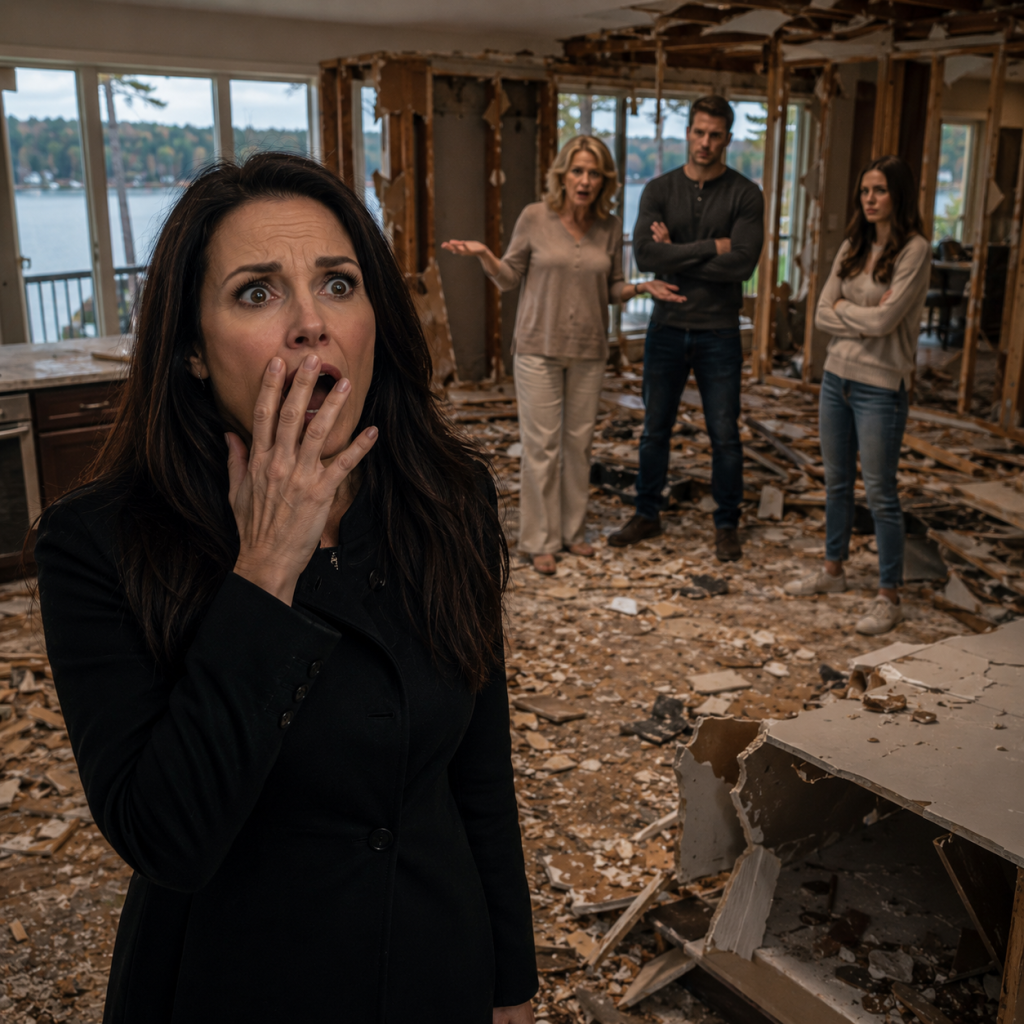
“Renovated?” The woman from the preservation board lifted her clipboard and looked past him into the shattered interior of my kitchen. “You removed original cabinetry, flooring, and part of a support arch dating back to 1891.”
Cassian shrugged. “It looked old.”
“It was old,” I said.
His face reddened. “Don’t talk to me like I’m stupid.”
I looked at the heap of splintered oak near the doorway, the dust still drifting through the sunlight, the blue tiles my father had restored by hand now broken in a pile near a garbage bin.
“I don’t have to.”
His jaw tightened, but for once he had no audience willing to laugh.
My mother descended one step.
“Sheriff, I don’t know what Aurelia has told you, but this is a family matter.”
Marcus Vale turned a page in the folder. He had the calm brutality of a man who never raised his voice because paper did all his shouting for him.
“Fraud is not a family matter.”
My mother’s eyes snapped to him.
Marcus continued, “Nor is the concealment of a living heir in connection with a property transfer, inheritance, and trust instrument.”
“You’re making accusations you can’t prove.”
“I brought the proof.”
He handed the sheriff a sealed envelope.
I watched my mother watch it leave his hand. That was when I knew. Not guessed. Knew.
She had not simply lied. She had built our entire life around the lie, brick by brick, smile by smile, Sunday brunch by Sunday brunch.
And I had lived inside it like a dutiful daughter.
Lyra whispered, “Who is Clara Whitcomb?”
No one answered.
So I did.
“She worked for Grandfather Vance one summer. Dad met her before he met Mom. They had a daughter.”
Selene frowned. “And you knew?”
“I found out six months ago.”
My mother gave a short laugh, brittle and elegant. “Of course. Of course you did. Always digging through things that don’t belong to you.”
“That’s funny,” I said. “I was going to say the same thing to Cassian.”
He glared at me.
Behind him, through the broken kitchen wall, I could see the place where he had ripped out my father’s measuring marks. Tiny pencil lines on the doorframe, one for each of us, from childhood to adolescence. Mine, Selene’s, Lyra’s. Even Cassian’s after Mom insisted he be included, though he had only joined the family when he was nine and my father was already tired of pretending happiness came naturally.
Those marks were gone now.
But the house had kept deeper records.
Marcus nodded toward the woman from the preservation board. “Ms. Penn, would you confirm the emergency stop order?”
She stepped forward, handed Cassian a document, then passed one to my mother.
“All work ceases immediately. No removal of materials from the property. No entry except by authorized personnel until structural assessment is complete. Any attempt to continue work may result in fines and criminal referral.”
Cassian looked at the paper as if it were written in a dead language.
“You can’t ban me from my own family’s house.”
“It isn’t your family’s house,” I said.
The words were not loud.
They did not need to be.
My mother turned fully toward me then, and I saw something pass across her face. Not fear. Not yet.
Recognition.
She finally understood that I had not come to scold, plead, or negotiate. I had come prepared.
And that was something she had never forgiven in anyone but herself.
Sheriff Halden gestured toward the cruiser. “Mrs. Vance, I’m asking you to come with me voluntarily.”
My mother lifted her chin. “Am I under arrest?”
“Not at this time.”
“Then I’ll speak with my attorney.”
Marcus smiled politely. “I assumed you would. I notified him.”
Her eyes flashed.
“You had no right.”
“I had every right,” I said. “You made sure of that when you called me unstable in front of the family board last month.”
Lyra’s mouth parted.
Selene looked away.
That, at least, they had known.
My mother’s voice softened. It was her most dangerous voice, the one she used when she wanted people to lean closer before she cut them.
“Aurelia, you are upset. You’ve always been sensitive about your father. I understand that.”
I walked down the driveway until only three feet stood between us.
“No,” I said. “You understood how to use that.”
For a moment, the lake wind moved between us, carrying the smell of pine, dust, and old rain trapped inside torn walls.
Then my mother smiled.
It was small. Almost private.
“You think you’ve won because you found a ghost?”
“No,” I replied. “I think I’ve started because I found an heir.”
That was the first time Cassian looked frightened.
Not angry. Not embarrassed.
Frightened.
“Where is she?” Selene asked.
Marcus glanced at me, asking without words if I wanted to answer.
I did not.
Not yet.
Because the truth was, I had only met my half sister once.
Her name was Mara Whitcomb, though my father’s letters called her Marigold.
She lived four states away, in a gray coastal town where the sea ate paint from the houses and everyone looked like they had learned not to expect visitors. She ran a small antique repair shop behind a hardware store. When I walked in six months ago with my father’s watch in my palm, she had known who I was before I spoke.
“You have his eyes,” she had said.
I had nearly replied, So do you.
But I could not.
Because she did.
Not the color. The expression. That watchful sadness, the habit of seeming half in the room and half in memory.
I found her after discovering the first letter in the false bottom of my father’s desk.
My dearest Clara,
I have done something cowardly, and calling it protection does not make it less cowardly.
There were twenty-three letters. None sent. All kept.
The last one was addressed not to Clara, but to Mara.
My firstborn,
If this reaches you, then I failed to be brave while alive. I have tried to be braver in paper.
The lake house was his apology.
And my mother had buried it.
Sheriff Halden asked again, “Mrs. Vance?”
My mother did not move.
Then, from behind her, my grandmother’s old brass doorbell rang.
Everyone turned.
The sound was impossible.
The bell had been disconnected for years.
It rang again.
Clear. Bright. Almost cheerful.
Cassian swore under his breath.
The front door opened.
A woman stepped out of the house.
For a second, no one spoke.
She was tall, with dark hair tied at the nape of her neck, wearing a navy coat despite the warm afternoon. She held a leather satchel in one hand. Her face was composed, but her knuckles were white around the strap.
Mara Whitcomb looked at all of us as if she had walked into a room where strangers were wearing pieces of her life.
My mother whispered, “No.”
Mara’s gaze rested on her.
“Yes,” she said.
The single word seemed to age my mother ten years.
I heard Lyra inhale sharply beside me. Selene’s expression had gone blank in the way it did when she was hiding panic. Cassian stared at Mara with open resentment, like her existence was a personal insult.
I stepped forward.
“You came.”
Mara looked at the ruined kitchen behind me. Pain flickered across her face, quick but unmistakable.
“You said he loved this place.”
“He did.”
Her eyes moved to the broken tiles. “Apparently not everyone did.”
Cassian barked a humorless laugh. “Who even are you?”
Mara looked at him.
“The person your mother erased.”
That silenced him.
My mother’s face tightened. “I erased nothing. I protected my family.”
Mara descended the porch steps slowly. “From an infant?”
“You don’t know what happened.”
“Then tell me.”
It was not a challenge. It was worse.
It was an invitation.
My mother looked around at all of us, measuring witnesses, alliances, exits. I could almost see the old machinery turning behind her eyes.
Then she said, “Your mother took money.”
Mara’s expression did not change.
My mother continued, gaining strength. “Clara agreed to leave. She knew your father was engaged to me. She knew the scandal would destroy him. My family paid her enough to start over.”
Marcus interjected, “There is no record of payment.”
“Of course there isn’t.”
“Convenient.”
My mother ignored him. “Clara was unstable. She wrote letters. She threatened us. She claimed Daniel promised her marriage, promised her this house, promised her everything.”
Mara’s voice was quiet. “Did he?”
For the first time, my mother faltered.
The answer was yes.
We all heard it in the silence.
Mara nodded once, as if confirming something she had already mourned.
“My mother never took money,” she said. “She waited for him for eight months. Then a woman came to the boarding house with a nurse and a paper. The woman said the Vance family would make sure Clara was declared unfit if she caused trouble. She said the baby would vanish into an institution. She said Clara could keep me only by disappearing.”
My mother’s lips parted, but no sound came.
Mara stepped closer.
“That woman wore pearls in the morning.”
My mother’s hand rose unconsciously to her throat.
There were no pearls there now.
Lyra began crying silently.
Selene whispered, “Mom, is that true?”
My mother turned on her. “Don’t you dare look at me like that. Everything you have, every school, every holiday, every door opened for you—do you think those things came from kindness? They came because I understood what had to be protected.”
“Protected?” I asked. “Or possessed?”
Her eyes cut to me.
“You were always his favorite because you asked the fewest questions.”
That landed harder than I wanted it to.
Because once, it had been true.
As a child, I had loved my father with a devotion that needed no explanations. When he disappeared into silence for days, I curled beside him. When my mother hosted dinners and he stared past the candles, I did not ask why. I brought him tea. I learned his moods like weather.
I thought that was love.
Maybe it was.
Maybe love could still be incomplete.
Mara looked at the house again. “He knew I was alive?”
“Yes,” I said.
Her jaw tightened.
“He knew where I was?”
I hesitated.
That was enough.
She closed her eyes.
The betrayal in her face was so quiet that I could not look away.
“My mother died telling me he tried,” Mara said. “She said he must have tried.”
My voice broke despite my effort. “He did, at first. Then he stopped.”
The lake moved behind us, flashing white under the sun.
Mara opened her eyes. “Thank you for not dressing it up.”
My mother laughed softly. “How touching. Two abandoned daughters bonding over disappointment.”
Sheriff Halden said, “Mrs. Vance.”
But Mara raised a hand.
“No. Let her talk. I want to know how she sounds when she thinks she’s still in control.”
My mother smiled at her.
And there she was again.
The queen restored. Bruised, cornered, but still convinced the room belonged to her.
“You want the house?” she asked. “Take it. Take the mold, the taxes, the rotten dock, the memories of a man who chose me every morning he stayed. A deed won’t make you loved.”
Mara flinched.
I moved before thinking, stepping between them.
My mother’s smile widened.
“Oh, Aurelia. Still guarding people who won’t stay.”
I felt Selene look at me then.
There were old wounds in that glance. Things sisters know and never say. The fiancé who left after my mother showed him carefully selected medical records from the year I broke down after Dad died. The board seat I lost after rumors of my “fragility” reached donors. The cousins who stopped calling because Elise Vance had sighed into telephones and said I needed rest.
My mother had not destroyed me all at once.
She had done it in embroidery.
A thread here. A thread there.
Until everyone saw the picture she wanted.
Marcus cleared his throat. “Aurelia, there is one more matter.”
I turned.
He looked almost reluctant.
That frightened me more than any of the rest.
“What matter?”
He handed me another folder.
“This was delivered to my office this morning by courier. It was marked to be opened only if Mara appeared at the lake house.”
“From who?”
“Your father.”
The world narrowed.
Even my mother stopped breathing.
The folder was old, the seal brittle, the handwriting unmistakable.
For my daughters, if truth ever finds the courage I lacked.
My fingers would not work at first. Mara stepped closer, and together we opened it.
Inside was a key, a bank receipt, and a single page.
I read aloud because silence would have crushed me.
“My girls,
If you are reading this, then the house has done what I could not. It has brought you together. I do not ask forgiveness. That would be another theft. I only leave instructions.”
I swallowed hard.
“Beneath the north boathouse, sealed in the stone locker, is the record of what happened the week Mara was born. Not my memory. Not Elise’s. The record. Use it carefully. It will hurt the living more than the dead.”
No one moved.
Then Cassian bolted.
He did not get far.
One of Marcus’s men caught him halfway to the side path leading down toward the dock. Cassian twisted, shouting, “Get off me! I’m allowed to walk!”
But his panic had already betrayed him.
My mother’s face went bloodless.
Selene stared at him. “What did you do?”
Cassian stopped struggling. His eyes darted to my mother.
That was answer enough.
I gripped the key until its teeth cut my palm.
“You knew about the locker.”
Cassian said nothing.
Marcus turned to the sheriff. “I believe we have cause to secure the boathouse.”
Sheriff Halden nodded to his deputy.
My mother stepped down from the last stair.
“No.”
Everyone looked at her.
Her voice was no longer sharp. It was low, stripped bare.
“No one goes down there.”
Mara faced her. “Why?”
For one moment, I thought my mother might confess.
Instead, she looked at me with something almost like pity.
“Because your father was not the only coward in this family.”
Then she turned and walked to the sheriff’s cruiser.
No argument.
No demand for her attorney.
No performance.
Just surrender.
And somehow that frightened me most of all.
The deputy drove her away while the rest of us walked down to the boathouse.
The path curved beneath old cedars, their roots pushing through the dirt like knuckles. As children, we had raced down this slope barefoot, shrieking with laughter, my father calling after us not to run on the dock. The boathouse had always smelled of rope, wet wood, and gasoline. Now it smelled of rot.
Cassian walked between Marcus’s men, silent at last.
Lyra stayed near Selene, trembling. Mara walked beside me, close enough that our shoulders nearly touched but did not.
At the north wall, behind stacked oars and a rusted anchor, we found the stone locker.
It was smaller than I expected.
The key turned with a scrape.
Inside was a metal box wrapped in oilcloth.
Marcus carried it to the workbench and opened it under the gray light coming through the dirty windows.
There were documents inside. Photographs. Hospital forms. Letters.
And a cassette tape.
Lyra wiped her cheeks. “What is that?”
“A recording,” Marcus said.
Cassian made a strangled sound. “Don’t.”
Selene turned on him. “Why?”
He looked at me then, and the hatred in his face had curdled into fear.
“Because she’ll ruin everything.”
I laughed once.
It sounded unlike me.
“Cassian, look around.”
Marcus found an old player in one of the supply cabinets. My father had kept everything. Batteries, tools, maps, receipts from restaurants that no longer existed. The player crackled when he pressed the button, then clicked into motion.
At first, there was only static.
Then my father’s voice filled the boathouse.
You said she was dead.
A younger version of my mother answered, cold and furious.
I said what needed to be said.
My knees weakened.
Mara gripped the edge of the workbench.
On the tape, my father said, Elise, where is my daughter?
A pause.
Then my mother said, Which one?
The cruelty of it passed through the room like smoke.
The recording continued.
My father’s voice was ragged. Not the distant, gentle man I remembered, but someone raw with grief.
Clara is gone. The boarding house is empty. Her sister says your father threatened them.
My mother replied, My father protected us from a girl who wanted to trap you.
She had my child.
She had a mistake.
There was a sharp sound, perhaps glass breaking.
Then my father spoke so quietly we had to lean in.
I will never forgive you.
My mother laughed.
You will. You have three daughters upstairs who need a father more than a scandal needs a hero. You will forgive me every morning because leaving would make you the villain too.
The tape hissed.
Then came another voice.
Older. Male. My grandfather.
Enough. Daniel, listen carefully. Clara Whitcomb signed the papers. She left with the child. She will not return. If you chase her, I will bury you in court until your daughters inherit nothing but headlines.
My father said, The house goes to Mara.
My grandfather laughed. Give the ghost a house, then. But ghosts don’t collect deeds.
The tape ended with a click.
No one spoke.
The lake slapped softly against the pilings beneath us.
Mara’s face had become unreadable. Lyra was crying openly now. Selene looked ill.
I could not move.
The dead had spoken, and instead of peace, they had given us a room full of knives.
Marcus carefully removed the cassette. “This changes the civil case significantly.”
Mara said, “Civil?”
Her voice was hollow.
Marcus met her eyes. “And possibly criminal, depending on what else is here.”
Cassian suddenly laughed.
It was too loud.
“You’re all acting like this matters. It was decades ago. Clara’s dead. Dad’s dead. Grandpa’s dead. What are you going to do, sue a grave?”
Mara turned toward him.
“No,” she said. “I’m going to take my house.”
He leaned forward. “You think I care about this dump?”
“Yes,” I said.
Cassian looked at me.
“You care because Mom promised it to you.”
His silence confirmed it.
“She told you that after the family board removed me, she’d break the trust and give you the property. That’s why you started demolishing before the vote. You wanted to make Mara’s inheritance worthless.”
His face twisted. “You always think you’re so smart.”
“No,” I said. “I think you’re predictable.”
He lunged then.
Not at me.
At the box.
Marcus’s men caught him again, but not before his hand struck the papers and sent them spilling across the floor. Photographs scattered over damp boards.
One slid to my feet.
I picked it up.
At first, I did not understand what I was seeing.
It was a photograph of the lake house porch, taken at night. My father stood near the door, younger than I had ever known him. Beside him was Clara Whitcomb, holding a baby wrapped in a pale blanket.
On the back was written:
The night Elise brought them back.
My blood went cold.
“Mara,” I said.
She looked at the photograph.
Then at me.
Then at the date.
Her face changed.
“That’s impossible,” she whispered. “My mother said we never came here.”
Marcus searched through the papers quickly, then found a second envelope tucked beneath the hospital forms. This one was sealed with red wax.
Not my father’s handwriting.
My mother’s.
To Daniel, should you ever mistake mercy for weakness.
Marcus did not open it until I nodded.
Inside was a single page.
And a second birth certificate.
For a child named Marigold Clara Vance.
Date of birth: March 3.
But Mara had always believed her birthday was March 7.
Four missing days.
Four days in which she had not been dead.
Not gone.
Here.
At the lake house.
Selene covered her mouth.
Lyra whispered, “What happened in those four days?”
The boathouse door creaked behind us.
We all turned.
My mother stood in the doorway.
Sheriff Halden was not with her.
Neither was the deputy.
Her hair had loosened in the wind, and for the first time in my life, she looked less like a woman and more like the ruin of one.
Cassian stared. “Mom?”
She ignored him.
Her eyes were fixed on the photograph in Mara’s hand.
“I told them not to open that box,” she said.
Marcus stepped forward. “Mrs. Vance, how did you get here?”
She smiled faintly.
“People always underestimate how much a driver hears when families talk in cars.”
A dark stain spread across her sleeve. Not blood. Ink. Her signature ink, the deep blue she used on every letter, every check, every command disguised as correspondence. It dripped from the smashed pen in her hand.
She had signed something.
Or destroyed something.
My stomach tightened.
“What did you do?”
My mother looked at me then, and for the first time there was no mask left.
Only triumph.
“I corrected your father’s final mistake.”
Marcus checked his phone.
His face changed.
“Aurelia,” he said slowly, “the trust account just transferred ownership authorization.”
“That’s impossible.”
“It required two trustee approvals.”
“I’m the only active manager.”
He looked toward Cassian.
Cassian’s fear had vanished.
In its place was a smile.
My mother reached into her coat and removed a folded document.
“Your father was sentimental,” she said. “But sentiment is rarely as useful as blood.”
Mara whispered, “What does that mean?”
My mother unfolded the paper.
A DNA report.
My name was on it.
Cassian’s name was on it.
And beside the word Relationship, in clean black type, was the result:
Paternal half-siblings.
The boathouse tilted beneath me.
Cassian grinned.
“Surprise,” he said softly.
My mother looked at Mara, then at me.
“Daniel’s firstborn was not the only secret he left behind.”
Outside, across the water, the lake house bell began to ring again.
…If you want to know what happened next, please type “YES” and like for more.