Part 1: The Chronicle of a Coup d’État
I have spent the better part of my adult life constructing a fortress. It isn’t built of stone or mortar, but of statutes, precedents, and iron-clad motions. In the professional circles of the County Attorney’s Office, they see me as a rising star, a woman with a surgical tongue and a heart carved from granite. For me, however, my career was never about justice in the abstract. It was a chronicle of my own slow-motion coup d’état. I was the girl who had escaped the Blackwood Farmhouse at eighteen with nothing but a bruised rib, a suitcase full of library books, and a silent vow never to look back.
But the past is a persistent creditor. It doesn’t stay buried; it just waits for a rainy Tuesday to scream through the receiver.
The call came at 11:42 PM. Outside the courthouse, the sky was a bruised, sickly purple, and the rain wasn’t just falling; it was an assault. I was sitting in my car, the heater humming a low, mechanical lullaby, as I reviewed a particularly nasty case of financial exploitation involving a veteran. My hands were steady, my mind sharp, until the screen of my phone illuminated the dark interior of the car.
When I answered, there was no greeting. There was only the sound of wet, rhythmic bubbling—the sound of someone trying to breathe through a nose filled with blood. It is a sound I know from my own nightmares. Behind that wet gasp, I could hear the roar of the storm against the farmhouse windows, the rattle of glass that always sounded like it was a second away from shattering.
“Lily?” my voice was a jagged shard of glass, cutting through the silence of the car.
The world narrowed until all I could see were the wipers slashing across my windshield, back and forth, like a frantic heartbeat. My lungs felt as if they were filling with the same cold rain drowning the city.
“Where are you, Lily?” I forced my voice into the clinical, detached tone I used when interviewing victims of violent crimes. If I felt the emotion, I would shatter. If I shattered, she was alone in that house with the monsters.
In the background, a voice I loathed—a voice that sounded like gravel grinding over bone—roared, “Give me that damn phone! Who are you talking to? You want to play the martyr? You want to see what a real martyr looks like?”
That was Garrett. My stepfather. A man who viewed my sister’s spinal condition not as a challenge to be met with love, but as a personal insult to his convenience. To Garrett, vulnerability was a provocation.
Then came the second voice. The one that hurt worse because it should have been the shield. Soft, melodic, and dripping with a slow-acting poison.
“Lily, stop being dramatic,” my mother, Eleanor, said. “You tripped. You’ve always been clumsy, dear. You’re making a scene and upsetting Garrett. Now give him the phone before you make him truly angry. You know how he gets when he’s stressed.”
The line went dead with a final, sickening thud.
Cliffhanger: As I threw the car into gear, I didn’t just see the road ahead; I saw the legal file I had been secretly building for three years, and I realized with a cold, terrifying clarity that the “accident” Eleanor mentioned was the exact same phrase she used the night my father “fell” down the basement stairs.
Part 2: The Architecture of the Abyss
The five-hour journey to the Blackwood Farmhouse was a blur of lightning and adrenaline. Every mile was a mile closer to the ghost of the girl I thought I’d killed. Lily had been born with a spinal condition that left her legs unpredictable. On her best days, she walked with a stubborn, rolling gait and forearm crutches. On her worst, she used the wheelchair. To the world, she was “disabled.” To me, she was the only person who had ever shared the secret language of our childhood—a language of whispered stories under bedsheets while the house shook with our mother’s latest volatile romance.
I had tried to get her out a dozen times. But Eleanor was a master of the emotional leash. She had convinced Lily that the world outside was too steep, too fast, and too cruel for someone like her. She had turned the farmhouse into a gilded cage, and then she had invited the wolf, Garrett, to be the gatekeeper.
By the time the farmhouse appeared through the gray dawn, my knuckles were white against the steering wheel. The house looked like a rotted tooth sticking out of the mud of the valley. The paint was peeling like sunburnt skin, and the porch sagged under the weight of decades of neglect.
I didn’t knock. I used my old key—the one I’d kept like a hidden dagger—and I stepped into the foyer.
The smell hit me first: stale tobacco, expensive gin, and the metallic, copper tang of blood.
“Ava? What on earth are you doing here at this hour?”
My mother was standing at the top of the stairs, wrapped in a silk robe that cost more than Lily’s monthly physical therapy. She looked down at me with an expression of mild annoyance, as if I were a solicitor interrupting her morning tea.
“Where is she, Mom?” I didn’t climb the stairs. I stood in the center of the foyer, a black silhouette against the morning light.
“She’s resting. She had a little tumble in the kitchen. You know how she is, always forgetting her limitations,” Eleanor said, smoothing her hair.
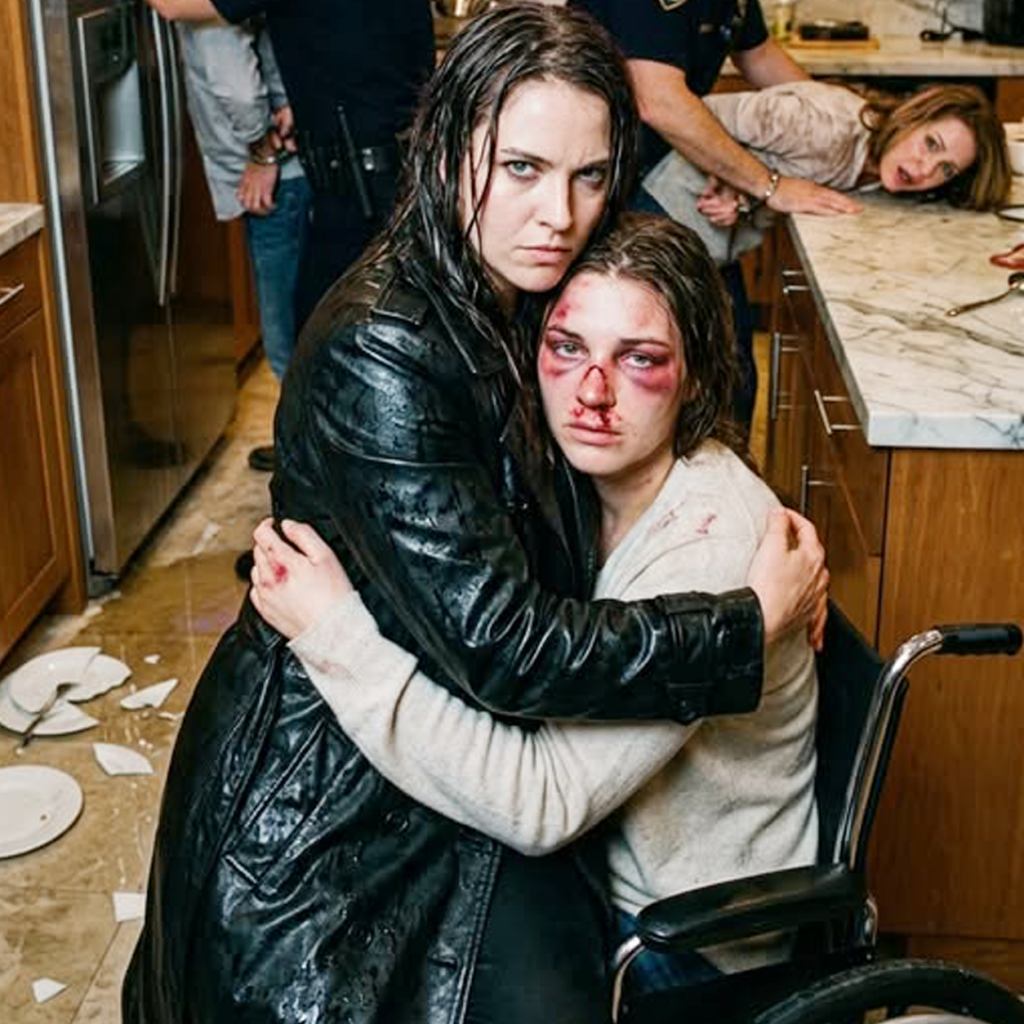
I pushed past her toward the kitchen. The scene was worse than I had imagined. Lily was slumped on the sofa in the breakfast nook, a pathetic figure wrapped in a threadbare blanket. A towel was pressed to her face, already blooming with a deep, angry crimson. One eye was swollen shut, the skin a mottled shade of plum and obsidian. Her hands—those brilliant, artistic hands that could draw the soul out of a person—were shaking so hard the tea in her mug sloshed over the rim, staining her lap.
Garrett was leaning against the counter, still in his robe, looking as smug as a king who had just successfully quelled a peasant revolt. He was holding a glass of amber liquid. It wasn’t even 7:00 AM.
“Look at this,” Garrett sneered, gesturing toward me with his glass. “The big-city lawyer returns to the nest. Did you come to sue the floor for being too hard?”
I didn’t look at him. I walked straight to Lily. I knelt in the blood on the tile—the blood they hadn’t even bothered to wipe up—and took the mug from her hands.
“Can you feel your toes, Lil?” I whispered, my heart hammering against my ribs like a trapped bird.
“A little,” she breathed, her voice a ghost of itself. “It’s just the shock, Ava. Don’t make them mad. Please.”
I looked at the refrigerator. There was a dent in the stainless steel at exactly the height of a wheelchair’s backrest. There was a smear of blood there, too—a signature of the violence that had occurred.
“A tumble?” I asked, finally turning my gaze to Garrett. My voice was a low hum, the sound a transformer makes right before it blows.
Garrett smiled. He had the kind of teeth that looked like they belonged in a shark’s mouth—too many, and all of them sharp. “She threw herself into the fridge, Ava. You know how unstable she is. She wanted attention because your mother and I were planning a trip to the coast. She’s been a burden on Eleanor since the day your father died, and frankly, I’m the only one with the patience to deal with her ‘episodes.’”
“A burden?” I repeated the word, tasting the bile in the back of my throat.
“Don’t start trouble, Ava,” my mother snapped, coming into the kitchen and resting her hand on Garrett’s arm. It was a gesture of solidarity that made my stomach turn. “We are a family. We handle our own business. You chose to leave this family. You don’t get to come back and play judge.”
They still saw me as the eighteen-year-old girl who ran away in the middle of the night. They saw the tired lines under my eyes and the old car in the driveway. They didn’t see the Legal Advocate badge in my pocket. They didn’t know that for the last six months, I hadn’t just been working on county cases—I had been building a digital gallows for them.
“Families do handle things,” I said, pulling my phone from my pocket. I set it on the table. The red light was already blinking. “And professionals document them.”
Cliffhanger: As Garrett laughed and stepped toward me to snatch the phone, I didn’t flinch. I simply pointed toward the window, where the first of four black SUVs began to roll silently up the gravel driveway.
Part 3: The Theater of Denial
“You think calling the local deputies is going to change anything?” Garrett barked, his face turning a mottled purple. “I play poker with the Sheriff every Thursday. I donated the new uniforms for the high school ball team. You’re playing in the wrong league, little girl.”
“I’m not calling the local police, Garrett,” I said, my voice steadying. “I’m calling the State Investigators from the Adult Protective Services division. And they aren’t here for a domestic dispute. They’re here for the felony.”
The room went silent. The only sound was the wind rattling the windowpane and the distant crunch of boots on gravel.
I opened my briefcase and pulled out a stack of documents, bound in professional blue covers. I placed them on the coffee table next to the bloody towel.
“What’s this?” Eleanor sneered, though I could see the pulse jumping in her neck. “More lawyer junk? You always were so dramatic, Ava. Just like your father.”
“This,” I said, pointing to the top page, “is the Medical Power of Attorney Lily signed six months ago when I visited her while you were at the spa. It names me her sole legal advocate and protector. This second pile is the forensic audit of Lily’s disability bank account and the survivor benefits from Dad’s pension.”
I looked my mother in the eye. “The audit shows twenty-four thousand dollars in ‘household expenses’ over the last year that seem to coincide perfectly with Garrett’s gambling debts at the riverside casino and your new jewelry habit, Mom. That is financial exploitation of a protected person. In this state, that’s a mandatory minimum of five years.”
Garrett lunged then. He wasn’t a man of words; he was a man of momentum. But as his hand closed toward my throat, the front door didn’t just open—it was kicked off its hinges.
The men who entered weren’t the friendly deputies Garrett knew. They were tactical units, and leading them was Mark Vance, the most aggressive trust attorney in the tri-state area.
“Garrett Hayes,” one of the officers shouted. “Hands behind your head! Get on the floor! Now!”
It wasn’t like a movie. There was no dignity in his defeat. Garrett went down ugly—spitting, cursing, and eventually weeping as the zip-ties bit into his wrists. His silk robe tore, exposing the soft, cowardly underbelly of a man who only fought those who couldn’t fight back.
I watched as they hauled him out into the rain. He looked small. He looked like the nothing he had always been.
I turned to my mother. She was clutching the back of the sofa, looking at Lily, but there was no love in her eyes. Only a cold, sharpened resentment. “You did this,” she hissed at my sister. “You ruined everything because you couldn’t just be quiet and grateful for a roof over your head.”
Lily looked up. For the first time in my life, I saw the light of the Blackwood fire in her eyes—not the fire that burns a house down, but the fire that forges steel. “No, Mom,” Lily said, her voice shaking but clear. “I was quiet for twenty years. I’m just finally speaking your language. The language of consequences.”
The paramedics arrived then. They were gentle with Lily, lifting her with a grace Garrett had never shown. As they moved her toward the door, she gripped my hand. Her fingers were cold, but her grip was like a vise.
“Where are we going, Ava?”
“To a place where the doors lock from the inside, Lil,” I promised. “And I’m the only one with the key.”
Cliffhanger: As the paramedics wheeled Lily out, one of the investigators pulled me aside. “Ms. Blackwood, we found something in the cellar. You need to see this before we process the scene. It’s about your father’s ‘accident.’”
Part 4: The Ghost in the Foundation
The cellar of the Blackwood Farmhouse had always been a place of shadows. As a child, I believed monsters lived there. As an adult, I realized I had been right.
The investigator led me down the narrow wooden stairs. In the corner, behind a stack of rotted hay bales, the floorboards had been pried up.
“We were looking for the financial records Lily mentioned,” the investigator said, shining a high-powered flashlight into the hole. “We found the records. But we also found this.”
At the bottom of the hole sat an old metal lockbox, rusted and caked in dirt. But inside wasn’t just money. It was a journal, written in my father’s cramped, precise handwriting, and a collection of Polaroids. The photos showed bruises on my mother’s arms from twenty years ago—bruises she had blamed on “clumsiness.” But the journal told a different story. It was a log of Eleanor’s own volatility, her history of staged accidents to gain sympathy and control.
And the last entry, dated the night my father died, read: She found out about the trust I set up for Lily. She’s talking to a man named Garrett. I think they’re planning something. If I don’t make it to the city tomorrow, look under the floor.
My father hadn’t fallen. He had been harvested.
The weight of the revelation nearly brought me to my knees. My mother wasn’t just a victim who had turned into a bystander; she was the architect of the entire nightmare.
I walked back upstairs. My mother was sitting on the porch, a cigarette in her hand, watching the rain. She looked at me with a hollow, haunting smile.
“You think you’ve won, Ava? You’ve just traded one cage for another. You’ll spend the rest of your life taking care of her. You’ll never have a life of your own. You’re just like me—bound to this family by blood and misery.”
“I’m nothing like you,” I said, the words feeling like cold stones in my mouth. “Because when I look at Lily, I see a human being. You just see an obstacle.”
I watched the police car take her away, too. She didn’t scream like Garrett. She just stared ahead, her face a mask of aristocratic boredom.
The following weeks were a blur of hospitals and depositions. The reality of Lily’s “scratch” was laid bare by the medical examiners. A shattered septum. Two cracked ribs. A concussion. And, most chillingly, an X-ray that showed three older fractures in her legs that had never properly healed—fractures from “falls” my mother had ignored over the last two years.
I sat in the plastic chair by her bed in the high-security wing of the hospital, the fluorescent lights humming overhead. My phone was blowing up. My mother’s sisters, my cousins—people I hadn’t heard from in a decade—were calling to tell me I was heartless for ‘evicting a grieving widow’ and ‘destroying a family over a misunderstanding.’
I blocked them all. One by one, their names vanished from my screen like stars winking out.
By Monday, Garrett’s employer at the local mill had seen the arrest record. He was fired before lunch. By Wednesday, the state had frozen every bank account tied to the Blackwood name. And by Friday, I was standing in a courtroom, staring at a judge who looked like he had seen too much of the worst of humanity.
Cliffhanger: Just as the judge was about to sign the emergency protection order, Garrett’s high-priced defense attorney—paid for by a secret account we hadn’t found—stood up with a smirk. “Your Honor, we have a witness who claims Ms. Ava Blackwood coerced her sister into making these allegations.”
Part 5: The Architecture of a Trap
The “witness” was a distant cousin, a woman named Sarah who had always been envious of the small trust fund my father had left. She stood at the stand and spun a web of lies, claiming I had “brainwashed” Lily because I wanted sole control of the Irrevocable Trust.
I felt the blood in my veins turn to ice. This was the play. They couldn’t win on the facts of the assault, so they were going after my credibility.
I looked at the defense table. Garrett was sitting there in a cheap, ill-fitting suit, trying to look like a victim of a ‘vindictive daughter-in-law.’ My mother sat in the gallery, weeping into a lace handkerchief for the benefit of the local reporters.
“Your Honor,” the defense lawyer argued, “this is a family dispute blown out of proportion by an ambitious prosecutor looking for a headline. Mr. Hayes is a pillar of the community. A simple disagreement over household chores was escalated by a woman who hasn’t been home in ten years.”
The judge looked at me. “Ms. Blackwood, does the victim wish to speak?”
Lily was in the back of the courtroom, hidden from view. I walked back to her. She looked so small in her wheelchair, her face still yellow and green with healing bruises.
“You don’t have to do this, Lil,” I whispered. “I can find another way.”
“No,” she said, her voice stronger than I’d ever heard it. “Push me in, Ava.”
The courtroom went silent as I wheeled my sister to the front. She didn’t look at our mother. She didn’t look at Garrett. She looked at the judge.
“I am not a victim of my sister’s ambition,” Lily said, her voice echoing in the wood-paneled room. “I am a victim of my mother’s silence and my stepfather’s hands. For twenty years, I was told that the world was too dangerous for me. But I’ve realized that the only dangerous place was the house I was born in.”
She then pulled a small digital recorder from her lap—one I didn’t even know she had. “I didn’t just record the night of the storm,” she said. “I’ve been recording for months.”
She pressed play.
The courtroom was filled with the sound of Garrett bragging about how he was going to “drain the gimp dry” and how Eleanor was “too drunk on gin to care as long as she got her pearls.”
The defense attorney turned the color of ash. My mother stopped weeping. The mask didn’t just slip; it shattered.
The judge didn’t even deliberate. The Permanent Restraining Order was granted on the spot. The criminal charges were moved to the grand jury. Garrett was led out in shackles, and my mother was served with a formal eviction notice from the house she had turned into a tomb.
But as we left the courthouse, the air was heavy. The victory felt like a paper shield—strong enough for now, but the storm wasn’t over.
Cliffhanger: Six months later, I received a letter from the prison where Garrett was awaiting trial. It wasn’t a plea for forgiveness or a legal motion. It was a single sentence, written in a jagged, violent hand: “I found out where you moved her, and the new locks won’t matter when the house starts to burn.”
Part 6: The Fortress of Yellow Curtains
Panic is a cold, creeping thing. It doesn’t scream; it simmers in the base of your skull.
When I read Garrett’s letter, I didn’t run. I went straight to the Sheriff’s Department. We traced the letter—not to Garrett, but to an associate of his, a man he’d met in the county lockup who had been released a week prior.
I moved Lily that very night. We didn’t take furniture. We didn’t take the memories. We took the clothes on our backs and my father’s journals.
We went to a small apartment in a high-rise in the city, three hours away from the valley. It had wide doorways, a ramp that didn’t creak, and windows that let in the morning sun from the twentieth floor. I painted the kitchen yellow because Lily said it looked like the color of a fresh start—the color of a sun that actually rose instead of just struggling through the gray clouds of the Blackwood Farmhouse.
We lived in a state of hyper-vigilance. Every heavy footstep in the hallway made me reach for the pepper spray I kept in my pocket. Every unscheduled knock made Lily’s breath hitch. We were safe, but we weren’t free.
But then, slowly, the architecture of our lives began to change.
Lily started taking online classes in Graphic Design. She spent hours at her desk, her stylus moving across the tablet with a fluidity she lacked in her legs. She started to laugh. Not the quiet, stifled giggle of a girl afraid of being noticed, but a loud, belly-shaking laugh that filled the apartment and made the shadows retreat.
I watched her bloom, and in doing so, I realized how much of my own life I had spent in a crouched position, waiting for the blow to fall. I had been a prosecutor because I wanted to hurt the people who hurt others. But Lily was teaching me that the real revenge wasn’t the conviction; it was the recovery.
The final confrontation didn’t happen in a dark alley or a storm-lashed farm. It happened in a sterile, wood-paneled room during the Asset Forfeiture Hearing.
My mother was there. She looked haggard, her expensive silk robes replaced by a cheap polyester coat. Without Garrett’s influence and the trust’s money, she had withered. She was living in a trailer on the edge of town, working as a laundress.
“I want to see her,” Eleanor pleaded, reaching out for my arm as I walked toward the witness stand. “Ava, please. She’s my daughter. I made mistakes, but I loved her in my own way.”
“You didn’t love her,” I said, and for the first time, there was no anger in my voice. Only a vast, echoing distance. “You loved the control she gave you. You loved the way her weakness made you feel strong. That’s not love, Mom. That’s a pathology.”
The trust attorney presented the final numbers. We had recovered sixty percent of the stolen funds. The Blackwood Farmhouse had been sold to a developer who planned to tear it down. The proceeds were being moved into a Special Needs Trust that would ensure Lily never had to rely on anyone—not even me—ever again.
As we signed the final papers, Mark Vance looked at me. “You’ve done a remarkable thing, Ava. Most people just walk away and never look back. They let the house burn with everyone inside.”
“I didn’t walk away,” I said, looking at Lily, who was busy sketching the city skyline through the window. “I just went back for the rest of me.”
Cliffhanger: As we walked out of the hearing, my phone buzzed. It was a text from an unknown number. A photo of the yellow curtains in our new apartment, taken from the street level.
Part 7: The Fragrance of Revenge
The photo was meant to break us. It was Garrett’s final attempt to reach out from behind bars and claim our peace.
But I had spent my life studying the law, and I knew how to use it as a weapon. Within an hour, the “associate” who had sent the photo was in custody. He had been trying to pawn my father’s old watch—the one Garrett had stolen from the farmhouse before his arrest. It was the final link.
Garrett was sentenced to an additional fifteen years for witness intimidation, conspiracy, and the original assault. He would be an old man before he ever saw the sun without bars in front of it.
It is now a year since the night of the storm.
Lily’s apartment is full of life. There are herbs on the balcony—rosemary, thyme, and mint—that she constantly forgets to water, but I do it for her when I visit. She has a boyfriend now, a kind, quiet man who treats her wheelchair like a bicycle and her mind like a cathedral.
My mother is a memory that occasionally surfaces in the form of a blocked voicemail. I don’t listen to them. Some might call it cruel; I call it boundaries. You cannot heal in the same environment that made you sick, and you cannot be a daughter to a woman who chose to be a predator.
People often ask me how I handled it—how I kept my cool while the world was screaming. I tell them that when you spend your childhood in a storm, you learn how to navigate by the lightning. You learn that the rain eventually stops, but only if you’re willing to walk through it.
The trauma doesn’t go away. Some nights, the sound of rain on the roof still makes Lily flinch. Some mornings, I wake up and check the locks three times before I can even think about making coffee. But we are no longer furniture. We are no longer victims waiting for a man’s permission to exist.
Revenge isn’t a bloody act. It isn’t a dramatic explosion in a parking lot.
Revenge is a life lived well.
It’s Lily standing on her own two feet at her graduation from the design institute, her crutches gleaming in the sun like silver wings. It’s the sound of her laughing at a joke I haven’t even finished telling. It’s the sight of the Blackwood Farmhouse being torn down to make room for a community park where children play in the sun.
Every time I see Lily smile, I remember the blood on the kitchen floor, and I think: We won.
We didn’t just survive the storm. We rewrote the ending of the book.
And as the sun sets over the city, painting the sky in shades of gold and amber, I realize that the most powerful thing a woman can possess isn’t a badge or a bank account. It’s the refusal to believe the lie that she is small. It’s the courage to pick up the broken pieces of her life and build a fortress that doesn’t just keep the world out—it lets the light in.
If you want more stories like this, or if you’d like to share your thoughts about what you would have done in my situation, I’d love to hear from you. Your perspective helps these stories reach more people, so don’t be shy about commenting or sharing.