The first time my parents tried to move into my lake house, they didn’t ask whether they could come.
They arrived with a U-Haul.
Three weeks earlier, at 7:12 on a Thursday morning, Dad texted: Your vacation house is perfect for the family reunion.
We’re coming next month.
No question.
Just a statement, as if the $680,000 Lake Norman house I had bought somehow belonged to everyone.
Then Mom called.
“Your dad told you, right?”
“He texted.”
“Good. Melissa’s boys will probably stay most of the summer. You hardly use the place anyway.”
“Most of the summer?”
“You know how cramped Melissa’s place gets.”
I did.
Melissa was my younger sister, and her emergencies had always somehow become mine.
She borrowed my car.
Mom stored boxes in my guest room.
My apartments became free lodging.
In my family, anything I owned was considered flexible as long as I was the owner. The lake house was supposed to be different. I had bought it after twelve years in medical device sales—flights, quotas, missed holidays, and years of hard work.
My family had always teased me for working too much. Funny how the rewards became “ours” once they wanted them. The house had cedar siding, four bedrooms, a fireplace, and a private dock.
I bought it because I wanted one place nobody else could casually claim. Mom waited for me to object.
Instead, I said: “Sure.”
She immediately called to Dad: “I told you she’d be reasonable.”
Reasonable.
That was always their favorite word whenever I gave in. Over the next three weeks, the reunion kept expanding.
A weekend became ten days.
Then two weeks.
Uncle Ron was bringing his boat.
Three cousins were invited.
Melissa texted: Can the boys leave clothes and fishing stuff there all summer? Then Mom said: “There’ll be enough beds if people bring air mattresses.
We have plenty of room.”
We.
That word did it.
That night, I called Wade, my property manager.
“I need you to change everything.”
“Everything?”
“Locks. Garage access. Gate code. Wi-Fi admin. Anything that opens remotely.”
“You expecting trouble?”
“I’m expecting family.”
He laughed.
“Say no more.”
By Sunday, every lock and code had been changed. The security system was reset, and I saved the deed showing my name—and only my name— on the property. Not because I wanted a fight.
Because my family had taught me that people remember things differently when property is involved. Then the first Friday in June arrived. I was working in Charlotte when my phone buzzed.
Motion detected.
Lake Norman — Front Gate.
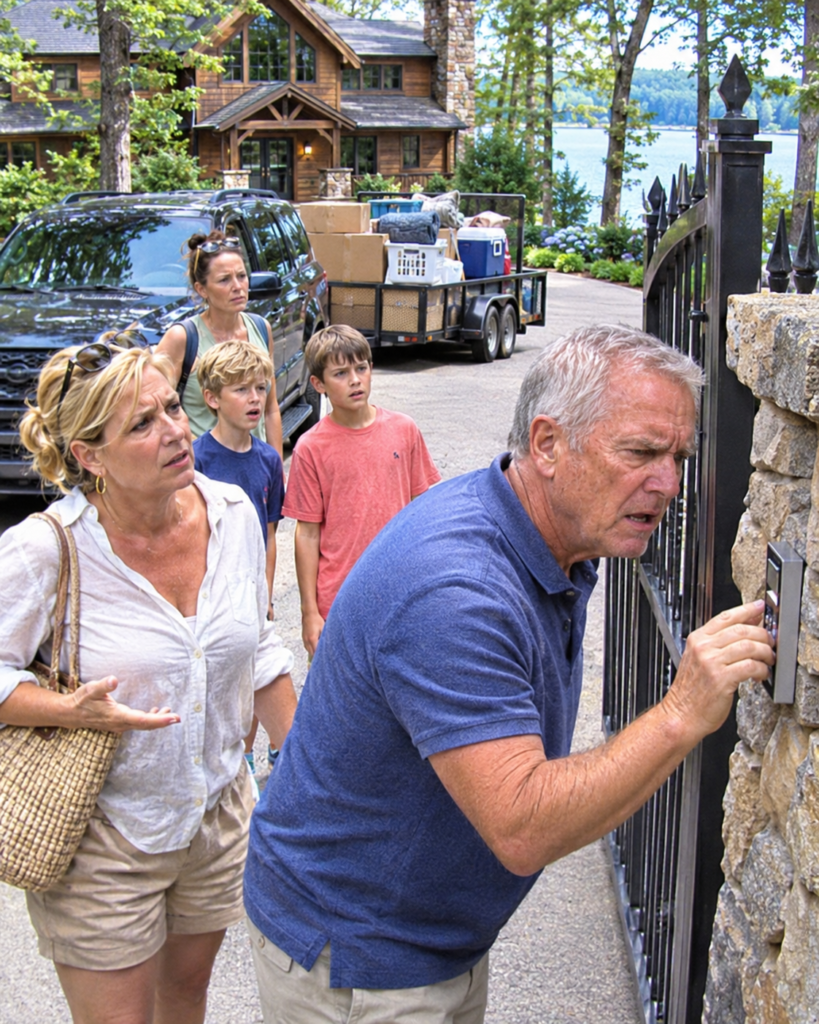
I opened the camera.
Dad’s SUV was sitting at the keypad.
Behind him was Melissa’s minivan.
Behind that was a rented U-Haul trailer.
Storage bins.
Bikes.
Coolers.
Fishing rods.
Patio chairs.
Luggage.
This wasn’t a reunion.
It was an occupation.
Dad entered the old code.
Red light.
Again.
Red light.
Melissa opened the van.
“I get the upstairs room!”
one of her boys yelled.
My upstairs room.
Mom stepped out of the SUV and stared at the locked gate.
My phone started ringing.
Dad.
Mom.
Melissa.
Dad again.
I ignored them.
On camera, Dad punched in the code once more.
Failed entry.
Then again.
Another alert.
Finally, he looked directly at the camera.
“Open it!”
Mom followed his gaze.
She slowly took off her sunglasses. And I saw the exact moment she understood.
I was watching everything.
The U-Haul.
The bins.
The luggage.
The plan they had never bothered to tell me about. For one second, I wanted to answer and list every borrowed car, hijacked guest room, unpaid favor, and every time my success had been treated like family property. Instead, I leaned back in my office chair.
Muted my desk phone.
Opened the live security intercom.
Dad turned toward the speaker.
Melissa froze beside the minivan.
Mom held her sunglasses loosely in one hand. Then I pressed the button and said: “Before any of you unload one more thing, you need to know what I found out about that U-Haul.”
“That trailer was rented in my name.”
Nobody moved.
Even Melissa’s boys stopped arguing.
Dad stared into the camera.
“What are you talking about?”
“The contract has my birth date.”
I opened the emailed document again.
“It has my driver’s license number.”
Mom’s hand dropped toward her side.
“And someone copied my signature.”
Melissa shut the van door.
Too quickly.
The sound cracked across the driveway.
Dad glanced at her.
That single glance told me plenty. I had enlarged the trailer’s orange contract sticker, called the rental branch, and answered their security questions. Their fraud supervisor found the reservation.
It identified me as the renter. The agreement listed the lake house as my primary residence. It also specified a ninety-day rental.
Not ten days.
Not two weeks.
Ninety days.
The payment card had already declined. The backup card belonged to Dad. The email address belonged to Melissa.
“I reported the contract as fraudulent.”
Dad’s face hardened.
“You reported your own family?”
“I reported identity theft.”
“That isn’t what this is.”
“Then explain my signature.”
“We needed a larger trailer.”
Dad stepped closer to the gate.
“You said we could come.”
“I agreed to a reunion.”
My voice remained quiet.
“I never agreed to residency.”
Mom finally spoke.
“It was probably a misunderstanding.”
“The application says permanent relocation.”
Her lips parted.
Nothing emerged.
“It lists Melissa as an authorized driver.”
Melissa folded her arms.
“I handled the paperwork for everyone.”
“By pretending to be me?”
“I knew you wouldn’t mind.”
“You knew I would.”
“That’s why you never asked.”
Dad struck the metal gate with his open palm.
“Enough.”
The clang startled the younger boy.
He turned toward his mother.
Dad pointed at the camera.
“You will open this gate.”
“No.”
“We sold our house.”
The words landed without warning.
Mom closed her eyes.
Melissa looked toward the road.
I leaned nearer the monitor.
“You did what?”
“We closed this morning.”
Dad said it almost triumphantly.
“Everything we own is in these vehicles.”
The boxes suddenly made sense.
So did the bicycles.
The patio chairs.
The filing cabinets beneath blue tarps.
This was not reunion luggage.
This was an entire household.
“You planned to move here permanently.”
“We planned to stay temporarily.”
“How long?”
Dad looked away.
Mom answered instead.
“Until we figured something out.”
“How long, Mom?”
Her mouth trembled.
“Maybe through Christmas.”
It was June.
Melissa stepped forward.
“The boys need stability.”
“So you uprooted them secretly?”
“They’re enrolled nearby.”
My stomach tightened.
“Enrolled where?”
“The middle school near the lake.”
“You used my address?”
“We needed proof of residency.”
Every sentence uncovered another violation.
“You submitted documents in my name.”
Melissa’s chin lifted.
“We did what families do.”
“No.”
I heard my own breathing.
“You did what people do when they expect forgiveness before they commit the offense.”
A patrol car appeared behind them.
Blue lights flashed silently.
Mom turned toward the road.
Dad’s anger faltered.
“You called the police?”
“The rental company did.”
That was only partly true.
Their fraud supervisor had advised me to make an immediate report.
I had.
Deputy Hall stepped from the cruiser.
Wade’s pickup arrived seconds later.
He stopped inside the property, behind the locked gate.
Dad waved toward him.
“Tell him to open it.”
Wade remained beside his truck.
“I work for the owner.”
“I’m her father.”
“I know who you are.”
“Then open the gate.”
“No, sir.”
Deputy Hall approached slowly.
He asked everyone to remain calm. Then he looked toward the camera.
“Ma’am, are you the property owner?”
“Yes.”
“Did you authorize these people to enter or occupy this residence?”
“No.”
Dad raised both hands.
“She invited us.”
“For a temporary family gathering.”
I kept my voice steady.
“That permission has been revoked.”
“You can’t revoke it after we sold our house.”
Dad sounded almost offended.
“I didn’t tell you to sell it.”
“You knew we were coming.”
“I knew about a reunion.”
I let the silence settle.
“I knew nothing about a move.”
Deputy Hall asked for identification.
Melissa hesitated before surrendering hers.
He compared it against information on his tablet. Then he walked toward the trailer.
“Who signed the rental agreement?”
Nobody answered.
He repeated the question.
Dad pointed toward me, though I was miles away.
“She did.”
Deputy Hall looked at the camera.
“Did you?”
“No.”
Melissa exhaled sharply.
“It was an electronic signature.”
“That wasn’t the question,” he said.
Her older son watched her.
His face had changed.
The excitement was gone.
Deputy Hall asked again.
“Who completed the agreement?”
Melissa stared at the gravel.
“I did.”
Mom whispered her name.
Melissa snapped toward her.
“What?”
“You said the company approved it.”
“They did approve it.”
“Because you used her identity.”
Dad interrupted them.
“Nobody stole anything.”
Deputy Hall’s expression stayed neutral.
“The equipment company disagrees.”
He instructed Melissa not to move the trailer.
A branch representative was coming.
The contract had been frozen.
The trailer would be collected until ownership of its contents could be properly documented.
Dad took another step forward.
“You’re leaving elderly people homeless.”
“You have your SUV,” I said.
“And more than enough money for a hotel tonight.”
His eyes narrowed.
“You don’t know what we have.”
“Then this is your opportunity to explain it honestly.”
The younger boy began crying.
Not loudly.
He pressed his face against the side of the van.
That sound nearly broke me.
Children had always been the sharpest tool in Melissa’s hand. She knew I could withstand accusations. She knew I struggled with frightened children.
I pressed the intercom again.
“Ben? Luke?”
Both boys looked toward the speaker.
“This is not your fault.”
Melissa’s face tightened.
“Don’t involve them.”
“You brought them here.”
I swallowed the anger.
“You’re safe. The adults will arrange somewhere comfortable.”
Dad gestured toward the house.
“They already have somewhere comfortable.”
“No.”
One word.
No explanation.
No bargaining.
No opening for negotiation.
Wade walked to the pedestrian gate. He placed bottled water on the pavement outside.
Then he stepped back inside.
Dad saw the boundary.
Something in his expression changed.
He had expected fury.
Fury could be called disrespect.
He had expected guilt.
Guilt could be bent.
What he had not expected was calm preparation. The rental representative arrived twenty minutes later. By then, traffic had backed up along the narrow access road.
Deputy Hall made Dad move his SUV. Melissa shifted the minivan behind it. The representative photographed the trailer, verified the serial number, and attached a wheel lock.
Dad demanded access to the contents. The representative handed him a form.
“You can collect verified belongings at our branch.”
“We need them tonight.”
“You should speak with the named renter.”
“She’s refusing to help us.”
The representative looked toward the camera.
“She is the reported victim.”
Dad stopped talking.
Mom stood apart from everyone.
Her sunglasses remained in her hand.
She looked smaller than usual.
For years, she had managed tension by softening Dad’s words, redirecting Melissa’s demands, and asking me to understand. Now there was nothing soft enough.
The facts had hard edges.
Deputy Hall asked where they would stay. Dad muttered something about a hotel. Melissa said she had no money.
Her older son looked embarrassed.
I nearly offered my card.
The impulse rose automatically.
Then I remembered the declined payment. My identity had been their first solution. My money would become the second.
“Aaron needs to know where the boys are.”
Melissa’s head snapped upward.
“Do not call him.”
“He shares custody.”
“He knows we’re traveling.”
“Does he know you changed schools?”
She said nothing.
That silence gave me another answer. Deputy Hall wrote down Aaron’s number.
Melissa protested.
He explained that custody disputes were not his decision. But the children’s other parent needed accurate information.
Dad called me again.
I rejected the call.
Then Mom tried.
I let it ring.
She left a message.
I did not play it.
The convoy finally pulled away.
Dad’s SUV went first.
Melissa’s minivan followed.
The immobilized trailer stayed behind.
When their taillights disappeared, Wade looked up at the camera.
“You all right?”
“No.”
It was the first honest answer I had given all afternoon.
“I’m leaving Charlotte now.”
“I’ll wait here.”
“You don’t need to.”
“I know.”
He glanced at the locked gate.
“Neither did you.”
I reached the lake after sunset. A bruised purple sky hung above the water. Wade had switched on the porch and dock lights.
The house looked peaceful.
That almost made everything worse.
I parked inside the gate.
It closed firmly behind me.
For several minutes, I remained inside my car. My hands would not release the steering wheel. I had spent the entire drive replaying Dad’s sentence.
We sold our house.
He had delivered it like a debt I owed.
Wade approached without knocking.
He waited until I looked up. Then he held up a thick overnight envelope.
“This arrived yesterday.”
My name appeared on the front. Below it, in smaller print, someone had added: Care of Melissa Warren.
Melissa’s married name.
I opened the envelope beneath the porch light. Inside was a utility transfer notice. Electric service was scheduled to move into Melissa’s name Monday.
A second document came from the county school district. It thanked me for verifying Melissa’s residency.
I had verified nothing.
The attached affidavit stated that Melissa and her children had lived with me since April.
My supposed signature appeared below.
The same curved strokes.
The same slanted final letter.
It looked genuine.
That frightened me more than a careless imitation would have.
Wade handed me his phone.
“There’s more.”
An email had arrived at his office that morning. The sender claimed to represent Norman Family Holdings. It instructed Wade to surrender all maintenance records, vendor contacts, alarm credentials, and duplicate keys to Dad.
Attached was an occupancy agreement.
The agreement granted my parents and Melissa indefinite use. It also authorized them to manage short-term rentals whenever I was away. My signature appeared on every other page.
A notary seal appeared at the end.
I read the document twice.
The lake seemed to disappear.
All I could hear was blood rushing through my ears.
“They weren’t only moving in.”
Wade shook his head.
“They planned to operate the place.”
The agreement called the house a contributed family asset. It gave Norman Family Holdings the right to collect rental income. It required ninety days’ notice before any occupant could be removed.
It even reserved the primary bedroom for Dad.
My bedroom.
Wade pointed toward the final page.
“Look at the date.”
It had been signed six weeks earlier.
Before Dad’s first text.
Before Mom called me reasonable.
Before anyone mentioned a reunion.
The entire conversation had been theater.
My “sure” was never permission.
It was camouflage.
I called Priya Shah, the attorney who handled my closing. She answered on the third ring.
I told her everything.
She did not interrupt once.
When I finished, she asked me to photograph every page separately.
“Don’t write on anything.”
“I won’t.”
“Don’t confront them tonight.”
“They’re demanding to meet.”
“They can demand sunlight at midnight.”
Her voice sharpened.
“Do not give them original documents.”
“What about the house?”
“Stay there if you feel safe.”
“I do.”
“Keep the system armed.”
She paused.
“And authorize no one.”
I looked around the porch.
Four chairs faced the water.
Mom had chosen them during an earlier visit.
She had called them ours.
I had laughed then.
That memory no longer felt harmless.
Priya continued.
“Tomorrow we secure your title records.”
“Can they claim residency?”
“Not truthfully.”
“They filed an affidavit.”
“Filing paper creates trouble.”
Her tone remained measured.
“It does not create facts.”
That distinction held me together.
Paper could lie.
Evidence could answer.
We spent the next hour building a timeline. The copied license likely came from my parents’ home files. Years earlier, Dad had kept a photocopy while helping with an insurance claim.
The forged signature appeared identical to one on my closing documents. Priya suspected it had been lifted digitally. The false notary seal belonged to someone named Carol Jennings.
Mom knew a Carol from her church committee. Priya told me not to speculate.
“We prove what happened.”
She let the sentence settle.
“We don’t decorate it.”
After the call, Wade checked every window.
Nothing had been disturbed.
No lock showed damage.
The house was physically untouched.
Still, I felt intruded upon.
Someone had inventoried my rooms.
They had assigned themselves beds.
They had calculated rental income from walls they never paid for. In the kitchen, I found a bottle of wine. A note beneath it read: For after the invasion.
Wade had signed his name.
I almost laughed.
Instead, I cried.
Not dramatically.
I sat on the floor beside the kitchen island.
The tears came soundlessly.
Wade stayed on the porch, giving me privacy without leaving.
I cried for the house.
Then I cried for every earlier surrender. The birthday trip I funded after Melissa missed rent. The six months Mom’s furniture occupied my first apartment.
The car Dad borrowed and returned nearly empty. The Christmas they criticized because I worked through dinner, though my bonus paid their mortgage arrears. None of those favors had purchased gratitude.
They had established precedent.
Every yes became evidence that my next no was cruelty. Near midnight, Mom’s message remained unopened.
I finally played it.
Her voice trembled.
“You embarrassed your father publicly.”
Not frightened.
Not apologetic.
Embarrassed.
“We are at a roadside hotel.”
A long breath followed.
“The boys have nothing.”
That was untrue.
Their minivan held suitcases.
“I know this looks bad.”
She lowered her voice.
“But we can explain.”
Another pause.
“Please open the house tomorrow.”
There it was.
Even after the deputy, the forged papers, and the immobilized trailer, she still believed persistence would become permission.
“You don’t have to forgive us.”
Her final words came softly.
“Just let us inside.”
I deleted nothing.
Priya would need the recording.
Then I went upstairs.
My bedroom door stood open.
Moonlight crossed the floor.
I remembered Melissa’s son shouting that he wanted this room.
He was only a child.
Someone had promised it to him.
That mattered.
It did not make it his.
The distinction felt brutal.
It was also necessary.
I slept poorly.
Every creak woke me.
At six the next morning, I made coffee on the dock.
Mist drifted above the water.
For twenty minutes, nothing demanded anything.
Then Dad texted.
Family meeting. Ten o’clock.
Harrison’s Diner.
Be there.
He still issued commands.
I forwarded the message to Priya.
Her answer came immediately.
Do not go alone.
At ten, I entered Harrison’s with her. Dad sat in the rear booth.
Mom occupied the inside corner.
Melissa sat opposite them.
None of the boys were present. Aaron had collected them from the hotel before sunrise.
I learned that later.
At the time, I only noticed their absence.
Dad looked at Priya.
“This is a private family discussion.”
“She represents me.”
“You brought a lawyer to talk with your parents?”
“I brought a lawyer to discuss forged documents.”
Several diners turned.
Dad lowered his voice.
“You enjoy humiliating us.”
“No.”
I slid into the booth.
“I enjoy accurate records.”
Priya remained beside me.
She placed a folder on the table without opening it.
Melissa glanced toward the entrance.
“Are police coming?”
“Not unless someone called them.”
She looked relieved too quickly.
I set my phone on the table.
“This conversation is being recorded.”
Dad pushed back.
“You don’t have my permission.”
“Then you may leave.”
He stayed.
A waitress brought coffee.
Nobody touched it.
I looked at Mom first.
“Did you know the move was permanent?”
Her fingers tightened around a napkin.
“We didn’t know how long.”
“That wasn’t my question.”
Dad answered for her.
“We needed a home.”
“You had a home.”
“We sold it.”
“Why?”
“We were downsizing.”
“To my four-bedroom lake house?”
His jaw tightened.
Melissa interrupted.
“The plan made sense financially.”
“For whom?”
“For everyone.”
“Explain how it benefited me.”
She opened her mouth.
Then closed it.
Dad leaned forward.
“You’re single.”
There it was.
“You travel constantly.”
“You don’t need two houses.”
“And therefore?”
“We could maintain this place.”
“I already pay Wade.”
“You waste money on management.”
“Wade protected the property yesterday.”
Dad looked away.
I turned toward Melissa.
“Did you forge my rental signature?”
“I entered your information.”
“That isn’t what I asked.”
“You would have approved it eventually.”
“So you forged it.”
“I used an electronic authorization.”
“Mine?”
She glanced at Priya.
Priya’s face revealed nothing.
Melissa rubbed both temples.
“Dad said you had agreed.”
Dad’s chair scraped.
“Do not put this on me.”
Mom flinched.
I noticed.
It was small.
But it was familiar.
Dad’s anger had always rearranged rooms.
Everyone adjusted themselves around it.
Melissa stared back at him.
“You gave me her license copy.”
The diner became very quiet.
Dad looked at her as if she had betrayed him.
“You said it was legal.”
“I said family permission was enough.”
“That is not legal,” Priya said.
Dad pointed at her.
“You stay out of this.”
“She is exactly where I asked her to be.”
I opened the utility notice.
“Who requested this transfer?”
Melissa folded the napkin repeatedly.
“I did.”
“The school affidavit?”
She nodded.
“The occupancy agreement?”
No answer.
I placed it beside her.
“Who created Norman Family Holdings?”
Dad spoke.
“I did.”
“Why?”
“To organize shared expenses.”
“What shared expenses?”
“Maintenance.”
“You have paid none.”
“We planned to.”
“Using rental income from my house.”
His silence confirmed it.
Mom stared at him.
Apparently, that part was new.
I turned the agreement toward her.
“They intended to rent the house while I traveled.”
She read the paragraph.
Her face drained.
“You said it was only bookkeeping.”
Dad dismissed her with one hand.
“It could have helped everyone.”
“With my house,” I said.
“Using my name.”
I drew a breath.
“While denying me control.”
Melissa reached across the table.
I moved my hand away.
“We were desperate.”
“How much did the house sell for?”
Dad’s expression closed.
“That’s private.”
“You’re claiming you had nowhere else.”
“We had obligations.”
“How much?”
Mom answered quietly.
“Three hundred eighty-two thousand.”
Dad stared at her.
“After the mortgage,” she continued, “we cleared about two hundred ninety.”
Melissa’s eyes filled with warning.
I looked between them.
“Where is it?”
Dad picked up his coffee.
“That money is invested.”
“In what?”
“A family opportunity.”
“What opportunity?”
Melissa whispered, “My business.”
Her online home-goods company had failed the previous winter.
She had called it restructuring.
I remembered sending her eight thousand dollars for payroll.
She never repaid it.
“How much did you give her?”
Dad placed his cup down.
“That is none of your concern.”
“It became my concern when you chose my house instead of purchasing another one.”
Mom’s voice nearly disappeared.
“Ninety thousand.”
Melissa shook her head.
“That includes loans.”
“Loans from whom?” I asked.
Nobody answered.
Priya finally opened her folder.
Inside were three documents.
The first revoked every alleged permission. The second demanded correction of the utility and school records. The third prohibited further use of my name, address, or property.
Priya slid copies across.
“These notices take effect immediately.”
Dad did not touch them.
“What happens if we refuse?”
“Then a judge explains them.”
He gave a humorless laugh.
“You think a judge will throw parents onto the street?”
“You were never inside,” Priya said.
“You possess substantial sale proceeds.”
She tapped the agreement.
“And this appears fraudulent.”
“It is a family contract.”
“The property owner never signed it.”
Dad turned toward me.
“You did sign it.”
“No.”
“We have witnesses.”
“Name them.”
His eyes shifted.
Mom looked down.
Melissa said nothing.
I understood then.
They had expected me to fear the appearance of conflict. They had counted on shame doing what evidence could not.
Dad reached for the folder.
He pushed it back.
“We are filing a lien.”
“On what basis?” Priya asked.
“Money invested in our daughter.”
I felt something inside me still.
Not break.
Settle.
“My childhood expenses?”
He did not answer.
“My college tuition?”
“We paid part of it.”
“You paid one semester.”
“And who raised you?”
Mom whispered, “Please.”
Dad ignored her.
“You became successful because of what we sacrificed.”
“Children are not investments.”
My voice surprised even me.
“They are not retirement accounts.”
His face reddened.
“Everything you have started with us.”
“Then every success Melissa has must belong to you too.”
“That’s different.”
Of course it was.
Melissa had always been fragile.
I had always been capable.
Her fragility earned protection.
My capability became communal property.
I rose from the booth.
Dad’s voice followed.
“If you walk away, you are ending this family.”
I looked at Mom.
She was crying silently.
Then I looked at Melissa.
She seemed frightened, but not yet remorseful.
Finally, I looked at Dad.
“No.”
I collected my documents.
“I am ending your access.”
Outside, summer heat pressed against the pavement.
My knees began shaking.
Priya guided me toward her car.
“You did well.”
“I feel terrible.”
“That does not mean you did wrong.”
I leaned against the door.
“They sold their home.”
“They also retained money.”
“What if Melissa spent it?”
“Then Melissa’s spending doesn’t become your eviction.”
That sentence stayed with me.
Consequences did not transfer simply because someone loved you. By Monday, the utility company restored my account. The school district opened an investigation.
The U-Haul company confirmed Melissa’s email and phone created the fraudulent reservation. Security logs showed the application came from Dad’s home internet.
The notary seal was counterfeit.
Carol Jennings had not notarized anything. She had stopped serving as a notary two years earlier. Her old seal image appeared on a church fundraiser form.
Someone had copied it.
Priya ordered a title alert.
No deed had transferred.
No lien had been recorded.
But Norman Family Holdings had applied for commercial insurance. The application described my home as a furnished vacation rental with eight sleeping spaces. Projected income was listed at seventy-eight thousand annually.
Dad named himself managing partner.
Melissa was operations director.
I was identified as passive owner.
My forged signature appeared again.
That discovery made me physically ill. They had built a business around the assumption that I would surrender.
Priya documented everything.
She sent preservation notices to the rental company, utility provider, insurer, school district, and email host.
Facts began gathering quietly.
My family gathered noise.
Dad posted a vague message online. Some children forget who sacrificed for them. Melissa followed with photographs of her sons beside packed suitcases.
She wrote that unexpected cruelty had left two children displaced.
She never mentioned the forgery.
She never mentioned the sale proceeds. Within hours, my phone filled with relatives.
Aunt June called first.
“How could you leave your mother homeless?”
“I didn’t.”
“She says you locked her out.”
“She never lived there.”
“You invited them.”
“I invited them for a reunion.”
“That sounds like splitting hairs.”
“Did Dad tell you he formed a company to rent out my house?”
Silence.
“Did he show you the document bearing my forged signature?”
Aunt June inhaled.
“He said you had transferred management.”
“I transferred nothing.”
Another silence followed.
This one felt different.
“Send me the documents,” she said.
“I’ll send what my attorney approves.”
Uncle Ron called next.
He did not accuse me.
Instead, he sounded confused.
“Your father told me the house entered a family trust.”
“It did not.”
“He said you wanted the place available to everyone.”
“I never said that.”
“He asked me to bring tools.”
“What kind?”
“Bolt cutters.”
The air left my lungs.
“He said the gate mechanism sometimes jammed.”
“Did you bring them?”
“No.”
Uncle Ron’s answer came quickly.
“It sounded wrong.”
“Why didn’t you call me?”
“I thought I was overreacting.”
I closed my eyes.
Everyone had sensed something.
Nobody had wanted discomfort.
That collective politeness nearly cost me my home.
“Please send Priya every message Dad sent.”
“I will.”
He hesitated.
“I’m sorry.”
The words were simple.
They mattered because they contained no demand.
Aaron contacted me that evening.
He had taken Ben and Luke to his sister’s house. He and Melissa had been separated for four months.
I had not known.
Melissa told everyone he was traveling for work.
“She planned to change their school?”
I asked.
“I found out yesterday.”
His voice sounded exhausted.
“She said the lake arrangement had your blessing.”
“It didn’t.”
“I believe you.”
He forwarded six screenshots.
The first came from Melissa.
She had sent it to Dad three weeks earlier.
She said sure.
We start with the reunion.
Once the furniture is inside, she won’t put us out.
Dad replied: Exactly.
Possession changes the conversation.
Another message said: Use the boys’ school paperwork. She won’t challenge anything that embarrasses them.
I had to stop reading.
Aaron remained on the line.
“I’m sorry.”
“You didn’t write them.”
“I should have noticed more.”
“We both should have.”
“No,” he said quietly.
“They trained you not to notice.”
That truth hurt differently.
It removed some blame.
It also exposed the pattern.
Melissa’s final message read: After six months, we ask for names on deed. If she refuses, Mom makes it public.
I forwarded everything to Priya.
Then I sat alone at the dining room table. The lake moved outside, dark and steady. My own family had planned to weaponize my generosity, my nephews, public shame, and even my mother’s age.
This was not impulsive entitlement.
It was strategy.
The next morning, I instructed Priya to pursue every lawful remedy.
Not revenge.
Not humiliation.
Documentation.
Correction.
Protection.
That distinction became my compass.
Dad responded by suing me.
His attorney filed a complaint claiming breach of an oral promise, detrimental reliance, and equitable family ownership. The forged occupancy agreement was attached as evidence.
So were selected text messages.
My single word— Sure— appeared alone on one page.
The surrounding conversation was omitted.
There was no mention of the reunion question.
No mention of two weeks.
No mention of thirty relatives.
They made one syllable look like a deed. Priya smiled grimly when she reviewed it.
“They made a mistake.”
“Only one?”
“They put the forgery before a court.”
The lawsuit requested immediate access.
Dad claimed he had sold his primary home based on my unconditional promise. Melissa claimed her children were already residents.
She submitted the school affidavit.
She also swore that personal belongings remained inside.
They did not.
Every box stayed at the rental company’s secured lot. Wade’s cameras proved nothing crossed the gate. The hearing was scheduled for three weeks later.
Those weeks felt longer than the previous twelve years.
I continued working.
Hospital procurement teams still expected presentations.
Surgeons still needed device data.
Flights departed.
Contracts closed.
From the outside, my life remained efficient.
Inside, every notification startled me.
One night at 2:14, the dock sensor triggered. I woke instantly and opened the camera. A small boat drifted near the edge of my property.
Its navigation lights were dark.
Two figures sat inside.
One raised a phone toward the back of the house.
I called Wade.
Then I called Deputy Hall.
Floodlights activated automatically.
The figures covered their faces.
The boat engine started.
They pulled away.
The camera captured its registration.
It belonged to Dad.
Deputies stopped it at the public marina.
Dad was driving.
Melissa sat beside him.
They claimed they were checking whether the property was occupied. A locksmith’s bag lay beneath Melissa’s seat.
The locksmith was not present.
He later told investigators Melissa had asked him to open a family vacation home. She claimed the keys were lost. When he requested identification matching the property record, she canceled the appointment.
The marina incident produced a formal trespass warning.
Dad called it harassment.
Melissa called it concern.
The judge called it relevant.
Two days before the hearing, Mom appeared at my gate.
Alone.
She carried an accordion folder against her chest.
Rain darkened her pale blouse.
She pressed the intercom.
“I need to speak with you.”
I watched from the kitchen.
Every old instinct told me to open the gate. Instead, I asked: “Is Dad with you?”
“No.”
“Is Melissa nearby?”
“No.”
“Why are you here?”
Her face crumpled.
“To stop lying.”
I wanted to believe her.
That made caution more important.
“I’ll meet you at Priya’s office.”
“Please.”
“Not inside the house.”
She lowered her head.
For once, she did not argue. Priya met us in a quiet conference room. Mom placed the folder between us.
She also surrendered a small silver key.
“What is that?” I asked.
“A copy of your old key.”
“I never gave you one.”
“Your father had it made after Christmas two years ago.”
The room seemed to tilt.
“Why?”
“He said families should have emergency access.”
“Did you ever use it?”
“No.”
“Did he?”
“I don’t know.”
Priya sealed the key inside an evidence envelope.
Mom watched her label it.
Every movement made the situation more real.
“What’s in the folder?” I asked.
“Your father’s planning notes.”
She opened it.
Inside were bank statements, printed emails, handwritten budgets, and photographs of a blue notebook. One page carried a heading: Lake Transition. Below it, Dad had listed stages.
Reunion announcement.
Move essential furniture.
Establish school residency.
Transfer utilities.
Create management agreement.
Operate weekend rentals.
Request deed addition by December.
If refused: Family pressure.
Legal occupancy claim.
Public exposure.
I read the list twice.
My father’s handwriting remained unmistakable.
Beside “public exposure,” he had written: Ungrateful daughter narrative.
Mom covered her mouth.
“I found that yesterday.”
“Where?”
“In his briefcase.”
“You knew about the move.”
“Yes.”
“You knew it was permanent.”
She began crying.
“Yes.”
“You knew they used my address.”
“Yes.”
Each admission hurt.
She gave none of them excuses.
“Did you know about the company?”
“I knew they created something.”
“Did you know about rentals?”
“No.”
“Did you know about my signature?”
She looked straight at me.
“I saw Melissa copy it.”
Priya stopped writing.
“When?” she asked.
“Six weeks ago.”
Mom’s voice became thin.
“She had one of the papers from the lake-house closing.”
“How did she get it?”
“My husband kept copies of all your financial records.”
A coldness moved through me.
“What records?”
“Old tax returns. Insurance forms. Loan statements. Your first condo paperwork.”
“Why?”
“He said he was organized.”
“That isn’t organization.”
“I know.”
“Do you?”
The words came sharper than intended.
Mom accepted them.
“I am beginning to.”
She described that evening.
Melissa sat at their dining table. Dad placed my closing document beside the laptop.
Melissa scanned the signature.
Mom asked whether I had approved. Dad said my earlier “sure” covered everything necessary.
Mom did not believe him.
She left the room.
That had been her pattern.
She rarely committed the harm.
She simply removed herself while it happened.
“I told myself you would forgive us later.”
Her shoulders shook.
“I told myself we needed you more than you needed fairness.”
I could not comfort her.
Not yet.
“Why are you telling us now?”
Mom looked toward the folder.
“Your father wants me to testify tomorrow.”
“The hearing is Thursday,” Priya said.
“He wants me prepared.”
Mom twisted her wedding ring.
“He told me to say you promised us permanent housing.”
“Did I?”
“No.”
“He told me to say we spent the sale money improving your property.”
“Did you?”
“No.”
“Where is the money?”
She removed another statement.
Dad still held one hundred ninety-eight thousand dollars in a high-yield account. Another ninety thousand had entered Melissa’s company. Of that amount, thirty-two thousand remained.
They were never destitute.
They could have rented a comfortable home for years. Dad simply considered rent wasteful when I owned unused bedrooms. Mom’s share of the proceeds sat under his sole control.
He had told her the account was temporarily frozen.
It was not.
“He changed the password,” she said.
“He said financial decisions were too stressful for me.”
The echo was unmistakable.
Dad treated Mom’s dependence the way they treated my competence.
Both became tools.
“What changed your mind?” I asked.
Mom pulled out one final notebook photograph.
It listed my assets.
The condo.
The lake house.
Retirement estimates.
Stock grants.
Even my life insurance.
Across the top, Dad had written: Available family resources.
“I saw your entire life reduced to a list.”
Her voice broke.
“Then I saw my own name.”
Beneath mine, Dad had listed Mom’s inheritance, retirement benefit, and jewelry values.
“He was counting everything.”
She looked down.
“He always said he protected us.”
A tear struck the table.
“I think he was protecting access.”
The room stayed silent.
Rain tapped the windows.
Priya closed the folder gently.
“Are you willing to sign a truthful affidavit?”
“Yes.”
“Are you willing to testify?”
Mom’s hands began trembling.
“Yes.”
“Your husband may face consequences.”
“He should.”
She whispered the words.
Then she looked at me.
“So should I.”
That was the first thing she had ever said that made forgiveness imaginable.
Not immediate.
Not complete.
Imagined.
Priya arranged independent counsel for Mom that afternoon.
I paid nothing.
Mom used money from her personal savings.
That boundary mattered.
She moved into a furnished apartment near Huntersville. A legal aid attorney helped secure access to her portion of the sale proceeds. She did not ask to stay at the lake house.
That mattered too.
The courthouse was crowded Thursday.
Dad arrived in a navy blazer.
Melissa wore a cream dress.
They looked respectable, injured, almost fragile. Their attorney, Martin Cole, carried two thick binders.
Mom entered separately.
Dad saw her beside Priya.
His expression changed from confidence to disbelief.
Then anger arrived.
He started toward her.
A bailiff stepped between them.
“Take your seat, sir.”
Dad pointed at Mom.
“She belongs with us.”
Mom’s face went pale.
Still, she answered.
“I belong in the truth.”
The courtroom quieted.
I felt those words move through the room.
Dad returned to counsel table.
He did not look at her again. The hearing began with his attorney describing a loving family agreement. He said my parents sold their long-term home in reasonable reliance on an unconditional promise.
He called the locked gate a sudden act of retaliation. He called the police response traumatic and unnecessary. He described Melissa’s children as innocent residents deprived of their belongings.
Then Priya stood.
“None of them ever entered.”
She projected the gate footage.
The judge watched Dad’s SUV arrive.
She watched the failed codes.
She watched the trailer remain outside.
She watched every vehicle leave.
“No possession occurred,” Priya said.
“No residency began.”
Martin argued that intent mattered.
Priya agreed.
Then she presented their intent.
Aaron’s screenshots appeared first.
Once the furniture is inside, she won’t put us out.
Possession changes the conversation.
Use the boys’ school paperwork.
She won’t challenge anything that embarrasses them.
Dad stopped taking notes.
Melissa whispered to her attorney.
Martin’s face tightened.
Priya introduced the rental records.
The application used my identity.
The email verification went to Melissa. The payment backup belonged to Dad. The originating internet address matched my parents’ former home.
Next came the utility request.
Then the school affidavit.
Then the commercial insurance application.
Finally, the occupancy agreement appeared on the screen.
Priya enlarged my signature.
Beside it, she placed the genuine signature from my closing document.
Every curve matched.
Every pixel matched.
Even a tiny scanning shadow beneath one letter matched. A document examiner testified that one image had been copied from the other.
Carol Jennings testified remotely.
She had never witnessed the agreement.
She had never met me.
She did not possess an active notary seal. Her image had been copied without her permission.
Martin requested a recess.
The judge granted ten minutes.
Dad leaned toward his attorney.
His whisper became a hiss.
Martin closed both binders.
Then he stood and walked away. In the hallway, he demanded answers.
We heard fragments.
You told me.
Authentic.
Witnessed.
Family authority.
Melissa began crying.
Dad blamed her.
She blamed him.
Mom stood near a window, hands clasped before her.
I went to her.
Not close enough to touch.
Close enough that she was not alone.
Dad noticed.
“You did this,” he told her.
Mom looked at him calmly.
“No.”
Her voice did not shake.
“I finally stopped helping.”
The bailiff called us inside.
Martin informed the court that serious factual conflicts had arisen with his clients. He requested permission to withdraw the agreement as supporting evidence. The judge refused to make it disappear.
“It was submitted under verified pleadings,” she said.
“It remains part of this record.”
Then Mom testified.
She walked slowly toward the witness chair.
Dad stared at the table.
Melissa stared at Mom.
Priya asked simple questions.
Did I promise permanent housing?
“No.”
Did I authorize signature use?
“No.”
Did Dad know that?
“Yes.”
Did Melissa know?
“Yes.”
Did they plan to enter under reunion permission?
“Yes.”
Why?
Mom swallowed.
“Because they believed she would not remove us once our belongings and the children were inside.”
A murmur moved behind us.
The judge silenced it.
Mom described the notebook.
She described the copied signature.
She described the sale proceeds.
She described Dad’s instruction to make me look unstable, ungrateful, and vindictive.
Martin cross-examined gently.
“Mrs. Warren, you participated in this plan.”
“Yes.”
“You packed your belongings.”
“Yes.”
“You intended to live there.”
“Yes.”
“You now face marital conflict.”
“Yes.”
“So you benefit by blaming your husband.”
Mom looked toward Dad.
For nearly forty years, she had softened every consequence.
That morning, she did not.
“I blame myself too.”
Her voice filled the room.
“I knew it was wrong.”
She wiped one tear.
“I went because I believed my daughter would absorb the harm.”
Nobody moved.
“I thought her strength made hurting her less serious.”
Mom looked at me.
“I was wrong.”
Martin had no further questions.
Dad insisted on testifying.
His attorney advised against it.
Dad did it anyway.
He said families make informal arrangements. He said signatures sometimes represent consent. He said my success came from parental sacrifice.
He said the house sat empty too often. He said commercial rentals would protect its value.
The judge interrupted.
“Did your daughter authorize you to rent this property?”
“She authorized family use.”
“That was not my question.”
Dad shifted.
“Not specifically.”
“Did she authorize the company you created?”
“She would have benefited.”
“Did she authorize it?”
“No.”
“Did she authorize the occupancy agreement?”
He looked toward Melissa.
“I believed she had.”
The judge leaned forward.
“You submitted a sworn complaint.”
Her voice became colder.
“Belief is not authorization.”
Dad tried another direction.
“We had nowhere to go.”
Priya handed the clerk his bank statement.
The judge reviewed it.
“You possessed nearly two hundred thousand dollars.”
“It was committed capital.”
“To what?”
He hesitated.
“A future investment.”
The judge removed her glasses.
“So preserving your investment required occupying your daughter’s home?”
Dad had no answer.
Melissa testified last.
She admitted creating the U-Haul account.
She admitted submitting school paperwork.
She denied knowing signatures were unauthorized.
Priya showed her Aaron’s messages.
Melissa claimed she was venting.
Priya showed the company application.
Melissa claimed Dad managed it.
Priya showed the document metadata.
The file had been created on Melissa’s laptop. It was titled: Lake Takeover Final.
The courtroom became utterly silent.
Melissa’s face collapsed.
Her attorney closed his eyes.
Priya asked one final question.
“Why did you name it that?”
Melissa stared at her hands.
“I was angry.”
“At whom?”
“At her.”
“Why?”
“Because she always had everything.”
The answer surprised me.
Not because it was true.
Because Melissa believed it.
Priya gestured toward the records.
“She worked twelve years to buy this house.”
“I had children.”
“You chose to have children.”
Martin objected.
The judge sustained him.
Priya changed course.
“Did your sister ever prevent you from working?”
“No.”
“Did she pay your rent?”
“Sometimes.”
“Did she fund your business?”
Melissa’s voice shrank.
“Yes.”
“Did she loan you a car?”
“Yes.”
“Did she provide childcare?”
“Yes.”
“Did she ever promise to give you this house?”
“No.”
The word broke something open.
Melissa began crying.
Not performatively.
Not delicately.
She covered her face with both hands.
“I thought she would say yes.”
Priya waited.
“Why not ask?”
Melissa lowered her hands.
“Because I knew she wouldn’t.”
There it was.
The entire case, reduced to one honest sentence.
The judge denied every claim.
She found no tenancy, no ownership interest, no enforceable promise, and no lawful management authority. She prohibited Dad and Melissa from entering the property, using my address, representing ownership, or contacting vendors in my name. She ordered them to correct every false filing.
She awarded attorney fees, subject to final accounting.
Then she addressed the documents.
“This court cannot ignore credible evidence of forgery, identity misuse, false notarization, and attempted fraudulent conversion.”
Dad’s shoulders dropped.
Melissa stopped crying.
“The record will be referred to appropriate investigators.”
The gavel sounded once.
It was not loud.
Still, it ended something enormous.
Outside the courtroom, two investigators waited.
They did not handcuff anyone.
There was no dramatic struggle.
They served Dad and Melissa with notices to appear for formal interviews.
Their passports were not seized.
Nobody shouted.
Consequences began quietly, the way evidence had gathered. Dad approached me before the bailiff blocked him.
“You destroyed this family.”
I looked at him.
“No.”
My voice stayed calm.
“I stopped you from using me to preserve it.”
He looked older then.
Not defeated.
Exposed.
Mom walked past him.
He called her name.
She stopped, but did not turn around.
“You’re coming home,” he said.
Mom looked over her shoulder.
“I don’t know where home is yet.”
Then she continued walking.
I followed Priya outside.
Sunlight covered the courthouse steps.
Reporters were not waiting.
Strangers did not applaud.
The world had no idea what had just ended.
That felt right.
I did not want spectacle.
I wanted my life back.
Justice did not feel triumphant.
It felt like exhaustion with room around it. That evening, I returned to the lake house. Wade had left the lights off.
I was grateful.
I walked through each room slowly.
Nothing had changed.
Yet every space felt reclaimed.
The primary bedroom remained mine.
The guest rooms remained unassigned.
The kitchen cupboards held only what I placed there. No one had earned ownership by imagining themselves inside.
I opened the patio doors.

Warm air moved through the house. For the first time in weeks, I slept without checking cameras.
The criminal investigation lasted months.
Digital records confirmed what the civil hearing exposed. Melissa had created the false occupancy agreement. Dad supplied documents and directed the plan.
Both had used my identity without authorization. Both had attempted to benefit financially.
Mom cooperated fully.
So did Aaron.
Uncle Ron turned over messages.
Carol provided her old records.
Wade preserved every camera file.
Nobody’s memory needed to carry the case alone.
Evidence carried it.
Dad eventually accepted a negotiated resolution. He admitted participating in fraudulent document use and attempted property deception. He received supervised probation, community service, financial penalties, and a binding no-contact restriction covering my property.
Melissa admitted identity misuse, forgery, and false residency filings. Her sentence required restitution, probation, counseling, and hundreds of service hours. Any further violation would activate incarceration.
Neither escaped consequence.
Neither lost every future.
That balance mattered to me.
I wanted accountability.
I did not need destruction.
The attorney-fee judgment totaled more than eighteen thousand dollars.
The rental company received compensation.
The utility and school records were formally corrected.
Norman Family Holdings dissolved.
The commercial insurance application was withdrawn and flagged. Dad sold his boat to satisfy part of restitution. Uncle Ron sent me a photograph of the empty slip.
I felt no pleasure.
Only finality.
Melissa’s company closed.
Aaron received primary residential custody while she stabilized her finances. The boys still saw her regularly. No one used them as evidence again.
When Ben asked Aaron why they could not visit me, Aaron called first.
He did not pressure me.
“He wants the truth,” he said.
“So does Luke.”
I met them at a public park.
Aaron stayed nearby.
Melissa did not attend.
Ben sat across from me at a picnic table. He was thirteen, old enough to sense lies.
“Did Mom steal your house?”
“No.”
I chose each word carefully.
“She tried to use it without asking honestly.”
“Did Grandpa tell her to?”
“They made choices together.”
Luke stared at his shoes.
“Were you mad at us?”
“Never.”
“Then why couldn’t we go inside?”
“Because adults were using you to make saying no harder.”
Ben understood first.
His expression tightened.
“That’s why Mom told us to pick rooms quickly.”
My chest ached.
“What did she say?”
“She said once our stuff was in the house, you couldn’t change your mind.”
Luke looked toward me.
“Is that true?”
“No.”
I softened my voice.
“But you should never have been placed in that situation.”
Ben pulled grass from beside the table.
“Can we ever visit?”
“Yes.”
Both boys looked up.
“When I invite you.”
Luke frowned slightly.
“What’s the difference?”
“The difference is choice.”
I pointed toward the playground.
“If you invite a friend onto your bicycle, that is sharing.”
He listened.
“If someone takes your bicycle because you shared yesterday, that is not sharing.”
“That’s stealing,” Ben said.
“Exactly.”
Luke considered this.
Then he nodded.
“When can you invite us?”
I almost laughed.
Not because it was funny.
Because children could ask directly what adults disguised.
“Not yet.”
His disappointment showed.
“But someday?”
“Someday.”
He accepted that.
No accusations.
No guilt.
Just an answer.
Before leaving, Ben hugged me.
Luke followed.
Their trust felt precious.
I refused to purchase it with surrender. Mom and I began meeting twice each month.
Always somewhere neutral.
A café.
A park.
Once, a quiet bookstore.
She never appeared unannounced.
She never asked for money.
Her attorney secured her share of the home proceeds. She rented a small townhouse with a sunny kitchen. For the first time, she chose furniture alone.
She sent one photograph after assembling a table.
The legs were uneven.
Her caption read: Mine anyway.
I smiled for several minutes.
At our fourth meeting, Mom brought no folder.
No paperwork.
Only herself.
We sat beside a walking trail near Davidson. Autumn leaves drifted across the path.
“I called you strong,” she said, “so I wouldn’t have to protect you.”
I looked toward her.
She kept speaking.
“I praised you for not needing anything.”
Her hands tightened together.
“Then I punished you whenever you did.”
A cyclist passed us.
Neither of us moved.
“I don’t know how to repair that,” she said.
“You don’t repair it once.”
She nodded.
“No.”
“You repair it every time the old pattern returns.”
“I’m learning to notice.”
“That isn’t the same as stopping it.”
“I know.”
There was no defense.
That became her greatest change.
She began attending counseling.
She joined a financial literacy group. She opened accounts Dad could not access. She volunteered twice weekly at a community garden.
Her life did not become glamorous.
It became hers.
Dad wrote me three letters.
The first began: I’m sorry you misunderstood.
I returned it unopened.
The second blamed stress, Melissa, retirement, and miscommunication.
I gave it to Priya.
She filed it.
The third arrived nearly nine months later.
It contained no request.
No excuse.
No reminder of sacrifice.
Dad listed his actions plainly.
He acknowledged copying my records.
He acknowledged planning to force possession. He acknowledged using Mom, Melissa, and the boys. He acknowledged that he viewed my success as something he had earned.
At the end, he wrote: I called your boundaries selfish because they prevented my selfishness. I owe you restitution, not access. I will accept whatever distance you choose.
I read it twice.
Then I put it away.
An apology did not create an obligation to reconcile.
Still, truth deserved recognition.
I asked his probation counselor whether the letter reflected progress.
She could not discuss details.
She said only that he attended every session, completed service without complaint, and made payments early. Three months later, I agreed to meet him.
We chose a public garden.
Priya knew where I was.
So did Wade.
Dad arrived ten minutes early.
He looked thinner.
His hair had gone mostly gray. For once, he did not comment on my schedule, my clothes, or the location.
“Thank you for coming,” he said.
I sat across from him.
“This meeting does not restore access.”
“I understand.”
“It does not erase anything.”
“I know.”
“If you blame Mom or Melissa, I will leave.”
“I won’t.”
He looked toward the roses.
“I blamed them for months.”
His voice was quiet.
“Then my counselor asked who wrote the first list.”
I remembered the blue notebook.
“You did.”
“Yes.”
“Who suggested the reunion cover?”
“I did.”
“Who said possession would change the conversation?”
“I did.”
“Who kept my documents?”
“I did.”
Each answer seemed to cost him. I did not make it easier.
Finally, he looked at me.
“I thought being your father meant I retained a claim.”
“A claim to what?”
“Your loyalty.”
“That isn’t property.”
“I know.”
“Do you?”
He nodded slowly.
“I confused being loved with being obeyed.”
The honesty struck deeply.
He continued.
“When you became successful, I felt proud.”
He swallowed.
“Then I felt entitled.”
“To my success.”
“Yes.”
“Why?”
“Because I had failed to build enough security myself.”
That was new.
Dad had never admitted failure.
“I looked at your house and saw proof that my problems had solutions.”
“Without asking me.”
“Because asking allowed refusal.”
We sat with that truth.
Nearby, water moved through a stone fountain.
“I cannot promise forgiveness,” I said.
“I’m not asking for it.”
“I may never trust you inside my home.”
“I understand.”
“You will never receive a key.”
His eyes lowered.
“I understand.”
I believed he finally did.
When we separated, he did not reach for me.
He simply said goodbye.
That restraint carried more meaning than a forced embrace.
Melissa took longer.
For nearly a year, all communication passed through attorneys or Aaron.
Her restitution checks arrived monthly.
They were sometimes small.
They were never late.
She found administrative work at a regional warehouse. She moved into a two-bedroom apartment. She sold the luxury SUV she could no longer afford.
Her social media accounts disappeared.
According to Aaron, she attended individual counseling and a financial accountability program.
Still, I waited.
Change observed from a distance was safer than promises. Then Melissa sent a letter through Priya. It began: I am not asking to enter your house.
I continued reading.
She wrote about envy.
Not childhood jealousy.
Adult envy.
Every time I solved a problem, she had interpreted competence as ease. Every time I helped, she had rewritten generosity as abundance. If I could afford one rescue, she assumed I could afford endless rescues.
When I finally protected something, she considered it betrayal. She confessed that Dad proposed the move, but she created the forgery.
She chose the school filings.
She named the computer file.
She planned the public posts.
She instructed the boys to claim rooms quickly. The admission that hurt most came near the end.
I knew you loved them.
I used their faces because your love was leverage.
She did not ask forgiveness.
She asked whether, after another six months, I might consider one supervised conversation.
I waited seven.
Then I agreed.
We met in Priya’s conference room.
Not because lawyers were necessary.
Because the room held truth before.
Melissa wore no makeup.
She looked older, quieter, and genuinely frightened.
I sat across from her.
She placed both hands flat upon the table.
“I rehearsed this,” she said.
“Then don’t.”
She nodded.
For several seconds, neither of us spoke. Finally, she said: “I wanted your life.”
“No.”
I held her gaze.
“You wanted the rewards.”
She absorbed that.
“Yes.”
“You didn’t want the flights.”
“No.”
“The missed holidays.”
“No.”
“The quotas.”
“No.”
“The years of saving.”
Her eyes filled.
“No.”
“You wanted the house.”
“Yes.”
“And when I refused?”
“I decided you were selfish.”
“Because that made theft easier.”
“Yes.”
Tears slid down her face.
She did not wipe them away.
“I was angry that you could say no.”
“Why?”
“Because I never learned how.”
The answer surprised me.
Melissa stared at the tabletop.
“Dad rescued me whenever I made a mess.”
Her breath caught.
“Mom made everyone quiet while he fixed it.”
She looked up.
“You fixed things too.”
“I did.”
“So I kept making bigger messes.”
“That was still your choice.”
“I know.”
No excuses followed.
No childhood story erased responsibility.
“I told Ben and Luke what I did,” she said.
“What exactly?”
“That you never invited us to move there.”
She steadied herself.
“That I used your name.”
“And them?”
“Yes.”
She closed her eyes briefly.
“I told them I used their disappointment to pressure you.”
“That must have been hard.”
“It should have been.”
Her reply came quickly.
“It was harder for them.”
That was the first moment I saw my sister again.
Not the sister I remembered.
Perhaps the sister she might still become.
“What do you want now?” I asked.
“A relationship someday.”
“With conditions?”
“Yours.”
I laid them out.
No financial requests.
No use of my address.
No unannounced visits.
No messages through the boys.
No public discussions about my private life. No claim that boundaries were punishment.
No invitation assumed permanent.
No forgiveness assumed access.
Melissa listened.
Then she repeated every condition back.
“What happens if I fail?” she asked.
“We step back.”
“For how long?”
“As long as I need.”
She nodded.
“That’s fair.”
Fair.
Our family had used that word only when demanding sacrifice. Hearing it protect me felt almost unfamiliar. Before leaving, Melissa placed an envelope on the table.
Inside was eight hundred dollars.
“I sold the patio furniture.”
“The furniture from the trailer?”
“Yes.”
“Why give this to me?”
“It covers part of your security upgrades.”
“The court already ordered restitution.”
“This is separate.”
I studied her face.
“What do you expect?”
“Nothing.”
She stood.
“I wanted one choice that didn’t create your obligation.”
I accepted the envelope.
Not because I needed it.
Because accountability deserved somewhere to land. The following spring, Uncle Ron organized the postponed family reunion.
He rented a county pavilion.
Every adult paid equally.
Nobody volunteered my house.
Nobody joked about it either.
Aunt June brought potato salad.
Ron brought his boat.
Dad attended for one hour.
Mom arrived separately.
Melissa came with Ben and Luke.
The gathering felt awkward.
Then it felt ordinary.
Ordinary had become valuable.
People asked before borrowing chairs.
They labeled leftover containers.
They took their own belongings home. Near sunset, Uncle Ron raised a paper cup.
“To knowing the difference between family and ownership.”
Several people shifted uncomfortably.
Then Mom raised hers.
“So we never forget again.”
I did not raise mine immediately.
Melissa noticed.
She did not pressure me.
After a moment, I lifted the cup.
Not in forgiveness.
In acknowledgment.
A beginning did not need to pretend it was completion. Two months later, I invited Ben and Luke to the lake house.
Only them.
Aaron brought them Saturday morning.
He stopped at the gate and called from outside. Even though I had sent him a temporary code, he waited.
That small courtesy moved me.
I opened the gate remotely.
The boys entered slowly.
No shouting about bedrooms.
No racing upstairs.
Ben carried fishing rods.
Luke carried a tackle box.
Their bags fit inside a single backpack.
“Where should we put this?”
Ben asked.
“In the downstairs guest room.”
“Just for today?”
“And tonight.”
They looked delighted.
Aaron handed me their medical information and pickup schedule.
Then he left.
The gate closed.
Nothing terrible happened.
We fished from the dock.
Luke caught nothing and narrated every attempt.
Ben landed a small bass.
He held it carefully, then released it. At dinner, they helped make tacos.
Nobody opened closed doors.
Nobody assigned future visits.
Before bedtime, Luke stood in the hallway.
“Can we come again?”
“Probably.”
“When?”
“When we plan it together.”
He smiled.
“Okay.”
One honest invitation felt warmer than assumed access. After they slept, I sat on the porch. The house no longer felt contaminated.
Their laughter remained in the rooms, but it did not erase me. Sharing by choice was not surrender. That was the lesson my family had refused to learn.
It was also the lesson I had once feared testing.
Mom visited next.
Alone.
She waited at the gate.
I walked down personally.
For several seconds, we stood on opposite sides.
Then I opened it.
“This is a visit,” I said.
“I know.”
“Until four.”
“I know.”
“No boxes.”
She lifted a small cake.
“Only this.”
I smiled despite myself.
“Come in.”
She stepped through carefully.
Inside, she did not call anything ours. She asked where to place her purse.
She asked before opening cupboards.
Eventually, I laughed.
“You may use a glass.”
“I’m trying.”
“I can tell.”
We ate cake on the dock. Mom watched sunlight move across the water.
“I found something,” she said.
She removed a folded paper from her purse. The paper was yellowed, creased, and covered in my childhood handwriting.
I recognized it slowly.
A school essay.
I had written it when I was eleven. The title appeared in purple pencil: The House I Want Someday.
I unfolded it carefully.
Most of the essay described a ridiculous mansion.
A swimming pool.
A library with ladders.
A kitchen that made pancakes automatically. Then I reached the final paragraph. My childish words read: My house will have a door people knock on.
They can come inside when I say yes.
Mom began crying.
“I saved it all these years.”
I read the lines again.
Even at eleven, I had known. Maybe children always knew where their boundaries were missing. Adults simply taught them to distrust the feeling.
On the back, Mom had written something to my teacher.
She had forgotten it.
I had never seen it.
She likes having things her way.
We are working on sharing.
Mom stared at the sentence.
“I made your need sound like a character flaw.”
“You thought sharing meant compliance.”
“Yes.”
She looked toward the house.
“I am sorry.”
I folded the essay.
This apology reached backward.
It could not change the child who had learned that closed doors were selfish.
But it could witness her.
“I believe you,” I said.
Mom covered her mouth.
It was not forgiveness.
Not entirely.
It was something equally necessary.
Recognition.
When four o’clock came, Mom collected her plate.
She checked the porch twice.
Then she walked to her car. At the gate, she turned back.
“Thank you for inviting me.”
Not letting me stay.
Not giving me access.
Inviting me.
The words were finally correct.
Dad’s first invitation came six months after that.
A daytime visit.
Two hours.
Mom would not attend.
Neither would Melissa.
I needed each relationship to stand independently.
Dad arrived early.
He parked outside.
He carried no bag.
When I opened the gate, he did not move.
“May I come in?”
The question held everything he had learned.
“Yes.”
He stepped through.
His eyes traveled toward the cedar siding, the porch, and the water beyond. For the first time, he saw the property without measuring his claim.
“It’s beautiful,” he said.
“Thank you.”
We walked to the dock.
He stopped before stepping onto it.
“May I?”
“Yes.”
Again.
The repetition did not annoy me.
It healed something.
We sat several feet apart.
Dad told me about his service work. He repaired shelves at a community housing center. He had started helping residents assemble furniture.
“The irony isn’t lost on me,” he said.
I smiled faintly.
“It shouldn’t be.”
He nodded.
“No.”
He told me he rented a small apartment.
It had one bedroom.
Nothing about it impressed him.
That, he admitted, was part of its value. He was learning to live inside his own means. Before leaving, he handed me a receipt.
It showed the final restitution payment.
“You didn’t need to bring this.”
“I know.”
“Then why?”
“Because I used to show you bills to make you feel indebted.”
He looked at the paper.
“I wanted to show you a debt completed.”
I accepted it.
At the gate, he paused.
“I understand if this never happens again.”
“I haven’t decided.”
“That is your right.”
He walked to his car.
He did not ask for a code. He did not look back until the gate had closed. A year after the attempted move, I hosted a small dinner.
Not a reunion.
An invitation.
Mom came first, carrying flowers and nothing else.
Melissa arrived with the boys.
Aaron joined us later.
Uncle Ron brought fish he had already cleaned.
Aunt June brought dessert.
Dad came last.
Every person waited until the gate opened. No one entered a code they were not given.
No moving truck followed them.
No boxes filled the driveway.
We cooked together.
Melissa paid for groceries.
Dad carried plates only after asking. Mom sat at the table instead of serving everyone. Ben and Luke fished until the light softened.
Wade stopped briefly.
I handed him a framed photograph of the gate. Beneath it, I had written: The lock worked.
He laughed.
“So did the owner.”
After dinner, we carried chairs toward the dock. The lake reflected a copper-colored sunset.
Conversation came in small pieces.
Nobody forced warmth.
Nobody demanded closure.
The boys skipped stones.
Aunt June discussed her garden.
Ron complained about boat fuel.
Mom asked Melissa about her new job. Dad listened more than he spoke. At one point, Melissa stood beside me.
Her eyes followed Ben along the shoreline.
“I hated that gate,” she said.
“I know.”
“I thought it proved you didn’t love us.”
“And now?”
She considered the question.
“Now I think it proved you loved yourself too.”
I looked at her.
“That shouldn’t have surprised you.”
“No.”
Her smile carried sadness.
“But it did.”
She did not ask whether everything was forgiven. I did not offer what I did not yet possess.
Still, we stood together.
That was enough.
At eight, people began gathering belongings.
Nobody assumed an overnight stay.
Ben checked beneath the guest bed.
Luke collected every fishing lure.
Melissa wiped the kitchen counter.
Mom carried leftover cake only after I offered it. Dad extinguished the fire pit completely.
Aaron loaded the boys’ bags.
Outside, engines started one by one.
Melissa stopped at the gate.
“Thank you for having us.”
“You’re welcome.”
She meant the visit.
I meant the answer.
Mom hugged me gently.
She waited for me to return the embrace.
I did.
Dad stood several feet away.
When his turn came, he extended his hand.
I looked at it.
Then I stepped forward and hugged him once.
His arms remained careful.
No gripping.
No claiming.
When we separated, his eyes were wet.
“Goodnight,” he said.
“Goodnight, Dad.”
Everyone drove away.
The gate closed behind them.
Its metal frame slid steadily across the darkening road.
Then it locked.
I walked back alone.
Not abandoned.
Alone.
There was a difference.
Inside, the house carried gentle evidence of people I had welcomed. Six plates dried beside the sink. A forgotten red lure rested near the back door.
Mom’s flowers brightened the table.
One chair remained slightly crooked.
Nothing felt occupied.
Nothing felt taken.
I carried the red lure outside.
Moonlight stretched across the lake.
At the end of the dock, water touched the pilings softly.
I remembered the U-Haul.
The blocked driveway.
Dad’s fist against the gate.
Melissa’s forged signature.
Mom holding her sunglasses, already knowing too much. For years, I had believed peace required keeping everyone satisfied. But satisfaction built from my surrender was never peace.
It was silence purchased with pieces of myself.
Real peace sounded different.
It sounded like honest questions.
It sounded like accepted answers.
It sounded like apologies without demands attached. It sounded like people leaving when the visit ended. Behind me, the house stood warm and quiet.
Mine.
Not because nobody entered.
Because entry remained mine to offer. I placed the lure on the dock rail. Then I sat beneath the stars.
The gate remained closed.
The door remained unlocked for no one but me. And the house I wanted when I was eleven finally existed.
People knocked.
I chose.
Sometimes I said no.
Sometimes I said yes.
And both answers were treated like love.