The Night I Returned Home
At 10:02 on a Thursday evening, a nurse contacted me to explain that my eight-year-old daughter had been taken to the hospital after a county deputy discovered her outdoors during a thunderstorm.
I was staying in a hotel less than an hour away, while my parents still thought I was serving overseas.
I grabbed my car keys before the nurse finished explaining.
“Is she awake?”
“She is. We’re warming her up and keeping an eye on her.”
“I’m on my way.”
Rain washed across the highway as I headed toward the hospital.
My parents lived outside Manhattan, Kansas, in the house where I had spent much of my childhood, and they had assured me that Sadie was being properly cared for while I served in Kuwait.
They were unaware that I had returned two days earlier. I had arrived home sooner than expected and intended to inform them once the remaining documents necessary to conclude their temporary guardianship were prepared.
For several months, the updates from home had become increasingly brief and difficult to understand.
My mother insisted Sadie was doing well, although she frequently redirected the conversation whenever I mentioned school.
My father suggested that I was overly concerned and reminded me that children benefited from clear boundaries.
Their explanations seemed reasonable individually, but inconsistencies appeared whenever I compared our conversations.
I had started keeping a green notebook, recording dates and seemingly minor details that continued to concern me: outstanding school lunch payments, shoes Sadie had outgrown, and conversations that abruptly ended whenever my father appeared.
I had never considered the notebook formal evidence. It simply helped me preserve an accurate account of events whenever my questions were dismissed as unnecessary worries.
At the first traffic light, I contacted Captain Paige Lowell, an Army attorney and longtime friend who had been assisting me with the guardianship arrangements.
I explained the weather conditions, the hospital visit, and the circumstances involving Sadie’s grandparents.
“Go be her mother,” Paige said, with the calm precision she brought to anything complicated. “Don’t get pulled into an argument tonight. I’ll call the deputy. You should let the county intake office know where Sadie is.”
I contacted the county intake office and provided the woman who answered with Sadie’s age, the address where she had been living, and the hospital’s name.
Then I returned my attention to the road, concentrating on reaching my daughter rather than imagining circumstances I did not yet fully understand.
My name is Mallory Walsh. I was thirty-one years old and served as a first lieutenant in the Army, specializing in logistics.
My responsibilities involved ensuring that essential supplies reached the appropriate people precisely when needed.
I had always valued organization, preparation, and having a dependable plan.
When my deployment orders arrived, I had carefully arranged everything for Sadie as well. Her grandparents lived near cousins she already knew, and the surroundings were familiar.
My mother promised to look after her, while my father assured me that he would maintain a stable household. I hoped that remaining somewhere familiar would make our separation more manageable for Sadie.
I also hoped my father might become the supportive grandfather I had imagined during my own childhood.
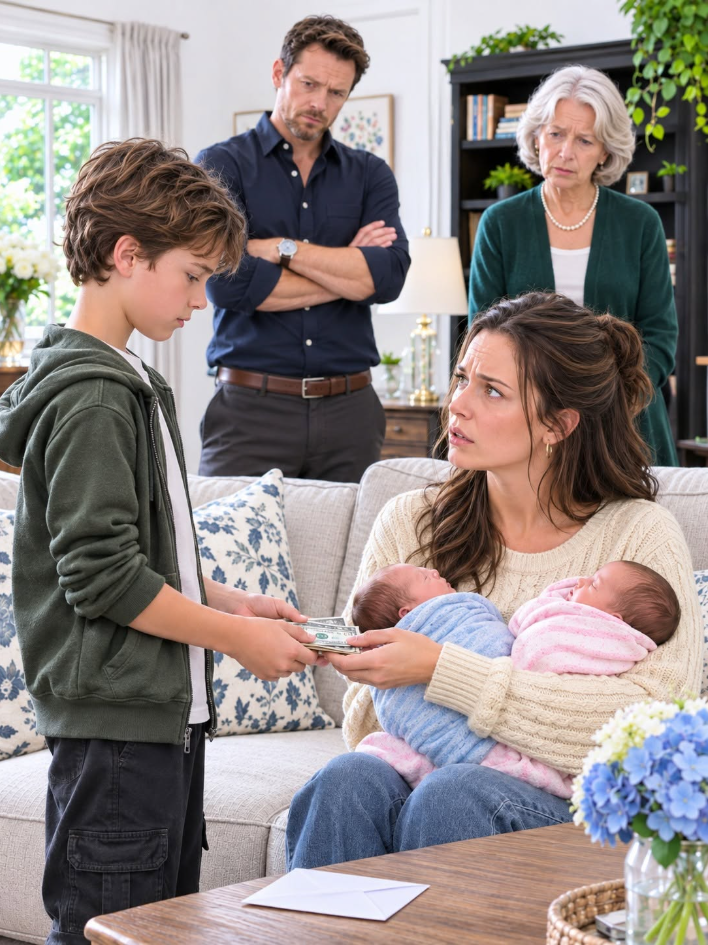
That expectation had endured numerous small disappointments over the years. My father had consistently shown a preference for Tyler, the son of my sister, Dana.
At Christmas, Tyler received presents wrapped in colorful paper and carefully tied ribbons, while Sadie’s gifts often arrived in an ordinary shopping bag from the hallway closet.
During Thanksgiving gatherings, although there was available seating at the main table, Sadie was frequently directed toward the kitchen to eat alongside the other children.
I convinced myself that these differences reflected thoughtlessness rather than intention.
Accepting my parents’ explanations seemed simpler than allowing every family gathering to become another disagreement.
Before departing, I arranged monthly financial support for Sadie’s clothing, meals, educational expenses, and anything else she might require.
I packed her favorite pajamas, colored pencils, family photographs, and a gray stuffed rabbit she had named Mister.
Inside a small compartment of her backpack, I placed a card containing my military contact details.
“If anything feels wrong, show this to a grown-up and tell them your mom is a soldier.”
Sadie laughed before wrapping both arms around my waist.
“Nothing’s going to be wrong.”
Her reassuring words returned to me as I continued driving through the rain.
At the hospital, a nurse named Holly greeted me near the department and guided me along a peaceful hallway.
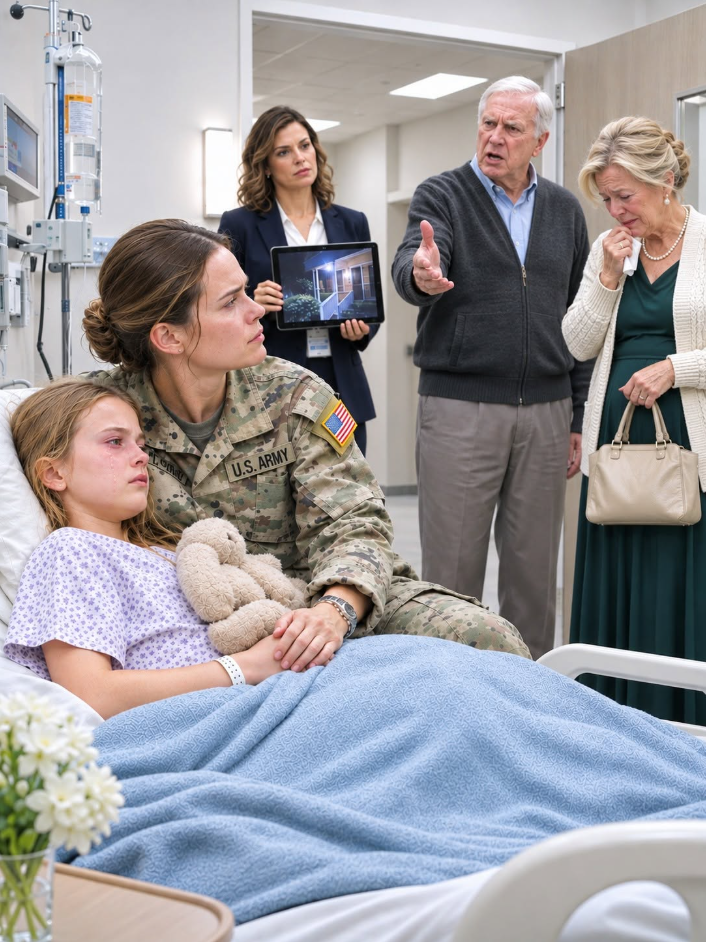
Sadie was resting beneath several warm blankets, with her feet supported by a folded towel. Her hair was still slightly damp, and she looked especially small against the hospital pillow.
I paused beside her bed, uncertain whether the intensity of my relief might be too much for her at that moment.
Then she noticed me, and her eyes became watery.
“Mommy.”
I moved a chair beside her and gently took her hand. She held mine tightly enough to leave me struggling to contain my emotions.
“You came.”
“I’m right here.”
She examined my expression carefully, as though she needed reassurance that I truly meant those words.
“I didn’t take Grandma’s necklace.”
“I believe you.”
Some of the tension gradually left her shoulders.
“Grandpa said I was a lying granddaughter.”
Holly straightened the blanket and explained that Sadie had arrived needing warmth and observation but was responding positively to the care she received.
A county deputy had located her near a drainage area beside a retention pond, where she had sought shelter while the storm passed through.
After Holly stepped away, Sadie spoke softly.
“Tyler put it in my bag. I saw him.”
I answered in a gentle voice. “You can tell me when you’re ready.”
“Grandpa doesn’t listen.”
“I’m listening.”
She allowed her eyes to close, although her hand remained wrapped around mine.
I remembered a drawing she had mailed to me several months before. It depicted my parents, my sister, her husband, and Tyler beneath a cheerful yellow sun, standing together with their hands joined.
Sadie had positioned herself several inches away, leaving a noticeable empty space between herself and the others.
When I questioned my father about the picture, he suggested that she was simply expressing her emotions because she missed me.
Following that conversation, I began maintaining more detailed notes. I recorded my parents’ explanations, the questions they avoided, and the things Sadie shared whenever she believed she could speak privately.
Her school counselor subsequently contacted me regarding outstanding lunch payments, footwear that needed replacing, and Sadie’s recurring remarks about feeling like a temporary visitor in her grandparents’ home.
My mother maintained that the counselor had misinterpreted the circumstances. My father believed Sadie was seeking additional attention.
Whenever I requested further clarification, their explanations shifted slightly.
Then, during one video conversation, Sadie glanced toward the doorway before silently communicating a message: Don’t call Grandpa. He sends me away.
Initially, I smiled, assuming she meant that he asked her to spend time in her bedroom whenever household disagreements occurred.
But her uneasy expression as she looked toward the hallway made me reconsider. My smile disappeared, and I realized that returning home needed to become my immediate priority.
Unfortunately, I had not arrived soon enough to prevent the circumstances of that Thursday evening.
What Sadie Had Been Trying to Explain
I was still wearing my uniform after traveling from the airport when Sadie eventually fell asleep. Her hand rested gently against my sleeve.
At 10:44, the hospital room door opened, and my father entered wearing his church windbreaker. My mother followed closely, holding her handbag against her side.
Dad glanced toward Sadie before looking at me. His attention settled on the name displayed above my uniform pocket.
“You’re supposed to be overseas.”
“I was.”
My mother became emotional.
“Mallory, honey, if you’d been here—”
“I trusted you to be here for her.”
I deliberately kept my voice quiet because Sadie had only recently fallen asleep. I refused to allow her hospital room to become another setting where adults disagreed about her circumstances.
A county deputy and an intake worker named Marlene stood behind my parents. Dad noticed their identification before directing his attention toward me again.
“What did you do?”
I continued holding Sadie’s hand.
For months, my understanding of her daily life had depended almost entirely on the information my parents provided.
Now, independent professionals would have the opportunity to examine the situation and ask their own questions.
The deputy, Aaron Bell, interviewed my father in the hallway while Marlene collected my statement in a nearby private room.
Through the wall, I recognized Dad’s composed, familiar tone, the voice he typically used when he expected his explanation to be accepted without further discussion.
“She took my wife’s necklace. We found it in her things, and then she got upset and ran.”
Shortly afterward, he added, “That child makes things up.”
I remembered hearing similar statements after the school counselor contacted me. According to my parents, Sadie misunderstood meal arrangements, misinterpreted household expectations, and occasionally provided inconsistent explanations while I was overseas.
I had documented each conversation in my notebook, carefully including the corresponding dates.
Around midnight, Sadie awakened and began explaining the evening’s events to Marlene.
Holly remained nearby, monitoring her condition and arranging the blankets while I stayed beside her.
Sadie explained that she had been completing homework in the back bedroom when Tyler entered looking for his baseball glove. He had moved several belongings near her backpack.
Later, Grandma discovered that her pearl necklace was missing.
Sadie had briefly visited the bathroom and returned to find Tyler standing near her belongings. He informed Grandpa that he had supposedly seen her place something inside her schoolbag.
Dad checked the backpack and discovered the necklace.
“He didn’t ask me,” Sadie kept saying. “He didn’t ask me.”
She explained that she had personally seen Tyler place the necklace inside.
“Tyler doesn’t lie,” Grandpa had told her.
My mother held the pearls without responding. My sister remained nearby and suggested that the situation might teach Sadie an important lesson.
Then Dad opened the front door and instructed Sadie to step outside. She requested her shoes and afterward asked for her jacket, but neither item was provided.
She waited, hoping someone would reconsider the decision or acknowledge the worsening weather conditions.
Unfortunately, no one intervened at that moment.
By the following morning, Paige had obtained an emergency order temporarily restricting contact between Sadie and my parents while county officials evaluated the circumstances.
The arrangement was preliminary rather than permanent, but it ensured that Sadie would remain somewhere else while questions concerning her previous care were addressed.
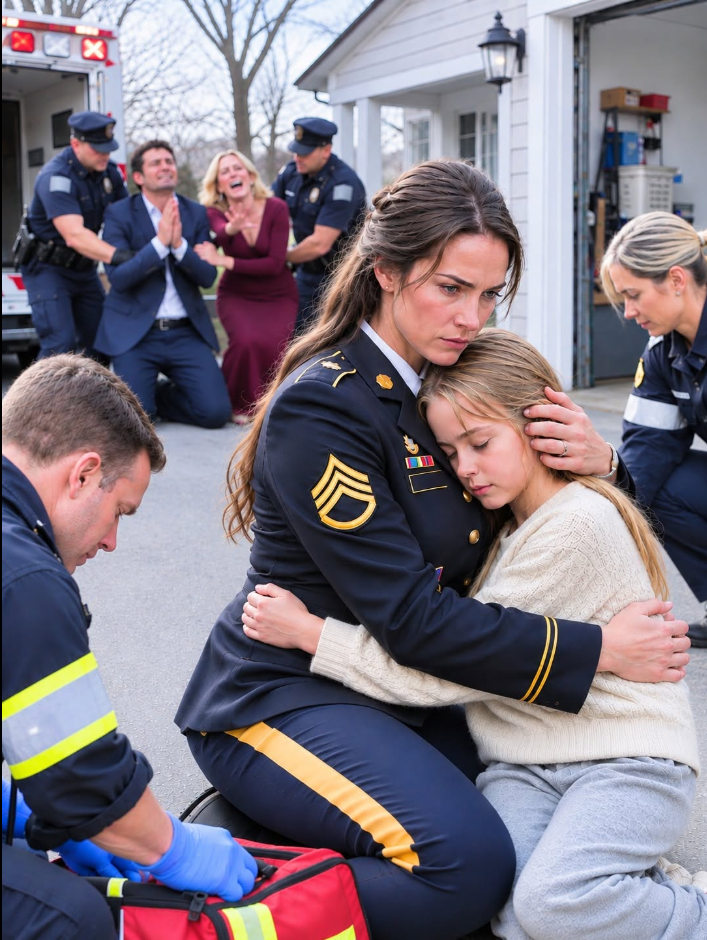
A neighbor named Ruth Delaney provided a statement to the county. Ruth had contacted emergency services after noticing Sadie outdoors during the thunderstorm.
She recalled hearing the front door close before observing a young figure walking along the street without proper footwear.
When Sadie approached the retention pond area and moved beyond Ruth’s view, Ruth decided to request assistance.
Sadie was discharged from the hospital on Sunday wearing comfortable socks and holding a stuffed bear Holly had given her. I carried her belongings and helped her into the car.
At our hotel, she frequently checked my whereabouts, even when I briefly crossed the room to get her a glass of water.
During our first night there, she awakened around three in the morning.
“Is Grandpa coming?”
“No.”
“Because I lied?”
I switched on the bedside lamp and sat next to her.
“You didn’t lie. Grandpa was wrong.”
She studied my expression for several moments before settling back beneath the covers.
I remained beside her until she returned to sleep, listening as the rainfall outside gradually softened and wishing I could have been present whenever she had questioned whether anyone would understand her.
On Monday, county investigator Tessa Grant conducted separate interviews with my parents.
Dad maintained that he had instructed Sadie to remain on the porch, while Mom suggested that Sadie had independently decided to go outside for some fresh air.
Tessa later explained why the distinction was significant.
“One is an instruction. One is a choice.”
The following day, Tessa interviewed Tyler in a welcoming room equipped with juice boxes and stress-relief toys.
Paige and I observed through a viewing window. Tyler offered three different accounts concerning his location when he supposedly witnessed Sadie handling the necklace.
Tessa remained patient, allowing him sufficient time to organize his thoughts.
Eventually, he explained that his mother had told him Grandpa would send Sadie away if she became involved in a serious household disagreement.
I noticed Paige shift slightly beside me.
Before Tessa could continue, my sister Dana entered the room and insisted that Tyler had become confused.
He held a stress ball between both hands while his mother attempted to clarify his answers on his behalf. Dana was subsequently asked to leave the interview room.
Watching Tyler lower his gaze, I recognized that Sadie was not the only young person affected by decisions made by adults.
Tyler had received instructions about what to say, and when he attempted to provide his own explanation, the person who had involved him interrupted the conversation.
What the Camera Revealed
The county meeting occurred the next morning. My parents sat opposite Paige and me, accompanied by their attorney, Mr. Pritchard.
Dad wore his usual Sunday clothing and rested his neatly folded hands on the table. He characterized the evening as a disagreement involving household discipline that others had misunderstood.
Tessa reminded him that Sadie had required medical attention.
“Kids get wet,” he said.
My mother lowered her head into her hands.
“It was one mistake.”
I remembered the footwear, outstanding lunch payments, abbreviated conversations, and the drawing in which Sadie stood separately from the family.
A single difficult evening might have been explained as an isolated incident. Fourteen months of recurring concerns required a more thorough examination.
Tessa presented the county’s conclusions. Concerns involving inadequate supervision and emotional well-being had been substantiated, existing contact restrictions would continue, and the agency recommended concluding the temporary guardianship arrangement.
Dad moved his chair backward, apparently assuming that the discussion had reached its conclusion.
Then Tessa placed a flash drive on the table.
Ruth owned a security camera positioned toward her driveway. Its recording area also captured my parents’ front porch and a portion of their walkway.
Ruth had previously mentioned the camera during a telephone conversation before my return. I had recorded a brief reminder in my green notebook: Ask if needed.
Tessa explained that Ruth and her granddaughter had preserved recordings from the evening of the thunderstorm, together with several hours of footage from earlier that day.
On the laptop display, Dana was crouching beside Tyler near the bushes.
“Say it back.”
Tyler repeated the instructions she had given him: place the necklace inside Sadie’s backpack, then inform Grandpa that he had witnessed Sadie putting something away.
Dana clarified where Tyler should claim to have been standing.
Tyler asked whether Sadie would get into trouble.
“That’s the point,” Dana said.
Her tone was surprisingly ordinary, almost as though she were reminding him to remember his baseball equipment.
She subsequently explained that if Grandpa believed Sadie had taken something without permission, he might be less inclined to accept anything Sadie later shared with her school or with me.
I kept my hands beneath the table while Dad continued staring at the recording.
“Dana planned it.”
Tessa selected footage from later that evening. Rain moved across the illuminated porch as Dad stood near the doorway and Sadie requested her shoes.
“I said get out.”
“It’s raining.”
“Then you should have thought of that.”
I shifted my attention away from the laptop and looked directly at my father.
He continued watching with a rigid expression, almost as though he expected another detail to appear that might provide context for his decision.
The recording showed the door closing while Sadie remained outdoors.
Approximately ten minutes afterward, my mother appeared carrying a flashlight and Sadie’s yellow jacket. She walked along the street until she moved beyond the camera’s recording area.
When she returned, Sadie was not accompanying her. Mom paused on the steps, appeared visibly concerned, and eventually went back inside.
Dad turned toward her.
“You knew where she was?”
My mother continued looking downward.
He repeated his question. Eventually, she acknowledged that she had reached the drainage area and heard Sadie nearby.
She had called my daughter’s name, but Sadie had remained in the sheltered location.
“She was afraid of me,” Mom said.
She explained that she had placed the yellow jacket near the entrance, intending to return shortly. Instead, she had gone back to the house.
She worried that Dad might insist Sadie remain outside or suggest that she was challenging his authority.
I could acknowledge that my mother may have felt uncomfortable opposing my father. I could also recognize that my eight-year-old daughter had needed an adult to ensure her safety during difficult weather conditions.
Understanding one circumstance did not eliminate the significance of the other.
Dad attempted to respond, but Mom continued speaking. She described previous occasions when he had disagreed with Sadie’s school counselor and reacted defensively toward people who questioned his decisions.
His attorney advised him not to comment further. Instead, Dad reached toward the laptop and requested that the recording be stopped.
Mr. Pritchard intervened before he could interrupt the presentation.
A chair shifted across the floor, and a pen fell from the table. Dad remained standing briefly before returning to his seat.
Everyone present had now witnessed enough to better understand why Sadie might have felt uncertain about approaching him.
Before the discussion fully settled, Dana arrived with her husband, Mark. She immediately asked whether the county intended to consider the security footage in its review.
Then she began describing everything her family had contributed toward Sadie’s care, suggesting that I could not fully appreciate their household responsibilities while stationed overseas.
“I sent support every month,” I said.
“That was nothing.”
She discussed household bills, Mark’s reduced working hours, and the financial pressures their family had experienced.
Then she suggested that the money belonged to them because they had provided Sadie with somewhere to stay.
After hearing her own explanation, she stopped speaking.
Paige opened her folder, and I rose from my chair.
“Sadie wasn’t a guest. She was a child in your care.”
I explained to Mom that her concerns about Dad’s reactions might provide context for some of her choices, but they could not justify leaving Sadie without appropriate assistance near the drainage area.
Then I turned toward my father.
I remembered how he had taught me to drive along a gravel road and affectionately called me “Mal” when I was younger. I did not need to dismiss those positive memories or pretend they had never existed.
However, those experiences did not entitle him to make decisions that compromised my daughter’s well-being.
“Don’t contact her. Don’t go to her school. When she’s older, she can decide what kind of relationship she wants.”
As I approached the doorway, Dad said he had genuinely believed Sadie had been dishonest.
I paused without turning around.
“You never asked.”
Creating a Home That Belonged to Us
That June, Mark reached out to me. He had moved away from the family home and was temporarily staying with his brother.
He explained that he had not fully understood how the financial support I provided for Sadie had been allocated.
Dana had described the payments as additional assistance for their household and had offered him different explanations concerning their vacation expenses and home renovations.
He volunteered to provide Paige with the relevant banking documents.
I accepted his assistance. I did not need to conclude that every decision he had made was appropriate before acknowledging that the information he possessed might be important.
On July 3, Sadie and I moved into a rental property in Junction City. My request for reassignment to Fort Riley had been approved.
The official paperwork simply stated that our family circumstances required additional stability. I appreciated having an explanation that did not require me to revisit every difficult detail.
Our first several weeks consisted of everyday activities: becoming familiar with the route to Sadie’s school, organizing the cereal, finding the perfect place for Mister, and choosing which kitchen drawer would hold our measuring cups.
I encouraged Sadie to select the curtains for her bedroom. She chose a vivid orange material that appeared almost golden whenever afternoon sunlight passed through it.
“That’s why I like it,” she said.
She started attending weekly appointments with a counselor named Dr. Lane every Tuesday.
One afternoon in August, I participated in a session while Sadie held a polished stone she had selected from a decorative bowl in the office.
“I want to tell you about Grandma’s flashlight.”
She recalled noticing its beam near the drainage area and hearing Grandma calling her name.
She also remembered Grandma standing inside the kitchen when Grandpa instructed her to go outside, without asking him to reconsider the decision.
Sadie explained that her jacket had been left nearby, but she had not collected it.
She had worried that returning to the house might result in another misunderstanding or accusation from Grandpa.
Then, in a quiet voice, she asked whether remaining where she was had been the wrong decision.
“No,” I said. “Getting you was a grown-up’s job.”
She gently turned the stone between her fingers. Dr. Lane asked whether she would like to bring it home, and Sadie nodded.
Later, while my daughter was spending time with a trusted caregiver, I sat alone in my car and allowed myself to cry.
I was gradually accepting that making thoughtful decisions in the present could not change everything that had happened previously.
During that same month, my mother sent Paige a fourteen-page handwritten letter.
She described years of carefully observing Dad’s moods and feeling uncertain about how he might respond whenever someone questioned him.
She expressed regret that she had not acted more confidently. Near the conclusion, she wrote that she had been unable to bring herself to walk the final ten steps toward the drainage area.
I returned to that particular sentence several times.
I still treasured certain memories involving my mother. She had remained beside me throughout a difficult night when I was unwell as a child, and she had taught me how to prepare homemade biscuits.
Those experiences remained meaningful. However, they did not change the fact that Sadie had needed her assistance during the storm.
I chose not to respond to the letter.
Instead, I placed it beside my notebook and went upstairs to see how Sadie was doing.
She was sleeping peacefully with Mister tucked beneath her chin and one hand resting above the blanket.
I remained in the doorway longer than necessary, appreciating the simple reassurance of knowing she was comfortable and safe.
The legal proceedings continued throughout the summer and autumn.
I became familiar with the distinctions between county findings, formal charges, negotiated legal resolutions, and court orders.
These were separate matters, despite the tendency of some relatives to discuss them as though they carried identical meanings.
In September, Dad entered a misdemeanor plea concerning child safety. The resolution included probation, parenting education, a financial penalty, and an order restricting contact with Sadie and me.
Mom accepted a lesser legal resolution involving probation, counseling, and comparable contact restrictions.
The county substantiated concerns regarding Dana’s conduct and its effect on Sadie’s emotional well-being, although prosecutors did not pursue separate criminal proceedings against her.
I learned that conduct could be formally documented as concerning without necessarily meeting the legal requirements for a criminal case.
Paige’s examination of the banking documents resulted in an additional civil matter.
Throughout fourteen months, I had transferred $16,800 specifically to support Sadie’s needs.
Even under the most generous interpretation of the available financial records, only $2,640 could be directly associated with her care.
The remaining $14,160 had been allocated toward other household expenses, including Dana’s family vacation and property improvements.
Investigators additionally identified a payment card connected to my mother’s account that displayed Dana’s name.
I remembered the conversation in which Sadie’s school counselor had explained that her footwear needed replacing.
The civil proceedings required additional time. Mark provided a formal statement, and in November, the court ordered repayment through monthly installments, with the recovered funds designated for Sadie’s future education.
Dana submitted a petition requesting visitation opportunities on behalf of the extended family. After considering the circumstances and reviewing the available recording, the court declined the request.
Sadie was never required to meet with her grandparents or personally repeat her account in front of them. I appreciated that consideration.
She needed reassurance that responsible adults were addressing her circumstances, rather than repeatedly revisiting one of the most difficult evenings she could remember.
The Picture on Our Refrigerator
Several relatives discovered ways to support us without expecting me to resolve the family’s disagreements first.
My uncle Pete asked whether he could send Sadie a birthday card and assured me that he expected no reconciliation in exchange.
My aunt Joyce visited our home, spent a little time sitting quietly on the porch, and left a homemade casserole without requesting that I reassure her about everything that had happened.
Ruth sent cards every week. She frequently mentioned her security camera and promised to remain attentive whenever anything concerning occurred near that familiar porch.
By the time her third card arrived, I recognized how deeply she regretted not responding sooner to other circumstances she had previously noticed.
I wrote back, explaining that her decision to request assistance had made a meaningful difference.
Every word was sincere.
Sometime later, Mark delivered a message from Tyler. He wanted Sadie to know that he regretted placing the necklace inside her backpack.
He explained that he had not understood how uncomfortable and upsetting the evening would eventually become.
After hearing his message, I remained in the kitchen for several minutes before deciding to write him a letter.
I explained that an adult had involved him in circumstances no young person should have been expected to manage.
I also told him that acknowledging a mistake and expressing genuine regret were meaningful steps.
I sent the letter through Mark, asking him to share it whenever he believed Tyler was prepared to receive it.
I never asked Sadie to reassure Tyler or offer forgiveness simply because doing so might make the adults more comfortable.
That responsibility did not belong to her.
She needed time and support to regain her confidence, and on certain evenings, that involved discussing difficult memories.
On other evenings, it meant enjoying pancakes, listening to a bedtime story, and leaving the hallway light illuminated without anyone questioning why she preferred it that way.
Sixteen months have passed since that Thursday evening. Sadie is nine now, and we live in a cheerful yellow house located three blocks from her school.
Her closest friend is a girl named Penny. She is learning to play the clarinet with considerably more enthusiasm than precision, while Mister continues occupying his familiar place on her pillow.
Sadie selected a pair of bright orange sneakers and insisted on wearing them to bed on the first evening she owned them.
I decided there was no reason to ask her to remove them.
She explained that having the shoes nearby made her feel ready for anything, so I allowed her to continue wearing them around our home the following morning.
Our Friday pancake tradition has returned. We occasionally disagree about homework, bedtime arrangements, and whether Mister needs to accompany us to every family occasion.
I value those ordinary disagreements far more than I ever imagined I would.
They remind me that Sadie feels comfortable expressing a different opinion and trusts that her thoughts will receive my attention.
She understands that she can ask questions, explain when something feels unfair, or admit that she does not understand a decision.
She also knows that I will remain present long enough to hear everything she wants to share.
I received my promotion to captain in March.
Paige attached my new rank insignia, became noticeably emotional, and promptly declared that she was maintaining perfect composure.
Mark occasionally sends photographs from Tyler’s school activities. Tyler is growing older, continues playing baseball, and sometimes asks how Sadie is doing when he believes nobody is paying particular attention.
I have not organized a reunion between them.
Perhaps, someday, the children will independently decide they would like to reconnect, after receiving sufficient time and support to make that decision comfortably.
I will not accelerate that process simply because waiting feels inconvenient for the adults.
Occasional updates about my parents still reach me. Dad has stepped away from his business, while Mom is no longer working at her church.
One relative mentioned that she had been staying with Joyce. Another family now occupies my parents’ former house, and I remain uncertain whether my parents are still together.
For a considerable time, those unanswered questions felt like additional family responsibilities I needed to address.
Now, I recognize that certain information no longer needs to occupy a significant place in my everyday life.
Some memories continue to surprise me unexpectedly. Occasionally, I dream about Dad teaching me how to drive.
In those dreams, he remains patient and encouraging, and none of the circumstances that followed have occurred.
I awaken remembering the father I once knew, while remaining committed to the boundaries necessary to protect my daughter’s well-being.
I cannot easily describe how affection for someone within a cherished memory can coexist with a firm decision to maintain distance from that person.
I simply understand that both emotions can exist without changing my responsibilities toward Sadie.
For her ninth birthday, I prepared a homemade cake decorated with a pink frosting rose that tilted slightly to one side.
She inspected it carefully, touched the frosting with one finger, and grinned.
“You did that on purpose.”
“A little.”
She laughed, and I enjoyed the moment without asking her to recreate it for a photograph or anyone else.
Last week, Sadie returned from school carrying another drawing. The classroom assignment was titled “My Family.”
She attached the picture to our refrigerator before moving on to another activity. I stood quietly in front of it, still holding a kitchen towel.
She had illustrated our house, a tall figure wearing an Army uniform, a smaller figure with brown hair, and Mister.
She had also included a dog named Biscuit, even though we currently do not own a dog.
According to Sadie, that particular detail will eventually become a reality.
Ruth appeared outside in her garden, waving cheerfully. Uncle Pete had sent another card.
Within the drawing, everyone stood together in a slightly uneven line, their hands joined.
There was no noticeable empty space separating Sadie from the other people.
I waited until she had fallen asleep before allowing myself to become emotional.
My final green notebook remains on the bedside table, although most of its pages have never been used.
Since that summer, I have added only one sentence accompanied by a date:
“She was right. I believed her.”
I no longer believe that every peaceful afternoon needs to be documented as evidence that our circumstances have improved.
I would much rather spend those afternoons enjoying her company.
Tonight, gentle rain falls against our porch. Sadie is comfortably settled on the sofa beneath a blanket, reading a book while still wearing her orange sneakers.
She explained that she wanted to keep them on during the thunderstorm simply because she was allowed to make that choice.
I brought her an additional blanket and sat beside her. Without lifting her eyes from the book, she gently leaned against my arm.
Outside, our porch light is glowing. The front door is securely closed.
And my daughter knows exactly where she can find me.