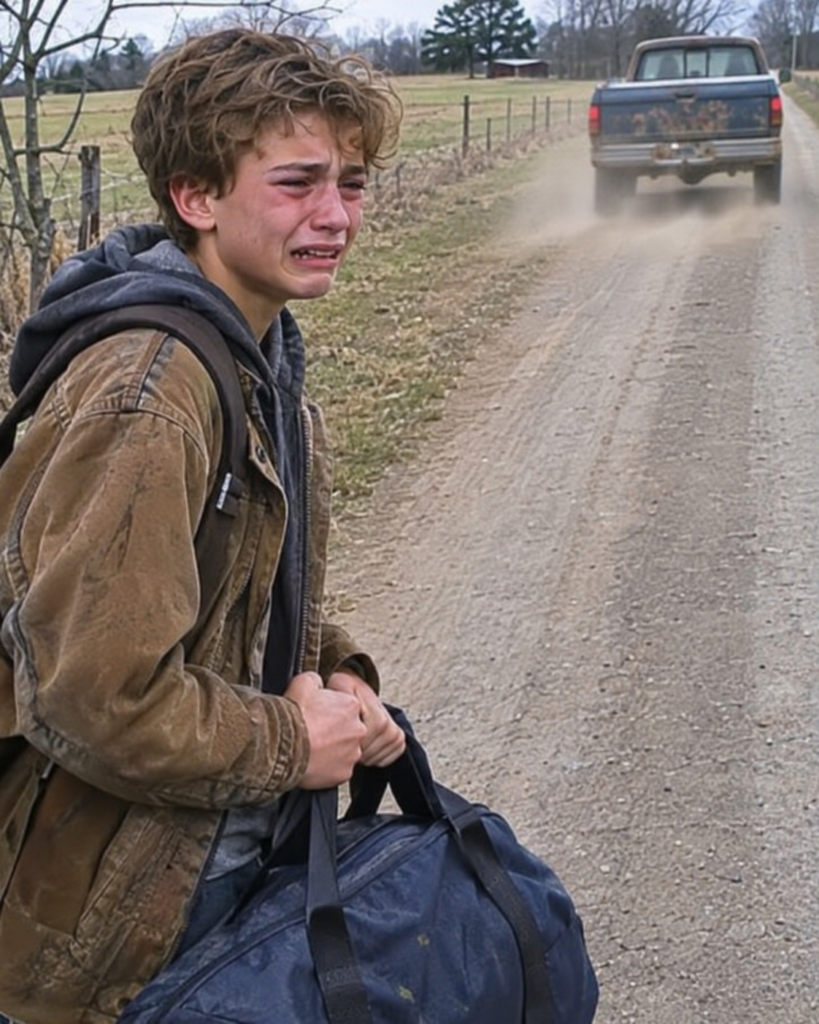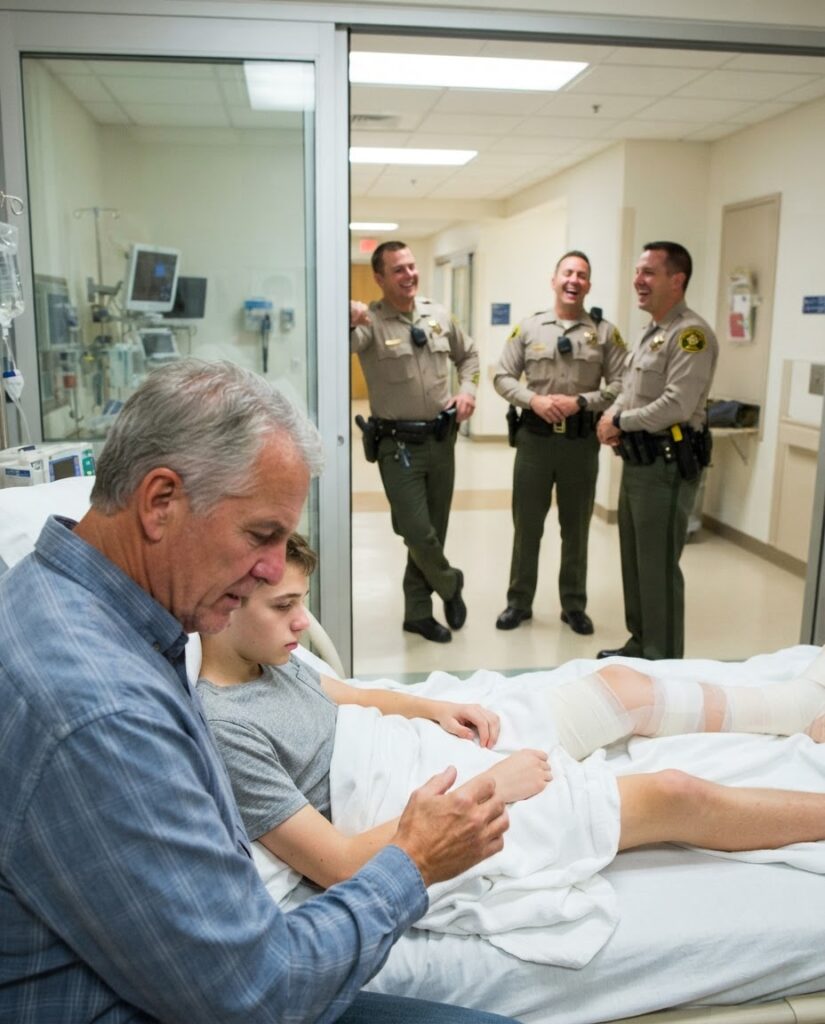
I was m0pping a courthouse floor when I got the call that my seventeen-year-old son had been s/h/0t through both kneecaps by the county sheriff—and that the man had laughed while he screamed. Less than an hour later, I was standing beside my boy’s hospital bed, listening to him whisper, “Dad… I don’t think I’ll ever walk again.”
The sheriff thought I was just a gray-haired janitor. He had no idea who I used to be.
PART 1
My name is Caleb Vance, and for seventeen years, I worked nights cleaning the Livingston County courthouse in a small Colorado town. To everyone who passed me in those halls, I was invisible—old boots, faded work shirt, mop bucket, tired eyes.
That was exactly how I wanted it.
Before I became a husband and father, I had another life. I spent nearly two decades leading elite military operations in places most Americans would never hear about, making decisions under gunfire and bringing men home from missions that were never supposed to exist.
Then I met Laura.
Then Ethan was born.
And I walked away from all of it.
That night, my phone buzzed while I was wringing out a mop.
Laura.
She never called during my shift.
The moment I heard her crying, my stomach dropped.
“Caleb,” she choked out. “It’s Ethan.”
My hand went numb. The mop hit the marble floor.
“What happened?”
“There’s been a shooting. Mercy General. Please… just hurry.”
I don’t remember the drive. I remember red lights, my hands crushing the steering wheel, and one thought repeating over and over in my head: Please let my son be alive.
When I burst into the emergency department, Laura was outside Trauma Bay Three, shaking so hard she could barely stand.
Then I looked through the glass.
Ethan was lying there.
My seventeen-year-old boy. Captain of his high school basketball team. The kid who left sneakers in the hallway and raided the refrigerator after midnight.
Now his face was white with pain.
Both legs were wrapped in thick bandages already soaked dark red.
A doctor stepped out, and I froze.
“Marcus?”
Dr. Marcus Vance stared at me.
We had served together years earlier overseas. Now he was one of the best trauma surgeons in Colorado.
“How bad?” I asked.
He hesitated.
That hesitation told me everything.
“Both kneecaps are destroyed,” he said quietly. “There are bone fragments everywhere. He’ll need multiple surgeries. Recovery could take months. Maybe years.”
Laura covered her mouth.
I grabbed the wall.
“Who did this?”
Marcus glanced down the hallway before leaning closer.
“Sheriff Vance Vance.”
The name landed like a hammer.
Everyone knew Sheriff Vance. Powerful. Connected. Protected. A man who carried his badge like it gave him ownership over everyone beneath him.
I walked into Ethan’s room and took his hand.
His eyes opened.
“Dad?”
Then he started crying.
“He shot me,” Ethan whispered.
I squeezed his fingers.
“He laughed.”
My jaw locked.
Ethan swallowed, fighting for breath.
“He said, ‘Shouldn’t have looked at me wrong, boy.’”
For a moment, all I could hear was the hospital monitor.
Then Ethan looked toward his bandaged legs.
“Dad… I can’t feel them.”
His voice cracked.
“I’ll never walk again.”
I kissed his forehead and told him I was going to take care of everything.
But somewhere inside me, something I had buried seventeen years ago opened its eyes.
Hours later, while Ethan was in surgery, I sat alone in the hospital parking lot with my phone in my hand.
Sheriff Vance believed his badge protected him.
He believed the county protected him.
He believed people like me were too weak to fight back.
I scrolled through contacts I hadn’t touched in nearly two decades until I found one number.
Then I pressed call.
The man answered after one ring.
“Reaper?”
I stared up at the hospital window where my son was fighting for his future.
“Get the team together,” I said.
The silence on the other end lasted three seconds.
And that was enough to tell me they understood exactly what kind of night this had become…
PART 2
The man on the other end of the phone didn’t ask questions.
He didn’t need to.
“How many?” he asked.
“All of them,” I replied.
A long silence followed.
Then I heard a chair scrape against the floor.
“Caleb, I haven’t heard that voice in seventeen years.”
“Neither have I.”
“Is this about your family?”
I looked through the hospital window. Laura was sitting beside Ethan, holding his hand while he slept beneath the white hospital sheets.
“Someone shot my son.”
The silence changed.
It wasn’t surprise anymore.
It was anger.
“Where?”
“Livingston County, Colorado. Mercy General Hospital.”
“Give me two hours.”
“Make it one.”
He exhaled.
“Understood, Reaper.”
The call ended.
I sat there for another minute, staring at my reflection in the dark hospital window.
Seventeen years.
Seventeen years since I’d heard that name.
Seventeen years since I’d commanded men who could move through hostile territory without leaving a footprint.
I had promised Laura that part of my life was over.
I had promised Ethan that his father would always be there.
But I had never promised that I would let someone destroy my family.
At 4:17 a.m., a black SUV pulled into the hospital parking lot.
Then another.
Then a third.
I recognized the first man who stepped out.
Daniel Mercer.
Former Army intelligence officer. My second-in-command during our final deployment. He was fifty now, with silver hair and a scar running from his left eyebrow to his cheek.
Behind him came Marcus Reed, a former combat medic, and Thomas Keller, who had once been responsible for keeping an entire unit alive during a mission that had gone catastrophically wrong.
Daniel entered the hospital carrying a small black case.
He looked at me.
“Sir.”
I shook my head.
“Not anymore.”
He nodded.
“Caleb, then.”
His eyes moved toward the room where Ethan was recovering.
“How’s the boy?”
“He’s alive.”
“That’s something.”
I looked down.
“They destroyed both his knees.”
Daniel’s jaw tightened.
“Who?”
“The county sheriff.”
For several seconds, nobody spoke.
Then Thomas asked the question I had been expecting.
“What do you need from us?”
I looked at the three men.
“Nothing illegal. Nothing reckless. I want the truth documented. Every witness, every camera, every record. I want that sheriff removed from power and prosecuted under the law.”
Daniel nodded slowly.
“Then we’ll do it properly.”
That was why I had called them.
Not because I wanted revenge in some dark alley.
Because I knew exactly how powerful men buried the truth.
And I knew how to dig it back up.
At 5:02 a.m., Daniel placed a laptop on the small table beside me.
“We’ve already started looking at public records,” he said. “There’s something you should know.”
He turned the screen toward me.
A photograph appeared.
Sheriff Raymond Vance.
Fifty-three years old. Twenty-six years in law enforcement. Three terms as county sheriff.
A smiling man in a polished uniform, standing in front of an American flag.
Underneath the photograph was a list of complaints.
Twelve formal excessive-force complaints.
Seven complaints involving unlawful searches.
Four civil lawsuits.
Two settlements paid by the county.
And one internal investigation that had mysteriously disappeared.
I stared at the screen.
“Why is he still wearing that badge?”
Daniel clicked another file.
“Because his brother-in-law is the county attorney, his campaign was funded by several local businessmen, and his wife sits on the county’s public safety board.”
I leaned back.
“Who supervises his department?”
“Technically, the county commissioners.”
“Technically?”
Daniel gave me a humorless smile.
“Three commissioners. Two have received campaign donations from people connected to the sheriff. The third is retiring next month.”
I studied the photograph again.
The man who had shot my son had spent years building a little kingdom.
And apparently, nobody had bothered to challenge him.
“Show me the incident report.”
Daniel opened another document.
It was a preliminary report.
According to Sheriff Vance, Ethan had been driving a stolen vehicle, refused to obey commands, and attempted to reach for a weapon.
The sheriff claimed he fired twice because he feared for his life.
I read the paragraph again.
Then I noticed the time.
“That’s impossible.”
Daniel leaned closer.
“What?”
“Ethan called his mother at 8:41 p.m. He told her he was walking home from basketball practice.”
“That doesn’t mean the report is wrong.”
“Ethan doesn’t drive. He doesn’t even have a license.”
Daniel looked at the document.
“Then why does the report say he was driving?”
I didn’t answer.
Because I already knew.
Someone had written the story before the investigation began.
And they had chosen my son to play the villain.
At 5:30 a.m., I went back into Ethan’s room.
Laura was awake.
She looked at me as I entered.
“Where were you?”
“Making some calls.”
Her eyes moved to my hands.
“Caleb, what are you doing?”
I pulled a chair beside her.
“Finding out what happened.”
She lowered her voice.
“Please don’t do anything stupid.”
I looked at my wife.
She knew about my military past. She knew I had been trained to deal with dangerous situations.
But she had never seen what happened when someone hurt one of my own.
“I’m not going to hurt anyone, Laura.”
“Then promise me you’ll stay here.”
I looked at Ethan.
His eyes were closed. His face was pale.
“I promise I won’t abandon him.”
She reached for my hand.
“That’s not what I asked.”
I didn’t have an answer.
Before she could say anything else, Ethan stirred.
“Dad?”
I immediately leaned forward.
“I’m here, buddy.”
He swallowed.
“Did they catch the guy?”
I looked at Laura.
Then back at my son.
“Yes.”
His eyes filled with tears.
“Is he going to jail?”
“That’s what we’re going to make sure happens.”
Ethan stared at the ceiling.
“He kept telling me nobody would believe me.”
My chest tightened.
“What exactly happened?”
He took a shaky breath.
“I was walking home. I had my headphones on, but I wasn’t listening to anything. They were just around my neck.”
He paused.
“A police SUV pulled up behind me.”
“Did you know the officer?”
“No. But he rolled down his window and told me to stop.”
“Then what?”
“He asked me why I was in the neighborhood.”
I frowned.
“What neighborhood?”
“Maple Ridge. I was cutting through because it was raining.”
Maple Ridge was a residential area less than a mile from our house.
“Did he ask for identification?”
“Yeah. I gave him my school ID.”
Ethan’s voice became quieter.
“He looked at it and started laughing.”
“Why?”
“He said, ‘Vance? You related to the old janitor at the courthouse?’”
I felt something cold settle in my stomach.
My job at the courthouse had apparently become part of the insult.
Ethan continued.
“I told him you were my dad. He said he knew exactly who you were.”
I looked at Laura.
She had gone completely still.
“What happened next?” I asked.
“He told me to put my hands on the hood.”
Ethan swallowed.
“I did.”
“And?”
“He kept asking where I’d stolen the car.”
“What car?”
“I told him I didn’t have one.”
His breathing became uneven.
“Then he pushed me against the hood. I told him he was hurting my shoulder.”
I squeezed his hand.
“You don’t have to rush.”
“But he wouldn’t listen.”
Ethan closed his eyes.
“He said people like us always thought the rules didn’t apply.”
I felt my jaw tighten.
“What happened when he shot you?”
“He told me to get on my knees.”
My fingers went cold.
“Did you move?”
“No, Dad. I told him I couldn’t understand why he was doing this.”
Tears slipped down Ethan’s cheeks.
“Then he kicked the back of my leg.”
I looked at the bandages.
“He pushed me down. I tried to catch myself, and then…”
His voice broke.
“Then he shot me.”
Laura covered her mouth.
Ethan began shaking.
“He shot the other one after I fell.”
I couldn’t breathe.
“Did he call an ambulance?”
Ethan shook his head.
“He just stood there.”
“What did he say?”
Ethan looked directly at me.
“He laughed.”
My son began crying harder.
“He said, ‘Let’s see how fast you run now.’”
I closed my eyes.
For a moment, the hospital room disappeared.
I was somewhere else.
Somewhere I had spent seventeen years trying to forget.
Then I heard Ethan whisper.
“Dad?”
I opened my eyes.
“Yes, buddy?”
“Please don’t let him get away with it.”
I kissed his forehead.
“He won’t.”
At 6:12 a.m., Dr. Marcus Vance entered the room.
He had changed into fresh scrubs, but his eyes looked exhausted.
“Caleb, I need to talk to you.”
I followed him into the hallway.
“What’s happening?”
“There’s something unusual about Ethan’s injuries.”
My heart sank.
“Unusual how?”
Marcus folded his arms.
“The bullet trajectories don’t match the sheriff’s preliminary statement.”
I stared at him.
“Explain.”
“According to the report, Ethan was standing when the first shot was fired. But the injuries suggest his legs were positioned differently.”
“Meaning?”
“Meaning the medical evidence doesn’t support the story that he was charging toward the officer.”
He paused.
“And there’s another problem.”
“What?”
“The sheriff’s report says Ethan was shot twice.”
Marcus looked directly into my eyes.
“He was shot three times.”
I felt the hallway tilt.
“Three?”
“Yes. One round grazed the outside of his right thigh. The other two caused the catastrophic damage to his knees.”
“Why would the report leave out a bullet?”
“That’s what I want to know.”
He handed me a preliminary medical summary.
“I’ve documented everything. The entrance wounds, the trajectories, the fragments, the surgical findings. I’ll also preserve the original imaging.”
I nodded.
“Thank you.”
Marcus placed a hand on my shoulder.
“Caleb, listen to me. Your son has a difficult road ahead. I can’t promise he’ll regain full function.”
“I understand.”
“But he’s young. We’ll explore every appropriate reconstructive option. Physical rehabilitation will be extensive.”
I looked through the glass at Ethan.
“Don’t give up on him.”
Marcus’s expression softened.
“I won’t.”
Then he added quietly.
“And don’t let that man convince your son that his life is over.”
I nodded.
That was the most important thing anyone had said all night.
At 7:00 a.m., the hospital administrator arrived with two men in suits.
One introduced himself as Deputy Sheriff Alan Brooks.
The other was a county attorney named Richard Harlan.
Neither looked particularly concerned.
“Mr. Vance,” Harlan began, “we’re sorry about what happened to your son.”
I said nothing.
“We understand this is an emotional situation. However, the sheriff has filed a report indicating that your son was involved in a dangerous confrontation.”
“My son is seventeen.”
“Yes, and we understand that.”
“He doesn’t have a driver’s license.”
Harlan glanced at Brooks.
“That’s something the investigation will establish.”
“Then why does your report say he was driving a stolen vehicle?”
The two men exchanged a look.
Brooks cleared his throat.
“We’re still gathering information.”
“Then perhaps you should gather it before writing it down.”
Harlan’s expression hardened.
“Mr. Vance, I would advise you not to make accusations.”
I stepped closer.
“I’m not making accusations. I’m asking questions.”
He lowered his voice.
“There’s a process for these matters. You need to let the department handle it.”
I looked at the badge on Brooks’s chest.
“Your department is investigating the man who shot my son?”
“Yes.”
“Isn’t that a conflict of interest?”
Harlan interrupted.
“There’s no conflict.”
I looked at him.
“Then you won’t object to an independent investigation?”
He hesitated.
Just for a second.
But I saw it.
“We’ll consider the appropriate channels.”
“Good.”
I turned to leave.
Then Harlan added something that made me stop.
“One more thing. The sheriff would like to speak with you when you’re ready.”
I slowly turned around.
“Why?”
“To explain his side of the incident.”
I stared at him.
“My son is lying in a hospital bed with both kneecaps destroyed. Your sheriff can explain himself to a judge.”
Brooks shifted his weight.
Harlan’s face reddened.
I walked away.
At 8:25 a.m., Daniel sent me a message.
We found the first witness.
I stepped into the stairwell and called him.
“Who?”
“Local delivery driver. Name’s Patrick Sullivan. He was parked across the street when the shooting happened.”
“What did he see?”
“He recorded part of it on his phone.”
My pulse quickened.
“Does he still have the video?”
“Yes.”
“Has anyone contacted him?”
“Apparently, the sheriff’s department called him at 6:40 this morning.”
I closed my eyes.
“What did they say?”
“They told him he was obstructing an active investigation and advised him to delete any recordings that could compromise officer safety.”
I gripped the railing.
“Did he delete it?”
“No.”
“Where is he?”
“At his apartment. He’s frightened.”
“Tell him not to delete anything. Tell him to make copies and contact an attorney.”
“Already done.”
Daniel paused.
“Caleb, there’s something else.”
“What?”
“The delivery driver says the sheriff wasn’t alone.”
I frowned.
“Who was with him?”
“Deputy Nolan Pierce.”
The name meant nothing to me.
“Get me everything you can legally obtain about him.”
“Working on it.”
I returned to Ethan’s room.
Laura was standing by the window, staring at the parking lot.
“What’s wrong?” I asked.
She turned.
“They called my phone.”
“Who?”
“The sheriff’s wife.”
I frowned.
“Why?”
“She said she wanted to apologize.”
I waited.
Laura’s expression changed.
“Then she said something strange.”
“What?”
“She told me Ethan should be careful about what he says. She said this town has a long memory.”
My stomach tightened.
“Did she threaten you?”
“Not directly.”
I took her phone and looked at the call log.
The number was unfamiliar.
I handed it back.
“Don’t answer another call from her.”
“Caleb, I’m scared.”
I pulled her into my arms.
“I know.”
“What if they come after Ethan again?”
I looked toward the hospital door.
“Then they’ll have to answer to people who don’t work for them.”
At 9:10 a.m., Sheriff Raymond Vance finally appeared.
He entered the hospital lobby wearing his uniform, his polished badge shining beneath the fluorescent lights.
Two deputies followed him.
A reporter near the entrance recognized him immediately.
“Is it true you shot a teenager last night, Sheriff?”
Vance smiled.
“An officer-involved shooting is under investigation. I won’t discuss operational details.”
“Was the teenager armed?”
“No further comment.”
He walked past the reporter.
Then he saw me.
His smile widened.
“Caleb Vance.”
I stood up.
“Raymond.”
He looked at my clothes.
My faded work shirt.
My old boots.
The hospital visitor badge clipped to my chest.
“Quite a morning, isn’t it?”
I didn’t answer.
He glanced toward Ethan’s room.
“How’s the boy?”
“He’s alive.”
“Good. Good.”
Then he lowered his voice.
“Listen, Caleb. I understand you’re upset. But your son put himself in a dangerous situation.”
I stared at him.
“He was walking home.”
“That’s your version.”
“That’s what happened.”
Vance gave a small laugh.
“Kids tell their parents all kinds of stories.”
I stepped closer.
“Did you shoot him?”
His smile disappeared for half a second.
Then returned.
“I discharged my weapon during a lawful intervention.”
“Three times?”
He narrowed his eyes.
“Who told you that?”
I didn’t answer.
He looked over my shoulder.
“Your son should be grateful he’s alive.”
I felt every muscle in my body tighten.
Then he leaned closer.
“Maybe you should spend less time playing soldier in your head and more time teaching your boy to respect authority.”
I looked at him for a long moment.
Then I said something quietly.
“You made one mistake, Raymond.”
He smirked.
“What’s that?”
“You thought nobody was watching.”
His expression changed.
Only slightly.
But enough.
He straightened his uniform.
“Be careful, Caleb. People who make trouble around here tend to regret it.”
Then he turned and walked toward the elevators.
I watched him leave.
Daniel’s voice came through my phone.
“Did he just threaten you?”
I looked at the security camera above the hospital entrance.
“Yes.”
“Good.”
I frowned.
“Good?”
“Because the hospital security manager just confirmed that the entire conversation was recorded.”
For the first time that morning, I smiled.
Not because I was happy.
Because the sheriff had finally started making mistakes.
At 10:30 a.m., Patrick Sullivan arrived at the hospital.
He was a thin man in his forties, wearing a delivery-company jacket and holding a phone in both hands.
Daniel introduced him to me.
“Mr. Sullivan, thank you for coming.”
Patrick looked nervous.
“I don’t want any trouble.”
“I understand.”
“I have two kids. I can’t afford to lose my job.”
“You won’t be asked to do anything you don’t want to do. But please don’t destroy the recording.”
He nodded.
“I haven’t.”
He unlocked his phone.
The video was shaky.
The first few seconds showed the street, the rain, and the flashing lights of a police SUV.
Then Ethan appeared.
He was standing near the hood of the vehicle.
His hands were visible.
The sheriff stood behind him.
Deputy Pierce was near the passenger side.
I leaned forward.
The audio was faint, but understandable.
“Get on your knees!”
Ethan replied.
“Sir, I haven’t done anything.”
“Do it!”
“I’m seventeen. I’m just walking home.”
Then the sheriff shoved him.
Ethan stumbled.
He tried to regain his balance.
And then the first gunshot rang out.
I stopped breathing.
The camera shook violently.
Patrick whispered something.
Then the second shot.
Ethan fell.
The sheriff walked closer.
And the third shot followed.
The video captured Ethan screaming.
It also captured something else.
Sheriff Vance laughed.
Not nervously.
Not in shock.
He laughed like a man amused by something he had done.
Then his voice came through the recording.
“Let’s see how fast you run now.”
Patrick stopped the video.
Nobody spoke.
I looked at the screen.
My son was lying on wet pavement, bleeding, while a man wearing a badge laughed above him.
“Is that the entire recording?” I asked.
Patrick nodded.
“Yes. I started recording when I saw the police lights.”
“Did you see Ethan holding a weapon?”
“No.”
“Did you see him attack the sheriff?”
“No. His hands were up.”
Daniel looked at Patrick.
“Would you be willing to preserve this recording for an independent investigator?”
Patrick swallowed.
“Yes.”
I shook his hand.
“Thank you.”
He looked at me.
“Mr. Vance?”
“Yes?”
“I have something else.”
He opened another video.
This one had been recorded a few minutes after the shooting.
The sheriff was standing beside his SUV.
Deputy Pierce was talking to him.
The audio was clearer.
Pierce said, “Sheriff, what are we going to put in the report?”
Vance replied, “The kid reached for something.”
Pierce hesitated.
“But he didn’t have anything.”
Vance turned toward him.
“Then you’d better remember what you saw.”
The video ended.
Daniel slowly closed the laptop.
“That’s witness intimidation and possible evidence fabrication.”
I stared at the screen.
“No.”
Daniel looked at me.
“Caleb?”
I swallowed.
“That’s my son.”
For a moment, nobody moved.
Then my phone rang.
It was Marcus.
“Caleb, Ethan is awake.”
I immediately stood.
“Is something wrong?”
“Not medically. He wants to see you.”
I hurried down the corridor.
When I entered the room, Ethan was staring at the television.
A news report was playing.
The headline read:
SHERIFF INVOLVED IN SHOOTING OF TEEN SUSPECTED OF VEHICLE THEFT.
Ethan’s face was pale.
“They’re calling me a criminal.”
I walked to the television and turned it off.
“Don’t watch that.”
“But everybody’s going to think I stole something.”
I sat beside him.
“Listen to me, Ethan.”
He looked at me.
“You didn’t do anything wrong.”
“What if nobody believes me?”
I took his hand.
“Then we’ll show them.”
He looked down at his legs.
“Will I ever play basketball again?”
I couldn’t lie to him.
“I don’t know.”
His eyes filled with tears.
“I had a scholarship offer.”
“I know.”
“Coach said I could make varsity all-state.”
“I know, buddy.”
He swallowed.
“Everything I worked for is gone.”
I leaned forward.
“Your basketball career may change. Your recovery may take a long time. There will be days when you hate all of this.”
He began crying.
“But listen carefully. You are not your legs. You are not a scholarship. You are not what that sheriff did to you.”
I brushed the tears from his cheek.
“You’re my son. And your life is worth more than any game you’ll ever play.”
He closed his eyes.
Then he whispered.
“Can you stay?”
I pulled the chair closer.
“Every minute.”
Outside the room, Daniel was already making another call.
By noon, the story had begun spreading.
A local news station received the witness video.
The hospital confirmed that Ethan was a minor who had suffered serious injuries.
The county sheriff’s office released a statement saying the department would not comment further.
But the sheriff himself made a mistake.
He posted a photograph on his personal social media account.
It showed him standing beside his patrol SUV.
The caption read:
Sometimes doing the right thing means making difficult decisions.
Within twenty minutes, hundreds of comments appeared.
Some praised him.
Others demanded answers.
Then Patrick’s video was released.
The comments changed.
The laughter was unmistakable.
The words were unmistakable.
And the teenager’s hands were clearly visible.
By 1:00 p.m., the sheriff’s office had disabled comments.
By 1:30 p.m., the county commissioner’s office was receiving calls.
By 2:00 p.m., a state investigator contacted the hospital.
Her name was Special Agent Rebecca Collins.
She introduced herself as an investigator with the Colorado Bureau of Investigation.
“I’d like to speak with Mr. Vance.”
I stepped into the hallway.
“About what?”
“The shooting.”
“Are you independent of the sheriff’s department?”
“Yes.”
“Are you aware that the sheriff’s office has already written a report claiming my son was driving a stolen vehicle?”
“I’ve seen the preliminary report.”
“Are you aware that a witness has video showing my son with empty hands?”
Her expression became serious.
“Yes.”
“Then you understand why I won’t let anyone from the county interview him without independent counsel present.”
She nodded.
“That’s reasonable.”
She handed me her card.
“I also want you to know that we’ve requested preservation of all body-camera footage, dispatch recordings, vehicle GPS data, and department communications related to the incident.”
I looked at her.
“Has the sheriff been informed?”
“Yes.”
“Then I hope he doesn’t delete anything.”
She held my gaze.
“Neither do we.”
For the first time, I felt that someone might actually be listening.
But the day wasn’t over.
At 3:45 p.m., Daniel called.
“Caleb, we found the vehicle.”
“What vehicle?”
“The one the sheriff claimed Ethan stole.”
I frowned.
“Where?”
“An impound lot outside town.”
“Who owns it?”
Daniel paused.
“A local construction company called Ridgeway Development.”
I knew the name.
It belonged to Thomas Ridgeway, one of the wealthiest businessmen in the county.
“What does that have to do with Ethan?”
“Nothing. That’s the problem.”
He sent me a photograph.
The vehicle was a black luxury SUV.
It had been reported stolen the previous evening.
But the police report showed something strange.
The theft had been reported at 9:03 p.m.
The shooting had occurred at approximately 9:11 p.m.
Ethan had been stopped less than a mile from our home.
And the vehicle had been found in the opposite direction.
I looked at the timestamps.
“Who reported the theft?”
“Thomas Ridgeway.”
I stared at the name.
“Does he know the sheriff?”
Daniel laughed without humor.
“Caleb, they play golf together every Sunday.”
I closed my eyes.
This was bigger than one violent officer.
Much bigger.
“Keep going,” I said.
“We found something else. The SUV was never registered as stolen in the state database until 9:26 p.m.”
I looked up.
“After the shooting?”
“Fifteen minutes after.”
I felt my pulse slow.
That was how it happened.
The story was being manufactured while my son was bleeding on the road.
“Daniel.”
“Yes?”
“Find out why.”
He paused.
“We’re working on it.”
“No. Find out who ordered it.”
I ended the call.
Then I looked toward Ethan’s room.
A man had shot my child.
Another man had helped write the lie.
And a powerful businessman might have been involved.
I had spent seventeen years believing I could leave my old life behind.
But I was beginning to understand something.
The skills I had learned overseas were never really about fighting.
They were about recognizing patterns.
And this pattern was becoming very clear.
PART 3
At 6:20 p.m., Laura came out of Ethan’s room holding a small plastic bag.
Inside was his school ID, his wallet, and a basketball wristband.
She placed the bag on the chair beside me.
“They gave us his belongings.”
I looked at the wristband.
It was blue and white.
His high school colors.
He had worn it during every basketball game since freshman year.
Laura sat beside me.
“Caleb, we need to talk.”
I put the bag down.
“Okay.”
She stared at the floor.
“I called your old commander.”
I looked at her.
“What?”
“General Whitaker.”
My stomach tightened.
“Why?”
“Because I knew you wouldn’t tell me what you were doing.”
I remained silent.
She turned toward me.
“I found the old photographs in the garage last night. The ones you thought I’d thrown away.”
I looked down.
“I remember them.”
“Then I found the letter.”
I knew exactly which letter she meant.
The one from the Pentagon.
The one that had arrived seventeen years earlier.
The one I had never discussed.
Laura continued.
“General Whitaker told me something.”
I waited.
“He said you weren’t just another soldier. He said you led a unit that operated under direct authorization from the highest levels of command.”
I didn’t respond.
“He also said you saved his life.”
I rubbed my forehead.
“Laura…”
“Why did you never tell me?”
I looked through the glass at our son.
“Because I wanted to be a father, not a commander.”
She reached for my hand.
“And now?”
I squeezed her fingers.
“Now I want to be the father Ethan needs.”
She studied my face.
“Promise me something.”
“What?”
“Whatever happens next, don’t become the man you used to be.”
I looked at her.
“I won’t.”
She leaned against my shoulder.
“Because Ethan needs his dad. Not a soldier.”
I kissed her forehead.
“You’re right.”
And for the first time since the shooting, I felt the anger inside me begin to settle.
Not disappear.
Settle.
Because Laura was right.
This wasn’t about proving that I could destroy a man.
It was about making sure that man could never destroy another family.
At 7:05 p.m., General Samuel Whitaker called.
I answered.
“General.”
“Caleb.”
His voice was older now, but still carried the authority I remembered.
“I heard about your boy.”
“Yes, sir.”
“I also heard you’re back in contact with your old team.”
I glanced at Laura.
“I am.”
“Are you planning something reckless?”
“No, sir.”
“Good. Because I remember what you did for my men. I also remember the kind of man you became when you came home.”
I remained silent.
He continued.
“Tell me what you need.”
I looked at the hospital corridor.
“I need an investigation that cannot be controlled by the county.”
“That’s already happening. I’ve contacted the state attorney general’s office. The case is being referred for independent review.”
I closed my eyes.
“Thank you.”
“Don’t thank me yet. There’s a press conference scheduled for tomorrow. I want you to attend.”
“Why?”
“Because the county is going to try to make this disappear.”
He paused.
“And Caleb?”
“Yes, sir?”
“Don’t let them make your son disappear with it.”
The call ended.
At 8:30 p.m., Daniel arrived with a thick folder.
He placed it on the table.
“Everything we’ve found so far.”
I opened it.
The first page contained the original vehicle theft report.
The second contained the dispatch log.
The third showed the time the vehicle was entered into the state database.
Then came a photograph of Sheriff Vance and Thomas Ridgeway at a charity golf tournament.
The two men were standing beside a large check made out to the sheriff’s reelection campaign.
Amount: $75,000.
I turned the page.
There were public business records showing that Ridgeway Development had received several county contracts during Vance’s administration.
One contract had been awarded despite a competing bid that was significantly lower.
Another involved a road project that had been delayed for almost two years.
Daniel pointed to a line in the documents.
“Look at the address.”
I read it.
Maple Ridge.
The same neighborhood where Ethan had been walking.
“What’s happening there?”
“Ridgeway Development is trying to acquire several properties for a private commercial development. Some residents have refused to sell.”
I looked up.
“Why does that matter?”
“Because the sheriff’s department has responded to multiple complaints involving those residents.”
“Complaints about what?”
“Code violations. Trespassing allegations. Suspicious activity. A few people have reported repeated police visits.”
I sat back.
“Are they trying to force people out?”
“That’s what it looks like.”
I looked at the map.
Ethan had been walking home through the same neighborhood.
And the sheriff had stopped him because he didn’t belong there.
Or because he thought he didn’t.
I closed the folder.
“Does Ethan’s shooting have anything to do with Ridgeway?”
“We don’t know yet.”
“Then don’t assume.”
Daniel nodded.
“Understood.”
He handed me another document.
“This one is more interesting.”
It was a copy of an internal email obtained through a public records request.
The sender was Deputy Nolan Pierce.
The recipient was an administrative officer at the sheriff’s department.
The subject line read:
Ridgeway Patrol Request.
The email had been sent three days before the shooting.
Pierce had written:
Sheriff wants increased patrol presence near Maple Ridge. Any suspicious individuals should be stopped and identified. Special attention to teenagers and unfamiliar vehicles.
At the bottom was a reply.
Understood. We will keep the area clear.
I stared at those words.
Keep the area clear.
I slowly closed the folder.
“How many people have been stopped?”
“At least eleven, based on the complaints we’ve found.”
“How many were arrested?”
“Four.”
“How many were convicted?”
Daniel shook his head.
“None so far.”
I looked at him.
“Then this isn’t about public safety.”
“No.”
“It’s about making people afraid.”
Daniel nodded.
“That’s what we’re trying to establish.”
At 9:15 p.m., a knock came at the hospital room door.
A young woman stood outside.
She looked about twenty-five, wearing a gray sweater and holding a brown envelope.
“Are you Caleb Vance?”
“Yes.”
“My name is Emily Carter. I’m Deputy Pierce’s sister.”
Daniel immediately stood.
“Why are you here?”
Emily looked frightened.
“I need to tell you something.”
I glanced at Daniel.
Then back at her.
“Come in.”
She placed the envelope on the table.
“My brother has been talking about what happened.”
I didn’t touch it.
“What did he say?”
“He told me the sheriff ordered him to lie.”
Daniel’s expression sharpened.
“Did he tell you that directly?”
Emily nodded.
“He came home yesterday. He was shaking. He said he couldn’t sleep.”
She looked toward Ethan’s room.
“I have a younger brother. He’s fifteen. I kept thinking about what happened to your son.”
I opened the envelope.
Inside were printed emails and several pages of handwritten notes.
Emily continued.
“Nolan told me the sheriff wanted a reason to stop anyone walking through Maple Ridge. He said the SUV theft was supposed to give them an excuse to arrest whoever they found.”
I looked at her.
“Who was supposed to be arrested?”
“I don’t know. But my brother said the sheriff was furious when he found Ethan.”
“Why?”
“Because Ethan gave him your name.”
My stomach tightened.
Emily swallowed.
“He recognized you.”
I looked at her.
“How?”
“He said the sheriff knew you worked at the courthouse. He also said the sheriff had been looking for a reason to humiliate you.”
Daniel stepped forward.
“Did your brother explain why?”
Emily shook her head.
“Not completely.”
Then she took another paper from the envelope.
It was a printed message.
The sender was listed as Raymond Vance.
The message read:
That janitor thinks he’s invisible. Let’s remind him where he belongs.
I read it twice.
Then I looked at Emily.
“Where did you get this?”
“My brother forwarded it to himself. He said he was afraid the sheriff would delete it.”
“Does he still have the original?”
“Yes.”
“Will he testify?”
She began crying.
“I don’t know. He’s scared.”
I stood up.
“Tell him nobody is going to force him to do anything. But if he wants to tell the truth, we’ll make sure the right people hear it.”
Emily nodded.
Before she left, she turned back.
“Mr. Vance?”
“Yes?”
“I’m sorry.”
I looked at her.
“You didn’t shoot my son.”
She wiped her eyes.
“No. But I know my brother helped cover it up.”
I nodded.
“Then help him do the right thing.”
At 11:40 p.m., Ethan woke up screaming.
Laura rushed to his side.
I was already standing.
A nurse entered the room and checked his monitors.
His blood pressure was elevated.
His breathing was rapid.
He kept repeating the same words.
“Don’t shoot me. Please don’t shoot me.”
I took his hand.
“Ethan. Buddy. Look at me.”
He opened his eyes.
For a second, he didn’t recognize where he was.
Then he saw me.
“Dad?”
“I’m here.”
He began crying.
“I can hear it.”
“Hear what?”
“The gunshots.”
I sat beside him.
“You’re safe.”
He shook his head.
“I keep seeing him standing over me.”
Laura held his other hand.
The nurse adjusted his medication and called Marcus.
After a few minutes, Ethan’s breathing slowed.
But he still wouldn’t let go of my hand.
“Dad?”
“Yes?”
“Do you think I’m weak?”
The question hit harder than anything else that night.
“No.”
“Because I couldn’t stop him.”
I leaned closer.
“Listen to me. You were a seventeen-year-old boy walking home. A grown man with a badge and a gun chose to hurt you. You didn’t fail to stop him. He failed to protect you.”
Ethan stared at me.
Then he whispered.
“Okay.”
I stayed until he fell asleep again.
Outside, I found Daniel waiting.
He had received another message.
“Caleb, the state investigators want to meet tomorrow morning.”
“Good.”
“There’s something else.”
“What?”
“The sheriff’s department just issued an emergency statement.”
He handed me his phone.
The statement claimed that Ethan had been “involved in a suspected criminal vehicle theft operation.”
I read it.
Then read it again.
“They’re still calling him a criminal?”
Daniel nodded.
“Even after the video?”
“Yes.”
I handed the phone back.
“Then tomorrow they can say it to my face.”
At 8:00 a.m. the next morning, the county courthouse was surrounded by reporters.
I had worked in that building for seventeen years.
I knew every hallway.
Every staircase.
Every security camera.
Every office where powerful people made decisions behind closed doors.
But that morning, I wasn’t carrying a mop.
I was wearing a clean dark suit.
Laura walked beside me.
Daniel followed a few steps behind.
The reporters recognized me.
“Mr. Vance! Is your son recovering?”
“Do you believe the sheriff used excessive force?”
“Are you demanding his resignation?”
I stopped.
I looked directly into the cameras.
“My son is seventeen years old. He was walking home from basketball practice. He was unarmed. He was shot three times.”
The reporters went silent.
I continued.
“The sheriff’s own preliminary report contains information that conflicts with the medical evidence and witness recordings. We have provided those materials to independent investigators.”
A reporter raised her hand.
“Do you think Sheriff Vance should resign?”
I looked at the courthouse doors.
“I think he should answer for what he did.”
Then I walked inside.
The county commissioners had scheduled a special public meeting.
Sheriff Raymond Vance was already seated at the front.
His uniform was immaculate.
His expression was confident.
Beside him sat County Attorney Richard Harlan.
Thomas Ridgeway was in the second row.
When the sheriff saw me, he smiled.
It was the same smile he had worn in the hospital.
But this time, he didn’t laugh.
The meeting began with the county commissioner reading a prepared statement.
He spoke about public safety, due process, and the importance of supporting law enforcement.
Then Sheriff Vance stood.
“First, I want everyone to know that I have dedicated my life to protecting this county.”
He paused.
“Unfortunately, sometimes young people make dangerous decisions. My actions were necessary to prevent a potentially deadly situation.”
A woman in the audience shouted.
“He was seventeen!”
The commissioner struck the table.
“Order!”
Vance continued.
“I will not apologize for protecting my deputies and the people of this county.”
I stood.
“Then answer one question.”
The room became silent.
The sheriff looked at me.
“Mr. Vance, this isn’t your turn.”
I didn’t move.
“Did my son have a weapon?”
Vance folded his arms.
“The investigation is ongoing.”
“Did he attack you?”
“No further comment.”
“Did he reach for anything?”
The sheriff looked toward Harlan.
Then back at me.
“I acted according to my training.”
I nodded.
“Thank you.”
I sat down.
Vance looked confused.
He had expected me to shout.
To lose control.
To make a scene.
Instead, I opened the folder on my lap.
The commissioner called the next speaker.
It was Special Agent Rebecca Collins.
She approached the microphone.
“On behalf of the independent investigative team, I need to announce that we have taken custody of the relevant dispatch recordings, body-camera files, vehicle data, and departmental communications.”
The sheriff shifted in his chair.
Collins continued.
“We have also secured witness recordings that appear to contradict significant portions of the preliminary incident report.”
A murmur spread through the room.
She looked toward the commissioners.
“Additionally, investigators have identified discrepancies in the timeline surrounding the reported vehicle theft.”
Thomas Ridgeway stood abruptly.
“This is ridiculous. My vehicle was stolen.”
Collins turned toward him.
“Mr. Ridgeway, we haven’t asked you to speak.”
He sat down.
She continued.
“At this stage, we are examining whether any individuals attempted to influence the incident report or interfere with evidence.”
The room fell silent.
Then the sheriff stood.
“This is a witch hunt.”
Collins didn’t blink.
“You’re welcome to provide your statement through counsel.”
The meeting was suspended for ten minutes.
During the break, Sheriff Vance approached me.
His face was red.
“You think you’ve won something?”
I looked at him.
“No.”
He leaned closer.
“You have no idea who you’re dealing with.”
I glanced toward Thomas Ridgeway.
Then back at the sheriff.
“I think I’m beginning to understand.”
He lowered his voice.
“You should have stayed with your mop.”
I stared at him.
“That mop cleaned this building for seventeen years, Raymond. It never once lied to a judge.”
His mouth tightened.
Then he walked away.
At 10:45 a.m., the second part of the meeting began.
This time, the state investigator brought a screen.
The first video was Patrick Sullivan’s recording.
The room watched in silence.
The sheriff’s commands.
Ethan’s empty hands.
The first shot.
The second.
The third.
And then the laughter.
When the sheriff’s voice said, “Let’s see how fast you run now,” a woman in the back row began crying.
The video ended.
Nobody spoke.
Then the investigator played the second recording.
Deputy Pierce asking what they would put in the report.
Sheriff Vance telling him what to remember.
The county attorney stood.
“This material has not been independently authenticated.”
Agent Collins replied calmly.
“It is currently being examined by forensic specialists. The original files and their metadata have been preserved.”
Then she displayed the medical timeline.
Three gunshot injuries.
Three corresponding medical findings.
The sheriff’s preliminary report listed two shots.
The difference was unmistakable.
But the most damaging evidence came next.
An email from Sheriff Vance to Deputy Pierce, sent at 9:18 p.m.
Seven minutes after the shooting.
It read:
Make sure the report reflects an attempted assault. The boy was reaching for something. We need a clean explanation before this becomes a problem.
The room erupted.
The commissioner struck the table repeatedly.
“Order! Order!”
The sheriff stood.
“That email is fabricated!”
Agent Collins looked at him.
“We have the original server records. The message was sent from your official account.”
Vance’s face changed.
For the first time, he looked afraid.
Thomas Ridgeway quietly stood and began moving toward the exit.
But another investigator approached him.
“Mr. Ridgeway, we need to speak with you.”
He stopped.
“About what?”
“The vehicle theft report.”
Ridgeway looked toward the sheriff.
The sheriff looked away.
That was the moment I realized their little kingdom was beginning to collapse.
Not because of my old military contacts.
Not because of some secret operation.
Because they had believed nobody would ever challenge them.
And now the truth was sitting in front of everyone.
At 11:30 a.m., Agent Collins approached me.
“Mr. Vance, we need to speak with you privately.”
I followed her into a conference room.
She closed the door.
“We’ve reviewed the witness material and initial records. The sheriff has been placed on administrative leave pending further proceedings.”
I nodded.
“What about Deputy Pierce?”
“He has agreed to cooperate with investigators. His attorney has arranged a formal interview.”
“And Ridgeway?”
“We’re investigating possible false reporting and potential interference with the investigation. We aren’t drawing conclusions until the evidence is reviewed.”
I appreciated that answer.
“Will the evidence be preserved?”
“Yes.”
She paused.
“There’s something else you should know. We found a second set of messages involving the sheriff and Ridgeway.”
“What messages?”
“Communications about increasing police stops in Maple Ridge and discouraging residents from remaining in the area.”
I looked at her.
“Are you investigating that separately?”
“Yes. The attorney general’s office has been notified.”
I nodded.
“Thank you.”
She studied me.
“Mr. Vance, I have one question.”
“Go ahead.”
“Why did you wait seventeen years to leave the courthouse?”
I looked through the glass toward the hallway.
Because I could have gone back to military contracting.
Because I could have worked security for wealthy executives.
Because I could have taken a dozen jobs that paid more than cleaning floors.
But none of those things mattered.
“I wanted my son to grow up knowing his father was home.”
She nodded.
“Then I hope he gets to see you home for a long time.”
I left the building.
Outside, reporters were still waiting.
But I didn’t stop.
I had somewhere more important to be.
At the hospital, Ethan was sitting up in bed when I entered.
Laura was beside him.
He looked at my clothes.
“Dad?”
“Hey, buddy.”
“Why are you wearing a suit?”
I smiled.
“Had a meeting.”
“With who?”
“Some people who needed to hear the truth.”
He looked at me carefully.
“Did you see the sheriff?”
“I did.”
“What happened?”
I pulled the chair closer.
“He’s been placed on administrative leave.”
Ethan stared at me.
“Does that mean he’s going to jail?”
“Not yet. There are still legal proceedings and an investigation.”
He lowered his eyes.
“Will he ever be able to do this to someone else?”
I took his hand.
“Not while the evidence is being properly investigated and the people responsible are held accountable.”
He nodded.
Then he asked something I hadn’t expected.
“Dad, are you still going to work at the courthouse?”
I looked at Laura.
She smiled faintly.
I turned back to him.
“No, buddy.”
“Why?”
I glanced at the window.
“Because I think it’s time I found a different job.”
He smiled weakly.
“Like what?”
I leaned forward.
“Being your full-time driver for a while.”
He laughed.
It was the first real laugh I had heard from him since the shooting.
And I would have given anything to hear it again.
The following six weeks were the hardest of our lives.
Ethan underwent two additional surgeries.
The doctors reconstructed what they could and began a long rehabilitation plan.
There were setbacks.
Infections.
Pain.
Nights when he woke up crying.
Mornings when he refused to look at his legs.
Sometimes he asked whether he would ever play basketball again.
I never gave him false promises.
I simply reminded him that recovery was not a straight line.
One day, he would manage a small movement.
The next day, he might struggle to stand.
But he kept going.
I was there for every appointment.
Laura was there for every difficult night.
And Marcus never stopped fighting for him.
Meanwhile, the investigation continued.
Deputy Nolan Pierce provided a formal statement.
He admitted that Sheriff Vance had instructed him to create a report suggesting Ethan had threatened the sheriff.
He also confirmed that the vehicle theft narrative had been discussed after the shooting.
The original dispatch recordings showed that Ethan had been reported as an unidentified pedestrian, not a vehicle thief.
The medical findings contradicted the sheriff’s account.
Patrick Sullivan’s video captured the shooting.
The hospital security footage captured the sheriff’s threatening conversation with me.
And the department’s electronic records preserved the messages that investigators had initially been told did not exist.
The district attorney eventually filed criminal charges against Sheriff Raymond Vance.
The charges included aggravated assault, official misconduct, and evidence tampering.
Additional charges were considered as the investigation uncovered more alleged misconduct.
Thomas Ridgeway was also charged in connection with false reporting and attempts to interfere with the investigation.
The county attorney, Richard Harlan, resigned after investigators examined his handling of the preliminary report and his communications with the sheriff’s office.
I didn’t celebrate.
Not once.
Because every time someone told me another charge had been filed, I looked at Ethan’s legs.
And I remembered that no courtroom could give him back the months he had lost.
No verdict could erase the sound of those gunshots.
No prison sentence could restore the future he had imagined before that night.
But justice mattered.
Not because it could undo the damage.
Because it could prevent the same man from doing it again.
Three months after the shooting, Ethan attended his first rehabilitation milestone appointment.
He was in a wheelchair.
His legs were still weak, and the pain had not disappeared.
But he had regained some movement.
The physical therapist smiled.
“That’s progress, Ethan.”
He looked down.
“How much?”
“Enough to keep going.”
I stood behind him.
He looked up at me.
“Dad?”
“Yes?”
“Do you think I can stand again?”
I crouched beside him.
“I think you can keep trying.”
He nodded.
Then he reached for the parallel bars.
The therapist helped position his feet.
His hands trembled.
His shoulders tightened.
He tried to push himself upward.
Nothing happened.
He lowered his head.
“Sorry.”
The therapist shook her head.
“Never apologize for trying.”
He tried again.
This time, his body lifted slightly.
Just a few inches.
Then he dropped back into the chair.
But he had moved.
He looked at me.
I was already crying.
He smiled.
“Did you see that?”
I nodded.
“I saw it, buddy.”
He looked down at his knees.
“That wasn’t much.”
I placed my hand on his shoulder.
“To someone who has never had to fight for it, maybe not.”
I paused.
“But to me, that was everything.”
Six months after the shooting, the trial began.
I sat in the front row with Laura.
Ethan was there, too.
He had insisted on attending the opening day.
He wore a dark blue shirt and his basketball wristband.
When Sheriff Vance entered the courtroom, he looked different.
No uniform.
No badge.
No polished belt.
Just a man in a dark suit, escorted by court officers.
For the first time, he looked like everyone else.
During the trial, the prosecution presented the video.
Patrick testified.
The medical team explained the injuries.
Digital forensic specialists authenticated the messages.
Deputy Pierce described the pressure he had received to change his account.
And then the prosecutor played the hospital security footage.
The sheriff’s voice filled the courtroom.
“People who make trouble around here tend to regret it.”
Then the video showed him walking away.
The prosecutor turned toward the jury.
“That was not a man trying to protect the public. That was a man who believed his authority made him untouchable.”
Sheriff Vance’s attorney argued that the shooting had happened during a confusing confrontation.
He suggested Ethan’s memory was unreliable because of trauma.
He questioned the witness’s recording.
He questioned the medical interpretation.
But the evidence was consistent.
The video showed what happened.
The medical records showed what happened.
And the sheriff’s own messages showed what he wanted the report to say afterward.
On the fourth day, Ethan took the stand.
He wore his blue shirt.
His hands shook slightly as he took the oath.
The prosecutor asked him to describe the night of the shooting.
He explained that he had been walking home from basketball practice.
He explained that he had no weapon.
He explained that he had followed the sheriff’s commands.
Then the prosecutor asked:
“What did the defendant say before he shot you?”
Ethan swallowed.
“He told me to get on my knees.”
“What did you say?”
“I told him I hadn’t done anything.”
“What happened next?”
Ethan looked toward the jury.
“He pushed me down.”
His voice trembled.
“Then he shot me.”
The prosecutor waited.
Ethan took a breath.
“He shot my other leg after I fell.”
The courtroom was silent.
“Did you threaten him?”
“No.”
“Did you attack him?”
“No.”
“Did you reach for a weapon?”
“No.”
The prosecutor nodded.
“Did the defendant say anything afterward?”
Ethan looked toward the sheriff.
“Yes.”
“What did he say?”
Ethan’s eyes filled with tears.
“He laughed.”
The prosecutor paused.
“What were his words?”
Ethan swallowed.
“He said, ‘Let’s see how fast you run now.’”
Nobody moved.
Then Ethan said something that wasn’t in any of the reports.
Something he hadn’t told me before.
“He didn’t just shoot my legs.”
His voice broke.
“He made me feel like my life didn’t matter.”
I lowered my head.
Laura squeezed my hand.
Ethan continued.
“I used to think police officers were people you could go to when you needed help. I don’t think that anymore.”
He paused.
“But I don’t want every police officer to be blamed for what he did.”
The prosecutor nodded.
“Why not?”
“Because I’ve met officers who helped me. One stayed with me until the ambulance arrived. Another came to the hospital and apologized for what happened.”
He looked toward the jury.
“I just want people to understand that wearing a badge doesn’t make someone better than everyone else.”
The courtroom remained silent.
“You’re supposed to protect people. Especially kids.”
That was when Laura began crying.
I held her hand.
And for the first time, I realized my son was becoming stronger in a way no physical therapist could measure.
The jury deliberated for two days.
On the second afternoon, the courtroom filled again.
I sat beside Laura.
Ethan was in his wheelchair.
The clerk asked everyone to stand.
The jury entered.
The foreperson handed the verdict form to the clerk.
My heart was pounding.
The judge looked toward the jury.
“Has the jury reached a verdict?”
“We have, Your Honor.”
The first charge was read.
Guilty.
The second.
Guilty.
The third.
Guilty.
Sheriff Raymond Vance stared straight ahead.
His attorney leaned toward him.
He didn’t move.
Then the foreperson read the final finding.
Guilty.
The room erupted in quiet sobs and whispered prayers.
Laura covered her face.
Ethan gripped the arms of his wheelchair.
I placed my hand on his shoulder.
He looked at me.
“Dad?”
“Yes, buddy?”
“Is it over?”
I looked toward the man who had shot him.
“That part is.”
Sheriff Vance was later sentenced to a lengthy prison term.
His law-enforcement career was finished.
His badge was revoked.
The civil rights investigation into the department continued, and the county was ordered to cooperate with reforms and oversight.
Thomas Ridgeway eventually faced his own legal consequences.
Several residents of Maple Ridge came forward with complaints about previous stops and pressure to sell their properties.
The case became bigger than one shooting.
It exposed a pattern that had been hidden behind a badge and a powerful businessman’s money.
And it all began because a seventeen-year-old boy refused to stop telling the truth.
One year after the shooting, I returned to the courthouse.
Not to work.
To collect my final paycheck and clear out my locker.
The building looked exactly the same.
The marble floors.
The tall windows.
The brass elevator doors.
The long hallway I had mopped thousands of times.
A young maintenance worker was pushing a mop bucket toward the entrance.
He looked at me.
“Morning, sir.”
“Morning.”
He glanced at the old work shirt folded over my arm.
“You used to work here?”
“For a long time.”
He smiled.
“Seventeen years?”
I nodded.
“Something like that.”
He looked down at the floor.
“Must have been a tough job.”
I looked around.
“Sometimes.”
Then I walked toward the exit.
Outside, Laura was waiting beside the car.
Ethan was in the passenger seat.
He had been making progress in rehabilitation.
He could now stand with assistance and take a few careful steps using supportive equipment.
He still had a long way to go.
But he was moving.
When I opened the car door, he looked at me.
“Ready, Dad?”
I smiled.
“Where are we going?”
He held up a folded piece of paper.
It was an invitation.
His high school was holding a special ceremony for graduating seniors who had overcome extraordinary challenges.
Ethan had been invited to speak.
I looked at him.
“You sure you’re ready for that?”
He nodded.
“I want to say something.”
I got into the driver’s seat.
“Then let’s go.”
The school gymnasium was packed.
Students, teachers, parents, and local reporters filled the seats.
Ethan was helped onto the stage.
He stood beside the microphone with his supportive equipment.
The room became quiet.
He unfolded his speech.
Then he looked up.
“My name is Ethan Vance.”
He paused.
“Last year, I thought my life was over.”
The audience listened.
“I was seventeen. I played basketball. I had plans for college. I thought I knew what my future would look like.”
He glanced down at his legs.
“Then someone with a badge shot me.”
A murmur passed through the room.
Ethan continued.
“For a long time, I thought the worst thing that happened to me was losing the ability to walk.”
He paused.
“But I was wrong.”
He looked toward the audience.
“The worst thing was believing that what happened was my fault.”
Laura began crying.
I felt my throat tighten.
Ethan continued.
“I want other kids to know something. If an adult with authority hurts you, threatens you, or tells you that nobody will believe you, that doesn’t make it true.”
He looked toward the back of the gym.
“And if you see something wrong happening, don’t pretend you didn’t see it.”
He paused.
“One man recorded what happened to me. That recording helped prove the truth.”
He looked directly at Patrick Sullivan, who was sitting near the aisle.
“Thank you for not looking away.”
Patrick nodded.
Ethan took a breath.
“I don’t know exactly what my future will look like. I may never play basketball the way I used to. I may need help with things I once did without thinking.”
Then he smiled.
“But I’m still here.”
The audience began applauding.
He raised one hand.
“One more thing.”
The room quieted.
“My dad used to clean this courthouse. People walked past him every day without noticing him.”
I lowered my head.
Ethan looked directly at me.
“But he taught me something.”
He paused.
“Your job doesn’t decide your worth. Your uniform doesn’t decide your character. And your power doesn’t give you the right to hurt someone.”
His voice became stronger.
“Real strength is doing the right thing when nobody is watching.”
The applause began again.
This time, it didn’t stop.
I stood up.
Laura stood beside me.
And Ethan smiled.
Not because he had defeated the sheriff.
Not because the courtroom had declared him innocent.
But because he had finally stopped seeing himself as the boy who had been shot.
He was simply Ethan again.
My son.
My stubborn, brave, basketball-loving boy.
That evening, we went home.
I helped Ethan into the living room.
Laura brought dinner.
The house smelled like roasted chicken and warm bread.
Everything was ordinary.
And that was the most beautiful thing about it.
After dinner, Ethan rolled his wheelchair toward the old photograph on the bookshelf.
It showed me in a military uniform, standing beside several men.
He had seen it before, but he had never asked much about it.
“Is this your old team?” he asked.
I nodded.
“Yes.”
“Are they the guys who came to help?”
“Some of them.”
He studied the photograph.
“You were really in charge?”
I smiled.
“Sometimes.”
He looked at me.
“Why did you quit?”
I thought about it.
Then I sat beside him.
“Because I wanted to be here.”
“Here?”
“With you and your mom. I wanted to watch you grow up. I wanted to help with your homework. I wanted to see your basketball games. I wanted to be the dad who came home every night.”
Ethan looked down.
“Do you regret it?”
I shook my head.
“Not for one second.”
He smiled.
Then he reached for the photograph.
“Can I have this?”
I handed it to him.
He held it carefully.
“Dad?”
“Yeah?”
“You’re not going back to that life, are you?”
I looked at my son.
“No.”
He nodded.
“Good.”
Then he said something that made me laugh.
“Because I still need a driver.”
I smiled.
“Looks like you’re stuck with me.”
He laughed.
And for a moment, the whole year disappeared.
There was no sheriff.
No courtroom.
No gunshots.
Just a father and his son sitting together in a quiet living room.
A few weeks later, I received a letter.
It was from the new county sheriff.
The department had appointed an independent oversight board, revised its use-of-force procedures, and begun reviewing older complaints.
The letter included a formal apology to Ethan.
It also acknowledged that the department had failed him.
I read it twice.
Then I placed it in a drawer.
Not because it meant nothing.
Because words were only the beginning.
Real change would take years.
But it was a beginning.
That night, Ethan asked me something while I was helping him prepare for bed.
“Dad, do you think people can change?”
I thought about the sheriff.
About Pierce.
About Patrick.
About all the people who had made choices when nobody was watching.
“Some people can,” I said.
“How do you know?”
I pulled the blanket over his legs.
“Because changing means admitting you were wrong and doing something different.”
He considered that.
Then he asked:
“Do you think the sheriff ever felt sorry?”
I looked at him.
“I don’t know.”
“Would that matter?”
I sat beside him.
“Maybe to him. But it doesn’t erase what happened to you.”
Ethan nodded.
Then he smiled faintly.
“I think I’m going to be okay.”
I kissed his forehead.
“I think so too.”
As I walked out of his room, I stopped at the doorway and looked back.
For seventeen years, I had cleaned the floors of a courthouse.
I had watched judges enter rooms.
I had watched lawyers argue.
I had watched powerful people walk past me without knowing my name.
I used to think my life had become small.
But I was wrong.
There was nothing small about choosing to come home every night.
There was nothing weak about raising a son with kindness.
And there was nothing insignificant about a father who refused to let the truth be buried.
The sheriff had looked at me and seen an old janitor.
He had seen faded clothes, tired eyes, and a man pushing a mop bucket through an empty hallway.
He never bothered to ask who I was.
He never bothered to wonder what I had done before I became a father.
But that wasn’t his greatest mistake.
His greatest mistake was believing that my son’s life mattered less than his badge.
He thought he had shot a helpless teenager and silenced a family.
Instead, he exposed himself.
And the man he had dismissed as invisible became the person who helped bring the truth into the light.
I never needed to pick up a weapon.
I never needed to threaten him.
I never needed to become the man I used to be.
I only needed to stand beside my son.
Because the greatest victory wasn’t watching Sheriff Vance lose his badge.
It was watching Ethan take his first assisted steps.
It was hearing him laugh again.
It was seeing him make plans for college.
And it was knowing that, no matter how difficult the road ahead became, he would never have to walk it alone.
I had spent seventeen years cleaning the floors of a courthouse. But the most important thing I ever did there was make sure the truth finally had a place to stand.