I got home a little after 5:30 on a Tuesday evening, my keys still cold against my palm and a grocery bag digging painfully into my wrist. The apartment hallway smelled like someone’s reheated dinner. Behind me, the aging elevator groaned shut. Through our front door, I should have heard cartoons playing, blocks hitting the floor, and Lucy’s tiny feet racing across the carpet.
Instead, all I heard was the refrigerator humming.
Nothing else.
It wasn’t peaceful silence.
It wasn’t nap-time silence.
It was the kind of silence that feels arranged before you even understand that something is wrong.
My two-year-old daughter, Lucy, was normally the loudest person in our little apartment. She sang songs to her stuffed giraffe. She shouted, “Mommy home!” before I could get both shoes through the doorway. She filled our home with the ordinary, beautiful mess toddlers create—crackers buried in the couch cushions and plastic cups stacked inside my work shoes.
But that evening, the living room looked far too tidy.
The television was dark.
Her sippy cup lay sideways beside the coffee table.
A single pink sock was tucked underneath the armchair.
Then I heard an odd, uneven sound coming from the couch.
I let go of the grocery bag so suddenly that a can rolled beneath the table.
Lucy was half-reclined against the cushions, her cheeks flushed, her little chest rising and falling in a way that turned my entire body cold. Her eyes met mine, glossy and frightened, and one tiny hand reached toward me as though she had been waiting for the second I came through the door.
“Lucy!”
I lifted her into my arms, and her skin felt far too warm. Her fingers weakly grabbed at my hoodie, and every breath she took sounded wrong.
Travis sat in the armchair beside the window, his thumb scrolling across his phone.
My husband for four years.
The man who once carried Lucy’s diaper bag without me having to ask. The man who kept her daycare pickup code in his wallet. The man who kissed her forehead while we waited in grocery store lines whenever strangers stopped to smile at her.
I had trusted him with our daughter because that is what marriage teaches you to do.
Until trust becomes the one thing you realize you should have questioned much sooner.
“What happened?” I yelled.
He hardly lifted his eyes.
“She just fell.”
“Fell from where?”
“The couch, I guess.” His tone was flat, irritated, almost uninterested. “She cried for a little while. She’s fine.”
Lucy made a faint sound against my shoulder.
Fine.
There are words people say because they want to reassure you, and there are words they say because they want to protect themselves.
That word felt like a door being locked in front of me.
“She needs to go to the hospital,” I said.
Travis finally put his phone down.
“You always do this,” he muttered. “You make everything into some huge emergency.”
At 5:42 p.m., I was fastening Lucy into her car seat with hands trembling so badly that I missed the buckle twice.
At 5:44, I was reversing past the mailboxes while Travis remained in the doorway, one hand resting on the frame.
He didn’t run after us.
He didn’t ask to come along.
He didn’t even ask whether she was okay.
He shouted after me, “You’re being dramatic.”
I didn’t answer because Lucy had become far too quiet again.
The drive to the emergency room still exists in broken pieces in my memory.
A red traffic light.
My right hand stretching backward to touch her ankle.
The smell of apple juice that had spilled across the back seat.
My own voice repeating, “Stay with me, baby,” again and again until the words no longer sounded like they belonged to me.
At the hospital intake desk, the woman behind the counter looked at Lucy once and stood before I could even finish explaining.
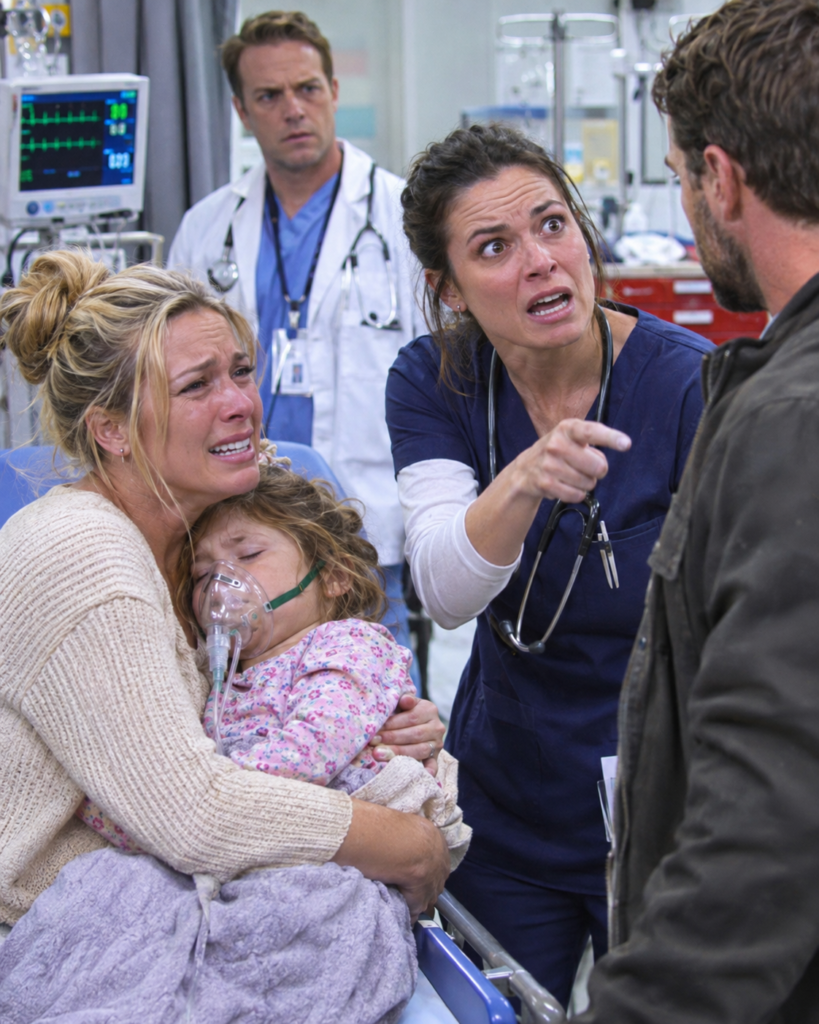
A triage nurse attached a monitor to Lucy’s finger. Another nurse closed the curtain. Someone called for respiratory support, and suddenly the room filled with scrubs, gloves, a rolling medical cart, a tiny oxygen mask, and an intake form sliding onto a clipboard with Lucy’s name and 6:03 p.m. printed across the top.
The doctor said, “This doesn’t look like a simple fall.”
Not a bump.
Not a little tumble.
Not the kind of ordinary accident a toddler has while trying to climb onto a couch with a stuffed giraffe tucked in her arms.
Something different.
I gripped the edge of the treatment bay doorway and fought to keep myself together. Fear makes certain people scream.
It made me completely still.
I listened to every sentence.
Watched every movement.
Memorized every procedural word because some instinct inside me already understood I might need to remember them later.
Documented.
Charted.
Examined.
Escalated.
Twenty minutes later, Lucy had oxygen covering her mouth and an IV secured to one small, soft hand. Her eyelashes were wet. Strands of hair clung to her forehead. When I quietly whispered her name, her eyes shifted toward me, and that tiny response nearly sent me to my knees.
Then the automatic doors to the ER slid open with a soft sigh.
Travis walked inside looking as though he was annoyed that someone had made him come.
His phone was still in his hand.
The pediatric nurse standing beside Lucy’s bed glanced up.
She saw his face.
And stopped cold.
The color disappeared from her expression so quickly that for a second I thought she might collapse. The chart slipped from her fingers and struck the floor with a sharp slap that made everyone nearby turn around.
She stared directly at my husband.
Not the way someone looks at a parent they recognize.
The way someone looks at a warning they remember.
Travis’s mouth moved slightly.
“What?”
The nurse slowly bent down to retrieve the chart, but her hands were shaking so badly that she struggled to gather the scattered papers.
Her eyes moved from Travis to Lucy.
Then back toward me.
Whatever she saw in my expression made her move closer, close enough that only I could hear the tremor in her voice.
Then she whispered—
“Why… why is he here?”
And in that instant, I understood that my daughter had not simply survived an accident…
PART 2
The nurse’s question left me frozen beside Lucy’s bed.
Before I could ask what she meant, Travis took one slow step forward.
The nurse immediately stopped moving.
Her eyes dropped to his phone, then to Lucy, and for a second she looked like she was deciding whether it was safe to say anything at all.
Travis forced a thin smile.
“You know me?”
The nurse didn’t answer him.
Instead, she leaned toward the doctor and whispered something I couldn’t hear. The doctor’s expression changed instantly.
Then he looked at Travis.
“Sir, I need you to wait outside.”
Travis’s jaw tightened.
That was when the nurse quietly reached for my wrist.
“There’s something in an old hospital record you need to see,” she whispered. “But first… I need to know if he’s been alone with her before tonight.”
My stomach dropped.
Before I could answer, Travis spoke from behind us.
“What old record?”
The nurse looked over her shoulder—and went completely silent.
For several seconds, nobody moved.
Travis stood at the entrance to Lucy’s treatment bay, his phone hanging loosely in one hand. His expression had changed. The irritation was gone, replaced by something I had never seen on his face before.
Fear.
“What old hospital record?” he repeated.
The nurse stepped away from him.
“Dr. Bennett, I think we need security.”
Travis let out a short, humorless laugh.
“Are you serious? I’m her father.”
Dr. Bennett didn’t look convinced.
“Then you should have no problem cooperating.”
Two security officers appeared outside the curtain. One remained near the entrance while the other approached Travis.
“Sir, we’d like you to come with us for a moment.”
Travis looked at me.
“Are you going to let them do this?”
I stared at him.
My husband.
The father of my little girl.
The man who had sat in our living room scrolling through his phone while our daughter struggled to breathe.
For the first time in four years, I didn’t feel the need to defend him.
“Tell me what happened to Lucy,” I said.
He shook his head.
“I already told you. She fell.”
“From where?”
“The couch!”
“You said you guessed.”
His mouth tightened.
I looked down at Lucy.
Her little hand was resting against the blanket, an oxygen mask covering her face.
“Then why didn’t you call 911?”
Travis looked away.
That was when the nurse spoke.
“Because this isn’t the first time.”
My stomach turned.
I looked at her.
“What?”
She swallowed.
“My name is Melissa. I was working in the pediatric emergency department at another hospital about eleven months ago. A little girl came in with injuries that were initially described as an accident.”
I felt my knees weaken.
Melissa continued.
“She was approximately thirteen months old. Her father brought her in. He said she’d fallen while playing. The injuries didn’t match the explanation.”
I couldn’t breathe.
“Was it Lucy?”
Melissa nodded slowly.
I grabbed the edge of the bed.
“No. No, that can’t be right.”
Travis suddenly stepped forward.
“She’s confused. That wasn’t me.”
Melissa looked directly at him.
“I remember you.”
His face hardened.
“You’ve got the wrong person.”
“No,” she said quietly. “I remember because you threatened to file a complaint against me when I requested a child-protection evaluation.”
The room seemed to tilt.
I turned toward Travis.
“Eleven months ago?”
He said nothing.
“Lucy was thirteen months old. What happened eleven months ago?”
He rubbed his forehead.
“Your mother-in-law is the reason we’re having this conversation. She put ideas in your head. You’ve always been paranoid about me.”
“Answer me!”
He flinched.
Melissa stepped closer.
“Ma’am, I need to explain something. At that time, the child’s injuries raised concerns. A report was made, and the case was referred to the appropriate authorities. I didn’t know what happened afterward.”
I stared at her.
“Why didn’t anyone tell me?”
She hesitated.
“According to the record, the father stated that the mother was aware of the incident and that the family had agreed to handle it privately.”
I felt something break inside my chest.
I looked at Travis.
“You told them I knew?”
He finally met my eyes.
“It was a misunderstanding.”
“A misunderstanding?”
“You weren’t home. Lucy was fine afterward. I didn’t want to upset you over something small.”
“Something small?”
My voice cracked.
“What did you do to our daughter?”
He raised both hands.
“Listen. I never meant to hurt her.”
The sentence hung in the air.
I stared at him.
He had just answered a question I hadn’t even finished asking.
Dr. Bennett stepped between us.
“Sir, you need to leave the treatment area now.”
This time, the security officer didn’t wait for another argument.
Travis was escorted into the hallway.
As he passed me, he leaned toward my ear.
“Don’t destroy our family over this.”
I didn’t answer.
Because at that moment, I finally understood something.
He wasn’t afraid of losing his family.
He was afraid of losing control of the story.
Melissa waited until Travis was out of earshot.
Then she pulled a chair beside me.
“I’m going to ask you some questions,” she said gently. “You don’t have to answer everything immediately. But we need to establish whether Lucy has been injured before.”
I nodded.
My hands were shaking.
“Please tell me what you know.”
She opened the hospital’s electronic record on a secure workstation.
A few minutes later, Dr. Bennett returned with a social worker named Karen.
They explained that Lucy would remain under observation while the medical team completed additional examinations. They also told me that the hospital had contacted the appropriate child-protection authorities and law enforcement because of the concerns surrounding her injuries.
I answered every question.
Had Lucy ever come home with unexplained bruises?
Yes.
Had Travis ever told me she was clumsy?
Yes.
Had I ever noticed that she became unusually quiet when he raised his voice?
I closed my eyes.
Yes.
There had been little things.
Things I had dismissed because I wanted to believe I was married to a good man.
Three months earlier, Lucy had developed a dark bruise on her upper arm.
Travis told me she had bumped into the coffee table.
Two weeks after that, she had a swollen lip.
He said she had fallen while trying to walk.
Another time, I came home and found her crying in her bedroom while Travis stood in the kitchen.
He told me she was having a tantrum.
I believed him.
I believed him because I was exhausted from working full-time, paying bills, managing daycare, and trying to keep our little family together.
I had thought being a good wife meant giving my husband the benefit of the doubt.
I hadn’t realized how much that benefit had cost my daughter.
Karen listened without interrupting.
When I finished, she placed a box of tissues beside me.
“None of this makes you responsible for what happened,” she said. “You brought Lucy here. You’re cooperating. Right now, our priority is keeping her safe.”
I covered my mouth and cried.
Not because I was relieved.
Because I was beginning to understand how many times my little girl might have needed me.
And how many times I hadn’t known.
At 8:17 p.m., the doctor returned with the results of Lucy’s initial examinations.
I stood immediately.
“Is she going to be okay?”
He nodded cautiously.
“She’s stable. We’re continuing to monitor her breathing and neurological condition. There are injuries that require further evaluation, and we’re taking every precaution.”
I gripped the back of the chair.
“Can I see her?”
“Of course.”
I walked to her bedside.
Her eyes were half-open.
“Mommy?”
One tiny word.
Barely audible.
I bent over her and kissed her forehead.
“I’m here, sweetheart.”
Her little fingers curled around mine.
“Home?”
I couldn’t hold back my tears.
“Yes, baby. We’ll go home when the doctors say it’s safe.”
I didn’t know then that home would never be the same place again.
At 9:06 p.m., a detective arrived.
His name was Detective Harris.
He introduced himself quietly and asked whether I would be willing to provide a statement.
I agreed.
He sat across from me in a small consultation room.
“Mrs. Carter, I understand this is overwhelming. But I need to ask about your husband’s behavior before tonight.”
I told him about the bruises.
The explanations.
The old hospital visit.
The way Travis always insisted that Lucy was simply difficult when she cried.
Then I remembered something.
“Wait.”
Detective Harris looked up.
“What is it?”
“Travis has a camera in the living room.”
He leaned forward.
“What kind of camera?”
“A small indoor security camera. He installed it about six months ago. He said it was for monitoring the apartment while we were away.”
“Do you have access to it?”
I nodded.
“It’s connected to our family account.”
He asked whether I could identify the recording system and provide the relevant footage through the appropriate process.
I took out my phone.
My fingers trembled as I opened the application.
The camera had recorded continuously.
I scrolled backward to Tuesday afternoon.
5:12 p.m.
Travis entered the living room carrying Lucy.
5:19 p.m.
He placed her on the couch.
5:23 p.m.
He walked out of the camera’s view.
5:27 p.m.
There was movement.
Then Lucy disappeared from the camera’s direct view.
I couldn’t watch anymore.
Detective Harris asked me to preserve the footage and avoid altering or deleting anything.
He arranged for the recording to be reviewed by investigators.
Then he asked another question.
“Does your husband have any reason to believe you might access this camera?”
I shook my head.
“No. He thinks I’m terrible with technology.”
Detective Harris nodded.
“Then don’t contact him about it. Let us handle the investigation.”
I looked down at my phone.
A notification appeared.
Travis: Where are you?
Another followed.
Travis: You need to tell them this was an accident.
Then:
Travis: Don’t let some nurse ruin my life.
I showed the detective.
He photographed the messages and asked me to preserve the entire conversation.
A fourth message arrived.
Travis: Remember what happened last time when you got involved with things you didn’t understand?
My blood ran cold.
I read it again.
Last time.
I looked at Detective Harris.
“Does that mean something?”
His expression became serious.
“It might. We’ll investigate it.”
For the first time that night, I realized that Travis might have been hiding more than one incident.
The next morning, Melissa came to Lucy’s room.
She had a folder in her hands.
“There’s something I wanted to tell you,” she said.
I stood.
“What is it?”
She looked toward Lucy, who was sleeping peacefully under the blanket.
“After the incident eleven months ago, I remembered the father’s name because of how aggressively he challenged the medical assessment. I later learned that the case had been referred for follow-up.”
She opened the folder.
“I also remembered that another hospital had documented a similar concern involving the same child.”
I felt sick.
“Another hospital?”
She nodded.
“Several months before that.”
I sat down.
“Why didn’t anyone stop him?”
Melissa’s expression softened.
“I can’t speak for what happened in the previous investigations. But I can tell you that we’re not going to ignore what we’re seeing now.”
She paused.
“There is something else. The earlier record mentioned that the father had been the sole caregiver during both reported incidents.”
I looked at Lucy.
Twice.
At least twice.
My daughter had been hurt while I was at work, and I had been told she was clumsy.
I pressed my hands against my face.
“I should have known.”
Melissa knelt beside my chair.
“You know what you did when you realized something was wrong? You brought her here. You stayed. You listened. You asked questions. That’s what matters now.”
I wanted to believe her.
More than anything, I wanted to believe that I could still be the mother Lucy needed.
By noon, the detective returned.
He informed me that Travis had been interviewed.
His explanation had changed several times.
Initially, he claimed Lucy had fallen from the couch.
Later, he said she had slipped while he was carrying her.
Then he suggested that she had injured herself earlier and that I had failed to notice.
But the timeline didn’t match the available information.
Investigators had also obtained the earlier medical records through the appropriate legal process.
The similarities between the incidents were concerning.
And the old hospital report contained something I hadn’t expected.
A note from the previous emergency physician.
The reported mechanism of injury is inconsistent with the child’s clinical presentation. Further safeguarding assessment recommended.
I read the sentence three times.
Then I looked at Detective Harris.
“Was I mentioned in the report?”
“Yes,” he said. “Your husband told the medical team that you were aware of the incident. However, there was no statement from you confirming that.”
My hands clenched.
“He lied.”
Detective Harris nodded.
“That is something we’re examining.”
He explained that the investigation was ongoing and that the evidence would need to be evaluated carefully.
Travis was no longer permitted to visit Lucy while the immediate safety assessment was underway.
The hospital had also arranged for a social worker to help me understand the next steps.
I asked the detective one question.
“Is he going to be allowed near her again?”
“That decision will depend on the investigation and the court’s orders. For now, we’re taking steps to protect Lucy.”
I nodded.
For now was enough.
I didn’t need promises.
I needed protection.
Three days later, Lucy was discharged.
She still tired easily, and the doctors arranged follow-up appointments.
I carried her out of the hospital in my arms.
Her stuffed giraffe was tucked beneath her elbow.
The same giraffe she had been holding the evening I found her on the couch.
Outside, the morning sun was bright.
Cars passed.
People hurried into the hospital.
The world continued as though nothing had happened.
But everything had changed.
My sister, Rachel, came to pick us up.
She had been crying since the moment I called her.
When she saw Lucy, she wrapped both arms around us.
“Oh, sweetheart,” she whispered. “I’m so glad you’re here.”
I climbed into the passenger seat while Rachel secured Lucy’s car seat.
As we pulled away, my phone vibrated.
It was Travis’s mother.
Margaret: You need to stop making this worse. Travis is a good father. Children fall. Don’t let one misunderstanding destroy his life.
I stared at the message.
Then another arrived.
Margaret: He hasn’t slept. He’s devastated. You should think about what you’re doing to him.
I looked at Lucy in the rearview mirror.
She was holding her giraffe.
Her eyes were closed.
I typed a response.
Me: My daughter is two years old. She cannot explain what happened to her. My job is to protect her, not protect your son’s reputation. Do not contact me again unless it’s through the appropriate legal channels.
Then I blocked her.
Rachel glanced at me.
“Are you okay?”
I looked out the window.
“No,” I said honestly. “But I will be.”
The investigation continued for several weeks.
The apartment security footage was reviewed.
Medical records were compared.
Witness statements were collected.
And the investigators discovered that Travis had searched online for information about childhood injuries and what doctors could identify during emergency examinations.
I didn’t know what to do with that information.
I couldn’t understand how the man who once sang nursery rhymes to Lucy could become someone I was afraid to leave alone with her.
But the evidence was no longer something I could dismiss.
Travis eventually faced criminal charges related to the incident.
The court also issued protective orders preventing him from contacting Lucy or approaching her while the proceedings continued.
During the first hearing, his attorney described him as a loving father who had made a terrible mistake.
I sat in the back row.
I didn’t interrupt.
I didn’t shout.
I simply watched the man who had once promised to protect our daughter sit at a table and listen while the evidence was presented.
At one point, Travis turned toward me.
His eyes were red.
He mouthed two words.
I’m sorry.
I looked away.
An apology was not a time machine.
It couldn’t return the eleven months when I believed his explanations.
It couldn’t erase the fear in Lucy’s eyes.
And it couldn’t make me forget the way he had stood in our doorway and called me dramatic while our daughter struggled to breathe.
The legal proceedings took time.
There were difficult days, additional evaluations, and meetings with professionals who wanted to understand exactly what Lucy had experienced.
I cooperated with every step.
I also began attending counseling.
Not because I had done something wrong by seeking help, but because I needed to learn how to live with the guilt, anger, and grief that followed.
Some nights, I still woke up hearing the sound of the grocery can rolling beneath the table.
Some mornings, I found myself checking Lucy’s breathing before I even got out of bed.
Healing wasn’t a straight line.
But slowly, we began to have ordinary days again.
Six months later, Lucy was sitting on the living room floor of our new apartment.
Sunlight spilled across the carpet.
Her stuffed giraffe sat beside a tower of colorful blocks.
She had become more talkative.
More playful.
And one afternoon, while I was folding laundry, she looked up at me.
“Mommy?”
I turned.
“Yes, baby?”
She held up a red block.
“Look!”
I smiled.
“That’s beautiful.”
She placed it on top of the tower.
Then she clapped for herself.
I laughed.
It was such a small moment.
A red block.
A little girl.
A mother sitting nearby.
But I felt something I hadn’t felt in months.
Peace.
Not the silence I had found when I first walked into our old apartment.
Not the silence that had made my instincts scream.
This was different.
This was the peaceful sound of a child who felt safe enough to play.
A few minutes later, Lucy climbed into my lap.
She pressed her little cheek against my chest.
“Mommy stay?”
I kissed her hair.
“Always, sweetheart.”
And I meant it.
One evening, I received an email from Melissa, the pediatric nurse.
She had found my contact information through the hospital’s approved follow-up process and wanted to check how Lucy was doing.
I wrote back that Lucy was recovering well.
A few minutes later, Melissa replied.
She told me that she still remembered the night she saw Travis walk into the emergency room.
She had recognized him immediately because of the earlier case.
She also admitted that she had been afraid.
Not because she didn’t know what to do.
But because she knew how easily a warning could be overlooked when someone appeared calm, confident, and convincing.
I read her message twice.
Then I wrote:
Thank you for remembering my daughter when I didn’t even know what I needed to remember.
She replied with one sentence.
You listened when someone finally asked you the right question. You saved her by refusing to ignore it.
I sat quietly for a long time after reading that.
I had spent months blaming myself.
I had replayed every bruise, every explanation, every moment when I had trusted Travis instead of questioning him.
But I finally understood that the responsibility for hurting Lucy belonged to the person who hurt her.
Not the person who loved her.
Not the person who believed the explanations she was given.
And certainly not the little girl who had never had the words to explain what was happening.
On Lucy’s third birthday, we had a small celebration at Rachel’s house.
There were balloons, cupcakes, paper decorations, and a stuffed giraffe wearing a tiny pink bow.
Lucy blew out her candles with both cheeks puffed up.
Everyone clapped.
She looked around the room, smiling.
Then she ran toward me.
“Mommy! Again!”
I laughed and picked her up.
“Again what?”
“Birthday!”
I kissed her forehead.
“Yes, sweetheart. We can celebrate again next year.”
She rested her head on my shoulder.
And for a moment, I thought about that Tuesday evening.
The cold keys in my hand.
The grocery bag digging into my wrist.
The refrigerator humming in an apartment that should have been filled with laughter.
I remembered the nurse dropping the chart.
I remembered her trembling voice.
“Why… why is he here?”
For months, I had wondered why she had asked that question.
Now I understood.
She had recognized something that I hadn’t been able to see.
She had remembered a little girl whose injuries had once raised serious concerns.
And she had refused to pretend she didn’t recognize the person standing beside her bed.
That single question had changed the course of our lives.
I looked down at Lucy.
She was laughing at the balloons.
Her little hands were sticky with frosting.
Her eyes were bright.
She was safe.
And that was all I wanted.
I used to think protecting a family meant keeping it together.
Keeping the arguments quiet.
Giving someone another chance.
Believing that love could fix what was broken.
I know better now.
Sometimes protecting your family means walking away from the person who is destroying it.
Sometimes it means asking questions that make everyone uncomfortable.
Sometimes it means refusing to accept an explanation simply because it comes from someone you love.
And sometimes, the most important thing a mother can do is listen when her instincts tell her something is wrong.
Because a child doesn’t need a perfect mother.
A child needs a mother who is willing to believe them, protect them, and stand between them and anyone who makes them afraid.
Even when that person is their own father.
Especially then.
I held Lucy a little tighter.
She wrapped her arms around my neck.
“Love you, Mommy.”
I closed my eyes.
“Love you more than anything, baby.”
And this time, there was no silence in our home.
Only laughter.
Only little footsteps.
Only the sound of a little girl growing up without having to be afraid.