I came home at 5:37 on a rainy Tuesday evening with a paper grocery bag cutting into my fingers and cold water soaking through the cuffs of my hoodie.
The carpet smelled like rain, damp shoes, and whatever somebody downstairs had fried for dinner, all of it so ordinary that I almost missed the first thing that felt wrong.
Lucy was not yelling for me.
My daughter was two years old, and silence had never been one of her habits.
Most evenings, she heard my key before I even opened the door and came charging toward the entryway with her stuffed bunny tucked under one arm, slapping her free hand against the coffee table and shouting, “Mama home!” as if she were announcing me to the entire building.
That Tuesday, there was nothing.
No cartoon voices from the television.
No little feet crossing the living room.
No toy hitting the floor.
The kitchen faucet dripped somewhere beyond the entryway, and the refrigerator hummed loudly enough that I could hear the motor cycle on.
Then I heard Lucy breathing.
It was wet, ragged, and wrong.
The grocery bag slipped out of my hand before I consciously decided to let go.
Eggs cracked across the tile, a carton tipped sideways, and something canned rolled beneath the narrow table by the door, but I never looked down.
I ran into the living room.
Lucy was half-slumped against the couch cushions in her pajamas, her small body folding into the fabric as though she no longer had the strength to sit upright.
Her cheeks were burning red.
The edges of her lips were turning dark.
Every breath dragged visibly through her chest, pulling hard beneath the thin cotton of her pajama top as if breathing had become a job her body could barely finish.
“Lucy?”
Her eyes moved toward me.
They were glassy, frightened, and far too quiet.
I had seen my daughter sick before.
I knew what a daycare cold looked like, what a fever felt like under my palm, and what kind of crying came after a scraped knee or an overtired afternoon.
I knew the dramatic sobbing that followed a dropped cookie and the angry tears that came when I said no to one more cartoon.
This was different.
There was fear in her face without enough air behind it to turn into a real cry.
I crossed the room and lifted her against my chest.
Her skin felt hot against my neck, and one of her hands curled weakly into the front of my shirt while another strained breath scraped through her throat.
That was when I looked across the room and saw Travis.
My husband was sitting in the armchair by the window with one ankle resting across his opposite knee and his phone in his hand.
He was close enough to hear every one of those breaths.
He barely looked up.
“What happened?” I shouted.
He gave a small shrug.
“She just fell.”
For a second, I thought I must have missed the rest of his explanation.
I waited for him to tell me where she had fallen, how hard she had hit, whether she had cried immediately, whether she had been coughing, whether she had swallowed something, whether he had called anyone.
I waited for him to get out of the chair.
He did not.
“She fell?” I said.
“She cried for a while,” he muttered. “Then she calmed down. You don’t have to come in here acting crazy.”
I looked down at Lucy.
Her mouth was beginning to turn purple.
The phrase he had used—calmed down—landed in my head with a sickening wrongness.
A sleeping child looked calm.
A toddler coloring on the floor looked calm.
A child fighting for each breath did not look calm.
Lucy’s fingers tightened once against my shirt and then weakened again.
Everything inside me narrowed to one command.
Get her out.
I shifted her higher against my shoulder and moved toward the entryway, grabbing my purse and keys while reaching for the diaper bag hanging from the hook beside the door.
Behind me, the chair finally creaked.
Travis stood.
For one irrational second, I expected him to rush ahead of me, open the door, carry the bag, or say he would drive while I stayed in the back seat with Lucy.
Instead, he stepped into my path.
“Where are you going?”
I stared at him.
“The ER.”
He scoffed as though I had just announced some ridiculous plan.
“You always overreact. She’s fine.”
Lucy made a choking sound against my shoulder.
Her little body jerked once beneath my hand.
Every part of me wanted to stop and demand answers.
I wanted to know how long she had been breathing like this.
I wanted to know what he meant by “fell.”
I wanted to know why a father could sit four feet from his two-year-old daughter while her lips changed color and still make my reaction the problem.
But there was no time to have the argument he seemed determined to start.
Rage could wait.
Oxygen could not.
I pushed past him and ran.
The rain hit us the moment I reached the outside walkway.
I held Lucy beneath my chin as best I could while hurrying toward the car, trying to shield her face with my body and keep the diaper bag from slipping off my shoulder.
My hands shook so badly that I missed the door handle the first time.
I got her into the back seat, fastened her as securely as I could, threw the bag onto the floor, and climbed behind the wheel.
My phone later showed that I left the apartment at 5:51 p.m.
The emergency room intake form would show 6:04 p.m.
Thirteen minutes.
I have never experienced thirteen minutes like those.
I drove with one hand gripping the steering wheel and kept reaching behind me with the other whenever traffic stopped.
Sometimes I touched Lucy’s ankle.
Sometimes her foot.
Once, all I could reach was the edge of her blanket, and even that small contact felt necessary because I needed proof that she was still physically behind me.
At every red light, I twisted around as far as the seat belt would allow and tried to see her chest moving.
“Stay with me, baby,” I said.
My voice sounded too loud inside the car.
“Breathe for Mommy. Come on, Lucy. Please keep breathing.”
She cried once during the drive.
It was not her normal cry.
There was no strength behind it, only a thin, weak sound that lasted a moment before she went quiet again.
That silence frightened me more than screaming would have.
My mind kept replaying what Travis had said.
She just fell.
She cried for a while.
Then she calmed down.
I tried to fit those sentences to what I had seen when I entered the apartment.
They did not fit.
If she had simply fallen, why was she struggling to breathe?
Why had he not called me?
Why had he not called for help?
Why had he been sitting with his phone in his hand while our daughter looked terrified?
And why, when I said I was taking her to the emergency room, had his first instinct been to stop me instead of helping me?
I had no answers, and I forced myself to stop trying to solve it while driving.
The only thing that mattered was getting Lucy through those doors.
When I reached the emergency entrance, I pulled beneath the drop-off awning so fast that I left the car crooked.
I did not shut the driver’s door.
Rain blew across the seat as I unbuckled Lucy and lifted her into my arms.
A security guard near the entrance looked up before I even reached the automatic doors.
A woman behind the check-in desk pushed back from her chair.
“My baby can’t breathe,” I said.
I do not remember deciding to say it.
The sentence came out before anything else could.
A pediatric nurse came toward us at once.
Her movements were quick but controlled, which somehow frightened me and reassured me at the same time.
She looked at Lucy’s face, then at the way her chest was working, and reached for her with steady hands.
“How old?”
“Two.”
She guided us toward the triage area while another staff member moved nearby.
“What happened?” the nurse asked.
I opened my mouth.
I had a sentence ready because Travis had given me one.
She fell.
But standing beneath those bright emergency-room lights, with a medical professional looking directly at my daughter, I suddenly realized how little I actually knew.
I had not seen Lucy fall.
I did not know when it happened.
I did not know where it happened.
I did not know what part of her body had hit anything.
I did not know what she had done immediately afterward except for Travis’s vague statement that she had cried.
All I truly knew was what I had found at 5:37 p.m.: a two-year-old child struggling to breathe and her father sitting nearby with his phone.
“I just got home,” I said. “My husband said she fell. I found her like this.”
The automatic doors hissed open behind me.
I heard footsteps but did not turn immediately because my eyes were fixed on Lucy.
Then the nurse looked past my shoulder.
Something changed in her face.
Until that moment, everything about her had been focused and professional.
She had been looking at symptoms, asking direct questions, and moving us forward.
Now she stopped.
I followed her gaze.
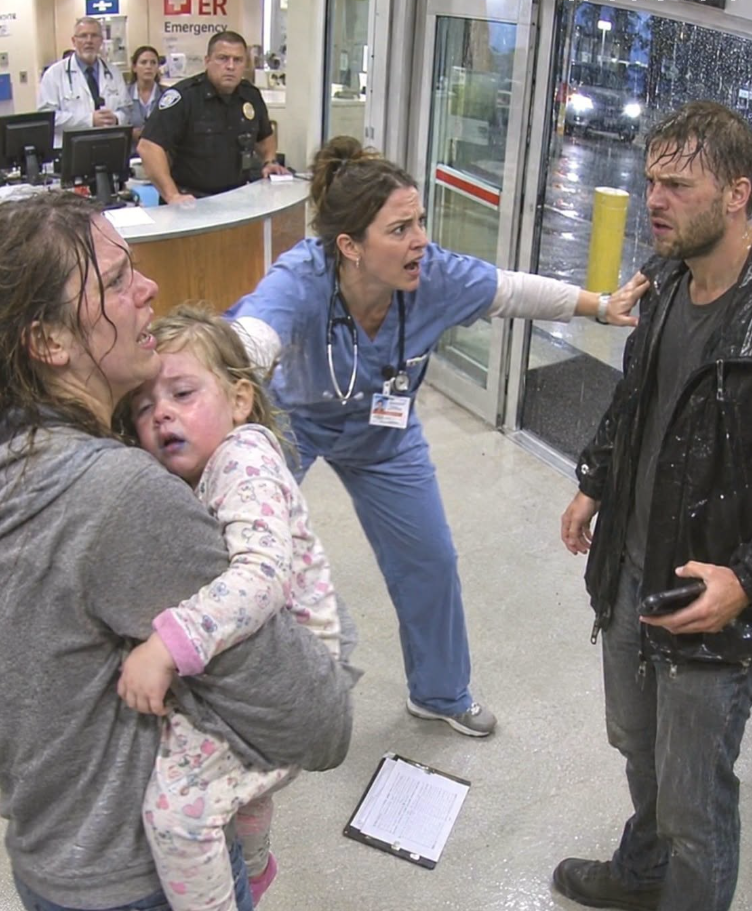
Travis had followed us to the hospital.
I had not heard his car behind mine.
I had not seen him in the parking area.
Yet there he was, standing just inside the emergency entrance with rain darkening the shoulders of his jacket.
His phone was still in one hand.
What struck me was not that he had come.
It was the expression on his face.
He did not look like a father who had spent thirteen minutes wondering whether his little girl would keep breathing.
He looked irritated.
He looked like someone who had been dragged into an argument he did not want to have.
The nurse stared at him.
Her expression was no longer simply concerned.
It was recognition.
The distinction was immediate enough that I felt it before I understood it.
Her fingers loosened around Lucy’s chart.
The clipboard slipped free.
It hit the floor with a flat plastic crack that seemed impossibly loud beneath the emergency-room lights.
Several people behind the desk looked toward us.
I looked from the clipboard to the nurse, then from the nurse to Travis.
She had gone pale.
Travis did not move toward Lucy.
He did not ask what the nurse was doing.
He did not reach for me.
For the first time since I had entered our apartment, I felt fear separate itself from panic and become something colder.
Panic had been about Lucy’s breathing.
This was about my husband.
The nurse stepped closer to us.
Then she moved between Travis and my daughter.
It was a small shift in position, but there was nothing accidental about it.
Her body was now a barrier.
I could hear Lucy’s strained breathing against the movement around us.
I could hear the rain tapping against the glass entrance doors.
I could hear someone farther down the desk asking another person a question I could not make out.
But my attention stayed on the nurse.
She was still staring at Travis.
I wanted her to tell me what was wrong with Lucy.
I wanted her to pick up the chart, keep moving, call whoever needed to be called, and make my daughter breathe normally again.
Instead, the nurse looked at my husband as though his presence had changed the meaning of everything I had just told her.
The apartment.
The silence.
His refusal to get out of the chair.
“She just fell.”
His attempt to block the door.
“You always overreact.”
The thirteen-minute drive.
The fact that he had followed us after acting as if the emergency room was unnecessary.
I tightened my arms around Lucy, suddenly aware that I was holding her differently now—not just like a terrified mother carrying a sick child, but like someone instinctively protecting her from something I could not yet name.
Travis’s eyes moved toward the nurse.
For the first time that evening, the certainty in his posture seemed to matter less than the fact that she knew exactly who she was looking at.
I turned back to her.
“What is it?” I asked.
My voice barely came out.
She did not answer me immediately.
Her eyes remained locked on my husband while she stood between him and Lucy.
Then, quietly enough that I almost thought I had misheard her, she asked the question that made the entire room tilt beneath my feet.
“Why… why is he here?”