PART 1 — The Numbers I Had Stopped Checking
“Then you’ll need to arrange childcare before you leave, sweetheart,” I said, lowering my coffee cup onto the balcony railing while I listened to my daughter breathe. Two thousand miles to the east, in a Dublin, Ohio, driveway, silence stretched across the line. Then Max’s little voice broke through, high with confusion. “Mommy, is Grandma not home?” “Not now, baby,” Lauren answered, her voice suddenly thin. “Mom. Mom, this isn’t funny.” “It isn’t meant to be,” I told her. “Happy birthday to me.” Beneath my balcony, sunlight was gilding Sedona’s red formations ridge by ridge. A hawk circled upward on the canyon’s first rising warmth.
I stopped in the hallway with the dress draped over my arm. I wish I could say anger rose immediately. Instead, an old, flat heaviness settled into me—the feeling I knew from an audit when the final figure confirmed a pattern I had been hoping to disprove. It’s not like Mom has much else going on. Then they mentioned the card. Lauren had a supplemental credit card on my account, with a fifteen-thousand-dollar limit, intended for the children’s medical expenses and school needs. I used Mom’s emergency card for the flights and hotel. Kevin repeated the amount: nine thousand two hundred dollars. Without announcing myself, I placed the tiramisu in the refrigerator, hung the dress in the laundry room, and returned to my car. I drove to Highbanks Park, stopped beneath a sycamore at the far end of a gravel lot, shut off the engine, and opened my banking app.
I still collected the children from school. That matters to me. None of this was about punishing them. Zoe appeared with her pink backpack and a braid coming loose, climbed into the back seat, and announced, “Grandma, I got a hundred on my spelling.” Max followed, carefully carrying a paper plate covered with macaroni art. I took them home, cooked dinner, and sat on the floor to build with their blocks. Their parents returned at nine, lively and flushed from a “business dinner” somewhere with candles on the tables. I pulled on my coat and kissed the children on their heads. Then I went back to my own house, where a maroon binder waited. That binder explains everything I did on Friday.
Richard and I had established a family trust in 2009 through our attorney, Grant Lawson. He was brisk and silver-haired, wore half-glasses, and kept a sign on his desk that read READ THE INSTRUMENT. In 2017, Lauren and Kevin had needed somewhere to live after losing a rental and seeing Kevin’s commissions reduced. We helped in the way parents help when they believe they can. The trust purchased a four-bedroom colonial in Dublin for $412,000 and offered them a rent-to-own lease. Their monthly payment was $2,100. After seven years, they could buy the property at its original price, with credit for the payments they had made. Richard had insisted on the paperwork. “A gift without a paper is a trap, Di.” At the time, he meant tenants. I have since learned that the warning can apply just as well to children.
At ten that night, beneath the yellow kitchen light, I opened the binder and read the ledger. Then I read it again. Lauren and Kevin were fourteen months behind. Every quarter, she had assured me, “It’s all current, Mom.” Sometimes she said it standing in her kitchen with a glass of wine, bright and certain. I had accepted the assurance because I was her mother, and accepting anything else felt unbearable. Their arrears totaled $29,400. Meanwhile, the trust had quietly paid the property taxes and insurance month after month. I had not reviewed the ledger, and Grant’s office had received no instruction to flag the missing payments. Nausea rolled through me. I had spent thirty-four years examining insurance companies’ records and had allowed my own family’s accounts to disappear into darkness. A clock ticked. A passing car swept its headlights across my ceiling.
Then I remembered something Zoe had asked while I was drying dishes. Grandma, when are you coming to live downstairs? She had been at the counter in pajamas, holding a glass of milk. Mom said you might sell your house after your birthday. I had stopped with a plate in my hands. “She told you that?” Zoe nodded. Daddy said you don’t need a whole house just for yourself. I explained that grown-ups sometimes discussed possibilities. She looked at me solemnly with Richard’s gray eyes and let the subject drop. Now, alone with the ledger, I could not dismiss it. Fourteen months of unpaid rent. A vacation purchased on my emergency card. My house being discussed as though the decision belonged to somebody else. Each item might have been explained away in isolation. Together, they formed something I recognized.
Sleep never came. I went into the study, settled into Richard’s chair, and unfolded the brochure from his drawer. Its creases had grown soft. Canyon Rose was the resort’s name. The photograph showed a woman holding coffee on a balcony above red cliffs. Richard had drawn his pencil circle around the week, but there was more at the bottom, written in that unmistakable square hand: Ask Lauren if she wants to come. She’ll say no. Go anyway. When I first discovered it three years earlier, I had assumed he was teasing. Now I rested my forehead on my folded arms across his desk. I had been so careful about everyone else’s needs that I had treated my own wish as something requiring permission. The brochure lay beneath my hands, a plan he had made and a promise I had left untouched.
At 7:45, I called Grant. At seventy-three, he was already working. By nine, I was seated across from him in the narrow brick building above a Broad Street florist. I had brought the trust papers, bank statements, ledger, and screenshots. For forty minutes, he read without speaking, using the eraser of a pencil to lift and turn the pages. Finally, he removed his glasses and pressed his fingers against the bridge of his nose. “Diane. How long have you known?” “About eighteen hours.” “And how do you feel?” “Like a woman who’s been robbed by her own firm.” His answer was gentle. “You haven’t been robbed.” Then he added, “You’ve been, forgive me, taken for granted. Those are different. One’s a crime and one’s a pattern.” “Some of it’s both.” “Some of it is.” He laid the pencil down. “I’d like to tell you what we can do. And then I’d like to ask what you want.”
Outside his window, the September morning was clear and blue. Across the street, a woman lifted a basket of mums into place. “I want to go to Sedona,” I said. Grant did not laugh, which is one reason he had remained my attorney for thirty years. “Then we’ll arrange it,” he replied. “Today. But let me first do what a lawyer does.” He opened a writing pad. “One. The supplemental card.” “I want it closed.” “Closed, or limited?” “I’d like to see what she does with a limit.” He nodded, slowly. “Closed is cleaner.” “I know. I’d rather give her the chance to tell me.” “All right. We’ll lower it to $500. A card that can’t buy a vacation. And I’d like you to call the bank yourself, today, and put a note on the account.” I watched his pencil move. “Two?”
“The nine thousand two hundred. I’d dispute it. Not to hurt her. To put it in writing that you didn’t authorize it.” “I’d rather not.” “Diane.” I drew a breath. “I mean it. I’d like to let her pay it. Not by my wish, by hers. If I dispute it, she’ll never have to look.” Grant studied my face. “You want her to see the bill.” “I want her to see me.” He wrote another note and let a little silence pass before continuing. “Three,” he said. “The lease.” Explaining that took an hour. The agreement contained a default provision: after ninety days of arrears, the trust could issue notice; after a hundred and twenty, it could end their purchase option. Lauren and Kevin were four hundred and twenty days behind. “You could end it tomorrow,” he said. “You’d be within your rights.” “I know.” “They’d have thirty days to vacate.” “I know that too.” “Do you want to?”
I pictured the children watching cartoons together. I pictured Zoe’s solemn face as she asked when I would move downstairs. “No,” I answered. “But I want them to know I could.” Grant tapped his pad. “Then I’d like to send a letter. Not a notice. A statement of account. Dated today. It’ll list what’s owed, and reserve the trust’s rights. It’ll arrive Monday.” “After they’ve flown.” “After they’ve flown. Or not flown.” His smile was thin. “It’s a polite letter. It says, ‘We should talk.’” I agreed. Only then did I notice that my hand had moved to my wallet. I drew out a small photograph and set it before him. Richard was fifty in it, squinting into Colorado sunshine beneath an absurd straw hat. “We were going to go,” I said. “Sedona. For my sixty-eighth.” Grant regarded the picture for a long time. He had known Richard for thirty-one years. Thursday-night poker had been part of their lives.
“I remember the brochure,” Grant said softly. “He showed it to me. In ’21. He said, ‘Grant, I’m going to surprise Di.’” My hand rose over my mouth. He removed his glasses again and polished them with his tie. “He asked me to keep it secret. I’d forgotten. God help me. It was the week before he died.” “He never said a word.” “He wasn’t a talker.” Grant put his glasses back on. “Diane, go. I’ll draft the letter. I’ll send it Monday. You’re not to answer your phone until Wednesday.” “Lauren will call.” “Let her.” “She’ll be frightened.” “Good,” he answered, his voice quiet and steady. “It’s high time somebody in that house was.” I looked down at Richard’s photograph, knowing now that the brochure had never been merely a suggestion. He had been preparing a surprise for me in the last week of his life—and I was only beginning to discover it.
PART 2 — The Gift Waiting in the Closet
My flight left Port Columbus at 6:40 on Friday evening. The little plane was half empty. With a window seat, a paperback, and a cardigan, I felt the strange, exhilarating freedom of a woman playing hooky. Packing had taken forty minutes: a blue linen dress, proper walking shoes, a hat, and Richard’s photograph secured in a zippered pocket. Before going to the airport, I had stopped in Dublin with Zoe’s altered navy dress wrapped in tissue. At six, knowing her parents would be out at a “dinner,” I used my key, placed the dress on her bed, and slipped a card beneath it. For your recital. Wear it with the red shoes. Love, Grandma. On the refrigerator, beneath a lighthouse magnet, I left another message. I’ll be away for my birthday. I’ve arranged for my own celebration. You’ll need to arrange childcare for Saturday. I love you both. —Mom. Not Grandma. Mom. I wanted the message to reach the people responsible.
I arrived in Phoenix at nine, hired a small white car, and headed north through the darkness. Interstate 17 carried me for two hours through a broad black desert interrupted by scattered lights. I switched off the radio and opened the window. Warm, dry air brought the scent of creosote and sage. Richard and I had looked at Arizona in countless calendar pictures and photographs, always meaning to go. At eleven-thirty, the road crested a rise and fell toward a valley. There they were in the starlight: enormous dark shapes beneath a sky thick with stars, rising like cathedral walls. Bell Rock. Courthouse Butte. A long outline resembling an animal asleep. I pulled off the road, stopped the engine, and kept both hands on the wheel. Forty-four years of waiting seemed to settle around me. I lowered my forehead to the steering wheel and cried.
At five-forty on my birthday, I woke beneath a quilt in a white bed at Canyon Rose. Through the window lay a courtyard of flagstone and agave. For a moment, I simply listened. A bird sent out a dry, bright, ascending call. Pink light glimmered through the curtains. I put on my robe, slid open the door, and stepped onto a little weathered wooden balcony furnished with two chairs and a table. The front desk had provided a thermos, and I poured coffee. Slowly, the highest rocks caught gold. Then the cliff faces emerged, red as brick and rust and the inside of a seashell. A fine veil of mist rested below, while a hawk rose on the warming air. I was sixty-eight, sitting outside in my robe, watching dawn touch the place my husband had circled in pencil. “Well, Richard,” I said aloud. “I’m here.” The hawk wheeled. The breeze carried sage, dust, and sun-warmed stone. I think I laughed.
Lauren called at 7:41 according to my watch, 9:41 in Ohio. Her name glowed on the phone beside my cup, and the vibration rattled against the table. I watched it for a moment. A woman taken for granted for three years could finish her coffee first. When I answered, she wanted to know why I was not opening my door. I told her I was away for my birthday. She reminded me that she and Kevin had a flight that morning. I told her they would have to arrange childcare. During the pause, I heard a car door, a child complaining, and Kevin speaking under his breath. Then he took the phone, using the controlled, agreeable tone he saved for difficult clients. Diane. Where are you? Visiting somewhere I’ve wanted to see for a very long time. Is this about the card? A band of shadow slid down the nearest butte like a curtain. I think, I said, it’s about quite a few things.
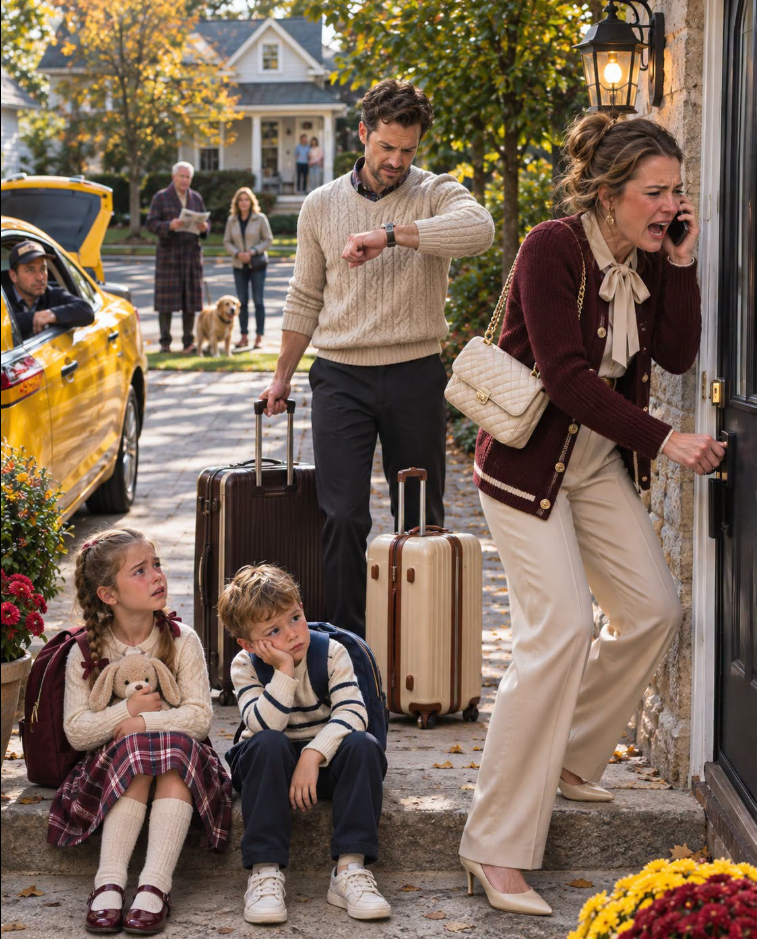
What happened in my driveway reached me later in pieces, mostly from Zoe, who reported with a nine-year-old’s precision. At 7:10, her parents had arrived in travel clothes with two rolling suitcases, a garment bag, and two children wearing winter coats over pajamas. Kevin pressed the bell for four minutes. They telephoned, sent messages, and tried the side entrance. At 7:35, Mrs. Okafor, my eighty-year-old neighbor, stepped outside in a quilted robe to collect her newspaper. “They’re not there, dear,” she told them. “Diane left Friday. In a cab.” “A cab?” Lauren asked. “To where?” “She didn’t say.” According to Zoe, Mrs. Okafor surveyed them over her glasses. “She said she’d earned a holiday.” Lauren went white. Zoe described it as watching a crayon melt. Standing on the front path in her camel coat and heeled boots, my daughter held her phone away and whispered, “She doesn’t do this.” “Do what?” Kevin asked. Her voice cracked. “Leave. She doesn’t leave.”
Back on the balcony, I had taken another sip and was preparing to end the call when Lauren spoke again. Mom. Please. The voice was not the bright, brisk one that managed everyone around her. It sounded low, frayed, and afraid. Mom. Where are you? I need you. I had imagined hearing that in the car, in the shower, in a hundred private rehearsals. None had prepared me for the dull maternal ache it brought, like pressure on a bruise. I know you do, I said. That’s the trouble. What does that mean? It means you need me when I’m useful. I kept my tone even. You’ve forgotten how to need me when I’m not. She breathed into the silence. Behind her, Max announced, “Mommy, I have to pee.” I told Lauren to take the children home, make breakfast, and telephone Kevin’s mother. She’s in Florida. Then call someone else. Looking at the cliffs, I reminded her that she was organized and would think of somebody. Mom. Happy birthday to me, I said gently, and ended the call.
For a long while, I stayed in the chair. The sun rose, changing the stone from rose to copper and then to a dry, pale orange. Below, a couple with hiking poles walked along the path, laughing together. Somewhere a woman called, “Honey, bring the water!” My phone vibrated repeatedly, then finally went still. At eight, someone knocked. A young woman in a pink Canyon Rose polo waited with breakfast: eggs, toast, a little dish of prickly-pear jam, and a card in a white envelope. “Compliments of the manager,” she said. “He says happy birthday.” “How did he know?” “It’s on the reservation.” Her smile was easy. “Somebody wrote it in. Months ago.” I stared at her. “Months?” “It says, ‘Special occasion. Please give her the east balcony.’” She tilted her head. “It was booked in 2021.” I steadied myself against the door frame. “By whom?” She checked the card. “R. Miller.”
There was an explanation. It was not a miracle, only paperwork preserved by kindness. In the spring of 2021, Richard had telephoned Canyon Rose and paid a refundable deposit for an October week the following year. That same week, a cardiologist had pronounced his heart “fine for sixty-seven.” He had come home and made pancakes shaped like Ohio. The deposit was a hundred and fifty dollars. After he died, I never canceled because I did not know there was anything to cancel. The resort kept it on file, sending a courteous message each October to an address I no longer used. In July, searching an old inbox for a recipe, I found an email from Priya Reyes in reservations. Its subject was Your deposit for the Miller party. Her message said, kindly, We’d love to honor it any time you’re ready. There’s no expiration. I stared at it for twenty minutes, then shut the laptop. I was not ready, I told myself. I would go when someone asked. Nobody did. At last, I had asked myself.
The card was cream-colored, the writing small and upright. Dear Mrs. Miller, Your husband called me himself, in 2021. I remember it. He said, “My wife has wanted to see the red rocks for forty years, and I’ve kept putting it off. I’d like to make sure that when she gets there, somebody makes a fuss.” I wrote it in the file. We never forgot. There’s a small gift in the room. Please look in the closet. With warm regards, Priya Reyes, Guest Services. I set the card down and rubbed my face with the back of my hand. Then I crossed to the closet. A plain brown paper bag rested on the shelf. Inside was a ridiculous wide-brimmed straw hat with a faded blue band, almost the twin of the one Richard wore in the Colorado photograph. Pinned inside its crown was a little yellow Post-it. The handwriting was more familiar to me than my own. Di. Wear it. Don’t hurry. —R.
I cannot remember lowering myself to the floor. Suddenly, I was sitting inside the closet in my robe with the hat across my lap, and three years of grief were coming out of me. It was quiet, the sort of crying that begins when a wall you never realized you built finally collapses. A vacuum hummed somewhere down the corridor. Outside, a mockingbird sang among the agave. After a long time, I turned the note over. There was another line in the same pencil: P.S. Tell Lauren I love her. Tell her to go to Sedona herself some day. Not for you. For her. I read that six times before placing it behind Richard’s photograph in my wallet. Then I tried the hat. It was a little too large, just as his hats always had been; he had guessed my size. In the mirror stood a gray-haired woman in a robe and an oversized straw hat, tears still streaking her cheek. I laughed aloud. Then I went looking for the trails.
I spent four days in Sedona, and not every hour needs recounting. At sunrise, I climbed Cathedral Rock with Wanda, a retired Minneapolis surgeon. She was seventy-one, stout and cheerful in a purple windbreaker. At the summit she declared, “Sweetheart, at our age, you either go up or you sit.” I joined a jeep tour led by a young man named Dev, who explained the geology with the affection another man might reserve for his mother. In a Tlaquepaque courtyard café, I ate a green-chile omelet, read my novel, and left my phone untouched. Each night at ten, I checked it once. Saturday had brought forty-seven missed calls. Sunday added thirty-one. Monday brought three firm, formal paragraphs from Kevin about “miscommunication.” On Tuesday, there was nothing. On Wednesday morning, at 6:15, I was back on the east balcony with my coffee and my hat when an unfamiliar number appeared. The area code was 614.
“Hello?” “Mrs. Miller? It’s Zoe.” I almost lost my grip on the cup. She was whispering from the landline in her kitchen. I could hear a refrigerator and a clock. “Zoe, honey. Where are your parents?” “In the living room. They’re fighting.” After a brief pause, she added, “I borrowed the phone. Mom’s is on the counter. I looked up your number in her contacts.” “Are you all right?” “I’m okay.” Her small, controlled voice faltered. “Max is watching TV. I made him toast.” I shut my eyes. “That was kind.” “Grandma.” It was the first time she had called me that during the conversation. “Are you coming back?” Sunlight had just reached the uppermost ridge, tracing fire along its edge. “On Thursday,” I promised. “I’ll be home Thursday.” “Are you mad at us?” “No, sweetheart.” I took a breath. “Not at you.”
“Are you mad at Mom?” I considered my answer while a hawk circled above the valley. “A little,” I said. “Mostly I’m tired.” Zoe went quiet. Then she said her mother had been crying a great deal and claiming it was allergies. “Grandma, I have to tell you something. It’s a secret.” “You don’t have to.” “I want to.” Her whisper dropped lower. “You know how Mom said you were going to sell your house?” “I remember.” “She didn’t say it. Daddy did.” Zoe swallowed. “He said it to Mr. Hollis. From the bank. On the phone. I was in the hall. He said, ‘Once the old lady’s in the downstairs unit, we can list her place.’” I set my coffee down. “And Mr. Hollis said, ‘And the trust?’” Her whisper was remarkably clear. “And Daddy said, ‘Her lawyer’s a dinosaur. He’ll fold.’”
I did not move. The mockingbird began again among the agave, and a breeze lifted my hat brim. “Zoe,” I asked, “Do you remember the date?” “It was last Tuesday. At dinnertime. I wrote it on my hand, because I thought it was important.” I heard a faint rustling. “It’s still there. It’s kind of faded. It says ‘9/19.’” I closed my eyes against the tightening in my throat. “You’re a very brave girl,” I told her. “Am I in trouble?” “Never.” “Are you?” “Not if I can help it.” Her laugh was little and damp and surprised. “That’s what Grandpa used to say.” At seven, I called Grant. He answered on the first ring with toast still in his mouth. “Diane.” “I need you to listen.”
I gave him everything in sequence, using the flat, precise voice I had relied on during years of audit interviews. The call. The conversation Zoe overheard. Her lawyer’s a dinosaur. Mr. Hollis at the bank. The date. Grant remained silent long enough for me to hear him put down his cup. “Hollis,” he finally said. “Dennis Hollis. He’s at First Mercantile. He’s the loan officer who handled their refinance in 2022.” “What refinance?” His voice grew very quiet. “The one I didn’t know about. Diane. I pulled the county records Monday. The deed to the Dublin house is still in the trust. But there’s a recorded lien. A second mortgage. $118,000. Against the property.” “On a house the trust owns?” “With a signature.” He paused. “Yours.” I pressed my hand to my chest. “I didn’t sign it.” “I know,” Grant answered. “I think I’d like to show it to someone with a badge.”
PART 3 — The First Honest Set of Books
I flew back Thursday, although I had intended to remain until Saturday. At the front desk, wearing my hat and holding my small suitcase, I changed the ticket. Priya hugged me goodbye. “Mrs. Miller. Come back.” “I will.” “Every October.” “I’ll try.” Her eyes shone. “Please. He’d have liked that.” I drove toward Phoenix in the early light with the windows open. At the last overlook, I stopped and stood beside the railing, holding the hat while wind tugged my hair. Below stretched an immense valley of rose and gold, beautiful and utterly indifferent. “Thank you,” I said, without naming whom I meant. Then I got back into the car. At six, Grant met me outside Port Columbus with his old Volvo, a thermos, and a folder. Rain had brought him forty minutes from home. He stood there in a gray overcoat, short and round and white-haired, holding his hat.
“You didn’t have to.” “I wanted to.” Taking my suitcase, he said, “I’ve got a detective.” “A what?” “A woman named Reyes. State Bureau, financial crimes. I’ve known her twenty years.” He opened the car. “She’s waiting at your kitchen.” “In my house?” “With your permission, which I took the liberty of assuming.” His smile was narrow. “She’d like to ask you some questions. And, Diane. She’d like to see the lien.” I settled into the passenger seat with the straw hat on my lap. “Does Lauren know?” “Not yet.” “Does Kevin?” “I’d imagine he’s about to,” Grant replied. Detective Imani Reyes was fifty-two, tall and spare, with dark hair, half-moon glasses, a gray blazer, and a legal pad. She sat at my kitchen table drinking tea, her shoes removed, looking as comfortable as someone who had known the house for years.
She rose to greet me. “Mrs. Miller.” “Detective.” “I’m sorry for the circumstances.” “I’m sorry for yours. It’s Thursday night.” She smiled. “It’s the best part of my week.” For ninety minutes, she asked questions, and I answered as carefully as I would have answered another auditor. She worked through my folder slowly: screenshots, ledger, trust papers, and lien. With a pencil, she made neat, precise notes. Finally, she laid it aside. “Mrs. Miller. Do you recognize this signature?” Across the table came a photocopy bearing a county recorder’s stamp and the printed name Margaret Diane Miller, Trustee. Beneath it was a signature in blue ink. I studied it. The imitation was excellent. The M carried my loop; the D had the little hook I had used since 1974. But its final r descended. Mine rose. “That isn’t mine,” I said. “I didn’t think so.” “Whose is it?” She turned the sheet over. Fourteen practice signatures ran down the back, each better than the last. “We found this,” she said, “in a notebook in Mr. Hollis’s desk.”
The next ten days were slow, tedious, and crowded with paper. Dennis Hollis was fifty-one, bald and tanned, with a soft voice and exceptionally white teeth. He had approved the 2022 refinance knowing the signature was false. Kevin Miller had paid him six thousand dollars in cash. They were golf partners, and in his recorded interview Hollis explained, “It looked like family business. I assumed she knew.” Kevin had acted without Lauren. I need that understood, because in the darkness on my balcony, over cold coffee at three in the morning, I had feared otherwise. For three nights, I had imagined my daughter practicing my name in a notebook. She had not. She had been at her kitchen sink making school lunches. On the Sunday after my return, Kevin finally sat her down beneath the children’s drawings and told her about the second mortgage, the $118,000, and the forged document. He claimed he had needed the money for “the business.” “What business?” she asked.
Zoe heard that conversation from the stairs. There was no business. There was Meridian Block, a cryptocurrency exchange operated by a friend of a friend and promising eleven percent every month. Kevin had poured in his $74,000 retirement account, money from a home-equity line, and the $118,000 secured against the trust’s house. Withdrawals froze in August. By September, the website had vanished. He had been sinking for fourteen months without telling Lauren, persuading himself it was temporary and he could recover everything. For six months, he had also withdrawn smaller amounts through her supplemental card: seven hundred here, a thousand there. The “tutoring service” was the Powell salon owned by his cousin, Priya Alvarez. Money passed through her to the exchange. Lauren herself had made only the $9,200 vacation charge. Later, she told me she had seen a bank balance of $412 and thought, I need five days where nobody’s asking me for anything. I understood that more deeply than I wanted to.
The conversation that mattered most happened on a gray, drizzly Saturday in October, the week after I came home. At ten, Lauren arrived alone, wearing a raincoat and no makeup. Her hands were buried in her pockets beneath my dripping porch roof. She looked awful—thinner, her hair tied back with a rubber band, gray shadows beneath her eyes like thumbprints. “Mom.” “Hello, Lauren.” “May I come in?” I stepped aside. She paused in the hall as she once had at twelve after breaking a lamp, her coat dripping onto the mat. “I brought nothing,” she said. “No casserole. No, nothing.” “That’s all right.” Her voice cracked. “I thought I should come empty-handed. I didn’t know what else was honest.” In the kitchen, I filled the kettle and brought down the blue-and-white cups that had belonged to her grandmother. We sat opposite each other, me in Richard’s old chair, neither speaking.
Eventually, she said, “I overheard you.” I lowered my cup. “On Thursday. In the kitchen. When you came with the dress.” Her gaze stayed on her hands. “I’d gone upstairs to get my purse. I came back down. You were in the hall. You’d put the dessert in the fridge.” She swallowed. “You didn’t see me. You were standing at the corner, holding Zoe’s dress. You had the saddest face I’ve ever seen.” Words would not come to me. “‘She always makes herself available.’ I said it like it was a, like it was a virtue. ” Her voice had broken as she explained that, afterward, she had heard herself for the first time. “Lauren.” “I stood on the stairs. I thought, ‘Go to her. Say something.’ And I couldn’t.” She pressed her fist to her mouth. “I called you at four-fifteen and said, ‘Come to breakfast.’ Like nothing had happened. I couldn’t stand it.” “I know.” “I’m so sorry.” “I know that, too.”
“I didn’t know about the card until Kevin told me,” she continued. “I mean, I knew about the vacation. I charged it. But the rest, the spa, the, I didn’t.” “I believe you.” “You do?” “You were in my kitchen at nine o’clock Thursday night,” I said, “making a child’s lunch.” She folded her arms on the table, lowered her head, and wept. I let her. Motherhood had taught me that sometimes love amounts to setting down a pot of tea at exactly the right moment. I made her a cup, added the two sugars she had taken since fourteen, and placed it beside her elbow. When she finally sat up and wiped her face with her wrist, she said, “Mom, I need to ask you something. And I don’t want you to answer right away.” “All right.” “Why didn’t you say?” Her eyes were swollen and red-rimmed, gray as her father’s. “In all these years. When I, when I asked for too much.”
I listened to the kettle ticking while the rain softened into mist. “Because I was afraid,” I answered. “Of what?” “Of being unnecessary.” She stared. “When your father died, I lost the person who needed me most. And you, and the children, you filled it. I’d get a call, ‘Mom, can you,’ and I’d think, ‘There I am.’” My smile was thin. “I’d have said yes to anything, if it meant I was still somebody’s Mom.” Her hand covered her mouth. “I’ve been using you,” I said. “I want you to know that. As much as you’ve been using me. We’ve been doing it to each other.” “That’s not true.” “It’s some true.” “Mom.” Her voice shook. “I never meant.” “I know you didn’t. Neither did I.” For a long time, we sat with the ticking of the clock Richard bought in 1981 and the occasional drop falling from the eave. Then Lauren reached into her pocket and unfolded a small sheet, its creases softened by handling. “I wrote this,” she said. “I’m not good at it.”
She smoothed the page across the table, and I put on my glasses. In her quick, rounded handwriting, amid corrections and crossed-out lines, she had made a list. Twice underlined at the top was WHAT I OWE MOM. Using three years of memories and my statements, she had calculated each item: Nov. ’23, school tuition gap: $3,200. Feb. ’24, dental: $1,800. June ’24, roof leak: $4,600. Beneath a double line, she had written Total, approximate: $67,400. Plus $9,200. Plus unpaid rent. One final entry had been rewritten four times before she settled on capitals: PLUS EVERYTHING I DIDN’T SAY. I lowered the sheet. “Lauren.” “I know it’s not a, you can’t pay that back.” “No.” “But I wanted you to see I’d counted.” Taking off my glasses, I pressed my fingers over my eyes. When I could speak steadily, I asked, “Lauren. Do you know what I did for a living?” “You audited.” “I looked for people who’d kept two sets of books.” She nodded through tears. “This is the first honest one I’ve seen in a decade,” I told her.
Putting things right took a year. There was nothing neat about it. In December, Detective Reyes brought charges. Kevin was indicted for forgery, theft by deception, and securities fraud through Meridian Block. He entered a plea in March. Grant had pursued the recommendation I requested: three years suspended, five years of probation, and restitution of $118,000. I asked Judge Hale, a tall gray woman, to handle it as a family matter. She regarded me over her glasses for a long moment. “Mrs. Miller,” she said. “Most victims ask for the maximum.” “I know, Your Honor.” “Why not you?” “Because I’d like my grandchildren to see their father again,” I answered. “Outside a visiting room.” She wrote something on her pad. Hollis received a harsher sentence: eighteen months and a permanent ban from banking. First Mercantile settled with the trust for $64,000, something I had not requested. An apologetic vice president in a bow tie delivered the check himself.
On my cold porch, he said, “Mrs. Miller, I’ve worked at this bank twenty-six years. I’ve never seen a signature that good.” “I have,” I replied. “It’s mine.” Lauren and Kevin remained in the house. I did not evict them, although Grant reminded me I had the right. For ten days, I considered it at my kitchen table with a legal pad and Richard’s photograph in front of me. Finally, I called Lauren. “Come Sunday. Both of you. Bring a pen.” They arrived at two. Kevin looked a decade older, gray and exhausted in a wrinkled blue shirt. His hands hung at his sides in my hall. He had lost his job in November and was now delivering forty hours a week. “Diane.” “Kevin. Sit down.” He perched on the sofa’s edge. Lauren sat beside him without touching him. Three sheets of paper and a pen waited on the coffee table.
“This is a new agreement,” I explained. “I drew it up with Grant. It does three things.” With my glasses on, I read in the voice I once used for compliance meetings. “One. The arrears. Twenty-nine thousand four hundred. You’ll pay it over five years, at four hundred and ninety a month. By check, on the first, to the trust.” “Yes,” Kevin answered hoarsely. “Two. The purchase option. It’s suspended. For five years. If you stay current, and complete a financial-counseling program, and the court-ordered restitution, I’ll consider reinstating it.” “That’s fair.” “It’s more than fair. It’s what I’d do for a stranger.” I turned the page. “Three. The children.” Lauren lifted her eyes. “I’d like to see them on Wednesdays. And one weekend a month. Not as childcare. As their grandmother.” Removing my glasses, I added, “And I’d like you to ask first. Every time. And I’d like to feel free to say no.”
Lauren covered her mouth. Her hand shook so much when she signed that the pen skipped. Kevin added his name beneath hers in small, cautious, unsteady printing. After putting the pen down, he remained still. “Diane,” he said. “I don’t know what to say.” “You don’t have to say anything.” “I do.” He kept his gaze lowered. “I called you a dinosaur.” I blinked. “I know. Zoe told me.” His face collapsed. Leaning forward, he covered it with both hands, a big, gray, heavy man trembling in my living room. “I’m so ashamed,” he said into his palms. “I know.” “I thought you were a, I thought you wouldn’t notice. You were so, you seemed so tired. ” “I was.” “I took advantage of it.” “Yes.” When he looked up, his eyes were bloodshot. “How are you not furious?”
I considered the question. The clock kept ticking. Outside, a mourning dove called from the elm. “I was,” I told him. “For about nine days. Then I stood on a balcony and watched the sun come up on a rock, and I thought, ‘It’s a very large world, and I’ve been very small in it.’” Tears ran silently down Lauren’s face. Kevin made a little hoarse noise. “I think,” I added, “you’ve been small, too.” Zoe’s recital was in November, on a Saturday afternoon in a Dublin school auditorium. A hundred folding chairs faced a banner reading FALL CONCERT. I sat in the third row wearing my good gray suit and the straw hat. I had decided to wear it, and no one seemed willing to challenge me. Lauren sat at my side, Kevin beside her. Max, wearing a clip-on tie, occupied my lap with a lollipop in his mouth.
Zoe stepped onto the stage in the navy dress I had taken in at the waist. Its hem fell above her red shoes. She held a small, worn violin. In the yellow stage light, she looked thin and serious, her braid already loosening. When she searched the audience, I raised my hand. She found me and smiled, crooked at one corner, with something of both her father and Richard in it. Her piece was a simple minuet. In the third line, her bow slipped. She winced but kept playing. At the end, she lowered the instrument and stood motionless while applause rose, warm and scattered and loud. I clapped until my hands hurt. Lauren cried openly beside me, looking toward the stage. Kevin put his arm around her. On my knee, Max shouted, “That was Zoe! ”
My sixty-ninth birthday is where this story ends, though not entirely. It fell on the second Saturday of October, a year to the day after that Dublin kitchen. I was back in Sedona, on the east balcony I had booked for myself, with my hat and the fine gold morning light moving across the rocks. A hawk rode the warming air. This time, the second chair was occupied. In July, Lauren had phoned and carefully asked whether she could come. Mom, would it be all right if I came? Not to, I don’t want to take anything. I’d just like to see it. With one hand resting on my kitchen counter, I had waited a long moment before saying yes. She made a sound like a hiccup. She paid for her own flight and took a bus from the airport rather than renting a car.
Now she sat beside me in a plain gray sweater, cupping Priya Reyes’s coffee while sunlight reached the cliffs. Neither of us spoke for some time. The breeze smelled of sage and dust. Finally, Lauren said, “Dad would have loved this.” “He did. He just didn’t know it yet.” Her laugh was small and wet. Setting her cup on the rail, she asked, “Mom. May I show you something?” “Of course.” From her bag, she took a flat parcel wrapped in brown paper, holding it as carefully as Zoe held a book she feared dropping. “I found it in the garage,” she explained. “In a box of Dad’s things. I’d never looked.” The package was heavy and rectangular, with softened corners. I slowly peeled away the wrapping.
Inside was a plain wooden frame containing a black-and-white photograph creased through the middle. A young woman of twenty-four stood on a trail before an enormous butte, wearing a floral dress. Wind blew her hair across her face. She was laughing at the person behind the camera, one hand raised against the light. “It’s you,” Lauren said. “It’s the 1982 trip. Before I was born. You and Dad drove out. You never told me.” I held the frame in both hands, unable to answer. “Turn it over.” On the back, in Richard’s pencil, was a line written in a hand I would have recognized without light: Sedona, 1982. D. wants to come back. Someday. I’ll take her. —R. My hand covered my mouth.
I had forgotten. God help me, I truly had. The memory returned: summer, a rented Chevy, a week at a Flagstaff motel with a broken air conditioner. On our final day, we had driven through Sedona for two hours. At a pullout, I had stood looking at the rocks and said, “Richard, I’d like to come back someday.” “We will, Di,” he had promised. I was twenty-four then. He had written it down. We remained on the balcony for a time I could not measure. Light shifted from gold to white, and the rocks changed from copper to a pale, dry color like bone. In the courtyard below, a woman watered the agave. The hose gave off a quiet, steady hiss.
Lauren laid her hand over mine where it rested on the frame. Her hand was warm, a little damp, and too thin. “Mom,” she said. “I want to say something. And I don’t want you to say anything back.” “All right.” Her voice was quiet and steady. “I love you. I didn’t say it enough. I thought you knew. I should’ve said, ‘Thank you,’ every time. Not ‘Can you.’” I closed my eyes. “And I’d like to ask,” she continued, “if next year, we could do your birthday somewhere. Together. Just us. And you’d pick.” When I opened my eyes, her face was turned toward the cliffs. Her clear, wet gray eyes were entirely her father’s.
“Ask me again in October,” I said. “I’ll tell you what I think.” Her laugh cracked. She leaned against me and rested her head on my shoulder—a grown woman of forty-one in a plain gray sweater—and I wrapped my arm around her. The hawk circled. Light ran down the nearest butte, red as brick, as the inside of a seashell, as a pencil circle on paper. “Well, Richard,” I said aloud. “We’re here.” Wind crossed the courtyard and lifted the brim of my hat. Beyond this morning waited another October, another question—and an answer I had not yet given.