My name is Cassandra Hayes. I am 34 years old, and this story started on a Thursday night.
It was almost 11:00. I was sitting alone at my desk in Richmond, Virginia, finishing drawings for a courthouse restoration project. My coffee had gone cold hours ago. My shoulders hurt. It felt like every other work night.
Then my phone rang.
Unknown number. Virginia area code.
I almost ignored it. Instead, I answered.
“Hello.”
A woman spoke softly. “Is this Cassandra Hayes?”
“Yes.”
“My name is Carmen Rivera. I’m a nurse at Shannondoa Hills Care Center.”
The second she said that, my stomach tightened.
My grandmother, Evelyn, lived there. She was 84 years old, and she was the only person in my family who had ever truly loved me.
“Is she okay?” I asked.
“She’s stable,” Carmen said. “But she’s having hip replacement surgery in three weeks. At her age, there are risks.”
I closed my eyes.
I hadn’t seen my grandmother in two years. Not because I didn’t want to. Because my father made sure I couldn’t.
Two years earlier, I had visited her secretly. We sat together for less than an hour. She held my hand and talked about flowers in her garden. It was one of the happiest afternoons I’d had in years.
Then someone told my father.
The next day, my name disappeared from the approved visitor list. Just like that, as if I were dangerous. As if loving my grandmother was a crime.
“Cassandra?” Carmen asked.
“I’m here.”
She hesitated. “Your grandmother wanted me to call you personally.”
I swallowed. “What did she say?”
“She said your father told her you can visit.”
I felt hope rise for a moment.
Then Carmen continued. “But only if you attend your sister’s wedding first, of course.”
There was always a condition. Always a price. Always a leash.
My father never gave anything freely. Not even access to my grandmother.
“There is something else,” Carmen said quietly.
“What?”
“Your grandmother asked me to warn you.”
My chest tightened. “Warn me about what?”
A long pause.
“They’re planning something at the wedding reception.”
I sat up straight. “What kind of something?”
“I don’t know. She only said it was about you.”
The room suddenly felt colder.
“She wanted you to be ready.”
After the call ended, I sat alone in silence. Across from my desk hung a framed award.
Virginia Emerging Architect of the Year.
Five years of hard work. Five years of success. Five years of rebuilding my life.
Yet the first call from my hometown wasn’t congratulations.
It was a warning.
And to explain why that mattered, I need to go back much further.
Sixteen years earlier, I was 18, still living at home, still hoping my family loved me.
I was sitting at the kitchen table when my father slid a document toward me.
Victor Hayes. Tall, sharp, always in control. The kind of man who never raised his voice because he never needed to. People obeyed him anyway.
“Sign it,” he said.
I looked down.
Land transfer papers.
The property was two acres on the edge of town. A creek, an old oak tree, rolling green grass. My grandmother had given it to me on my 16th birthday.
Legally, officially, it was mine.
My father pointed at the papers. “I need that land for the Oakidge development project.”
I looked up. “It belongs to me.”
“It belongs to this family.”
“No,” I said. “Grandma gave it to me.”
His eyes hardened.
“Sign.”
I looked toward my mother.
Lorraine Hayes sat at the end of the table reading a magazine. She never looked up. Not once.
Pages turned.
That was her answer.
I didn’t sign.
Three days later, my college fund disappeared. The money my father had promised since I was a child.
Gone.
One week later, he stood in the front hallway, arms crossed, face cold.
“If you walk out that door,” he said, “don’t come back.”
My little sister Belle stood halfway up the staircase, watching silently.
I kept waiting for someone to stop me. Someone to say this wasn’t right.
Nobody did.
So I left.
One duffel bag, $43, and nowhere to go.
That night, my father told everyone in town that I had run away, that I dropped out of school, that I broke my mother’s heart.
None of it was true.
But in our town, Victor Hayes’s version of events became reality.
For two weeks, I slept in my car. I worked at a gas station, then a diner, sometimes both jobs in the same day. I earned my GED, went to community college, transferred to university on scholarships, and worked harder than I thought was possible.
There were nights I survived on cereal and coffee. Nights I cried from exhaustion.
But I kept going because nobody could take education away from me.
At 23, I graduated. Cap, gown, diploma.
Nobody from my family came.
Not one person.
After the ceremony, I went home alone, bought takeout, sat on the floor of my apartment, and cried where nobody could see.
A year later, I married Preston Hail.
At first, he seemed charming, successful, confident, safe.
I was wrong.
Little by little, he controlled everything. My money, my friendships, my choices, even my phone calls.
He wasn’t my father. But he had learned from the same playbook.
I finally escaped at 27.
The divorce nearly broke me.
Then came the next blow.
At 28, a doctor told me I would never have children.
I sat alone in a waiting room afterward. Fluorescent lights overhead, old magazines on the table, no family, no husband, nobody beside me.
Just silence.
Somehow, Belle found out.
Preston had remained in contact with my family, and private information had always been treated like entertainment in our house.
Now I was 34, a senior architect, respected, successful, independent.
Yet my hometown still believed I was a failure.
The morning after Carmen’s call, I sat in my office thinking about my grandmother. Across the room, my coworker Nolan Pierce wore headphones while reviewing project files.
Nolan was one of the calmest people I had ever met. Reliable, loyal, steady. The closest thing I had to family.
I walked into his office.
“I need a favor.”
He removed his headphones. “What happened?”
So I told him everything. The nursing home, the wedding, the warning, the possible trap waiting for me.
When I finished, he leaned back.
“If you go,” he said, “you go with a plan.”
“I know. I’m still going. My grandmother might not survive surgery.”
He nodded immediately.
No argument. No hesitation.
“Then we’ll make sure you’re prepared.”
That night, I booked a hotel room in my hometown. I bought a navy-blue dress. Simple, elegant, professional. Definitely not something my mother would approve of.
And for the first time in 16 years, I started planning instead of hoping.
Three weeks before the wedding, my father demanded a family dinner. His condition before allowing me to visit Grandma Evelyn.
So I drove back to town.
The house looked exactly the same.
White columns. Perfect lawn. Perfect image.
Perfect lie.
The front door opened.
Lorraine looked me up and down.
“You look thin.”
I wasn’t thin. I exercised regularly. I was healthy.
But my mother never used concern to help people.
She used it to cut them.
Inside, Victor sat at the head of the dining table.
Same chair. Same posture. Same power.
“What are you doing these days?” he asked.
“I work for an architectural firm.”
“Answering phones?”
I stabbed my fork into my food.
Didn’t respond.
Correcting him never helped.
Belle arrived 20 minutes late. She entered like a celebrity making an appearance. Her engagement ring sparkled under the lights.
Four carats, maybe more.
She immediately pulled me into the hallway.
“I need a favor.”
I already knew I wasn’t going to like this.
“What?”
“Don’t wear anything flashy to the wedding.”
I stared at her.
She smiled. “Ashton’s family is important.”
Important.
Unlike me.
She tilted her head. “Still single?”
I said nothing.
“Some people just aren’t meant for marriage, I guess.”
Then she walked away smiling.
Before I left, my mother handed me a garment bag.
Inside was the ugliest dress I had ever seen.
Beige. Baggy. Two sizes too large.
Perfect for disappearing.
“This would look lovely on you,” she said.
At the front door, my father placed a hand on my shoulder.
“The Whitakers are old money.”
His voice was low.
“One mistake and an important business deal could disappear.”
Then he looked directly into my eyes.
“Don’t embarrass us.”
I drove away.
Halfway home, something clicked.
Whitaker.
I knew that name.
Not from Belle. Not from the engagement.
From work.
The next morning, I searched our firm’s client database.
And there it was.
Whitaker Heritage Foundation.
The organization funding one of our biggest restoration projects.
The chairwoman’s name appeared on screen.
Genevieve Whitaker.
Ashton’s mother.
For six months, I had worked directly with her. Emails, meetings, project reviews.
She knew my work. She trusted my judgment.
But we had never met in person.
I stared at the screen.
Interesting.
Very interesting.
I wasn’t planning to use that information, but I remembered it just in case.
That evening, Nolan called.
“I found something.”
“What?”
“The reception venue hired temporary AV staff.”
I frowned.
“So I applied.”
“Nolan.”
“They hired me.”
I laughed despite myself. “You didn’t.”
“I absolutely did.”
He sounded proud.
“They’re short-staffed.”
“You don’t have to do this.”
“Yes, I do.”
Then his voice softened.
“They already loaded the weapon, Cassandra.”
A pause.
“I’m just making sure you have a shield.”
By the end of the week, Nolan had access to the entire reception projection system.
And that’s when I began preparing for the possibility that my family might do exactly what Grandma Evelyn feared.
I wasn’t preparing revenge.
I was preparing truth.
And sometimes truth is far more powerful than revenge.
One week before the wedding, my father finally approved my visit with Grandma Evelyn.
Thirty minutes. Supervised.
That was the condition.
As if I were a criminal instead of her granddaughter.
The nursing home smelled like hand sanitizer and overcooked vegetables. My mother sat in the hallway scrolling through her phone.
She didn’t even come inside.
Grandma Evelyn was waiting by the window. She looked smaller than I remembered, older, more fragile.
But her eyes were still sharp.
The second she saw me, she reached for my hand.
“There you are.”
Her voice shook.
Tears filled my eyes immediately.
I sat beside her.
For a moment, neither of us spoke.
We just held hands.
“You look strong,” she said.
“I try.”
“No.”
She squeezed my fingers.
“You are strong.”
Something in my chest cracked.
Because she was the only person who had ever said those words and truly meant them.
Then she leaned closer.
“Don’t let them break you again.”
I swallowed hard.
“I won’t.”
She smiled.
“Good.”
Then she reached under her pillow carefully, slowly, and pulled out an envelope.
“Carmen helped me hide this.”
I opened it.
Inside was a photocopy of a property deed.
My eyes widened.
The two-acre parcel. The land my father had tried to force me to sign over 16 years earlier.
My name was still on it.
I stared at the document, confused.
“What is this?”
“It belongs to you.”
“It always belonged to me.”
She nodded.
“Victor never got it.”
I looked up. “What?”
“He tried. For years.”
Her voice dropped.
“But legally, he never owned it.”
I could barely breathe.
For 16 years, I had believed he somehow found a way around my refusal. That he had won.
But he hadn’t.
The land was still mine.
“He tells people it belongs to Hayes Development.”
Grandma Evelyn shook her head.
“But it doesn’t.”
Before I could speak, a knock came at the door.
My mother’s voice followed.
“Time’s up.”
Of course it was.
I folded the document carefully.
Grandma Evelyn squeezed my hand one more time.
“Remember who you are.”
I kissed her forehead, then I left.
My mother never asked how the visit went. She only checked her lipstick and said, “Let’s go.”
I walked out carrying two things.
Proof that my father had lied.
And proof that my grandmother still believed in me.
Back in Richmond, Nolan sat in my apartment reviewing the presentation we had prepared.
Slide one showed my graduation photo.
Alone.
Smiling.
The caption read:
“No one came to my graduation. I went anyway.”
Slide two showed my architecture license.
Slide three showed me at a construction site.
Slide four showed my award.
Slide five contained simple text:
“You called me a dropout. I earned a master’s degree.
You called me broke. I own my home.
You called me a failure. I build things that last.”
Nolan nodded.
“No insults.”
“That’s the point. Just facts.”
“Exactly.”
He closed the laptop.
“And if they don’t attack you, then nobody sees this.”
He smiled.
“You still think they’ll behave?”
I looked away.
“No.”
Five days before the wedding, my phone buzzed.
Family group chat.
The first message came from Belle.
A preview of the reception slideshow.
My stomach tightened as I watched the images load.
Old photographs of me. Bad angles. Edited pictures. Embarrassing captions.
Then the labels appeared.
Dropout.
Divorced.
Broke.
Alone.
Infertile.
I stared at the screen.
For several seconds, I couldn’t move.
Then Belle sent another message.
“This is going to be hilarious.”
My mother responded.
“Keep it tasteful.”
Not take it down.
Not this is cruel.
Just keep it tasteful.
As if humiliating your daughter could somehow be elegant.
My father said nothing.
I took screenshots and sent them to Nolan.
Then I sat in silence.
The word infertile stayed on my screen.
My deepest private pain reduced to a joke.
That night, I added one final slide to my presentation.
White text. Black background.
“The measure of a family is not how they celebrate their strongest. It is how they treat their most vulnerable.”
Then I closed my laptop.
The wedding day arrived beneath a bright October sky.
The church was packed.
Luxury cars filled the parking lot. Business owners, town leaders, country club members. Everyone important in town seemed to be there.
I sat alone in the last pew, exactly where my family wanted me.
Invisible.
Near the front sat the Whitaker family.
Genevieve Whitaker looked elegant and composed. Beside her sat her husband, Conrad.
I noticed Nolan near the side entrance, dressed as an AV technician, checking microphones, working quietly.
Our eyes met.
He gave me a tiny nod.
The ceremony began.
Ashton looked genuinely happy. His vows were heartfelt, emotional, real.
Belle’s vows felt different. Longer. More focused on herself.
I wondered if Ashton noticed.
The reception took place at the country club.
Crystal chandeliers hung overhead. White tablecloths covered every table. A giant projection screen stood behind the head table, exactly where everyone could see it.
I was assigned to table 14.
The table closest to the kitchen.
The worst seat in the room.
Every time the kitchen door opened, noise and heat blasted into my back.
Perfect.
A woman across from me smiled politely.
“What do you do?”
“I’m an architect.”
“How lovely.”
Nobody else seemed interested.
At the front of the room, Belle gave her first toast. She thanked everyone. Her friends, her planner, her florist, her new family.
Then she looked toward me.
“And my sister Cassandra…”
A pause.
“Who somehow managed to show up.”
Scattered laughter.
My mother appeared beside me moments later.
Her perfume hit before her words.
“Smile.”
I looked at her.
She smiled back.
The same fake smile she had worn my entire life.
Twenty minutes later, the lights dimmed.
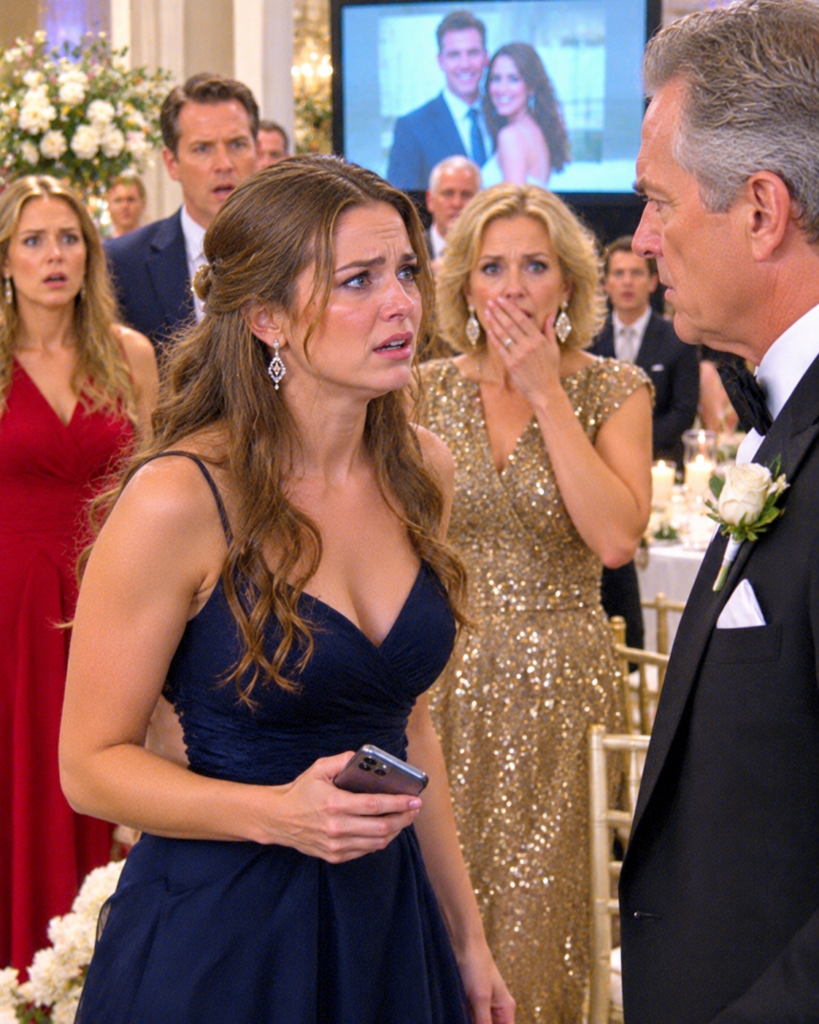
The slideshow began.
Baby pictures. Family vacations. Birthday parties. School events.
Every memory featured Belle.
Not a single image included me.
Then the music changed.
Playful. Mocking.
The screen displayed new words.
“Let’s meet the rest of the family.”
My heart slowed.
Everything became strangely calm.
Under the table, my phone was already in my hand.
The message remained open.
One word.
Begin.
I made myself a promise.
One last chance.
If they showed even a little kindness, I wouldn’t send it.
The first slide appeared.
My face.
An old high school photo.
Across it:
Dropout.
Laughter spread through the room.
Second slide.
Divorced.
More laughter.
Third slide.
Broke.
People chuckled openly now.
Fourth slide.
Alone.
I saw Belle grinning.
Then came the last slide.
A cartoon baby.
A giant red X.
One word.
Infertile.
The room went silent.
Not completely.
Some people still laughed, but many looked uncomfortable.
They knew this was wrong.
Then Belle leaned into her microphone.
“Don’t laugh too hard.”
She giggled.
“She might cry.”
My father lifted his glass.
“Just a joke, sweetheart.”
My mother smiled.
I looked around the room.
Two hundred people.
Watching. Judging. Laughing.
My private grief was now public entertainment.
That was enough.
I pressed send.
Three seconds passed.
The slideshow froze.
The screen turned black.
Belle frowned.
“What happened?”
Nolan calmly switched USB drives.
The screen lit up again.
A title appeared.
The Real Cassandra Hayes.
The room became completely silent.
My father stood immediately.
“What is this?”
Nobody answered.
First slide.
My graduation photo.
“No one came to my graduation. I went anyway.”
Whispers spread.
Second slide.
Licensed architect.
Third slide.
Senior architect.
Fourth slide.
Virginia Emerging Architect of the Year.
People turned toward me.
One table after another.
Faces changing. Expressions shifting.
The story they believed was falling apart.
The final slide appeared.
“You called me a dropout. I earned a master’s degree.
You called me broke. I own my home.
You called me a failure. I build things that last.”
I slowly stood.
My father looked furious.
“Turn it off.”
Nobody moved.
The final quote appeared.
“The measure of a family is not how they celebrate their strongest. It is how they treat their most vulnerable.”
Silence.
Pure silence.
Then my father began walking toward me.
Fast.
Angry.
When he reached my table, he lowered his voice.
“Sit down.”
I didn’t move.
His eyes narrowed.
“Do it.”
Still nothing.
Then came the threat.
“If you don’t stop this, you’ll never see your grandmother again.”
The old weapon.
The same one he always used.
But this time, it didn’t work.
I looked directly into his eyes.
“You don’t get to use Grandma Evelyn anymore.”
For the first time, I saw fear.
Then Ashton stood.
“Wait.”
Everyone turned.
He looked at me.
Then at Victor.
“Let her speak.”
Belle grabbed his arm.
“Ashton.”
He gently pulled away.
“I want to hear this.”
The room shifted.
The balance of power changed.
My mother stood.
“Cassandra, please.”
I faced her.
“For the first time in my life, I’m not the one embarrassing this family.”
Then I stepped forward into the center of the room.
Every eye followed me.
I didn’t need a microphone.
The room was quiet enough.
“I didn’t drop out.”
Nobody spoke.
“My father cut off my tuition because I refused to give him land that belonged to me.”
Gasps.
“I left home with $43.”
More silence.
“I worked. I studied. I built a career.”
I looked toward Belle.
“My divorce wasn’t failure.”
Then I looked directly at the giant screen.
“And infertility is not a joke.”
Belle’s face turned pale.
“You put my medical condition on a screen for 200 people.”
Nobody laughed now.
Not one person.
Then Genevieve Whitaker stood.
She walked calmly across the ballroom.
Every person watched.
She stopped in front of me.
“T. Hayes?”
I nodded.
“You’re the architect working on our heritage project.”
“Yes.”
She turned toward my father.
The look in her eyes was ice cold.
“The woman you humiliated tonight is the architect my foundation hired.”
My father’s face drained of color.
“I didn’t know.”
Genevieve didn’t blink.
“Exactly.”
A wave of whispers swept through the room.
“You didn’t know your own daughter.”
Belle rushed forward.
“She’s lying.”
Genevieve simply pointed at the screen.
“Am I looking at lies?”
No answer.
My mother tried next.
“This is a family matter.”
Genevieve’s voice sharpened.
“You made it public the moment you projected it onto a ten-foot screen.”
The room exploded with murmurs.
Then my father tried one final move.
“The Oakidge partnership—”
“There is no partnership.”
Genevieve cut him off.
The room froze.
“What?”
Her expression never changed.
“After what I witnessed tonight, there will be no partnership.”
My father looked stunned.
My mother looked ready to collapse.
Then I remembered the deed.
Slowly, I removed it from my purse.
“The land for Oakidge isn’t yours anyway.”
The room turned toward me.
I held up the document.
“The center parcel belongs to me.”
Genevieve’s eyes widened.
“So you misrepresented ownership?”
My father said nothing.
For the first time in his life, he had no answer.
Conrad Whitaker stood, buttoned his jacket, and walked toward the exit.
Genevieve followed.
“Ashton.”
Her voice was firm.
“We’re leaving.”
Ashton nodded.
Then he looked at Belle.
Not with anger.
With disappointment.
That hurt more.
The room began emptying.
Guests stood, collected coats, and left quietly.
Nobody wanted to stay.
Not after seeing the truth.
My mother finally broke.
Tears streamed down her face.
“You think you’re better than us?”
“No.”
I shook my head.
“I just stopped believing I was worse.”
She had no response.
One by one, people walked out.
The illusion was over.
Sixteen years of pretending had ended.
I looked at my family.
My father.
My mother.
My sister.
And I spoke one final time.
“I didn’t come here to destroy your wedding.”
I looked at Belle.
“I came because Grandma Evelyn asked me to.”
Tears rolled down her cheeks.
“I don’t hate any of you.”
Then I looked at my father.
“But I am done being your punching bag.”
Silence.
“If you want a relationship with me, it starts with respect.”
Nobody spoke.
I picked up my purse.
“And if you can’t do that…”
I took a breath.
“This is goodbye.”
Then I walked away.
Toward the exit.
Toward freedom.
Toward a life I built myself.
Before I reached the door, Genevieve stopped me.
“Monday morning.”
I looked at her.
“Our office.”
She smiled slightly.
“We have a project to finish.”
I nodded.
Outside, the night air felt cool and clean.
Nolan waited beside my car holding two coffees.
“You okay?”
I laughed softly.
“No.”
Then I looked back at the building.
“But I’m better than I’ve been in years.”
My phone buzzed.
A message from Carmen.
“Your grandmother watched everything online. She’s laughing. She says, ‘That’s my girl.’”
Tears filled my eyes.
For the first time all night, they were happy tears.
Three weeks later, life kept moving.
The Whitakers canceled the deal. My father’s reputation cracked. My mother’s social circle disappeared.
Belle and Ashton entered counseling.
But the biggest change happened inside me.
I stopped asking for permission to exist.
I visited Grandma Evelyn whenever I wanted.
No conditions. No supervision. No threats.
Just love.
Months later, I stood inside the historic textile mill I was restoring.
Sunlight poured through old windows. Workers moved around me.
The future was taking shape.
Brick by brick.
Beam by beam.
Just like my life.
People once called me divorced, failure, dropout, broke, alone.
Some of those things were true at different moments.
But none of them defined me.
What defined me was getting back up again and again and finally understanding something important.
You don’t need your family’s permission to build a beautiful life.
You only need the courage to stop asking for it.
And that was the day I finally walked away from table 14 forever.
Thank you for listening. If this story touched you, don’t forget to like, subscribe, and share where you’re watching from.
View more
At my sister’s wedding, my parents locked me in the bathroom and wrote in the family group chat: “that’s where you belong, out here is only for real family,” i smirked, made one phone call—thirty minutes later, ten limousines pulled up to the venue, the room froze
06/09/2026
At my wedding, my mom announced: “i want everyone to know my daughter trapped this man, she’s been lying about who she is,” 200 guests went silent, my sister recorded it, then my husband walked to the podium, pulled out his phone, and said: “actually, i have something about your family,” what he showed them made 6 people leave in tears
06/09/2026
After my parents’ funeral, my sister took the house and handed me a $500 card my parents left behind like some kind of “charity”—then kicked me out because i was adopted, i felt humiliated, so i threw it away and didn’t touch it for 5 years, when i went to the bank to cancel it… employee said 1 sentence that left me shocked
06/09/2026
Your support means more than you know.
Disclaimer: This story is fictional and created for entertainment purposes only.
Any names, characters, places, or events are fictitious or used fictitiously.
No real person or organization is intended to be portrayed.