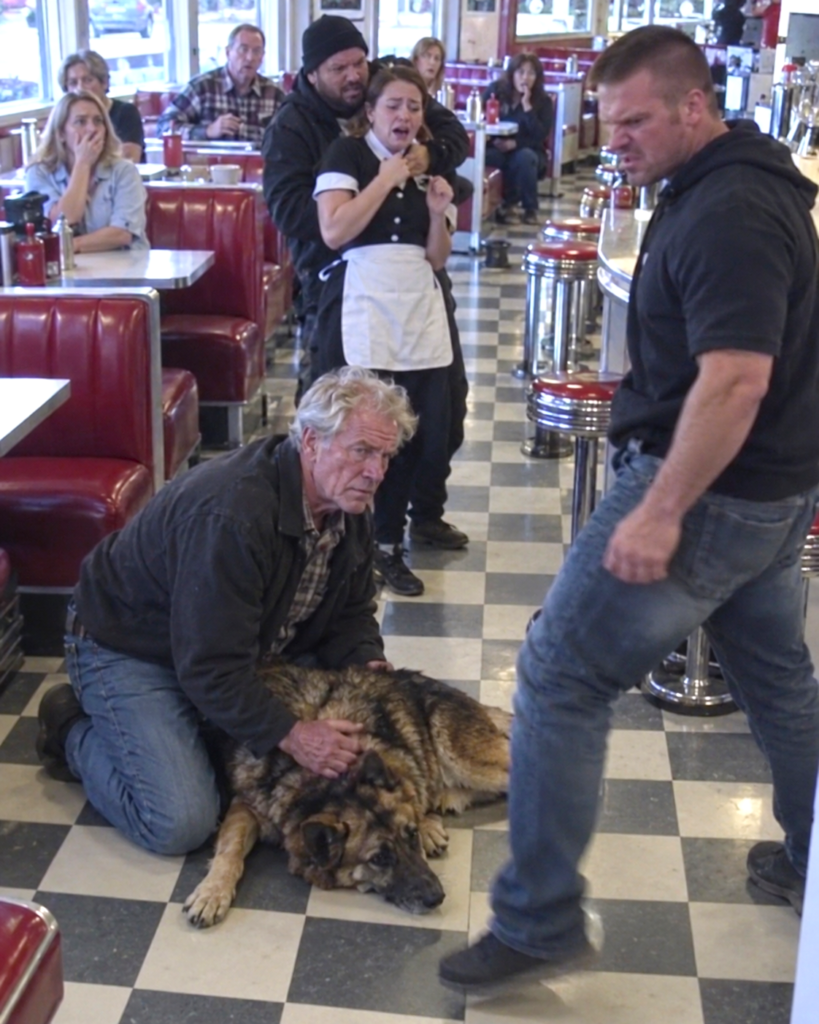
The German Shepherd hit the floor so hard that every coffee cup in the diner seemed to stop rattling at once.
For half a second, nobody moved.
Then Ranger made a sound I had never heard from him before.
It wasn’t a bark.
It wasn’t a growl.
It was a short, broken cry—the sound of an animal that had spent his entire life trusting me to keep the world predictable and had just discovered that a stranger could hurt him for amusement.
“Ranger!”
I was out of the booth before I realized I had moved.
The young man who had kicked him turned toward me with a grin still hanging on his face.
“Relax, Grandpa. Your mutt got in my way.”
Outside, spring rain hammered the windows of the Crossroads Diner west of Fort Worth. Lightning flickered beyond the parking lot, turning the eighteen-wheelers outside into black silhouettes against the storm.
Inside, nobody was thinking about the weather anymore.
There were six customers, one waitress, three young men blocking the exit, my dog struggling to breathe beside a chrome stool, and me.
My name is Ethan Walker.
I was fifty-seven years old that night.
Gray at the temples.
A little slower getting out of bed than I used to be.
Divorced.
Retired.
I lived alone on fourteen acres outside Weatherford, Texas, where I repaired old motorcycles mostly because machines made more sense to me than people did.
Most nights, I was exactly what I looked like.
An aging man drinking black coffee alone in a roadside diner.
That was all I wanted to be.
The young man who had kicked Ranger was named Cody Vance, though I didn’t know that yet. He was twenty-three, lean, athletic, and proud of the fact that everyone in the diner had flinched when he moved.
His friend Brock Mercer was bigger.
Much bigger.
Six-foot-three, heavily muscled, cauliflower ears, tattooed forearms, black compression shirt stretched across his shoulders. He had grabbed Hannah Cole, our waitress, by the wrist and dragged her toward the register after announcing that nobody needed to get hurt if everyone cooperated.
The third man, Dylan Ross, had locked the front door and pulled the blinds.
None of them had a firearm.
They didn’t think they needed one.
Brock fought in regional mixed martial arts competitions.
Cody had told us loudly ten minutes earlier that he was a second-degree black belt.
Dylan apparently trained with them.
Three fighters.
Three young men who had spent years learning what frightened ordinary people.
And judging by their smiles, they enjoyed the discovery.
I had noticed them when they walked in.
Of course I had.
Some habits survive because they become part of your bones.
Cody entered first.
Brock behind him.
Dylan last.
Brock looked at the register before he looked at the menu.
Dylan checked the parking lot twice.
Cody kept studying his reflection in the pie display.
Nothing illegal about any of that.
Nothing worth reacting to.
I had spent seven years learning not to treat every uncomfortable feeling like a warning siren.
So I drank my coffee.
Ranger lay beneath the table with his chin resting on my boot.
Hannah refilled my mug.
“Pie tonight, Ethan?”
“Trying to quit.”
“You’ve been trying to quit pecan pie for three years.”
“I respect consistency.”
She smiled.
Hannah was thirty-two and had been working evenings at Crossroads since before I first wandered in. She knew I hated small talk but didn’t take it personally. She knew Ranger could have a strip of bacon if the cook burned one. She knew I tipped too much.
What she didn’t know was why I always sat where I could see the entrance, kitchen, and parking lot.
She had asked once.
I told her I liked the view.
There wasn’t much of a view.
Twenty minutes after Brock and his friends entered, he stood from their booth and walked behind the counter.
Hannah told him customers weren’t allowed back there.
He smiled.
Then he grabbed her wrist.
“Open the register.”
The room changed instantly.
The truck driver in the booth nearest the restroom froze with his fork halfway to his mouth.
An older couple near the jukebox stared at each other.
A college-aged kid lowered his phone.
Nobody screamed.
Fear often arrives quietly.
Hannah tried to pull away.
Brock tightened his grip.
“I said open it.”
She looked toward the front door.
Dylan was already there.
He turned the deadbolt.
Cody laughed.
“Nobody do anything stupid.”
I stayed seated.
Not because I was afraid.
Not because I didn’t care.
Because violence is a door.
Once you open it, you don’t control everything that comes through.
I had opened that door more times than I could count.
I had spent the last seven years trying to keep it closed.
“Take the money,” I told Hannah.
Brock glanced at me.
“Smart old man.”
I ignored him.
Hannah punched the register code with a trembling finger.
The drawer opened.
Maybe that would have been the end of it.
Maybe they would have taken the cash and left.
I still think about that possibility.
Because Ranger was thirteen years old.
His hips were getting stiff.
His muzzle had turned gray.
He wasn’t a police dog.
He wasn’t an attack dog.
He was simply mine.
But Ranger had one habit he had never lost.
He hated hearing a woman cry.
Hannah made a frightened sound when Brock twisted her wrist.
Ranger lifted his head.
I felt him tense beneath the table.
“Stay,” I whispered.
He looked at me.
Then Hannah gasped again.
Ranger stood.
Slowly.
No barking.
No lunging.
He walked from beneath the table and moved toward the counter.
“Cody,” Brock said.
That was all.
Cody stepped forward.
Ranger stopped between him and Hannah.
His ears were forward, but his mouth was closed.
“He doesn’t bite,” I said.
Cody looked down.
“Move your dog.”
“Ranger.”
The old shepherd turned his head toward me.
He was coming back.
I know he was.
Then Cody kicked him.
Hard.
Ranger’s body lifted from the tile.
He struck the floor on his side.
Hannah screamed.
Something inside me went silent.
Not loud.
Silent.
That frightened me more.
“Ranger!”
I reached him and crouched.
His breath came shallow.
One back leg trembled.
His eyes found mine.
His tail moved once.
Barely.
That tiny movement reached somewhere in me that I’d spent years trying not to visit.
Ranger had been there when my marriage ended.
He had been there when I stopped answering friends.
He had been there when I woke at three in the morning with my heart trying to beat through my ribs.
He had been there the night I sat at my kitchen table with an unopened bottle of whiskey and watched sunrise slowly turn the windows gray.
I hadn’t spoken for hours.
Ranger had rested his head on my boot.
He stayed there until morning.
He didn’t know what memories were.
He didn’t know why certain sounds made me stop breathing.
He didn’t care what I’d done before he came into my life.
He simply stayed.
Now he was hurting because he had tried to protect a frightened woman.
And Cody was smiling.
“Dog tried to bite me.”
“He never touched you,” Hannah snapped.
Brock squeezed her wrist.
“Nobody asked you.”
I stood.
Slowly.
That was the first thing Cody should have noticed.
Not the scar below my left ear.
Not my age.
Not the faded denim jacket.
My hands.
They weren’t shaking.
“Take your hand off her,” I said.
Brock laughed.
“Or what?”
I looked at Hannah’s wrist.
Dylan at the door.
Cody three steps away.
The wet tile near the entrance.
The narrow aisle between the booths.
Ranger on the floor.
The kitchen.
The distance between all three men.
Angles.
Movement.
People.
Obstacles.
The calculations arrived automatically.
I hated them for still being there.
I hated myself for understanding them.
Cody bounced lightly on the balls of his feet.
“You deaf, old man?”
“No.”
“Then sit down.”
I crouched again and pressed two fingers gently against Ranger’s neck.
His pulse was fast.
“Easy, buddy.”
His eyes stayed on mine.
I stood.
“Last chance.”
Cody smiled.
“You threatening me?”
“I’m giving you a way out.”
Brock finally released Hannah and stepped around the counter.
“That’s funny.”
He rolled his neck.
Dylan moved away from the door.
Three against one.
Young against old.
Trained fighters against an aging mechanic.
That was what they saw.
Cody came closer.
“You know who you’re talking to?”
“No.”
“I’m a second-degree black belt.”
“Congratulations.”
His expression changed.
“Three amateur titles. Twenty-eight wins.”
I looked at him.
“Congratulations.”
He stepped closer until I could smell energy drink on his breath.
“You think you’re tough?”
“No.”
“Then what exactly do you think is about to happen?”
I looked once at Ranger.
Then back at Cody.
“I’m going to pick up my dog.”
I paused.
“And you’re going to move.”
“No.”
Thunder shook the windows.
“Then you’re about to learn the difference between fighting because somebody rings a bell…”
His eyes narrowed.
“…and fighting because nobody is coming to save you.”
Cody threw the first punch.
Three seconds later, everyone in the Crossroads Diner understood that the quiet old man in the corner booth had never been helpless.
But nobody in that room understood yet what I really was.
And the worst part was that I wasn’t sure I wanted them to.
Cody was fast.
I’ll give him that.
Young men like him often believed speed was the same thing as control.
It isn’t.
His punch came toward my face.
I moved.
Not dramatically.
Not the way fights look in movies.
There was no spinning kick, no shout, no pose.
One moment Cody was attacking.
The next he was stumbling sideways into the edge of a booth, shocked more than hurt.
His face said everything.
That wasn’t supposed to happen.
Brock stopped smiling.
Dylan stared.
I pointed toward the front door.
“Unlock it.”
Nobody moved.
“I’m not asking again.”
Cody pushed himself upright.
His cheeks had gone red.
Humiliation is dangerous in men who confuse respect with fear.
“You got lucky.”
I had heard those words before.
Different countries.
Different languages.
Same mistake.
“Walk away,” I said.
He charged again.
I shifted aside.
He went past me.
Momentum carried him into a table.
Coffee cups shattered.
The older woman near the jukebox screamed and ducked behind her husband.
“Cody!” Brock shouted.
That was when Dylan moved.
From my left.
Brock from the front.
The room narrowed.
Not visually.
Mentally.
People think experience makes a dangerous situation feel slower.
It doesn’t.
It makes irrelevant things disappear.
The storm vanished.
The lights vanished.
The customers became positions I had to protect.
Ranger became a location I could not allow anyone near.
Hannah became the person closest to the kitchen exit.
Everything else fell away.
Dylan reached me first.
I stopped him hard enough that he folded against the counter.
Brock grabbed for me.
He was powerful.
Stronger than I was now.
Maybe stronger than I had ever been.
He shoved me backward into a booth.
Pain flashed along my spine.
At fifty-seven, you learn something twenty-five-year-olds never consider.
You can still do many of the things you did when you were young.
Your body just sends the invoice faster.
Brock swung.
I ducked.
His fist struck the wall panel hard enough to crack it.
“You think you’re some badass?” he snarled.
“No.”
I meant it.
I wasn’t enjoying this.
That was another difference between us.
He was trying to prove something.
I was trying to end something.
Cody came from behind.
A warning shout came from Hannah.
“Ethan!”
I turned enough to avoid the worst of the impact, but Cody’s foot caught my shoulder.
Pain exploded down my arm.
I hit the table.
Ranger tried to stand.
“Stay!”
The command came out sharper than I intended.
Ranger froze.
His eyes never left me.
Brock laughed.
“There we go.”
He approached.
“This is what happens when old men try to be heroes.”
I pushed myself upright.
“I’m not a hero.”
He cracked his knuckles.
“No?”
“No.”
I looked at Ranger.
“I’m his person.”
Something about that answer irritated him.
Brock rushed me.
The next few seconds became noise and movement.
A chair overturned.
A plate shattered.
Dylan tried to join the fight and collided with the end of the counter.
Cody came in again, furious and reckless.
I kept moving.
No wasted motion.
No spectacle.
Just survival.
When Cody found himself on the floor a second time, the arrogance had finally left his face.
He looked confused.
“You…”
He swallowed.
“What are you?”
That question nearly stopped me.
Not who.
What.
For years, I had asked myself the same thing.
Brock didn’t give me time to answer.
He grabbed a chrome napkin dispenser from the counter and raised it.
Hannah shouted.
“Don’t!”
I stepped inside his swing.
The dispenser flew across the diner.
Brock crashed against the counter.
He slid down it slowly.
For the first time since the robbery began, nobody moved.
Only the storm made noise.
Rain.
Thunder.
The electric hum of the fluorescent lights.
Dylan was leaning against the counter, one hand pressed against his ribs.
Cody sat on the floor.
Brock was trying to understand how his night had gone wrong.
I looked at each of them.
“Unlock the door.”
Dylan hesitated.
I turned my eyes toward him.
He moved immediately.
The deadbolt clicked.
Hannah hurried around the counter and helped the older couple toward the exit.
“Go,” I told everyone. “Parking lot. Stay together.”
The truck driver didn’t move.
He stared at me.
“Mister, you need help?”
“No.”
His eyes went toward the three men.
“You sure?”
“No.”
That made him blink.
Then he nodded and left.
Hannah remained.
“Hannah.”
“I’m not leaving Ranger.”
For the first time that night, something almost like a smile reached me.
“Fair enough.”
Cody pushed himself upright.
Apparently humiliation had more control over him than common sense.
“You think this is over?”
I stared at him.
“It can be.”
“You don’t know who you’re messing with.”
I sighed.
People always think that sentence matters.
Brock wiped blood from the corner of his mouth.
“We’re gonna destroy you.”
“No.”
“Police show up, three athletes tell them an old guy attacked us?”
He grinned despite the pain.
“Who do you think they’re believing?”
Hannah stared at him.
“You robbed us!”
Brock pointed at her.
“Shut up.”
My eyes followed his finger.
“Don’t.”
He lowered his hand.
Maybe there was something in my voice.
Maybe he finally understood.
I was tired.
Not physically.
Older than that.
Tired of rooms where fear decided who got to speak.
Tired of men who hurt weaker things because they believed nobody would stop them.
Tired of knowing exactly how violence worked.
But Brock wasn’t finished.
He glanced at Dylan.
Then Cody.
Something passed among them.
I saw it.
So did Ranger.
The dog’s head lifted.
“Brock,” Cody said quietly.
Brock lunged toward the counter.
Not toward me.
Toward Hannah.
His arm wrapped around her shoulders.
She screamed.
Everything changed.
“Back off!” Brock shouted.
I stopped.
He pulled Hannah against his chest.
One forearm across her collarbone.
Dylan moved toward me again.
Cody staggered upright.
Brock smiled.
There it was.
The real man beneath the fighter.
Not brave.
Not disciplined.
Afraid.
And willing to hurt someone else rather than face what he had started.
“You touch me again,” he said, “she gets hurt.”
Hannah’s eyes found mine.
Terrified.
I kept my hands where he could see them.
“Let her go.”
“Get on your knees.”
I said nothing.
“Do it!”
My eyes shifted.
Barely.
Hannah noticed.
She didn’t know what I wanted.
Neither did I, exactly.
Then Ranger moved.
The old German Shepherd dragged himself to his feet.
His legs shook.
“Ranger,” I whispered.
Brock looked down.
That fraction of distraction was enough.
Hannah drove her heel backward and twisted away.
I moved.
Brock hit the counter.
Hannah stumbled free.
Cody tried to intervene.
He didn’t reach me.
Dylan took one look at what was happening and backed toward the door.
“Enough!” I shouted.
Not because I was losing control.
Because I was afraid I wouldn’t.
The word filled the diner.
Everyone froze.
Even me.
Brock lay against the cabinets behind the counter.
Cody was on his knees.
Dylan’s hand hovered near the door.
I was breathing hard now.
My shoulder hurt.
My back hurt.
My right hand had started trembling.
Not fear.
Memory.
The old physical echo I hated most.
Hannah stared at my hand.
“Ethan?”
“I’m fine.”
I wasn’t.
A sound reached us through the storm.
Sirens.
Far away.
Coming closer.
Brock’s face changed.
Hannah exhaled.
“I hit the silent alarm when they first came behind the counter,” she said.
Brock looked at her with disbelief.
“You—”
“I told you to take the money and leave.”
Red and blue light began flickering through the blinds.
Dylan immediately raised both hands.
Cody followed.
Brock didn’t.
He stared at me.
“You planned this.”
“No.”
“You knew the cops were coming.”
“No.”
“Then why’d you fight us?”
I looked down at Ranger.
He was still standing.
Barely.
“Because you kicked my dog.”
Brock laughed once.
A bitter, unbelieving sound.
Then his eyes fell on my left forearm.
My jacket sleeve had pulled back during the fight.
Under the fluorescent light, an old tattoo was visible.
Faded.
Simple.
Something I almost never thought about anymore.
Brock’s laughter stopped.
His face changed.
He knew enough to recognize it.
“Wait.”
I pulled my sleeve down.
Too late.
“What?” Cody asked.
Brock kept staring at me.
“What are you?”
I heard car doors slam outside.
Boots splashed through rain.
Someone shouted for everyone inside to put their hands where officers could see them.
I looked at Brock.
“My name is Ethan Walker.”
He shook his head.
“No. I mean what were you?”
The front door opened.
Police flooded the diner.
I raised my hands.
For a moment, the room became another room from another life.
Men shouting.
Hands visible.
Bright lights.
My pulse hammering.
And Ranger struggling to stand beside me.
Then Hannah grabbed the sleeve of the first deputy inside.
“They were robbing us,” she said. “Those three. Ethan stopped them. Please—his dog is hurt.”
The deputy looked from Brock to Cody to Dylan.
Then to me.
Then to Ranger.
“Sir, are you injured?”
“Dog first.”
“We’ve got EMS—”
“Dog first.”
The deputy stared at me for a second.
Then nodded.
“I’ll get somebody.”
As he turned, another officer entered.
Older than the others.
Broad shoulders under a rain-dark uniform.
His eyes moved across the destruction.
Broken plates.
Overturned chairs.
Three trained fighters.
Me.
Then his face went completely still.
“Walker?”
I looked at him.
It took me a moment.
“Tom Reyes.”
The deputy nearest us frowned.
“You know him, Sheriff?”
Tom didn’t answer immediately.
He kept staring at me as if a ghost had walked into his diner.
Finally, he looked toward Brock.
Then Cody.
Then Dylan.
“You three picked the wrong man.”
Cody swallowed.
“Who is he?”
Tom’s eyes came back to me.
I already knew what he was about to say.
I didn’t want him to say it.
Not here.
Not in front of Hannah.
Not while Ranger lay hurt beside me.
But Tom Reyes had known me before the quiet diner booth.
Before the motorcycles.
Before the gray hair.
He knew the version of me I had spent years trying to bury.
“Ethan Walker,” he said slowly, “served twenty-two years in Naval Special Warfare.”
The diner went silent.
Tom’s next words landed harder.
“Retired Navy SEAL.”
Nobody spoke.
Cody stared at me.
Dylan lowered his eyes.
Even Brock seemed to shrink.
I didn’t feel victorious.
I felt exhausted.
Then Ranger’s front legs buckled.
I dropped beside him.
And suddenly none of the men, the robbery, the sirens, or my old life mattered.
“Ranger?”
His eyes opened.
But he didn’t get back up.
I rode in the back of Tom Reyes’s patrol SUV with Ranger’s head in my lap.
The emergency veterinary clinic was seventeen minutes away.
Tom made it in eleven.
I remember every red light.
Every turn.
Every shallow breath Ranger took.
“Stay with me, buddy.”
His eyes opened when I spoke.
Then closed again.
My hands wouldn’t stop shaking.
Tom glanced at me through the rearview mirror.
“You okay?”
“Drive.”
“Ethan—”
“Drive.”
He did.
At the clinic, two technicians rushed out with a stretcher.
I walked beside them until a veterinarian stopped me at a set of double doors.
“We’ve got him.”
“I’m coming.”
“You can’t.”
“He’s afraid of strangers.”
The veterinarian looked through the doors at Ranger.
The old dog was too exhausted to be afraid of anything.
Her voice softened.
“We’ve got him.”
I stood there with my hands hanging uselessly at my sides.
That feeling was worse than the fight.
Waiting.
Waiting has always been harder for me than action.
Action gives your body a job.
Waiting leaves you alone with your head.
Tom found me thirty minutes later sitting in a plastic chair beneath a framed poster about canine arthritis.
He handed me coffee.
I didn’t take it.
“You still drink it black?”
I looked at him.
“You remember that?”
“You threatened to throw me off a ship once because I put powdered creamer in yours.”
“I didn’t threaten you.”
“You absolutely did.”
“That wasn’t me.”
Tom smiled.
For a few seconds we were younger.
Then the smile faded.
He sat beside me.
Tom and I had met more than twenty-five years earlier.
He wasn’t a SEAL.
He had been Navy security support assigned alongside our people during one deployment before eventually leaving the service and returning to Texas.
We hadn’t spoken in six years.
Not because of a fight.
Because I had become very good at disappearing.
He looked at my bruised knuckles.
“Three guys?”
I stared at the floor.
“Three idiots.”
“Hannah said they were trained fighters.”
“So?”
Tom gave me a sideways look.
“You’re fifty-seven.”
“Thank you.”
“I’m serious.”
“So am I.”
He exhaled.
“Still impossible.”
I finally took the coffee.
It tasted terrible.
That helped.
“How are they?”
“All conscious. Nothing life-threatening. Brock Mercer has a busted nose, injured shoulder, bruised ribs. Cody’s got a concussion and enough pride damage to keep him uncomfortable for years. Dylan’s mostly bruised.”
“Good.”
Tom studied me.
“You didn’t go too far.”
I looked at him.
That sentence hit somewhere deeper than he intended.
“Are you asking me?”
“I’m telling you.”
“You weren’t there.”
“We’ve got witness statements. Cameras. Hannah. They initiated everything.”
I said nothing.
He lowered his voice.
“Ethan.”
“I heard you.”
“No, you didn’t.”
I looked over.
“You stopped.”
That word sat between us.
Stopped.
There had been a time when I wasn’t certain I could.
Seven years earlier, after I retired from the Navy, I discovered something nobody had explained to me clearly enough.
You can leave a profession without leaving the person it built.
For twenty-two years, my value had been easy to measure.
Protect the man beside you.
Complete the mission.
Come home if you can.
Then one day people shook my hand, handed me paperwork, and told me to enjoy retirement.
I had fourteen acres.
A workshop.
A marriage that had survived more absences than it should have.
And no idea how to be ordinary.
My wife, Laura, tried.
God knows she tried.
For two years.
She tried when I checked every window three times before bed.
She tried when a dropped pan sent me into a defensive crouch in our kitchen.
She tried when I stopped wanting to attend restaurants unless I could sit facing the door.
She tried when I woke up shouting names of men she had never met.
I never hit her.
Never threatened her.
Never blamed her.
But distance can injure a marriage without raising its voice.
One morning, she packed a suitcase.
She cried when she told me she still loved me.
That somehow made it worse.
“I don’t know how to reach you anymore,” she said.
I didn’t ask her to stay.
Not because I wanted her gone.
Because part of me believed she deserved a life that wasn’t organized around my silence.
A month later, a friend convinced me to visit an animal rescue outside Abilene.
I told him I didn’t want a dog.
Ranger chose differently.
He was six then.
Former working-dog candidate.
Too cautious around unfamiliar handlers.
Too attached once he trusted someone.
The rescue volunteer joked that we had matching personalities.
Ranger walked up to me, sat on my left boot, and refused to move.
I took him home.
Maybe he took me home.
After that, routines became easier.
Morning walks.
Feeding schedule.
Vet appointments.
Someone waiting at the door.
Someone who didn’t need explanations.
Someone who didn’t mistake silence for rejection.
“You disappeared again,” Tom said.
I blinked.
“Sorry.”
“Thinking about Laura?”
I looked at him sharply.
He raised both hands.
“Guess.”
I stared into the coffee.
“Sometimes.”
“You ever talk to her?”
“No.”
“She remarried?”
“I heard she did.”
“You okay with that?”
“She deserved to be happy.”
Tom waited.
I hated people who knew how to wait.
“What?”
“You didn’t answer the question.”
I looked toward the clinic doors.
“I don’t know.”
That was the truth.
A technician came through.
“Mr. Walker?”
I stood so quickly the coffee spilled over my hand.
“How is he?”
“The doctor will explain everything, but Ranger is stable.”
I closed my eyes.
Two seconds.
Maybe three.
Stable.
The best word I had heard in years.
The veterinarian came out shortly afterward.
Ranger had two cracked ribs.
Severe bruising.
No punctured lung.
No internal bleeding.
His hip arthritis had been aggravated by the fall, but there was no fracture.
“He needs rest,” she said. “Pain management. No stairs. Very limited activity.”
“He’ll recover?”
“We expect him to.”
I gripped the edge of the counter.
The veterinarian studied my face.
“He’s tough.”
“Yeah.”
She smiled.
“He also tried to stand as soon as he heard your voice outside.”
My throat closed.
“Can I see him?”
A few minutes later, I sat beside Ranger on a padded floor in a recovery room.
He looked offended by the IV line.
“Hey.”
His eyes opened.
His tail thumped once.
I leaned forward and pressed my forehead gently against his.
“I’m sorry.”
His ears moved.
“I should’ve stopped it.”
That was irrational.
I knew that.
Still said it.
“You protected Hannah.”
His eyes stayed on me.
“Stubborn old fool.”
His tail moved again.
Tom stood in the doorway.
“Talking to yourself?”
“Get out.”
“That’s more like the Ethan I remember.”
Ranger looked toward him.
Tom crouched carefully.
“Hey, partner.”
Ranger sniffed his hand.
“Your human always this friendly?”
Ranger closed his eyes.
“Exactly.”
Tom stood.
“I need a formal statement.”
“Tomorrow.”
“Fine.”
He hesitated.
“There’s something else.”
I looked up.
“Brock’s already talking.”
“About?”
“You.”
My stomach tightened.
“What about me?”
“He recognized your tattoo. Heard what I said. Apparently he’s telling anybody who’ll listen that he got attacked by a Navy SEAL.”
“He robbed a diner.”
“I know.”
“He assaulted Hannah.”
“I know.”
“He kicked Ranger.”
“I know.”
“So what’s the problem?”
Tom leaned against the doorframe.
“The problem is people are going to hear ‘retired Navy SEAL beats up three martial artists,’ and half of them are going to turn it into some ridiculous legend before breakfast.”
I looked at Ranger.
“I don’t care.”
“I know you don’t.”
“Then why tell me?”
“Because Hannah cares.”
I looked up.
“What?”
“She asked me to make sure people know why you stepped in.”
“Why?”
“Because Brock is already trying to make himself the victim.”
That sounded exactly like him.
Tom continued.
“The cameras inside the diner recorded most of it.”
“Good.”
“Very good.”
He paused.
“Especially the part where Cody kicked Ranger.”
My hand closed around the edge of Ranger’s blanket.
Tom noticed.
“Easy.”
“I’m fine.”
“No. You’re controlled. That’s not always the same thing.”
I looked at him.
That was something I would have said twenty years ago.
Maybe he remembered.
“Get some sleep,” Tom said.
“I’ll call in the morning.”
He turned.
“Tom.”
He looked back.
“Thanks.”
He nodded once.
“Anytime.”
After he left, I stayed with Ranger until nearly dawn.
At 4:17 a.m., I finally checked my phone.
Thirty-eight missed notifications.
Two voicemails.
Seven texts from numbers I didn’t recognize.
One from Hannah.
Ranger okay?
I typed back.
Stable. Cracked ribs. He’ll recover.
Her answer came instantly.
Thank God.
Then another message.
I’m sorry.
I stared at it.
For what?
If he hadn’t tried to protect me—
I typed three words.
Not your fault.
Then deleted them.
Because they sounded too simple.
Instead I wrote:
Ranger made his own choice. He likes you.
Three dots appeared.
Disappeared.
Appeared again.
Her reply finally came.
Tell him I owe him bacon for life.
For the first time since the kick, I smiled.
Then another notification appeared.
This one was a link.
A local social media page.
The headline was already spreading.
THREE MMA FIGHTERS HOSPITALIZED AFTER ATTACK BY “RETIRED NAVY SEAL” AT ROADSIDE DINER.
I stared at the words.
Attack.
By me.
No robbery in the headline.
No Hannah.
No Ranger.
No context.
Just violence.
Just the old story.
The version of me the world found easiest to understand.
My phone rang.
Unknown number.
I almost ignored it.
Then I answered.
“Ethan Walker?”
“Who’s asking?”
A man’s voice.
“Mr. Walker, I’m calling about the incident at Crossroads. Brock Mercer claims you escalated a misunderstanding and used excessive force after he attempted to de-escalate—”
I hung up.
Ranger opened one eye.
“Yeah,” I told him.
“That’s what I thought too.”
I put the phone down.
But another message arrived.
And another.
By sunrise, strangers had started arguing about me.
Hero.
Psycho.
War veteran.
Dangerous old man.
Legend.
Criminal.
Nobody knew me.
That had never bothered me before.
Then I read one comment.
If he’s such a hero, why did he let his dog get hurt first?
I looked at Ranger.
Something inside me cracked.
Not anger.
Guilt.
And for the first time since the diner, I wondered whether stopping those three men had actually been the easy part.
Ranger came home two days later wearing a support wrap and carrying a pharmacy bag that cost more than half the motorcycles I had owned in my twenties.
I built a temporary ramp over the porch steps.
He refused to use it.
I stood at the bottom.
He stood at the top.
We stared at each other.
“You’re thirteen.”
Ranger blinked.
“You have two cracked ribs.”
He looked away.
“Doctor’s orders.”
Nothing.
I pointed at the ramp.
“Use it.”
He took one careful step toward the stairs.
“Ranger.”
He stopped.
Then, with the theatrical suffering only old dogs can manage, he turned and slowly walked down the ramp.
“Thank you.”
He sneezed at me.
Life began pretending to become normal again.
I made coffee.
Worked in the shop.
Changed Ranger’s compress.
Ignored my phone.
Failed to ignore my phone.
The story had spread.
A customer at the diner had filmed part of the confrontation from beneath a table. The clip was shaky and incomplete, but it showed enough to make people curious.
Cody’s kick.
Me standing.
The beginning of the fight.
Then chaos.
One version had millions of views by the weekend.
I hated everything about it.
People slowed down outside my property.
Two reporters left business cards in my mailbox.
A man I didn’t know drove up my gravel road and asked whether I taught “SEAL fighting.”
I told him no.
He offered cash.
I told him to leave.
He asked whether I could teach his teenage son.
Ranger growled from the porch.
The man left.
On Monday morning, Tom called.
“Come to the station.”
“Why?”
“Because I asked nicely.”
“No.”
“Because the county attorney wants to close the loop on your statement.”
“I gave a statement.”
“Come in.”
I looked at Ranger.
He was asleep beside the workbench.
“Can I bring my dog?”
There was a pause.
“Would anything I say stop you?”
“No.”
“Then apparently yes.”
The station was small.
Ranger became the most popular visitor in the building within three minutes.
A dispatcher brought him a bowl of water.
One deputy crouched beside him and whispered, “Who’s a good boy?”
Ranger ignored him.
“He only responds to compliments from people he respects,” I said.
The deputy looked wounded.
Tom laughed from the hall.
“Still mean.”
He led me into an interview room.
Hannah was already there.
She stood immediately.
“Ranger.”
The dog limped toward her.
She dropped to her knees.
“Oh, baby.”
Ranger leaned his head against her chest.
I looked away.
Something about the sight made my throat tighten.
Hannah carefully scratched behind his ears.
“I brought you bacon.”
“Of course you did.”
She glanced up.
“You said bacon for life.”
“That was not legally binding.”
“Ranger thinks it was.”
Ranger looked at me.
“Traitor.”
Tom entered carrying a laptop.
“Ready?”
“For what?”
“The security footage.”
I sat.
Hannah took the chair beside me.
Ranger lay across both our shoes.
Tom pressed play.
I had not seen the footage.
I didn’t want to.
The camera above the register had captured almost everything.
Brock grabbing Hannah.
Dylan locking the door.
Cody laughing.
Ranger leaving my booth.
Then the kick.
Watching it was worse than remembering it.
In memory, everything moved quickly.
On screen, it was brutally clear.
Ranger wasn’t attacking.
He wasn’t even close enough to Cody to bite him.
He was standing sideways, watching Hannah.
Cody stepped toward him.
Lifted his leg.
Kicked.
Deliberately.
Hannah made a sound beside me.
I stared at the screen.
Tom paused the footage.
“You okay?”
“Keep going.”
“Ethan—”
“Keep going.”
The video resumed.
I watched myself stand.
I looked older than I felt.
Smaller too.
I saw myself crouch beside Ranger.
Saw Cody talking.
Saw Brock release Hannah.
Then the fight.
The camera angle didn’t make it look impressive.
It made it look ugly.
Fast.
Confusing.
Three younger men moving around tables.
Me staying between them and the customers.
Hannah trying to get away.
Ranger on the floor.
Then the moment Brock grabbed Hannah.
Tom slowed the footage.
Brock’s arm went around her.
My entire posture changed.
I saw it.
Hannah saw it.
Tom saw it.
“Pause,” I said.
Tom did.
On the screen, my face looked like someone else’s.
Blank.
Cold.
I knew that face.
I had worn it in places I did not discuss.
Hannah turned toward me.
“What?”
I pointed at the image.
“That.”
“What about it?”
“I hate that.”
She studied the screen.
Then me.
“Why?”
“Because I know that man.”
She waited.
I looked at Ranger.
“I spent years trying not to be him anymore.”
Hannah was quiet.
Finally she said, “That man saved me.”
“No.”
“Yes.”
“I could have lost control.”
“But you didn’t.”
“You don’t know that.”
“I was there.”
Her voice sharpened.
“So was I.”
I looked at her.
“You stopped every time somebody was no longer a threat. You told us to leave. You gave them chances. You kept checking Ranger. You didn’t chase Dylan when he backed away.”
She pointed toward the screen.
“Brock grabbed me, Ethan. Not you.”
I said nothing.
“He made that choice.”
Tom leaned back against the wall.
“I’ve been telling him the same thing.”
“I didn’t ask either of you.”
“No,” Hannah said. “Apparently nobody has told you anything useful in years.”
That surprised a laugh out of Tom.
I didn’t laugh.
Hannah wasn’t done.
“You know what I thought when Cody kicked Ranger?”
“What?”
“That we were all in trouble.”
She swallowed.
“Not because of you. Because that dog walked over to help me and I couldn’t protect him.”
She looked down at Ranger.
“So maybe you’re not the only one carrying guilt that doesn’t belong where you’re putting it.”
The room went quiet.
I hated when people said things I couldn’t immediately dismiss.
Tom closed the laptop.
“The county attorney reviewed the footage.”
“And?”
“No charges against you.”
I nodded.
“Brock, Cody, Dylan?”
“Robbery. Unlawful restraint. Assault charges. Animal cruelty count for Cody. Additional charges connected to the hostage situation.”
I looked at him.
“No surprises?”
“No surprises.”
“Good.”
“Brock’s attorney is already pushing the argument that it was an impulsive robbery, nobody had a firearm, and his client panicked.”
“That’s what courts are for.”
Tom nodded.
“You don’t sound happy.”
“I’m not supposed to be happy.”
“They’re facing consequences.”
“Good.”
“Then what do you want?”
I looked down at Ranger.
“I want Tuesday night back.”
Nobody answered.
Because everybody in the room understood.
Justice doesn’t reverse time.
It doesn’t make a dog unhurt.
It doesn’t un-frighten a woman.
It doesn’t put shattered plates back on tables.
It doesn’t return innocence to people who watched three men turn an ordinary diner into a locked room.
Justice matters.
But it isn’t magic.
Hannah reached down and stroked Ranger’s head.
“Crossroads reopens Friday.”
I looked at her.
“Already?”
“New front door. New camera system. Fresh coffee.”
“Same pie?”
“Obviously.”
“Then what’s the point?”
She smiled.
“Come Friday.”
“No.”
“Come Friday.”
“I don’t like crowds.”
“Who said anything about a crowd?”
Tom suddenly became very interested in his paperwork.
I looked between them.
“What did you do?”
“Nothing,” Hannah said too quickly.
“Hannah.”
“Just come have coffee.”
“No reporters.”
“Fine.”
“No speeches.”
“Fine.”
“No weird Navy nonsense.”
Tom coughed into his fist.
I turned.
“Tom.”
“I said nothing.”
I should have known.
Friday evening, Crossroads Diner had thirty-two people inside and another twenty standing beneath the awning.
I nearly turned around.
Hannah saw my truck.
Too late.
She came outside.
“You lied.”
“I strategically omitted.”
“That’s lying with a college education.”
“Come inside.”
Ranger sat in the passenger seat wearing a new blue collar.
He looked at the crowd.
Then at me.
“No.”
He looked toward Hannah.
His tail moved.
“You’re unbelievable.”
Hannah opened his door.
Ranger carefully climbed onto the ramp I’d brought.
People applauded.
I froze.
Ranger didn’t care.
He walked directly inside looking for bacon.
I followed because apparently I no longer controlled my own life.
The diner looked almost the same.
New glass in the front door.
Fresh paint behind the counter.
One repaired booth.
The same jukebox.
The same pie display.
The same fluorescent hum.
But something had changed.
The frightened silence was gone.
The older couple from robbery night sat near the window.
The truck driver was there.
The college kid too.
Two deputies stood near the counter.
Tom leaned against the wall.
Hannah guided me toward my usual booth.
Someone had placed a small brass plaque beside it.
I stared.
ETHAN & RANGER’S BOOTH
I looked at Hannah.
“Absolutely not.”
“It’s already screwed in.”
“Unscrew it.”
“No.”
“Tom.”
He raised his coffee cup.
“Not my jurisdiction.”
I sat.
Ranger lowered himself beside me.
Then a little girl approached.
Maybe eight years old.
Her mother followed nervously.
The girl held something in both hands.
A red rubber dog toy.
“For Ranger.”
I looked at the mother.
She smiled.
“My daughter saw the video.”
The girl crouched.
“Can he have it?”
“He’s old.”
“So is my grandpa.”
Her mother closed her eyes.
“Emily.”
I almost smiled.
“Yes. He can have it.”
The girl placed the toy beside Ranger.
He sniffed it.
Then rested his chin on top.
Emily beamed.
People began talking again.
Coffee poured.
Silverware clinked.
Normal sounds.
Beautiful sounds.
For the first time in a week, my shoulders lowered.
Then the front door opened.
A woman walked in.
I recognized her immediately.
And suddenly every defense I had rebuilt came apart.
Laura.
My ex-wife.
She stood beneath the bell above the door wearing a dark green raincoat.
Her hair was shorter.
There were faint lines around her eyes that hadn’t existed seven years earlier.
She looked older.
So did I.
For several seconds, neither of us moved.
Then Ranger saw her.
The dog stood.
Pain forgotten.
Tail swinging.
Laura covered her mouth.
“Ranger.”
He limped toward her.
She dropped to her knees and wrapped her arms around him.
I couldn’t breathe.
Ranger remembered.
Of course he remembered.
Laura looked over his back at me.
“Hi, Ethan.”
I stood.
“Hi.”
The diner noise faded around us.
I looked at Tom.
He immediately looked away.
Coward.
Laura stood slowly.
“I saw the story.”
I nodded.
“And Tom called.”
My eyes cut toward him again.
Tom suddenly became fascinated by the pie menu.
Laura smiled faintly.
“Some things never change.”
“Some do.”
Her expression softened.
“Yeah.”
I looked at her left hand.
Wedding ring.
The ache came.
But it was quieter than I expected.
“How’s your husband?”
“Michael’s good.”
I nodded.
“I’m glad.”
“I mean it.”
“I know.”
She looked toward Ranger.
“He looks old.”
“He is.”
“So are you.”
“There it is.”
She laughed.
I had forgotten what that sounded like.
For one moment, grief and gratitude occupied the same space.
Then she became serious.
“I wanted to tell you something.”
“You didn’t have to come.”
“I know.”
She stepped closer.
“When we were married, I kept waiting for you to become the man you were before every deployment.”
I said nothing.
“But I eventually realized I didn’t know who that was either.”
She took a breath.
“I thought leaving meant I had failed you.”
“You didn’t.”
“I know that now.”
“Good.”
“And you didn’t fail me either.”
That landed harder.
I looked away.
“Ethan.”
I forced myself to meet her eyes.
“You were hurt. I was tired. We loved each other and still couldn’t keep living the way we were living.”
She glanced around the diner.
“When I watched that video, I saw something I hadn’t seen in a long time.”
I braced myself.
Not for praise.
For judgment.
“You chose to protect people,” she said. “But you also chose when to stop.”
I looked at the floor.
“Tom told me you’ve spent years afraid of the part of yourself that knows how to fight.”
She shook her head.
“Maybe the part that matters isn’t that you know how.”
Her eyes moved toward Ranger.
“Maybe it’s that you know why.”
I didn’t answer.
Couldn’t.
She touched my arm.
“I hope you let yourself live, Ethan.”
Then she smiled.
“Not just survive.”
Laura hugged Ranger once more and left twenty minutes later.
I watched through the window as she crossed the parking lot.
I expected the old pain.
It came.
But it didn’t destroy me.
Hannah slid into the booth across from me.
“She’s beautiful.”
“Don’t.”
“What?”
“Whatever you’re about to do.”
She lifted both hands.
“I was going to ask if you wanted pie.”
“You’re lying.”
“Absolutely.”
I looked at Ranger.
He was asleep again, chin on the red toy.
Hannah followed my gaze.
“He’s a good dog.”
“The best.”
She nodded.
Then her expression changed.
“What?”
She glanced toward the window.
I looked.
Across the road, beside a parked sedan, a young man stood beneath the rain.
For one second, I didn’t recognize him.
Then I did.
Dylan Ross.
The third robber.
He had been released pending trial.
And he was staring directly at the diner.
I stood.
Hannah caught my wrist.
“Ethan.”
“It’s Dylan.”
“I know.”
“Stay here.”
“Police.”
“I see Tom.”
Tom was already moving.
I headed toward the door.
He intercepted me.
“Sit down.”
“He’s outside.”
“I have eyes.”
“Then use them.”
Tom gave me the expression he had perfected twenty-five years earlier.
“Let me do my job.”
I hated that he was right.
Dylan didn’t approach the diner.
He remained beside the sedan, soaked by rain, hands visible.
Tom and another deputy crossed the road.
They spoke to him for several minutes.
Nobody drew a weapon.
Nobody shouted.
Eventually Tom looked toward me through the glass.
Then he motioned.
Come here.
Hannah frowned.
“You don’t have to.”
“I know.”
I stepped outside.
Rain tapped against the diner awning.
Dylan looked different without Cody and Brock beside him.
Smaller.
Younger.
Scared.
There was a bruise fading beneath his eye.
Tom stood between us.
“Dylan says he came to speak to you.”
“My attorney told me not to,” Dylan said quickly.
“Smart attorney.”
“I needed to.”
“No, you didn’t.”
He swallowed.
“I did.”
I waited.
He looked toward the diner.
At Ranger visible through the window.
Then at me.
“I’m sorry.”
I said nothing.
He continued.
“I know that doesn’t mean anything.”
“It means whatever you do after saying it.”
He looked down.
“I didn’t kick the dog.”
“No.”
“I didn’t grab the waitress.”
“No.”
“But I locked the door.”
“Yes.”
His jaw tightened.
“I could’ve left.”
“Yes.”
“I could’ve stopped it.”
“Maybe.”
He looked up.
“But I didn’t.”
“No.”
Rain blew beneath the awning.
Dylan shoved both hands into his jacket pockets, then immediately pulled them out when Tom stiffened.
“Sorry.”
Tom relaxed slightly.
Dylan looked at me.
“When Brock first talked about taking the register money, I thought he was joking.”
I didn’t answer.
This wasn’t an excuse I wanted to hear.
“He’d been drinking earlier. Cody kept laughing. I thought…” He shook his head. “I don’t know what I thought.”
“You locked the door.”
“I know.”
“That’s the moment you stopped being somebody standing near a bad decision.”
His eyes lowered.
“That’s when you joined it.”
“I know.”
Something about the way he said it kept me from walking away.
Not because I trusted him.
Because for once he wasn’t defending himself.
He glanced toward Ranger.
“When Cody kicked him…”
His voice broke.
“I knew we had crossed a line.”
I felt anger rise.
“You knew before that.”
He nodded.
“Yeah.”
“You knew when Brock grabbed Hannah.”
“Yeah.”
“You knew when people got scared.”
“Yeah.”
“You knew when you locked that door.”
His face tightened.
“Yeah.”
I took one step closer.
Tom watched me carefully.
“Then don’t build your apology around the worst thing Cody did. Own what you did.”
Dylan nodded.
Tears mixed with rain on his face.
“I locked the door.”
“Yes.”
“I helped rob them.”
“Yes.”
“I stood there while Brock hurt Hannah.”
“Yes.”
“I helped create that room.”
I waited.
He looked through the window again.
“I’m sorry.”
This time I believed he understood what the words were supposed to contain.
Not absolution.
Responsibility.
“What happens now?” he asked.
“That’s between you, your lawyer, and the court.”
“You don’t forgive me?”
The question surprised me.
“That’s not why you apologize.”
He frowned.
“Then why?”
“Because something was wrong and you did it anyway.”
He stared at me.
“You say you’re sorry because the truth matters. What I do with your apology is mine.”
He nodded slowly.
“I understand.”
“No, you don’t.”
I looked toward Ranger.
“But maybe someday.”
Dylan left.
Tom watched the sedan disappear down the wet highway.
“That was almost wise.”
“Careful.”
“Wouldn’t want to ruin your reputation.”
We went back inside.
Hannah was waiting.
“What did he want?”
“To apologize.”
“And?”
“He apologized.”
She studied me.
“That’s it?”
“That’s it.”
“You forgive him?”
“I don’t know.”
She nodded.
“Fair.”
The criminal cases moved forward over the following months.
Brock and Cody both eventually entered guilty pleas after the video evidence and witness statements made their version of events impossible to maintain.
Dylan also accepted responsibility.
I attended only one hearing.
Not because I wanted to watch them suffer.
Because Hannah didn’t want to sit alone.
Ranger stayed home.
The courthouse wouldn’t let me bring him.
He considered that a personal betrayal.
When Cody stood before the judge, he looked nothing like the young man who had bragged about twenty-eight wins.
No compression shirt.
No swagger.
No bouncing on the balls of his feet.
Just a twenty-three-year-old man discovering that skill doesn’t protect you from consequence.
At one point, his attorney referenced his martial arts training as evidence of discipline and a previously structured life.
The judge looked over his glasses.
“Training that teaches discipline creates greater responsibility, not less.”
Cody lowered his head.
I remembered him saying:
I’m a second-degree black belt.
As if the belt made him untouchable.
It hadn’t.
Because a belt is only cloth.
A title is only sound.
Training reveals character when there is no referee.
That night revealed all of ours.
Brock had strength and used it to frighten people.
Cody had skill and used it to hurt an old dog.
Dylan had a choice and followed stronger personalities instead.
Hannah was terrified and still fought to protect Ranger.
Ranger was injured and still stood when Hannah was in danger.
And me?
I was still figuring that part out.
Summer came.
Then fall.
Ranger recovered slowly.
His ribs healed.
His hip never quite returned to where it had been, but the veterinarian reminded me he had been thirteen before the diner and was still thirteen afterward.
“He’s not getting younger, Mr. Walker.”
“Neither are you.”
She laughed.
“You’re a difficult client.”
“I’ve been told.”
Crossroads became part of our routine again.
Tuesday nights.
Black coffee.
Occasional pecan pie.
Hannah still overfed Ranger.
The brass plaque remained beside my booth despite repeated complaints to management.
I discovered Hannah was management.
That explained the lack of progress.
People eventually stopped asking for photographs.
The internet found newer stories.
The legend faded.
I was grateful.
One cool November evening, almost seven months after the robbery, I sat outside the diner beneath the awning with Ranger asleep beside my chair.
Hannah brought coffee.
“No pie?”
“You said you were quitting.”
“I say many things.”
She placed a slice of pecan pie in front of me.
“Thought so.”
She sat across from me.
Traffic moved along the interstate.
Nothing dramatic.
No storm.
No sirens.
Just Texas evening air and the smell of coffee.
“Can I ask you something?”
“You usually do.”
“Why did you retire completely?”
“I got old.”
“No.”
I looked at her.
She waited.
I had known Hannah for nearly four years.
I realized I knew almost nothing about her outside the diner.
But she knew when Ranger’s birthday was.
She knew I hated cinnamon in coffee.
She knew I had served.
She knew Laura had remarried.
She knew enough.
“I got tired of being useful only when something was wrong,” I said.
She didn’t interrupt.
“For most of my adult life, people called when situations had already gone bad. You solve the problem. Come home. Train again. Go somewhere else. Solve another problem.”
I stirred coffee I didn’t need to stir.
“When I left, I didn’t know what I was for anymore.”
Hannah looked toward Ranger.
“He seems to have found a purpose for you.”
“Feeding him?”
“Apparently.”
Ranger’s ears moved at the word.
I smiled.
Hannah leaned back.
“You repair motorcycles.”
“Sometimes.”
“You help Tom at the veterans’ center now.”
“Twice.”
“Three times.”
“You’re keeping count?”
“You fixed Mrs. Greene’s porch railing.”
“It was loose.”
“You drove Walter home when his truck died.”
“He lives four miles away.”
“You sit in this diner every Tuesday and make Ranger beg for bacon.”
“That’s not purpose.”
“Maybe purpose doesn’t always look dramatic.”
I stared at her.
She shrugged.
“Maybe you’re still expecting it to arrive wearing body armor.”
That one stayed with me.
A month later, Tom asked me to speak at a veterans’ support group.
I said no.
He asked again.
I said no again.
Then Ranger climbed into the truck on meeting day without being invited.
Traitor.
I went.
I didn’t talk about combat.
I didn’t talk about missions.
I talked about coming home.
About silence.
About divorce.
About the embarrassing fact that a German Shepherd had done more to keep me alive emotionally than anything I had learned in twenty-two years of service.
One man laughed.
Then cried.
So did I.
I went back the next week.
And the week after.
Nobody called me a hero there.
That helped.
The following spring, Ranger turned fourteen.
Hannah organized a birthday party at the diner.
I objected.
Nobody listened.
There was a dog-safe cake.
A paper crown.
Thirty people.
Ranger tolerated the crown for eleven seconds before removing it with one paw.
Everyone cheered.
I took him outside when he became tired.
We sat beneath the same awning where I’d spoken to Dylan months earlier.
Ranger lowered himself carefully beside my chair.
His body was old.
His eyes weren’t.
“You know,” I told him, “this is all your fault.”
His tail tapped the concrete.
“Before you, I had a very efficient system.”
Tap.
“I avoided everybody.”
Tap.
“Never talked about anything.”
Tap.
“Excellent system.”
He rested his head on my boot.
I looked through the diner window.
Hannah was laughing with Tom.
The older couple from robbery night sat at their usual table.
Emily—the little girl who had given Ranger the red toy—was eating fries with her parents.
Life.
Messy.
Loud.
Ordinary.
For years, I had believed peace meant never needing the dangerous parts of myself again.
That night at Crossroads taught me something different.
Peace wasn’t pretending those parts didn’t exist.
Peace was knowing they answered to me.
Strength wasn’t what Cody thought it was.
It wasn’t a black belt.
It wasn’t twenty-eight wins.
It wasn’t Brock’s muscles.
It wasn’t a Navy trident.
It wasn’t a scar.
It wasn’t being the most dangerous person in the room.
Strength was what you protected when you could have protected only yourself.
It was Hannah refusing to leave Ranger.
It was an old dog standing on injured ribs because someone needed him.
It was Dylan eventually saying, without excuses, I locked the door.
It was Laura building another life instead of letting our broken marriage destroy both of us.
It was me learning that survival wasn’t the same as living.
Ranger shifted against my boot.
“You want bacon?”
His head lifted immediately.
“Thought you were asleep.”
He stood.
Slowly.
Stiffly.
Proudly.
I opened the diner door.
The bell rang.
Hannah looked over.
“He’s had enough bacon.”
Ranger stared at her.
Hannah lasted three seconds.
“Fine. One piece.”
I pointed.
“You are weak.”
“He’s a wounded hero.”
“That was a year ago.”
“Still counts.”
Ranger followed her toward the counter.
I slid into my booth.
The plaque was still there.
ETHAN & RANGER’S BOOTH.
This time, I didn’t complain.
I watched Ranger sit beside Hannah while she tore bacon into small pieces.
The room was warm.
Coffee cups rattled.
The jukebox played quietly.
Truck headlights moved beyond the windows.
Nothing was wrong.
Nobody needed saving.
Nobody was afraid.
And I realized that might have been the most beautiful thing I had ever seen.
People still occasionally recognized me.
Sometimes they asked whether the story was true.
“Did three black belts really try to rob that diner?”
Yes.
“Did one of them really kick your German Shepherd?”
Yes.
“Were you really a Navy SEAL?”
Yes.
Then came the question everyone seemed most interested in.
“What happened when they realized who you were?”
For a long time, I gave them no answer.
Now I tell them the truth.
Nothing magical happened.
I didn’t become younger.
They didn’t become weaker.
A title didn’t win the fight.
My past didn’t save us.
Choices did.
Their choices put everyone in danger.
Hannah’s choices helped people survive.
Ranger’s choice put him between fear and someone he cared about.
And my choice was simply not to stay seated.
The three young men walked into Crossroads believing strength was the ability to make people afraid.
They walked out knowing something different.
So did I.
Because the quiet old man in the corner booth wasn’t dangerous because he’d once been a Navy SEAL.
He was dangerous because he had spent seven years learning when not to fight.
And when Cody kicked Ranger across that diner floor, he finally gave me a reason worth standing up for.
Ranger lived another two years.
He slowed down.
His hearing faded.
His muzzle turned completely white.
But every Tuesday, he still recognized the turn into the Crossroads parking lot.
Every Tuesday, his tail started moving before I shut off the engine.
And every Tuesday, he walked through those doors like the diner belonged to him.
Maybe it did.
On his final Tuesday, he ate half a piece of bacon, rested his head on my boot, and slept through most of dinner.
Hannah sat across from me.
Neither of us said what we were thinking.
We didn’t need to.
I looked down at the old dog who had carried me through the quietest war of my life.
The dog who had sat beside me when my marriage ended.
The dog who had kept me company through nights I didn’t trust myself to be alone.
The dog who had once stood between a frightened waitress and three dangerous men.
I scratched the gray fur behind his ear.
“Good boy.”
His tail moved once.
Barely.
Exactly the way it had on the diner floor years earlier.
But this time, the sound around us wasn’t screaming.
It was laughter.
Coffee pouring.
Silverware touching plates.
Ordinary people living ordinary lives.
Ranger closed his eyes.
And I finally understood what he had spent all those years trying to teach me.
You don’t have to save the whole world.
Sometimes you just stay beside one person until morning.
Sometimes you stand between fear and someone smaller than you.
Sometimes you walk back into a place where something terrible happened and refuse to let that terrible thing own it forever.
Sometimes strength is simply staying.
I put my hand on Ranger’s back.
He breathed slowly beneath my palm.
Outside, rain began tapping gently against the windows.
Not a storm.
Just rain.
And for once, I didn’t watch the door.
I watched my dog sleep.
THE END