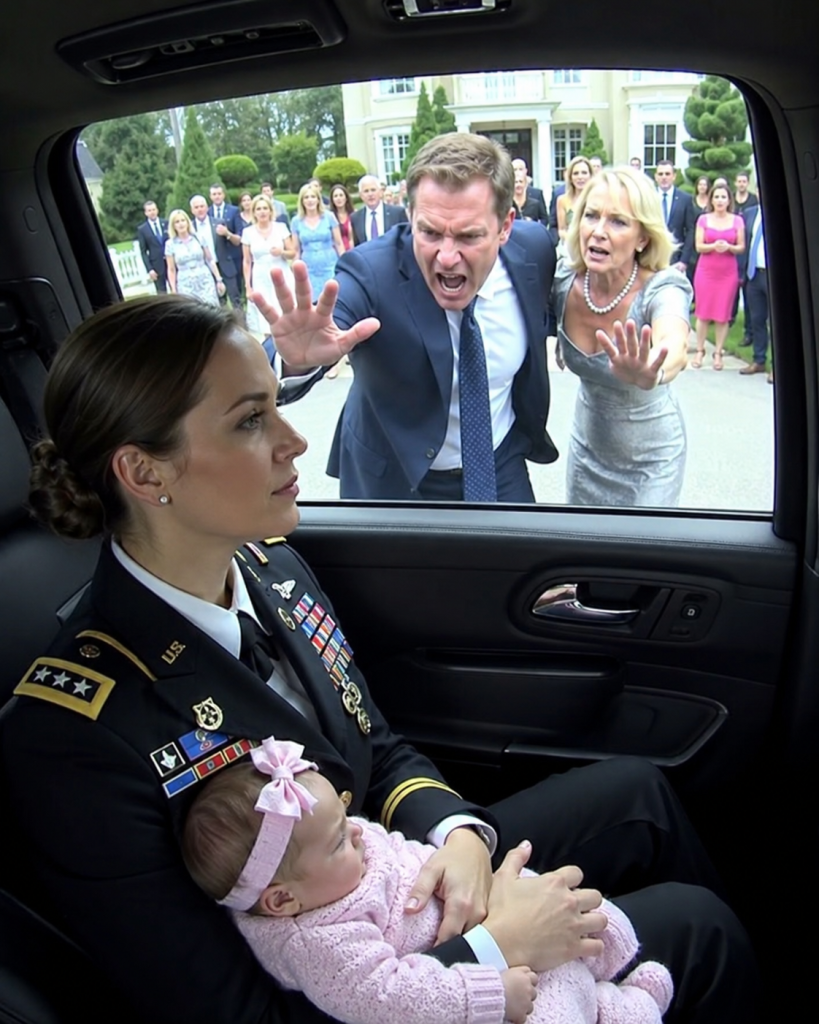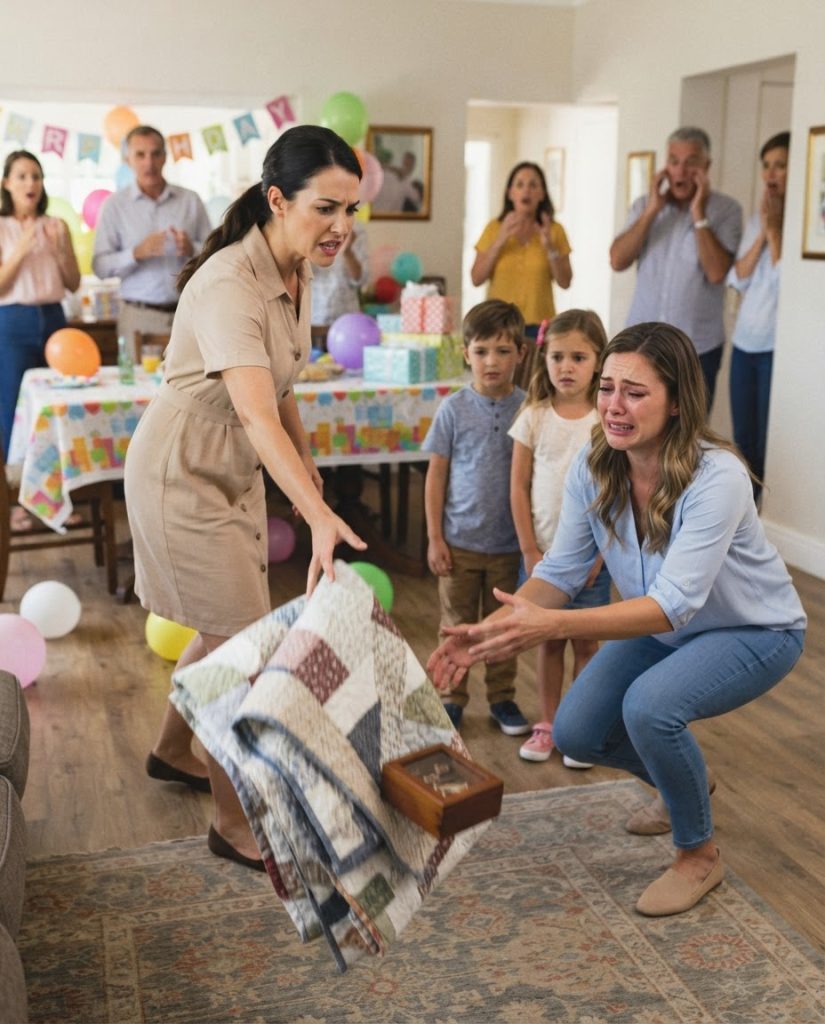
My name is Megan Ferris, and the moment that finally changed my marriage happened on a hardwood floor at my children’s joint birthday party. My sister-in-law Brooke looked at the quilt my late grandmother had made for Owen and the carved jewelry box she had restored for Lily, lifted both gifts from the table, and dropped them onto the floor in front of nearly twenty relatives. “My kids don’t need cheap things from you,” she said, then looked straight at my children and laughed. “Your mom can’t afford the good stuff.” I waited for my husband to defend them. Colin only said, “Brooke, come on. Let’s not do this here.”
For three years, I had accepted smaller versions of that humiliation because Colin could not stand disappointing his mother, Judith, or his younger sister. Brooke had married a successful contractor and slowly turned money into a measuring stick: comments about my minivan, jokes about discount-store clothes while looking at Owen’s sneakers, expensive gifts handed over with a smile that dared me to compete. I never did. Owen and Lily had a warm home, two parents who loved them, and more books than shelf space. Whenever I complained, Colin said, “That’s just Brooke. Don’t make it a thing.” So I kept swallowing it in the name of peace.
The birthday gifts were different. My grandmother Eleanor had died the year before, and those were the last things she ever made for anyone. The quilt had taken almost a year, stitched through swollen arthritic hands with Owen’s birth date and time worked into the corner. Lily’s small wooden jewelry box had been carved by my grandfather decades earlier and restored by Eleanor after he died, complete with a hidden compartment. When the children opened them, Judith explained why they mattered. Owen went quiet with that solemn expression children get when they sense love older than they are, and Lily gasped when she discovered the secret latch.
Then Brooke threw them down. I watched Owen’s face collapse and Lily look from her aunt to me, trying to understand whether love could really be cheap because it had not come from a store. I knelt, picked up the quilt and box, brushed them carefully, and told my children, “These are beautiful. I’ll keep them safe.” I stayed another ninety minutes because I refused to turn Brooke’s cruelty into entertainment, but something inside me had shut.
That night Colin admitted, “I should’ve said something.” I told him his sister had humiliated our children while he protected the party from becoming uncomfortable. He promised to talk to her, the same promise he had made for three years. I lay awake thinking about Eleanor’s saying that people who constantly looked down on others often needed the height. Understanding Brooke’s insecurity did not excuse what she had done. Two days later, I drove to Grandma’s old house needing to feel close to her, opened a forgotten desk drawer, and found a brittle stack of papers with a letter marked: To be opened only if it becomes necessary.
Chapter 2
Two Days Later Eleanor’s Hidden Letter Changed Everything I Knew
I sat on the floor of Eleanor’s empty bedroom and unfolded the letter with shaking hands. Years earlier, after a bad fall, Grandma had temporarily stayed with Brooke and her husband while recovering. She had trusted Brooke to manage a small savings account, pay several bills, and keep track of the balance until she was steady enough to handle things herself again. When Eleanor checked the account four months later, $11,400 was missing.
Grandma wrote that she questioned Brooke once, privately. Brooke insisted Eleanor was confused about the original balance and swore she had never taken a cent beyond authorized expenses. Eleanor did not stage a confrontation or accuse her publicly. She simply trusted the numbers more than the denial and documented everything, including dates and statements, because she believed truth should survive even when a family chose silence.
Tucked behind the letter was an old business card for Arthur Prescott, the attorney who had handled Eleanor’s estate planning for nearly twenty years. The letter explained that a copy had been placed in his files so nobody could someday dismiss it as something written impulsively. Eleanor had also changed parts of her final wishes after discovering the missing money. She did not describe that as revenge. She wrote that she had learned not to leave responsibility in the hands of someone who had already treated trust like permission.
I read the pages twice before noticing one detail that made my stomach tighten. Eleanor wrote that the missing withdrawals lined up with the timing of Brooke’s first major home renovation, the project she had shown off to our entire family with glossy photographs and endless talk about custom finishes. Grandma had not claimed that proved everything by itself, but she had remembered it because the dates were impossible to forget. Suddenly Brooke’s obsession with appearances looked less like confidence and more like something she had been defending for years.
The next morning I called Arthur Prescott’s office. I did not ask him to sue anyone, recover money, or expose Brooke. I only asked whether Eleanor’s letter was really on file and whether he could confirm that she had written it and deposited it with her estate records years earlier. Arthur remembered her immediately. He confirmed the letter’s existence and authenticity but explained that he would not disclose private financial details himself. “If your grandmother gave you her copy, you can decide what to do with her words,” he said. I thanked him and hung up. For the first time since the party, I no longer felt humiliated. I felt clear.
Chapter 3
One Phone Call Turned Brooke’s Denial Into Public Panic Fast
I spent two days deciding what clarity required. The angry version of me imagined reading Eleanor’s letter in front of everyone and watching Brooke’s face fall exactly as Owen’s had. But that would have made humiliation the point, and I did not want my children learning that cruelty becomes acceptable when you finally have the stronger weapon. I wanted the truth heard, nothing more.
The following Sunday, Judith hosted a smaller family dinner. Before we went, I asked Colin whether Brooke would be there and told him I had something to address after the children left the table. He asked what it was, but I only said, “You’ll understand.” After dessert, Owen and Lily went into the next room for a movie. Colin, Judith, Brooke, Brooke’s husband, and two cousins remained around the dining table. I placed my phone beside my plate.
“I want to say something about last week,” I began. Brooke straightened immediately, her mouth already tightening for a defense. “I’m not here to fight. I found something Grandma Eleanor left behind, and before I read it, I want everyone to know it’s real.” I called Arthur on speaker. As arranged, he simply confirmed that Eleanor had written a private letter years earlier, that his office had retained a copy in her estate records at her request, and that the document had remained there unchanged. I thanked him and ended the call.
Then I read. I described Eleanor’s fall, the account Brooke managed, and the $11,400 that disappeared over four months. Brooke interrupted sharply. “That is not what happened. She was confused.” I looked down at the page. “She wrote that you said exactly that.” The room went still. Judith looked from Brooke to me while Colin stared at his hands.
I continued to the final paragraph, where Eleanor connected the missing dates to the down payment and early expenses on Brooke’s first major renovation. Brooke’s face changed before I even finished. Her jaw loosened, her eyes filled, and she covered her face with both hands. “I was going to put it back,” she said through tears. She admitted she had borrowed the money thinking Eleanor would never notice, then the renovation went over budget and panic made denial easier than confession.
Nobody rushed to comfort her. Brooke kept crying and said she had spent years resenting Eleanor for changing her estate plans because anger was easier than admitting shame. I let the silence sit before saying, “I didn’t bring this here to punish you. I brought it because last week you told my children their mother couldn’t afford to love them properly. You don’t get to build yourself taller by making Owen and Lily feel small.” Brooke lowered her hands. For once, she had no argument left.
Chapter 4
Brooke Finally Confessed What Shame Had Made Her Hide Years
Brooke stayed at the table long after her confession, shoulders folded inward in a way I had never seen. The woman who usually filled every room with certainty now spoke carefully, almost as though each sentence had to pass through years of pride before reaching us. She said she had never intended to steal permanently. She had convinced herself she was borrowing from a woman who had enough, promising she would replace everything before Eleanor noticed, then chose the lie once the truth became expensive.
Judith asked why Brooke had never admitted it after Eleanor died. Brooke wiped her face and said, “Because then I would have had to admit she was right about me.” She had interpreted every reduced gift, every boundary, and every change in Eleanor’s plans as rejection instead of consequence. Over time she built a version of herself that was successful, polished, and above judgment because acknowledging the old theft meant admitting the foundation had cracks.
I told her I was not ready to forgive her, and I refused to manufacture forgiveness to make dinner easier. What mattered to me was Owen and Lily. Brooke had taken the shame she carried and placed it on two children who had done nothing except cherish gifts created by their great-grandmother. “Those gifts weren’t cheap,” I said. “They were irreplaceable. And even if they had cost five dollars, you had no right to make my children feel poor.”
Brooke nodded without defending herself. Colin finally spoke too, but not to manage the room. He looked at his sister and said, “Megan’s right. I should have stopped you at the party.” Then he looked at me. “And I should have stopped this years ago.” That mattered because his silence had been its own betrayal. He had spent years calling avoidance peace while leaving me alone to absorb every insult. I told him we would discuss that privately because an apology in front of his family could not repair what he had failed to do as a husband and father.
Nothing magically healed that night. Brooke did not become humble in one confession, and I did not suddenly trust her. But the balance had changed because the story she had protected was gone. Eleanor’s letter had done what Eleanor intended: it kept the truth from becoming whatever the loudest person said it was. When we left, Colin carried the quilt and jewelry box to the car himself. Owen ran his fingers over the stitched corner in the back seat while Lily worked the hidden latch again and again. The objects Brooke had treated like trash were going home with the only people whose opinion of their value actually mattered.
Chapter 5
The Gifts She Mocked Became Our Family’s Strongest Truth Again
A few days later, Brooke asked to visit Owen and Lily without an audience. I agreed only after making sure the children were comfortable. She sat with them in our living room, apologized directly for throwing their gifts and for saying something cruel about me, and did not explain herself away. Owen asked why she had called the quilt cheap. Brooke swallowed and said, “Because I was wrong about what makes something valuable.” Lily opened her jewelry box and showed Brooke the hidden compartment without saying much. Children have their own timetable for trust.
Judith later told us Brooke had started seeing a counselor. I never asked for details because her work on herself was not mine to supervise. Months later, the $11,400 was quietly repaid into a small account Judith managed for Owen and Lily’s future. There was no family announcement, no oversized check, and no social-media performance. The transfer simply appeared, and that restraint meant more to me than another speech would have.
My harder work was with Colin. I told him plainly that “Brooke, come on” had not been neutral. When his sister humiliated two children under ten and he worried first about keeping the party comfortable, he had chosen his family’s peace over his children’s dignity. Colin did not argue. For once, he listened all the way through. He began speaking up when Brooke crossed smaller lines later, not perfectly and not dramatically, but early enough that I no longer had to stand alone.
The quilt now stays on Owen’s bed. Some nights he traces the stitched date and time in the corner before falling asleep, checking the thread almost as if he is checking that Eleanor’s love is still there. Lily keeps the jewelry box beside her bed and opens the hidden compartment constantly just to hear the soft wooden click. They do not understand every adult secret behind those gifts, and they do not need to.
What they know is enough. Their great-grandmother sat with aching hands and made something that would outlive her. Their mother picked those gifts up when someone tried to make them seem worthless. Their father eventually learned that silence could hurt people he loved, and their aunt learned that money could not make shame disappear.
For three years I had believed keeping peace meant absorbing disrespect quietly. Eleanor’s letter taught me otherwise, but so did the quilt lying on that hardwood floor. Anybody can buy something impressive. Not everybody can make something that lasts. Brooke once mistook price for value because she needed everyone else to believe she was standing higher. In the end, the most valuable things in our family were the ones no amount of money could manufacture: truth kept carefully, love stitched patiently, and the courage to finally protect both.
THE END