The first thing I felt was not fear. It was the hard electric bite between my shoulder blades while my hands were still raised over my head, fingers spread under the white glare of patrol lights, the pavement cold enough to cut through my knees when I hit the shoulder of Route 17 outside Norfolk. My face scraped the asphalt.
Gravel pressed into my cheek. Somewhere above me, a man laughed.
“Trying to reach for something, hero?” Officer Ray Maddox said.
My name is Commander Elias Grant, United States Navy, assigned to Naval Logistics Command near Norfolk, Virginia. I was forty-three years old that night, old enough to know the most dangerous moments do not always start with gunfire.
Sometimes they start with a man in authority deciding the truth before he has earned the right to touch it.
I had just left an official command reception in my white service dress uniform. The jacket was still buttoned. My ribbons were still pinned straight. In the rear of my vehicle sat a sealed Department of Defense transfer case logged under a federal chain-of-custody receipt at 8:16 p.m.
That case should never have been removed from my custody.
It should never have been photographed beside a county evidence tag.
And it absolutely should never have been carried into a booking room by a patrol officer who thought my uniform was a costume.
Maddox did not know that. Or maybe worse, he had already decided it did not matter.
His younger partner, Officer Caleb Norris, stood near the patrol SUV with one hand resting on his belt, face tight in the wash of red and blue lights. He looked like a man watching a mistake gather speed and realizing too late he was standing inside it.
“Officer,” I said from the pavement, forcing my jaw to move through the shock still crawling down my spine, “I followed every command you gave me.”
Maddox stepped close enough that his boot landed beside my ribs.
“You reached toward your waistband.”
“I adjusted my uniform jacket. Both hands stayed visible.”
“You don’t get to decide what I witnessed.”
Norris looked at the taser wires still fixed against my back.
“Ray,” he said quietly, “his hands were raised.”
Maddox turned on him so fast the younger man flinched.
“Shut your mouth.”
Then his knee came down into my shoulder and my wrists were forced behind my back.
I did not fight him.
For one ugly second, every instinct in my body wanted to twist, drive my weight sideways, make him understand that restraint is a choice, not weakness. But I had spent my adult life around armed men making emotional decisions in tight spaces.
A calm man survives longer than a right man.
The cuffs snapped hard around my wrists. Pain cut through the numbness.
“You are detaining a commissioned officer performing federal duty,” I said. “Contact your supervisor and notify base security.”
Maddox bent low, his breath hot with old coffee.
“Out here, that costume doesn’t mean anything to me.”
Costume.
I looked at the white sleeve being ground into roadside dust, at the gold buttons catching the patrol lights, at the ribbons over my chest. I thought of folded flags I had carried with both hands. I thought of families who stood straighter because the cloth meant something when words failed.
And I understood exactly what kind of man I was dealing with.
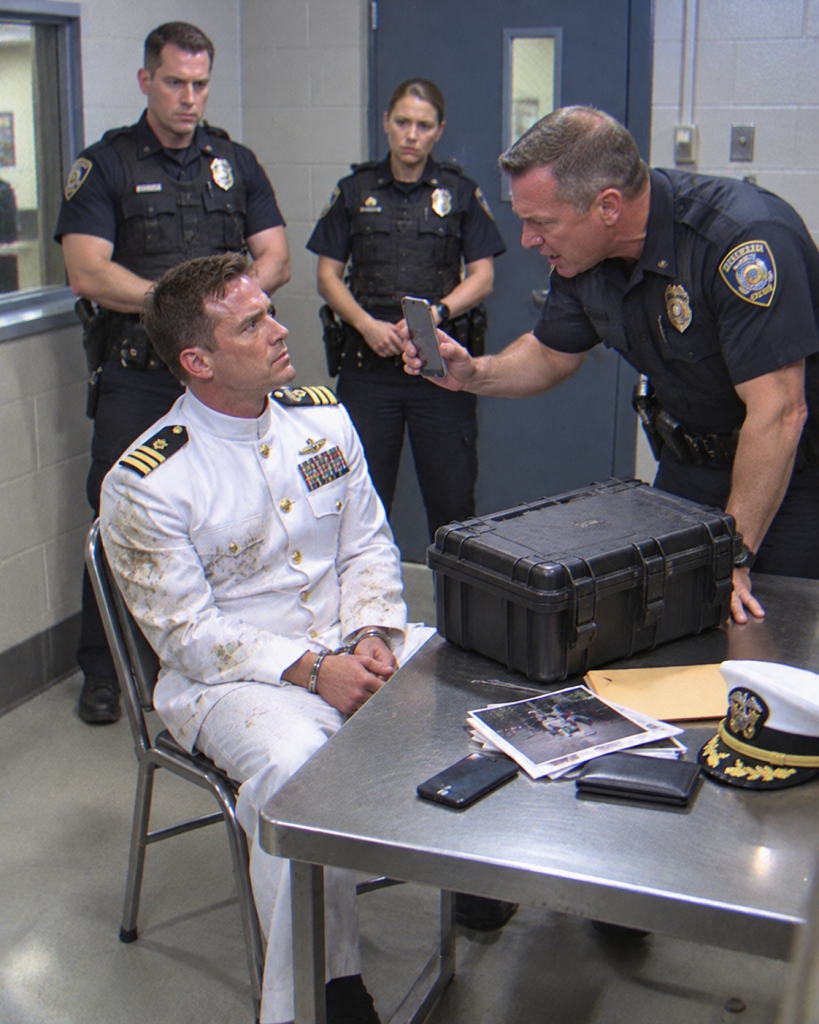
At 9:02 p.m., they brought me into the county station still cuffed, still in my torn and filthy uniform. Maddox emptied my property onto a metal table: wallet, military identification, phone, keys, command pass.
Then he placed the sealed black transfer case in front of me.
The federal seal faced up.
Norris saw it. I saw him see it.
Maddox tapped the lock twice with two fingers.
“Fancy little briefcase.”
“Do not attempt to open it,” I said.
He smiled.
“Or what happens?”
Every nerve in me wanted to rise from that chair. Every year of training told me to stay seated.
“That case is under federal transfer authority,” I said. “Contact base security.”
“Maybe I will,” Maddox said, “after I figure out what you’re hiding.”
There was a camera in the upper corner of the room. There was a booking log on the counter. There was a CAD entry from the stop, an evidence intake sheet half-filled in blue ink, and Norris’s body camera still blinking near his chest.
Men who lie casually often forget the room has a memory.
Norris stepped into the doorway, pale now.
“Officer Maddox, Commander Grant requested his phone call.”
Maddox did not turn his head.
“You in charge of this shift now, rookie?”
“No, sir,” Norris said. “I’m following department policy.”
That was the first honest sentence anyone in that station had spoken to me.
Maddox shoved my phone across the table.
“One call. Speaker.”
I dialed a number I knew by memory.
Not my wife.
Not my attorney.
Not my commanding officer’s office.
A voice answered after the first ring.
“Naval Security Operations.”
I kept my eyes on Maddox.
“This is Commander Elias Grant. Authentication code Hawthorne Six. I have been assaulted, unlawfully detained, and separated from a sealed federal transfer case. Begin immediate recovery protocol.”
The line went silent for half a second.
Then the voice changed.
“Commander, remain in your present location. Naval command is taking control of the response.”
Maddox laughed like he had just heard a joke.
“Naval command is taking control of the response?” he repeated. “Do you even hear yourself?”
Norris was not laughing. He looked at the phone. Then at the transfer case. Then at the camera in the corner.
The room got smaller.
“Ray,” Norris whispered, “maybe we need to stop.”
Maddox grabbed the phone off the table and ended the call.
I looked at his hand wrapped around my phone, then at the sealed federal case sitting between us.
“That was an error,” I said.
His smile tightened.
“No,” he said. “Your error was thinking that uniform makes you impossible to touch.”
I studied my reflection in the one-way glass: dirt on my cheek, a cut near my eyebrow, cuffs still locked around my wrists because he enjoyed leaving them there.
“Untouchable?” I said. “No.”
Then the station phone behind him began to ring.
And for the first time that night, Officer Ray Maddox stopped smiling…
The first ring echoed through that little holding room like it had found the one quiet place Maddox could not control.
He did not answer it right away. He just stared at me, phone still in his hand, jaw tight enough to show the muscle jumping near his ear. Norris looked from the station phone to the sealed transfer case, and I could see the decision forming on his face before he had the courage to make it.
“Ray,” he said, louder this time, “don’t touch that case again.”
Maddox slowly turned toward him.
“Say that one more time.”
The station phone rang again.
Then a second line lit up on the desk.
That was the new sound in the room. Not fear. Procedure. The kind of sound that starts small because the machine behind it is already moving.
Norris stepped backward, pulled a small department notepad from his shirt pocket, and wrote something down with a shaking hand. I saw the time at the top of the page: 9:07 p.m.
Then he looked at the evidence intake sheet Maddox had left beside the case.
His face changed.
“Ray,” Norris said, almost sick now, “you wrote that the case was voluntarily surrendered.”
Maddox went still.
That single line did more damage than the taser ever could.
Because now it was not only excessive force. It was not only unlawful detention. It was paperwork. A false statement. A sealed federal transfer case documented inside a county booking room under a version of events one witness had already contradicted.
Norris swallowed hard and reached for his body camera.
Maddox saw the movement.
“Don’t,” he snapped.
But Norris had already pressed the button, and when the red light blinked again, he whispered the sentence that finally made Maddox turn pale:
“Commander Grant… I need you to repeat what happened from the beginning…”
Officer Caleb Norris’s voice trembled, but his body camera remained pointed directly at me.
For the first time since the traffic stop, I looked at someone in that station without seeing an enemy.
“Officer Norris,” I said, “are you asking me as a witness, or are you finally documenting what happened?”
His throat moved.
“As an officer who needs the truth on record.”
I nodded once.
“Then document everything.”
Ray Maddox slammed his palm against the table.
“Turn that camera off!”
Norris flinched, but he didn’t obey.
“Sir, I’m required to preserve evidence involving a potential criminal complaint.”
“I’m your superior!”
“And he’s a federal officer.”
The room fell silent.
Maddox stared at his partner as though the younger man had just betrayed him in a language he couldn’t understand.
Then the desk phone rang again.
This time, Maddox answered.
“What?”
He listened for three seconds.
His face lost its color.
“No, sir. We have a situation under control.”
Another pause.
“Yes, sir. I understand who he claims to be.”
His eyes moved toward me.
“I said I understand.”
He slammed the receiver down.
I watched him carefully.
“Your sheriff?” I asked.
“Shut up.”
“Or perhaps someone from Naval Security?”
His jaw tightened.
“You think you’re important because you wear white?”
“No,” I replied. “I think the truth matters because you keep trying to bury it.”
He stepped toward me.
Then the phone rang a third time.
Maddox didn’t move.
Norris reached across the desk and answered.
“Norfolk County Sheriff’s Office. Officer Caleb Norris speaking.”
His expression changed almost immediately.
“Yes, ma’am.”
He straightened.
“Yes, ma’am. Commander Elias Grant is here.”
Another pause.
“Understood. I will preserve all recordings and evidence.”
He hung up slowly.
Then he turned toward Maddox.
“Sheriff Whitaker wants you in his office.”
Maddox let out a bitter laugh.
“Of course he does. I’ll explain everything.”
Norris hesitated.
“He also ordered you to leave the evidence room untouched and surrender your badge and weapon to the duty lieutenant.”
For the first time, Maddox looked genuinely afraid.
Not angry.
Not offended.
Afraid.
Because he had finally realized that whatever story he intended to tell, someone else had already started writing the truth.
And the truth had timestamps.
At 9:14 p.m., the first federal vehicle arrived outside the station.
At 9:17, a second pulled in behind it.
By 9:20, two federal investigators and a Navy security officer had entered the building.
They did not shout.
They did not threaten anyone.
They presented credentials, requested the custody records for the sealed transfer case, and asked who had authorized its removal from my vehicle.
No one answered.
Maddox stood beside the booking desk, his arms crossed, trying to look bored.
“This is a local traffic matter,” he announced. “The driver resisted lawful commands, and we detained him for officer safety.”
One of the investigators, a woman with silver-framed glasses and a dark blue suit, opened a folder.
“Officer Maddox, is that your statement?”
“Yes.”
“Then perhaps you can explain why the dispatch recording shows six separate stops initiated against the same vehicle within a short period, despite no recorded traffic violation.”
Maddox blinked.
“Routine patrol.”
“Six times?”
“Suspicious behavior.”
“What behavior?”
“He was driving suspiciously.”
The investigator glanced down at her notes.
“According to dispatch, your first stop was initiated before the vehicle entered the road where you eventually detained Commander Grant.”
Maddox said nothing.
She continued.
“Your second stop was canceled. Your third was marked as a vehicle identification check. Your fourth was canceled without contact. Your fifth was initiated by another unit. And your sixth resulted in this arrest.”
She closed the folder.
“Can you explain the pattern?”
Maddox looked toward Sheriff Whitaker’s office.
No help came.
“I don’t have the dispatch records in front of me.”
“We do.”
The investigator placed another sheet on the desk.
“And we have the traffic camera footage.”
Maddox’s expression hardened.
“Traffic cameras don’t tell the whole story.”
“No,” she agreed. “That’s why we’re also preserving your patrol vehicle’s dash camera, Officer Norris’s body camera, the station surveillance recordings, the radio traffic, and the evidence intake log.”
She turned toward the duty lieutenant.
“Please make sure none of those records are deleted, overwritten, or modified.”
The lieutenant nodded.
Then the investigator looked at me.
“Commander Grant, are you injured?”
“My shoulder took the brunt of the force. I also have a facial abrasion.”
“We’ll arrange a medical evaluation.”
“Thank you. I also request that the federal transfer case remain sealed and that its chain of custody be independently verified.”
“It will.”
She turned back to Maddox.
“Who opened the vehicle’s rear compartment?”
Maddox stared at her.
“I did.”
“Who authorized you to remove the case?”
“I believed it might contain evidence.”
“Evidence of what?”
He hesitated.
“Possible contraband.”
“Based on what?”
His mouth opened.
Then closed.
The investigator waited.
That silence became the most honest thing he had said all night.
At 9:31 p.m., Sheriff Daniel Whitaker finally entered the booking area.
He was a broad-shouldered man in his late fifties, with gray hair and a face that looked permanently tired.
I had met him once at a public military-community event several years earlier.
He recognized me immediately.
“Commander Grant?”
I stood as much as the remaining cuff allowed.
“Sheriff.”
He looked at my uniform.
The torn sleeve.
The blood near my eyebrow.
The cuffs around my wrists.
Then he turned toward Maddox.
“Tell me this is not what it looks like.”
Maddox straightened.
“Sheriff, the subject refused to cooperate. I used appropriate force, secured a suspicious case, and brought him in for questioning.”
Whitaker stared at him.
“Subject?”
“Sir, I didn’t know who he was.”
The sheriff’s voice dropped.
“That is not an answer to what I asked.”
Maddox shifted his weight.
“I followed procedure.”
Sheriff Whitaker turned toward Norris.
“Officer, did you witness the arrest?”
“Yes, sir.”
“Tell me what happened.”
Norris took a breath.
“Commander Grant complied with the commands given to him. His hands were visible. Officer Maddox deployed his taser after claiming the commander reached for his waistband. I did not see that happen.”
Maddox lunged toward him.
“You little—”
“Enough!” Whitaker barked.
The sound bounced off the walls.
Maddox stopped.
The sheriff looked at Norris again.
“Did you document that disagreement at the scene?”
“No, sir. I should have. I was afraid of making things worse.”
For a moment, Whitaker said nothing.
Then he nodded.
“Thank you for telling the truth now.”
He turned toward Maddox.
“Hand over your badge and service weapon.”
Maddox stared at him.
“You can’t be serious.”
“You are being removed from active duty pending an investigation.”
“After everything I’ve done for this department?”
Whitaker’s face hardened.
“This isn’t about your years of service. It’s about what you did tonight.”
Maddox slowly unclipped his badge.
But before he placed it on the desk, he looked directly at me.
“You think you’ve won?”
I met his eyes.
“No.”
His expression changed, confused by the answer.
“I think you have no idea how much evidence you’ve left behind.”
He dropped the badge onto the table.
The metallic clatter sounded strangely final.
At 9:46 p.m., a federal security officer verified the transfer case’s seal.
It was intact.
That mattered more than anything Maddox had said.
Inside were classified logistics records, sealed transfer documentation, and encrypted storage devices associated with a federal review of irregularities in military supply movements.
I was not authorized to discuss their contents with local law enforcement, and I had no intention of doing so.
The case had been entrusted to me under a documented chain of custody.
My job was to deliver it.
Nothing more.
Nothing less.
But the circumstances surrounding the traffic stops had created another problem.
Why had my vehicle been targeted six times?
Why had Maddox removed the case?
And why had he written that I voluntarily surrendered it?
The federal investigator pulled me aside.
“Commander, we have a preliminary concern.”
“What kind?”
“We’re examining whether the repeated stops were genuinely routine or whether someone had a reason to know your vehicle was carrying a sensitive transfer.”
I looked toward Maddox.
He was standing beside the duty lieutenant, no longer wearing his badge.
“Do you believe he knew what was inside?”
“We don’t know yet.”
“Then find out.”
She nodded.
“We will.”
At 10:03 p.m., I was taken to a medical facility for examination.
The physician documented the injuries to my shoulder and face. Photographs were taken, and my medical records were preserved for the investigation.
By then, my wife, Rachel, had called eleven times.
I returned her call from a secure line.
She answered before the first ring finished.
“Elias?”
Her voice cracked.
“I’m here.”
“Someone from the Navy called. They said you’d been assaulted. They wouldn’t tell me anything else.”
“I was detained during a traffic stop. I’m safe now.”
“Safe?” She drew a shaky breath. “You sound like you’re talking about somebody else’s life.”
I closed my eyes.
For the first time that night, the discipline I had relied on began to feel heavy.
“I know.”
“Were you afraid?”
I looked at the bruising on my wrist.
“Yes.”
She went quiet.
Then she said something I would remember long after the investigation ended.
“You’re allowed to be afraid, Elias. You’re not required to pretend that nothing hurts just because people expect you to be strong.”
I pressed my fingers against my forehead.
“I know.”
“Come home when they let you.”
“I will.”
“And Elias?”
“Yes?”
“Don’t let them convince you that staying calm means what they did was acceptable.”
I swallowed hard.
“They won’t.”
The investigation lasted four months.
Four months of interviews.
Four months of reviewing recordings, dispatch logs, patrol records, access histories, and internal messages.
Four months during which Maddox maintained that he had acted reasonably.
His attorney described the incident as a misunderstanding. A routine stop that escalated. A difficult situation involving an officer who believed he faced a threat.
But the recordings told a different story.
The first stop showed Maddox approaching my vehicle and asking where I was going.
I answered calmly.
He examined my identification, returned it, and let me continue.
There was no warning.
No citation.
No explanation for the stop.
The second recording showed him following me for several miles before calling in another vehicle check.
The third showed him canceling a stop after learning my registration was valid.
The fourth showed him speaking to another officer over the radio.
The audio was imperfect, but investigators isolated one sentence.
“Let’s see where he goes.”
The fifth stop involved a different patrol unit. That officer found no violation and released me.
The sixth was Maddox’s.
By then, the evidence established a pattern of repeated attention that his initial report had failed to explain.
The station camera captured him taking the transfer case from the vehicle.
His own words were audible.
“Let’s see what this guy’s so protective of.”
Then came the false statement on the intake sheet.
*Property voluntarily surrendered by subject.*
Norris’s body camera captured him questioning that entry.
The booking-room camera showed Maddox attempting to end my call after I contacted Naval Security Operations.
And the dispatch system preserved a detail that became crucial: Maddox had described my conduct as threatening before the recorded footage supported his account.
The evidence did not prove every suspicion investigators had considered.
But it proved enough to destroy the story he had told.
Maddox was placed on administrative leave. The department opened a formal disciplinary investigation, and the sheriff referred the matter to the appropriate authorities for independent review.
The case also exposed serious failures in supervision and evidence handling.
Sheriff Whitaker announced changes to traffic-stop documentation, evidence intake procedures, and mandatory reporting of force used during arrests.
Norris cooperated fully with investigators.
He also faced disciplinary scrutiny for failing to challenge Maddox sooner and for not documenting his disagreement at the scene.
He accepted that responsibility.
When I met him months later, he looked older than he had on Route 17.
“I should have stopped him,” he said.
I studied him for a moment.
“Yes,” I replied. “You should have.”
He lowered his eyes.
“I was afraid he’d ruin my career.”
“And now?”
“Now I understand that being afraid doesn’t excuse doing nothing.”
I nodded.
“That understanding will matter more than any apology you could give me.”
He looked up.
“Do you forgive me?”
I considered the question.
“Forgiveness isn’t a switch I can flip because you’ve finally said the right words. But I believe people should have the chance to become better than the worst decision they’ve made.”
His eyes reddened.
“Thank you, sir.”
“Don’t thank me yet, Officer. Prove it the next time someone beside you does something wrong.”
“I will.”
I hoped he meant it.
The final hearing took place on a rainy Thursday morning.
I wore my white service dress uniform again.
This time, my wife sat in the second row.
I had considered wearing a civilian suit. My attorney suggested it might keep attention focused on the evidence rather than the uniform.
But I decided otherwise.
I wasn’t wearing it to intimidate anyone.
I was wearing it because Maddox had called it a costume.
And I wanted to remember that his insult had never changed what it represented.
The hearing room was packed with reporters, department officials, and members of the public.
Maddox sat at the far table with his attorney.
He looked smaller without his badge.
When the proceedings began, the investigator presented the recordings in chronological order.
The repeated stops.
The contradictory statements.
The use of force.
The transfer case.
The false intake entry.
The interrupted phone call.
Every time Maddox’s attorney tried to frame the incident as an isolated misunderstanding, another recording complicated the explanation.
Then Officer Norris testified.
He did not exaggerate.
He did not pretend to have been braver than he was.
He described what he saw and admitted what he failed to do.
His honesty was uncomfortable.
That was precisely why it mattered.
When I took the stand, the attorney representing the department asked me a question I had anticipated.
“Commander Grant, are you claiming that your rank should have exempted you from a lawful traffic stop?”
“No.”
“Are you suggesting that police officers should be expected to recognize military personnel before enforcing the law?”
“No.”
“Then what exactly is your complaint?”
I looked toward the hearing panel.
“My complaint is that the law was treated as something one officer could invent and rewrite whenever the facts became inconvenient.”
The room grew quiet.
“I was willing to answer questions. I was willing to provide identification. I was willing to comply with lawful instructions. I did not demand special treatment because of my rank.”
I paused.
“What I object to is being punished for an action I did not take, having my compliance described as resistance, and having federal property removed from my custody under a false account of events.”
The attorney glanced at his notes.
“You could have identified yourself more forcefully.”
“I identified myself.”
“You could have demanded a supervisor.”
“I did.”
“You could have made it clear that the case was protected by federal authority.”
“I did that as well.”
“And yet you were arrested.”
“Yes.”
“Why do you think that happened?”
I looked at Maddox.
“Because the officer had already decided what kind of man I was before he decided what the evidence showed.”
My voice remained steady.
“That is the danger. Not that officers sometimes make mistakes. Mistakes can be corrected. The danger is when someone with authority believes his assumptions are more important than the truth, and then uses that authority to make everyone else afraid to challenge him.”
No one moved.
I continued.
“My uniform did not make me innocent. My rank did not make me untouchable. The evidence did.”
For several seconds, the hearing room remained completely silent.
Then the chairwoman thanked me and asked me to step down.
As I passed Maddox, he looked up.
Our eyes met.
He seemed to be waiting for me to say something.
I didn’t.
There was nothing left to prove to him.
The ruling was announced three weeks later.
The disciplinary panel found that Maddox had violated department policy, used unjustified force, made materially false statements in official records, and mishandled property associated with a federal transfer.
His employment with the sheriff’s department was terminated.
The independent investigation also resulted in criminal proceedings related to his conduct. Those proceedings were handled separately, with their own evidence, legal standards, and outcomes.
Sheriff Whitaker announced an external review of the department’s supervisory failures and committed to publishing a public summary of the reforms.
The county also revised its procedures for preserving body-camera footage, documenting vehicle searches, and escalating incidents involving disputed evidence custody.
Maddox appealed his termination.
The appeal was denied.
He later faced the consequences of the criminal investigation through the courts.
I did not attend every hearing.
I did not need to watch him lose his career to know that the truth had finally been heard.
What mattered was that the record could no longer be rewritten to suit him.
The sealed transfer case had reached its destination.
Its chain of custody remained intact.
And the six stops that once seemed designed to make me disappear into a system of paperwork had become the very evidence that brought the truth into the open.
Several months later, I returned to Route 17.
It was a clear morning.
The pavement had dried, the traffic moved normally, and the roadside looked so ordinary that someone passing through would never have guessed what had happened there.
I pulled into a safe turnout and stepped out of my vehicle.
For a moment, I stood beside the road and remembered the cold asphalt against my cheek.
I remembered the taser wires.
The laughter.
The word *costume*.
I remembered how easily a man could mistake silence for surrender.
My wife stepped out beside me.
“You all right?” she asked.
I nodded, then reconsidered.
“Getting there.”
She slipped her hand into mine.
We stood together without speaking.
Finally, she said, “Do you think anything will really change?”
I looked at the passing cars.
“I think change is what happens when people refuse to let the truth disappear.”
“That sounds like something you would say at a command briefing.”
I laughed softly.
“Occupational hazard.”
She leaned against my shoulder, careful of the injury that had never fully stopped aching on cold mornings.
Then she asked, “What happens now?”
I thought about Norris, who had begun speaking at department training sessions about the cost of remaining silent.
I thought about the officers who would now have clearer procedures and better oversight.
I thought about the citizens who might never know that a single preserved recording had helped change how their county handled a traffic stop.
And I thought about the uniform folded neatly in my closet.
“Now,” I said, “we make sure the next person doesn’t have to depend on luck to get the truth heard.”
A year after the arrest, I received a letter from Officer Norris.
It was handwritten.
He wrote that he had been promoted to a different assignment after completing additional training and that he had spent the previous six months helping review the department’s new evidence-preservation procedures.
He did not ask for forgiveness again.
He simply described the day he had watched the recordings with a group of new officers.
One of them had asked him a question.
*What would you do if the officer standing next to you was the one breaking the law?*
Norris wrote that he had answered honestly.
“I would document it. I would report it. And I would not wait until someone with more authority arrived to decide whether I had the courage to do the right thing.”
At the bottom of the letter, he had added one final sentence.
“I wish I had understood that before Route 17.”
I folded the letter and placed it in my desk.
Not as a reminder of what Maddox had done.
As a reminder of what Norris had almost failed to do.
Because the truth is that authority can be abused by one person, but it can also be protected by another.
Sometimes the difference is a single sentence spoken when silence would be easier.
On the anniversary of that night, my unit held a small ceremony recognizing the personnel who had maintained the federal transfer’s chain of custody during a difficult investigation.
There were no reporters.
No speeches about revenge.
No dramatic announcements.
Just colleagues who understood that integrity is rarely tested when everything is easy.
After the ceremony, a young sailor approached me.
“Commander, may I ask you something?”
“Of course.”
“How did you keep your composure when that officer humiliated you?”
I considered giving him the answer he might have expected.
Discipline.
Training.
Experience.
All of those things had helped.
But they were not the whole truth.
“I didn’t stay calm because I wasn’t hurt,” I told him. “I stayed calm because I knew that if I allowed anger to make my decisions, I might give someone else the opportunity to change the story.”
He nodded slowly.
“So the goal is never to react?”
“No. The goal is to react in a way that protects the truth, protects people, and doesn’t create another injustice.”
I placed a hand on his shoulder.
“Courage isn’t always loud. Sometimes it’s refusing to lie when lying would save you trouble. Sometimes it’s speaking up when your superior tells you to be quiet. And sometimes it’s having the patience to let evidence do what anger never could.”
The sailor thanked me and returned to his group.
I watched him walk away, wondering which moment in his career would test those words.
I hoped it would be a long time before he needed them.
But I knew he would need them eventually.
We all do.
That evening, I returned home and hung my white service dress uniform in its place.
The damaged jacket had been repaired.
The ribbons were straight again.
The gold buttons shone beneath the closet light.
I ran my fingers over the sleeve where the fabric had torn against the road.
For a moment, I could almost hear Maddox’s voice again.
*Out here, that costume doesn’t mean anything to me.*
I closed the closet door.
He had been wrong about the uniform.
But not because it made me superior to him.
He had been wrong because he believed its meaning depended on whether he respected the person wearing it.
It didn’t.
The uniform represented an obligation, not a privilege.
An obligation to serve.
An obligation to follow the law.
An obligation to tell the truth, even when the truth threatened someone powerful.
And on Route 17, that obligation had required something more difficult than fighting back.
It had required me to endure the humiliation without surrendering the facts.
Maddox had six opportunities to stop.
Six opportunities to reconsider.
Six opportunities to choose a different course.
He chose otherwise.
And in the end, it wasn’t my rank that brought his actions to light.
It wasn’t a threat.
It wasn’t revenge.
It was the evidence he believed no one would ever examine.
I turned off the light and walked downstairs, where Rachel was waiting with dinner.
She looked up from the table.
“Long day?”
“Long year,” I replied.
She smiled gently.
“Then sit down. You’re home.”
I took my seat beside her.
Outside, the evening settled over the neighborhood, quiet and ordinary.
For the first time in a long time, I allowed myself to feel the weight of what had happened without needing to turn it into a lesson.
I had been afraid.
I had been humiliated.
I had been hurt.
And I had survived.
Not because I was untouchable.
Because the truth had been preserved, because one frightened young officer had eventually found his voice, and because the system had been forced to examine what its own people had done.
That was enough.
The night on Route 17 had begun with a man who believed his badge gave him the final word.
It ended with a record he could no longer control.
And that was the lesson I carried forward:
A badge can grant authority. A uniform can represent service. A title can command attention. But none of them gives anyone the right to stand above the truth.