PART 1
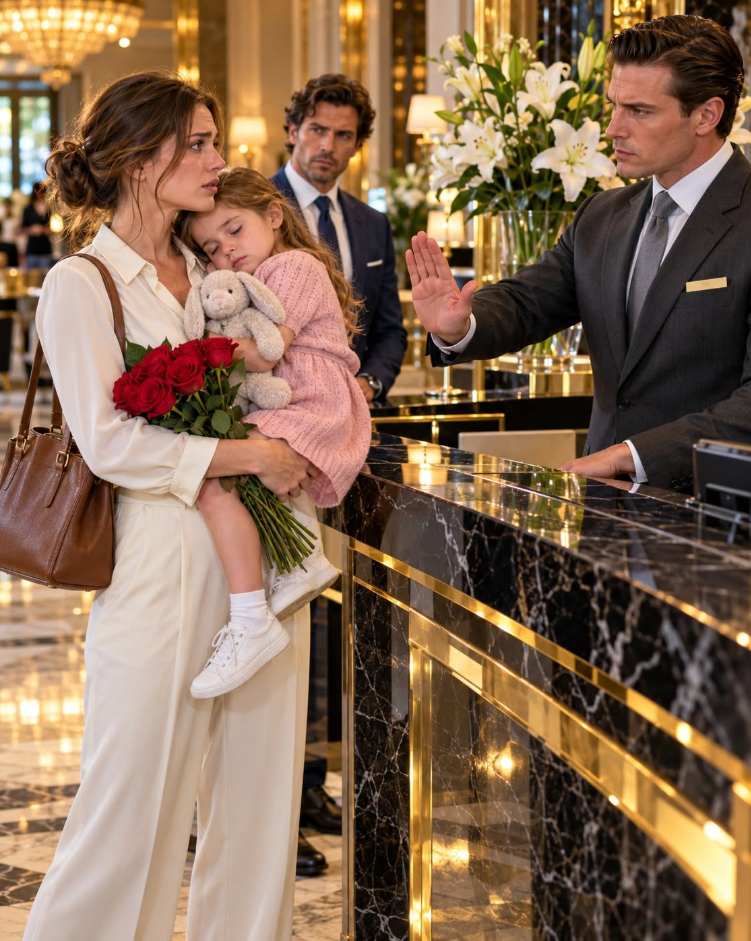
“Ma’am, with that sleeping child and those bruised flowers, you might want to look for a cheaper motel down the road.”
For a moment, I thought I had misheard him. Not because his words were unclear, but because I was standing inside a hotel that belonged to me.
In my left hand, I held a bouquet of red roses.
That little red petal probably saved him from the response I wanted to give.
She had fallen asleep five minutes before we arrived.
Every parent understands what that means.
When an exhausted child finally falls asleep, you will carry them through rain, fire, humiliation, or wounded pride rather than risk waking them.
So I swallowed everything.
The insult.
The cold smile.
The way both men had inspected my jacket, worn boots, backpack, and daughter before deciding what kind of woman I must be.
“I have a reservation,” I whispered. “Under Clara Vance.”
The man speaking wore a gold nametag that read PATRICK.
His hair looked as though every strand had agreed to stay perfectly in place. His suit was immaculate. His smile seemed professional but offered no genuine warmth.
He looked me over once more.
Then he entered my name into the computer.
Beside him, another receptionist named Karl leaned against the counter, observing me with the faint amusement of someone expecting to be entertained.
Patrick typed for several seconds.
Then he stopped.
“Nothing.”
“It was booked through the corporate office,” I said. “Please check the executive block.”
His hands went still.
“Ma’am, we are completely sold out.”
“I understand.”
“There’s a major corporate gala in the ballroom tonight. We have executives, investors, and VIP guests staying throughout the property.”
I nearly smiled.
I knew exactly who would be attending that gala.
The event belonged to a national conference partner that had signed a three-year agreement with our hospitality group six months earlier.
I had personally approved that contract.
“I still have a reservation,” I said.
Karl chuckled.
Not loudly enough to make his disrespect obvious.
But loudly enough for me to hear.
“People always think that if they push hard enough,” he said, “a luxury suite magically appears.”
Patrick made no effort to intervene.
Instead, he gave me the patient expression people reserved for someone they considered too stubborn to understand reality.
“You can try one of the budget inns closer to the highway.”
I stared at him.
Behind the desk, the Grand Regent’s crest shone in brushed gold.
Beneath it were five words I had written eleven years earlier, when our company owned only one struggling twenty-eight-room hotel outside Denver.
EVERY GUEST DESERVES TO FEEL SEEN.
Those words had once been handwritten on printer paper and taped behind an inexpensive reception counter.
Now they were engraved in Italian marble.
Patrick stood beneath them, treating me like someone he wanted out of the lobby.
Lily stirred against my shoulder.
“Mommy?”
Her voice was barely a whisper.
“I’m here, baby.”
She settled back into sleep.
I kissed her hair.
Tomorrow marked three years since Daniel’s death.
My husband had been thirty-seven.
Lily had been three.
Cancer had taken sixteen months to claim his life, but grief had taken far longer to teach us how to keep living.
Every year on the anniversary of his death, Lily chose a vase.
I bought red roses.
We arranged them in the living room and shared one funny memory of Daniel.
That was our tradition.
One story.
One laugh.
No matter how much it hurt.
I had purchased the roses at Denver International Airport because the following morning would be busy. I didn’t want to spend time searching Chicago for flowers while Lily wondered why I had forgotten Daddy.
Now the stems were bent.
My daughter slept in my arms.
And two employees of my company were recommending a motel beside the highway because I apparently didn’t look wealthy enough to deserve my confirmed reservation.
“May I speak with the general manager?” I asked.
Patrick’s expression tightened.
“The general manager is occupied.”
“Please tell him Clara Vance would like a word.”
Karl sighed.
“The manager is overseeing the gala. We’re not going to disturb him because you can’t find your booking.”
A cold sensation spread through me.
Not anger.
Not yet.
Anger burns.
This was quieter.
It was the moment disappointment became useful information.
Over the years, I had visited dozens of our hotels anonymously because scheduled inspections were essentially performances.
Managers polished everything.
Staff smiled more brightly.
Problems vanished into closets until the owner was gone.
But ordinary guests experienced the truth.
So I traveled without an assistant.
No corporate vehicle.
No advance warning. Casual clothing whenever possible.
I observed.
I listened.
Most of the time, those visits strengthened my confidence in our employees.
Sometimes, they did not.
Before I could reply, a service door opened behind the reception desk.
A woman in her mid-fifties stepped out, carrying a stack of neatly folded white towels.
She wore a maroon housekeeping vest, and her dark hair, streaked with gray, was braided back.
Her nametag read LUPITA.
She took three steps.
Then stopped.
Her gaze shifted to Lily.
Then to the roses.
Then to me.
Finally, she looked at Patrick and Karl.
No one needed to explain the tension.
She placed the towels on a luggage cart.
“Excuse me, ma’am,” she said softly. “Is everything all right?”
“My reservation isn’t appearing in the main system.”
Lupita turned toward Patrick.
“Did you check the corporate holding block?”
“I checked.”
“The secondary corporate tab?”
Patrick tightened his jaw.
“I know how to do my job.”
“I didn’t say you didn’t.”
“Then go back to your floor.”
Lupita’s expression changed slightly.
Not with fear.
With restraint.
I recognized it immediately.
It was the same self-control I was trying to maintain.
“The executive bookings sometimes don’t transfer into the main search correctly,” she said. “It happened last month.”
Karl rolled his eyes.
“Lupita, this isn’t housekeeping.”
“No,” she replied. “But a tired mother holding a sleeping child is standing in our lobby asking for help. That makes it everyone’s business.”
I looked at her.
She had no idea who I was.
That mattered more than anything else happening there.
Patrick stared at her for a moment.
Then he turned back to his computer, visibly annoyed.
He clicked twice.
Typed.
Clicked again.
Four seconds passed.
His shoulders tightened.
The color drained from his face.
Karl noticed.
“What?”
Patrick remained silent.
“Patrick?”
He swallowed.
Then looked at me.
“Suite 904,” he murmured.
I didn’t move.
He checked the screen again, as though hoping the information might somehow change.
“Executive reservation. Confirmed two weeks ago.”
An uncomfortable silence fell over the reception desk.
Lupita briefly closed her eyes.
Karl unfolded his arms.
Patrick straightened.
His voice suddenly became gentler.
“Ms. Vance, I apologize. It appears there was a system—”
“No.”
I spoke quietly.
He stopped.
“Don’t blame the system.”
His mouth opened.
I adjusted Lily against my shoulder.
“You hadn’t checked the correct screen.”
“I believed—”
“You believed me before you checked.”
That left him speechless.
Patrick glanced at my jacket.
My backpack.
The flowers.
I watched the moment he understood what I meant.
But he still had no idea who I was.
Not yet.
He forced a smile.
“Your suite is available. I can check you in immediately.”
Karl turned toward another computer, suddenly engrossed in its display.
I faced him.
“Did you find my request amusing?”
His expression tightened.
“No, ma’am.”
“You laughed.”
“I wasn’t laughing at you.”
“What were you laughing at?”
He had no answer.
Lupita lowered her eyes.
Patrick cleared his throat.
“I’ll prepare the key.”
I could have ended everything right there.
I could have shown my corporate identification, watched both men panic, summoned the general manager, and turned the lobby into a courtroom.
But Lily stirred.
When she opened her eyes, she looked confused.
“Mommy?”
“Yes, sweetheart.”
“Are we there?”
“We’re there.”
She raised her head and looked around.
The lobby ceiling stretched three stories overhead, adorned with warm chandeliers and glass panels. When Daniel and I approved the renovation five years earlier, Lily had been a toddler running around our apartment in socks.
Now she looked around in wonder and whispered, “It’s pretty.”
Something tightened inside me.
“Yes.”
“Can we go sleep?”
Patrick lowered his eyes.
I nodded.
“We can.”
He handed me two keycards.
“Suite 904.”
“Thank you.”
I curled my fingers around them.
Then Lupita stepped forward.
“May I carry your backpack?”
“You’ve already helped enough.”
“It’s all right.”
I hesitated.
My shoulder was aching from carrying Lily.
So I let Lupita take the backpack.
Together, we crossed the lobby.
Near the elevators, I heard Patrick exhale behind us.
He thought the worst was over.
He believed he’d made a mistake, corrected it, and escaped the consequences.
He was wrong.
Because just before the elevator doors closed, I glanced back toward reception.
I saw Karl lean toward him.
He spoke quietly.
But not quietly enough.
“Some people just like making a scene.”
The doors slid shut.
Lupita turned pale.
I stared at my reflection in the polished metal.
My sleeping daughter against my shoulder.
Crushed roses in my hand.
And one thought became unmistakably clear.
Tomorrow, they would discover exactly whose scene this was.
Lupita remained silent until the elevator reached the ninth floor.
Then she spoke.
“I’m sorry.”
I turned toward her.
“You have nothing to apologize for.”
She pressed her lips together.
“You shouldn’t have been treated like that.”
“No.”
The elevator chimed.
We stepped into a quiet corridor lined with cream carpeting and brass wall sconces.
Suite 904 was at the far end.
Since both my arms were occupied, Lupita opened the door.
The lights came on automatically.
Everything inside was exactly as I expected.
A living room.
A dining table.
Two bedrooms.
Floor-to-ceiling windows overlooking downtown Chicago.
Fresh fruit on the counter.
A handwritten welcome note from corporate reservations.
WELCOME BACK, MS. VANCE.
I noticed Lupita reading it.
Her eyes stopped.
Then shifted toward me.
I knew what she was about to ask.
“Ms. Vance?”
I carried Lily toward the smaller bedroom.
“Give me one minute.”
I gently laid her down.
She protested when I tried to remove the stuffed rabbit from beneath her arm, so I left it there and took off her shoes.
Her socks featured tiny yellow stars.
Daniel had adored stars.
On winter evenings, he would wrap Lily in a blanket, take her outside, and point toward anything bright enough to shine through the city lights.
“That one is yours,” he would tell her.
“What’s it called?”
“The Lily Star.”
“There’s no Lily Star.”
“There is now.”
After his death, she once asked whether Daddy lived on the Lily Star.
I had told her maybe.
Sometimes parents lie because the truth is too overwhelming for a child. I tucked the blanket around her and stayed beside her until her breathing settled into a steady rhythm.
When I returned to the living room, Lupita was still standing near the entrance.
She had placed my backpack on a chair.
Her hands were clasped tightly together.
“Are you…” She hesitated. “Are you the Clara Vance?”
I almost smiled.
“I don’t know how many there are.”
“The owner.”
“One of them, technically. Vance Hospitality owns this property. I founded the group.”
She stared at me.
Then she turned toward the door, looking as though she intended to hurry downstairs and warn everyone.
“Please don’t.”
She looked back.
“Don’t what?”
“Don’t tell them.”
Her eyebrows rose.
“I don’t want anyone changing their behavior because they suddenly know I’m upstairs.”
Lupita thought about that.
Then she slowly nodded.
“I understand.”
“Do you?”
“Yes.”
She glanced toward Lily’s bedroom.
“You wanted to know how people act when they think nobody important is watching.”
Her words stayed with me.
“Exactly.”
Lupita lowered her eyes.
I walked to the kitchenette and placed the roses on the counter.
A vase had already been provided.
I filled it with water.
Lupita helped me straighten the stems.
One was too badly damaged to save.
Using a small knife from the fruit tray, I trimmed it shorter.
We worked quietly for a while.
Then she spoke.
“Your daughter is beautiful.”
“Thank you.”
“How old?”
“Six.”
“She looks younger when she sleeps.”
“They all do.”
Lupita offered a faint smile.
Then she glanced at the flowers.
“Special occasion?”
I rarely explained the reason to strangers.
But something about her felt different.
There was no intrusive curiosity.
No desire for gossip.
Only kindness.
“Tomorrow is the anniversary of my husband’s death.”
Her expression softened immediately.
“I’m sorry.”
“Three years.”
She gently picked up a bent rose petal.
“My husband died eleven years ago.”
I looked up.
“Heart attack. Forty-nine.” She shrugged slightly, conveying years of experience. “You keep going because there are people who need breakfast.”
I laughed unexpectedly.
A genuine laugh.
Small.
Painful.
But real.
Lupita smiled.
“Exactly,” I said.
She started toward the door.
“I should let you rest.”
“Lupita.”
“Yes?”
“How long have you worked here?”
“Eight years.”
“Housekeeping the whole time?”
“Mostly.”
“Mostly?”
“I trained new hires for two years. Then the supervisor changed.”
Her answer sounded guarded.
I noticed.
“Do you like working here?”
She paused again.
“I like the guests.”
It wasn’t really an answer.
Which made it one.
I didn’t push her.
“Thank you for helping us tonight.”
“Anyone should have.”
“But you did.”
She nodded.
Then left.
I locked the door.
For several minutes, I stood alone in the quiet suite.
Chicago glittered beyond the windows.
Traffic moved below in streams of red and white lights.
My phone showed fourteen unread messages.
Most concerned work.
One was from Mom, asking whether we had landed safely.
Another came from my chief operating officer, David Mercer.
Hope the Regent visit goes smoothly. GM believes you’re arriving Sunday, so your anonymous window is intact.
I studied his message.
The general manager, Robert Haines, wasn’t expecting me for another two days.
Corporate had reserved my suite through the executive booking system without informing the hotel of my early arrival.
That explained the booking confusion.
It didn’t excuse their behavior.
I replied.
Arrived. Do not contact property. I’ll call you tomorrow.
Then I put my phone down.
I should have gone to sleep.
Instead, I changed Lily into pajamas without fully waking her, took a shower, and sat beside the roses with a hotel notepad.
I wrote three names.
Patrick.
Karl.
Lupita.
Under Patrick:
Failed to verify reservation.
Assumed inability to pay.
Suggested budget motel.
Denied manager request.
Blamed system.
Under Karl:
Mocked guest.
Supported Patrick’s assumptions.
Dismissed Lupita.
Insulted guest after resolution.
Under Lupita:
Noticed distress.
Helped without authority.
Understood reservation procedures.
Advocated for guest.
Acted without knowing identity.
Then I stopped.
I disliked making these lists. Not because they were useless.
But because people were more complicated than a few brief notes.
Patrick might have a sick parent.
Karl could be under tremendous pressure.
Lupita might have made serious mistakes I had never witnessed.
Running a company teaches you that a single moment can reveal something about a person’s character without necessarily telling you everything about them.
So I added another line.
Investigate before deciding.
Daniel would have approved.
He had always been the cautious one.
I acted quickly.
He asked questions.
I wanted immediate solutions.
He wanted evidence.
Whenever I came home furious about a manager, contract, vendor, or employee, he would listen patiently.
Then he’d say, “Okay. Now tell me the version where the other person isn’t a cartoon villain.”
I used to hate that question.
After losing him, I began asking it of myself.
I went to bed shortly after midnight.
At 2:17 a.m., Lily’s crying woke me.
It was soft.
She sat upright, clutching her rabbit.
I hurried to her bedside.
“Hey. Hey, I’m here.”
“I dreamed Daddy was at the airport.”
My heart broke in that same familiar place.
“What happened?”
“He was waiting for us.”
I sat beside her.
“Was he smiling?”
She nodded.
“Then it sounds like a good dream.”
“But we left him there.”
I wrapped my arms around her.
“No, baby.”
“We got on the plane and he didn’t.”
“Daddy can’t get on airplanes anymore.”
She already knew that.
Of course she did.
Children understand death long before they learn how to live with it.
“Tomorrow is the flower day,” she whispered.
“Yes.”
“Can we still do it?”
“Always.”
She leaned against me.
After a moment, she asked, “Why were those men mean to you?”
I froze.
I hadn’t realized she’d heard enough to understand what had happened.
“They were tired,” I said.
Even I found that explanation unconvincing.
Lily frowned.
“You’re tired and you’re not mean.”
Sometimes children dismantle every convenient excuse adults invent.
I stroked her hair.
“No. I’m not.”
“Did we do something wrong?”
Her question hurt more than Patrick’s insult ever could.
Because that was the real damage.
Not the embarrassment.
Not the inconvenience.
My daughter had watched adults treat her mother like an unwelcome stranger, and now she wondered whether we had somehow deserved it.
“No,” I said firmly. “We didn’t do anything wrong.”
“Then why?”
I looked at her.
How could I explain prejudice to a six-year-old while still feeling furious at the people responsible?
“They looked at us and made guesses before they knew us.”
“Bad guesses?”
“Yes.”
She thought about that.
“Like when I thought Mia didn’t like me but she was just shy?”
I smiled sadly.
“A little like that. Except grown-ups are supposed to know better.”
She leaned against me.
“Are they in trouble?”
I could have said yes.
Instead, I replied, “Tomorrow I’m going to find out what happened.”
“Then?”
“Then I’m going to decide what’s fair.”
She seemed satisfied with that answer.
Within minutes, she was asleep again.
I stayed awake until morning.
At seven-thirty, room service arrived.
I hadn’t requested it.
Lupita stood outside carrying a tray.
“I asked the kitchen if they had extra pancakes.”
A nervous young server stood behind her.
Lily appeared beside me in her pajamas.
PART 2
“Pancakes?”
Lupita smiled.
Lily gasped as though someone had offered her diamonds.
We ate beside the window.
Then I put on yesterday’s leather jacket.
No suit.
No briefcase.
I slipped my corporate badge into my pocket.
And headed downstairs.
Patrick was standing at reception.
Karl was there, too.
Neither knew my identity.
But another man stood beside them.
Tall, wearing a charcoal suit.
Robert Haines.
The general manager.
When he saw me crossing the lobby, he frowned as though recognizing a problem from the previous evening.
That was when I began to suspect the issue might involve more than two receptionists.
Robert Haines had managed the Grand Regent for eighteen months.
On paper, his performance was impressive.
Guest satisfaction had improved.
Labor costs remained under control.
Revenue per available room was strong.
The corporate gala had gone smoothly.
His monthly reports were polished, his video meetings efficient, and his forecasts accurate.
I had met him twice before.
Both times, I had worn a tailored suit.
Both times, he had casually addressed me as “Clara.”
But that morning, dressed in jeans and my old leather jacket, I was unrecognizable to him.
He glanced at Patrick.
Then at me.
Then back at Patrick.
“This is the guest from last night?” he asked.
Patrick nodded.
My disappointment deepened.
Not because Robert failed to recognize me.
I had expected that.
People notice circumstances before faces more often than they care to admit.
What bothered me was his choice of words.
The guest from last night.
They had clearly discussed me.
I approached the reception desk.
“Good morning.”
Robert gave me a professional smile.
“Good morning, ma’am. I understand there was an issue with your reservation.”
“There was.”
“I’ve reviewed the matter.”
“Have you?”
“Yes.”
“What happened?”
He glanced at Patrick.
“There was a technical issue locating the booking.”
Patrick stared straight ahead.
Something inside me became perfectly still.
“A technical issue.”
“Yes.”
“Was there also a technical issue when I was told to look for a cheaper motel?”
Robert’s smile tightened.
“I’m sure no offense was intended.”
“Was there a technical issue when your employee laughed at me?”
Karl lowered his gaze.
“Again, I wasn’t present.”
“That’s true.”
Robert seemed relieved by my agreement.
Then I continued.
“But Lupita was.”
His expression changed.
Only slightly.
“Housekeeping?”
“Yes.”
“She shouldn’t have interfered with a front-desk matter.”
I let the silence linger.
That was his immediate reaction.
Not asking what she had witnessed.
Not asking whether she had helped.
Not asking whether the guest had been all right.
She shouldn’t have interfered. “Why not?”
“Because employees are trained to stay within their assigned responsibilities.”
“Even when another department is failing?”
He stiffened.
“I wouldn’t characterize it that way.”
“Of course not.”
A woman approached the neighboring reception desk.
She wore an expensive cream-colored coat and carried leather luggage.
Patrick’s demeanor changed instantly.
“Good morning, Ms. Bellman. Did you sleep well?”
“Perfectly.”
“Wonderful. May I arrange transportation?”
He smiled.
Warmly.
Naturally.
She thanked him.
He asked about her flight.
Karl stepped around the counter to collect her suitcase.
I watched in silence.
Clearly, they knew how to be kind.
That made their behavior even worse.
If they had treated everyone poorly, the problem would simply have been bad service.
But they understood how to make guests feel valued.
They had decided I wasn’t worth the same courtesy.
After Ms. Bellman left, I turned to Robert.
“Do you know my name?”
He hesitated.
“Ms. Vance, according to the reservation.”
“And did you review the reservation?”
“Yes.”
“All of it?”
“I reviewed the incident note.”
“Not the booking profile.”
His eyes narrowed.
“No.”
“Why not?”
“Because the issue had already been corrected.”
There it was.
The belief behind everything.
The room had been located.
Therefore, nothing serious had happened.
A humiliated guest.
A frightened child.
A housekeeper criticized for offering help.
But the keycard worked, so the matter was supposedly resolved.
I reached into my pocket.
Patrick watched.
So did Karl.
I placed my corporate identification on the marble counter.
Robert looked down.
His eyes moved across the card.
CLARA VANCE
FOUNDER & CHIEF EXECUTIVE
VANCE HOSPITALITY GROUP
The color drained from his face so quickly that I almost felt sorry for him.
Almost.
Patrick leaned forward.
Karl froze.
Nobody spoke.
A phone rang behind reception.
No one answered it.
Robert looked from the badge to my face.
Then back down.
“Clara?”
“Yes.”
He opened his mouth.
Then closed it.
Patrick whispered, “Oh my God.”
I turned toward him.
“You found my reservation last night.”
His face had turned gray.
“Yes, ma’am.”
“You saw my name.”
“Yes.”
“But even after that, it never occurred to you to wonder whether I might be connected to the company.”
“I—I didn’t—”
“No. You didn’t.”
Karl took a step backward.
Robert managed to compose himself enough to respond.
“I sincerely apologize. If I had known—”
I raised my hand.
Those words hurt more than he realized.
“If you had known what?”
He stopped.
“If you had known I owned the hotel?”
Silence.
“Would you have treated me differently?”
“Of course.”
“Then we have a much bigger problem than a reservation.”
He lowered his eyes.
People nearby began to notice.
A bell attendant by the entrance stood motionless.
Two other receptionists pretended not to listen.
A family crossing the lobby slowed down.
I kept my voice quiet.
I didn’t want a spectacle.
I wanted answers.
“I am not angry because you failed to recognize me.”
Robert swallowed.
“I’m angry because you believe recognizing me should have mattered.”
Nobody moved.
“A hotel does not exist to make powerful people feel powerful. It exists to make tired people feel safe.”
My voice trembled slightly.
Not from nervousness.
But from remembering Lily wondering whether we had done something wrong.
“I came through these doors carrying a sleeping six-year-old child. I had a confirmed reservation. I asked politely for help. Your staff looked at my clothes, my luggage, my flowers, and decided I did not belong here.”
Patrick looked panicked.
“I’m sorry.”
“I believe you’re sorry now.”
He flinched.
“That’s not the same thing.”
I turned to Robert.
“You said Lupita should not have interfered.”
He remained silent.
“She was the only person who behaved according to this company’s values.”
“I didn’t have all the information.”
“Neither did she.”
That struck him.
“She didn’t know I was the owner. She didn’t know whether I could afford this hotel. She didn’t know if I was important. She saw a mother carrying a sleeping child and decided that was enough reason to help.”
Robert stared at me.
“That is hospitality.”
I picked up my badge.
“I want yesterday’s lobby camera footage preserved.”
“Yes.”
“I want the front-desk activity log.”
“Yes.”
“I want training records for every employee on this shift.”
He nodded quickly.
“And I want the last six months of guest complaints involving front desk, class-of-room disputes, walkaways, reservation searches, and staff conduct.”
His expression changed.
That request frightened him more than the surveillance footage.
I noticed.
“Is there something I should know?”
“No.”
Too quickly.
Patrick glanced at Robert.
Then looked away.
A contradiction.
Small.
But unmistakable.
Daniel’s familiar advice echoed in my mind.
Tell me the version where the other person isn’t a cartoon villain.
I studied Robert for a moment.
“I’ll review everything before making decisions.”
He nodded.
“Of course.”
“No one is to retaliate against Lupita.”
His expression tightened.
“Of course not.”
“And no one discusses my visit with her before I speak to her.”
“Yes.”
I turned to leave.
Then Karl spoke.
“Ms. Vance.” I stopped.
He looked terrified.
“I am sorry.”
I waited.
He forced himself to continue.
“What I said was wrong.”
“Yes.”
“I thought…” He struggled to find the words. “I thought you were trying to pressure Patrick into giving you a room you hadn’t booked.”
“Why?”
He looked at me.
Then at my jacket.
That told me enough.
“I don’t know.”
“You do know.”
His jaw tightened.
“I made an assumption.”
“Yes.”
“I shouldn’t have.”
“No.”
He swallowed.
“I’m sorry Lily heard it.”
I looked at him again.
I had never told Karl my daughter’s name.
He must have seen it on the reservation.
Or heard it from Patrick.
Still, he had thought about my daughter.
That mattered.
Not enough to erase what he had done.
But enough to remind me that he was human.
“Thank you for saying that.”
I headed toward the elevators.
Before I reached them, Lupita emerged from the service corridor carrying fresh linens.
She surveyed the lobby.
The expressions on everyone’s faces.
Then me.
Finally, Robert.
His face told her everything.
Her shoulders slumped.
Not with relief.
With fear.
That surprised me.
Robert noticed it, too.
“Lupita,” he said.
She stopped.
I stepped between them.
“I was just coming to find you.”
She regarded me cautiously.
“Am I in trouble?”
The immediacy of her question tightened my stomach.
“For helping me?”
She didn’t answer.
I looked at Robert.
He turned away.
That was the second contradiction.
Suddenly, yesterday’s incident wasn’t the only thing I needed to investigate.
I invited Lupita into a small private conference room near the executive offices.
She perched on the edge of her chair, looking as though someone might tell her she didn’t belong there.
I sat across from her.
“You’re not in trouble.”
She nodded but remained tense.
“Why did you think you were?”
“I interrupted the front desk.”
“You said that last night.”
“No. Mr. Haines said that.”
“When?”
She looked up.
“Before.”
The room fell silent.
“How many times?”
Lupita hesitated.
I gave her time.
Finally, she answered, “A few.”
“What happened?”
She rubbed her palms together.
“Sometimes guests need things. Directions. Help with luggage. Someone to call a cab. Sometimes they’re upset and they see the first uniform.”
“That sounds normal.”
“It is.”
“Then why were you told not to help?”
She gave me a weary smile.
“Because helping takes time.”
I frowned.
“Our housekeeping productivity targets increased last year.”
I knew that.
The number of rooms expected to be cleaned per shift had been adjusted following a staffing review.
“The targets are demanding,” she continued. “If we stop too often, we fall behind. If we fall behind, supervisors get pressured. Then we get pressured.”
“That’s not what the metric is for.”
“I know.”
Her answer stung.
Because I had approved those metrics.
Numbers developed around a corporate conference table had reached the ninth floor as minutes taken away from people who needed help.
That responsibility was mine.
“What else?”
She looked uncomfortable.
“Nothing.”
“Lupita.”
“I don’t want anyone fired because I talked.”
“People will be held accountable for their own actions. Not for your honesty.”
She looked at me.
I waited.
Eventually, she spoke.
“Some guests get helped faster than others.”
“Based on what?”
She gave me a knowing look.
I understood.
But I needed her to explain what she had witnessed.
“Clothes,” she said. “Credit card. Accent. Luggage. Sometimes skin.”
Her voice softened on the final word.
My jaw tightened.
“Have you reported it?”
“Once.”
“To whom?”
“My supervisor.”
“And?”
“She told Mr. Haines.”
“What happened?”
“He held a meeting.”
“That sounds appropriate.”
Lupita gave me a long look.
“The meeting was about staff staying in their lanes.”
I briefly closed my eyes.
This wasn’t proof of a conspiracy.
Nor was it evidence that Robert had explicitly instructed anyone to discriminate.
But it revealed a workplace culture that prioritized appearances over intervention.
“Do you believe Mr. Haines encourages employees to mistreat guests?”
“No.”
Her answer came immediately.
I opened my eyes.
“No?”
“He wants everything smooth. Fast. No complaints. No complications. He doesn’t tell people to be cruel.”
She paused.
“He just doesn’t ask many questions when the numbers look good.”
That sounded more believable.
And somehow more dangerous.
Villains are easy to recognize.
Systems built around convenience are harder to confront.
I spent the next four hours reviewing records.
The security footage confirmed my recollection.
Patrick’s initial search lasted eleven seconds.
He entered my name once.
When nothing appeared, he stopped searching.
Only after Lupita intervened did he open the executive reservation tab.
Karl’s laughter was visible.
So was Patrick’s refusal to contact the manager.
There was no room for doubt.
The complaint records were less straightforward.
Most involved ordinary problems.
Noise.
Billing disagreements.
Early check-in requests.
Yet a pattern emerged.
During the previous six months, twelve guests had complained about reception staff who had been dismissive or failed to properly verify reservations.
Seven described feeling judged by their clothing, appearance, or payment method.
Three specifically identified Patrick.
Two named Karl.
None resulted in formal disciplinary action.
They had all been marked “service recovery completed.”
A complimentary bottle of wine.
Loyalty points. Breakfast vouchers.
Late checkouts.
Complaints compensated.
Never properly investigated.
I found Robert in his office at two-thirty.
He was standing by the window.
When I entered, he turned around.
“I assume you’ve reviewed everything.”
“Enough.”
He nodded.
“I failed.”
This time, there was no defensiveness in his voice.
I sat down.
“Tell me why.”
He lowered himself into the chair across from me.
“The property was struggling when I came in.”
“I know.”
“Turnover was high. Guest scores were unstable. Costs were out of control. Corporate wanted results.”
“Corporate wanted improvement.”
“I know.”
“Not this.”
“I know that now.”
I studied him.
“You knew it before.”
He didn’t argue.
After a pause, he said, “I rewarded speed. Efficiency. High-value guest retention. Gala accounts. Loyalty members. People who could hurt us publicly.”
“And everyone else?”
“I didn’t tell staff to ignore them.”
“No. You just taught them what mattered most.”
He briefly closed his eyes.
“That’s fair.”
I almost smiled at the irony.
Fair.
That was the promise I’d made Lily.
“What happened with the complaints?”
“Most were resolved.”
“They were paid off.”
He looked at me.
“I wouldn’t use that term.”
“I would.”
I slid the printed records across his desk.
“Voucher. Points. Wine. Upgrade. Apology email. Case closed.”
He lowered his eyes.
PART 3
“Do you know what isn’t in those files?”
He remained silent.
I leaned back.
He answered quietly.
At least he finally understood the problem.
I thought about Daniel.
The version of the story in which the other person isn’t a cartoon villain.
Robert wasn’t evil.
Neither was Patrick.
Nor Karl.
They were people who had allowed stress, impatience, status, routine, and unchecked assumptions to influence their behavior.
That didn’t make the harm any less real.
It made accountability even more necessary.
“What would you do if you were me?” I asked.
Robert looked startled.
Then he let out a humorless laugh.
“Fire me.”
“Is that what you think fixes this?”
“No.”
“Then why say it?”
“Because I’m the general manager.”
“Yes.”
“And culture is my responsibility.”
“Yes.”
He held my gaze.
“I knew Patrick could be dismissive.”
I waited.
“I coached him twice. Informally.”
“No documentation.”
“No.”
“Why?”
“He was one of our fastest front-desk agents. Strong upsell numbers. Excellent with VIPs.”
There it was.
The truth beneath his explanation.
Patrick wasn’t considered valuable in spite of his behavior.
Some of that behavior had become valuable because it favored the customers management prioritized.
“What about Karl?”
“Newer. Follows the strongest personality in the room.”
“That doesn’t excuse him.”
“No.”
“What about Lupita?”
Robert looked ashamed.
“She embarrassed a supervisor six months ago by helping a guest after being told not to.”
“Helping how?”
“An elderly man had gotten confused about which floor his wife was on after she had a medical episode. Lupita stayed with him until security located her.”
I stared at him.
“And the problem was?”
“Her floor fell behind.”
For several moments, I couldn’t speak.
Robert rubbed his forehead.
“When you say it aloud, it sounds…”
“Exactly like what it is.”
He nodded.
I stood.
“You’re not being fired today.”
He looked surprised.
“Patrick and Karl are suspended pending formal HR review.”
He nodded.
“You are being placed on immediate performance probation. Corporate operations will supervise this property directly for ninety days.”
His expression tightened, but he accepted the decision.
“You will conduct a full service-culture review with an outside facilitator. Every department. Every shift.”
“Yes.”
“And the productivity targets for housekeeping will be reviewed. Not because standards don’t matter, but because no employee should fear discipline for helping a frightened guest.”
“I agree.”
“One more thing.”
“Yes?”
“Stop calling some people high-value guests.”
He blinked.
“That language appears in our reports.”
“I know.”
I had approved those reports myself.
“That changes now.”
I left his office and found Patrick and Karl waiting in HR.
I met with them separately.
Patrick cried.
Not theatrically.
Quietly.
He explained that his father had worked in service jobs for thirty years and would be ashamed of his behavior.
He didn’t ask me to justify his actions.
That mattered.
Karl admitted he’d laughed because Patrick did.
I asked whether following someone else’s cruelty made his own behavior any less cruel.
He said no.
Neither knew whether they would keep their jobs.
I didn’t make that decision immediately.
Accountability driven by anger can become revenge disguised as professionalism.
I wanted HR to examine their records thoroughly.
I wanted consistency.
I wanted fairness.
But consequences were already underway.
By five o’clock, both had surrendered their badges and left.
Reception looked different without them.
Not necessarily better.
Simply quieter.
At six, I returned upstairs.
Lily sat cross-legged on the carpet, watching cartoons.
She jumped to her feet when she saw me.
“Mommy!”
I caught her in my arms.
She smelled of shampoo and syrup.
Marisol gathered her belongings and left.
Lily studied my face.
“Did you decide what was fair?”
I smiled.
“Some of it.”
“Are the mean men fired?”
“Not yet.”
She frowned.
“Why?”
“Because being fair means you have to listen even when you’re angry.”
She thought about that.
“I don’t like that.”
I laughed.
“Neither do I.”
She pointed toward the dining table. Our roses stood in their vase.
Lily had rearranged them.
Or at least attempted to.
The stems leaned in different directions.
The broken rose stood shorter than the others.
“Tomorrow is Daddy’s flower day,” she said.
“I know.”
“Can we tell the story tonight instead?”
“Why?”
“Because I miss him now.”
My throat tightened.
I sat beside her.
She climbed into my lap.
For several minutes, we simply watched the flowers.
Then Lily spoke.
“I know the story.”
“Which one?”
“The hotel pancakes.”
I smiled immediately.
During a snowstorm, Daniel had once tried making pancakes in a hotel suite using a tiny electric skillet.
He burned six.
Set off the smoke detector.
Then somehow blamed the skillet.
Lily had been only two at the time, but I’d told the story so many times that she believed she remembered it.
“He said the pan was defective,” I said.
“It was his fault.”
“Absolutely.”
“He was bad at pancakes.”
“Terrible.”
We laughed together.
Then I cried.
Not the overwhelming grief I’d endured during the first year.
Just tears.
Quiet ones.
Lily wiped one away with her thumb.
“Mommy?”
“I’m okay.”
She leaned against me.
Beyond the window, Chicago began to glow with evening lights.
For the first time since we arrived, the hotel felt peaceful.
Then my phone rang.
It was the corporate HR director.
I answered.
“Clara, we completed the preliminary file review on Patrick.”
I glanced at Lily.
She was adjusting her stuffed rabbit’s ear.
“What did you find?”
There was a pause.
“Last night was not the first time.”
And suddenly, the decision I’d been trying to postpone could no longer be avoided.
Patrick’s personnel file contained two earlier written guest complaints that corporate HR had never received.
Both had remained at the hotel level.
One involved a young couple celebrating their anniversary.
The other concerned a woman traveling with her elderly mother.
In both incidents, Patrick had challenged their reservations more aggressively than necessary.
Robert had handled both matters informally.
The guests received compensation.
Yet the underlying behavior continued.
Karl had no previous formal complaints.
His employment record was otherwise clean, although brief.
That distinction mattered.
Three days later, HR completed its investigation.
Patrick’s employment was terminated.
Not because he’d insulted me.
Not because I owned the hotel.
But because of a documented pattern of behavior, previous coaching, and another serious incident.
Karl received a final written warning, mandatory retraining, and sixty days of supervised daytime shifts.
Robert remained general manager under ninety-day probation.
Several executives disagreed with my decisions.
One believed Robert deserved to be terminated immediately.
Another worried that firing Patrick would make employees afraid to make mistakes.
Neither persuaded me.
This had never been about one isolated mistake.
It was about what happened when mistakes became normalized.
The Grand Regent improved gradually.
That mattered.
Real change rarely unfolds like a movie scene.
No single speech repaired everything.
No applause filled the lobby.
No dramatic declaration instantly made every employee kinder.
We reviewed complaint procedures.
We revised the process for escalating repeated service problems.
We eliminated language that encouraged employees to rank people primarily by status.
We introduced training scenarios addressing unconscious assumptions.
We adjusted housekeeping productivity expectations so employees wouldn’t be punished for providing reasonable assistance to guests.
Managers were now required to document not only how complaints were compensated but also what had caused them.
And Lupita—
Lupita became a problem.
At least, according to Lupita herself.
When I invited her to meet before we returned to Denver, she arrived looking suspicious.
“You are not making me manager,” she declared before sitting down.
I stared at her.
“Good morning to you too.”
“I know that look.”
“What look?”
“The look people get before they give you more work because you did one nice thing.”
I laughed so hard I leaned back in my chair.
She remained serious.
“I don’t want Mr. Haines’s job.”
“I wasn’t offering it.”
“Good.”
“I was going to ask what job you do want.”
That silenced her.
She studied her hands.
“I like housekeeping.”
“Then stay in housekeeping.”
“I like training.”
“I know.”
She looked up.
“I used to train.”
“I know that too.”
She narrowed her eyes.
“You read everything.”
“It’s an annoying habit.”
For the first time, she smiled.
I offered her the position of Housekeeping Training Lead, an existing role that had remained vacant at the Regent for four months.
It came with a salary increase.
Additional responsibilities.
And plenty of hands-on work on the floor if she preferred.
Her first answer was no.
Her second was maybe.
Her third, after asking for two days to think it over, was yes.
She insisted that I prove the position hadn’t been invented specifically for her.
I showed her the previous job posting.
Only then did she believe me.
On our final morning in Chicago, Lily and I came downstairs carrying two suitcases, a stuffed rabbit, a backpack, and our vase of roses.
I’d asked permission to take the vase.
Patrick was gone.
Karl was working a supervised shift farther along the counter.
He hesitated when he saw me.
Then he approached.
“Ms. Vance.”
“Good morning.”
He glanced toward Lily.
“Hi.”
She moved slightly behind my arm.
Karl noticed and kept his distance.
“I wanted to apologize to both of you.”
I remained silent.
He turned toward Lily.
“I said something unkind when you and your mom were tired. That was wrong.”
She stared at him.
Children aren’t obligated to make adults feel comfortable.
After a long pause, she asked, “Why did you do it?”
Karl swallowed.
“I wanted someone else to think I was funny.”
She wrinkled her nose.
“It wasn’t funny.”
“No.”
He looked genuinely ashamed.
“It wasn’t.”
She considered his answer.
Then she held up her stuffed rabbit.
“His name is Mr. Buttons.”
Karl blinked.
“Hi, Mr. Buttons.”
That was all she offered him.
It was enough.
We continued toward the entrance.
Lupita was waiting near the concierge counter.
“You’re taking hotel property,” she said, pointing toward the vase.
“I have permission.”
“From who?”
“The owner.”
She gave me an unimpressed look.
Lily laughed.
I handed Lupita a small envelope.
She immediately frowned.
“What is this?”
“A card.”
“If there is money inside, I’m giving it back.”
“There’s no money.”
She opened it.
Inside was a photograph Marisol had taken the previous evening.
Lily and I were sitting beside the roses.
On the back, I’d written:
For the person who helped before she knew it mattered.
Lupita read it twice.
Then pressed her lips together.
“Now you’re trying to make me cry at work.”
“I would never.”
She embraced me before I could react.
For a moment, I stood motionless.
Then I hugged her back.
Lily wrapped her arms around both of us.
There we stood in the lobby—the owner, the housekeeper, and the little girl who had slept through the beginning of everything.
When Lupita stepped back, she wiped her eyes.
“Your husband would be proud of you.”
Her words caught me off guard.
I glanced at the roses.
“I hope so.”
“He would.”
“You didn’t know him.”
“No.”
She smiled. “But I know you bought flowers after a terrible flight because your daughter needed a tradition. That tells me enough.”
I couldn’t find the words.
So I kissed her cheek.
Then Lily and I made our way toward the revolving doors.
Outside, Chicago was bright and chilly.
Our car was waiting at the curb.
Before climbing inside, Lily tugged at my hand.
“Mom?”
“Yes?”
“Do you own the whole hotel?”
I smiled.
“Yes.”
“Even the beds?”
“Technically.”
“The pancakes?”
“No. We have to keep paying the pancake people.”
She laughed.
Then her expression grew serious.
“Why didn’t you tell the mean men?”
I looked back through the glass entrance.
The reception desk was visible from the sidewalk.
Guests moved in and out.
A businessman in a suit.
A family with three children.
An elderly woman pulling a small suitcase.
A delivery driver carrying flowers.
Employees greeted them.
Helped them.
Acknowledged them.
For years, I’d considered anonymous inspections valuable because they revealed whether standards were being followed.
Now I understood that the real question was much simpler.
How do people behave toward someone they believe has no power over them?
That’s when character reveals itself.
“I wanted to know how they would treat me if they thought I was nobody,” I told Lily.
She frowned.
“But you’re not nobody.”
I crouched to meet her eyes.
“No one is.”
She considered my answer.
Then she smiled.
“Oh.”
I kissed her forehead.
We climbed into the car.
As we drove away, I watched the Grand Regent disappear behind us.
I’d spent eleven years building hotels.
I’d worried about occupancy.
Revenue.
Design.
Reviews.
Expansion.
Debt.
Payroll.
Contracts.
Brand reputation.
Every one of those things mattered.
But that encounter at reception reminded me of something Daniel had understood long before I did.
A beautiful building can still make people feel insignificant.
A company’s values can be engraved in marble while its employees fail to put them into practice.
And apologizing after discovering someone’s influence isn’t the same as offering kindness from the beginning.
Patrick learned that lesson too late.
Robert nearly did.
Karl received an opportunity to learn before his behavior became ingrained in his character.
Lupita had never needed that lesson.
She already understood.
My phone vibrated as we reached the expressway.
A message from Robert appeared.
First morning briefing under new service protocol completed. Lupita corrected me twice.
I smiled.
Another message followed.
Possibly three times.
I replied.
Listen to her.
Then I put my phone away.
Lily slept beside me, Mr. Buttons tucked beneath her chin.
The roses rested between us.
Some petals were bruised.
Several stems leaned at awkward angles.
One had been trimmed much shorter than the others.
They no longer resembled the flawless bouquet I’d bought in Denver.
I preferred them this way.
They’d survived the journey.
So had we.
I leaned back against the seat and watched Chicago pass outside.
Tomorrow would bring another hotel.
Another report.
Another problem.
Another person waiting at reception, hoping to be treated with dignity.
I couldn’t oversee every interaction across every property I owned.
But I could decide how to respond when the truth reached me.
And I could make sure my daughter understood something I hoped she would remember far longer than that unpleasant night.
You don’t wait to discover someone’s identity before deciding whether they deserve kindness.
You make that choice first.
Because they already matter.